

Knee Surgeries and Arthroplasty Pain Management Therapeutics Market Size and Forecast: 2026-2033
The Knee Surgeries and Arthroplasty Pain Management Therapeutics Market is estimated to be valued at USD 4,876.4 Mn in 2026 and is expected to reach USD 7,107.3 Mn by 2033, exhibiting a compound annual growth rate (CAGR) of 5.2% from 2026 to 2033.
Key Takeaways
- By Drug, Non-steroidal Anti-inflammatories hold the largest market share of 36.8% in 2026 owing to its rising volume of knee surgeries & arthroplasty procedures.
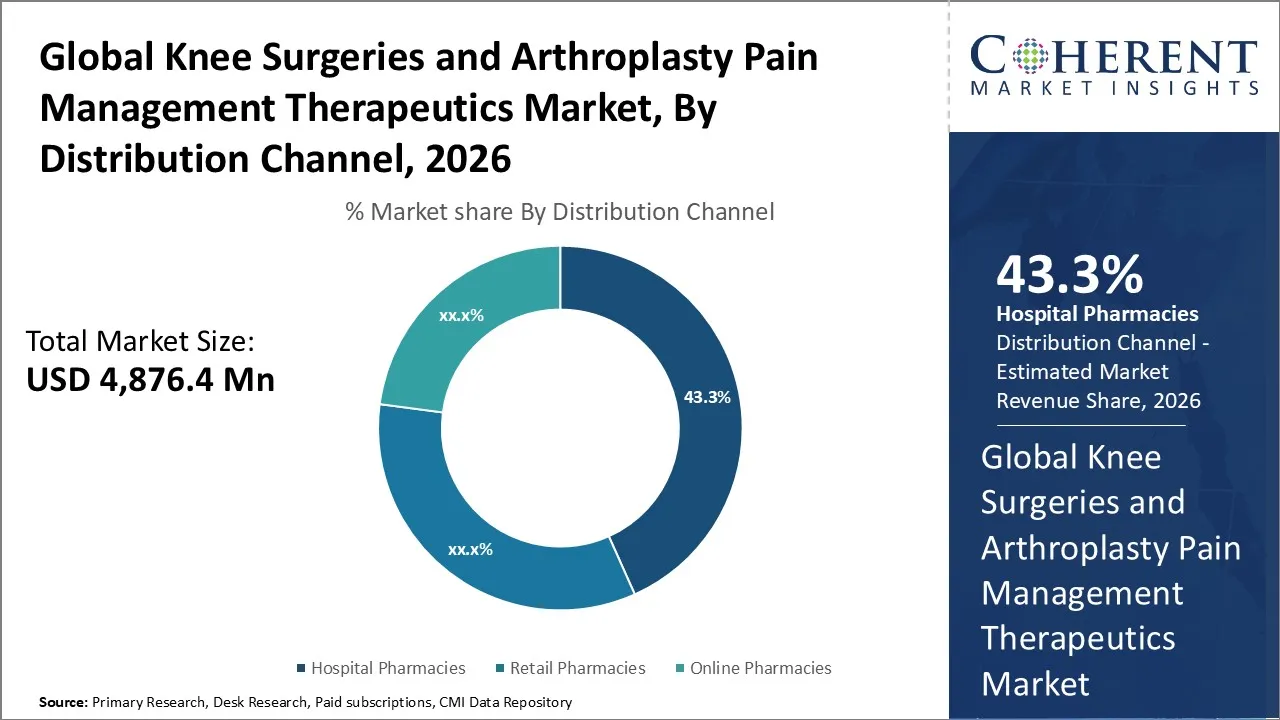
- By Distribution Channel, Hospital Pharmacies expected to hold largest market share of 43.3% in 2026 owing to the direct integration with surgical & inpatient care.
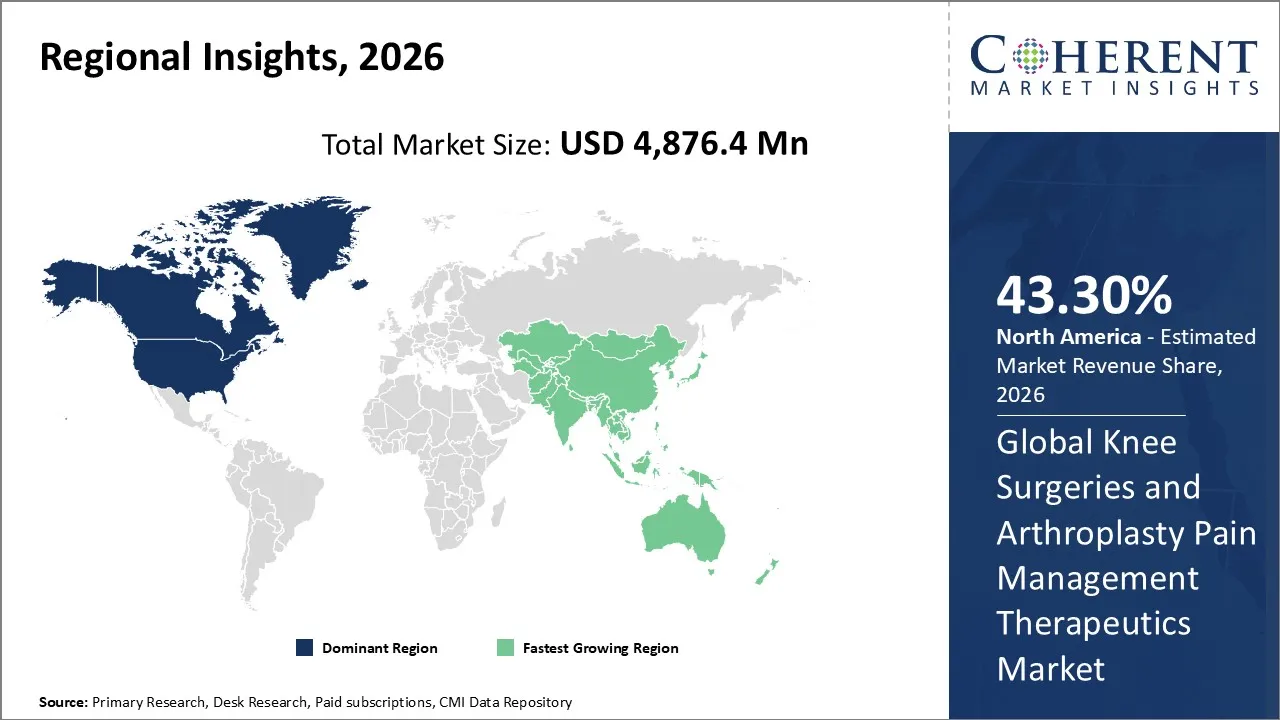
- By Region, North America dominates the overall market with an estimated share of 43.3% in 2026 owing to the high prevalence of knee disorders.
Market Overview
The Knee Surgeries and Arthroplasty Pain Management Therapeutics Market deliver effective solutions for managing postoperative pain after knee surgeries, including total and partial knee arthroplasty. It offers a variety of therapeutics, such as NSAIDs, opioids, local anesthetics, and multimodal analgesic regimens, to improve patient comfort and accelerate recovery. Rising knee disorder cases, increasing surgical procedures, advanced healthcare infrastructure, and the implementation of enhanced recovery protocols actively drive market growth, with hospital pharmacies and specialty clinics distributing these therapies.
Current Events and their Impact on the Knee Surgeries and Arthroplasty Pain Management Therapeutics Market
Current Events | Description and its impact |
Global Aging Population & Increasing Osteoarthritis Prevalence |
|
Technological Innovations in Surgical Procedures and Pain Management |
|
Geopolitical Tensions and Supply Chain Disruptions |
|
Segmental Insights
- Current Industry Events of 2026
- Market Size Estimation
- Regional Breakdown
- Competitive Landscape
- Customer Intelligence
- Segmental Analysis
- Pricing Analysis
- Key Market Drivers, Challenges & Future Trends
- Customized Insights Section
Knee Surgeries and Arthroplasty Pain Management Therapeutics Market Insights, By Distribution Channel - Hospital Pharmacies contribute the highest share of the market owing to its support for multimodal & enhanced recovery protocols
Hospital Pharmacies expected to hold largest market share of 43.3% in 2026. Hospital pharmacies actively drive the Knee Surgeries and Arthroplasty Pain Management Therapeutics Market by distributing pain management drugs efficiently and under strict control. They provide access to prescription-only medications, implement multimodal analgesia protocols, and handle high patient volumes from surgeries. By enhancing safety, optimizing dosing, and collaborating closely with clinical teams, they enable personalized patient care. Increasing surgical procedures, advanced hospital infrastructure, and the demand for regulated drug dispensing continue to strengthen hospital pharmacies’ central role in postoperative pain management. For instance, in November 2025, Chief Commercial Officer Duncan McKechnie reported that the launch of the non-opioid pain reliever Journavx is showing positive trends.
Knee Surgeries and Arthroplasty Pain Management Therapeutics Market Insights, By Drug - Non-steroidal Anti-inflammatories contribute the highest share of the market owing to its patient & healthcare provider awareness.
Non-steroidal Anti-inflammatories hold the largest market share of 36.8% in 2026. Non-Steroidal Anti-Inflammatories (NSAIDs) drive growth in the Knee Surgeries and Arthroplasty Pain Management Therapeutics Market by effectively controlling postoperative pain and inflammation. Healthcare providers actively integrate NSAIDs into multimodal pain management strategies to minimize opioid use and accelerate patient recovery. Increasing knee surgery procedures, growing awareness of non-opioid pain relief, the availability of advanced NSAID formulations, and their incorporation into hospital protocols all boost adoption, establishing NSAIDs as a central element of postoperative care. For instance, in February 2026, Pharma major Lupin Limited launched the authorized generic of Horizon Therapeutics’ Vimovo (naproxen/esomeprazole magnesium) delayed-release tablets, 375 mg/20 mg and 500 mg/20 mg, in the U.S. The combination of naproxen, an NSAID, and esomeprazole magnesium, a PPI, treats arthritis pain in patients aged 12 and above while reducing the risk of naproxen-induced gastric ulcers.
Regional Insights
North America Knee Surgeries and Arthroplasty Pain Management Therapeutics Market Trends
North America dominates the overall market with an estimated share of 43.3% in 2026. The North American Knee Surgeries and Arthroplasty Pain Management Therapeutics Market actively embraces advanced pain management strategies, such as multimodal analgesia and non-opioid therapies. Healthcare providers implement enhanced recovery protocols to improve postoperative outcomes and shorten hospital stays. Well-established healthcare infrastructure, high surgical volumes, and robust insurance coverage enable widespread access to innovative therapeutics. Increasing knee disorder prevalence, ongoing clinical research, and the rapid introduction of new drug formulations and delivery methods continue to drive and shape market trends across the region.
Asia Pacific Knee Surgeries and Arthroplasty Pain Management Therapeutics Market Trends
The Asia Pacific Knee Surgeries and Arthroplasty Pain Management Therapeutics Market is rapidly developing as healthcare systems modernize and surgical infrastructure strengthens across the region. Rising knee disorder cases and increased awareness of effective postoperative pain management drive the use of NSAIDs, opioids, and multimodal analgesics. Hospitals actively implement standardized pain control protocols and enhanced recovery practices. Expanding hospital networks, improved access to advanced therapeutics, and continued investments in orthopedic care actively shape the region’s market, establishing it as a key growth segment in global postoperative pain management. For instance, in March 2025, Medicover Hospital in Navi Mumbai introduced the MISSO high-tech robotic system for knee and hip replacements, enhancing surgical precision while reducing patient discomfort and enabling faster recovery.
United States Knee Surgeries and Arthroplasty Pain Management Therapeutics Market Trends
The United States Knee Surgeries and Arthroplasty Pain Management Therapeutics Market actively advances as hospitals and surgical centers adopt cutting-edge pain management strategies, including multimodal analgesia and non-opioid therapies. Rising cases of knee disorders and increasing demand for total and partial knee arthroplasty drive widespread use of NSAIDs, opioids, and local anesthetics. Healthcare providers implement enhanced recovery protocols to boost patient outcomes and reduce hospital stays, while robust insurance coverage, established healthcare infrastructure, and ongoing clinical research accelerate the adoption of innovative pain management solutions.
Japan Knee Surgeries and Arthroplasty Pain Management Therapeutics Market Trends
The Japan Knee Surgeries and Arthroplasty Pain Management Therapeutics Market actively grows as hospitals adopt advanced postoperative pain management strategies, including multimodal analgesia and non-opioid therapies. An aging population and rising knee disorder cases drive higher demand for total and partial knee arthroplasty, increasing the use of NSAIDs, opioids, and local anesthetics. Healthcare providers implement enhanced recovery protocols to boost patient outcomes and shorten hospital stays, while investments in orthopedic infrastructure, expanded access to innovative therapeutics, and growing awareness of effective pain control actively shape market development.
Role of Robotics in Arthroplasty Pain Management Therapeutics Market
Robotics is playing an increasingly important role in the arthroplasty pain management therapeutics market by improving surgical precision and patient outcomes. Robotic-assisted joint replacement systems enable surgeons to perform procedures with greater accuracy, minimizing tissue damage and reducing postoperative pain. This leads to faster recovery, shorter hospital stays, and lower reliance on pain medications, including opioids. Additionally, robotics supports personalized surgical planning and better implant alignment, which can enhance long-term joint function and reduce complications.
In July 2025, Sarvodaya Hospital in Gaur City 2, Greater Noida West introduced a fully operational Joint Replacement Robot (RJR) for joint replacement surgeries. The system enhances surgical precision and helps reduce patient recovery time, reflecting the hospital’s commitment to integrating advanced technology into clinical care.
Knee Surgeries and Arthroplasty Pain Management Therapeutics Market Trend
Rise of Multimodal Analgesia
Hospitals and surgical centers increasingly adopt multimodal analgesia strategies, combining NSAIDs, opioids, local anesthetics, and adjunct therapies. This approach enhances pain control while minimizing opioid-related side effects, supporting faster mobilization and recovery. Clinicians favor integrating multiple drug classes and regional anesthesia techniques to tailor therapy to patient needs, improve outcomes, and reduce hospital stays. The trend reflects a broader shift toward personalized, protocol-driven postoperative pain management in orthopedic procedures.
Increased Adoption of Non-Opioid Therapies
Growing awareness of opioid risks drives healthcare providers to emphasize non-opioid analgesics, including NSAIDs, COX-2 inhibitors, and acetaminophen. These alternatives reduce dependency potential and improve safety profiles, particularly for elderly or comorbid patients. Non-opioid therapies are increasingly incorporated into standardized recovery protocols, aligning with enhanced recovery after surgery (ERAS) guidelines, and hospitals actively invest in training staff on proper implementation to maximize patient comfort and optimize postoperative outcomes.
Knee Surgeries and Arthroplasty Pain Management Therapeutics Market Opportunity
Expansion of Minimally Invasive Surgeries
The growing adoption of minimally invasive knee surgeries presents opportunities for tailored pain management solutions. These procedures require precise postoperative analgesia to support early mobilization and rapid recovery. Manufacturers can focus on developing fast-acting, targeted therapeutics, including local anesthetics and controlled-release NSAIDs, that align with shorter hospital stays. Integrating these solutions into surgical protocols offers hospitals and providers a chance to enhance patient satisfaction and improve rehabilitation outcomes while reducing overall healthcare costs.
Market Report Scope
Knee Surgeries and Arthroplasty Pain Management Therapeutics Market Report Coverage
| Report Coverage | Details | ||
|---|---|---|---|
| Base Year: | 2025 | Market Size in 2026: | USD 4,876.4 Mn |
| Historical Data for: | 2020 To 2024 | Forecast Period: | 2026 To 2033 |
| Forecast Period 2026 to 2033 CAGR: | 5.2% | 2033 Value Projection: | USD 7,107.3 Mn |
| Geographies covered: |
| ||
| Segments covered: |
| ||
| Companies covered: | Pfizer Inc, Allay Therapeutics, Mallinckrodt, Johnson & Johnson, Zydus Cadila Healthcare Ltd., Novartis AG, Purdue Pharma, Delphis Pharmaceutical, Taj Pharmaceuticals Limited, GlaxoSmithKline plc, AbbVie Inc., and Aurobindo Pharma | ||
| Growth Drivers: |
| ||
| Restraints & Challenges: |
| ||
Knee Surgeries and Arthroplasty Pain Management Therapeutics Market News
- In November 2024, Apollo Spectra Hospital, Mumbai, part of the Apollo Group of Hospitals, installed the ROSA Surgical Robot for robotic knee replacement surgeries at its Tardeo and Chembur centers, enhancing surgical safety and precision.
- In June 2025, Allay Therapeutics, a clinical-stage biotechnology company developing ultra-sustained analgesic products for post-surgical pain management, secured $57.5 million in Series D funding. Lightstone Ventures and ClavystBio co-led the round, with participation from NEA, Arboretum Ventures, Vertex Growth, Vertex Ventures Healthcare, and Brandon Capital.
Analyst Opinion (Expert Opinion)
- The pain management landscape following knee arthroplasty is undergoing a substantive shift that industry stakeholders have largely underestimated. Clinical practice is decisively moving away from traditional opioid‑centric regimens toward structured multimodal analgesia, not as a theoretical best practice but as a measurable clinical imperative. Surveys of arthroplasty specialists demonstrate that multimodal protocols now exceed 90% adoption, with nonsteroidal anti‑inflammatories used by nearly all surgeons surveyed and peripheral nerve blocks adopted by over 80%, reflecting a broad clinician consensus that layered analgesia improves patient care while reducing opioid exposure.
- Furthermore, the divergence in analgesic utilization patterns — for example, routine opioid prescription coupled with limited NSAID use in certain hospital settings — exposes a structural inconsistency in clinical adoption that vendors and policymakers must reconcile. Without a unified standard of care that aligns pharmacologic innovations with evidence‑based protocols, the market risks fragmentation, leaving significant patient subpopulations underserved.
- In summary, the market’s trajectory is not driven by superficial demand growth but by measurable shifts in clinical behavior, regulatory pressures to reduce opioid reliance, and real‑world evidence favoring multimodal protocols. The most compelling opportunities lie in products and delivery systems that meaningfully improve analgesic efficacy without perpetuating opioid dependence, rather than incremental modifications to legacy therapies.
Speak to the analyst
Want personalized insights?
Take the findings above to one of our principal consultants, or have the report rebuilt around the segments, geographies and competitors you actually track.
Market Segmentation
- By Drug
- Acetaminophen
- COX-2 inhibitors
- Opioids
- Non-steroidal Anti-inflammatories
- Ketamine
- Others
- By Distribution Channel
- Hospital Pharmacies
- Retail Pharmacies
- Online Pharmacies
- By Regional Insights
- North America
- U.S.
- Canada
- Latin America
- Brazil
- Argentina
- Mexico
- Rest of Latin America
- Europe
- Germany
- U.K.
- Spain
- France
- Italy
- Russia
- Rest of Europe
- Asia Pacific
- China
- India
- Japan
- Australia
- South Korea
- ASEAN
- Rest of Asia Pacific
- Middle East
- GCC Countries
- Israel
- Rest of Middle East
- Africa
- South Africa
- North Africa
- Central Africa
- North America
- Key Players Insights
- Pfizer Inc
- Allay Therapeutics
- Mallinckrodt
- Johnson & Johnson
- Zydus Cadila Healthcare Ltd.
- Novartis AG
- Purdue Pharma
- Delphis Pharmaceutical
- Taj Pharmaceuticals Limited
- GlaxoSmithKline plc
- AbbVie Inc.
- Aurobindo Pharma
Sources
Primary Research interviews
- Interviews with orthopedic surgeons specializing in arthroplasty pain protocols
- Discussions with hospital pharmacy directors on analgesic formulary trends
- Conversations with clinical anesthesiologists focused on multimodal pain pathways
- Insights from postoperative rehabilitation specialists
Databases
- PubMed/Medline clinical research repository (postoperative pain management studies)
- Embase database for analgesic strategy systematic reviews
- Scopus indexed literature on arthroplasty pain therapeutics
- Medicare/Medicaid prescription and outcomes data for orthopaedic pain treatments
Magazines
- Orthopaedic Surgery Today clinical features on postoperative care
- Pain Management Digest summaries of analgesic best practices
- Surgical Techniques Review updates on knee arthroplasty modalities
Journals
- Journal of Arthroplasty (analgesia and opioid‑sparing study reports)
- Orthopaedic Surgery postoperative pain management review
- Arch Orthop Trauma Surg pharmacologic strategy analysis
- Knee clinical outcomes of opioid‑reduction protocols
- Journal of Orthopaedic Reports opioid‑free arthroplasty analyses
Newspapers
- Healthcare coverage and opioid policy impact articles in The New York Times health section
- Pain management policy reporting in The Washington Post healthcare column
- Surgical innovation features in The Wall Street Journal health and wellness
Associations
- American Academy of Orthopaedic Surgeons (AAOS) clinical practice guidelines
- American Association of Hip and Knee Surgeons (AAHKS) surgeon surveys
- European Society of Regional Anaesthesia and Pain Therapy procedural recommendations
- American Joint Replacement Registry (AJRR) procedural outcomes database
Public Domain sources
- Knee Surgery, Sports Traumatology, Arthroscopy journal overview and scope
- NIH clinical research repositories with accessible abstracts
- Government health statistics on arthroplasty pain treatment patterns
Proprietary Elements
- CMI Data Analytics Tool
- Proprietary CMI Existing Repository of information for last 8 years
Get access to 250+ pages report
Every segment, forecast, competitor profile and data table behind the analysis above — available for instant download.
- ESOMAR Member
- ISO 9001:2015 Certified
- D-U-N-S Registered
- GDPR & CCPA Compliant
Missing comfort of reading report in your local language? Find your preferred language:
Transform your Strategy with Exclusive Trending Reports
Frequently Asked Questions
The Knee Surgeries and Arthroplasty Pain Management Therapeutics Market is estimated to be valued at USD 4,876.4 Mn in 2026 and is expected to reach USD 7,107.3 Mn by 2033.
Surge in the number of knee surgeries and arthroplasty and increasing research and development activities by pharmaceutical companies is expected to drive the market growth over the forecast period.
Non-steroidal Anti-inflammatories segment is expected to hold the major market share in the market.
North America holds the largest market share in the market.
Major factors hampering the market growth include product recall and side effects associated with the use of medication.
Major players operating in the market include Pfizer Inc, Allay Therapeutics, Mallinckrodt, Johnson & Johnson, Zydus Cadila Healthcare Ltd., Novartis AG, Purdue Pharma, Delphis Pharmaceutical, Taj Pharmaceuticals Limited, GlaxoSmithKline plc, AbbVie Inc., and Aurobindo Pharma.