

Global Mixed Mode Chromatography Resin Market Size and Forecast – 2026 To 2033
The global mixed mode chromatography resin market is expected to grow from USD 128.6 Mn in 2026 to USD 280.8 Mn by 2033, registering a compound annual growth rate (CAGR) of 11.8% from 2026 to 2033. The market for global mixed mode chromatography resin is poised for significant expansion, fueled by the increasing development and manufacturing of biologic therapies, which is driving demand for advanced downstream purification solutions.
The U.S. Food and Drug Administration (FDA) reported 18 Biologics License Applications (BLAs) filed through March 31, 2026, indicating continued development activity across biologic therapies and supporting demand for advanced downstream purification technologies.
Key Takeaways of the Global Mixed Mode Chromatography Resin Market
- Cation exchange mixed mode resins are projected to hold 48.7 % of the global mixed mode chromatography resin market share in 2026, making it dominant product type segment, across North America due to established biopharmaceutical manufacturing and stringent chromatography process controls. Under 21 CFR §211.67, the U.S. FDA requires appropriate cleaning and maintenance of manufacturing equipment, while FDA guidance for licensed biological products specifically addresses cleaning, storage, regeneration, reuse limits, and validation of chromatography columns.
- Monoclonal antibody purification is projected to hold 43.8 % of the global mixed mode chromatography resin market share in 2026, making it dominant application segment, particularly across Europe, supported by the region’s established biologics manufacturing base and stringent purification requirements. For instance, the EMA’s guidance for monoclonal antibodies requires purification methods and in-process controls to be described, justified, and validated, including validation of column loading capacity, regeneration, sanitization, and column-use duration.
- Pharmaceutical and biotechnology companies are projected to hold 59.4 % of the global mixed mode chromatography resin market share in 2026, making it dominant end user segment, across Asia Pacific, where expanding biologics manufacturing is increasing demand for controlled downstream processing. For instance, China’s NMPA requires commercial-scale manufacturing process validation before drug registration testing for biological products under its drug-registration framework, reinforcing the need for validated manufacturing and purification processes.
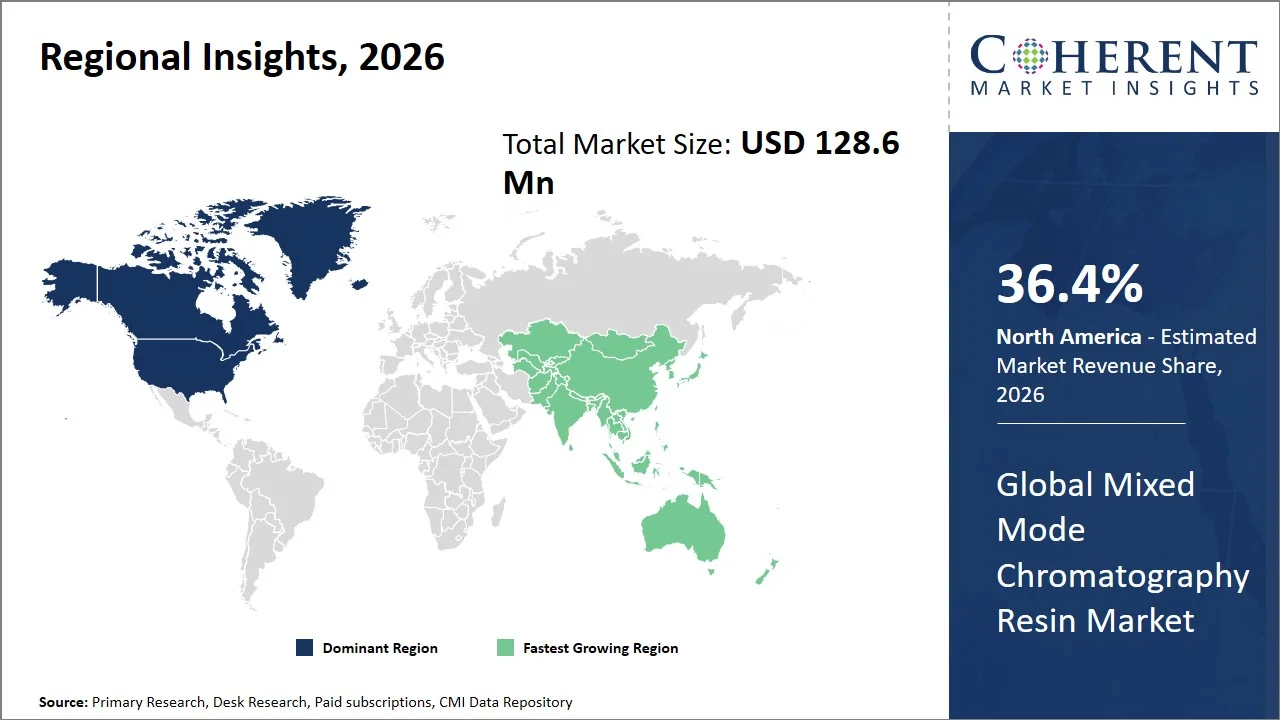
- North America market maintains dominance with an expected share of 36.4 % in 2026, bolstered by its established biopharmaceutical manufacturing base and stringent controls over purification processes. The U.S. FDA’s 2026 biologics inspection program requires validation and requalification of sterilization and sanitization processes for equipment used in purification operations, reinforcing demand for validated chromatography media.
- Asia Pacific is expected to exhibit the fastest growth in the global mixed mode chromatography resin market, registering an estimated CAGR of 13.7 % during 2026–2033, driven by expanding biologics manufacturing and strengthening regulatory oversight across the region. For instance, Singapore’s Health Sciences Authority (HSA) introduced a new GMP conformity-assessment procedure in January 2026 for overseas drug-substance manufacturing sites supporting biologic applications, requiring eligible manufacturers to undergo HSA GMP inspection before submission of an NCE/NBE registration application.
Segmental Insights
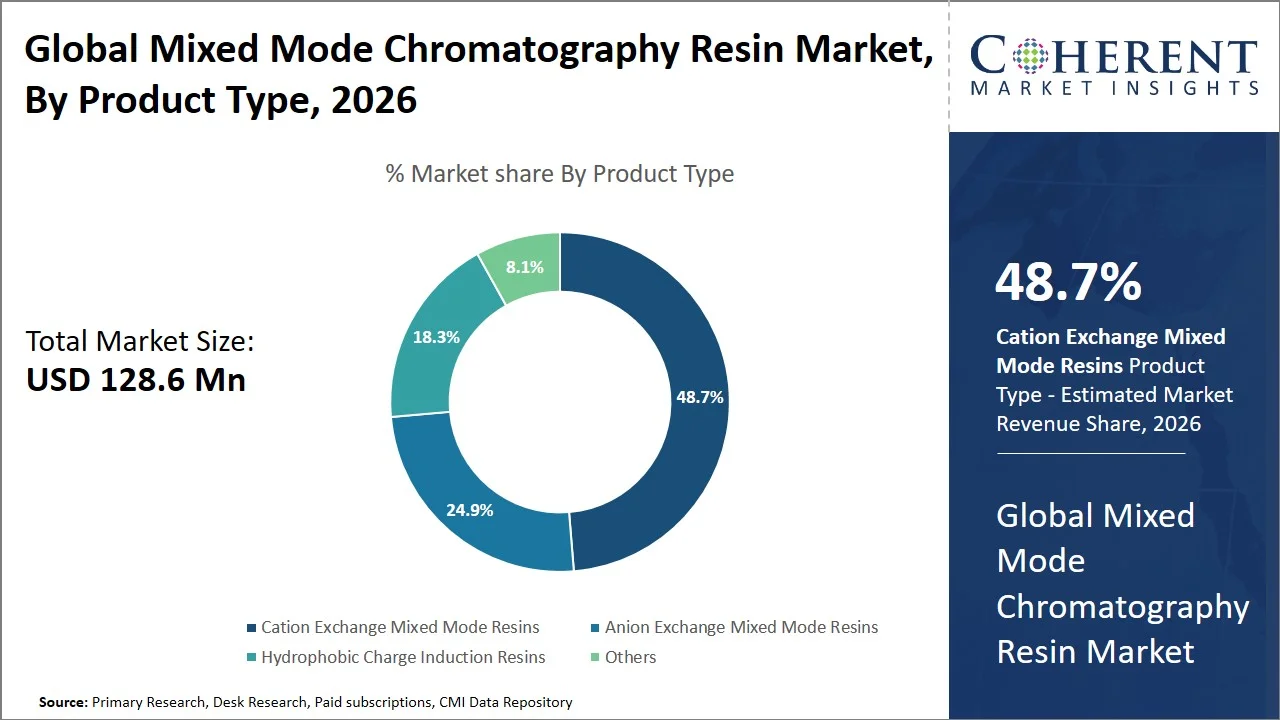
Why Do Cation Exchange Mixed Mode Resins Dominate the Global Mixed Mode Chromatography Resin Market?
Cation exchange mixed mode resins are projected to hold the market share of 48.7% in 2026, owing to its combined weak cation-exchange and hydrophobic interactions mechanism which leads to selective purification of diverse and complicated biologics. Such products are capable of removing a gamut of compounds such as aggregate, host cell protein as well as other impurities, while ensuring optimum product recovery throughout downstream processes. Increased adoption for the purification of both monoclonal antibodies and recombinant proteins will likely boost the demand of this product segment with demand especially escalating where existing conventional single-mode resins fail to provide required specificity. For instance, Thermo Fisher Scientific's POROS Caprylate Mixed-Mode Cation Exchange Resin is a solution for high-throughput and scalable flow-through polishing of therapeutic antibodies. This resin helps remove host-cell proteins, aggregates, and other impurities.
- Current Industry Events of 2026
- Market Size Estimation
- Regional Breakdown
- Competitive Landscape
- Customer Intelligence
- Segmental Analysis
- Pricing Analysis
- Key Market Drivers, Challenges & Future Trends
- Customized Insights Section
Why Does Monoclonal Antibody Purification Represent the Largest Application Segment in the Mixed Mode Chromatography Resin Market?
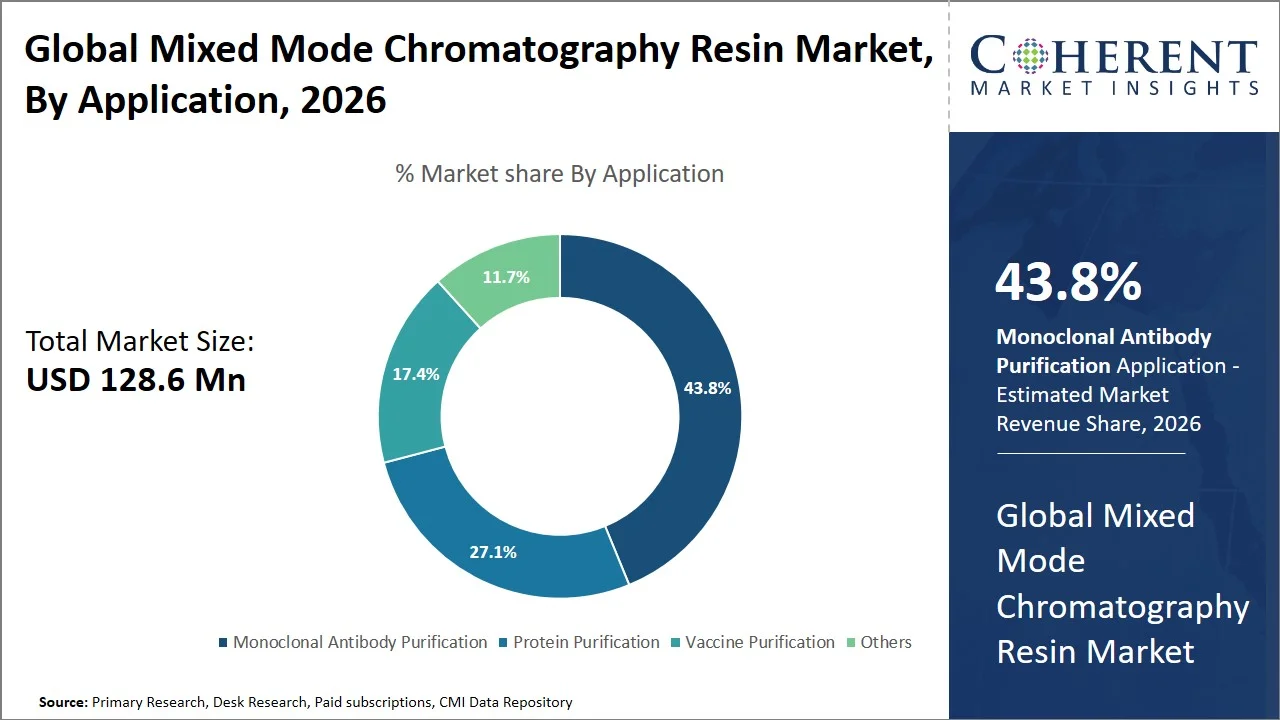
Monoclonal antibody purification is projected to hold a market share of 43.8% in 2026, owing to the need of highly selective removal of aggregates, host-cell proteins, DNA and other process-related impurities. Mixed mode resins possess a number of interaction forces which enables separation of closely-eluting antibodies and effective downstream purification. Rising production of elaborate antibodies formats such as bispecific antibodies and antibody-drug conjugates reinforces its demand. For instance, in May 2026, a review published by National Library of Medicine, highlights multimodal chromatography as a purification method of mAbs and antibody derivatives such as bispecific antibodies and antibody-drug conjugates, focusing on selectivity, impurity clearance, removal of aggregation and rational selection of the resin.
Pharmaceutical and Biotechnology Companies Segment Dominates the Global Mixed Mode Chromatography Resin Market
The pharmaceutical and biotechnology companies segment is projected to hold a market share of 59.4% in 2026, driven by their rich biologics pipeline and in-house downstream purification requirements. Mass production of monoclonal antibodies, recombinant proteins and other complex biologic drugs drives the need for the highly specific and scalable purification media, usage in the sector also increases as it helps improve the yield, impurity clearance, process efficiency and process consistency. For instance, the U.S. FDA's CBER Advanced Technologies Program foster support for the development and utilization of the enabling technologies and new manufacturing approaches and process monitoring and control for the manufacture of biological products.
Currents Events and their Impact
Current Events | Description and its Impact |
U.S. FDA Issues Final Guidance on CMC Flexibility for Cell and Gene Therapies (May 2026) |
|
U.S. FDA Updates Biologics Manufacturing Inspection Requirements for Chromatography Resins (April 2026) |
|
EMA Updates GMP Guidance for Biological/Advanced Therapies (March 2026) |
|
Mixed Mode Chromatography Resin Market Dynamics
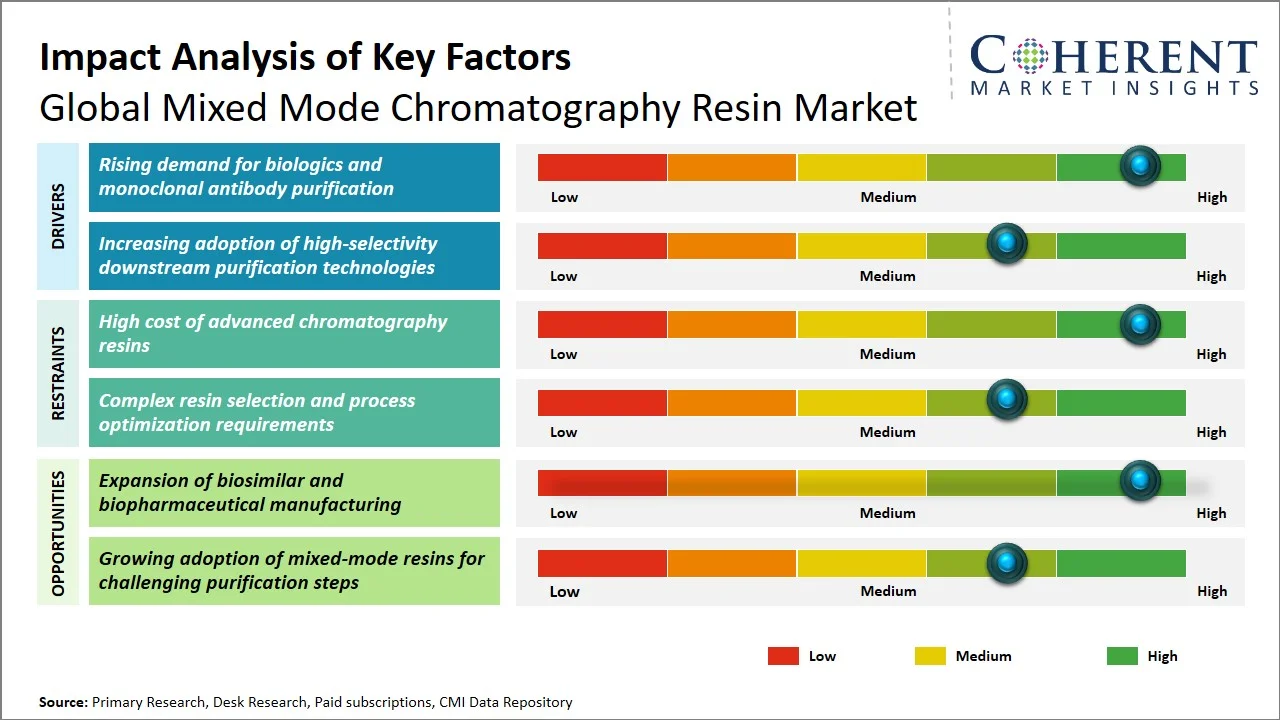
Market Drivers
- Rising demand for biologics and monoclonal antibody purification: The expanding number of biologic and biosimilar approvals is increasing the need for scalable downstream purification technologies, including mixed mode chromatography resins. The growing number of biologic products also increases the need for consistent impurity removal and process scalability during commercial manufacturing. For instance, the U.S. FDA approved biosimilars for rituximab, ranibizumab, golimumab, pegfilgrastim, insulin aspart, and insulin glargine between January and July 2026, directly expanding the number of biologic products requiring commercial-scale purification processes.
- Increasing adoption of high-selectivity downstream purification technologies: The increasing complexity of biologics is driving demand for high-selectivity downstream purification technologies capable of achieving efficient impurity clearance while maintaining product yield and quality. Mixed mode resins combine multiple molecular interactions, enabling selective separation of closely related impurities and reducing dependence on multiple conventional purification steps. The need for consistent column performance and impurity removal is particularly important as biologics manufacturing moves toward larger commercial-scale processes. For instance, the U.S. FDA’s Compliance Program 7346.832M, issued in April 2026, requires manufacturers to review chromatography traces, step yields, impurities, and other performance measures to verify consistent column chromatography performance from batch to batch.
- Increasing demand for process intensification: The shift toward process-intensified biomanufacturing is increasing demand for chromatography resins that provide high productivity, consistent impurity clearance, and reliable performance across purification cycles. Mixed mode resins combine multiple separation mechanisms within a single medium, supporting efficient purification while reducing downstream processing complexity. For instance, EMA guidance on biotechnology-derived active substances requires downstream purification steps to be evaluated for column loading capacity, flow rate, yield, chromatographic profiles, and performance throughout the expected column lifetime, supporting the use of robust chromatography media in intensified processes.
Emerging Trends
- Advanced ligand engineering and rational resin design: Mixed mode resin development is increasingly shifting toward engineered ligands with precisely controlled ionic, hydrophobic, hydrogen-bonding, and aromatic interactions. High-throughput screening, molecular modeling, and QSPR approaches are enabling more rational selection and optimization of resin chemistry.
- Growing use in complex biologics purification: Mixed mode resins are gaining importance for purification of bispecific antibodies, antibody fragments, Fc-fusions, and antibody-drug conjugates, where conventional single-mode chromatography may provide insufficient selectivity. Their ability to remove aggregates, charge variants, and other impurities is supporting broader adoption in advanced downstream processing.
- Increasing focus on high-selectivity and orthogonal purification: Manufacturers are increasingly using mixed mode chromatography as an orthogonal polishing step to achieve impurity clearance that is difficult to obtain with conventional resin technologies. Recent research is emphasizing ligand structure, ligand density, and operating conditions to improve selectivity while maintaining recovery and process scalability.
Regional Insights
Why is North America a Strong Market for Mixed Mode Chromatography Resin?
North America leads the global mixed mode chromatography resin market, accounting for an estimated 36.4% share in 2026, aided by well-established pharmaceutical and biotechnology industry with substantial requirement of innovative purification technology used in downstream. Moreover, favorable regulatory landscape backed by strong guidelines and approval process stipulated by authorities such as Food and Drugs administration, helps in maintaining stringent norms in purification technology innovation.
For instance, U.S. FDA's biological products manufacturing inspection framework focuses on the validation, reuse, cleaning, and performance testing of chromatography resins applied in commercial biologics manufacturing. Furthermore, well-established bioprocessing infrastructure in developed regions aids commercial biologics manufacture with high selectivity mixed mode chromatography.
Why Does Asia Pacific Mixed Mode Chromatography Resin Market Exhibit High Growth?
Asia Pacific is expected to exhibit the fastest growth in the global mixed mode chromatography resin market, registering an estimated CAGR of 13.7% during 2026–2033. The region is projected to account for approximately 25.1% of the global market in 2026, driven by the presence of rapidly developing pharmaceutical manufacturing and biotechnology sectors in China and India. The region offers incentives to the companies for inbound foreign direct investment (FDI) and the development of advanced infrastructure, which has encouraged global makers of chromatography resins to set up manufacturing and R&D centers.
For instance, in July 2026, Shanghai rolled out 25 supporting measures for foreign investment-based biopharmaceutical projects, covering manufacturing, R&D, industry parks, and investment support. (Source: Shanghai Municipal People's Government) Furthermore, burgeoning biologics and biosimilars manufacturing infrastructure plays a vital role in demand for low-cost, scalable downstream purification techniques.
Global Mixed Mode Chromatography Resin Market Outlook for Key Countries
Why is the U.S. Leading Innovation and Adoption in the Mixed Mode Chromatography Resin Market?
The U.S. is at the forefront of innovation and adoption in the mixed mode chromatography resin market driven by mature biopharmaceutical purification landscape including the successful utilization of mixed-mode resins for the purification of challenging antibodies and proteins. Priorities are increasingly moving towards highly selective polishing applications, process intensification, and scalable resins that facilitate highly efficient impurity removal and simplified downstream process development and/or intensification.
Is Japan a Favorable Market for Mixed Mode Chromatography Resin Market?
Japan has an attractive market for mixed mode chromatography resin with strong focus on mAb and complex protein purification. The biopharmaceutical sector in the country possesses great experience in advanced chromatography and local research has been devoted to the design of effective mixed-mode ligands for increasing selectivity and salt tolerance, and aggregate clearance. Opportunities thus exist for developing high-performance resins geared towards selective polishing and process intensification.
Is China Emerging as a Key Growth Hub for the Mixed Mode Chromatography Resin Market?
China is a high-growth market due to its expandability in biopharmaceutical production and downstream purification capacity. The country is investing heavily in indigenous capacity for its growing biologics production and localization in bioprocessing inputs, paving the way for the market demand growth for mixed mode resins in mAb, recombinant protein, and vaccine purification.
Why Does Germany Top the European Mixed Mode Chromatography Resin Market?
Germany leads the European mixed mode chromatography resin market because it is rich in both biopharmaceutical manufacturing facilities and downstream process development expertise. The country has developed the knowledge of how mixed-mode chromatography can be used for the purification of antibodies, fusion proteins and ADCs especially for complex removal of impurity/aggregate products. The established bioprocessing industry allows for efficient utilization of high selectivity resins for scalable purification.
Is Mixed Mode Chromatography Resin Market Developing in India?
India represents a developing market for mixed mode chromatography resins driven by increasing domestic production of mAbs and biotherapeutics. The key market segment for significant opportunities is based in purification technologies assisting mAb scale up and the increasing sophistication of downstream processing in India's buildup of its domestic biomanufacturing ecosystem.
Global Mixed Mode Chromatography Resin Market – Key Performance Parameters by Resin Type, 2026
Resin Type | Primary Interaction Mechanism | Typical Purification Role | Key Performance Attribute |
Cation Exchange Mixed Mode Resins | Cation exchange + hydrophobic interactions | Polishing / impurity removal | High selectivity for charge variants and aggregates |
Anion Exchange Mixed Mode Resins | Anion exchange + hydrophobic interactions | Intermediate purification / polishing | Effective removal of negatively charged impurities |
Hydrophobic Charge Induction Resins | Hydrophobic interaction + charge modulation | Capture / intermediate purification | Selective binding under controlled pH conditions |
Others | Multiple complementary interactions | Specialized purification | Application-specific selectivity |
How is the expansion of biosimilar and biopharmaceutical manufacturing creating new growth opportunities in the mixed mode chromatography resin market?
The surging demand due to increase in biosimilar and biopharmaceutical production requires versatile and selective downstream purification methods, especially in newer production sites. Mixed-mode chromatography resin can enhance impurity removal and process economics for difficult-to-purify bioprocesses, and enable intensified processing. Additionally, increasing regulatory acceptance for biomanufacturing and biosimilar development opens the addressable market for advanced chromatography media. For instance, in May 2026, the Japan Pharmaceuticals and Medical Devices Agency (PMDA) issued new considerations in identifying the requirement for a comparative efficacy study in the development of biosimilar drug products, paving way for easier regulatory pathway in these products.
Market Players, Key Development, and Competitive Landscape
Key Developments
- In July 2026, Sartorius expanded its Pionic platform with Quad and Cross modules, enabling flexible multi-column chromatography and integrated downstream processing. The development supports intensified biopharmaceutical purification by improving process flexibility, scalability, and chromatography resin utilization.
- In April 2026, DuPont launched AmberChrom XT20 SL and XT30 SL chromatography resins for biopharmaceutical purification. The new slurried resins eliminate the hydration step, helping streamline downstream purification of oligonucleotide and peptide therapeutics. The launch expands DuPont’s chromatography resin portfolio for advanced bioprocessing applications.
- In April 2026, Merck KGaA acquired JSR Life Sciences’ chromatography business, adding a Belgium-based chromatography operation and more than 50 employees. The acquisition expands Merck’s downstream purification capabilities and strengthens its chromatography portfolio for biopharmaceutical manufacturing. It also enhances Merck’s capabilities in protein and monoclonal antibody purification applications.
Competitive Landscape
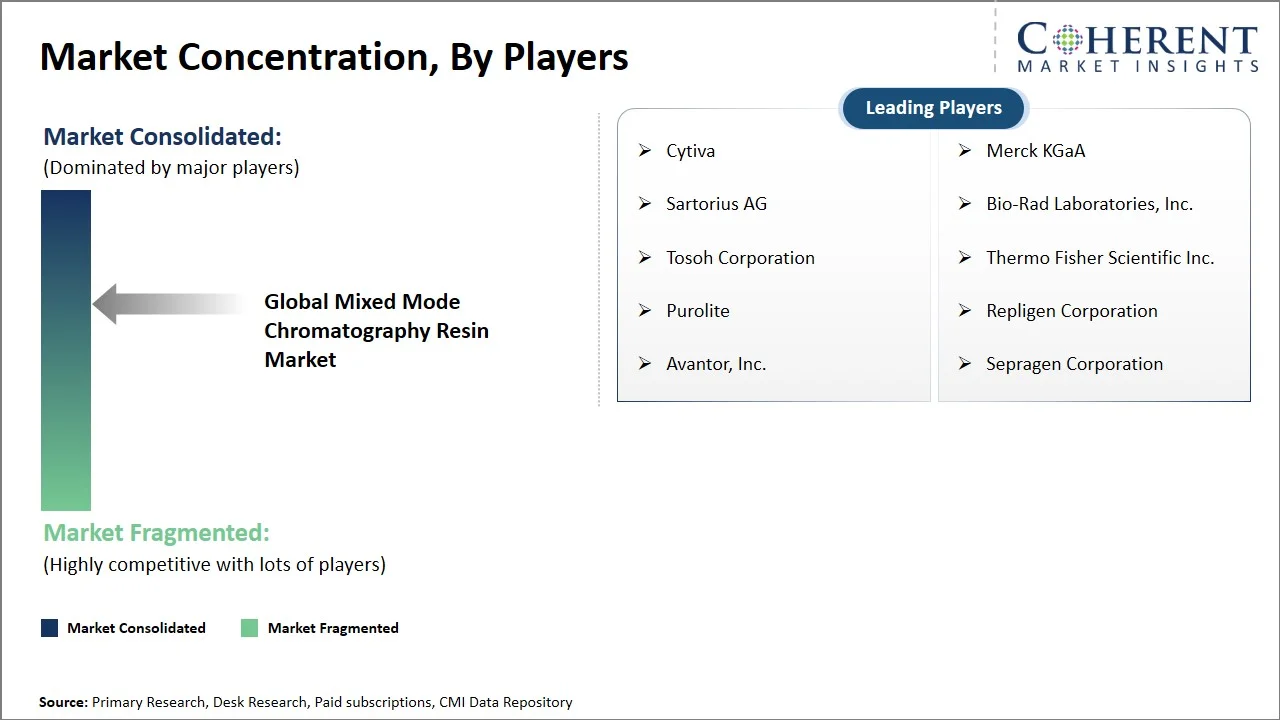
The global mixed mode chromatography resin market is moderately competitive, with competition centered on ligand selectivity, binding capacity, impurity clearance, resin lifetime, scalability, and reproducibility across biopharmaceutical purification processes. Market participants are increasingly focusing on improving multimodal ligand chemistry and resin performance to address complex biomolecules and achieve higher purification efficiency. Key focus areas include:
- Development of multimodal ligands combining ionic, hydrophobic, hydrogen-bonding, and other interactions to enhance purification selectivity
- Improvement of dynamic binding capacity, mass-transfer characteristics, and impurity clearance for high-productivity purification processes
- Optimization of resin chemical stability, lifetime, and reusability to support consistent commercial-scale biopharmaceutical manufacturing
- Expansion of mixed-mode purification solutions for monoclonal antibodies, recombinant proteins, vaccines, and other complex biologics
Market Report Scope
Mixed Mode Chromatography Resin Market Report Coverage
| Report Coverage | Details | ||
|---|---|---|---|
| Base Year: | 2025 | Market Size in 2026: | USD 128.6 Mn |
| Historical Data for: | 2020 To 2024 | Forecast Period: | 2026 To 2033 |
| Forecast Period 2026 to 2033 CAGR: | 11.8% | 2033 Value Projection: | USD 280.8 Mn |
| Geographies covered: |
| ||
| Segments covered: |
| ||
| Companies covered: | Cytiva, Merck KGaA, Sartorius AG, Bio-Rad Laboratories, Inc., Tosoh Corporation, Thermo Fisher Scientific Inc., Purolite, Repligen Corporation, Avantor, Inc., Sepragen Corporation | ||
| Growth Drivers: |
| ||
| Restraints & Challenges: |
| ||
Analyst Opinion (Expert Opinion)
- In the coming years, the global mixed mode chromatography resin market will be shaped by the shift from conventional single-mode purification toward high-selectivity, application-specific multimodal resins. Demand will increasingly favor resins capable of handling complex biologics, reducing purification steps, improving impurity clearance, and maintaining consistent performance at commercial scale. The industry is also expected to move toward process-intensified purification, rapid resin screening, and ligand designs tailored to specific molecule characteristics.
- The maximum opportunities will probably exist within cation exchange mixed mode resins for monoclonal antibody purification in China. China offers a particularly attractive combination of expanding biologics manufacturing, increasing antibody production capacity, and growing demand for scalable downstream purification. Players that develop high-capacity, salt-tolerant cationic mixed-mode media specifically optimized for mAb aggregate and host-cell protein removal can capture significant growth opportunities in this market.
- In order to obtain a competitive advantage, market participants should move beyond competing primarily on resin availability and price and instead differentiate through application-specific performance, process-development support, and total purification economics. Developing resins with higher binding capacity, broader operating windows, longer usable lifetimes, and predictable performance across different feedstocks can strengthen customer retention. In parallel, establishing local application-development capabilities and providing rapid screening, scale-up, and process-optimization support can create a stronger competitive advantage, particularly in high-growth Asian biomanufacturing markets.
Speak to the analyst
Want personalized insights?
Take the findings above to one of our principal consultants, or have the report rebuilt around the segments, geographies and competitors you actually track.
Market Segmentation
- Product Type Insights (Revenue, USD Mn, 2021 - 2033)
- Cation Exchange Mixed Mode Resins
- Anion Exchange Mixed Mode Resins
- Hydrophobic Charge Induction Resins
- Others
- Application Insights (Revenue, USD Mn, 2021 - 2033)
- Monoclonal Antibody Purification
- Protein Purification
- Vaccine Purification
- Others
- End User Insights (Revenue, USD Mn, 2021 - 2033)
- Pharmaceutical and Biotechnology Companies
- Contract Research and Manufacturing Organizations
- Academic and Research Institutes
- Others
- Regional Insights (Revenue, USD Mn, 2021 - 2033)
- North America
- U.S.
- Canada
- Latin America
- Brazil
- Argentina
- Mexico
- Rest of Latin America
- Europe
- Germany
- U.K.
- Spain
- France
- Italy
- Russia
- Rest of Europe
- Asia Pacific
- China
- India
- Japan
- Australia
- South Korea
- ASEAN
- Rest of Asia Pacific
- Middle East
- GCC Countries
- Israel
- Rest of Middle East
- Africa
- South Africa
- North Africa
- Central Africa
- North America
- Key Players Insights
- Cytiva
- Merck KGaA
- Sartorius AG
- Bio-Rad Laboratories, Inc.
- Tosoh Corporation
- Thermo Fisher Scientific Inc.
- Purolite
- Repligen Corporation
- Avantor, Inc.
- Sepragen Corporation
Sources
Primary Research Interviews
- Process development scientists and downstream-processing specialists involved in biopharmaceutical purification
- Chromatography scientists and resin-development specialists working on mixed-mode purification technologies
- Bioprocess engineers responsible for chromatography scale-up and process optimization
- Pharmaceutical and biotechnology professionals involved in monoclonal antibody and recombinant protein manufacturing
- Contract manufacturing and process-development experts evaluating chromatography media for commercial production
Stakeholders
- Pharmaceutical and biotechnology companies
- Contract development and manufacturing organizations (CDMOs)
- Contract research organizations (CROs)
- Biopharmaceutical process-development and downstream-processing laboratories
- Chromatography resin and purification technology providers
- Academic and research institutions
- Biologics manufacturing and quality-control laboratories
- End-use Sectors
- Pharmaceutical and biotechnology companies
- Contract research and manufacturing organizations (CROs and CDMOs)
- Academic and research institutes
- Biopharmaceutical process-development laboratories
- Government and regulatory research laboratories
- Biologics manufacturing and downstream-processing facilities
- Regulatory & Health Bodies
- U.S. Food and Drug Administration (FDA)
- European Medicines Agency (EMA)
- Pharmaceuticals and Medical Devices Agency (PMDA), Japan
- National Medical Products Administration (NMPA), China
- Medicines and Healthcare products Regulatory Agency (MHRA), U.K.
- Therapeutic Goods Administration (TGA), Australia
- Health Sciences Authority (HSA), Singapore
Databases
- FDA Drugs@FDA Database
- FDA Biologics License Application (BLA) resources
- ClinicalTrials.gov
- NIH RePORTER
- WHO ICTRP
- European Union Clinical Trials Information System (CTIS)
Associations
- International Society for Pharmaceutical Engineering (ISPE)
- Parenteral Drug Association (PDA)
- BioPhorum
- American Chemical Society (ACS)
- American Association of Pharmaceutical Scientists (AAPS)
- International Society for Cell & Gene Therapy (ISCT)
Public Domain Sources
- U.S. Food and Drug Administration (FDA) – biologics manufacturing, purification, and chromatography guidance
- European Medicines Agency (EMA) – biological medicines, monoclonal antibody production, and process-validation guidelines
- National Institutes of Health (NIH) – biopharmaceutical and protein-purification research resources
- National Institute of Standards and Technology (NIST) – biotechnology measurement and analytical standards
- World Health Organization (WHO) – biological products and biomanufacturing guidance
- Organisation for Economic Co-operation and Development (OECD) – biotechnology and biopharmaceutical industry data
Proprietary Elements
- CMI Data Analytics Tool, Proprietary CMI Existing Repository of information for last 10 years.
Get access to 250+ pages report
Every segment, forecast, competitor profile and data table behind the analysis above — available for instant download.
- ESOMAR Member
- ISO 9001:2015 Certified
- D-U-N-S Registered
- GDPR & CCPA Compliant
Missing comfort of reading report in your local language? Find your preferred language:
Frequently Asked Questions
The global mixed mode chromatography resin market is estimated to be valued at USD 128.6 Mn in 2026 and is expected to reach USD 280.8 Mn by 2033.
Cation exchange mixed mode resins dominate due to their high selectivity for protein purification, effective removal of aggregates and host-cell proteins, and broad applicability across antibody and recombinant protein purification workflows.
Mixed mode chromatography resin is a purification medium that combines multiple molecular interactions, such as ion exchange, hydrophobic, and hydrogen-bonding interactions, within a single resin to enhance separation selectivity.
Mixed mode chromatography resin separates biomolecules by combining two or more interaction mechanisms, such as ionic, hydrophobic, and hydrogen-bonding interactions, within a single purification medium.
The major types include cation exchange mixed mode resins, anion exchange mixed mode resins, hydrophobic charge induction resins, and other specialized mixed mode media.
They are primarily used for selective purification and impurity removal in monoclonal antibodies, proteins, vaccines, and other biopharmaceutical products.
Mixed mode chromatography provides greater selectivity than single-mode approaches by exploiting multiple molecular interactions to separate closely related impurities and product variants.