

Global Niche Perfume Market Size and Forecast – 2026 To 2033
The global niche perfume market is projected to grow from USD 3.12 Bn in 2026 to USD 6.52 Bn in 2033 at a compound annual growth rate (CAGR) of 11.1% during the forecast period between 2026 and 2033. This growth reflects increasing consumer preference for distinctive, high-quality fragrances that emphasize exclusivity, artistic craftsmanship, and individual expression. The introduction of specialized fragrance collections and innovative scent compositions is further strengthening premium consumer engagement.
In September 2025, GIVET announced the NOVELLISTA Black Edition, which will include three unisex fragrances based on literary classics, and unique compositions with oud, amber, leather and gourmand accords. The event underscores the unique approach of small-scale perfumeries to craft their lines and tell them in different ways while also demonstrating their ability to develop niche products that appeal to discerning luxury shoppers.
Key Takeaways of the Global Niche Perfume Market
- Eau de Parfum (EDP) is expected to hold 51.8% of the global niche perfume market in 2026, with a projected CAGR of 11.4% during 2026–2033. It offers a practical middle ground: enough scent intensity for consumers seeking lasting performance, without the higher price typically attached to extrait concentrations. In February 2025, Le Labo introduced Eucalyptus 20 Eau de Parfum to its Classic Collection. And they’re simple to use daily, so they make customers want to come back to their favorite scent.
- Woody and Amber fragrances are expected to account for 34.5% of the global niche perfume market in 2026, growing at a CAGR of 11.8% through 2033. These fragrances are gaining traction among the consumers due to their versatility and warm and rich fragrance notes which are suitable for both the genders. Niche perfume brands also realize product differentiation and are able to maintain premium pricing due to their unique compositions. Amouage’s Essences collection was launched in October 2024. Outlands is a woody, amber scent.
- The luxury perfumes segment is expected to account for 47.2% share of the global niche perfume market by 2026, and a compound annual growth rate (CAGR) of 10.4% through 2033. Its edge rests on the depth of its perfume-making talent, ingredient supply network and specialist retail culture. In October 2025, Boots opened its London boutique dedicated to fragrances. The boutique offered personal consultations and brought together independent niche houses and luxury collections.
- Europe is expected to lead the global niche perfume market with a 36.2% share in 2026, growing at a CAGR of 10.4% through 2033. The quality of its fragrance-creating expertise, sourcing and niche retail culture is what it has to offer. The new boutique in London by Boots consolidated independent niche houses and luxury collections with personal consultations, under the new label fragrance-focused. Boots' London boutique opened in October 2025 combined independent niche houses and luxury collections with personal consultations.
- North America will account for 29.3% of the global niche perfume market in 2026, and will experience the highest regional CAGR of 12.6% for the period 2026–2033. Independent brands are attracting consumers via strategic distribution deals and an appetite for fragrance discovery. Saujet Fragrances Group is a newly launched group of luxury niche perfume brands by Saujet Holdings, and is available in the North American market since April 2025.
Segmental Insights
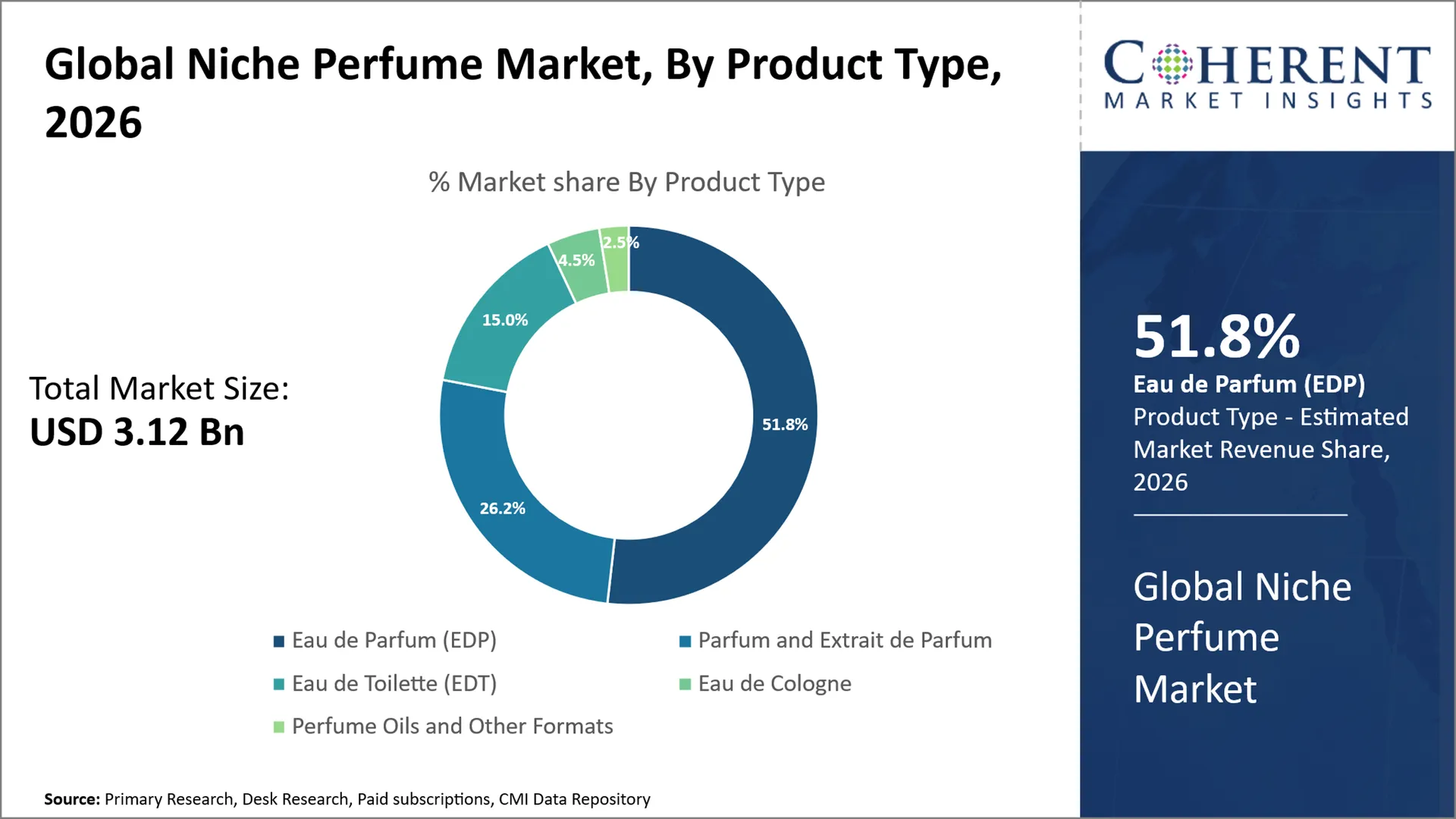
Why Does Eau de Parfum (EDP) Dominate the Global Niche Perfume Market?
Eau de Parfum (EDP) is expected to account for 51.8% of the global niche perfume market in 2026. It is also great for companies that create a range of fragrances as part of a collection. The established filling and stability-testing procedures simplify the production process, and the availability of a variety of bottle sizes can accommodate a variety of budgets and gifting occasions. Meanwhile, LVMH revealed the launch of Kurky, a gourmand-musky eau de parfum, from Maison Francis Kurkdjian in April 2025, in both 35ml and 70ml formats. In April 2025, LVMH reported that Maison Francis Kurkdjian had unveiled Kurky, a gourmand-musky eau de parfum in 35ml and 70ml sizes. Its format strategy demonstrates how niche houses can increase consumer access to a single creation without compromising the fragrance’s identity.
- Current Industry Events of 2026
- Market Size Estimation
- Regional Breakdown
- Competitive Landscape
- Customer Intelligence
- Segmental Analysis
- Pricing Analysis
- Key Market Drivers, Challenges & Future Trends
- Customized Insights Section
Why Do Woody and Amber Fragrances Represent the Largest Fragrance Type in the Global Niche Perfume Market?
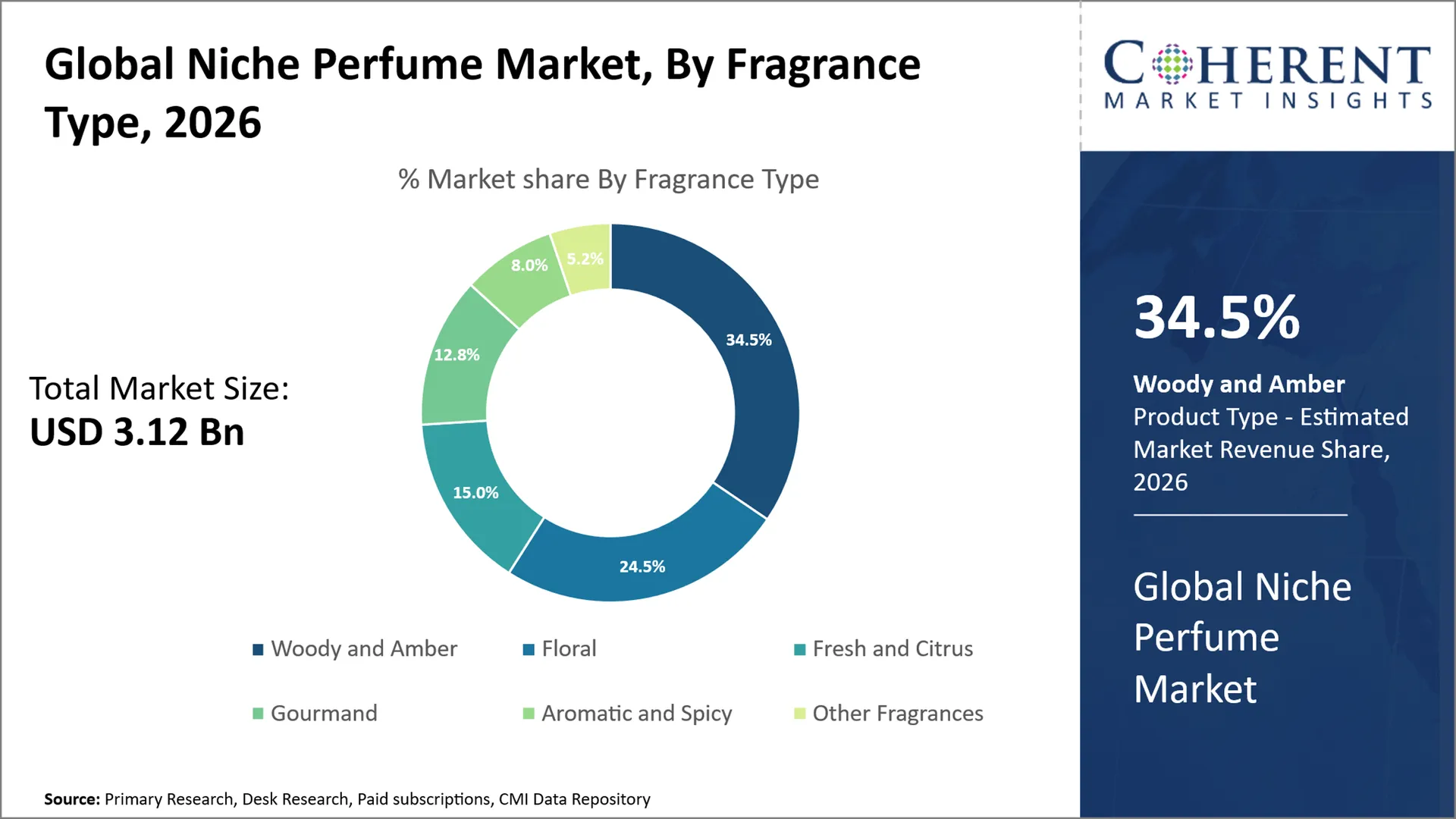
Woody and Amber fragrances are expected to capture 34.5% of the global niche perfume market in 2026, leading the fragrance type category through their broad formulation possibilities. This is attributed to the wide formulation possibilities of these fragrances. Adding cedarwood, aromatic resins, balsams and modern amber materials, perfumers can create dry, smoky, creamy or liquor-like effects within the same fragrance family. This versatility supports themed collections and gives ingredient suppliers opportunities to develop differentiated aroma materials. This versatility allows themed collections and offers opportunities for ingredient suppliers to create differentiated aroma materials. These perfumes are ideal for comparative smelling sessions at a specialty fragrance counter with a base note that can be layered with other perfumes, and where the development of an accord is a selling point for the fragrance enthusiast. In August 2024, KILIAN PARIS presented Old Fashioned, featuring concentrated cedarwood essence, styrax, and Tolu balm within a whisky-inspired composition. The introduction demonstrates how woody-resinous materials can underpin commercially distinctive scent narratives.
Why Does Luxury Dominate the Price Range Category of the Global Niche Perfume Market?
Luxury perfumes are expected to account for 47.2% of the global niche perfume market in 2026, representing the largest share by price range. It's a position of importance in between the high-end and the more limited ultra luxury purchases, as it enables the consumer to enjoy the expertise of a specialist without going into the collectible price range. Here, for producers, the tier can provide the capacity for skilled perfumery, strict quality checks and controlled replenishment of international ingredients. Manufacturers can increase their retail partners' benefit when they can ensure their products are available and serviced at a consistent level across the various markets. In March 2026, Kering announced completion of its L'Oréal acquisition, which also involved the luxury perfumer's house Creed. The deal is indicative of an existing specialty perfumery brand offering that can attract such investment seeking to bolster research and development, production and global distribution capabilities.
Current Events and their Impact
Current Event | Description and Its Impact |
August 2026 – Canada expands mandatory fragrance allergen disclosure |
|
July 2026 – European Union fragrance allergen labeling transition |
|
Global Niche Perfume Market Dynamics
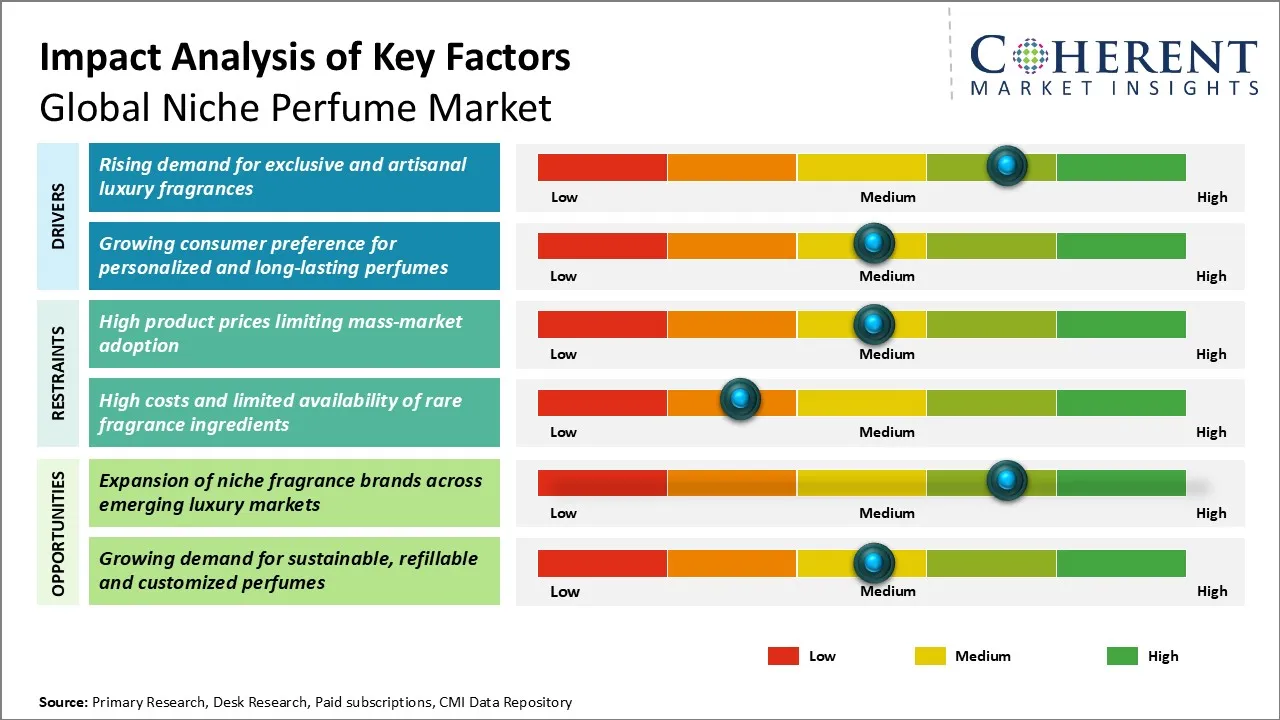
Key Market Drivers
- Rising demand for exclusive and artisanal luxury fragrances: The appeal of niche perfume increasingly rests on creative authorship rather than familiar designer labels. Consumers who associate fragrance with collecting and artistic expression are more willing to explore unusual compositions and pay for clearly differentiated work. This gives specialist ingredient suppliers, selective retailers and independent perfumers more pricing leverage. In September 2026, Anecdotes by Artists debuted at Sephora with collections conceived by individual perfumers who received creative freedom instead of conventional commercial briefs. Its method shows how to achieve a credible product differentiation through the inclusion of visible perfumer identity.
- Growing consumer preference for personalized and long-lasting perfumes: There is a growing consumer preference for customized and long-lasting perfumes, and niche fragrance buyers are increasingly judging perfumes on how they wear on the skin and how their compositions evolve over time. The more concentrated formats allow for premium upgrades and education on ingredients helps consumers choose fragrances that fit their personal preferences.” It works very well for niche companies that are focused on formulation performance, quality control and educated consultations. In July 2025, MIND GAMES introduced Kingside and Queenside as extrait de parfums, accompanied by concentrated ingredient-extract vials. The launch connects high-concentration perfumery with more informed individual fragrance exploration.
Emerging Market Trends
- Ingredient provenance becomes commercially important: A description such as 'natural' or 'rare' is no longer enough to distinguish a premium fragrance on its own. Buyers and retail partners increasingly expect a clearer account of where notable ingredients come from and how they were sourced. For perfume houses, this raises the value of reliable grower relationships, consistent supplier specifications and traceable purchasing records. Those records can strengthen a product's credibility, but they also require more discipline from smaller manufacturers.
- Experimental compositions move beyond familiar fragrance families: Niche perfumers are working with mineral, tea-like, creamy, vegetal and even subtly savory impressions that do not fit neatly into traditional floral or citrus categories. Such compositions attract curious fragrance enthusiasts, but they are harder to communicate through standard retail descriptors. Independent houses can benefit from testing ideas in limited runs, while retailers may need more knowledgeable staff and better sampling experiences to explain the finished scents.
Regional Insights
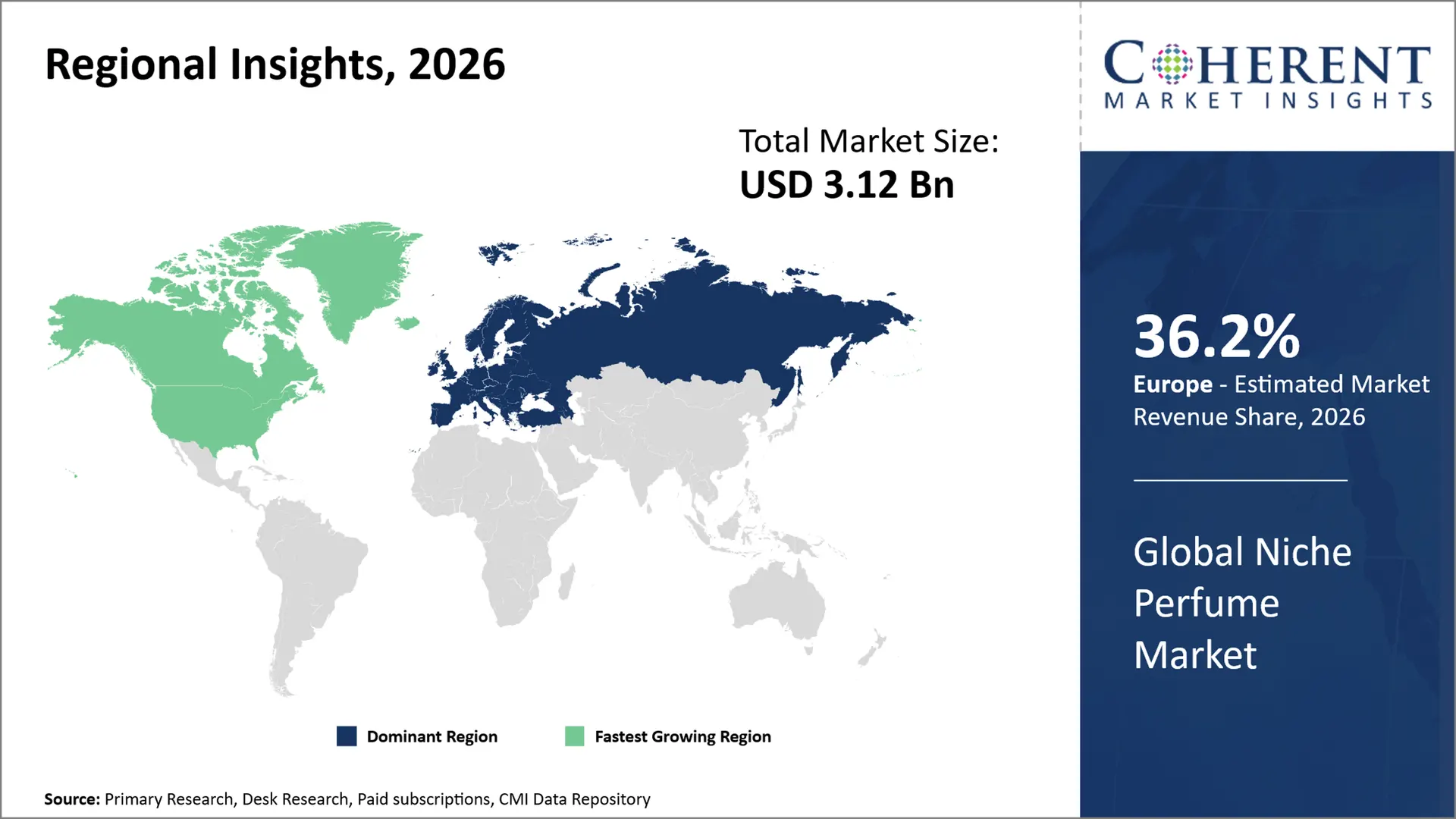
Why Does Europe Dominate the Global Niche Perfume Market?
Europe is projected to represent 36.2% of global niche perfume revenue in 2026. Its position is rooted in an established industrial base: ingredient producers, experienced perfumers, formulation specialists and luxury retail businesses operate within relatively close networks. That makes it easier for smaller houses to source expertise and bring a new fragrance to market. France and Italy are especially important contributors, although independent labels and buyers are active across the wider region. In November 2025, Polaris Olfactive Week in Stockholm brought together independent and artisanal perfume houses from different countries, providing a dedicated platform for fragrance discovery, professional networking, and direct consumer engagement. Such initiatives strengthen Europe's role as a center for niche fragrance creativity and commercialization.
Why Is North America Emerging as the Fastest-Growing Region in the Global Niche Perfume Market?
North America is expected to dominate the market with a share of 29.3% in 2026 and the highest regional growth rate of 7.7% during 2026-2033. The interest in unconventional compositions and houses is growing among a community of fragrance collectors. Key middlemen have emerged in the form of specialist distributors who help bring these labels to customers without requiring a full store rollout. In January 2025, ScentXplore highlighted several fragrance collections showcased at its sixth convention, including new offerings from House of Noya, Kierin, and Qhue. These introductions demonstrate the importance of niche fragrance events in facilitating product discovery and direct interaction between brands and potential buyers.
Global Niche Perfume Market Outlook for Key Countries
Why Is the U.S. a Key Market for the Global Niche Perfume Market?
There is a robust independent perfumery industry in the U.S. with niche laboratories, artisanal perfumers and individuals who enjoy discovering original fragrance blends. Domestic perfume producers also have the benefit of being able to try out small batches, collect feedback, and gain brand traction from a portion of the population prior to mass distribution. The setting is conducive to product testing and to new fragrance entrepreneurs. The Institute for Art and Olfaction held their 11th Art and Olfaction Awards in the city of Los Angeles in May 2025, honoring independent and artisan fragrances such as Bad Lily by TALE Parfum. This recognition helps to improve visibility for smaller perfume houses and reinforces the creative perfumery position of the country.
What is China's significance on the global Niche Perfume Market?
The younger urban Chinese are the primary drivers of interest in niche perfumes and are creating new opportunities for China. Shanghai will become a commercial center for international perfume houses and domestic brands to test their ideas and market their products. In addition, local manufacturers are benefiting from the increased recognition of fragrances that are culturally inspired. Moreover, increasing awareness for culturally inspired fragrances is helping the local manufacturers. More than 200 perfumery and fragrance brands from 19 countries and regions attended the Notes Shanghai Spring Exhibition in March 2025, the Shanghai Municipal Government said. It is a sign of the country’s growing role in the global perfume business and of the growth of the niche fragrance market in China.
What accounts for India’s investment in the Global Niche Perfume Market?
Overall, the Indian market presents a good opportunity for niche perfumes to grow, driven by the rising demand for luxury products and the country’s long-standing tradition of craftsmanship. The country's rich heritage in the field of attars, botanical distillation and natural ingredients for perfumery gives possibilities of creating unique local products. Meanwhile, luxury fragrance merchants are launching global niche brands to their high-end clientele in big cities. Sawariya Group recently announced the acquisition of a luxury fragrance store called SCENTIDO Niche Perfumery.In October 2025, Sawariya Group announced the acquisition of luxury fragrance store SCENTIDO Niche Perfumery, an Indian luxury fragrance retailer. The investment reflects the rising commercial interest in specialty retail of perfumes and the possibility of organized players to expand their foothold in the premium perfumery market in India.
Why France is a Strategic Country in the Global Niche Perfume Market?
France's advantage in niche perfumery lies in its know-how in the field of perfumery formulation, perfumery ingredient processing and professional perfumery. Today, Grasse is still a vital source of botanical ingredients and a hub for creating high-end perfume formulations. French perfume brands have access to experienced perfumers and established suppliers, which allows them to produce their products with a good quality and present new fragrances. Business France participated in the Esxence in Milan in February 2025 with about 40 French brands of fragrance to showcase to international buyers. The campaign underscores the country's efforts in export development and its reputation as a leading producer of artisanal perfumes in the global market.
Why Is Italy an Important Growth Market for the Global Niche Perfume Market?
Italy brings a different set of strengths to niche perfumery. Its expertise in design, decorative glass and premium packaging helps brands translate a fragrance concept into a finished luxury product. Established fashion and specialty retail channels provide further routes to market. Florence, in particular, has become a meeting place for creative houses and professional buyers looking for additions to their assortments. At the September 2025 Fragranze exhibition in Florence, Pitti Immagine reported 258 participating brands and nearly 2,200 buyers and industry operators. For smaller makers, access to that audience can create wholesale opportunities without the expense of opening stores in multiple countries.
Niche Perfume Formulation and Product Innovation Landscape
Technology | Application in Niche Perfumery | Adoption Landscape | Commercial Impact |
Headspace Sampling and GC-MS Analysis | Characterizes volatile aroma compounds and supports the recreation of complex natural scent profiles. | Specialized fragrance laboratories and advanced formulation teams. | Supports unusual fragrance development, ingredient assessment, and formulation consistency. |
Biotechnology-Derived Aroma Ingredients | Uses fermentation or other biotechnology processes to manufacture selected fragrance molecules. | Selective adoption through established aroma chemical and ingredient suppliers. | Offers alternatives to certain supply-constrained natural materials and can improve sourcing flexibility. |
AI-Assisted Olfactory Profiling | Interprets fragrance preferences and scent attributes to support recommendations and product discovery. | Developing within digitally enabled luxury fragrance retail. | Helps improve product matching and can reduce uncertainty when purchasing perfume online. |
Advanced Fixative and Volatility Management | Applies aroma-chemical selection and formulation techniques to influence fragrance evaporation and scent development. | Established formulation science with continuing innovation in ingredient combinations. | Supports performance differentiation and targeted development of longer-lasting fragrance profiles. |
Digital Ingredient and Batch Traceability | Connects ingredient records, supplier information, batch documentation, and relevant allergen declarations. | Increasingly relevant to internationally distributed specialist brands. | Strengthens quality investigations, compliance preparation, and supply-chain accountability. |
How Are Hospitality and Experiential Luxury Partnerships Creating New Growth Opportunities in the Global Niche Perfume Market?
Independent perfume houses have a relatively new avenue to market with collections of personal perfumes made with the intent to be sent to a hospital. With boutique hotels, luxury lodges, private members' clubs and cultural attractions all devoting more and more attention to distinctive items related to a place or experience, there are more than ever opportunities for them to use authentic product from within these destinations. There are more opportunities now than ever for authentic product from within these destinations to be used as distinctive merchandise for boutique hotels, luxury lodges, private members' clubs and cultural attractions. Instead of providing ambient fragrances or toiletries, specialty companies may create toiletries (fragrance) that are ready for retail based on local flora, local architecture or local culture. The commercial model can include an exclusive opening allocation, with continuous replenishment of the boutiques, and post-visit ordering via the official brand websites. The opportunity can be seized with the help of fragrance briefs created in collaboration with venue operators, dependable contract filling, portable packaging, but high-quality and agreements about IP, minimum orders, and territories. The organization also needs to list allergens and comply with cosmetic labeling laws in the destination market. “The larger manufacturers are able to maintain production and deliver multiple properties rollouts, while the independents are all about the creative side. Revenue sharing agreements will be transparent and benefit both the fragrance creators and the hospitality partners.
Market Players, Key Development, and Competitive Landscape
Key Developments
- In January 2026, Ajmal Perfumes announced in January 2026 it would expand its footprints in the U.S. by providing access to its OUD MARQUIS collection, which is centered on ouds, through its American website and select partners. The development increases the availability of the traditions of Arabian perfumes and creates a specialized export channel for high-quality compositions not produced in their usual regional area.
- In October 2025, KAYALI launched its first stand-alone e-commerce site in the U.S. and U.K. The site includes a fragrance-finding tool and brand-exclusive products. The move will give the fragrance house greater control over its full product offering, customer relationships and digital merchandising.
- In April 2025, Scentbird partnered with Neiman Marcus to introduce Neiman's Select, offering curated luxury and niche fragrances in travel-size formats through its subscription platform. It offers specialist perfume houses an organized way to test new products with new customers, without having to commit to ordering an entire stock of perfume.
Competitive Landscape
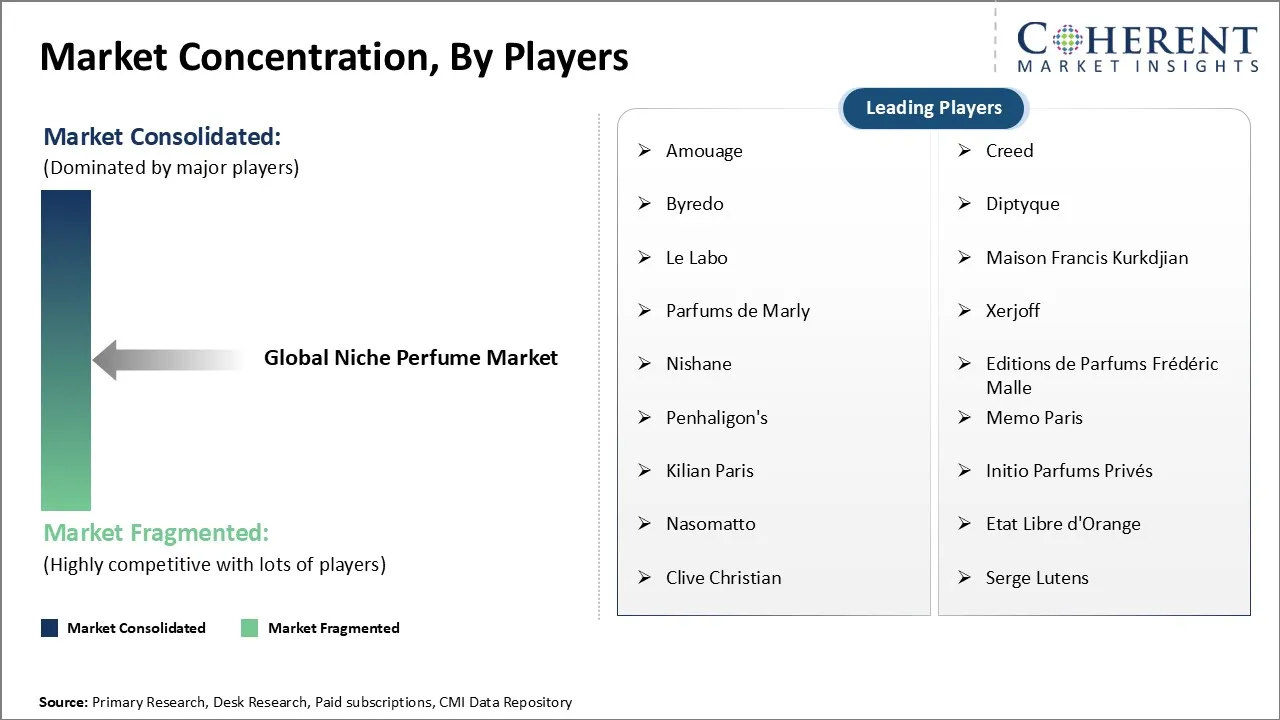
The global niche perfume market is split into three areas: the founder-led perfumery, the independent perfumeries, and the specialist perfume distributors and the luxury-group perfume portfolios. Ownership of unique compositions, disciplined distribution, consistent batch quality, and justification of price premiums no heavy marketing are the factors that shape the competition. Even as regional ateliers become redundant, local knowledge of materials and connections with buyers continue to be important, as do the benefits for scalers in manufacturing resilience, retailer access, and compliance administration.
Key competitive focus areas include
- Distinctive fragrance compositions: Build scents that customers can recognize, supported by clear creative direction and sound control of formulas.
- Reliable production: Maintain ingredient specifications and batch controls so repeat purchases meet customer expectations.
- Selective retail placement: Choose partners that can explain the product and uphold agreed commercial terms.
- Pricing and margins: Review packaging costs, wholesale economics and promotions without weakening the brand's positioning.
- Regulatory preparation: Address safety assessment, ingredient documentation and destination-market labels early in development.
Market Report Scope
Niche Perfume Market Report Coverage | |||
Report Coverage | Details | ||
Base Year | 2025 | Market Size in 2026: | USD 3.12 Bn |
Historical Data For: | 2020 To 2024 | Forecast Period: | 2026 To 2033 |
Forecast Period 2026 To 2033 CAGR: | 11.1% | 2033 Value Projection: | USD 6.52 Bn |
Geographies covered: |
| ||
Segments covered: |
| ||
Companies covered: | Amouage, Creed, Byredo, Diptyque, Le Labo, Maison Francis Kurkdjian, Parfums de Marly, Xerjoff, Nishane, Editions de Parfums Frédéric Malle, Penhaligon's, Memo Paris, Kilian Paris, Initio Parfums Privés, Nasomatto, Etat Libre d'Orange, Clive Christian, Serge Lutens | ||
Growth Drivers: |
| ||
Restraints & Challenges: |
| ||
Analyst Opinion (Expert Opinion)
- The global niche perfume market leadership is likely to depend increasingly on the commercial durability of fragrance intellectual property rather than the frequency of product launches. Houses that develop recognizable scent assets, secure reliable production arrangements, and maintain coherent portfolios should achieve stronger long-term economics. Businesses expanding their assortments without protecting the identity of their core creations may struggle to sustain customer loyalty and full-price sales.
- The economics of the fragrance industry could change dramatically with the creation of multi-brand niche fragrance platforms. Portfolio operators benefit from a structural advantage over independent labels, as they share the same sourcing, regulatory administration and international sales infrastructure. But excessive centralization could threaten the creative freedom that makes specialist perfumery such an attractive commercial proposition. The shift will likely benefit platforms that separate operational infrastructure from creative decision-making the most.
- For niche perfume companies, focus on building reliable contract manufacturing, qualifying backup ingredients, developing solid formulation histories and negotiating comprehensive wholesale contracts. Anyone wants to invest in products that have a track record of customer retention and sustainable contribution margins. Companies are encouraged to be wary of over-commitment to flagship stores, speculative product proliferation and dependence on a single specialty ingredient supplier. International expansion will be crucial to maintaining profitability through more stringent quality controls and geographically diversified sourcing.
Speak to the analyst
Want personalized insights?
Take the findings above to one of our principal consultants, or have the report rebuilt around the segments, geographies and competitors you actually track.
Market Segmentation
- Product Type Insights (Revenue, USD Bn, 2021 - 2033)
- Eau de Parfum (EDP)
- Parfum and Extrait de Parfum
- Eau de Toilette (EDT)
- Eau de Cologne
- Perfume Oils and Other Formats
- Fragrance Type Insights (Revenue, USD Bn, 2021 - 2033)
- Woody and Amber
- Floral
- Fresh and Citrus
- Gourmand
- Aromatic and Spicy
- Other Fragrances
- Price Range Insights (Revenue, USD Bn, 2021 - 2033)
- Premium
- Luxury
- Ultra-Luxury
- End User Insights (Revenue, USD Bn, 2021 - 2033)
- Men
- Women
- Unisex
- Distribution Channel Insights (Revenue, USD Bn, 2021 - 2033)
- Brand-Owned Boutiques
- Specialty Fragrance Stores
- Department Stores
- Online Retail
- Duty-Free and Travel Retail
- Regional Insights (Revenue, USD Bn, 2021 - 2033)
- North America
- U.S.
- Canada
- Latin America
- Brazil
- Argentina
- Mexico
- Rest of Latin America
- Europe
- Germany
- U.K.
- Spain
- France
- Italy
- Russia
- Rest of Europe
- Asia Pacific
- China
- India
- Japan
- Australia
- South Korea
- ASEAN
- Rest of Asia Pacific
- Middle East
- GCC Countries
- Israel
- Rest of Middle East
- Africa
- South Africa
- North Africa
- Central Africa
- North America
- Key Players Insights
- Amouage
- Creed
- Byredo
- Diptyque
- Le Labo
- Maison Francis Kurkdjian
- Parfums de Marly
- Xerjoff
- Nishane
- Editions de Parfums Frédéric Malle
- Penhaligon's
- Memo Paris
- Kilian Paris
- Initio Parfums Privés
- Nasomatto
- Etat Libre d'Orange
- Clive Christian
- Serge Lutens
Sources
Primary Research Interviews
- Niche perfume manufacturers, independent perfumers, and luxury fragrance houses
- Fragrance ingredient suppliers, formulation specialists, and contract manufacturers
- Luxury retailers, specialty fragrance distributors, and industry experts
Stakeholders
- Artisanal and luxury perfume manufacturers
- Essential oil, aroma chemical, and fragrance ingredient suppliers
- Specialty retailers, e-commerce platforms, and distributors
- Packaging suppliers, brand owners, and end consumers
End-use Sectors
- Personal luxury fragrances
- Artisanal and bespoke perfumery
- Luxury gifting and fragrance collections
- Travel retail and specialty fragrance boutiques
Regulatory and Industry Bodies
- International Fragrance Association (IFRA)
- Research Institute for Fragrance Materials (RIFM)
- U.S. Food and Drug Administration (FDA)
- European Commission
- European Chemicals Agency (ECHA)
- International Organization for Standardization (ISO)
Databases
- Company annual reports and investor presentations
- UN Comtrade and ITC Trade Map fragrance trade datasets
- Eurostat and national cosmetics industry statistics
- Fragrance ingredient pricing, production, and patent databases
- Luxury retail, consumer spending, and perfume import-export databases
Magazines and Journals
- Perfumer & Flavorist
- Flavour and Fragrance Journal
- International Journal of Cosmetic Science
- Cosmetics & Toiletries
- Journal of Essential Oil Research
Associations
- International Fragrance Association (IFRA)
- The Fragrance Foundation
- Cosmetics Europe
- British Society of Perfumers (BSP)
- Cosmetic, Toiletry and Perfumery Association (CTPA)
Public Domain Sources
- Perfume production, consumption, and international trade statistics
- Luxury fragrance purchasing patterns and consumer preferences
- Fragrance ingredient sourcing, pricing, and formulation developments
- Niche perfume launches, partnerships, acquisitions, and retail expansion
- Fragrance safety, sustainability, and regulatory updates
Key Standards and Regulations
- Regulation (EC) No. 1223/2009 – EU Cosmetics Regulation
- Commission Regulation (EU) 2023/1545 – Fragrance allergen labeling
- ISO 22716:2007 – Cosmetics Good Manufacturing Practices (GMP)
- U.S. Modernization of Cosmetics Regulation Act of 2022 (MoCRA)
- India Cosmetics Rules, 2020 – Cosmetic manufacturing and import requirements
Proprietary Elements
- CMI Data Analytics Tool and proprietary CMI repository covering fragrance industry intelligence, niche perfume demand, luxury consumer preferences, ingredient pricing, product innovation, distribution channels, regulatory developments, and competitive intelligence.
Get access to 250+ pages report
Every segment, forecast, competitor profile and data table behind the analysis above — available for instant download.
- ESOMAR Member
- ISO 9001:2015 Certified
- D-U-N-S Registered
- GDPR & CCPA Compliant
Frequently Asked Questions
The CAGR of global niche perfume market is projected to be 11.1% from 2026 to 2033.
The global niche perfume market is estimated to be valued at USD 3.12 billion in 2026 and is expected to reach USD 6.52 billion by 2033.
Key opportunities include independent fragrance brand development, specialty retail expansion, artisanal perfume manufacturing, and strategic investments in premium fragrance portfolios.
Consumers are increasingly prioritizing fragrance originality, ingredient quality, brand authenticity, and distinctive scent experiences over conventional designer fragrance offerings.
Manufacturers face challenges related to sourcing rare ingredients, maintaining formulation consistency, managing production costs, preventing counterfeiting, and complying with international cosmetic regulations.
The report helps manufacturers, investors, and distributors assess competitive positioning, identify market-entry opportunities, evaluate consumer preferences, and develop pricing, product portfolio, and distribution strategies.
The growing demand for exclusive, artisanal luxury fragrances and increasing consumer preference for personalized, long-lasting perfumes are the key factors driving growth in the global niche perfume market