

North America Polysomnography (PSG) Market Size and Forecast – 2026 To 2033
The North America polysomnography (PSG) market is expected to grow from USD 6,242.6 Mn in 2026 to USD 10,337.5 Mn by 2033, registering a compound annual growth rate (CAGR) of 7.5% from 2026 to 2033. The North America polysomnography (PSG) market is poised for significant expansion, fueled by the increasing prevalence of sleep disorders, particularly obstructive sleep apnea (OSA), which continues to the increase demand for accurate sleep diagnostics.
According to the American Academy of Sleep Medicine (AASM), approximately 29.4 million U.S. adults have obstructive sleep apnea (OSA) (based on 2015 economic model), of which nearly 23.5 million (around 80%) remain undiagnosed, highlighting the substantial unmet need for polysomnography testing and early diagnosis.
Key Takeaways of the North America Polysomnography (PSG) Market
- Services are projected to hold 58.4 % of the North America polysomnography (PSG) market share in 2026, making it the dominant product and services segment, owing to the increasing demand for sleep study interpretation, diagnostic reporting, and technical monitoring services. For instance, the U.S. Centers for Medicare & Medicaid Services (CMS) revised its accreditation and credentialing requirements for polysomnography in March 2024, reaffirming that facilities billing Medicare for PSG services must maintain accreditation through the American Academy of Sleep Medicine (AASM), The Joint Commission, or the Accreditation Commission for Health Care (ACHC), reinforcing the importance of accredited diagnostic service providers.
- Hospitals are projected to hold 43.6 % of the North America polysomnography (PSG) market share in 2026, making it the dominant end user segment, due to their advanced sleep laboratories, multidisciplinary care teams, and ability to manage complex sleep disorders. For instance, U.S. Centers for Medicare & Medicaid Services (CMS) local coverage determinations require hospital and non-hospital sleep laboratories performing reimbursable polysomnography to operate under qualified physician supervision and maintain accreditation from recognized organizations such as the Academy of Sleep Medicine (AASM), The Joint Commission, or the Accreditation Commission for Health Care (ACHC), supporting continued hospital-led delivery of PSG services.
- Rising Adoption of Sleep Testing Services: The growing demand for sleep testing services across North America is creating significant opportunities for PSG providers. Increasing referrals for obstructive sleep apnea (OSA), insomnia, and other sleep disorders, coupled with the expansion of accredited sleep laboratories and home-based diagnostic programs, is driving higher utilization of polysomnography services. This trend is expected to support recurring revenue through diagnostic testing and clinical interpretation.
- Expansion of Sleep Tech Devices Integrated with Polysomnography (PSG): The rapid evolution of sleep tech devices is enhancing the efficiency and accessibility of polysomnography. Advanced wireless sensors, cloud-connected monitoring systems, and AI-enabled sleep analysis platforms are improving data accuracy, patient comfort, and workflow automation. These innovations are encouraging healthcare providers to modernize sleep laboratories and expand diagnostic capabilities, supporting long-term market growth.
Segmental Insights
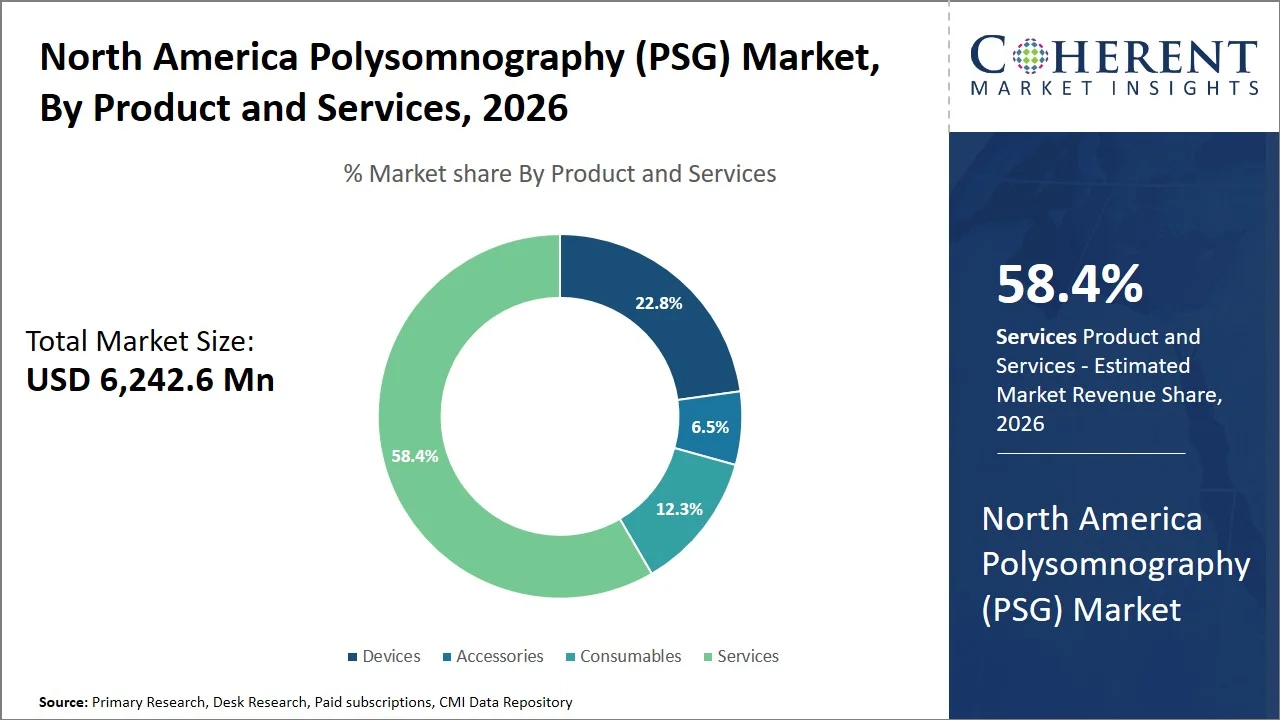
Why Do Services Dominate the North America Polysomnography (PSG) Market?
Services are projected to hold a market share of 58.4% in 2026, because every sleep study depends on certain clinical services for patient setup, overnight sleep tracing, sleep stage analysis, physician review of data, and after-study analysis and patient follow-up. As the demand for accredited and comprehensive diagnostic services for sleep grows, the need for services will increase simultaneously. For instance, in January 2025, American Academy of Sleep Medicine (AASM) launched its new service-based accreditation model. It permits sleep programs to obtain accreditation of diagnostic services like home apnea and in-home testing with an integrated network in a centralized, simplified system enhancing operational efficiency and expanding access to standardized sleep diagnostic services.
- Current Industry Events of 2026
- Market Size Estimation
- Regional Breakdown
- Competitive Landscape
- Customer Intelligence
- Segmental Analysis
- Pricing Analysis
- Key Market Drivers, Challenges & Future Trends
- Customized Insights Section
Why Do Hospitals Represent the Largest End User Segment in the North America Polysomnography (PSG) Market?
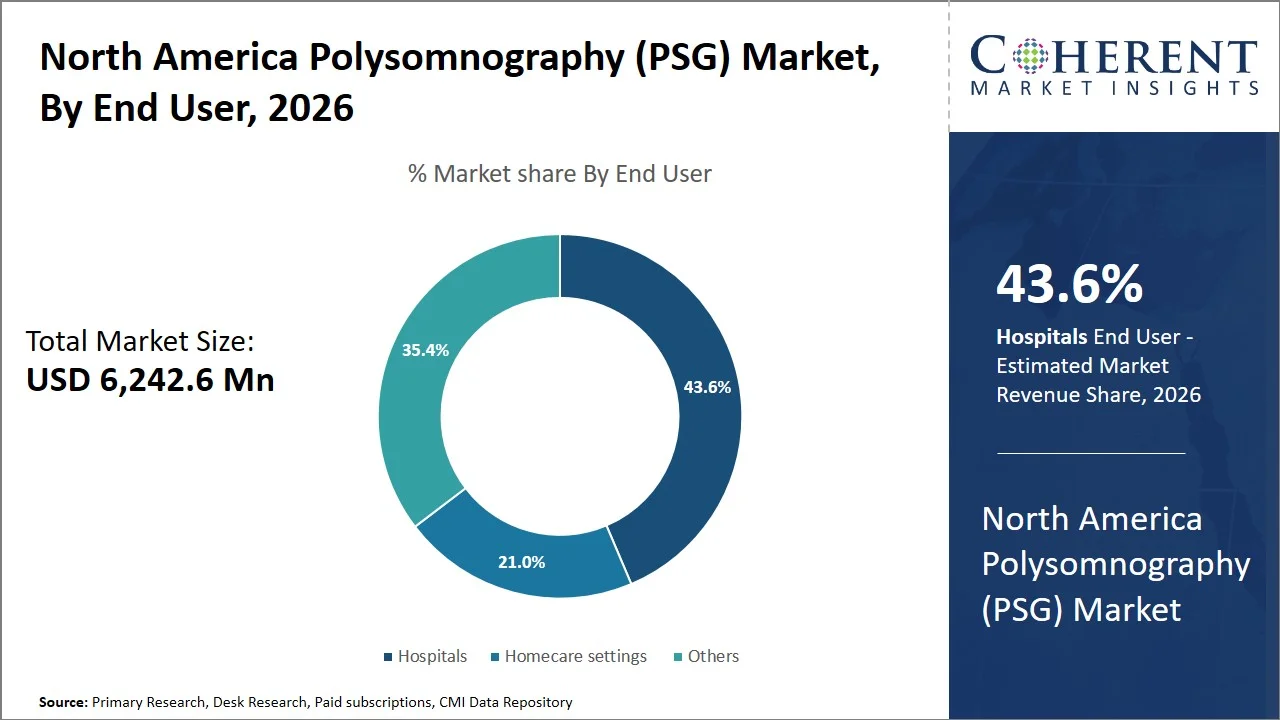
Hospitals are projected to hold 43.6% of the market share in 2026, because of their on-site integrated sleep labs, expertise and multidisciplinary team, capability to cater to complicated individuals with comorbid disease states that require comprehensive evaluation of sleep state. Additionally, it has a huge superior diagnostic system along overnight monitoring, and coordinated follow-up care under one clinical setting. For instance, in April 2025, UCHealth established the 10-bed sleep lab to help meet rising patient demand by increasing on-campus hospital capacity for both in-facility overnight sleep tests and the multidisciplinary sleep health team.
Current Events and their Impact
Current Events | Description and its Impact |
Centers for Medicare & Medicaid Services (CMS) – Local Coverage Determination (LCD) for Polysomnography and Other Sleep Studies (L36839) (June 2025) |
|
Centers for Medicare & Medicaid Services (CMS) – Accreditation Requirements for Medicare-Participating Sleep Laboratories (March 2025) |
|
North America Polysomnography (PSG) Market Dynamics
Market Drivers
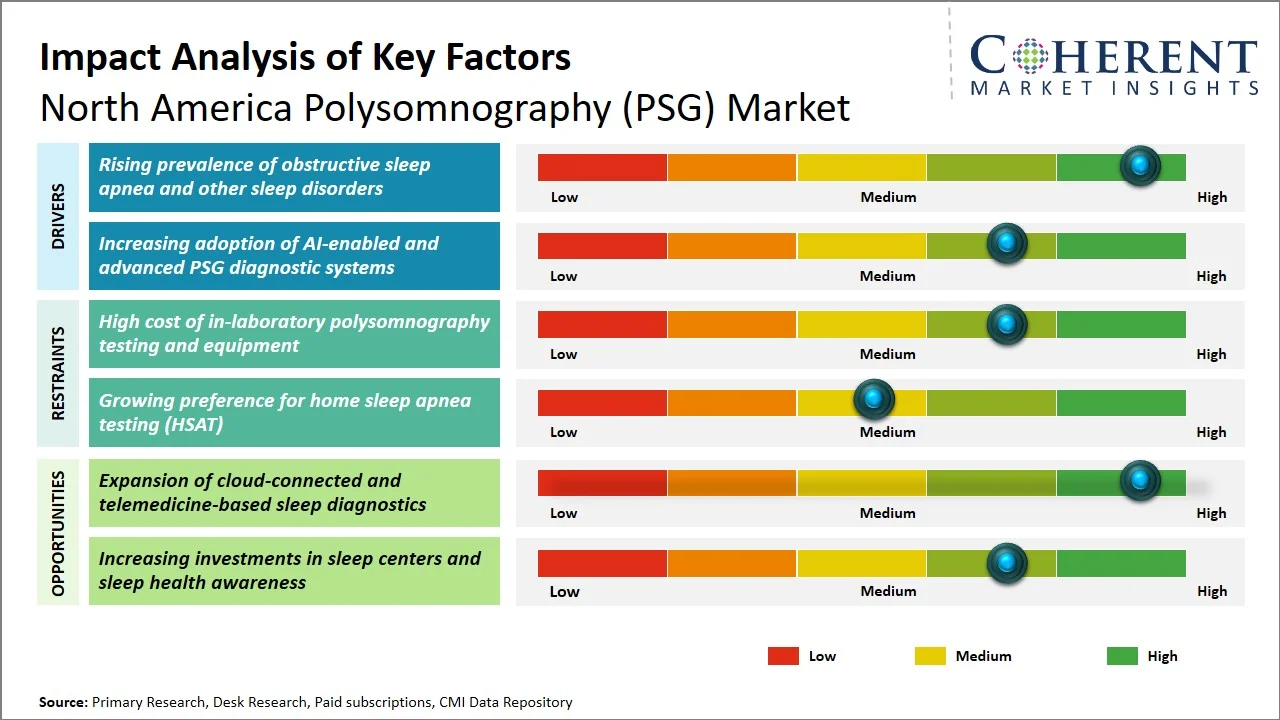
- Rising prevalence of obstructive sleep apnea and other sleep disorders: The increasing burden of obstructive sleep apnea (OSA), driven by rising obesity rates and an aging population, is significantly boosting the demand for polysomnography (PSG) across North America. As awareness of the cardiovascular and metabolic risks associated with untreated obstructive sleep apnea (OSA) rises, healthcare providers are expanding referrals for comprehensive sleep evaluations. For instance, in December 2024, the U.S. Food and Drug Administration (FDA) approved Zepbound as the first medication for adults with moderate-to-severe obstructive sleep apnea (OSA) and obesity, highlighting the growing clinical focus on identifying patients through accurate PSG-based diagnosis before treatment selection.
- Increasing adoption of AI-enabled and advanced PSG diagnostic systems: The integration of artificial intelligence (AI) and advanced digital technologies into polysomnography (PSG) systems is transforming sleep diagnostics by improving automated sleep staging, respiratory event detection, and clinical workflow efficiency. AI-assisted PSG platforms help reduce interpretation time, enhance diagnostic consistency, and support faster clinical decision-making. For instance, in June 2025, the U.S. Food and Drug Administration (FDA) granted clearance to EnsoData's AI-powered sleep diagnostic software, EnsoSleep PPG, enabling automated analysis of sleep studies using photoplethysmography (PPG) signals and expanding the adoption of AI-driven sleep diagnostics.
Emerging Trends
- Growing Adoption of Multimodal Sleep Diagnostics: Sleep laboratories are increasingly integrating polysomnography with complementary diagnostic tools such as actigraphy, wearable biosensors, and cardiopulmonary monitoring to provide a more comprehensive assessment of sleep disorders. This multimodal approach enables clinicians to evaluate complex sleep conditions alongside cardiovascular and neurological comorbidities, improving diagnostic precision and personalized treatment planning.
- Expansion of Cloud-Based Sleep Data Management Platforms: Healthcare providers are increasingly adopting cloud-enabled PSG platforms that facilitate secure storage, remote access, and seamless sharing of sleep study data across healthcare networks. These platforms improve interoperability with electronic health records (EHRs), streamline clinical workflows, and support collaboration among sleep specialists, neurologists, pulmonologists, and primary care physicians.
Regulatory and Reimbursement Factors Influencing the North America Polysomnography (PSG) Market
Regulatory/Reimbursement Policy | Authority | Year | Key Change | Market Impact |
Medicare Coverage for PSG & HST | Centers for Medicare & Medicaid Services | 2025 | Updated Local Coverage Determination for Polysomnography and Other Sleep Studies, reaffirming reimbursement criteria for in-laboratory polysomnography and home sleep testing. | Supports reimbursement for accredited sleep diagnostic services and encourages broader patient access to polysomnography. |
Physician Fee Schedule | Centers for Medicare & Medicaid Services | 2026 | Finalized the CY 2026 Physician Fee Schedule, maintaining reimbursement support for telehealth and remote physiologic monitoring services. | Facilitates expansion of digital sleep care and follow-up services, complementing polysomnography-based diagnosis. |
Sleep Laboratory Accreditation | American Academy of Sleep Medicine/ Centers for Medicare & Medicaid Services | 2025 | Implemented revised accreditation standards emphasizing quality management, patient safety, staff competency, and standardized sleep diagnostic practices. | Encourages modernization of sleep laboratories and strengthens the quality of polysomnography services. |
AI-enabled PSG Software Clearance | Food and Drug Administration | 2025 | Granted regulatory clearance for advanced artificial intelligence-enabled sleep diagnostic software to support automated sleep study analysis. | Accelerates adoption of next-generation polysomnography technologies and improves diagnostic workflow efficiency. |
How is the expansion of cloud-connected and telemedicine-based sleep diagnostics creating new growth opportunities in the North America polysomnography (PSG) market?
Sleep diagnostic solutions that utilize cloud connectivity and offer remote telemedicine capabilities improve accessibility by enabling remote patient evaluation, seamless data sharing, and faster clinical decision-making. This also allows for efficient collaboration of data and expedites decision-making, reducing the reliance on traditional sleep clinics to enhance operational workflows and the ease of patient diagnostics. For instance, in April 2025, OpenLoop Health, Inc., a U.S. health tech company, entered into a collaboration with Happy Sleep to launch at home sleep diagnostic capabilities through OpenLoop's national provider network further enhancing access to U.S. FDA-cleared sleep tests, facilitating the adoption of remote PSG pathways in the U.S.
Market Players, Key Development, and Competitive Landscape
Key Developments
- In June 2026, ResMed Inc. completed the acquisition of Noctrix Health, a medical technology company specializing in neurostimulation therapies for chronic neurological disorders affecting sleep. The acquisition expands ResMed's clinical sleep health portfolio by integrating innovative therapeutic technologies, reinforcing its position across the sleep diagnosis, treatment, and long-term patient management continuum.
- In June 2026, Onera Health announced the integration of its Onera hPSG home polysomnography solution with Somnoware by ResMed. The integration enables clinicians to conduct comprehensive PSG studies in patients' homes while managing study review, interpretation, and reporting through a unified workflow, improving operational efficiency and expanding access to sleep diagnostics.
- In August 2025, Nox Medical announced the U.S. launch of Nox SAS (Self-Applied Somnography), an advanced EEG technology that enables full polysomnography testing in both laboratory and home settings. Used with the Nox A1 PSG recorder, the solution simplifies electrode placement while maintaining clinical-grade diagnostic accuracy, supporting faster workflows and broader patient access to PSG testing.
Competitive Landscape
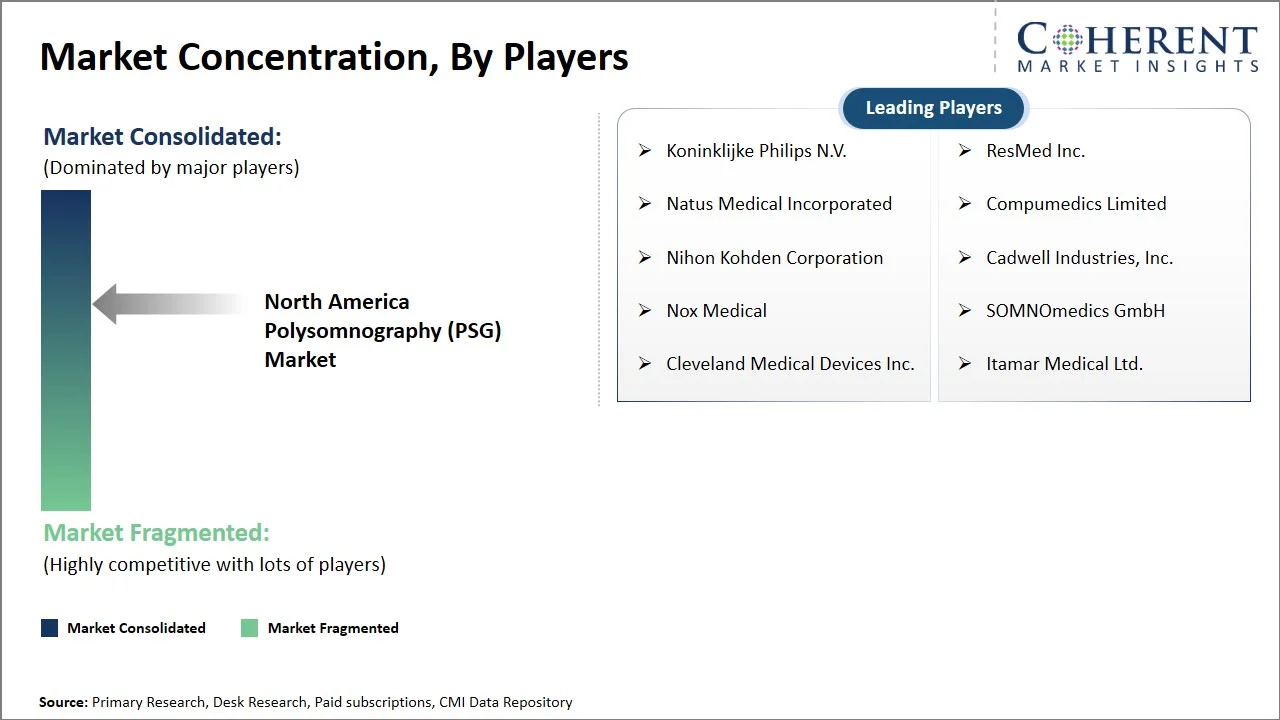
The North America polysomnography (PSG) market is moderately consolidated, with leading companies competing through innovations in AI-enabled sleep diagnostics, portable and home-based PSG systems, and cloud-connected data management platforms. Market participants are strengthening their positions through regulatory approvals, strategic collaborations, and expansion of digital sleep diagnostic capabilities to address the growing demand for accurate and accessible sleep disorder diagnosis across hospitals, sleep laboratories, and home healthcare settings. Key focus areas include:
- Development of portable, wireless, and home-based polysomnography systems for remote sleep diagnostics
- Integration of artificial intelligence (AI) and cloud-based analytics for automated sleep study interpretation
- Expansion of connected digital sleep platforms with telemedicine and electronic health record (EHR) integration
- Strategic partnerships, regulatory approvals, and product innovation to strengthen market presence across North America
Market Report Scope
North America Polysomnography (PSG) Market Report Coverage
| Report Coverage | Details | ||
|---|---|---|---|
| Base Year: | 2025 | Market Size in 2026: | USD 6,242.6 Mn |
| Historical Data for: | 2020 To 2024 | Forecast Period: | 2026 To 2033 |
| Forecast Period 2026 to 2033 CAGR: | 7.5% | 2033 Value Projection: | USD 10,337.5 Mn |
| Segments covered: |
| ||
| Companies covered: | Koninklijke Philips N.V., ResMed Inc., Natus Medical Incorporated, Compumedics Limited, Nihon Kohden Corporation, Cadwell Industries, Inc., Nox Medical, SOMNOmedics GmbH, Cleveland Medical Devices Inc., and Itamar Medical Ltd. | ||
| Growth Drivers: |
| ||
| Restraints & Challenges: |
| ||
Analyst Opinion (Expert Opinion)
- In the coming years, the North America polysomnography (PSG) market is expected to transition toward AI-enabled, cloud-connected, and home-based sleep diagnostic solutions, supported by increasing sleep disorder prevalence, telehealth adoption, and advancements in digital healthcare infrastructure. Growing integration of artificial intelligence for automated sleep analysis and remote patient monitoring is expected to improve diagnostic efficiency and expand access to sleep testing beyond traditional sleep laboratories.
- The maximum growth opportunity lies within home-based polysomnography systems for obstructive sleep apnea diagnosis in the U.S., where the high burden of sleep disorders, favorable reimbursement policies, and widespread adoption of telemedicine continue to accelerate demand. Increasing preference for decentralized care and portable diagnostic technologies is expected to further drive market expansion in this segment.
- In order to create an advantage for themselves, the competitors should prioritize the development of portable wireless PSG systems, AI-powered sleep analysis software, and cloud-integrated diagnostic platforms. Companies should also focus on obtaining timely regulatory clearances, expanding partnerships with hospitals, accredited sleep centers, and telehealth providers, and generating strong clinical evidence demonstrating improved diagnostic accuracy, workflow efficiency, and patient outcomes.
Speak to the analyst
Want personalized insights?
Take the findings above to one of our principal consultants, or have the report rebuilt around the segments, geographies and competitors you actually track.
Market Segmentation
- Product and Services Insights (Revenue, USD Mn, 2021 - 2033)
- Devices
- Accessories
- Consumables
- Services
- End User Insights (Revenue, USD Mn, 2021 - 2033)
- Hospitals
- Homecare settings
- Others
- Key Players Insights
- Koninklijke Philips N.V.
- ResMed Inc.
- Natus Medical Incorporated
- Compumedics Limited
- Nihon Kohden Corporation
- Cadwell Industries, Inc.
- Nox Medical
- SOMNOmedics GmbH
- Cleveland Medical Devices Inc.
- Itamar Medical Ltd.
Sources
Primary Research Interviews
- Sleep Medicine Specialists – clinical adoption trends for in-laboratory and home-based polysomnography, obstructive sleep apnea diagnosis, and sleep disorder management
- Pulmonologists – utilization of polysomnography and home sleep apnea testing in diagnosing sleep-related breathing disorders
- Neurologists – application of polysomnography in narcolepsy, parasomnias, epilepsy, and other neurological sleep disorders
- Sleep Technologists & Sleep Laboratory Directors – workflow optimization, patient monitoring protocols, and adoption of AI-enabled PSG systems
- Hospital Sleep Center Administrators – procurement strategies, reimbursement challenges, and expansion of accredited sleep diagnostic services
- Home Healthcare & Telehealth Providers – adoption of portable polysomnography systems, remote patient monitoring, and cloud-connected sleep diagnostic platforms
Stakeholders
- Polysomnography (PSG) Device Manufacturers (e.g., ResMed Inc., Natus Medical Incorporated, Compumedics Limited, Nihon Kohden Corporation, Cadwell Industries Inc.)
- End-use Sectors
- Hospitals
- Sleep Centers & Sleep Laboratories
- Specialty Clinics
- Home Healthcare Providers
- Academic & Research Institutes
- Regulatory & Health Bodies
- U.S. Food and Drug Administration (FDA)
- Health Canada
- Centers for Medicare & Medicaid Services (CMS)
- American Academy of Sleep Medicine (AASM)
- American Thoracic Society (ATS)
Databases
- United States Food and Drug Administration 510(k) Premarket Notification Database – polysomnography system, home sleep apnea testing device, and sleep diagnostic software clearances
- Centers for Medicare & Medicaid Services Data Repository – reimbursement policies for polysomnography, home sleep apnea testing, and sleep diagnostic services
- National Heart, Lung, and Blood Institute (NHLBI) – epidemiology of sleep disorders, obstructive sleep apnea statistics, and sleep health research
- Centers for Disease Control and Prevention (CDC) – prevalence of sleep disorders, sleep duration, and public health surveillance data
- National Library of Medicine– clinical studies on polysomnography, home sleep apnea testing, artificial intelligence-assisted sleep analysis, and sleep medicine
- ClinicalTrials.gov – ongoing clinical trials involving polysomnography systems, sleep apnea diagnostics, wearable sleep monitoring technologies, and digital sleep health
- American Academy of Sleep Medicine (AASM) Clinical Practice Guidelines – standards for polysomnography, home sleep apnea testing, sleep scoring, and accreditation guidelines
Magazines
- Sleep Review Magazine
- Medical Device & Diagnostic Industry (MD+DI)
- HealthTech Magazine
- Neurology Today
Journals
- Journal of Clinical Sleep Medicine (JCSM)
- Sleep Medicine Reviews
- Journal of Sleep Research
Associations
- American Academy of Sleep Medicine (AASM)
- National Sleep Foundation (NSF)
- American Sleep Apnea Association (ASAA)
- Association of Polysomnographic Technologists (AAST)
Public Domain Sources
- U.S. Food and Drug Administration (FDA)
- Centers for Medicare & Medicaid Services (CMS)
- National Institutes of Health (NIH) – National Heart, Lung, and Blood Institute (NHLBI)
- U.S. Centers for Disease Control and Prevention (CDC)
Proprietary Elements
- CMI Data Analytics Tool, Proprietary CMI Existing Repository of information for last 10 years.
Get access to 250+ pages report
Every segment, forecast, competitor profile and data table behind the analysis above — available for instant download.
- ESOMAR Member
- ISO 9001:2015 Certified
- D-U-N-S Registered
- GDPR & CCPA Compliant
Missing comfort of reading report in your local language? Find your preferred language:
Transform your Strategy with Exclusive Trending Reports
Frequently Asked Questions
The North America polysomnography (PSG) market is estimated to be valued at USD 6,242.6 Mn in 2026 and is expected to reach USD 10,337.5 by 2033.
Services dominate due to the recurring demand for overnight sleep studies, professional sleep test interpretation, continuous patient monitoring, and follow-up diagnostic services performed in accredited sleep laboratories and hospitals.
Polysomnography (PSG) is a comprehensive overnight sleep study that simultaneously records multiple physiological parameters to diagnose sleep disorders such as obstructive sleep apnea, insomnia, narcolepsy, and periodic limb movement disorder.
The CAGR of the North America polysomnography (PSG) market is projected to be 7.5% from 2026 to 2033.
A polysomnography (PSG) study monitors brain activity (electroencephalography), eye movements, muscle activity, heart rhythm, airflow, respiratory effort, oxygen saturation, and limb movements during sleep.
In-laboratory polysomnography provides comprehensive multi-parameter sleep monitoring under clinical supervision, whereas home sleep apnea testing is a simplified diagnostic test primarily used to detect obstructive sleep apnea in appropriate patients.
In terms of end user, hospitals are estimated to dominate the market revenue share in 2026.