

U.S. Elastomeric Infusion Pumps Market Size and Forecast – 2026 to 2033
The U.S. Elastomeric Infusion Pumps Market is anticipated to grow at a CAGR of 7.8% with USD 231.8 Mn share in 2026 and is expected to reach USD 389.7 Mn in 2033. The growing preference for home-based healthcare and outpatient treatment is driving the U.S. elastomeric infusion pumps market.
Key Takeaways
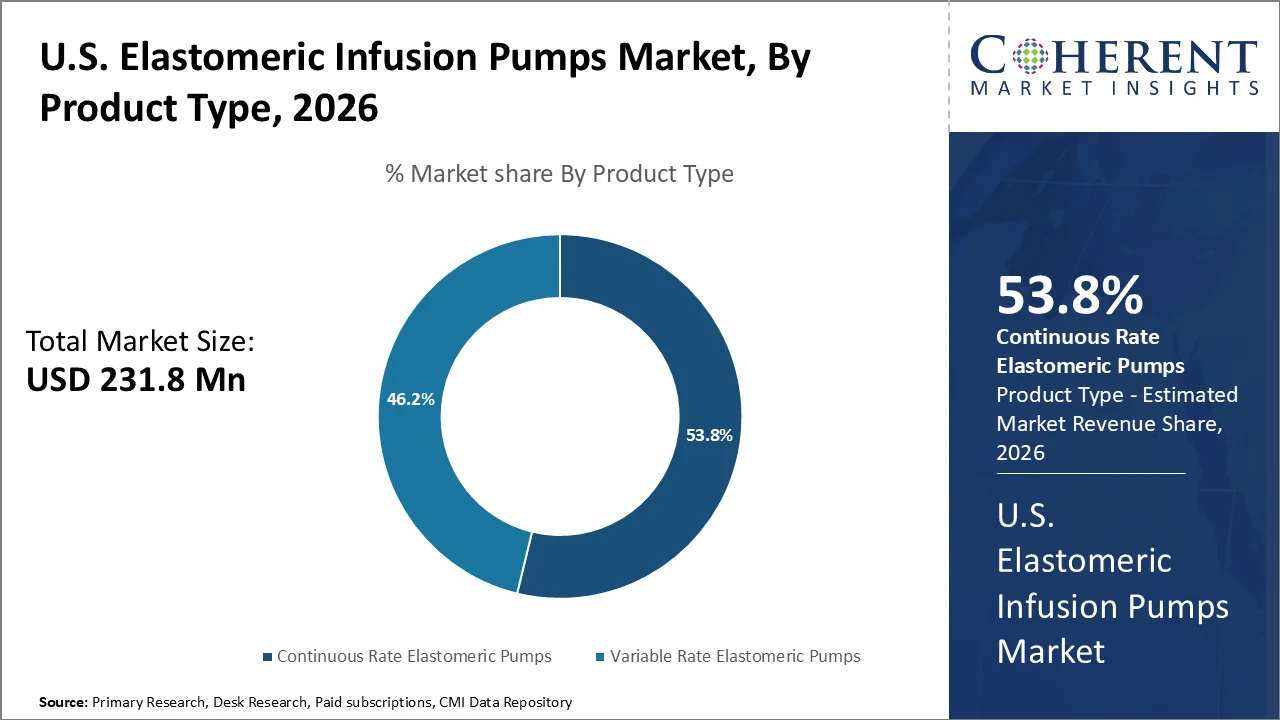
- Continuous Rate Elastomeric Pumps hold the largest market share of 53.8% in 2026 owing to its expansion of home-based infusion therapy.
- Oncology expected to hold largest market share of 42.2% in 2026 owing to the rising cancer incidence. More than 2,000,000 of cancer cases are projected to report in 2025.
- Hospitals and Others acquired the largest market share of 39.9% in 2026 owing to its high surgical procedure volume. An estimated 40–50 Mn major surgeries are performed annually in the United States.
Current Events and Their Impact on the U.S. Elastomeric Infusion Pumps Market
Current Event | Description and its Impact |
CMS Implementation of the NOPAIN Act (Effective January 1, 2025) |
|
Medicare Coverage Policy Continues to Exclude Disposable Elastomeric Pumps Under the DME Benefit (2025 Update) |
|
Segmental Insights
- Current Industry Events of 2026
- Market Size Estimation
- Regional Breakdown
- Competitive Landscape
- Customer Intelligence
- Segmental Analysis
- Pricing Analysis
- Key Market Drivers, Challenges & Future Trends
- Customized Insights Section
Why is Continuous Rate Elastomeric Pumps Acquiring the Largest Market Share?
Continuous Rate Elastomeric Pumps hold the largest market share of 53.8% in 2026. Continuous-rate elastomeric pumps are gaining traction in the U.S. elastomeric infusion pumps market as healthcare providers increasingly shift infusion therapies to home-based and outpatient settings. These portable, disposable devices enhance patient convenience while helping reduce hospital stays. Healthcare professionals also rely on them for continuous antibiotic administration, postoperative pain management, chemotherapy, and palliative care. Hospitals and ambulatory surgical centers prefer these pumps because they operate without electricity or programming, simplify clinical workflows, lower maintenance costs, and deliver reliable, consistent medication across a broad range of therapeutic applications.
Oncology expected to hold largest market share
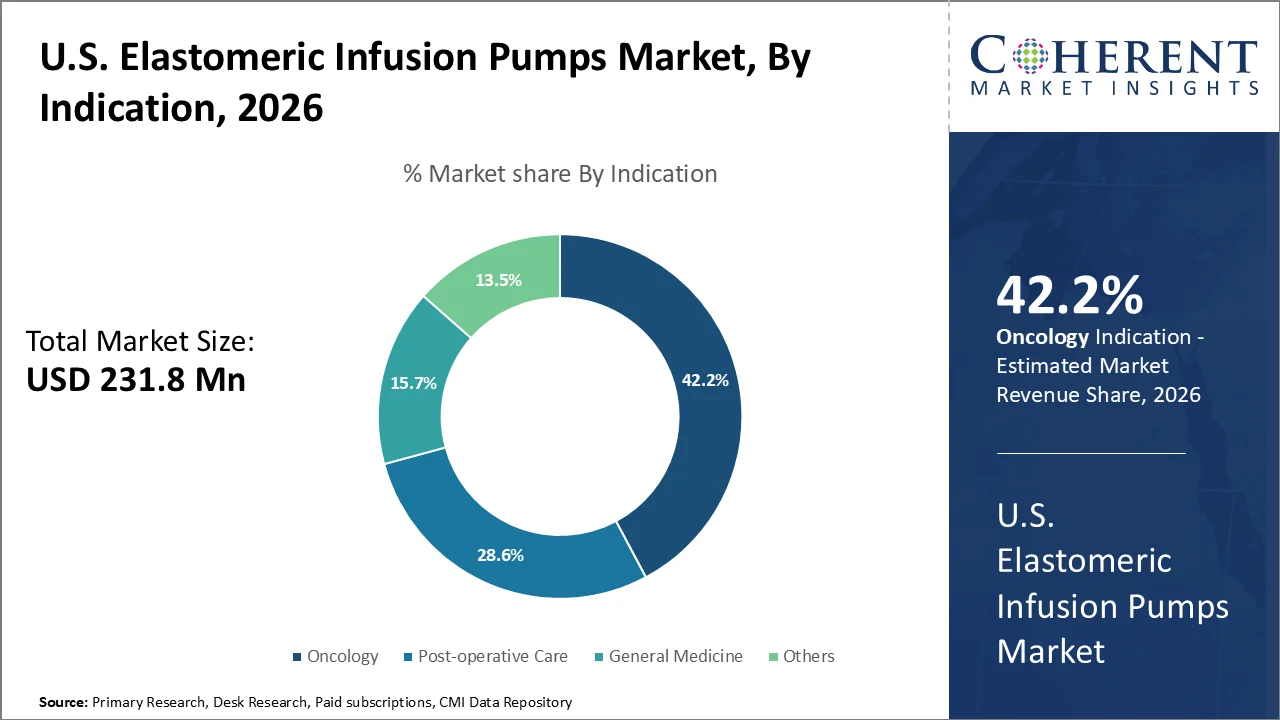
Oncology expected to hold largest market share of 42.2% in 2026 owing to the growth of home-based cancer care. Healthcare providers are driving growth in the oncology segment of the U.S. elastomeric infusion pumps market by expanding outpatient and home-based chemotherapy services that improve patient convenience and shorten hospital stays. Rising cancer incidence is increasing the need for continuous infusion therapies, especially prolonged chemotherapy regimens. In 2025, the United States is projected to report 2,041,910 new cancer cases and 618,120 cancer deaths. Clinicians use elastomeric pumps to enhance patient mobility, simplify drug administration, and avoid electronic programming. Hospitals and oncology centers choose these portable devices to streamline treatment, lower equipment costs, deliver consistent medication, and improve the overall quality and efficiency of patient care.
Which End User segment dominates the market?
Hospitals and Others acquired the largest market share of 39.9% in 2026. Hospitals and other healthcare facilities are actively expanding the use of continuous infusion therapies in the U.S. elastomeric infusion pumps market chemotherapy, antibiotic delivery, and palliative care. Increasing surgical volumes and the growth of outpatient procedures are driving demand for portable, disposable infusion devices that enable earlier patient discharge. Healthcare providers favor elastomeric pumps because they streamline clinical workflows, eliminate the need for electricity or programming, reduce maintenance costs, lower infection risks through single-use designs, and ensure consistent and reliable drug delivery across multiple therapeutic areas.
U.S. Elastomeric Infusion Pumps Market Trends
- Rising adoption of home-based and outpatient infusion therapies increases the use of portable elastomeric pumps, supporting early discharge and reducing hospital burden.
- Growing shift toward ambulatory surgical centers and enhanced recovery after surgery (ERAS) protocols encourages use of disposable infusion devices that improve patient mobility and simplify post-surgical care.
- Rising focus on infection control and patient safety accelerates adoption of single-use elastomeric pumps, reducing risks associated with reusable electronic infusion equipment in hospital and home settings.
Who are the Major Companies in U.S. Elastomeric Infusion Pumps Industry
Some of the major key players in U.S. Elastomeric Infusion Pumps are B. Braun Melsungen AG, Baxter International Inc., Werfen, Ambu A/S, Avanos Medical Inc., NIPRO and Progressive Medical, Inc.
Key News
- In August 2025, Terumo India, a subsidiary of Japan-based Terumo Corporation, launched its Terufusion Advanced Infusion Systems in India, introducing connected infusion technology to enhance the safety and efficiency of drug administration in intensive care units (ICUs).
Market Report Scope
U.S. Elastomeric Infusion Pumps Market Report Coverage
| Report Coverage | Details | ||
|---|---|---|---|
| Base Year: | 2025 | Market Size in 2026: | USD 231.8 Mn |
| Historical Data for: | 2020 To 2024 | Forecast Period: | 2026 To 2033 |
| Forecast Period 2026 to 2033 CAGR: | 7.8% | 2033 Value Projection: | USD 389.7 Mn |
| Segments covered: |
| ||
| Companies covered: | B. Braun Melsungen AG, Baxter International Inc., Werfen, Ambu A/S, Avanos Medical Inc., NIPRO and Progressive Medical, Inc. | ||
Analyst Opinion
- The U.S. elastomeric infusion pumps market is fundamentally demand-driven, not trend-driven. Over 60 million Americans live with multiple chronic conditions requiring long-term drug therapy, and this patient base continues to expand, making continuous infusion systems a clinical necessity rather than a discretionary choice.
- Oncology remains the most structurally supportive use case. Colorectal cancer alone accounts for more than 150,000 new cases annually in the U.S., and standard regimens such as 5-FU-based chemotherapy rely heavily on 24–46 hour continuous infusions. In practice, this makes elastomeric pumps a procedural requirement rather than an alternative technology.
- Postoperative pain management is increasingly shifting toward continuous regional anesthesia techniques. Studies in orthopedic surgery show that continuous peripheral nerve block systems can reduce opioid consumption by more than 30–50% in the immediate recovery phase, directly reinforcing adoption of portable elastomeric devices in ambulatory settings.
- More than 70% of U.S. surgeries are now performed in outpatient or ambulatory settings, forcing providers to adopt low-complexity, non-electronic infusion systems that can safely extend therapy beyond hospital walls without increasing nursing burden.
- Hospital preference is strongly shaped by operational risk reduction. Unlike electronic pumps, elastomeric devices eliminate programming errors and battery dependency, which aligns with patient safety benchmarks. For example, infusion-related medication errors remain one of the most reported adverse events in hospital settings, and simplified mechanical systems are increasingly used as a mitigation strategy.
Speak to the analyst
Want personalized insights?
Take the findings above to one of our principal consultants, or have the report rebuilt around the segments, geographies and competitors you actually track.
Market Segmentation
- By Product Type (Revenue, USD Mn, 2021-2033)
- Variable Rate Elastomeric Pumps
- Continuous Rate Elastomeric Pumps
- By Indication (Revenue, USD Mn, 2021-2033)
- Oncology
- Post-operative Care
- General Medicine
- Others
- By End User (Revenue, USD Mn, 2021-2033)
- Ambulatory Surgical Centers
- Clinics
- Home Care Settings
- Oncology
- Post-operative Care
- General Medicine & Others
- Hospitals
- Others
Sources
Primary Research Interviews
- Interviews with U.S. healthcare professionals (hospital procurement heads, nurses, and clinical pharmacists) using elastomeric infusion pumps
- Discussions with biomedical engineers and hospital biomedical equipment maintenance teams
- Inputs from home healthcare service providers involved in outpatient parenteral therapy (OPAT)
- Feedback from oncology, pain management, and infectious disease specialists
- Insights from medical device distributors and supply chain managers
Databases
- U.S. Food and Drug Administration (FDA) device approval and recall database
- Centers for Disease Control and Prevention (CDC) chronic disease and infection statistics database
- World Health Organization (WHO) global health and disease burden statistics database
- National Institutes of Health (NIH) biomedical and clinical research repository
- PubMed and Medline biomedical literature database
- U.S. healthcare utilization and reimbursement databases (CMS-related datasets)
Magazines
- MedTech Dive (medical device industry updates)
- Healthcare Finance News (healthcare cost and reimbursement trends)
- Pharmaco-medical trade publications covering infusion therapy trends
- Clinical practice and nursing magazines focused on infusion therapy and home care delivery
- Biomedical engineering and hospital technology magazines
Journals
- Journal of Infusion Nursing (clinical infusion therapy practices)
- Journal of Medical Devices (design and innovation in infusion technologies)
- Drug Delivery and Translational Research (drug delivery systems and technologies)
- Journal of Clinical Pharmacy and Therapeutics (clinical applications and outcomes)
- International Journal of Pharmaceutics (controlled drug delivery systems research)
Newspapers
- Healthcare-focused sections of national newspapers reporting on hospital infrastructure and device adoption
- Financial newspapers covering medical technology investments and healthcare spending trends
- Regional U.S. newspapers reporting on hospital expansions and home healthcare adoption
- Business newspapers reporting on medical device regulatory updates and product recalls
Associations
- American Society of Health-System Pharmacists (ASHP)
- Infusion Nurses Society (INS)
- American Medical Association (AMA)
- Association for the Advancement of Medical Instrumentation (AAMI)
- National Home Infusion Association (NHIA)
Public Domain Sources
- U.S. FDA device clearance, safety alerts, and recall notices
- CDC epidemiological reports on chronic diseases and infections
- WHO global disease prevalence and mortality datasets
- U.S. Census Bureau healthcare demographics
- National Cancer Institute (NCI) cancer treatment statistics
- Peer-reviewed open-access clinical research publications
Proprietary Elements
- CMI Data Analytics Tool
- Proprietary CMI Existing Repository of Information for Last 10 Years
Get access to 250+ pages report
Every segment, forecast, competitor profile and data table behind the analysis above — available for instant download.
- ESOMAR Member
- ISO 9001:2015 Certified
- D-U-N-S Registered
- GDPR & CCPA Compliant
Missing comfort of reading report in your local language? Find your preferred language:
Transform your Strategy with Exclusive Trending Reports
Frequently Asked Questions
The U.S. Elastomeric Infusion Pumps Market is anticipated to grow at a CAGR of 7.8% with USD 231.8 Mn share in 2026 and is expected to reach USD 389.7 Mn in 2033.
Increasing incidence of chronic diseases such as cancer and advantages of elastomeric pumps are expected to drive growth of the market.
Continuous rate elastomeric pumps is estimated to hold major market share in the market during the forecast period, owing to the increasing product offerings of automated and technologically advanced continuous rate elastomeric pumps by major players in the market.
Oncology segment is estimated to hold major market share in the market during the forecast period, owing to increasing incidence of cancer in the U.S.
Hospital segment is estimated to hold major market share in the market during the forecast period, owing to increasing hospital spending by cancer patients in U.S. for treatment of cancers.
High cost of infusion pumps are the key factors that are expected to hamper growth of the market.