

Hospital Stretchers Market Size and Share Analysis- Growth Trends and Forecasts (2026-2033)
The Hospital Stretchers Market size is anticipated to grow at a CAGR of 4.3%, from USD 3.34 Bn in 2026 to approximately USD 4.49 Bn by 2033. The primary drivers are largely defined by the rising number of hospital admissions and emergency care visits, expansion of hospital infrastructure, increasing demand for efficient patient transfer systems, and growing adoption of advanced powered and hydraulic stretchers designed to improve patient handling and caregiver safety. According to the U.S. Centers for Disease Control and Prevention (CDC), U.S. emergency departments recorded approximately 155.4 million visits, of which 17.8 million resulted in hospital admissions and 3.1 million resulted in admission to critical care units, highlighting the substantial volume of patient transfers occurring across emergency and acute-care settings.
Key Takeaways
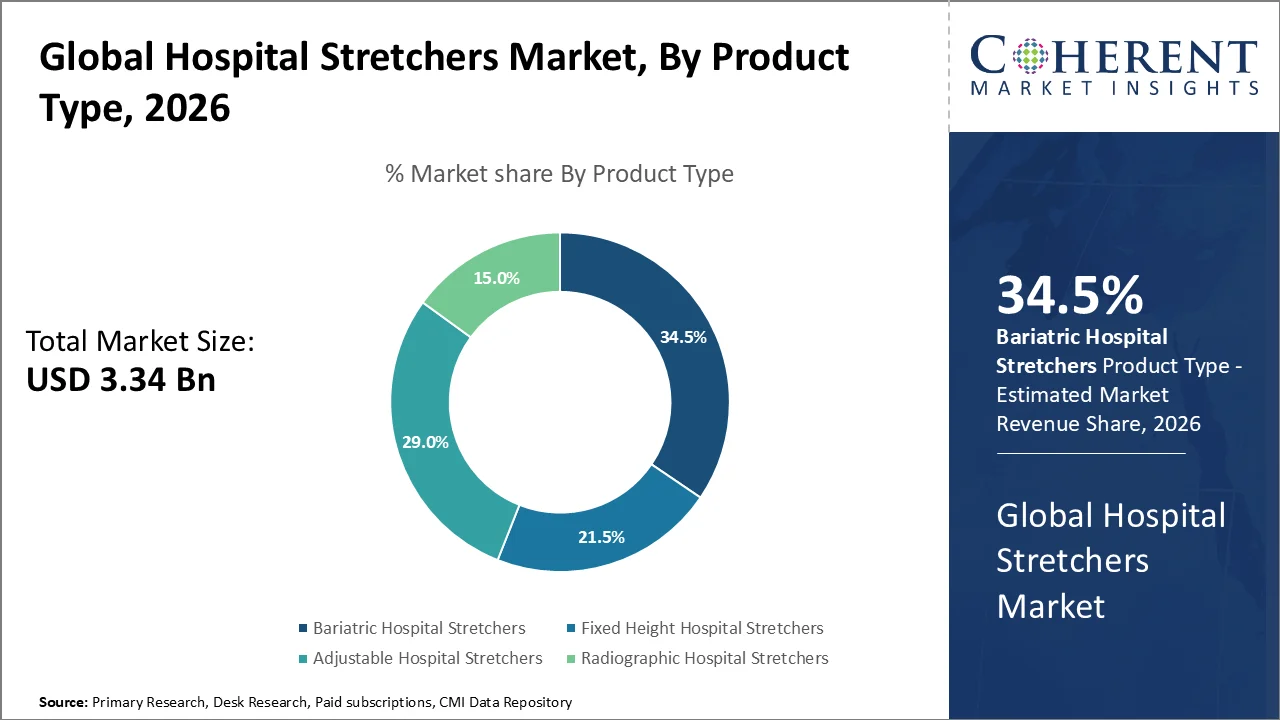
- The bariatric hospital stretchers segment is likely to dominate the market with approximately 34.5% in 2026. The segment’s growth is owing to the rising prevalence of obesity, increasing need for high-capacity patient handling equipment, wider use of reinforced stretcher frames, and greater emphasis on safe transport of heavier patients. Higher load-bearing capability is becoming an important design requirement for bariatric patient handling. Stryker’s Bari10A bariatric platform provides a 1,050-lb safe working load and can expand 6 inches on each side. This is an example of how manufacturers are changing equipment dimensions and structural capacity for heavier patients.
- The emergency department segment is set to lead the application category with approximately 35.0% in 2026. The segment’s growth is owing to high patient throughput, frequent trauma and accident cases, rapid movement between triage and diagnostic areas, and continuous need for short-distance patient transportation. According to the OECD Health at a Glance 2025, across 26 OECD countries, there were on average 31 emergency department visits per 100 people in 2023.
- The motorized hospital stretchers segment is expected to dominate the technology category with approximately 58.0% in 2026. The segment’s growth is owing to powered height adjustment, easier patient positioning, reduced manual handling, improved caregiver ergonomics, and increasing replacement of conventional transport equipment in advanced hospitals. A peer-reviewed study indexed by the U.S. National Institutes of Health (NIH) found that use of a power-drive system on hospital beds and stretchers reduced estimated three-dimensional spinal loads by approximately 8%–21% compared with manual pushing.
- The hospital segment is likely to dominate the end-user category with approximately 71.5% in 2026. The segment’s growth is owing to extensive stretcher utilization across emergency departments, inpatient wards, operating rooms, radiology units, and interdepartmental patient transfers. According to the U.S. had approximately 6,100 hospitals, 907,216 staffed hospital beds and 35.66 million hospital admissions, according to the American Hospital Association’s Fast Facts on U.S. Hospitals, published in February 2026, showing the degree of institutional demand for patient-transport equipment.
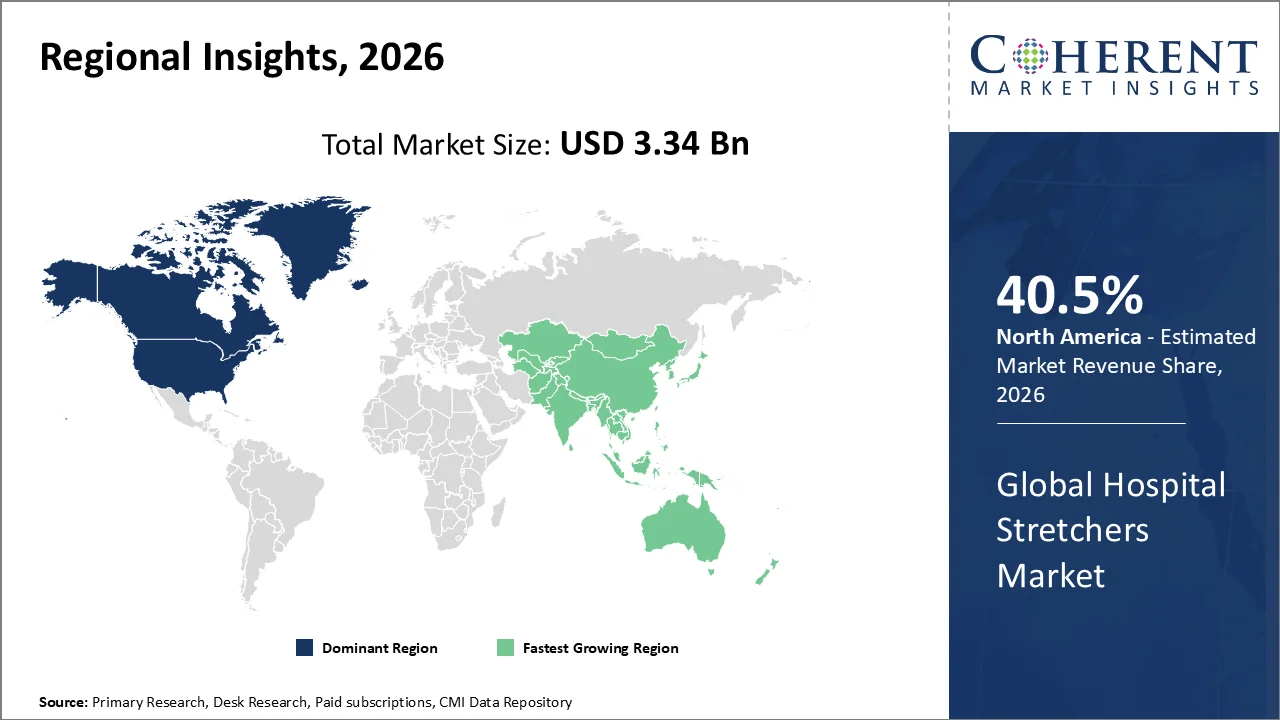
- The North America region dominated the global Hospital Stretchers Market with around 40.5% market share in 2026. The region’s dominance is supported by its large hospital infrastructure, high utilization of emergency care, increasing adoption of powered patient handling systems and ongoing investments in hospital modernization. The AHA 2026 data show that 3,567 of the nation’s community hospitals are part of a health system, out of a total of 5,121 community hospitals.
Market Drivers
Rising Patient Volumes and Hospital Utilization are Increasing Demand for Hospital Stretchers
The Hospital Stretchers Market is driven by the rising volume of inpatients and outpatients, which in turn is leading to an increased frequency of patient movement across emergency departments, diagnostic units, operating rooms and inpatient wards. Higher patient throughput requires hospitals to have sufficient stretchers to support the flow of patients being admitted, transferred, observed and discharged.
According to the American Hospital Association, published March 11, 2026, U.S. hospital inpatient volumes grew 5.3% in 2025 and outpatient visits grew 9.8%. The increase in patient activity is strengthening utilization of transport equipment across acute-care and ambulatory hospital environments.
Growing Emphasis on Safe Patient Handling is Accelerating Adoption of Motorized and Ergonomic Stretchers
Healthcare facilities are increasingly prioritizing safe patient handling because transporting, lifting, and repositioning patients’ exposes nurses, nursing assistants, and orderlies to substantial physical strain. This is encouraging hospitals to adopt motorized drive systems, powered height adjustment, improved braking, and ergonomic stretcher designs that reduce manual pushing and pulling.
Nursing assistants spend an average of 79.2% of their workday standing, while 97.6% are required to perform work in low postures. BLS also lists nursing assistants and orderlies as occupations with especially high injury and illness rates because they often have to physically move patients.
Current Events and Their Impact on the Hospital Stretchers Market
Current Event | Description and its Impact |
U.S. CMS Implements FY 2026 Hospital Inpatient Payment and Quality Policy Changes (August 4, 2025) |
|
OSHA Continues to Strengthen Safe Patient Handling Expectations in U.S. Hospitals (2026) |
|
- Current Industry Events of 2026
- Market Size Estimation
- Regional Breakdown
- Competitive Landscape
- Customer Intelligence
- Segmental Analysis
- Pricing Analysis
- Key Market Drivers, Challenges & Future Trends
- Customized Insights Section
Segmental Insights
Why are Bariatric Hospital Stretchers Acquiring the Largest Share?
On the basis of product type, the bariatric hospital stretchers segment is projected to account for the largest Hospital Stretchers Market share of approximately 34.5% in 2026. The segment’s growth is owing to the increasing number of patients with severe obesity, higher load-bearing requirements, wider patient surfaces, reinforced frames, and greater emphasis on reducing manual handling during transfers.
According to the American Society for Metabolic and Bariatric Surgery (ASMBS), an analysis of nearly 20 million U.S. patients with severe obesity found that 90%–95% received no obesity treatment, published May 5, 2026. The same analysis found more than 1.4 million GLP-1 prescriptions in 2025, indicating the large size of the severe-obesity patient population that healthcare facilities must accommodate, regardless of treatment pathway.
In March 2025, Graham-Field announced the Hausted 5B800ST All Purpose Bariatric Electric Stretcher, designed for bariatric patient management in pre-op, treatment and recovery environments.
Why is the Emergency Department Segment Holding the Largest Market Share?
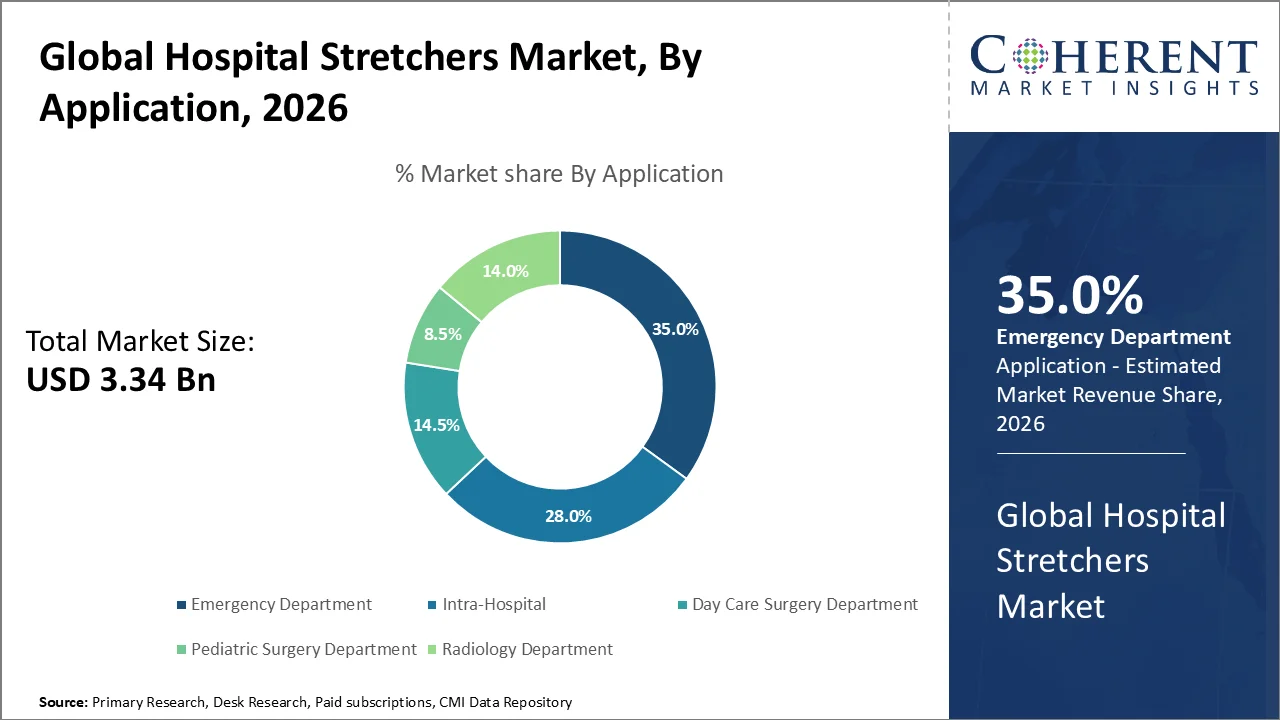
On the basis of application, the emergency department segment is projected to lead the Hospital Stretchers Market with approximately 35.0% share in 2026. The segment’s growth is owing to continuous patient turnover, prolonged boarding, trauma and acute-care requirements, ambulance handoffs, and frequent transfer of patients between emergency, diagnostic, surgical, and inpatient departments.
In April 2025, ACEP reported the introduction of three additional hospital boarding measures in the 2025 Leapfrog Hospital Survey, including the percentage of admitted ED patients boarding for more than four hours and measures of ED length of stay. Greater institutional scrutiny of boarding and patient flow supports investment in flexible patient-transport infrastructure within emergency departments.
Why are Motorized Hospital Stretchers Acquiring the Largest Share?
On the basis of technology, the motorized hospital stretchers segment is expected to dominate with approximately 58.0% market share in 2026. The segment’s growth is owing to powered propulsion, electric height and positioning adjustments, improved caregiver ergonomics, easier maneuverability of heavier patients, and increasing integration of safety and connectivity functions.
The Agency for Healthcare Research and Quality, with its falls resource reviewed in 2024, reports that hospital falls occur at an estimated rate of 3–5 per 1,000 bed-days. The ongoing safety burden is prompting hospitals to purchase stretchers with powered positioning, low height capabilities, built-in alarms, improved braking and other features that aim to reduce risks associated with patient transfers and falls.
Why do Hospitals Hold the Largest Market Share?
The hospital segment is projected to dominate the Hospital Stretchers Market with a share of about 71.5% by end user in 2026. Hospitals need much larger fleets of stretchers than clinics or ambulance bases because the equipment is used in emergency departments, radiology, perioperative care, inpatient units, intensive care areas and internal patient-transfer services.
According to the American Hospital Association, published March 11, 2026, U.S. Invested Over USD 10 Billion in Surgical and Medical Instruments in 2024, a 7% Increase Over 2023 Spending on diagnostic imaging equipment also increased to nearly USD 1.4 billion, up 8%, illustrating the scale of hospital capital investment in medical equipment, and underpinning ongoing replacement and modernization of patient-handling infrastructure.
In October 2025, Erpomed announced its New Generation Emergency & Patient Transfer Stretcher that was designed to improve mobility, safety and patient comfort during hospital and critical-care transportation.
Hospital Stretchers Market Trends
- The increasing adoption of smart and connected hospital stretchers is revolutionizing traditional patient transport equipment into digitally-enabled care platforms. Manufacturers are adding bed-exit alarms, wireless connectivity, electronic medical record integration, safety status indicators and remote notifications. In January 2026, Baxter introduced its Dynamo Series smart stretcher, which can be equipped with an optional wireless feature to send selected clinical safety and patient information to electronic medical records.
- The growing adoption of powered mobility and electric positioning systems is accelerating the transition from traditional non-motorized stretchers to motorized platforms. Powered drive, electric lift and automated positioning lessen the need for manual pushing, pumping and repositioning. Stryker’s newest Prime Series features a Zoom Motorized Drive that virtually eliminates manual pushing and an electric lift functionality that eliminates manual pumping in height adjustment.
- Stretcher designs are increasingly incorporating fall-prevention technologies. Hospitals are increasingly prioritizing the prevention of patient injuries during observation and transport with the growing adoption of connected bed-exit alarms, visual safety indicators, automated alarm rearming and nurse-call integration. According to AHRQ, approximately 700,000–1 million people experience falls in U.S. hospitals annually. Baxter's 2026 Dynamo Series consequently incorporates three-mode bed-exit alarms and SafeView+ visual safety-status technology.
Regional Insights
North America Dominates Owing to Advanced Hospital Infrastructure and High Adoption of Powered Patient-Handling Systems
The North America region is expected to account for approximately 40.5% of the global Hospital Stretchers Market in 2026. The region’s dominance is owing to its advanced acute-care infrastructure, high hospital utilization, large installed base of emergency and surgical facilities, and early adoption of motorized, bariatric, and connected stretcher systems.
According to the American Hospital Association’s 2026 Fast Facts, the country has 907,216 staffed hospital beds, including 775,297 staffed beds in community hospitals. Such a large installed base supports recurring procurement, maintenance, and replacement demand for transport stretchers across acute-care facilities.
In June 2026, Transdev Canada expanded its medical transportation operations by acquiring Inter-Facility Services in British Columbia. The transaction marked Transdev Canada’s entry into non-emergency medical transportation in the province and expanded its patient-transport capabilities across Western Canada.
Asia Pacific Hospital Stretchers Market Trends
Asia Pacific is expected to be the fastest-growing regional market over the forecast period. The region’s growth is owing to rapid hospital-capacity expansion, increasing healthcare utilization, a large and ageing population, rising trauma and chronic-disease burden, and growing adoption of powered and higher-capacity patient-transport systems in China, India, Japan, South Korea, and Southeast Asia.
Demographic trends are also strengthening long-term demand. The World Health Organization reports that the Western Pacific Region already has more than 245 million people aged 65 years and above, and this population is expected to double by 2050. The ageing population is increasing requirements for acute care, mobility assistance, safe patient handling, and transport systems designed for patients with reduced mobility.
In April 2025, Reliance Medical Australia received two separate TGA registrations for hospital stretchers, ARTG IDs 485085 and 485086.
Advanced Hospital Infrastructure and Continued Technology Investment are Supporting the Hospital Stretchers Market in the United States
The U.S. Hospital Stretchers Market is growing at a steady CAGR due to the well-established acute-care infrastructure, rising focus on connected patient handling and hospital investments in safer transport equipment. The market is increasingly leaning toward motorized, electrically adjustable, radiographic and smart stretchers that can reduce caregiver strain and improve patient movement across emergency, perioperative and inpatient settings.
In September 2025, CMS launched the USD 50 billion Rural Health Transformation Program, with USD 10 billion available annually beginning in FY 2026. The program explicitly supports modernization of rural healthcare infrastructure and adoption of innovative technologies, creating opportunities for replacement of patient-handling and transport equipment.
Large Hospital Capacity and Healthcare Modernization are Accelerating the Hospital Stretchers Market in China
The China Hospital Stretchers Market is expected to witness strong growth over the forecast period. The growth is owing to the country’s enormous hospital network, increasing inpatient activity, expansion of emergency and critical-care capacity, and government programs aimed at improving medical equipment and healthcare infrastructure.
Government policy is further strengthening the equipment base. In September 2025, China’s State Council approved the Medical and Health Strengthening Foundation Project, which calls for improved emergency-care and patient-transfer capabilities, upgrading equipment conditions, and strengthening emergency medical systems at county and primary-care levels through 2030.
Who are the Major Companies in Hospital Stretchers Industry
Some of the major key players in Hospital Stretchers Market are TransMotion Medical Inc., Gendron Inc., Hill-Rom Holdings Inc., GF Health Products Ltd., TransMotion Medical, ArjoHuntleigh Inc., Stryker Corporation, Fu Shun Hsing Technology Co. Ltd., Mac Medical, Inc. Spencer Italia S.r.l. and Anetic Aid Limited.
Key News
- In April 2026, Baxter showcased the Dynamo Series smart stretcher at the AORN Global Surgical Conference & Expo 2026. Baxter highlighted its ability to support multiple procedures directly on the stretcher, reducing unnecessary patient transfers while improving positioning, safety, and workflow efficiency.
- In July 2025, GF Health Products introduced the Gendron Regency Heavy-Duty Bed, strengthening its portfolio of high-capacity patient-handling equipment. The U.S.-manufactured platform supports a safe working load of 800 lb and incorporates design features intended to improve strength and mobility for heavier patients.
Market Report Scope
Hospital Stretchers Market Report Coverage
| Report Coverage | Details | ||
|---|---|---|---|
| Base Year: | 2025 | Market Size in 2026: | USD 3.34 Bn |
| Historical Data for: | 2020 To 2024 | Forecast Period: | 2026 To 2033 |
| Forecast Period 2026 to 2033 CAGR: | 4.3% | 2033 Value Projection: | USD 4.49 Bn |
| Geographies covered: |
| ||
| Segments covered: |
| ||
| Companies covered: | TransMotion Medical Inc., Gendron Inc., Hill-Rom Holdings Inc., GF Health Products Ltd., TransMotion Medical, ArjoHuntleigh Inc., Stryker Corporation, Fu Shun Hsing Technology Co. Ltd., Mac Medical, Inc. Spencer Italia S.r.l. and Anetic Aid Limited. | ||
| Growth Drivers: |
| ||
| Restraints & Challenges: |
| ||
Analyst Opinion
- The Hospital Stretchers Market is expected to continue to enjoy structural support from the ongoing modernization of hospital infrastructure and increasing adoption of safer, powered patient-handling systems. In the U.S., CMS finalized a 2.6% increase in FY 2026 inpatient hospital payment rates for qualifying hospitals. Estimated changes in operating and capital payments will increase hospital payments by approximately USD 5.0 billion, which will help support continued investment in clinical equipment and infrastructure.
- The market is also likely to benefit from rising emphasis on workforce safety and reduction of manual patient handling. The U.S. Bureau of Labor Statistics reported about 216,000 nonfatal cases of workplace injury and illness in hospitals in 2024. Motorized drive, electric positioning, better brakes and ergonomic stretcher designs are needed to lessen the physical strain on caregivers.
- The demand is shifting from basic transport platforms to smart, multifunctional stretchers that facilitate longer patient stays and more complex workflows. In January 2026, Baxter introduced its Dynamo Series smart stretcher in the U.S., combining powered mobility, positioning, bed-exit monitoring and wireless connectivity for emergency, perioperative and hospital transport. This indicates that future market competition will increasingly center on connectivity, safety, ergonomics, and workflow integration rather than price alone.
Speak to the analyst
Want personalized insights?
Take the findings above to one of our principal consultants, or have the report rebuilt around the segments, geographies and competitors you actually track.
Market Segmentation
- By Product Type (Revenue, USD Bn, 2021-2033)
- Fixed Height Hospital Stretchers
- Adjustable Hospital Stretchers
- Bariatric Hospital Stretchers
- Radiographic Hospital Stretchers
- By Application (Revenue, USD Bn, 2021-2033)
- Intra-Hospital
- Emergency Department
- Day Care Surgery Department
- Pediatric Surgery Department
- Radiology Department
- By Technology (Revenue, USD Bn, 2021-2033)
- Motorized Hospital Stretchers
- Non-motorized Hospital Stretchers
- By End User (Revenue, USD Bn, 2021-2033)
- Hospital
- Clinic
- Ambulance Facilities
- By Region (Revenue, USD Bn, 2021-2033)
- North America
- U.S.
- Canada
- Latin America
- Brazil
- Mexico
- Argentina
- Rest of Latin America
- Europe
- Germany
- U.K.
- France
- Italy
- Spain
- Russia
- Rest of Europe
- Asia Pacific
- China
- India
- Japan
- Australia
- South Korea
- ASEAN
- Rest of Asia Pacific
- Middle East
- GCC
- Israel
- Rest of Middle East
- Africa
- South Africa
- Central Africa
- North Africa
- North America
Sources
Primary Research Interviews
- Hospital administrators and facility managers
- Emergency department heads and trauma-care professionals
- Nurses, patient transport teams, and safe patient handling specialists
- Hospital procurement and biomedical engineering managers
- Ambulance and emergency medical services operators
- Hospital stretcher manufacturers and product development teams
- Medical equipment distributors and suppliers
- Key opinion leaders (KOLs) in patient mobility, ergonomics, and hospital equipment
Databases
- U.S. Centers for Disease Control and Prevention (CDC)
- Centers for Medicare & Medicaid Services (CMS)
- U.S. Bureau of Labor Statistics (BLS)
- Agency for Healthcare Research and Quality (AHRQ)
- Organisation for Economic Co-operation and Development (OECD)
- World Health Organization (WHO)
- Canadian Institute for Health Information (CIHI)
- National Bureau of Statistics of China
Magazines
- Healthcare Purchasing News
- Health Facilities Management
- Medical Design & Outsourcing
- Medical Device and Diagnostic Industry (MD+DI)
- Healthcare Design Magazine
- EMS World
Journals
- Applied Ergonomics
- International Journal of Industrial Ergonomics
- Journal of Patient Safety
- BMJ Quality & Safety
- Journal of Emergency Medicine
- Injury Epidemiology
- International Emergency Nursing
Newspapers
- The New York Times
- The Wall Street Journal
- Financial Times
- Reuters
- The Guardian
- The Economic Times
Associations
- American Hospital Association (AHA)
- American College of Emergency Physicians (ACEP)
- Emergency Nurses Association (ENA)
- Association for the Advancement of Medical Instrumentation (AAMI)
- American Society for Health Care Engineering (ASHE)
- National Association of Emergency Medical Technicians (NAEMT)
- American Society for Metabolic and Bariatric Surgery (ASMBS)
Public Domain Sources
- Company Annual Reports and Investor Presentations
- Company Product Catalogs, Technical Datasheets, and Press Releases
- FDA Medical Device and GUDID Databases
- U.S. CMS Hospital Payment and Healthcare Infrastructure Publications
- OSHA Safe Patient Handling and Healthcare Worker Safety Publications
- Government Hospital Infrastructure and Healthcare Utilization Statistics
- Hospital Procurement and Medical Equipment Tender Documents
- Regulatory Publications from FDA, TGA, and other national medical device authorities
- Peer-reviewed studies related to patient handling, ergonomics, and hospital transport equipment
Proprietary Elements
- CMI Data Analytics Tool
- Proprietary CMI Existing Repository of Information for the Last 10 Years
Get access to 250+ pages report
Every segment, forecast, competitor profile and data table behind the analysis above — available for instant download.
- ESOMAR Member
- ISO 9001:2015 Certified
- D-U-N-S Registered
- GDPR & CCPA Compliant
Missing comfort of reading report in your local language? Find your preferred language:
Transform your Strategy with Exclusive Trending Reports
Frequently Asked Questions
The Hospital Stretchers Market is expected to reach approximately USD 4.49 Bn in 2033, increasing from USD 3.34 Bn in 2026.
Major players operating in the global Hospital Stretchers Market include TransMotion Medical Inc., Gendron Inc., Hill-Rom Holdings Inc., GF Health Products Ltd., ArjoHuntleigh Inc., Stryker Corporation, Fu Shun Hsing Technology Co. Ltd., Mac Medical, Inc., Spencer Italia S.r.l., and Anetic Aid Limited.
The high investment cost of advanced hospital stretchers and high maintenance and servicing expenses are among the key factors hampering market growth.
The rising number of hospital admissions and emergency department visits, increasing demand for safe and efficient patient transport systems, expansion of hospital infrastructure, and growing adoption of advanced powered and hydraulic stretchers are driving market growth.
The Hospital Stretchers Market is anticipated to grow at a CAGR of approximately 4.3% between 2026 and 2033.
Among regions, North America is expected to account for the largest share of the global Hospital Stretchers Market, with approximately 40.5% market share in 2026.
Asia Pacific is expected to be the fastest-growing regional market over the forecast period, supported by expanding hospital capacity, rising healthcare utilization, population ageing, and increasing adoption of advanced patient-transport systems.