

Patient Handling Equipment Market Size and Share Analysis - 2026 To 2033
The Global Patient Handling Equipment Market is anticipated to grow at a CAGR of 6.6% with USD 19.2 Bn share in 2026 and is expected to reach USD 34.5 Bn in 2033. The growing geriatric population is a major demand driver for the Patient Handling Equipment Market. For instance, according to the data published by the World Health Organization (WHO), the global population aged 60 years and older is estimated to increase from 1.0 Bn in 2020 to 1.4 Bn by 2030, meaning that approximately 1 in 6 people globally will be aged 60 or older by 2030. WHO also projects that this population will reach 2.1 Bn by 2050.
(Source: WHO)
Key Takeaways
- Wheelchairs and Scooters is expected to account the largest share of 28.7% in 2026, because of rising mobility impairment, population ageing, chronic diseases, and the need for independent mobility. WHO estimates 80 million people require wheelchairs globally, with demand increasing as populations age and chronic conditions rise. For instance, in 2026, CDC reported 12.2% of U.S. adults have mobility disabilities, while FDA continues to regulate powered wheelchairs as Class II medical devices.
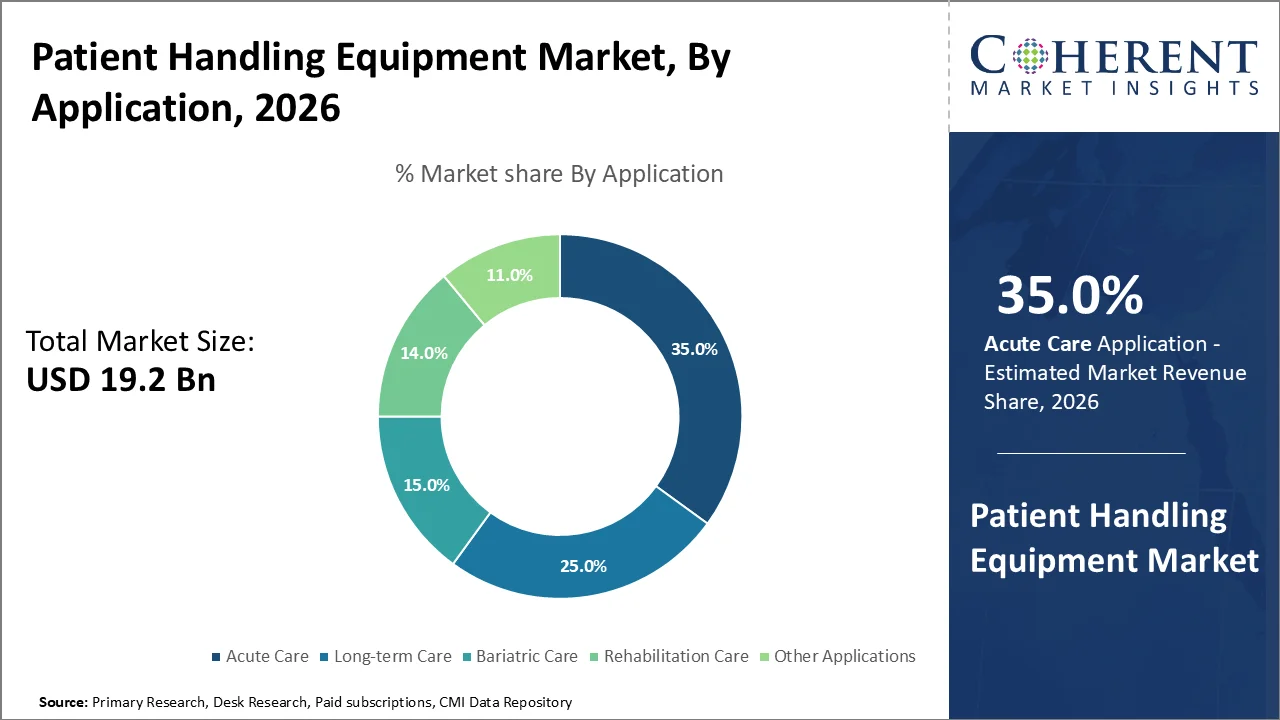
- Acute care will be led by 35.0% in 2026, as hospitals are handling large numbers of patients, frequent transfers, repositioning and patients with limited mobility. For instance, in 2026, the CDC stated that 1 in 31 hospital patients has a healthcare-associated infection. 2 The problem with hospital care is serious. The FDA also classifies patient lifts and transfer devices as general-hospital medical devices, which supports their wide use in acute care.
- Hospitals hold the leading share of 46.0% in 2026, due to the large patient volume requiring lifting, repositioning, transfers and mobility support. For instance, in 2026, the FDA classifies non-powered patient lifts as “General Hospital” devices, and the CDC acknowledges that older adults have limited mobility in the hospital, thereby increasing the demand for safe patient handling solutions.
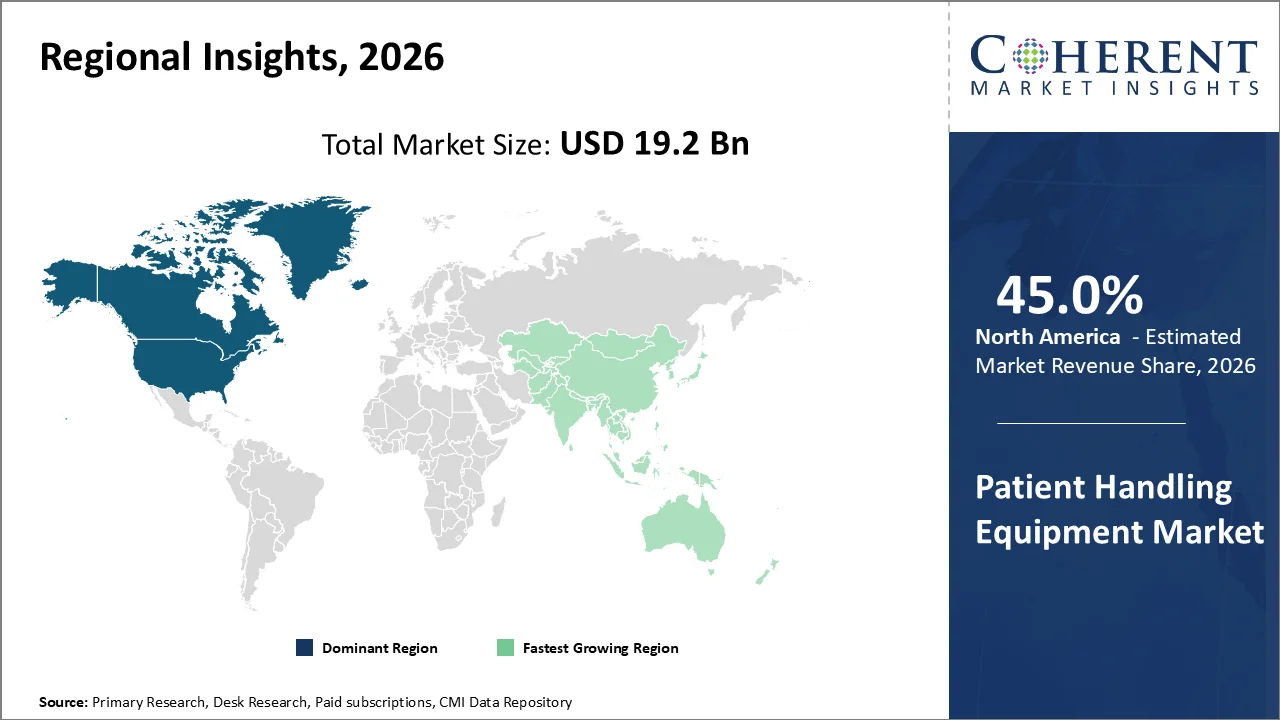
- North America is expected to acquire the dominant share of 45.0% in 2026, due to its advanced healthcare infrastructure, high adoption of patient-handling technologies, ageing population, and stringent patient-safety practices. As a 2026 instance, FDA continues to classify patient lifts under General Hospital devices, while CDC reports nearly 3 million annual fall-related emergency visits among older U.S. adults, reinforcing demand for safe mobility and transfer solutions.
Market Drivers
Growing elderly population and mobility-related needs
The increasing ageing population is a major driver of the Patient Handling Equipment Market, as older adults are more likely to experience mobility limitations, falls, and the need for assistance during transfers. For instance, in 2026, the CDC reports that more than 1 in 4 adults aged 65+ fall each year, with approximately 3 million fall-related emergency-department visits annually. This increases demand for patient lifts, transfer devices, wheelchairs, and mobility-support equipment.
(Source: CDC)
Increasing emphasis on safe patient handling and caregiver safety
Growing awareness of patient and caregiver injuries associated with manual transfers is driving healthcare facilities toward mechanical and powered handling solutions. The FDA states that patient lifts are designed to transfer patients between beds, baths, chairs, and stretchers and can reduce injury risks when properly used. For instance, in 2026, FDA continues to classify powered and non-powered patient lifts as regulated medical devices under the General Hospital specialty, reinforcing their role in clinical care.
AI-Powered Patient Handling: Turning Equipment into Intelligent Care Systems
The integration of AI, computer vision, sensors, and connected hospital infrastructure is creating a new growth opportunity for patient handling equipment by enabling real-time monitoring of patient movement, fall risks, bed-exit events, repositioning, and caregiver workflows. For instance, in 2026, Stryker launched its Smart Hospital Platform, integrating connected devices, data, and care teams; its AI-driven ambient-monitoring solutions can detect patient presence, motion, and behavior and support fall prevention and patient-turning compliance.
Moreover, in June 2026, AI vision systems can recognize a patient's movement and intention to exit a bed without requiring a wearable device. For instance, in June 2026, VirtuSense's VSTAlert uses ambient-vision AI to identify potential bed exits and send alerts to caregivers. This creates an opportunity for patient-handling manufacturers to integrate AI cameras and sensors directly into beds, stretchers and mobility systems.
(Source: Stryker)
Current Events and Their Impact on the Global Patient Handling Equipment Market
Current Event | Description and its Impact |
CMS Expands 2026 Focus on Coverage and Access to Patient Lifts |
|
CMS Updates 2026 DMEPOS Payment Framework |
|
FDA Continues Regulatory Support for Safe Patient-Lift Use |
|
OSHA Promotes Safe Patient Handling Programs in Hospitals |
|
- Current Industry Events of 2026
- Market Size Estimation
- Regional Breakdown
- Competitive Landscape
- Customer Intelligence
- Segmental Analysis
- Pricing Analysis
- Key Market Drivers, Challenges & Future Trends
- Customized Insights Section
Segmental Insights
Acute Care holds the Largest Market Share
Based on application, acute care dominates the market, accounting for a significant 35.0 % share in 2026. Hospitals are the largest segment of the acute care industry and, with high patient volumes and frequent lifting, repositioning, transferring and early-mobility activities, there remains demand for patient-handling equipment. For instance, in 2026, the CDC reports approximately 1 million fall-related hospitalizations among older U.S. adults annually, while the FDA identifies patient lifts as devices specifically designed for transfers between beds, chairs, baths, and stretchers. Stryker's 2026 patient-transfer technology further demonstrates continued adoption in acute-care settings.
Why is Wheelchairs and Scooters Acquiring the Largest Market Share?
Based on the product type, wheelchairs and scooters is projected to account for the largest share in global patient handling equipment market in 2026, representing approximately 28.7% of the total volume. This segment is dominant due to rising mobility limitations, ageing populations, disabilities, and chronic conditions. For instance, in 2024, WHO estimates that around 80 million people globally require wheelchairs, while access remains limited. In 2026, Stryker’s Prime TC transport wheelchair demonstrates continued innovation in hospital mobility, incorporating ergonomic push handles, anti-tip wheels, central braking, and stand-assist features to improve patient transport.
Which End User segment dominates the market?
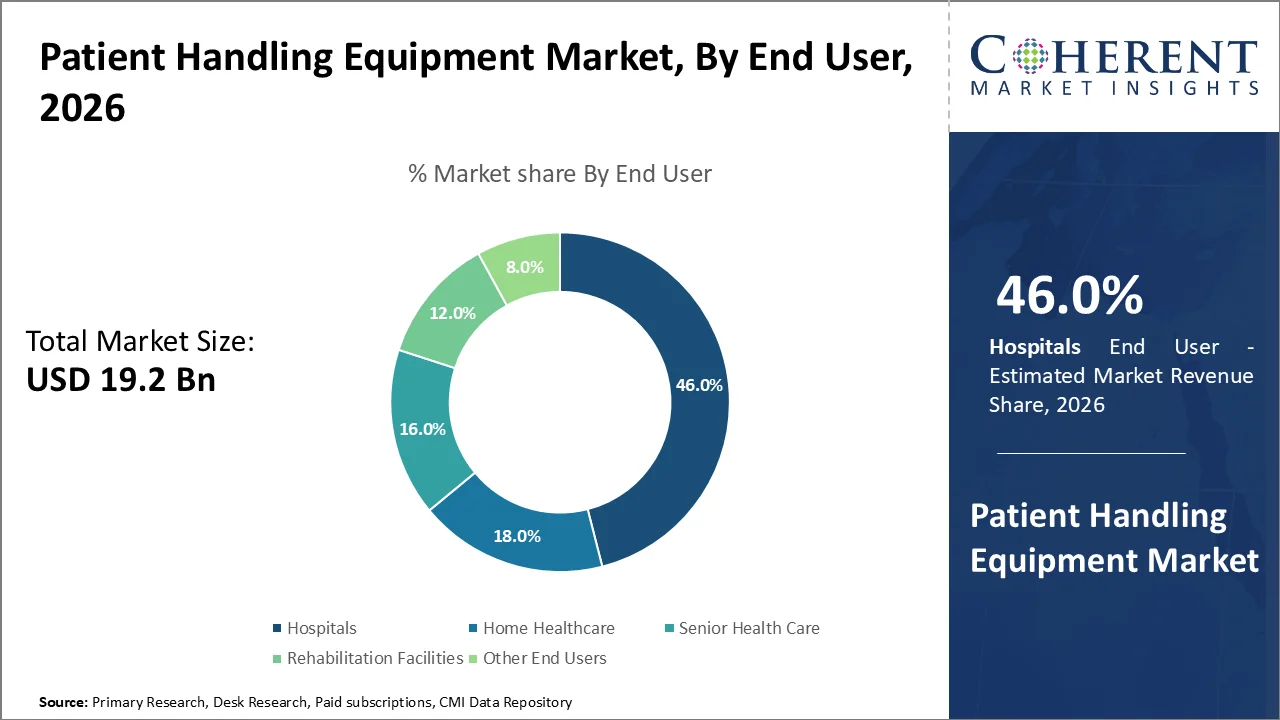
Hospitals account for the largest share of 46.0% in 2026 because hospitals perform the vast majority of device implantations and related care due to the high clinical complexity and procedural requirements. The hospitals segment is dominant due to the high patient volumes and the need for frequent lifting, transferring, repositioning, transportation, and mobility assistance in emergency, surgical, intensive care, and inpatient departments. For instance, in 2026, CDC reported approximately 1 million fall-related hospitalizations among older U.S. adults annually, highlighting the substantial need for safe mobility and transfer solutions. FDA also specifically classifies patient lifts under General Hospital devices and states that they are designed to transfer patients between beds, chairs, baths, and stretchers.
Global Patient Handling Equipment Market Trends
Shift toward technology-assisted patient handling
A major trend is the movement from manual handling toward powered, air-assisted, and ergonomic patient-transfer and positioning technologies. In 2026, Stryker launched Multi-Position MATS 2.0, an air-assisted patient-transfer and positioning system designed for operating-room workflows. The development reflects increasing emphasis on reducing caregiver physical strain while improving patient-transfer efficiency and safety.
(Source: Stryker)
Integration of patient handling with acute-care workflows
Patient handling is increasingly being integrated into broader acute-care, perioperative, and hospital workflow systems rather than being treated as a standalone activity. Stryker's 2026 medical and surgical portfolio emphasizes equipment designed around care-team safety, patient outcomes, and ease of care delivery, while its acute-care business focuses specifically on safety, prevention, and ease of use.
Increasing focus on fall prevention and patient safety
Fall prevention is becoming increasingly important as healthcare systems manage ageing populations and mobility-impaired patients. In January–February 2026, the CDC reported that more than 14 million, or 1 in 4, U.S. adults aged 65 and older report falling each year, while nearly 1 million older adults are hospitalized annually because of fall injuries. This is supporting demand for safer transfer, positioning, mobility, and patient-support equipment.
Growing adoption of assistive and mobility technologies
The market is benefiting from increasing demand for wheelchairs, mobility equipment, patient lifts, transfer aids, and other assistive products. WHO estimates that 2.5 billion people currently need one or more assistive products, with this figure expected to exceed 3.5 billion by 2050 because of population ageing and rising noncommunicable diseases. In March 2026, WHO published an assessment highlighting the need to strengthen national capacity for assistive-technology access.
(Source: WHO)
Growing demand for solutions that protect both patients and caregivers
Another important trend is the development of equipment that meets both patient safety and healthcare-worker injury prevention. Stryker’s patient-positioning portfolio includes products designed to reduce risks such as pressure injury and healthcare-worker injury, including turning, positioning, lateral transfer and seated-positioning products. This promotes the continued uptake of ergonomic handling and repositioning technologies in all hospitals and other care settings.
(Source: Stryker)
Greater emphasis on regulatory compliance and safe equipment use
Patient-handling equipment is increasingly subject to attention around device safety, correct sling compatibility, training, inspection, and proper operation. The FDA's patient-lift guidance specifically emphasizes matching slings to the appropriate lift and patient weight and following manufacturer instructions. This trend is encouraging healthcare providers to select compliant, safety-focused equipment and manufacturers to strengthen product design and risk management.
Regional Insights
North America dominates owing to Advanced Healthcare Infrastructure
North America account 45.0% market share in 2026, supported by large population with mobility limitations, strong hospital infrastructure and technology adoption and increasing emphasis on fall prevention and safe patient handling. Furthermore, due to strong hospital infrastructure and technology adoption in North America makes it dominant region in the global market. North America has a large, technologically advanced healthcare system with significant investment in acute-care equipment. Stryker, for instance, markets its ProCuity smart, connected hospital bed, designed for different patient-care environments and incorporating technologies focused on patient and caregiver safety.
Moreover, the U.S. has a substantial population requiring mobility and patient-handling support. In its May 2026 update, the CDC reported that more than 1 in 4 U.S. adults has a disability, with 12.2% reporting a mobility disability. This creates significant demand for wheelchairs, patient lifts, transfer equipment, specialized beds and other handling technologies.
(Source: Stryker)
Asia Pacific Global Patient Handling Equipment Market Trends
The Asia-Pacific region is poised to be as the fastest-growing region through 2026-2033, owing to rapid ageing, improving tertiary-care access, and high cardiovascular disease burden. The Asia Pacific region is expected to be a key growth region for the Patient Handling Equipment Market due to rapid population ageing, rising disability and increasing demand for rehabilitation and assistive technology. In a 2026 WHO update, the South-East Asia Region reported that its population aged 60+ is projected to rise from 12.2% in 2024 to 22.9% by 2050. WHO also highlights wheelchairs and other assistive technologies as essential for mobility and independence, supporting regional demand.
Increasing nursing workforce and ergonomic requirements is Accelerating the Global Patient Handling Equipment Market Demand in United States
The U.S. country dominates the North American patient handling equipment market because increasing aging population, growing need for nursing workforce and large population with mobility limitations. The U.S. market is also being supported by efforts to reduce caregiver injuries and improve workplace ergonomics. Older adults represent an important demand base for patient-handling equipment. CDC data indicate that approximately 2 in 5 U.S. adults aged 65 and older have a disability, while CDC also emphasizes that falls are a major threat to older adults' independence. This supports demand for safer beds, transfer systems, mobility equipment and fall-prevention technologies.
China Global Patient Handling Equipment Market Trends
China’s dominance in the patient handling equipment market is propelled by its vast patient pool and high cardiovascular disease burden an estimated 330 million people suffer from cardiovascular diseases in China, creating significant demand for pacing and rhythm‑management solutions. China is a leading country in the Asia Pacific Patient Handling Equipment Market because of its rapidly ageing population, large number of people requiring long-term care, expanding healthcare and rehabilitation infrastructure, and increasing government support for disability and elderly-care services. For instance, in 2026, China reported more than 323 million people aged 60+, representing about 23% of its population, while a government plan for 2026–2030 is expanding rehabilitation, care services, accessibility, and technology-assisted support for people with disabilities.
(Source: State Council of China)
Who are the Major Companies in Global Patient Handling Equipment Market
Some of the major key players in Global Patient Handling Equipment Market are Stryker Corporation; Hill-Rom Holdings, Inc.; Invacare Corporation; Getinge Group; ArjoHuntleigh, Inc.; Joerns Healthcare, Inc.; Stiegelmeyer, Inc.; Benmor Medical Ltd.; Prism Medical Ltd; Etac Ltd.; Mangar International Ltd; Linet Americas, Inc.
Key News
- In 2026, Stryker, medical technology company launched Multi-Position MATS 2.0, an air-assisted patient transfer and positioning system designed for operating-room workflows. The system supports lateral patient transfers and positioning changes while helping reduce the physical effort required from perioperative care teams.
(Source: Stryker)
- In 2026, ArjoHuntleigh Healthcare introduced Maxi Move 5, a next-generation multifunctional patient floor lift designed to improve patient transfers, caregiver safety, and workflow efficiency. The equipment incorporates Motion Assist technology, powered positioning, and single-caregiver operation for a range of patient-handling tasks.
(Source: ArjoHuntleigh Healthcare)
Market Report Scope
Global Patient Handling Equipment Market Report Coverage
| Report Coverage | Details | ||
|---|---|---|---|
| Base Year: | 2025 | Market Size in 2026: | USD 19.2 Bn |
| Historical Data for: | 2020 To 2024 | Forecast Period: | 2026 To 2033 |
| Forecast Period 2026 to 2033 CAGR: | 6.6% | 2033 Value Projection: | USD 34.5 Bn |
| Geographies covered: |
| ||
| Segments covered: |
| ||
| Companies covered: | Stryker Corporation; Hill-Rom Holdings, Inc.; Invacare Corporation; Getinge Group; ArjoHuntleigh, Inc.; Joerns Healthcare, Inc.; Stiegelmeyer, Inc.; Benmor Medical Ltd.; Prism Medical Ltd; Etac Ltd.; Mangar International Ltd; Linet Americas, Inc. | ||
Analyst Opinion
- The Patient Handling Equipment Market was a traditional provider of lifting and transfer devices, is now becoming a part of the modern healthcare system owing to aging populations, rising rates of disability, increasing demand for mobility aids and increasing focus on safety of patients and caregivers. WHO estimates that more than 2.5 billion people worldwide need one or more assistive products, and this number is expected to rise to over 3.5 billion by 2050. This is a large long-term addressable market for wheelchairs, patient lifts, transfer systems, specialized beds and mobility equipment.
(Source: WHO – Assistive Technology)
- Patient safety and caregiver injury prevention are increasingly shaping equipment procurement decisions. The U.S. FDA states that patient lifts can reduce the risk of injury to patients and caregivers when properly used and notes that safe-patient-handling laws have been enacted in several U.S. states, supporting increased adoption of patient lifts. This indicates that regulatory attention to safe handling is translating into a structural demand driver for powered lifts, transfer equipment, and other safer handling technologies.
(Source: U.S. FDA – Patient Lifts)
- The U.S. market provides particularly strong demand potential because of the high prevalence of mobility limitations and disability. In its May 2026 update, the CDC reported that more than 1 in 4 U.S. adults has a disability, while 12.2% have a mobility disability. This large patient population supports sustained demand for mobility aids, patient lifts, transfer devices, rehabilitation equipment, and specialized beds across hospitals, long-term-care facilities, and home-care environments.
- Technology integration will be a major competitive differentiator as manufacturers transition to connected, intelligent ecosystems for patient handling. March 2026: Stryker launched the SmartHospital Platform, a platform to connect medical devices, data and care teams across hospitals to deliver useful information and improve workflow efficiency. This is the case of integration of digital hospital systems with patient handling equipment for smart beds, connected stretchers, real time monitoring, fall prevention, AI based patient care solutions etc.
(Source: Stryker)
Speak to the analyst
Want personalized insights?
Take the findings above to one of our principal consultants, or have the report rebuilt around the segments, geographies and competitors you actually track.
Market Segmentation
- By Product Type (Revenue, USD Bn, 2021-2033)
- Wheelchairs and Scooters
- Manual Wheelchair
- Powered Wheelchair
- Medical Beds
- Curative Care Beds
- Psychiatric Care Beds
- Maternity and Bariatric Beds
- Long-term Care Beds
- Mechanical Equipment
- Patient Lifts
- Medical Lifting Slings
- Non-mechanical Equipment
- Ambulatory Aids
- Shower and Toilet equipment
- Others
- Wheelchairs and Scooters
- By Application (Revenue, USD Bn, 2021-2033)
- Acute Care
- Long-term Care
- Bariatric Care
- Rehabilitation Care
- Other Applications
- By End-user (Revenue, USD Bn, 2021-2033)
- Hospitals
- Home Healthcare
- Senior Health Care
- Rehabilitation Facilities
- Other End Users
- By Region (Revenue, USD Bn, 2021-2033)
- North America
- U.S.
- Canada
- Latin America
- Brazil
- Mexico
- Argentina
- Rest of Latin America
- Europe
- Germany
- U.K.
- France
- Italy
- Spain
- Russia
- Rest of Europe
- Asia Pacific
- China
- India
- Japan
- Australia
- South Korea
- ASEAN
- Rest of Asia Pacific
- Middle East
- GCC
- Israel
- Rest of Middle East
- Africa
- South Africa
- Central Africa
- North Africa
- North America
Sources
Primary Research Interviews
- Interviews with doctors, nurses, physiotherapists, occupational therapists and patient handling specialists to learn about the challenges of using new technologies, what patients need for moving, how to safely transfer and reposition patients, concerns for caregiver safety, how easy the equipment is to use and how patient-handling technologies affect patients and caregivers.
- Insights from manufacturers of patient-handling equipment, engineers, product developers, and biomedical researchers about new technologies, such as powered and ceiling lifts; smart beds; air-assisted transfer systems; ergonomic designs; battery-powered equipment; remote monitoring features; how different equipment works together; and new ideas to make patient mobility safer.
- Consults with healthcare consultants, regulatory specialists, and market researchers on market trends, competition, payment policies, buying habits, regulations, safety requirements, and the use of patient-handling equipment in hospitals, rehabilitation centers, long-term care facilities, and home healthcare.
- Liaison with hospital administration, purchasing agents, nursing directors, rehabilitation facility administrators and government health regulators for the purpose of identifying spending priorities, equipment purchasing criteria, budget limitations, staff training needs, maintenance and replacement cycles, infection control issues, post-sale surveillance and compliance with applicable statutes and safety regulations including those administered by the FDA and OSHA.
Databases
- U.S. Food and Drug Administration (FDA) Medical Device Databases (MAUDE, 510(k), PMA, Device Registration & Listing)
- World Health Organization (WHO) Global Health Observatory (GHO)
- Centers for Disease Control and Prevention (CDC) National Center for Health Statistics (NCHS)
- European Union Medical Device Database (EUDAMED)
- National Medical Products Administration (NMPA) Medical Device Databases (China)
- ClinicalTrials.gov (U.S. National Library of Medicine)
Magazines
- Medical Device and Diagnostic Industry (MD+DI) Magazine
- Medical Device Network Magazine
- Medical Design & Outsourcing
- MassDevice
- Healthcare Purchasing News (HPM)
Journals
- Journal of Clinical Nursing – Patient Handling and Healthcare Practice
- International Journal of Occupational Safety and Ergonomics
- BMC Health Services Research
- Journal of Rehabilitation Research and Development
- Applied Ergonomics
- International Journal of Environmental Research and Public Health (IJERPH)
Newspapers
- Reuters – Healthcare and Medical Technology
- The New York Times – Health Section
- Financial Times – Healthcare and MedTech
- The Wall Street Journal – Health and Medical Devices
- The Guardian – Health and Science
Associations
- American Nurses Association (ANA) – Healthcare Workforce & Patient Safety
- Association of periOperative Registered Nurses (AORN) – Safe Patient Handling
- American Physical Therapy Association (APTA) – Mobility and Rehabilitation
- American Occupational Therapy Association (AOTA) – Patient Mobility & Rehabilitation
- National Association for Healthcare Quality (NAHQ) – Healthcare Quality & Safety
- International Organization for Standardization (ISO) – Medical Device Standards
Public Domain Sources
- World Health Organization (WHO) – Assistive Technology & Ageing
- U.S. Food and Drug Administration (FDA) – Medical Device Guidance & Regulatory Updates
- Centers for Disease Control and Prevention (CDC) – Falls, Disability & Healthcare Data
- Occupational Safety and Health Administration (OSHA) – Safe Patient Handling Resources
- Centers for Medicare & Medicaid Services (CMS) – DMEPOS Coverage & Payment Policies
- National Institutes of Health (NIH) / NCBI PubMed – Patient Mobility & Healthcare Research
- ClinicalTrials.gov – Patient Handling and Mobility Studies
Proprietary Elements
- CMI Data Analytics Tool
- Proprietary CMI Existing Repository of information for last 10 years
Get access to 250+ pages report
Every segment, forecast, competitor profile and data table behind the analysis above — available for instant download.
- ESOMAR Member
- ISO 9001:2015 Certified
- D-U-N-S Registered
- GDPR & CCPA Compliant
Missing comfort of reading report in your local language? Find your preferred language:
Transform your Strategy with Exclusive Trending Reports
Frequently Asked Questions
The Global Patient Handling Equipment Market is expected to reach USD 19.2 Bn in 2033.
Major players operating in the global Global Patient Handling Equipment Market include Stryker Corporation; Hill-Rom Holdings, Inc.; Invacare Corporation; Getinge Group; ArjoHuntleigh, Inc.; Joerns Healthcare, Inc.; Stiegelmeyer, Inc.; Benmor Medical Ltd.; Prism Medical Ltd; Etac Ltd.; Mangar International Ltd; Linet Americas, Inc.
Limited reimbursement and financing, limited availability and distribution and shortage of trained personnel are the major factors hampering the growth of the patient handling equipment market.
Growing elderly population and mobility-related needs and Increasing emphasis on safe patient handling and caregiver safety are the factors driving the growth of the patient handling equipment market.
The Global Patient Handling Equipment Market is anticipated to grow at a CAGR of 6.6% between 2026 and 2033.
Among regions, North America is expected to account for a largest market share in the global Patient Handling Equipment Market over the forecast period.
The Patient Handling Equipment Market comprises devices and systems used to lift, transfer, reposition, mobilize, transport, and support patients safely. Key products include patient lifts, transfer aids, wheelchairs, scooters, stretchers, hospital beds, slings, and other mobility and positioning equipment.