

3D Printing in Healthcare Market Analysis & Forecast: 2026-2033
3D Printing in Healthcare Market is estimated to be valued at USD 3.73 Bn in 2026 and is expected to reach USD 12.76 Bn in 2033, exhibiting a compound annual growth rate (CAGR) of 19.2% from 2026 to 2033.
Key Takeaways
- Based on Component, the System/Device segment is expected to account for 51.6% share of the market in 2026, as it forms the essential hardware for all medical 3D printing applications.
- Based on Technology, the Photopolymerization segment leads with the largest share of the market in 2026, as it enables the creation of high-precision, biocompatible, and complex medical structures.
- Based on Application, the Implants segment is projected to dominate with the highest share of the market in 2026, due to the technology’s ability to produce customized, patient-specific solutions that perfectly match anatomical requirements.
- Based on End User, the Medical & Surgical Centers segment acquired the greatest share of the market in 2026, due to its ability to produce patient-specific implants, prosthetics, surgical guides, and anatomical models.
- Based on Region, North America is expected to lead the market, holding a share of 33.6% in 2026. While, Asia Pacific is anticipated to be the fastest growing region during the forecast period.
Market Overview
The adoption of 3D printing technology in medical & surgical centers, pharmaceutical & biotechnological companies, and academic institutions has significantly increased and is projected to rise further. Technological advances are streamlining processes, lowering costs, and making end products more affordable. This, combined with a large consumer base, is expected to drive 3d printing in healthcare market demand during the forecast period.
Current Events and their Impact on the 3D Printing in Healthcare Market
Current Event | Description and Its Impact |
Market Expansion Drivers and Clinical Validation Milestones |
|
Regulatory Framework Evolution and Global Standardization |
|
Technological Breakthroughs and Innovation Acceleration |
|
Role of Artificial Intelligence (AI) in 3D Printing in Healthcare Market
AI plays a transformative role in the 3D printing healthcare market by enhancing speed, precision, and personalization. It automates the conversion of medical imaging data (like CT and MRI scans) into accurate; 3D printable models used for surgical planning, implants, prosthetics, and training. AI algorithms improve image segmentation, detect anomalies, and optimize design parameters, reducing human error and time. This leads to faster diagnostics, better surgical outcomes, and cost-effective solutions.
In January 2025, Belfast-based Axial3D secured $18.2 million to scale its AI-driven 3D medical imaging platform. The company’s cloud-based technology transforms CT and MRI scans into 3D printable models for use in surgical planning, custom implants, prosthetics, device testing, training, and patient education—aiming to make personalized healthcare more accessible.
- Current Industry Events of 2026
- Market Size Estimation
- Regional Breakdown
- Competitive Landscape
- Customer Intelligence
- Segmental Analysis
- Pricing Analysis
- Key Market Drivers, Challenges & Future Trends
- Customized Insights Section
Segmental Insights
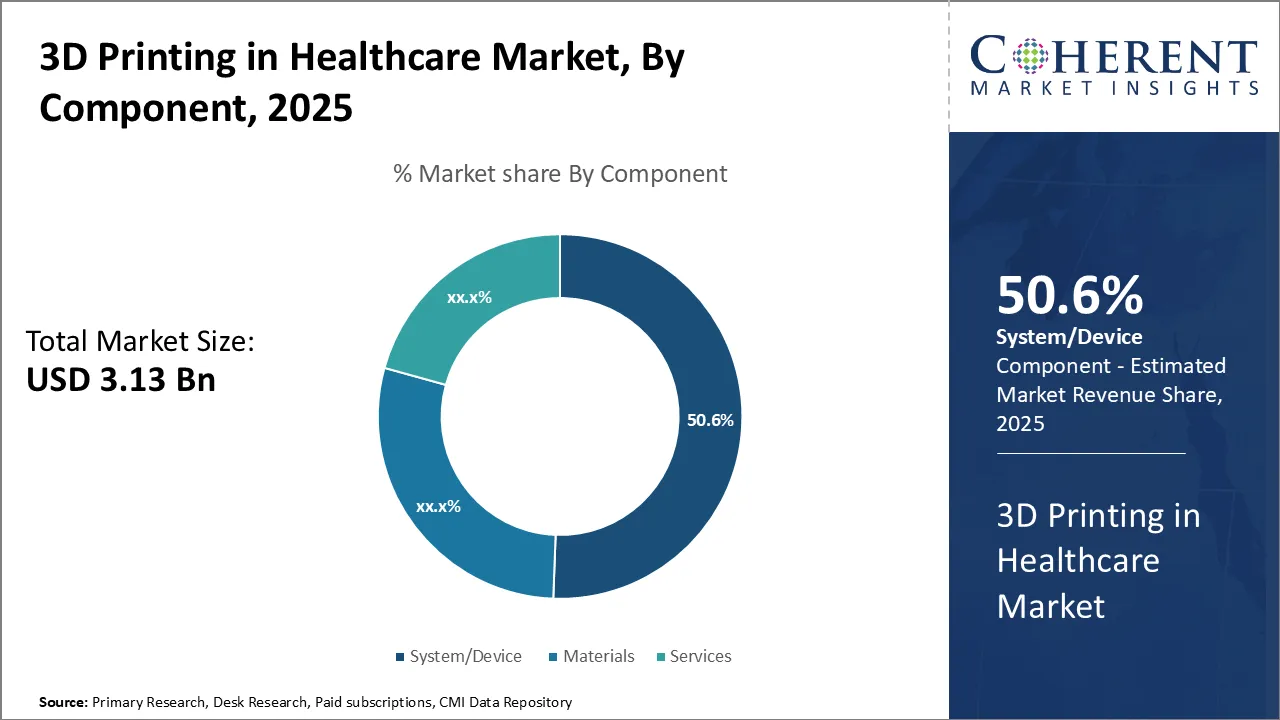
3D Printing in Healthcare Market Insights, By Component: System/Device Dominates as it is an Essential Hardware
In terms of component, the system/device segment dominates the market with 51.6% share in 2026, as it forms the essential hardware for all medical 3D printing applications. Hospitals, surgical centers, and research institutions rely on advanced 3D printers to produce patient-specific implants, prosthetics, anatomical models, and surgical guides. Increasing adoption of personalized medicine, rising demand for rapid prototyping in pharmaceuticals, and technological advancements in printer precision, speed, and material compatibility are driving the need for these systems. Additionally, ongoing investments in healthcare infrastructure and the expansion of biomedical research further amplify demand for high-performance 3D printing devices.
For instance, in March 2025, A new clinical trial commenced to evaluate a groundbreaking 3D-printed bioresorbable device designed to treat infants with tracheobronchomalacia, a rare and life-threatening airway condition. Developed by Michigan Medicine in collaboration with Materialize, the device aims to support the airways of affected infants, reducing reliance on ventilators.
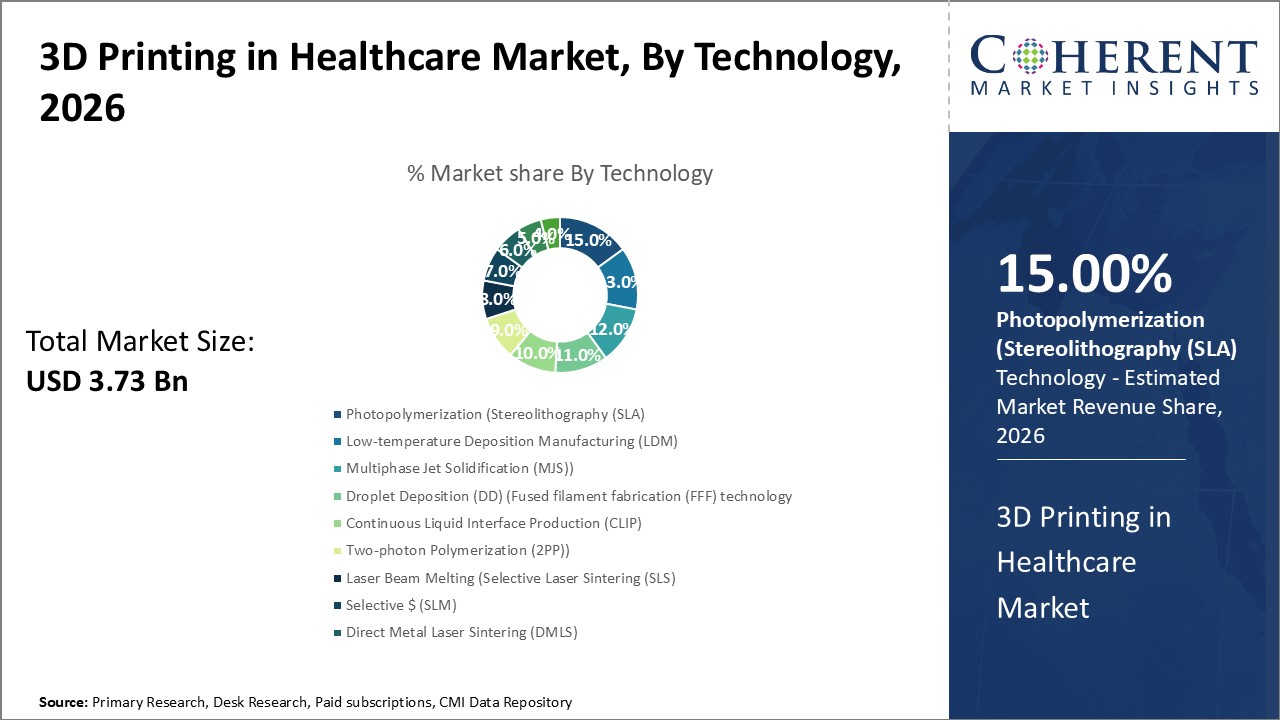
3D Printing in Healthcare Market Insights, By Technology: Photopolymerization Leads as it Enables Creation of high Precision, and Biocompatible Structures
In terms of technology, the photopolymerization segment is expected to contribute the largest share of the market in 2026, as it enables the creation of high-precision, biocompatible, and complex medical structures such as surgical guides, dental models, hearing aids, and custom implants. The technology offers fast curing, fine resolution, and smooth surface finishes, making it ideal for medical applications that require accuracy and reliability. Its compatibility with bioresins and specialized medical polymers further drives adoption, supporting personalized healthcare solutions and accelerating product development in hospitals, dental labs, and research institutions.
For instance, in May 2025, researchers at the Rochester Institute of Technology, led by PhD candidate Vincent Mei with Kory Schimmelpfennig and Prof. Christopher L. Lewis, developed a self-healing photopolymer for 3D printing. Their dual-phase material restores mechanical strength after damage, aiming to boost durability and reduce waste in additive manufacturing.
3D Printing in Healthcare Market Insights, By Application: Implants are Demanding Due To the Technology’s Ability to Produce Customized, Patient-Specific Solutions
In terms of application, the implants segment is projected to account for the highest share of the market in 2026, due to the technology’s ability to produce customized, patient-specific solutions that perfectly match anatomical requirements. 3D-printed implants offer faster production, improved surgical outcomes, reduced rejection rates, and lower costs compared to traditional manufacturing. Rising prevalence of orthopedic, dental, and craniofacial conditions further drives adoption.
For instance, in August 2025, OIC International (USA), Medi Mold (India), and AddUp (France), partnered to establish India's first large-scale 3D printing hub for orthopedic implants at the Andhra Pradesh MedTech Zone (AMTZ) in Visakhapatnam. The facility will utilize AddUp’s FormUp 350 metal 3D printing technology to produce patient-specific implants, enhancing customization and reducing production costs.
3D Printing in Healthcare Market Insights, By End User: Medical & Surgical Centers Dominating Due to Its Ability is Producing Patient-Specific Implants, Prosthetics, Surgical Guides and Many More
In terms of end user, the medical & surgical centers segment is anticipated to capture the greatest share of the market in 2026, due to its ability to produce patient-specific implants, prosthetics, surgical guides, and anatomical models. 3D printing enhances surgical precision, reduces operation times, and improves patient outcomes. Rising adoption of personalized medicine, growing complex surgeries, and increasing investments in advanced medical technologies further drive demand from these centers.
For instance, in September 2024, Aakash Healthcare Super Speciality Hospital in Dwarka, inaugurated an Advanced 3D Printing Lab in collaboration with Stratasys. Equipped with the Stratasys Digital Anatomy 3D Printer, the facility aims to revolutionize orthopaedic practices by producing precise anatomical models customized to individual patients. These models are expected to enhance staff training, support pre-surgical planning, and improve surgical accuracy, thereby reducing complications and accelerating recovery times.
Regional Insights
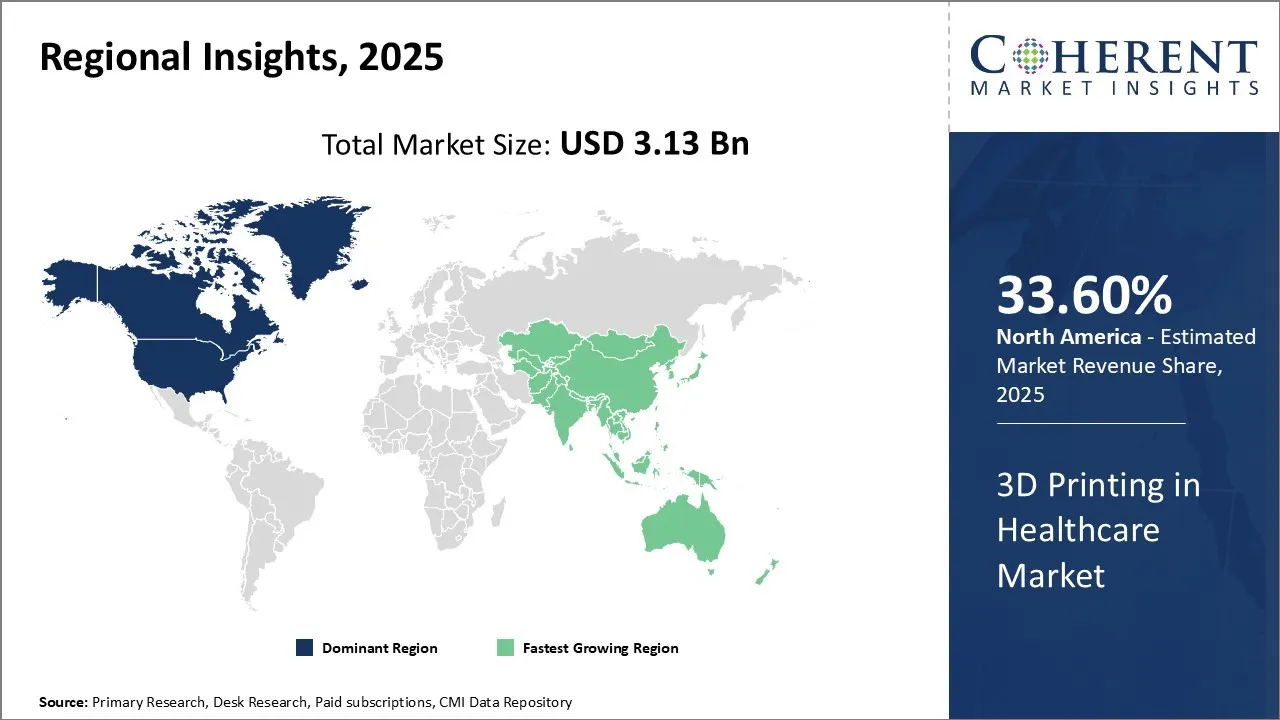
North America 3D Printing in Healthcare Market Analysis & Trends
North America 3D printing in healthcare market is projected to account for an estimated 33.60% share in 2026, supported by the region’s advanced healthcare infrastructure, high adoption of cutting-edge medical technologies, and significant R&D investments. Strong presence of hospitals, surgical centers, and biotech firms, combined with government support for innovation, is driving demand for 3D-printed implants, prosthetics, anatomical models, and personalized medical devices.
For instance, in July 2026, Nanochon, a Washington, D.C.-based medical device startup, received approval from Health Canada to initiate its first human clinical trial of Chondrograft™, a 3D-printed knee implant designed to treat articular cartilage defects. This minimally invasive implant, developed from research at George Washington University's Tissue Engineering and Nanotechnology Lab, allows for immediate weight-bearing and motion, potentially reducing recovery time.
Asia Pacific 3D Printing in Healthcare Market Analysis & Trends
The Asia Pacific region is anticipated to witness the fastest growth in the 3D printing in healthcare market in 2026, fueled by its rapid advancements in medical infrastructure, rising adoption of personalized healthcare solutions, and increasing investments in hospitals, dental clinics, and research institutions. Countries like China, India, and Japan are witnessing growing demand for cost-effective prosthetics, implants, surgical models, and bioprinting applications, driven by large patient populations, expanding medical tourism, and supportive government initiatives promoting healthcare technology adoption.
For instance, in July 2026, Sengkang General Hospital (SKH) in Singapore has initiated an innovative approach to diabetic foot care by producing 3D-printed custom insoles in-house. This advancement is the result of a collaboration with Singapore General Hospital’s 3D printing centre. The process begins with digitally scanning foam box impressions of patients' feet, followed by designing insoles using specialized software that adjusts densities and topography for optimal fit. Preliminary results indicate that these custom insoles reduce peak pressure by up to 28.5% and improve pressure distribution by 52.7%, surpassing the benefits of traditional insoles. Such initiatives are accelerating the 3D printing in healthcare market share.
3D Printing in Healthcare Market Outlook Country-Wise
The U.S. 3D Printing in Healthcare Market Trends
The 3D printing in healthcare market is highly demanding in the U.S. due to advanced medical infrastructure, high adoption of innovative technologies, and a strong focus on personalized medicine. Widespread use in surgical planning, prosthetics, dental applications, and bioprinting, coupled with supportive regulations and R&D investments, drives substantial market demand.
For instance, in June 2026, Ricoh USA, Inc. launched Ricoh 3D printing for Healthcare, LLC to advance the adoption of FDA-cleared, patient-specific medical devices. This initiative aims to empower hospitals to produce customized devices on-site, enhancing surgical planning and patient outcomes. Ricoh's approach includes establishing point-of-care manufacturing studios within healthcare facilities, providing clinicians with immediate access to 3D printed anatomic models and support.
Australia 3D Printing in Healthcare Market Trends
The demand for 3D printing in healthcare in Australia is driven by government support, personalized medical solutions, and cost-effective technologies. Collaboration between research institutions and industry, along with regulatory guidance from the TGA, is fostering innovation in implants, prosthetics, and bioprinting, boosting the 3D printing in healthcare market growth.
For instance, in May 2026, Concord Hospital in Sydney conducted a world-first clinical trial using 3D-printed skin to treat burn injuries. The innovative procedure involves isolating a patient's own skin cells, which are then printed directly onto a wound using a robotic device developed by Inventia Life Science. This method aims to accelerate healing and reduce pain compared to traditional grafts.
Market Report Scope
3D Printing in Healthcare Market Report Coverage
| Report Coverage | Details | ||
|---|---|---|---|
| Base Year: | 2025 | Market Size in 2026: | USD 3.73 Bn |
| Historical Data for: | 2020 To 2024 | Forecast Period: | 2026 To 2033 |
| Forecast Period 2026 to 2033 CAGR: | 19.2% | 2033 Value Projection: | USD 12.76 Bn |
| Geographies covered: |
| ||
| Segments covered: |
| ||
| Companies covered: | 3D Systems Corporation, Exone Company, Formlabs Inc., General Electric (GE Additive), Materialise NV, Organovo Holdings, Inc., Oxford Performance Materials Inc., Proto Labs, Inc., Stratasys Ltd., SLM Solutions Group AG, and among others. | ||
| Growth Drivers: |
| ||
| Restraints & Challenges: |
| ||
Global 3D Printing in Healthcare Market Drivers
- Increase in biomedical applications is expected to propel the market growth
3D printing technology has several applications in the healthcare sector. In addition to printing prosthetics, dental implants, and hearing aids, this technology is used for printing various organs, which can be implanted in the body. Several companies have focused on printing and commercializing organs such as livers and thyroid glands, which are being used in pre-clinical drug testing. In addition, 3D printing technology is used in stem cell biology and biomedical engineering, thus leveraging the scope of its biomedical application. Furthermore, extensive research is being carried out to improve the efficacy of drugs using 3D printing technology. Novel healthcare applications of 3D printing have surfaced due to extensive research and development activities being conducted at both industrial and academic levels. This in turn is expected to drive the growth of the 3D printing healthcare market during the forecast period.
For instance, in March 2023, Hovione and Laxxon Medical entered into a strategic collaboration to advance the use of 3D screen printing technologies for the pharmaceutical industry. The partnership combines Laxxon´s expertise in 3D screen printing, based on their SPID-Technology, with Hovione’s product and process development, engineering and manufacturing expertise in pharmaceutical applications.
Global 3D Printing in Healthcare Market Opportunities
3D printing technology is being used to bioprint bones, ears, exoskeletons, windpipes, jaw bones, eyeglasses, cell cultures, stem cells, blood vessels, tissues, and organs. Although still in the nascent stage and not yet commercialized, these applications are expected to gain momentum. Reduced time and cost for producing artificial organs are anticipated to create lucrative opportunities, driving the 3d printing in healthcare market forecast in the coming years.
Global 3D Printing in Healthcare Market Trends
- Presence of large patient pool
Majority of the individuals suffer from organ failure, amputation, and sever injuries, owing to increase in prevalence of diseases, accidents, and congenital defects. In 2018, approximately 114,000 patients in the U.S. were on the waiting list for organ transplantation. In addition, rapid rise in geriatric population suffering from bone and joint problems boosts the growth of the market. Furthermore, almost 12.35 million amputees are estimated to be present across the globe. This has significantly fuelled the growth of the market, as 3D printers are used for printing body parts, which has led to increase in customer base. Moreover, population suffering from auditory disorder and dental problems has increased at alarming rate, which acts as a key driver of the global market. This is attributed to the fact that 3D printing in dentistry is used to generate a 3D model of teeth.
Analyst Opinion (Expert Opinion)
The 3D Printing in Healthcare Market is undergoing a transformative phase, characterized by rapid technological advancements, increasing adoption across various medical applications, and a growing emphasis on personalized patient care. While the market's growth trajectory is evident, several critical factors warrant attention for a comprehensive understanding of its dynamics.
The integration of 3D printing technologies in healthcare has revolutionized the production of medical devices, implants, and prosthetics. Innovations in bioprinting, particularly the development of patient-specific implants and tissue engineering, are at the forefront of this transformation. These advancements not only enhance the precision of medical treatments but also significantly improve patient outcomes by providing customized solutions tailored to individual needs.
However, the rapid pace of technological development presents challenges in terms of regulatory approvals and standardization. The healthcare industry must navigate complex regulatory landscapes to ensure the safety and efficacy of 3D-printed medical products. Additionally, the lack of universally accepted standards can lead to inconsistencies in product quality and performance.
Speak to the analyst
Want personalized insights?
Take the findings above to one of our principal consultants, or have the report rebuilt around the segments, geographies and competitors you actually track.
Global 3D Printing in Healthcare Market: Key Developments
- In May 2025, AIIMS Bhopal is pioneering the use of 3D printing technology to enhance the safety and precision of kidney stone surgeries. The Department of Urology has secured a ₹9 lakh research grant from the Madhya Pradesh Council of Science and Technology (MPCST) to develop customized 3D-printed puncture guides for Percutaneous Nephrolithotomy (PCNL). These guides will be based on patient-specific kidney models derived from CT scans, allowing for better pre-surgical planning.
- In March 2025, PolyUnity partnered with Nova Scotia Health to launch a 3D printing initiative aimed at enhancing healthcare delivery. This collaboration provides clinical engineering teams with access to 3D printing capabilities, enabling them to design and produce custom medical parts and tools on demand. The "test and try" project empowers healthcare facilities to address equipment challenges, extend device lifespans, and improve patient care.
- In October 2024, Sparsh Hospitals inaugurated India's first advanced on-site 3D printing lab, marking a significant milestone in healthcare innovation. This state-of-the-art facility aims to revolutionize orthopaedic and personalized medical care by offering comprehensive solutions, including the creation of patient-specific implants, prosthetics, and surgical guides.
- In July 2023, Desktop Health, a trusted production-grade medical 3D printing brand of Desktop Metal, Inc., announced a breakthrough in bioprinting with the launch of PrintRoll, an innovative rotating build platform that can produce intelligent tubular solutions for the body’s vascular, digestive, respiratory, and reproductive channels on the 3D-Bioplotter premier bioprinting system.
Market Segmentation
- Global 3D Printing in Healthcare Market, By Component (Revenue, USD Bn, 2021 - 2033)
- System/Device
- Materials
- Services
- Global 3D Printing in Healthcare Market, By Technology (Revenue, USD Bn, 2021 - 2033)
- Droplet Deposition (DD)
- Fused filament fabrication (FFF) technology
- Low-temperature Deposition Manufacturing (LDM)
- Multiphase Jet Solidification (MJS)
- Photopolymerization
- Stereolithography (SLA)
- Continuous Liquid Interface Production (CLIP)
- Two-photon Polymerization (2PP)
- Laser Beam Melting
- Selective Laser Sintering (SLS)
- Selective $ (SLM)
- Direct Metal Laser Sintering (DMLS)
- Electronic Beam Melting (EBM)
- Laminated Object Manufacturing
- Droplet Deposition (DD)
- Global 3D Printing in Healthcare Market, By Application (Revenue, USD Bn, 2021 - 2033)
- External Wearable Devices
- Clinical Study Devices
- Implants
- Tissue Engineering
- Homes
- Global 3D Printing in Healthcare Market, By End User (Revenue, USD Bn, 2021 - 2033)
- Medical & Surgical Centers
- Pharmaceutical & Biotechnology Companies
- Academic Institutions
- Global 3D Printing in Healthcare Market, By Geography (Revenue, USD Bn, 2021 - 2033)
- North America
- U.S.
- Canada
- Latin America
- Brazil
- Argentina
- Mexico
- Rest of Latin America
- Europe
- Germany
- U.K.
- Spain
- France
- Italy
- Russia
- Rest of Europe
- Asia Pacific
- China
- India
- Japan
- Australia
- South Korea
- ASEAN
- Rest of Asia Pacific
- Middle East
- GCC Countries
- Israel
- Rest of Middle East
- Africa
- South Africa
- North Africa
- Central Africa
- North America
- Key Companies Insights (Revenue, USD Bn, 2021 - 2033)
- 3D Systems Corporation
- Exone Company
- Formlabs Inc.
- General Electric (GE Additive)
- Materialise NV
- Organovo Holdings, Inc.
- Oxford Performance Materials Inc.
- Proto Labs, Inc.
- Stratasys Ltd.
- SLM Solutions Group AG
Sources
Primary Research Interviews from the following stakeholders
Stakeholders
- Interviews with hospital procurement heads, clinical/biomedical engineers, surgeons (orthopedics, maxillofacial, cardiovascular), radiologists, dental laboratory managers, pathology lab managers, pharmacy R&D leads, hospital facility managers, clinical trial managers, and medical device regulatory leads across leading global markets.
Specific Stakeholders
- Clinical leads / surgeons at major hospital systems
- Heads of biomedical engineering and device sterilization at tertiary care hospitals
- Procurement and supply chain heads at hospital networks and pathology chains.
- R&D and product managers at medical device OEMs using additive manufacturing
- Heads of dental laboratories and dental chains using dental 3D printing
- Production managers at contract manufacturing/medical device CMOs offering additive manufacturing services.
- Quality assurance and regulatory affairs lead at device manufacturers and contract manufacturers.
- Clinical trial managers running trials that include 3D-printed devices or patient-specific implants.
- Bioprinting research leads in universities and translational research institutes.
- Hospital IT and PACS managers (for imaging-to-print workflows).
- Heads of hospital central sterile services (CSSD) and sterilization specialists
- Procurement leads at large dental chains, orthotics & prosthetics clinics, and implant distributors.
- Material scientists and product managers at biomaterials suppliers
- Representatives from medical imaging vendors (CT/MRI) and imaging-to-CAD workflow providers.
Databases
- World Trade Organization (WTO) Trade Statistics
- UN Comtrade Database
- U.S. Food and Drug Administration (FDA) Device & 510(k)/PMA databases
- ClinicalTrials.gov (U.S.)
- PubMed / MEDLINE (publication and clinical evidence extraction)
- European Medicines Agency (EMA) device/medical guidance databases
- China Customs Statistics / NMPA filings (where available)
- Directorate General of Commercial Intelligence and Statistics (DGCIS), India
- Eurostat (health & manufacturing statistics)
- Korea Customs Service Data Portal
- Japan External Trade Organization (JETRO) trade and industry data
Magazines / Trade Press
- 3D Printing Industry (medical section)
- Additive Manufacturing (magazine)
- Medical Device + Diagnostic Industry (MD+DI) — Additive/Manufacturing features
- Dental Lab Products / The Dental Technician (dental 3D printing coverage)
- Orthopedics Today (technology features)
- Pharma Manufacturing (for pharma/bioprinting coverage)
- Medical Plastics News (materials and processing)
- TechRadar Pro — Healthcare Technology section (relevant features)
Peer-Reviewed Journals
- Additive Manufacturing (Elsevier)
- Biofabrication (IOP Publishing)
- 3D Printing in Medicine (SpringerOpen)
- Biomaterials
- Journal of Biomedical Materials Research
- Tissue Engineering Part A/B/C
- Journal of Medical Devices (ASME)
- Journal of Prosthetic Dentistry (for dental applications)
- Journal of Orthopaedic Research (for implants and orthopedics)
- Journal of Surgical Research (for surgical guides and applications)
Newspapers / Business Press (industry & supply-chain coverage)
- The Wall Street Journal — Health / Tech & Life sections
- Financial Times — Health Tech and Industry Reports
- The New York Times — Health / Science coverage
- The Economic Times — Healthcare & Tech (India)
- The Hindu Business Line — Healthcare Technology & Industry
- Nikkei Asia — Electronics, medical device supply chain coverage
- South China Morning Post — Tech & medical manufacturing news
Associations & Standards Bodies
- ASTM F42 — Additive Manufacturing Technologies committee (standards)
- ISO/TC 261 — Additive manufacturing (international standards)
- AAMI (Association for the Advancement of Medical Instrumentation)
- Society for Biomaterials
- Society for Manufacturing Engineers (SME) — Additive manufacturing workgroups
- International Organization for Standardization (relevant committees)
- RSNA (Radiological Society of North America) — imaging-to-print workflows and sessions
- Dental Trade Alliance / National Association of Dental Laboratories (regional chapters)
- Association for 3D Printing (regional industry groups)
- Bioprinting communities & consortiums at leading universities
Public Domain / Government Sources
- U.S. Food and Drug Administration (FDA) guidance documents on additive manufacturing (device guidance, technical considerations)
- National Institute of Standards and Technology (NIST) — additive manufacturing program & standards research
- Central Drugs Standard Control Organization (CDSCO), India — device and medical device rules/guidance references
- European Commission / MEDDEV guidance and MDR (medical device regulation) resources
- World Health Organization (WHO) — procurement and device safety guidelines (as applicable)
- NIH / NCBI repositories and funded research catalogs
- National health ministry portals for country-level procurement & policy (e.g., MoHFW India)
Proprietary Elements (internal / organization-specific data sources)
- CMI Data Analytics Tool, and Proprietary CMI Existing Repository of information for last 8 years
*Definition: 3D printing is an additive process whereby layers of material are built up to create a 3D part. This is the opposite of subtractive manufacturing processes, where a final design is cut from a larger block of material. As a result, 3D printing creates less material wastage.
Get access to 250+ pages report
Every segment, forecast, competitor profile and data table behind the analysis above — available for instant download.
- ESOMAR Member
- ISO 9001:2015 Certified
- D-U-N-S Registered
- GDPR & CCPA Compliant
Missing comfort of reading report in your local language? Find your preferred language:
Transform your Strategy with Exclusive Trending Reports
Frequently Asked Questions
The 3D Printing in Healthcare Market is estimated to be valued at USD 3.73 Bn in 2026, and is expected to reach USD 12.76 Bn by 2033.
The CAGR of the 3D Printing in Healthcare Market is projected to be 19.2% from 2026 to 2033.
Increase in biomedical applications is fuelling the growth of the market.
The Tissue Engineering segment is the leading application segment in the market.
High cost associated with 3D printing, and increase in reimbursement challenges is major factors which responsible for restraining growth of the market.
Major players operating in the area 3D Systems Corporation, Exone Company, Formlabs Inc., General Electric (GE Additive), Materialise NV, Organovo Holdings, Inc., Oxford Performance Materials Inc., Proto Labs, Inc., Stratasys Ltd., SLM Solutions Group AG, and among others.
Bioprinting enables customized tissue and organ creation, improving regenerative medicine, personalized therapies, drug testing, and future transplant solutions.