

Bariatric Surgery Devices Market Size and Forecast — 2026 - 2033
The Global Bariatric Surgery Devices Market size is estimated to be valued at USD 4.2 billion in 2026 and is expected to reach USD 7.8 billion by 2033, exhibiting a compound annual growth rate (CAGR) of 9.1% from 2026 to 2033.
Overview
The bariatric surgery devices market is driven by the increasing prevalence of obesity and related conditions such as diabetes, cardiovascular diseases, and hypertension, which boost demand for weight-loss surgeries. Rising awareness about the health risks of obesity and the effectiveness of surgical interventions further supports adoption. Technological advancements in minimally invasive and laparoscopic devices improve surgical outcomes, safety, and recovery times, encouraging both patients and surgeons. Additionally, growing healthcare expenditure, expanding insurance coverage for bariatric procedures, and the increasing availability of skilled surgeons and specialized centers contribute significantly to market growth worldwide.
Key Takeaways
The Gastric Banding Devices segment dominates with a 38% market share, driven by widespread use across laparoscopic procedures, while the robotic-assisted surgery subsegment achieves the fastest growth due to enhanced precision and reduced complications.
Laparoscopic surgery leads in adoption among surgery types, whereas endoscopic procedures are the fastest-growing because of their minimally invasive nature and quicker recovery time.
North America holds the largest industry share, supported by advanced healthcare infrastructure and a high prevalence of obesity. Europe follows with steady growth driven by increasing adoption of robotic-assisted bariatric devices, while Asia Pacific records the highest CAGR due to expanding healthcare access and improving reimbursement policies.
Bariatric Surgery Devices Market Segmentation Analysis
Bariatric Surgery Devices Market Insights, By Product Type
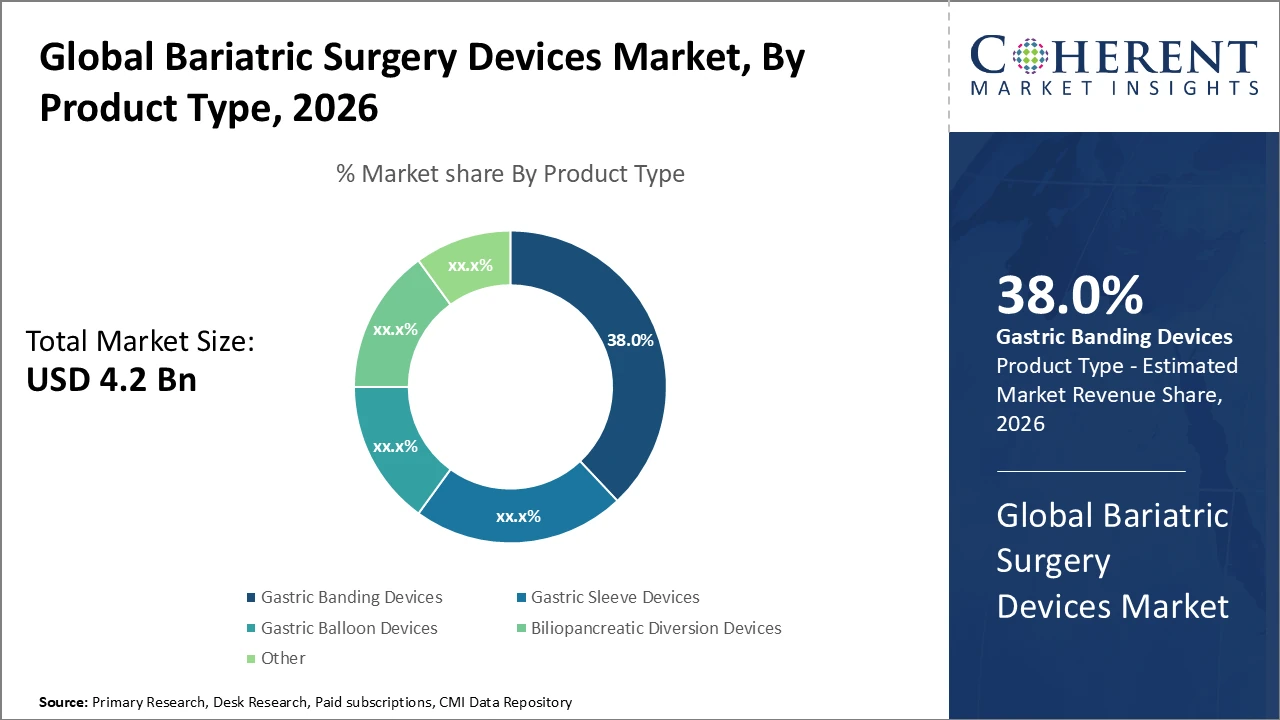
Gastric Banding Devices hold the largest market share at 38%, driven by their long-standing clinical reliability, procedural simplicity, and wide acceptance among surgeons. Continuous advancements in adjustability and minimally invasive techniques further sustain their demand. Meanwhile, Gastric Sleeve Devices represent the fastest-growing subsegment, gaining traction due to their strong metabolic benefits and suitability for a broader patient population. Rising clinical evidence supporting sleeve gastrectomy for managing type 2 diabetes is accelerating adoption. Other segments, including Gastric Balloon Devices and Biliopancreatic Diversion Devices, serve niche needs, particularly for non-surgical or high-risk patients, supporting overall market diversity and growth.
Bariatric Surgery Devices Market Insights, By Surgery Type
Laparoscopic surgery dominates the market, driven by its balance of precision, safety, and shorter recovery time, accounting for the highest bariatric procedure volume globally in 2026. Robotic-assisted surgery is the fastest-growing segment, supported by superior visualization, improved dexterity, and reduced complications, along with rising investments in advanced robotic systems and AI integration. Open surgery remains limited to complex or revisional cases due to its invasive nature and longer hospital stays. Endoscopic procedures are gaining momentum for being minimally invasive and suitable for high-risk patients, while hybrid and experimental techniques are emerging in specialized centers, contributing to future innovation.
Bariatric Surgery Devices Market Insights, By End User
Hospitals account for the largest market share, as they perform the majority of bariatric procedures with access to advanced surgical infrastructure and comprehensive post-operative care. Their ability to manage complex cases strengthens their dominance. Ambulatory Surgical Centers are the fastest-growing segment, driven by cost efficiency and increasing demand for outpatient procedures among low-risk patients. These centers are adopting advanced laparoscopic and robotic technologies to improve outcomes and efficiency. Specialty clinics cater to niche patient groups with personalized treatment approaches, while other settings, including research institutions and mobile units, play a smaller but steadily growing role in expanding access to care.
Bariatric Surgery Devices Market Trends
Market trends in the Bariatric Surgery Devices sector highlight rapid advancements in device automation and digital integration, improving surgical precision and overall patient safety.
The adoption of AI-guided laparoscopy devices has increased significantly, with 2025 clinical trials in Europe showing nearly 20% improvement in intraoperative outcomes.
Endoscopic bariatric therapy devices are gaining strong traction as minimally invasive alternatives, offering faster recovery and shorter hospital stays.
These endoscopic devices have recorded sales growth of over 30% in the past two years, reflecting rising patient and physician preference.
The expansion of telemedicine and remote monitoring tools is enhancing preoperative and postoperative care management.
Such digital health solutions are particularly advancing patient engagement and follow-up efficiency in developed healthcare markets.
Bariatric Surgery Devices Market Insights, By Geography
North America Bariatric Surgery Devices Market Analysis and Trends
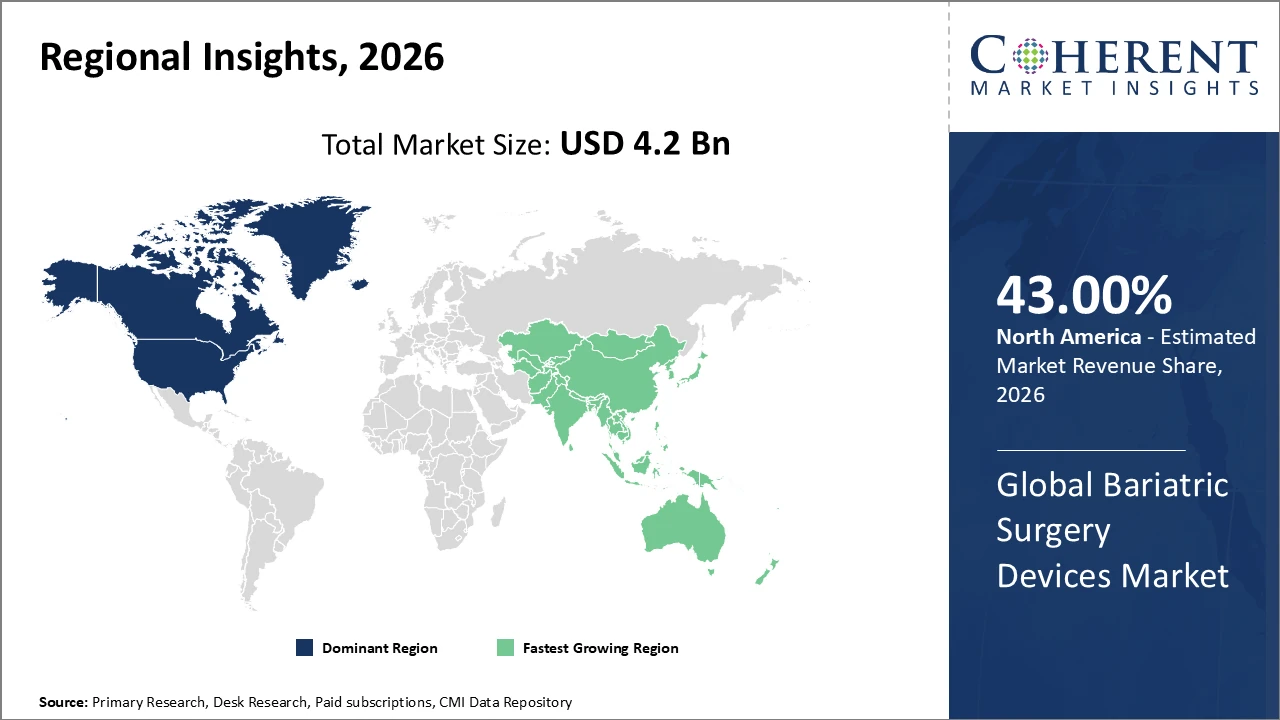
North America leads the Bariatric Surgery Devices market with a share of 43% due to its advanced healthcare infrastructure, high awareness of obesity treatment options, and substantial government spending on weight management programs. The United States accounts for nearly 45% of the regional market, supported by a strong network of specialized bariatric centers and high procedure volumes. Major industry players, including Medtronic and Intuitive Surgical, continue to invest heavily in research, innovation, and next-generation surgical technologies. Favorable reimbursement policies and early adoption of robotic-assisted and minimally invasive procedures further strengthen the region’s dominance and contribute to sustained market growth.
Asia Pacific Bariatric Surgery Devices Market Analysis and Trends
Asia Pacific represents the fastest-growing region in the Bariatric Surgery Devices market, with a CAGR exceeding 11%, driven by rapid expansion of healthcare infrastructure and rising obesity rates. Countries such as India and China play a crucial role, supported by government health initiatives and increasing investment in specialized bariatric care facilities. Growing awareness about surgical weight loss options and improved access to treatment are further accelerating demand. Additionally, local manufacturers are strengthening production capabilities and expanding exports, making devices more accessible and cost-effective, which significantly contributes to the region’s strong and sustained market growth trajectory.
Bariatric Surgery Devices Market Outlook for Key Countries
USA Bariatric Surgery Devices Market Analysis and Trends
The United States bariatric surgery devices market is driven by high obesity prevalence, estimated at around 42.4% among adults in 2026, which is significantly increasing demand for effective weight-loss interventions. This has accelerated the adoption of minimally invasive solutions such as laparoscopic and robotic-assisted surgical systems. Leading market players are investing heavily in clinical research, device innovation, and performance improvements to enhance patient outcomes and procedural efficiency. Additionally, advanced stapling systems and gastric banding devices are witnessing strong uptake, contributing to a revenue growth of over 10% year-on-year and reinforcing the country’s position as a major market contributor.
Germany Bariatric Surgery Devices Market Analysis and Trends
Germany’s bariatric surgery devices market is influenced by strict regulatory standards and a high-quality healthcare system. The country’s robust hospital infrastructure and advanced surgical capabilities support widespread adoption of innovative devices, particularly robotic-assisted systems, which achieved 22% sales growth in 2025. Leading global and local medical device manufacturers actively collaborate with German surgical centers to conduct clinical trials, validating device performance and safety. These initiatives have increased clinician confidence and facilitated broader acceptance in both public and private hospitals. Continuous investments in training and technology upgrades further strengthen Germany’s position as a key European market for bariatric devices.
Analyst Opinion
Rising adoption of laparoscopic devices is driving market share growth, with over 65% of bariatric procedures in North America using advanced laparoscopic instruments in 2024, significantly boosting device revenue. Price optimization has also improved accessibility in emerging markets.
Integration of robotic-assisted bariatric surgery systems is reshaping market dynamics, offering enhanced precision and reduced operative time. Case studies from 2025 show a 25% reduction in patient recovery periods, increasing hospital throughput and revenue. Growing approvals of robotic platforms support broader use in surgical centers worldwide.
Demand-side growth is fueled by obesity-related comorbidities, expanding bariatric device applications in endocrinology and metabolic treatments. The U.S. obesity rate of 42.4% in 2026 correlates with a 15% year-over-year rise in procedures.
Supply-side trends show expanded production capacity for gastric bands and intestinal sleeves, with Asian manufacturers scaling facilities. In 2024, exports from China and India to Europe and North America increased by 18%, highlighting growing global supply chain integration.
- Current Industry Events of 2026
- Market Size Estimation
- Regional Breakdown
- Competitive Landscape
- Customer Intelligence
- Segmental Analysis
- Pricing Analysis
- Key Market Drivers, Challenges & Future Trends
- Customized Insights Section
Market Scope
| Report Coverage | Details | ||
|---|---|---|---|
| Base Year: | 2025 | Market Size in 2026: | USD 4.2 billion |
| Historical Data for: | 2020 To 2024 | Forecast Period: | 2026 To 2033 |
| Forecast Period 2026 to 2033 CAGR: | 9.1% | 2033 Value Projection: | USD 7.8 billion |
| Geographies covered: |
| ||
| Segments covered: |
| ||
| Companies covered: | Medtronic, Johnson & Johnson, Zimmer Biomet, Dextera Surgical, Stryker Corporation, Boston Scientific, LivaNova PLC, Intuitive Surgical, Apollo Endo Surgery, CONMED Corporation | ||
| Growth Drivers: |
| ||
Bariatric Surgery Devices Market Growth Factors
The increasing global prevalence of obesity is the primary driver of Bariatric Surgery Devices market growth. According to WHO data in 2026, over 650 million adults worldwide were affected by obesity, fueling demand for surgical interventions. Advances in minimally invasive and robotic-assisted devices have improved procedural safety, efficacy, and patient outcomes, broadening the eligible patient population. Higher healthcare spending and expanded insurance coverage in developed regions reduce cost barriers, supporting market expansion. Additionally, growing public awareness and government initiatives addressing obesity-related health risks have further increased the adoption of bariatric surgery, contributing to sustained growth in the global devices market.
Bariatric Surgery Devices Market Development
In May 2024, the Apple Vision Pro AR device was used for the first time in a live bariatric surgery. Dr. Mohit Bhandari performed the procedure at a Pristyn Care surgical centre in New Delhi, which included a sleeve gastric bypass and a Single Anastomosis Duodenal-Ileal (SADI) procedure.
Key Players
Leading Companies of the Market
Medtronic
Johnson & Johnson
LivaNova PLC
Boston Scientific
Stryker Corporation
CONMED Corporation
Dextera Surgical
Apollo Endo Surgery
Intuitive Surgical
Several leading market players have strategically expanded their product portfolios through acquisitions and technology partnerships. In 2025, Medtronic acquired Apollo Endo Surgery, strengthening its sleeve gastrectomy device offerings and contributing to a 12% increase in its bariatric surgery devices revenue in 2026. Similarly, Johnson & Johnson’s Ethicon segment introduced next-generation stapling devices with real-time tissue assessment capabilities, enhancing surgical precision by 18%, as demonstrated in 2024 clinical trials. These strategic initiatives highlight the focus on innovation and portfolio diversification, enabling companies to meet rising demand for advanced bariatric procedures and maintain competitive advantage in the global market.
Bariatric Surgery Devices Market Future Outlook
The Bariatric Surgery Devices market is poised for strong growth in the coming years, driven by rising global obesity rates and increasing awareness of surgical weight-loss options. Advances in minimally invasive, robotic-assisted, and endoscopic technologies are expected to enhance procedural safety, efficiency, and patient outcomes. Expanding healthcare infrastructure in emerging markets, coupled with improved insurance coverage and reimbursement policies, will increase accessibility. Additionally, ongoing innovation by key players, including AI integration, smart surgical systems, and next-generation stapling and gastric devices, is likely to expand the eligible patient population and drive adoption, positioning the market for sustained growth through 2033.
Bariatric Surgery Devices Market Historical Analysis
The Bariatric Surgery Devices market has experienced steady growth over the past decade, driven by rising obesity prevalence and increasing demand for minimally invasive weight-loss interventions. Historically, laparoscopic surgery dominated the market due to its procedural safety and shorter recovery times, while traditional open surgeries gradually declined. Technological advancements, including stapling devices, adjustable gastric bands, and early robotic-assisted systems, improved surgical outcomes and expanded patient eligibility. North America led global adoption, supported by advanced healthcare infrastructure and high patient awareness, followed by Europe and Asia Pacific. Market expansion was also fueled by growing investments in clinical research, device innovation, and the emergence of endoscopic bariatric solutions.
Sources
Primary Research Interviews:
Executives, product managers, and operations heads at bariatric device manufacturers
Regulatory affairs specialists, quality assurance managers, and clinical affairs officers in medical device companies
Technology providers offering robotic-assisted, endoscopic, and minimally invasive surgical systems
Magazines:
Medical Device and Diagnostic Industry (MD+DI) – Innovations in bariatric surgery technologies
Surgical Products – Trends in minimally invasive and robotic-assisted surgery devices
Healthcare Technology Management – Advances in surgical instrumentation and device automation
DeviceTalks – Updates on medical device market developments and company strategies
Journals:
Journal of Bariatric Surgery – Clinical outcomes and device efficacy studies
Obesity Surgery – Research on surgical techniques and device innovations
Surgical Endoscopy – Studies on laparoscopic and endoscopic bariatric procedures
Newspapers:
The Wall Street Journal – Bariatric device market trends and healthcare investments
Financial Times – Global medical device industry developments
Business Standard – Growth of surgical device sector in emerging markets
Business Insider – Updates on robotic-assisted and minimally invasive surgical technologies
Associations:
American Society for Metabolic & Bariatric Surgery (ASMBS) – Guidelines, standards, and clinical insights
International Federation for the Surgery of Obesity and Metabolic Disorders (IFSO) – Global bariatric surgery trends
Medical Device Manufacturers Association (MDMA) – Regulatory and manufacturing best practices
Get access to 250+ pages report
Every segment, forecast, competitor profile and data table behind the analysis above — available for instant download.
- ESOMAR Member
- ISO 9001:2015 Certified
- D-U-N-S Registered
- GDPR & CCPA Compliant
Missing comfort of reading report in your local language? Find your preferred language:
Transform your Strategy with Exclusive Trending Reports
Frequently Asked Questions
Dominant players include Medtronic, Johnson & Johnson (Ethicon), Apollo Endo Surgery, and Intuitive Surgical, recognized for their advanced device portfolios and innovation-led strategies.
The market size is projected to grow from USD 4.2 billion in 2026 to USD 7.8 billion by 2033, following a CAGR of 9.1%.
Hospitals remain the largest end-user segment, driven by increased bariatric surgery volumes and modernization of surgical suites.
Market trends will emphasize robotic-assisted surgeries, AI integration, and minimally invasive endoscopic therapies, accelerating device adoption and innovation.
The competitive landscape is marked by technology-driven product innovation and consolidation, with challenges including regulatory hurdles and high device costs.
Strategies include product portfolio expansions, geographic market penetration, collaborative clinical research, and technology licensing to maintain competitive advantage.