

Medical Dynamometer Market Size and Forecast — 2026-2033
The Global Medical Dynamometer Market size is estimated to be valued at USD 402.8 million in 2026 and is expected to reach USD 615 million by 2033, exhibiting a compound annual growth rate (CAGR) of 7.4% from 2026 to 2033.
Overview
Medical dynamometers are diagnostic instruments used to measure muscle strength, grip force, and rehabilitation progress in clinical and sports medicine settings. Available as handheld digital, hydraulic, and isokinetic variants, they provide objective data for physiotherapy assessments, injury evaluation, and treatment planning.
Key Takeaways
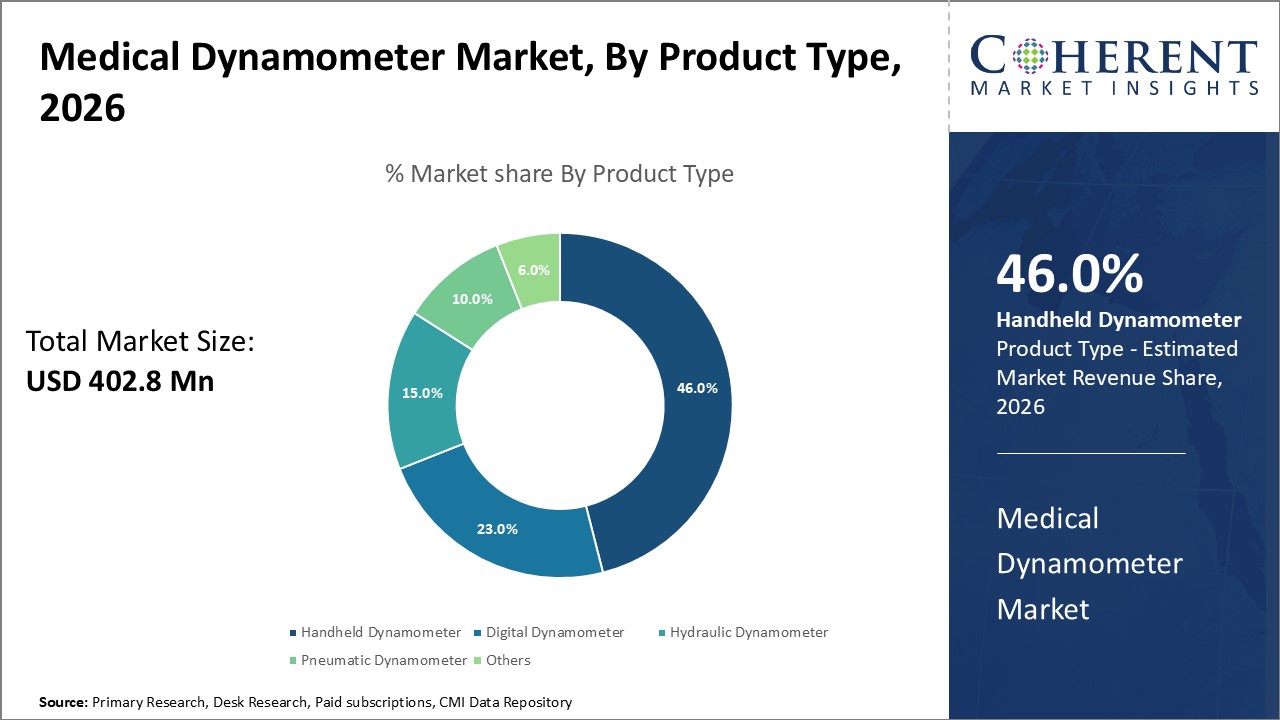
The Handheld Dynamometer segment dominates the product category with 46% market share, driven by ease of use and mobility, while Digital Dynamometers are the fastest-growing due to integration with electronic health records.
Rehabilitation application continues to hold the largest share at 39%, emphasizing the market’s focus on clinical patient care with digital solutions leading growth.
Hospitals, commanding 51% of the end-user segment, remain the primary purchasers due to their scale and diversified rehabilitation services.
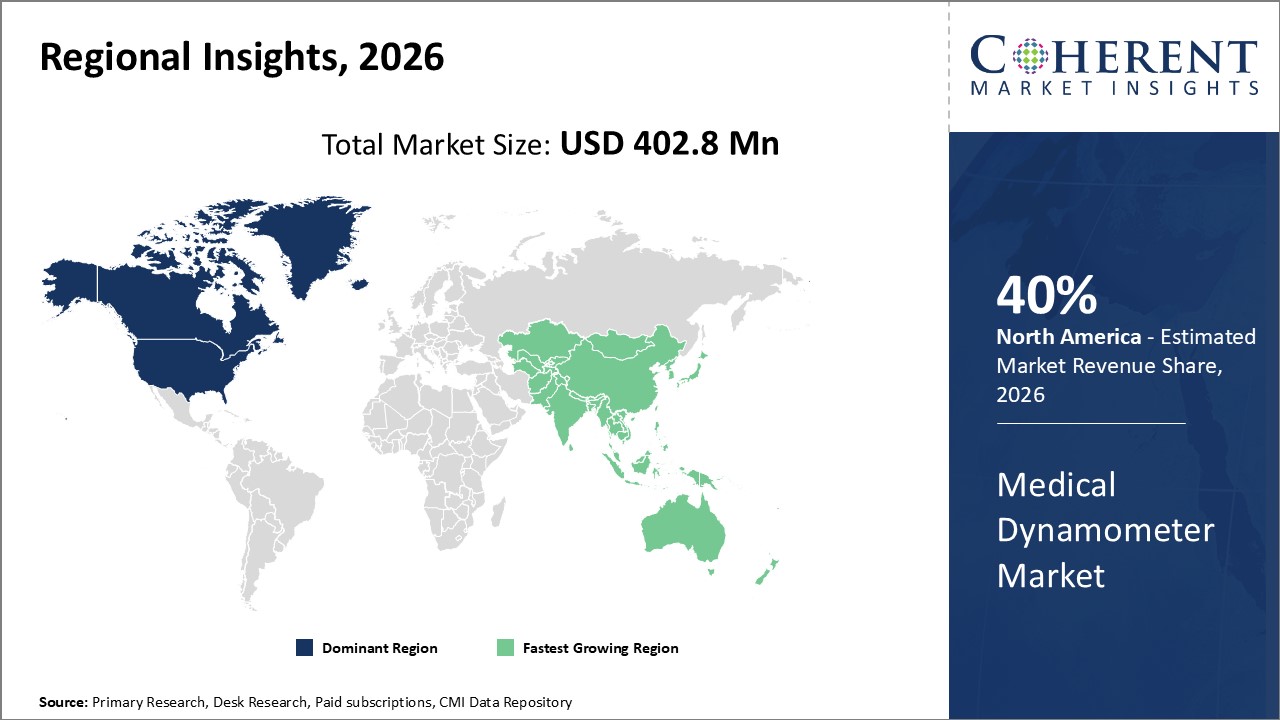
North America retains market leadership with about 40% market revenue share, driven by established healthcare infrastructure and R&D focus.
Asia Pacific exhibits the highest CAGR of 8.1%, supported by expanding ADL (Activities of Daily Living) rehabilitation programs and increasing government expenditure.
Europe maintains steady growth, reflecting strong adoption of regulatory compliance and emerging digital health initiatives in countries like Germany and the U.K.
Medical Dynamometer Market Segmentation Analysis
Medical Dynamometer Market Insights, By Product Type
Handheld Dynamometers dominate the market share at 46%, primarily due to their portability, ease of use, and cost-effectiveness, making them a preferred choice in sports medicine and outpatient rehabilitation. These devices’ minimal setup needs and quick measurement capabilities have significantly driven their adoption globally. Digital Dynamometers, identified as the fastest-growing subsegment, leverage wireless connectivity and AI algorithms to provide enhanced data analytics and seamless integration with electronic medical records, catering notably to high-end clinical setups and research applications. Hydraulic and Pneumatic Dynamometers remain relevant, predominantly in specialized clinical environments where their precision and durability are valued.
Medical Dynamometer Market Insights, By Application
Rehabilitation dominates with a 38% market share, reflecting the healthcare industry's increasing emphasis on patient recovery and functional muscle evaluation. Innovations such as AI-assisted assessment tools have enhanced rehabilitation effectiveness, leading to greater device utilization. Sports Medicine is the fastest-growing segment owing to rising sports injuries and wellness awareness; dynamometers assist in performance tracking and injury prevention, which is increasingly adopted by professional teams worldwide.
Medical Dynamometer Market Insights, By End-User
Hospitals are holding the largest market share of 50%. This dominance is driven by hospitals’ expansive clinical capabilities and diversified rehabilitation services requiring frequent muscle strength assessments. Adoption of digital dynamometers integrated into hospital IT systems has further enhanced their market share. Physiotherapy Centers represent the fastest-growing segment as outpatient services expand globally alongside increased chronic disease management. Home Care is gaining traction with portable dynamometers facilitating remote monitoring during rehabilitation, reflecting shifts towards decentralized healthcare.
Medical Dynamometer Market Trends
The Medical Dynamometer market is prominently driven by digitalization and miniaturization trends. Increasing adoption of wireless dynamometers and AI-enabled muscle strength analysis tools has revolutionized clinical and sports rehabilitation.
For example, in 2026 alone, the use of AI-enhanced devices grew by 26%, enabling clinicians to achieve more accurate diagnostics and personalized therapy.
Additionally, the surge in home-care rehabilitation is altering traditional usage frameworks, with portable devices seeing a 21% higher adoption rate compared to conventional models in 2025.
Connectivity with telemedicine platforms represents another growth vector, exemplified by integration initiatives in U.S. outpatient therapy centers.
Medical Dynamometer Market Insights, By Geography
North America Medical Dynamometer Market Analysis and Trends
In North America, the dominance in the Medical Dynamometer market is bolstered by robust healthcare infrastructure, high adoption of advanced rehabilitation technologies, and substantial investment in R&D activities. The region commands approximately 40% market share owing to established hospital systems and sports medicine prominence. Major entities such as JTech Medical and MicroFET Technologies greatly contribute to continuous product development and market penetration.
Asia Pacific Medical Dynamometer Market Analysis and Trends
Meanwhile, the Asia Pacific region exhibits the fastest growth with a CAGR surpassing 8%, propelled by rising healthcare expenditure, policy support for medical technology adoption, and expanding rehabilitation services. Countries like China and India are expanding their healthcare ecosystems aggressively, supported by government initiatives improving accessibility. Notable companies focusing on this region include Saehan Corporation and Baseline Evaluation Instruments, which are localizing products to meet regional cost and functionality needs.
Medical Dynamometer Market Outlook for Key Countries
USA Medical Dynamometer Market Analysis and Trends
The USA stands as the leading contributor to the Medical Dynamometer market globally due to its advanced healthcare infrastructure and ongoing investments in medical technology innovation. The country’s large number of rehabilitation centers and sports medicine facilities drives high device utilization. For example, in 2025, approximately 35% of total market revenue was generated by the U.S., with leading firms like JTech Medical and Lafayette Instrument Company spearheading AI-enabled dynamometer adoption. Additionally, robust reimbursement policies and integration with electronic health records stimulate continuous market growth.
Germany Medical Dynamometer Market Analysis and Trends
Germany represents a key European market known for stringent regulatory standards and integrated healthcare systems. The country’s emphasis on precision rehabilitation has elevated demand for medical dynamometers in hospitals and research institutes alike. Market companies such as Biometrics Ltd. and Medup Healthcare have capitalized on Germany’s drive for innovation, capturing significant market shares through technologically advanced devices tailored to neurological and orthopedic applications. Government support for digital health adoption further bolsters Germany’s position as a frontrunner in the region.
Analyst Opinion
The surge in sports injury prevalence globally has accelerated the demand for medical dynamometers, particularly in rehabilitation centers. For instance, recent data from the American Physical Therapy Association revealed a 6% year-over-year increase in musculoskeletal injury treatments, boosting device deployment. Market revenue from sports medicine applications increased by approximately 9% in 2025, reflecting growing utilization.
Technological innovation focused on portable and wireless dynamometer variants is enhancing ease of use and patient compliance. Production capacity of handheld dynamometers expanded by 13% in 2025, spurred by demand in outpatient and home care settings. These supply-side improvements correlate with a 10.5% growth in exports from manufacturing hubs in East Asia reported in 2025.
Pricing dynamics remain competitive due to the entrance of cost-effective devices with multi-functional capabilities integrating smart software platforms. Recent import data shows a 15% increase in cost-effective devices in emerging markets, indicating strong demand-side preference shifts. Varied use cases across geriatrics and pediatric rehabilitation are pushing customized pricing strategies.
Micro-indicators like increasing research funding for neuromuscular disorder studies have broadened the application spectrum, as demonstrated by a 8% rise in neuromuscular clinical trials utilizing dynamometry in 2026. This growth underpins market growth and validates investment in evolving product portfolios tailored to niche clinical needs.
- Current Industry Events of 2026
- Market Size Estimation
- Regional Breakdown
- Competitive Landscape
- Customer Intelligence
- Segmental Analysis
- Pricing Analysis
- Key Market Drivers, Challenges & Future Trends
- Customized Insights Section
Market Scope
| Report Coverage | Details | ||
|---|---|---|---|
| Base Year: | 2025 | Market Size in 2026: | USD 402.8 million |
| Historical Data for: | 2020 To 2024 | Forecast Period: | 2026 To 2033 |
| Forecast Period 2026 to 2033 CAGR: | 7.4% | 2033 Value Projection: | USD 615 million |
| Geographies covered: |
| ||
| Segments covered: |
| ||
| Companies covered: | Micro Medical Limited, North Coast Medical, Medup Healthcare, Patterson Medical, Vald Performance, Instron, Shimpo Instruments Corporation, Takei Scientific Instruments, Smedley Dynamometer Co., Command Dynamics. | ||
| Growth Drivers: |
| ||
Medical Dynamometer Market Growth Factors
Growing demand for precise muscle strength evaluation in neurological and musculoskeletal disorder diagnostics is a significant driver, as approximately 8 million physical therapy visits in North America utilized dynamometers in 2025. Rising government funding towards rehabilitation infrastructure, especially in Asia Pacific’s emerging economies, has led to a 15% increase in procurement budgets for medical dynamometers in recent years. Technological advancements enabling integration with electronic health records and AI-powered muscle assessment algorithms are enhancing diagnostic accuracy and expanding market scope. As early as 2026, nearly 25% of new medical dynamometer deployments worldwide incorporated AI features. Increasing awareness among sports medicine practitioners globally about standardized strength measurement protocols is fueling consistent market growth, with approximately 18% rise in dynamometer adoption rates in professional sports teams reported in 2025.
Medical Dynamometer Market Development
In January 2019, ActivBody launched Activforce, a digital dynamometer platform designed to give clinicians precise, real-time measurements for manual muscle testing. The system enhanced patient assessment by integrating force analytics, cloud connectivity, and clinician-friendly reporting tools.
In 2026, Hoggan Scientific introduced new features in its wireless microFET3 dynamometer, offering handheld, Bluetooth-enabled force measurement for physical therapy, occupational therapy, and sports performance applications. The device improved portability and accuracy compared with earlier wired models.
Key Players
Leading Companies of the Market
Micro Medical Limited
North Coast Medical
Medup Healthcare
Patterson Medical
Vald Performance
Instron
Shimpo Instruments Corporation
Takei Scientific Instruments
Smedley Dynamometer Co.
Command Dynamics
Leading market players are actively adopting strategies such as portfolio diversification and strategic partnerships to strengthen their market hold. For example, JTech Medical’s integration of wireless connectivity in their latest dynamometer models has increased their share in the rehabilitation segment by 7% in 2025. Meanwhile, Saehan Corporation’s collaboration with university research centers has accelerated product innovation, resulting in a 11% uptick in medical institution procurements.
Medical Dynamometer Market Future Outlook
In the coming years, the market growth will be driven by the rising incidence of musculoskeletal disorders, aging populations, and expanded access to rehabilitative care. Technological advancements—such as wireless connectivity, AI-assisted data interpretation, cloud-based patient tracking, and integration with electronic health records—will enhance clinical decision-making and therapy personalization. Home-based and tele-rehabilitation trends are expected to increase demand for portable, user-friendly digital dynamometers. Growing sports performance testing and workplace ergonomics evaluation will further diversify market opportunities.
Medical Dynamometer Market Historical Analysis
The market historically evolved from basic manual strength gauges to more advanced hydraulic and digital measurement systems used in orthopedics, sports medicine, neurology, and rehabilitation. Growing clinical emphasis on objective musculoskeletal assessment, along with increased physiotherapy utilization, supported steady market expansion. Hospitals, rehabilitation centers, and research institutions have long relied on dynamometers for injury evaluation, post-surgical progress tracking, and workforce health testing, helping establish them as standard diagnostic tools.
Sources
Primary Research Interviews:
Physiotherapists
Sports Medicine Specialists
Rehabilitation Equipment Distributors
Databases:
Eurostat Healthcare Equipment Data
NIH Rehab Research Data
Magazines:
Medical Device News Magazine
Rehab Management
Sports Medicine Journal Review
Journals:
Journal of Rehabilitation Medicine
Clinical Biomechanics
Journal of Strength and Conditioning Research
Newspapers:
USA Today (Health)
The Hindu (Medical Technology)
The Globe and Mail (Healthcare)
Associations:
American Physical Therapy Association (APTA)
International Society of Biomechanics (ISB)
WHO Rehabilitation Alliance
Get access to 250+ pages report
Every segment, forecast, competitor profile and data table behind the analysis above — available for instant download.
- ESOMAR Member
- ISO 9001:2015 Certified
- D-U-N-S Registered
- GDPR & CCPA Compliant
Missing comfort of reading report in your local language? Find your preferred language:
Transform your Strategy with Exclusive Trending Reports
Frequently Asked Questions
The dominant companies include JTech Medical, LLC, MicroFET Technologies, Saehan Corporation, Biometrics Ltd., and Baseline Evaluation Instruments, noted for their wide product portfolios and innovation-led growth.
The market size is projected to grow from USD 402.8 million in 2026 to USD 615 million by 2033, reflecting a CAGR of 7.4%, driven by technological advancements and rising clinical applications.
Hospitals currently hold the largest market share at 50%, with fastest growth observed within physiotherapy centers and home care sectors due to increased outpatient rehabilitation demand.
The market will increasingly embrace AI integration, wireless technology, and remote monitoring, resulting in expanded use in home-based and sports rehabilitation, supported by growing healthcare digitization.
The landscape is fragmented with emphasis on innovation, cost optimization, and partnerships. Market challenges include pricing pressures and need for regulatory compliance across regions.
Key strategies include product innovation with smart features, strategic alliances with healthcare providers, and focus on emerging markets through affordable device offerings.