

Global Air Ambulance Services Market Size and Forecast 2026-2033
Global air ambulance services market is estimated to be valued at USD 8.30 Bn in 2026 and is expected to reach USD 15.97 Bn by 2033, exhibiting a compound annual growth rate (CAGR) of 9.8% from 2026 to 2033.
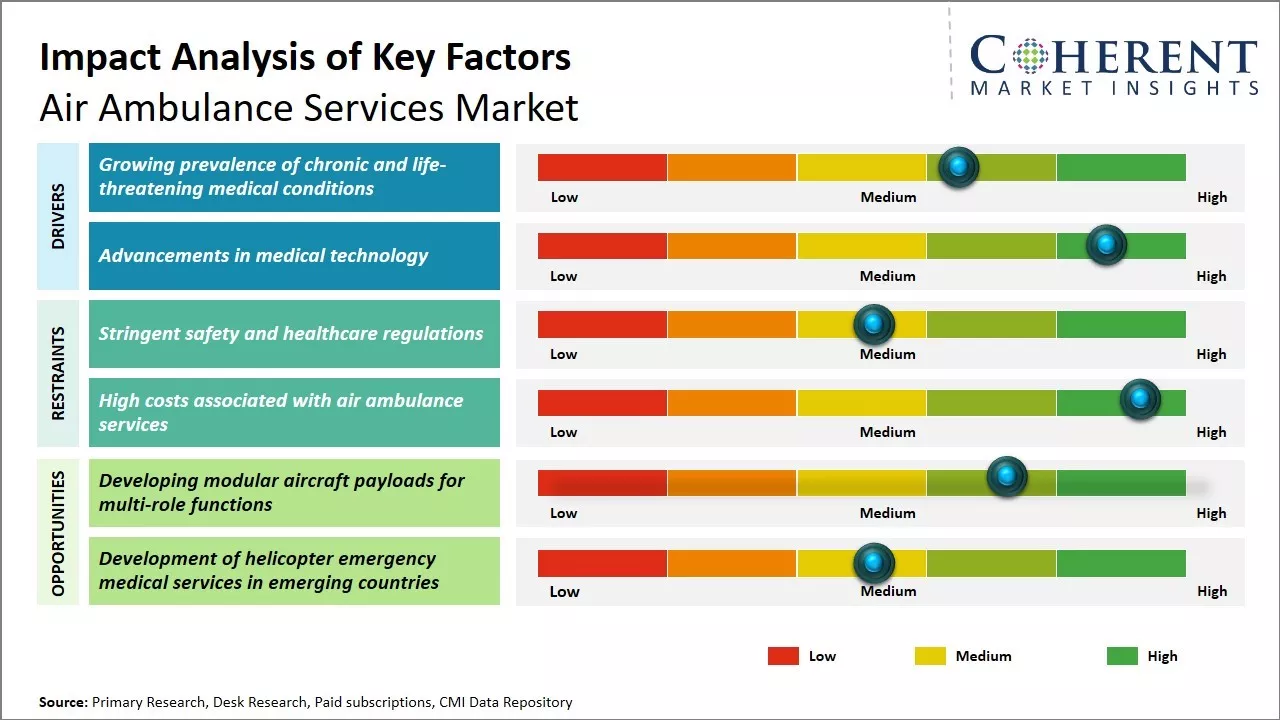
Key Takeaways of the Global Air Ambulance Services Market
- By service type, the hospital-based services segment is anticipated to hold 57.9 % of the market share in 2026.
- By aircraft, the fixed winged aircraft segment contributes the highest share of the market and is expected to hold 63.3 % of the market share in 2026.
- By application, the inter-facility segment contributes the highest share of the air ambulance services market and is projected to hold 33.1 % of the market share in 2026.
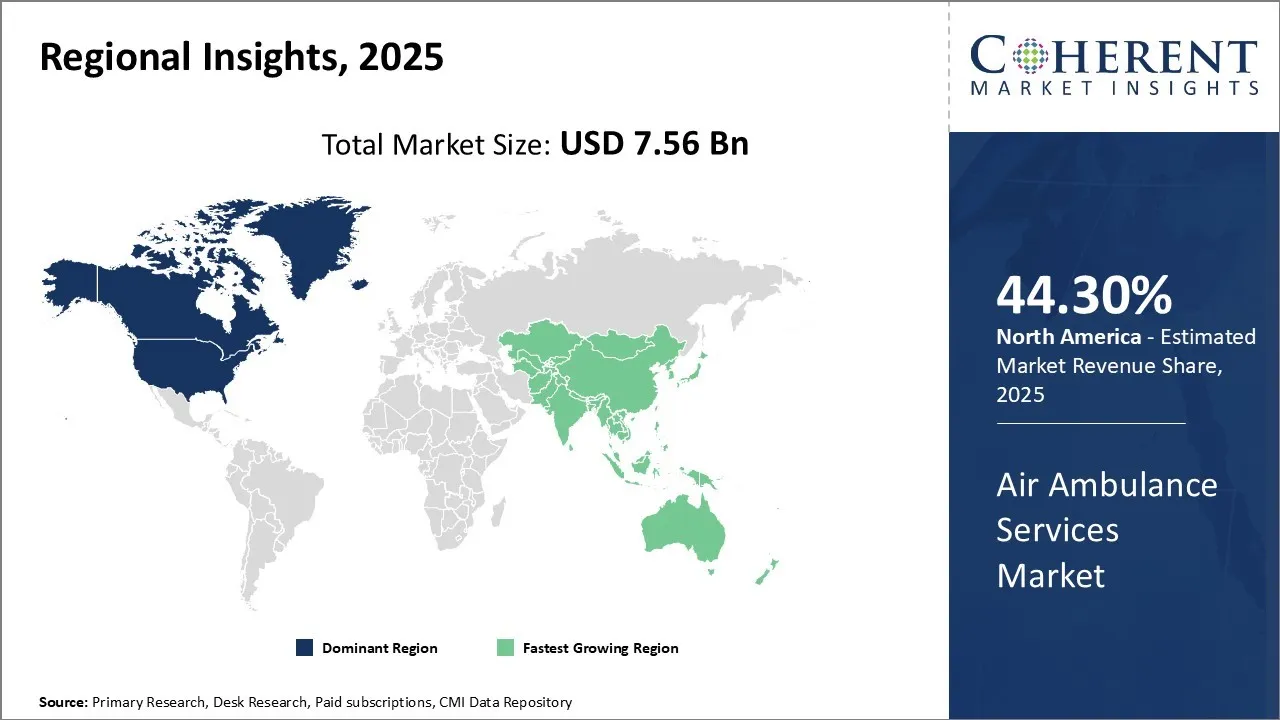
- North America has been the dominant region in the global air ambulance services market and is anticipated to hold 44.3 % of the market share in 2026.
Market Overview
The market is expected to witness positive growth over the forecast period, due to factors such as rising prevalence of chronic and infectious diseases, growth in the number of trauma cases and accidents, and advantages associated with air ambulance services such as increased accessibility to remote and rural areas and faster transportation.
Growing geriatric population who are more susceptible to medical emergencies and injuries are also contributing to demand for air ambulance services. However, high costs associated with these services and shortage of helicopter pilots can hamper the market growth.
Current Events and Its Impact
Current Events | Description and its impact |
Escalation of Armed Conflicts (Regional: Ukraine and the Middle East) |
|
Geopolitical Medical Initiatives |
|
Impact of AI on the Global Air Ambulance Services Market
Artificial Intelligence (AI) is reshaping the air ambulance services sector by enhancing operational efficiency, response time, and patient care.
- Air Medical Group Holdings (AMGH), a U.S.-based air medical transport and emergency medical service provider, uses AI to analyze factors like weather, urgency, and aircraft availability for optimized dispatch.
- The ARTPARK project “Aero108,” supported by the Indian Institute of Science, is working on developing an autonomous air ambulance equipped with AI-powered navigation and remote operation capabilities.Intended to carry patients, life support equipment, and a humanoid assistant, the project is scheduled for pilot testing by 2030.
- LifeFlight has implemented an AI-powered triage and dispatch system that prioritizes critical cases and integrates with hospitals. This has led to a 20% improvement in response accuracy and better patient outcomes.
- Startups such as AutoNav Air Ambulance, MediLink SkyConnect, and DiagnoFly are piloting AI-enabled navigation, remote specialist consultations, and onboard diagnostics to accelerate response and medical decision-making.
- Current Industry Events of 2026
- Market Size Estimation
- Regional Breakdown
- Competitive Landscape
- Customer Intelligence
- Segmental Analysis
- Pricing Analysis
- Key Market Drivers, Challenges & Future Trends
- Customized Insights Section
Market Trends
Growing Prevalence of Chronic and Life-threatening Medical Conditions
One of the key drivers contributing to the growth of the air ambulance services market is rising prevalence of chronic and life-threatening medical conditions across the world. An increasing number of people are suffering from diseases such as cardiovascular disorders, cancer, stroke, trauma injuries and other emergencies that often require swift medical attention and emergency transportation to advanced healthcare facilities. Air ambulance services offer a fast and efficient mode of transportation in time-critical medical situations, where every minute is crucial. This help reduce the time taken to transport critically ill patients to hospitals and provide emergency medical care during transit.
In December 2024, a 33‑year‑old brain‑dead donor in Jhalawar, Rajasthan, India had eight organs including heart, lungs, kidneys, liver, and corneas airlifted by helicopter to Jaipur (SMS Hospital) and Jodhpur (AIIMS) within 3 hours. This rapid transfer preserved the organs in optimal condition and saved multiple lives.
Advancements in Medical Technology
Rapid developments occurring in the fields of medical devices, pharmaceuticals and emergency care have significantly improved clinical outcomes for critically ill patients over the past decade. Sophisticated diagnostics, minimally invasive procedures, targeted drugs and other therapeutic innovations now enable the treatment of complex, life-threatening conditions with higher success rates. This has increased expectations of access to advanced healthcare facilities especially during medical emergencies.
Air ambulances help fulfill this need by transporting patients to tertiary or quaternary hospitals equipped with state-of-the-art therapeutic capabilities within golden hour timeframes. Continuous upgrades in air ambulance services, facilitated by evolving technology, also contribute to their increased reliance. Advanced helicopters and aircraft equipped with ICU-level equipment allow comprehensive emergency care to be provided new route to hospitals. Features such as computerized flight dispatch systems, onboard critical care monitoring devices and telemedicine enhance safety and efficacy. Use of night-vision goggles and forward-looking infrared cameras helps air ambulance operations during poor visibility.
For example, a January 2025 case study reported that AI‑driven dispatch systems are now being used to analyze emergency calls in real-time, optimize flight paths based on weather and traffic, and relay live patient vitals to hospital teams resulting in significantly reduced response times and improved in-flight care coordination.
Market Concentration and Competitive Landscape
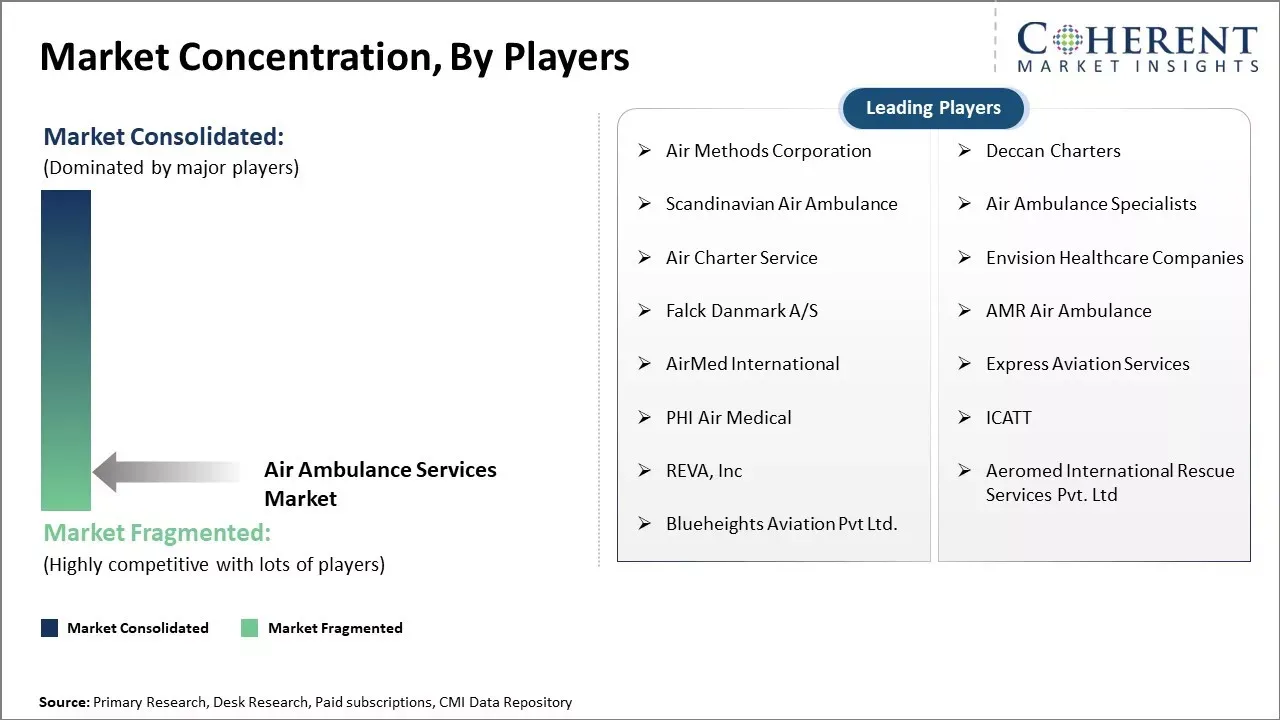
Analyst View
- Air ambulance operators that are not leveraging AI for triage, dispatch, and routing are at risk of obsolescence. For example, Air Methods’ integration of AI-based dispatch systems has reduced response times by approximately 18%, directly impacting patient survival in time-critical emergencies. In an increasingly competitive market, such digital infrastructure is no longer an upgrade it’s the baseline for operational excellence.
- The industry is undergoing a necessary shift toward high-performance aircraft equipped with advanced life support systems. REVA Inc.'s investment in Learjet 45XRs demonstrates how fleet modernization is being driven by clinical complexity, especially for intercontinental transfers involving cardiac or neonatal patients. Operators relying on outdated helicopters or aircraft will soon find themselves unable to meet the rising clinical expectations of hospitals and regulators alike.
- One of the most urgent structural flaws in the industry is the lack of reimbursement transparency. In 2023, nearly 40% of air ambulance claims were denied by Medicaid in the U.S., triggering patient backlash and policy scrutiny. Without standardized billing systems and insurer alignment, providers face reputational damage and legal pushback, undermining the very trust required to scale lifesaving services globally.
Speak to the analyst
Want personalized insights?
Take the findings above to one of our principal consultants, or have the report rebuilt around the segments, geographies and competitors you actually track.
Market Opportunity: Developing Modular Aircraft Payloads for Multi-Role Functions
As medical technology advances, more complex care can be delivered via air. An aging population prone to emergencies would drive demand. Developing modular aircraft payloads for multi-role functions could boost utilization rates. Partnerships with national healthcare providers or insurance firms may help reduce costs and expand coverage to underserved areas.
Moreover, partnerships with public health agencies and insurers can help expand coverage to remote and underserved areas, addressing affordability barriers. For instance, in October 2024, the U.S. Army Applications Laboratory awarded a contract to LIFT Aircraft and Near-Earth Autonomy to develop a modular medical payload container usable for both blood resupply and autonomous casualty evacuation (CASEVAC) missions. This container can be quickly configured for either ground or air deployment, features built-in vital‑sign monitoring and climate control for blood transport, and demonstrates the strategic value of multi-role modular systems in time‑critical care.
Segmental Insights
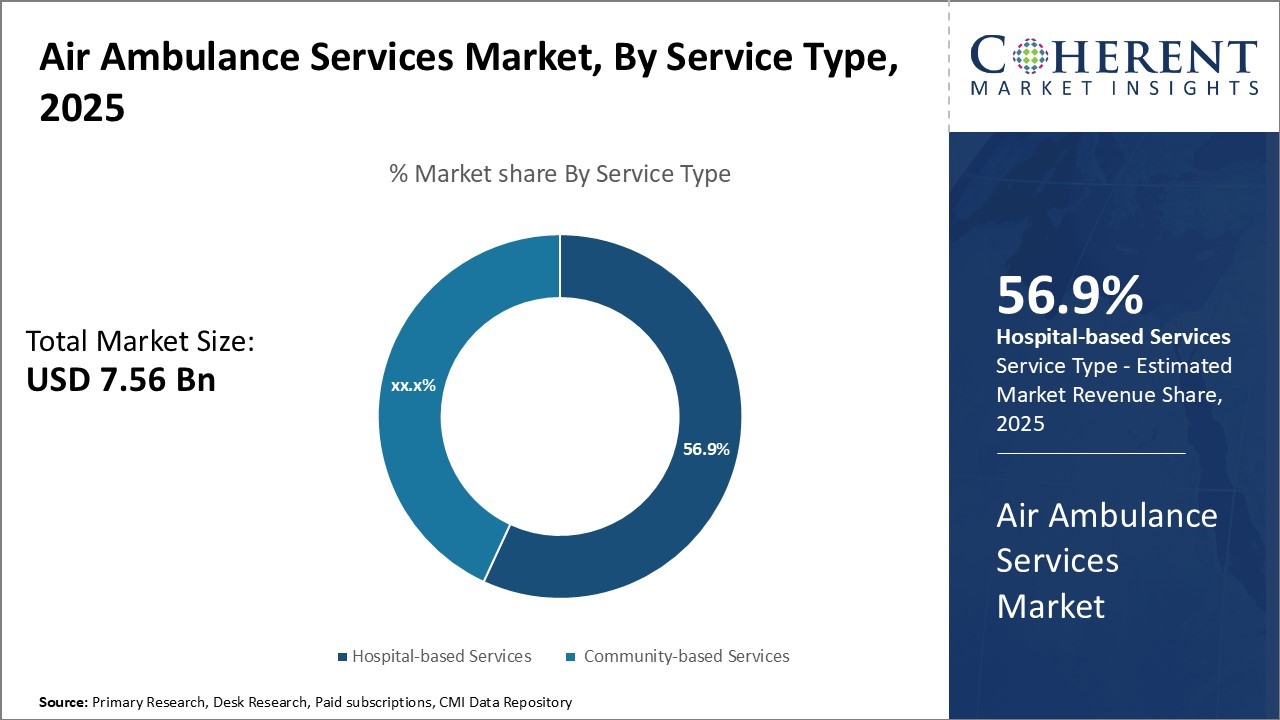
Global Air Ambulance Services Market Insights, By Service Type: Growing dependence on emergency medical care boosts hospital-based services segment growth
The service type segment includes hospital-based services segment and community-based services segment. Hospital-based services segment is anticipated to hold 57.9% of the market share in 2026. Hospital-based air ambulance services offer a convenient option for patients requiring urgent medical attention to be transferred between medical facilities.
As lifestyle diseases and chronic health conditions continue to rise globally, the strain on hospital emergency and ICU units has increased tremendously. This has augmented demand for services that can transfer critical patients swiftly and safely between hospitals. Increasingly aging population profile of developed nations indicates a steady growth in age-related illnesses requiring immediate hospitalization and monitoring. This aging demographic is expected to fuel the need for hospital-based air ambulance fleets in the coming years.
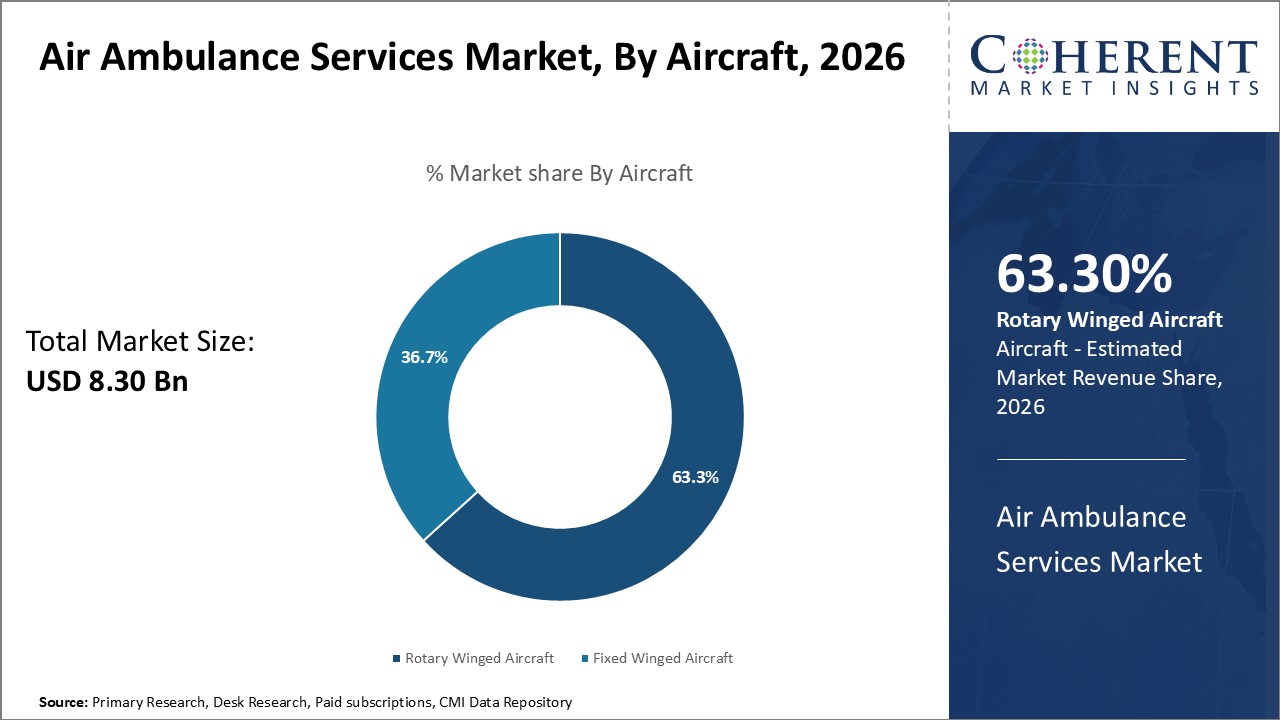
Global Air Ambulance Services Market Insights, By Aircraft: Ongoing upgrade of aviation infrastructure propels fixed winged aircraft segment growth
The aircraft segment includes rotary winged aircraft and fixed winged aircraft. Fixed winged aircraft segment contributes the highest share of the market and is expected to hold 63.3% of the market share in 2026. Compared to rotary aircraft, fixed wing airplanes have a much greater flying range capacity on a single fuel tank. This allows them to effectively undertake long-distance interstate and even inter country medical evacuations. As healthcare networks expand their reach beyond boundaries, having aircraft suited for transcontinental retrievals is pivotal. Several nations have invested massively in developing advanced airport runways and aviation fuel facilities in recent times. This upgradation of basic aviation logistics encourages increased adoption of fixed wing air ambulance planes within their territories.
Global Air Ambulance Services Market Insights, By Application: Rising demand for specialized services drives demand for inter-facility transfers
The application segment includes inter-facility, rescue helicopter services, organ transplant logistics, overweight patient transport, infectious disease services, neonatal transport, pediatric transport, and others. Inter-facility segment contributes the highest share of the air ambulance services market and is projected to hold 33.1% of the market share in 2026.
As medical research elevated the standards of critical care globally, many life-threatening conditions now warrant tertiary or quaternary level super-specialty treatment availability only in select advanced facilities. For instance, managing severe burns or performing organ transplants require infrastructure beyond the primary capabilities of community hospitals. Air ambulance services enabling quick shifting between networked medical centers have thus become imperative, as referrals to specialized units saw a huge upsurge.
Regional Insights
North America Air Ambulance Services Market Trends and Analysis
North America region has emerged as the dominant regional market for air ambulance services and is anticipated to hold 44.3% of the market share in 2026. The large size of the regional healthcare industry along with high per capita healthcare spending has boosted air ambulance operations. Most leading air ambulance service providers have established sizeable fleets across major cities to ensure quick response times in emergency situations. Furthermore, the presence of advanced Medicare and insurance policies provides coverage for air ambulance transportation costs, making it an affordable option for patients. For instance, in November 2024, Global Medical Response (GMR) announced a major fleet expansion to support rural and urban critical care services in the U.S. The investment includes 43 new helicopters (Airbus H125, H130, H135, H145) and eight King Air B350 turboprops for Alaska, plus Challenger 605 jets for long-range medical transport.
Asia Pacific Air Ambulance Services Market Trends and Analysis
The Asia Pacific region has emerged as the fastest growing regional market for air ambulance services during the projected period. Rapid economic development and improving access to healthcare has boosted the need for such facilities. Countries like India and China owing to their large populations and geographic challenges require efficient emergency response networks. While still in the growth phase, both nations have initiated policy reforms to encourage private investments and set operational guidelines. This has spurred the entry of global players who are partnering with local hospitals and emergency centers. For example, during Aero India 2023, Hindustan Aeronautics Limited (HAL) and U.A.E-based Response Plus Holding PJSC signed an MoU to collaborate on helicopter emergency medical services, targeting deployments within India, the Gulf, and MENA regions.
U.S. Air Ambulance Services Market Trends and Analysis
In the U.S., air ambulance services continue to evolve as a vital part of the emergency medical ecosystem, with demand rising due to frequent trauma cases, strokes, and cardiac events. The market benefits from a mature healthcare system and wide availability of advanced aircraft equipped for critical care. Technological upgrades, including onboard monitoring, AI-based dispatch tools, and telemedicine integration, are improving service speed and patient outcomes.
However, pricing concerns and insurance disputes remain a challenge. Increased hospital-operator collaborations are streamlining patient transfers over long distances, especially in underserved rural regions. For instance, in November 2024, AirCARE1 upgraded its entire fleet to the Learjet 60, standardizing on a modern, long-range platform equipped for ICU-level care. This move highlights a push toward fleet modernization aimed at improving speed, comfort, and clinical capability in high-acuity transports.
India Air Ambulance Services Market Trends and Analysis
India’s air ambulance sector is gaining momentum, with growing recognition of its role in life-saving interventions and organ transport across states. Demand is rising in semi-urban and remote regions where quick access to specialized care is limited. Efforts by private providers and government agencies to enhance emergency medical services are pushing the market forward.
High operational costs, limited infrastructure, and lack of insurance coverage make services inaccessible for many. New approaches such as tying air ambulance access into health insurance plans and forming public-private partnerships are being explored to improve affordability and reach. For example, on June 17, 2026, the Indian Air Force used a Super Hercules aircraft to airlift a liver and two kidneys from Pune to New Delhi under a “green air corridor,” enabling three successful transplants and demonstrating the strategic impact of coordinated air medical logistics.
Canada Air Ambulance Services Market Trends and Analysis
Canada’s air ambulance services market is shaped by its vast geography and sparsely populated rural regions, making airborne medical transport a critical necessity. Provinces like Ontario and British Columbia operate well-established government-backed programs such as ORNGE and BC Ambulance Service, which are key players in fixed- and rotor-wing services. Increasing investments in upgrading fleets with advanced life-support equipment and enhanced telehealth capabilities are boosting service efficiency. Furthermore, partnerships with private operators to serve remote indigenous communities are expanding reach. The rising demand for neonatal and cardiac air transfers is also shaping future service offerings.
China Air Ambulance Services Market Trends and Analysis
China's air ambulance market is witnessing strong growth driven by rapid urbanization, rising accident rates, and growing awareness of emergency medical services. Major cities like Beijing and Shanghai have expanded HEMS (Helicopter Emergency Medical Services) through public-private partnerships and military-civil integration.
In 2023, companies like Reignwood Group and Sino Jet collaborated to boost air ambulance capacity using helicopters equipped with ECMO and ICU-level equipment. However, challenges remain in regulatory standardization and infrastructure, especially in inland provinces. Continued investment in helipads, trained personnel, and inter-hospital connectivity is expected to accelerate market maturity.
Market Report Scope
Air Ambulance Services Market Report Coverage
| Report Coverage | Details | ||
|---|---|---|---|
| Base Year: | 2025 | Market Size in 2026: | USD 8.30 Bn |
| Historical Data for: | 2020 To 2024 | Forecast Period: | 2026 To 2033 |
| Forecast Period 2026 to 2033 CAGR: | 9.8% | 2033 Value Projection: | USD 15.97 Bn |
| Geographies covered: |
| ||
| Segments covered: |
| ||
| Companies covered: | Air Methods Corporation, Deccan Charters, Scandinavian Air Ambulance, Air Ambulance Specialists, Air Charter Service, Envision Healthcare Companies, Falck Danmark A/S, AMR Air Ambulance, AirMed International, and Express Aviation Services | ||
| Growth Drivers: |
| ||
| Restraints & Challenges: |
| ||
Global Air Ambulance Services Industry News
- On May 15, 2025, RapidSOS, an intelligent safety technology company, announced a new agreement with Global Medical Response (GMR) to streamline air ambulance requests through RapidSOS UNITE. This product expansion revolutionizes how Emergency Communication Centers (ECCs) request air medical support—enabling one-click requests, real-time aircraft tracking, and instant sharing of critical, life-saving data.
- In 2024, Air Methods Corporation launched a telehealth-integrated aircraft fleet designed to provide critical patient data in real time during transport.
- In 2023, REVA Inc. expanded its air ambulance fleet by adding a long-range jet to enhance cross-border and transatlantic patient transport services.
Emerging Applications in the Global Air Ambulance Services Market
- Future growth is anticipated in drone-enabled medical supply delivery for critical items like organs and anti-venoms, as well as the development of dedicated air fleets for mass evacuations during climate disasters, with these innovative segments potentially making up about 22% of the market by 2030.
- Strategic investments offering high returns include developing modular aircraft interiors that can be easily reconfigured for various specialized needs (e.g., infectious disease or neonatal transport) and implementing AI-powered platforms for better coordination and dispatch.
Market Segmentation
- Service Type Insights (Revenue, USD Bn, 2021 - 2033)
- Hospital-based Services
- Community-based Services
- Aircraft Insights (Revenue, USD Bn, 2021 - 2033)
- Rotary Winged Aircraft
- Fixed Winged Aircraft
- Application Insights (Revenue, USD Bn, 2021 - 2033)
- Inter-Facility
- Rescue helicopter services
- Organ transplant logistics
- Overweight patient transport
- Infectious disease services
- Neonatal transport
- Pediatric transport
- Others
- Regional Insights (Revenue, USD Bn, 2021 - 2033)
- North America
- U.S.
- Canada
- Latin America
- Brazil
- Argentina
- Mexico
- Rest of Latin America
- Europe
- Germany
- U.K.
- Spain
- France
- Italy
- Russia
- Rest of Europe
- Asia Pacific
- China
- India
- Japan
- Australia
- South Korea
- ASEAN
- Rest of Asia Pacific
- Middle East
- GCC Countries
- Israel
- Rest of Middle East
- Africa
- South Africa
- North Africa
- Central Africa
- Key Players Insights
- Air Methods Corporation
- Deccan Charters
- Scandinavian Air Ambulance
- Air Ambulance Specialists
- Air Charter Service
- Envision Healthcare Companies
- Falck Danmark A/S
- AMR Air Ambulance
- AirMed International
- Express Aviation Services
- PHI Air Medical
- ICATT
- REVA, Inc
- Aeromed International Rescue Services Pvt. Ltd
- Blueheights Aviation Pvt Ltd.
Sources
Stakeholders
- Air Ambulance Service Providers
- Healthcare Facility Administrators
- Emergency Medical Technicians and Paramedics
- Aviation Service Operators
- Others
Magazines
- Air Medical Journal
- Healthcare Purchasing News
- Aviation Today
- Others
Journals
- Journal of Emergency Medical Services (JEMS)
- Critical Care Medicine
- Air Medical Journal
- Others
Newspapers
- The Wall Street Journal
- Healthcare Dive
- Aviation Week
- The Financial Times
- Others
Associations
- Association of Air Medical Services (AAMS)
- International Association of Air Medical Services (IAAMS)
- European Aero-Medical Institute (EURAMI)
- Air & Surface Transport Nurses Association (ASTNA)
- Others
Public Domain sources
- World Health Organization (WHO)
- Centers for Disease Control and Prevention (CDC)
- National Health Services (NHS)
- Federal Aviation Administration (FAA)
- Others
Proprietary Elements
- CMI Data Analytics Tool
- Proprietary CMI Existing Repository of information for last 8 years
Get access to 250+ pages report
Every segment, forecast, competitor profile and data table behind the analysis above — available for instant download.
- ESOMAR Member
- ISO 9001:2015 Certified
- D-U-N-S Registered
- GDPR & CCPA Compliant
Missing comfort of reading report in your local language? Find your preferred language:
Transform your Strategy with Exclusive Trending Reports
Frequently Asked Questions
The air ambulance services market is estimated to be valued at USD 8.30 Bn in 2026, and is expected to reach USD 15.97 Bn by 2033.
The CAGR of the air ambulance services market is projected to be 9.8% from 2026 to 2033.
Growing prevalence of chronic and life-threatening medical conditions and advancements in medical technology are the major factors driving the growth of air ambulance services market.
Stringent safety and healthcare regulations and high costs associated with air ambulance services are the major factors hampering the growth of air ambulance services market.
North America is expected to lead the air ambulance services market in 2026.
In terms of service type, the hospital-based services segment is estimated to dominate the market in 2026.
Air Methods Corporation, Deccan Charters, Scandinavian Air Ambulance, Air Ambulance Specialists, Air Charter Service, Envision Healthcare Companies, Falck Danmark A/S, AMR Air Ambulance, AirMed International, Express Aviation Services are the major players in the global air ambulance services market.