

Europe Air Ambulance Services Market Size and Share Analysis - 2026 To 2033
The Europe air ambulance services market is anticipated to grow at a CAGR of 8.9% with USD 2.13 Bn in 2026 and is expected to reach USD 3.92 Bn in 2033. The escalating significance of organ donation (More than 50,000 Europeans currently await a life-saving organ, with around 9 individuals dying every day on transplant waiting lists) and transplantation is propelling the market growth. Organ transport is highly time-critical and logistically complex. Organs such as hearts, lungs, livers, and kidneys have very limited viability windows once retrieved, requiring rapid, well-coordinated transportation between donor and recipient hospitals, often across regions or national borders.
Key Takeaways
- Rotary wing segment is expected to account the largest share of 65% in 2026, due to its ability to provide rapid, flexible, and direct emergency medical response, which is the core demand driver in Europe’s air ambulance system. High operational utilization of over 100,000 annual missions in Europe, and critical role in rural and emergency access where it enables up to 80% of mountain rescue operations.
- Independent segment will dominate with 48% in 2026, due to its operational flexibility, scalability, and cross-border service capability.
- Domestic segment will dominate with 60% in 2026, because most missions are urgent, short-distance, and within national healthcare systems. Around 30% of Europe’s population lives in rural areas, where air ambulances are essential for in-country emergency response.
Segmental Insights
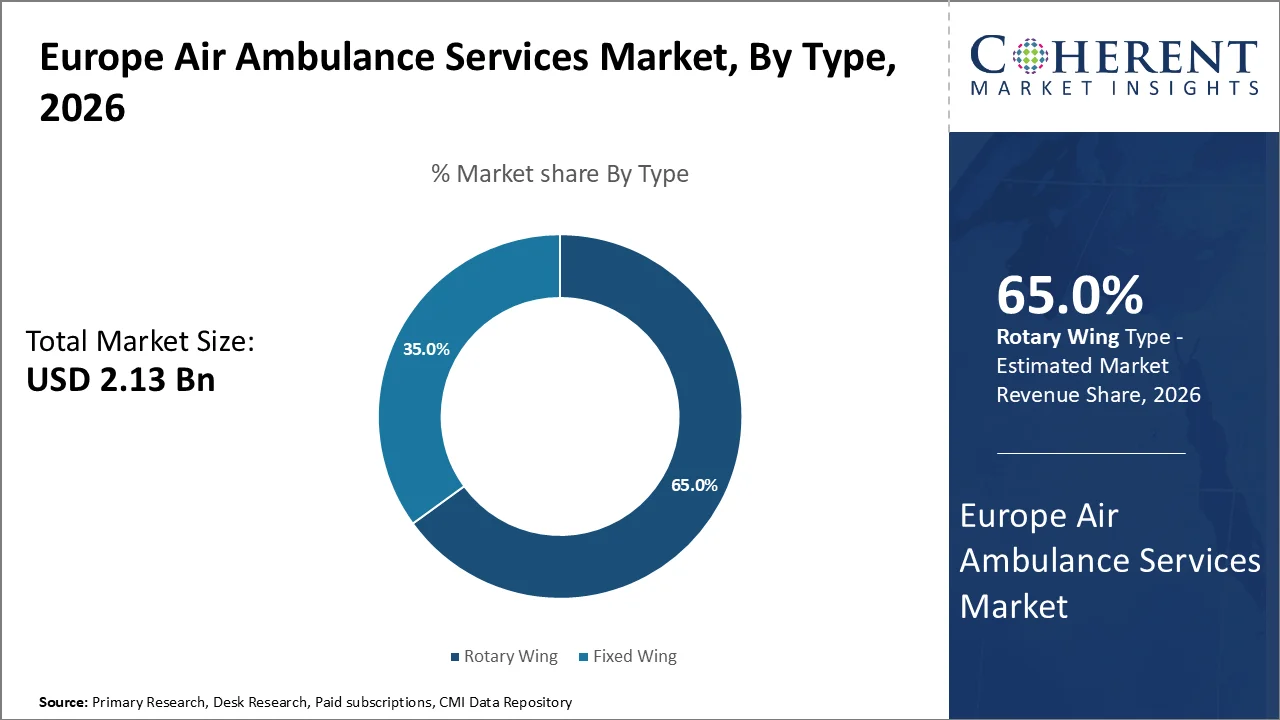
Why is Rotary Wing Acquiring the Largest Market Share?
Rotary wing segment is projected to account for the largest share of formulation in 2026, representing approximately 65% of the total volume. Its distinct operational advantages and the critical role it plays in emergency medical situations is propelling the market growth. Rotary Wing aircraft commonly helicopters offer unparalleled accessibility and speed in urban environments, mountainous terrains, and areas where traditional runways are unavailable or difficult to reach.
This flexibility makes them indispensable for rapid patient retrieval, especially in acute trauma cases having immediate transport to the nearest trauma care center. A total of 313 trauma-related deaths were recorded: 151 in 2019 and 162 in 2022. Median age was 72 years (P25–P75: 52–84), and 67% were men.
For example, Germany’s ADAC Luftrettung, one of Europe’s largest helicopter emergency medical service providers, works an extensive fleet of rotary wing aircraft equipped with advanced lifesaving technologies.
Their ability to instant reach accident sites, even in congested cities or remote rural areas, majorly lowers the time between injury occurrence and arrival at a specialized care center, thus improving patient survival and recovery rates.
- Current Industry Events of 2026
- Market Size Estimation
- Regional Breakdown
- Competitive Landscape
- Customer Intelligence
- Segmental Analysis
- Pricing Analysis
- Key Market Drivers, Challenges & Future Trends
- Customized Insights Section
Independent holds the Largest Market Share
Based on service model, independent dominates the market, accounting for a significant 48% share in 2026. Independent air ambulance providers have made a substantial niche by providing specialized, customer-focused services that are usually more flexible as well as refractive than traditional hospital or government-run models.
These organizations usually work with the agility to cater to instant patient needs, serve a wider network of hospitals, as well as provide customized medical transport services that are not always limited by bureaucratic protocols.
For example, well-established independent operators including the Luxembourg-based DRF Luftrettung, which, while technically a non-profit, work with a level of operational flexibility similar to independent providers, shows how agile service delivery can effectively cater to patient demand across various regions.
By targeting on swift inter-hospital transfers, repatriation services, as well as private contracts, independent operators usually attract client segments who need personalized or international air ambulance solutions, including private insurance holders as well as multinational corporations needing employee medical evacuation.
Domestic holds the Largest Market Share
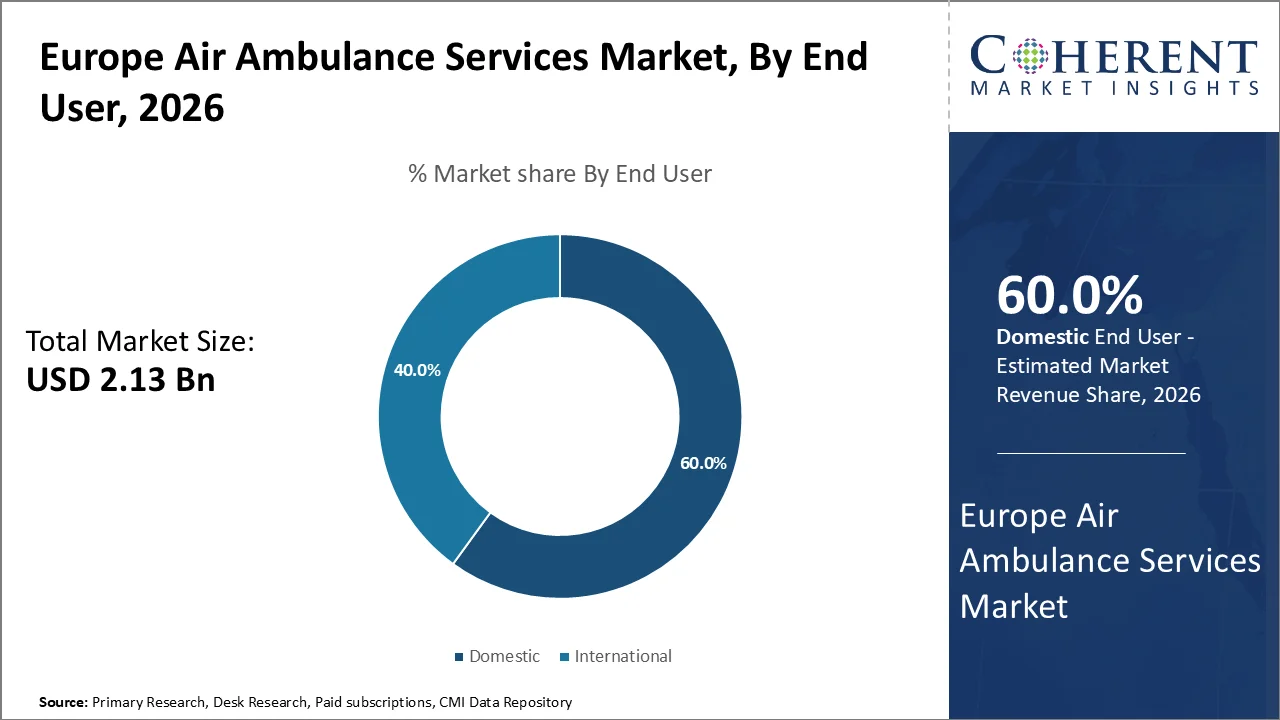
Based on end user, domestic dominant the market, accounting for a significant 60% share in 2026, owing to several critical factors deeply rooted in healthcare infrastructure, accessibility, and regional emergency response frameworks.
The dense network of hospitals, regional trauma centers, as well as specialized medical facilities goes across European countries that frequently require rapid intercity or intraregional patient transfers.
These transfers usually involve critical care situations including severe trauma cases, cardiac arrests, or acute stroke treatments, where timely transportation can majorly influence patient survival and recovery outcomes. Nearly 10 million people are living with the long-term consequences of stroke. Stroke care costs EU countries an estimated €60 billion a year.
For instance, countries including Germany, France, the United Kingdom, etc., have well-established emergency medical systems that integrate air ambulance services as an important component of their broader healthcare delivery frameworks.
Aircraft Technology is transforming the Europe Air Ambulance Services Industry
Advanced aircraft technology in air ambulance services includes modern helicopters as well as fixed-wing aircraft including Airbus Helicopters H145/H135, Leonardo AW109, Pilatus PC-24, etc. These aircraft are made with improved avionics, better fuel efficiency, higher payload capacity, as well as advanced medical interiors. They aid operators improve response time, extend flight range, and ensure safer and more comfortable patient transport, including access to remote or hard-to-reach areas.
Another development is the utilization of Night Vision Imaging Systems (NVIS) as well as Instrument Flight Rules (IFR), which enable 24/7 emergency operations even in poor visibility or night conditions. NVIS improves pilot visibility utilizing night vision goggles, while IFR allows aircraft to fly safely using instruments when weather conditions are not suitable for visual flying. Together, these technologies essentially enhance mission reliability, safety, as well as continuous emergency medical coverage.
Current Events and Their Impact on the Europe Air Ambulance Services Market
Current Event | Description and its Impact |
Stronger EU aviation safety and medical transport regulations (EASA updates 2025–2026) |
|
Expansion of cross-border emergency medical coordination under EU health frameworks (2025–2026) |
|
Europe Air Ambulance Services Market Trends
- The Europe air ambulance services market is positioned for rapid growth, propelled by high demand for rapid emergency medical transportation, technological advancements in aviation and medical equipment, along with rising healthcare expenditure across the region. Current healthcare expenditure in the EU was €1 720 billion in 2023. This was equivalent to 10.0% of gross domestic product (GDP).
- The market is experiencing major trends including the integration of advanced telemedicine as well as critical care monitoring systems on board, the expansion of specialized air ambulance networks, with the growing partnerships between private operators and national health services to enhance response times and patient outcomes.
- Germany, the United Kingdom, France, and Italy emerge as the most lucrative markets by revenue potential, due to their extensive healthcare infrastructure, high incidence of chronic and emergency health conditions, as well as strong support by government authorities for emergency medical services. There are 234k businesses in the Healthcare Activities industry in Germany, which has grown at a CAGR of 0.7 % between 2021 and 2026.
- Additionally, the Nordic countries, particularly Sweden, Norway, etc., while smaller in volume, offer attractive opportunities due to challenging geographies and a high emphasis on quality healthcare delivery.
- Emergency medical transport remains the dominant application segment, driven by the urgent need to transfer trauma and critical care patients rapidly to specialized facilities.
Who are the Major Companies in Europe Air Ambulance Services Industry
Some of the major key players in Europe air ambulance services market include, Aero Medical Ambulance Service, Aero-Dienst GmbH, Airlec Air Espace, European Air Ambulance, Flightserve International, IAS Medical, Medical Air Service, Quick Air Jet Charter GmbH, Babcock Scandinavian Air Ambulance, Capital Air Ambulance
Key News
- In June 2026, Technip Eneries, Airbus, Safran and Tereos have joined forces to create Rebound, a new joint venture that aims to develop one of Europe’s largest sustainable aviation fuel (SAF) production facilities at the Port of Dunkirk in northern France.
- In September 2025, Malteser AeroMedical expanded its European air ambulance network with the opening of a new operational base at Vienna International Airport (LOWW), marking the organization’s second dedicated air ambulance base alongside its existing operation in Cologne, Germany.
Market Report Scope
Europe Air Ambulance Services Market Report Coverage
| Report Coverage | Details | ||
|---|---|---|---|
| Base Year: | 2025 | Market Size in 2026: | USD 2.13 Bn |
| Historical Data for: | 2020 To 2024 | Forecast Period: | 2026 To 2033 |
| Forecast Period 2026 to 2033 CAGR: | 8.9% | 2033 Value Projection: | USD 3.92 Bn |
| Geographies covered: |
| ||
| Segments covered: |
| ||
| Companies covered: | Aero Medical Ambulance Service, Aero-Dienst GmbH, Airlec Air Espace, European Air Ambulance, Flightserve International, IAS Medical, Medical Air Service, Quick Air Jet Charter GmbH, Babcock Scandinavian Air Ambulance, Capital Air Ambulance | ||
| Growth Drivers: |
| ||
| Restraints & Challenges: |
| ||
Analyst Opinion
- The Europe Air ambulance services market is witnessing notable growth driven primarily by increasing demand for rapid emergency medical transportation and advancements in air medical technologies. The study population included 1,250 patients transferred by air ambulance and 5,650 by ground ambulance. (Tehran emergency database).
- Rising incidences of critical health conditions, along with expanding geriatric populations across European countries, are fueling the need for timely and efficient air ambulance services. The average cost of medical evacuation from the U.S. to the UK exceeded £192,212 in 2024, while repatriation from Spain now averages £45,136, an 18% increase in two years, according to Avanti Travel Insurance.
- Moreover, advance healthcare infrastructure as well as growing awareness about specialized medical evacuation support contribute significantly to market expansion. Following medical evacuation, nearly 4000 patients have returned to Ukraine and continue to receive care within the national health system.
- However, the high operational and maintenance costs of air ambulance fleets and stringent regulatory frameworks present considerable challenges.
- These factors can limit the scalability of services, particularly in less urbanized areas. Additionally, weather dependency and limited availability of landing zones in remote regions pose logistical restraints that stakeholders need to address.
- Opportunities for market players lie in expanding their service portfolios by integrating telemedicine and advanced life support systems within aircraft, enhancing real-time patient monitoring. There is also potential in increasing collaborations with government bodies and private healthcare providers to broaden service accessibility.
Speak to the analyst
Want personalized insights?
Take the findings above to one of our principal consultants, or have the report rebuilt around the segments, geographies and competitors you actually track.
Market Segmentation
- By Type (Revenue, USD Bn, 2021-2033)
- Rotary Wing
- Fixed Wing
- By Service Model (Revenue, USD Bn, 2021-2033)
- Hospital Based
- Government Run
- Independent
- By End User (Revenue, USD Bn, 2021-2033)
- Domestic
- International
Sources
Primary Research Interviews
- Air Ambulance Service Providers (Europe)
- Aviation Regulatory Authorities
- Healthcare Providers & Hospitals
- Medical Equipment Suppliers
- Others
Databases
- IQVIA
- ClinicalTrials.gov
- EvaluatePharma
- Others
Magazines
- Air Medical Journal
- European Aviation Safety Magazine
- Healthcare Business International
- Others
Journals
- Journal of Air Transport Management
- International Journal of Emergency Services
- European Journal of Healthcare Management
- Others
Newspapers
- The Financial Times (Europe Edition)
- The Guardian (Health Section)
- Aviation Week & Space Technology
- Others
Associations
- European Aeromedical Institute (EURAMI)
- European Air Ambulance Association (EAAA)
- International Association of Air Medical Services (IAAMS)
- Others
Public Domain Sources
- European Union Aviation Safety Agency (EASA) Reports
- World Health Organization (WHO) Regional Publications
- European Centre for Disease Prevention and Control (ECDC)
- Others
Proprietary Elements
- CMI Data Analytics Tool
- Proprietary CMI Existing Repository of information for last 10 years
Get access to 250+ pages report
Every segment, forecast, competitor profile and data table behind the analysis above — available for instant download.
- ESOMAR Member
- ISO 9001:2015 Certified
- D-U-N-S Registered
- GDPR & CCPA Compliant
Missing comfort of reading report in your local language? Find your preferred language:
Transform your Strategy with Exclusive Trending Reports
Frequently Asked Questions
The Europe air ambulance services market is expected to reach USD 3.92 Bn in 2033.
Major players operating in the Europe air ambulance services market include Aero Medical Ambulance Service, Aero-Dienst GmbH, Airlec Air Espace, European Air Ambulance, Flightserve International, IAS Medical, Medical Air Service, Quick Air Jet Charter GmbH, Babcock Scandinavian Air Ambulance, Capital Air Ambulance.
Regulatory complexities and stringent aviation laws is expected to restrain the Europe air ambulance services market growth over the forecast period.
Increasing inorganic activities such as acquisitions is driving growth of the Europe air ambulance services market.
The Europe air ambulance services market is anticipated to grow at a CAGR of 8.9% between 2026 and 2033.
An air ambulance typically costs between USD15,000 and USD 30,000 for a domestic flight in the US (or ₹1.5 lakh to ₹10+ lakh in India), but can exceed USD 100,000 for long-range or international transfers.
An air ambulance aircraft is used for the safe and comfortable transportation of patients who are critically ill and cannot travel long distance using other mode of transport. An air ambulance is a business class aircraft and is equipped with advanced medical appliances to provide urgent medical assistance for patients.