

Intravenous Access Devices Market Size and Share Analysis - 2026 to 2033
The global intravenous access devices market size is expected to reach approximately USD 62,350 Mn in 2026 and is projected to grow at a compound annual growth rate (CAGR) of 6.6% during the forecast period (2026-2033), reaching USD 97,750 Mn by 2033. This is growth attributable to rising prevalence of chronic diseases requiring intravenous therapy and advancements in minimally invasive medical devices.
Key Takeaways from the Intravenous Access Devices Market Report
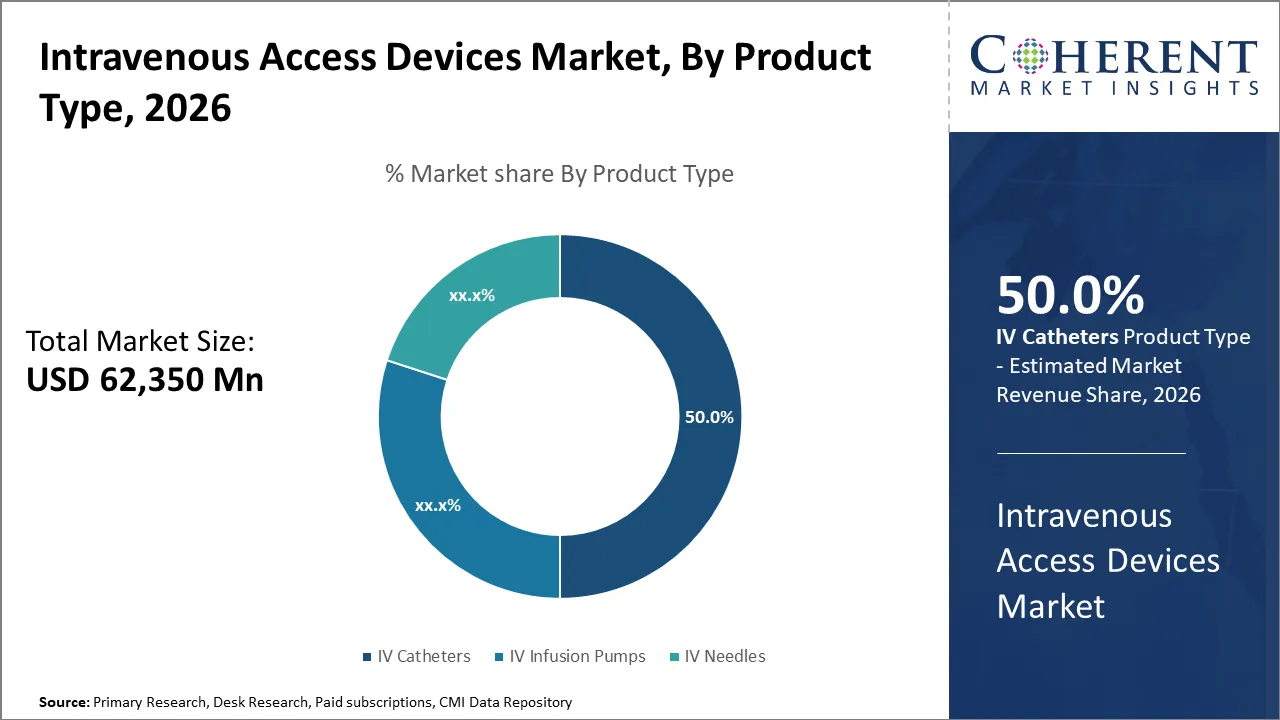
- IV catheters segment is expected to dominate the market, accounting for nearly 50% of the market revenue share in 2026, due to routine use, disposability, and broad clinical application.
- By catheter type, peripherally inserted central catheters (PICCs) segment is slated to account for around 40% of the global intravenous access devices market share in 2026 as a result of their long term use in oncology, nutrition, and antibiotic delivery.
- Hospitals & clinics are likely to remain leading end users of intravenous access devices during the forecast period, accounting for a share of over 70% in 2026 due to surgical, emergency, and chronic care usage.
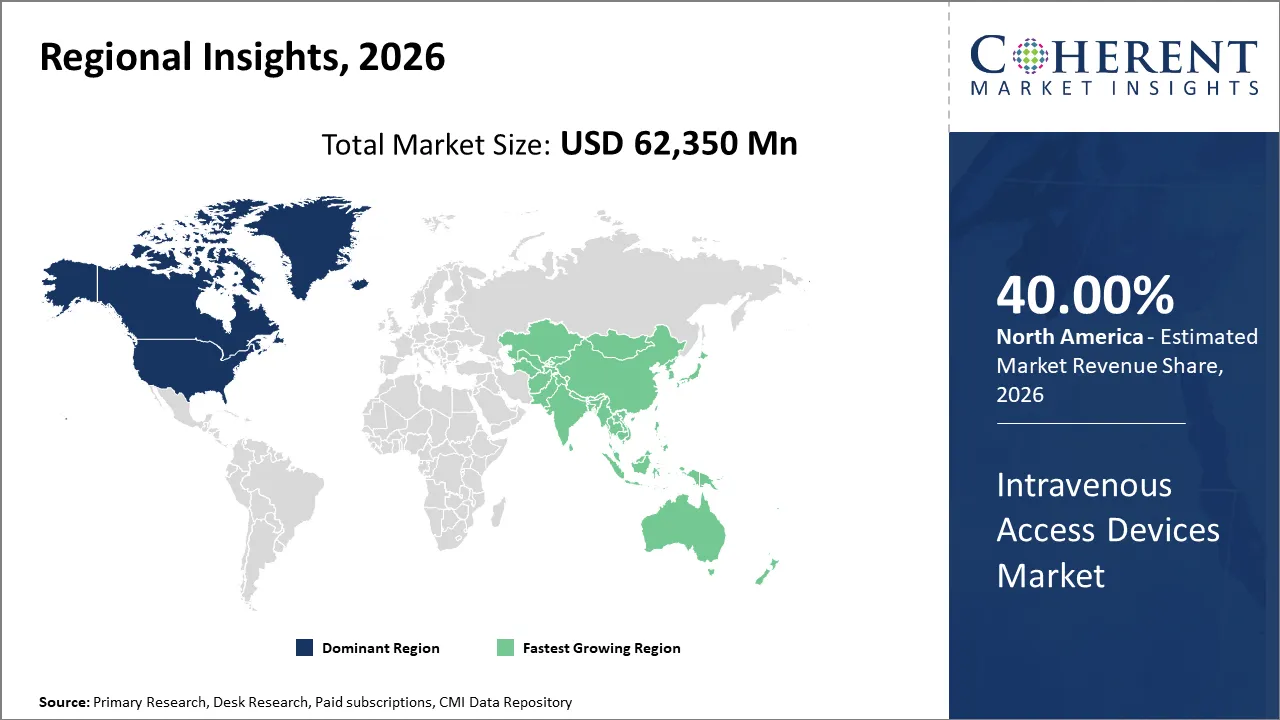
- North America is projected to lead the global intravenous access devices industry with a share of 40% in 2026, thanks to high adoption of advanced healthcare technologies, well-established healthcare infrastructure, and increasing prevalence of chronic diseases.
- Asia Pacific, with a share of 20% in 2026, is anticipated to emerge as the most lucrative pocket for intravenous access device manufacturers during the forecast period, mostly due to expanding access and rising clinical procedures.
Intravenous Access Devices Market Overview
The global intravenous access devices market is expected to grow steadily during the forecast period. This is primarily due to rising prevalence of chronic diseases, increasing number of surgical procedures, and growing demand for minimally invasive therapeutic interventions. In addition, expansion of hospital infrastructure, advancements in catheter and infusion technologies, and heightened awareness regarding infection prevention and patient safety are supporting market expansion.
Intravenous access devices (IVADs) are small, flexible tubes placed in veins to provide long-term access to the bloodstream for people who require frequent or continuous medication, fluid, or blood administration. Some IVADs, such as totally implantable venous ports, are implanted under the skin and connect to central veins in the chest or neck.
IVADs, which include catheters and ports, also make repeated access to the bloodstream easier and less painful, reducing the need for multiple needle sticks. Rising adoption of these medical devices in hospitals, clinics, home care, and other healthcare facilities is expected to provide a strong impetus for the growth of intravenous access devices market during the forecast period.
Shift towards minimally invasive and patient-centric solutions is supporting expansion of the intravenous access devices market. There is rising demand for minimally invasive, patient-friendly devices that increase comfort, reduce complication risks, and support outpatient care. Similarly, growth in home infusion therapy is fueling demand for intravenous access devices. As healthcare shifts toward home-based treatment models, demand grows for user-friendly IV access solutions suitable for non-clinical settings.
Current Events and Their Impact on the Intravenous Access Devices Market
Current Event | Description and its Impact |
Global Aging Population and Chronic Disease Surge |
|
Technological Advancements in Smart Medical Devices |
|
Segmental Insights
- Current Industry Events of 2026
- Market Size Estimation
- Regional Breakdown
- Competitive Landscape
- Customer Intelligence
- Segmental Analysis
- Pricing Analysis
- Key Market Drivers, Challenges & Future Trends
- Customized Insights Section
Which is the Most Sought-After Product Type in the Market?
IV Catheters Retain Top Spot in Global Market
IV catheters are expected to remain the top-selling product type in the market, accounting for a revenue share of 50% in 2026. This is mostly due to increasing use of intravenous catheters in hospitals and clinics for short-term and long-term intravenous therapy, ease of insertion, and cost-effectiveness compared to other intravenous access devices.
Rising prevalence of chronic diseases, increasing surgical procedures, and growing demand for minimally invasive treatments are driving the continuous adoption of IV catheters across various healthcare settings. Innovations such as safety-engineered catheters and advanced materials that reduce infection risks further reinforce their dominant position in the global market.
Who is the Leading End User of Intravenous Access Devices?
IV Access Device Adoption Remains High in Hospitals & Clinics
According to Coherent Market Insights, hospitals and clinics are anticipated to remain the leading end users of intravenous access devices during the forecast period, holding a market share of 70% in 2026. This is attributable to high volume of inpatient and outpatient procedures requiring intravenous therapy, as well as the increasing prevalence of chronic and acute diseases.
Rising demand for advanced IV technologies that improve patient care and reduce complications is driving intravenous adoption in hospitals and clinics. In addition, hospitals and clinics usually have the infrastructure, trained staff, and resources to support widespread use of devices like IV catheters, infusion pumps, and needles, thereby boosting growth of the target segment in the market.
Regional Insights
North America Remains at the Epicenter of Intravenous Access Devices Market Growth
North America is anticipated to retain its dominance over the global intravenous access devices market, capturing a share of 40% in 2026. This is mostly due to high adoption of advanced IV technologies such as smart infusion pumps, safety IV catheters, and automated monitoring systems. Hospitals are increasingly focusing on reducing IV-related complications, improving patient safety, and streamlining workflow efficiency, which drives the demand for reliable intravenous access devices.
Strong presence of some of the top medical device manufacturers, including Becton, Dickinson and Company, Teleflex, Inc., C.R. Bard, Inc., Smiths Medical, Inc., and Baxter International Inc. in the U.S. is also fostering market growth. Government initiatives supporting hospital modernization and the widespread use of outpatient surgical centers further boost market expansion. In addition, North American hospitals are increasingly implementing stringent patient safety protocols, which encourage the adoption of high-quality IV devices.
Asia Pacific Intravenous Access Devices Market Trends
Asia Pacific is emerging as the fastest‑growing regional market for intravenous and vascular access devices in the world. This rapid growth is mainly driven by increasing cases of chronic diseases (such as cancer, diabetes, cardiovascular disorders), a growing elderly population, and expanding healthcare infrastructure and hospital care needs across countries like China, India, and Japan. The region is likely to account for 20% of global intravenous access device sales in 2026.
Asia Pacific is experiencing a rise in chronic diseases like diabetes and cardiovascular disorders, which often need frequent IV treatments, driving demand. For example, the International Diabetes Federation estimates that adults with diabetes in China will reach 168.3 million by 2050. This high diabetes burden is expected to increase sales of intravenous access devices during the forecast period.
Rising demand for long‑term intravenous therapies, including chemotherapy, dialysis, and critical care treatments, is significantly increasing the use of vascular access and IV devices in the region. Similarly, rising government spending, expanding hospital networks, and adoption of modern surgical and perioperative care practices are creating strong demand for IV catheters, infusion pumps, and related devices in Asia Pacific.
Intravenous Access Devices Market Outlook – Country-wise
U.S. Intravenous Access Devices Market Trends
The U.S. is expected to remain the leading market for intravenous access devices during the forecast period. This is mostly due to advanced healthcare infrastructure, high patient volumes, and widespread adoption of safety-focused IV technologies, including smart infusion pumps and safety catheters. Hospitals are increasingly implementing protocols to reduce IV-related complications and improve workflow efficiency, which is driving demand for reliable intravenous access devices.
Rising emphasis on patient safety and technological adoption is providing a strong impetus for the growth of intravenous access devices market in the U.S. Hospitals and outpatient surgical centers are investing in automated IV monitoring systems and advanced catheters to improve treatment outcomes.
China Intravenous Access Devices Market Forecast
The intravenous access devices market in China is poised to exhibit robust growth during the forecast period. This can be attributed to rapid expansion of modern hospitals, rising surgical volumes, and increased healthcare spending. The government’s Healthy China 2030 initiative is supporting hospital modernization and the adoption of advanced medical devices.
Rise of minimally invasive and robotic-assisted surgeries in tier-1 and tier-2 cities is also playing a key role in boosting intravenous access devices market value in China. These procedures require precise intravenous access and monitoring, boosting demand for smart infusion pumps, safety catheters, and related devices across hospitals and surgical centers.
Intravenous Access Devices Industry News
- In March 2026, Baxter International Inc. launched the IV Verify Line Labeling System to support safer medication administration. This automated solution is designed to improve IV labeling in healthcare settings.
- In February 2025, Johnson & Johnson launched the CEREGLIDE 92 Catheter System in the U.S. to treat acute ischemic stroke. This catheter helps doctors safely guide medical devices through the brain’s blood vessels.
- In October 2024, BD launched the Intraosseous Vascular Access System. This device helps doctors and nurses quickly give fluids or medicine in emergencies when a regular IV is hard to use.
- In May 2024, Teleflex added the Arrow EZ-IO Intraosseous Access Procedure Tray to its vascular access products. This kit gives doctors all the tools they need to quickly get access to a patient’s bone when regular IVs are difficult.
Market Report Scope
Intravenous Access Devices Market Report Coverage
| Report Coverage | Details | ||
|---|---|---|---|
| Base Year: | 2025 | Market Size in 2026: | USD 62,350 Mn |
| Historical Data for: | 2020 To 2024 | Forecast Period: | 2026 To 2033 |
| Forecast Period 2026 to 2033 CAGR: | 6.6% | 2033 Value Projection: | USD 97,750 Mn |
| Geographies covered: |
| ||
| Segments covered: |
| ||
| Companies covered: | Becton, Dickinson And Company, Teleflex, Inc., C.R. Bard, Inc., Fresenius Medical Care, Smiths Medical, Inc., Hospira, Inc., Covidien Plc, Fresenius Medical Care AG & Co., and Baxter International Inc. | ||
| Growth Drivers: |
| ||
| Restraints & Challenges: |
| ||
Intravenous Access Devices Market Drivers
Rising Prevalence of Chronic Diseases There is a notable increase in chronic conditions such as cancer, diabetes, cardiovascular diseases, and kidney disorders globally. For instance, according to the International Agency for Research on Cancer (IARC), the annual number of new cancer cases is projected to rise to over 35 million by 2050. This high chronic disease burden is expected to create demand for intravenous access devices because these diseases often require long-term IV therapies like chemotherapy and parenteral nutrition.
Increasing Surgical Procedures and Hospitalizations Rising number of surgical interventions and hospital admissions globally is boosting demand for IV access devices, particularly in acute and critical care settings. A widely cited modeling study linked to The Lancet found that more than 234 million major surgical procedures are performed worldwide each year. The rising number of these procedures directly boosts sales of intravenous access devices, which are crucial during surgery.
Intravenous Access Devices Market Trends
Shift Towards Single-Use and Disposable IV Access Systems Rising adoption of disposable intravenous access devices, such as peripheral IV catheters and safety-engineered IV systems, is a key trend shaping market growth. Healthcare professionals in the contemporary world increasingly prefer single-use systems to prevent cross-contamination and comply with strict infection control protocols. This trend is expected to drive growth of the intravenous access devices industry during the forthcoming period.
Intravenous Access Devices Market Opportunities
Expansion of Outpatient and Home Care Services
Ambulatory care centers and home healthcare services are expanding significantly, especially across developing regions like Asia Pacific. This, in turn, is driving demand for portable, easy to use IV access devices that support treatments outside hospitals. Thus, rising adoption of home care services is expected to create lucrative growth opportunities for the intravenous access devices during the forecast period.
Technological Advancements in Intravenous Access Products
Innovation is at the forefront of the intravenous (IV) access devices market. Advancements such as smart monitoring systems, needle-free access technologies, and safer catheter materials enhance patient safety, improve dosing accuracy, and simplify clinical workflows, driving greater adoption in healthcare settings.
Leading manufacturers of intravenous access devices are introducing novel solutions like ultrasound-guided IV catheters, antimicrobial-impregnated catheters, and wearable IV infusion systems. These innovations not only reduce the risk of infection and improve patient comfort but also enable real-time monitoring of fluid delivery, making IV therapy more efficient and reliable.
Analyst Opinion (Expert Opinion)
- Clinical efficiency matters more than device familiarity. Traditional IV cannulas are often picked out of habit, but studies show that ultrasound-guided peripheral IVs can lower first-attempt failure rates by up to 41 % in patients with difficult access. Hospitals with high patient acuity are increasingly selecting devices that demonstrably improve cannulation success, indicating that performance under real-world conditions — not legacy comfort — is dictating procurement decisions.
- Integrated technology is changing device value. Smart IV catheters with built-in pressure sensors and real-time patency monitoring are becoming more popular. Early users report up to 30 % fewer infiltration events. Clinicians now prefer devices that give continuous feedback and actionable alerts over standard catheters, showing that future advantage will depend on digital integration and proactive complication management.
- Usability under clinical stress is the ultimate performance metric. Bench simulations and live ICU trials show that devices with ergonomic wings and flexible shafts reduce insertion time by 15–20 % in emergent scenarios. High-volume nursing teams prefer these designs, proving that ease of handling and adaptability in fast-paced environments outweigh cost and brand in influencing purchasing decisions.
- Patient safety and material innovation are key factors. Reports show that poor catheter materials can cause phlebitis and device blockage in up to 12 % of cases. IV devices with biocompatible, antimicrobial coatings are being chosen more often in tertiary care centers. This shows that hospital committees now consider material quality and safety history just as important as mechanical reliability when selecting IV access devices.
Speak to the analyst
Want personalized insights?
Take the findings above to one of our principal consultants, or have the report rebuilt around the segments, geographies and competitors you actually track.
Market Segmentation
- By Product Type Insights ( Revenue, USD Mn, 2021 - 2033)
- IV Catheters
- IV Infusion Pumps
- IV Needles
- By Catheter Type Insights ( Revenue, USD Mn, 2021 - 2033)
- Midline Peripheral Catheters
- Peripherally Inserted Central Catheters
- Centrally Inserted Central Catheters
- Others
- By End User ( Revenue, USD Mn, 2021 - 2033)
- Hospitals and Clinics
- Ambulatory Surgery Centers
- By Region Insights ( Revenue, USD Mn, 2021 - 2033)
- North America
- U.S.
- Canada
- Latin America
- Brazil
- Argentina
- Mexico
- Rest of Latin America
- Europe
- Germany
- U.K.
- Spain
- France
- Italy
- Russia
- Rest of Europe
- Asia Pacific
- China
- India
- Japan
- Australia
- South Korea
- ASEAN
- Rest of Asia Pacific
- Middle East & Africa
- GCC Countries
- Israel
- Rest of Middle East & Africa
- North America
- Key Players in the Intravenous Access Devices Market
- Becton, Dickinson And Company
- Teleflex, Inc.
- C.R. Bard, Inc.
- Fresenius Medical Care
- Smiths Medical, Inc.
- Hospira, Inc.
- Covidien Plc
- Fresenius Medical Care AG & Co.
- Baxter International Inc.
Sources
Primary Research interviews
- Healthcare professionals (interventional radiologists, anesthesiologists)
- Hospital procurement managers
- Nurses specializing in vascular access
- Medical device distributors
- Biomedical engineers in hospital settings
Databases
- World Health Organization (WHO) database
- Centers for Disease Control and Prevention (CDC) data repository
- National Health Statistics Reports (e.g., NHS Digital from UK)
- PubMed Central
- ClinicalTrials.gov
Magazines
- Medical Device & Diagnostic Industry (MD+DI)
- Healthcare Purchasing News
- Becker’s Hospital Review
- Medical Design & Outsourcing
Journals
- Journal of Vascular Access
- American Journal of Infection Control
- Critical Care Medicine
- The Lancet – Vascular Access & Catheterization Sections
- Journal of Clinical Nursing
Newspapers
- The New York Times – Health Section
- The Guardian – Health & Science
- The Times of India – Health News
- The Hindu – Health
Associations
- Association for Vascular Access (AVA)
- Infusion Nurses Society (INS)
- World Federation of Societies of Anaesthesiologists (WFSA)
- American Society of Anesthesiologists (ASA)
- National Institute for Health and Care Excellence (NICE)
Public Domain sources
- U.S. Food and Drug Administration (FDA) product and guidance database
- European Medicines Agency (EMA) device notifications
- National health ministries (India, UK, Canada etc.)
- Clinical practice guidelines (publicly available)
Proprietary Elements
- CMI Data Analytics Tool
- Proprietary CMI Existing Repository of information for last 8 years
Get access to 250+ pages report
Every segment, forecast, competitor profile and data table behind the analysis above — available for instant download.
- ESOMAR Member
- ISO 9001:2015 Certified
- D-U-N-S Registered
- GDPR & CCPA Compliant
Missing comfort of reading report in your local language? Find your preferred language:
Transform your Strategy with Exclusive Trending Reports
Frequently Asked Questions
The global market is estimated to be valued at USD 62,350 Mn in 2026.
The global Intravenous Access Devices Market value is expected to reach USD 97,750 Mn by 2033.
The global market is poised to exhibit a CAGR of 6.6% from 2026 to 2033.
Major growth factors include increasing prevalence of chronic diseases and rising number of surgical procedures.
High costs of advanced products and risk of infection might slow down market growth.
IV Catheters, with about 50% market share in 2026, remain the top-selling product type.
Some major companies in the Intravenous Access Devices Market include Becton, Dickinson And Company, Teleflex, Inc., C.R. Bard, Inc., Fresenius Medical Care, Smiths Medical, Inc., Hospira, Inc., Covidien Plc, Fresenius Medical Care AG & Co., and Baxter International Inc.