

Global Robotic Surgery Market Size and Forecast – 2026 to 2033
The global robotic surgery market is estimated to be valued at USD 15.00 Bn in 2026 and is expected to reach USD 45.29 Bn by 2033, exhibiting a compound annual growth rate (CAGR) of 17.1% from 2026 to 2033. Increasing technological advancements, rising demand for minimally invasive surgeries, and the expanding adoption of robotic systems across various medical specialties worldwide significantly drive the market growth.
Key Takeaways of the Global Robotic Surgery Market
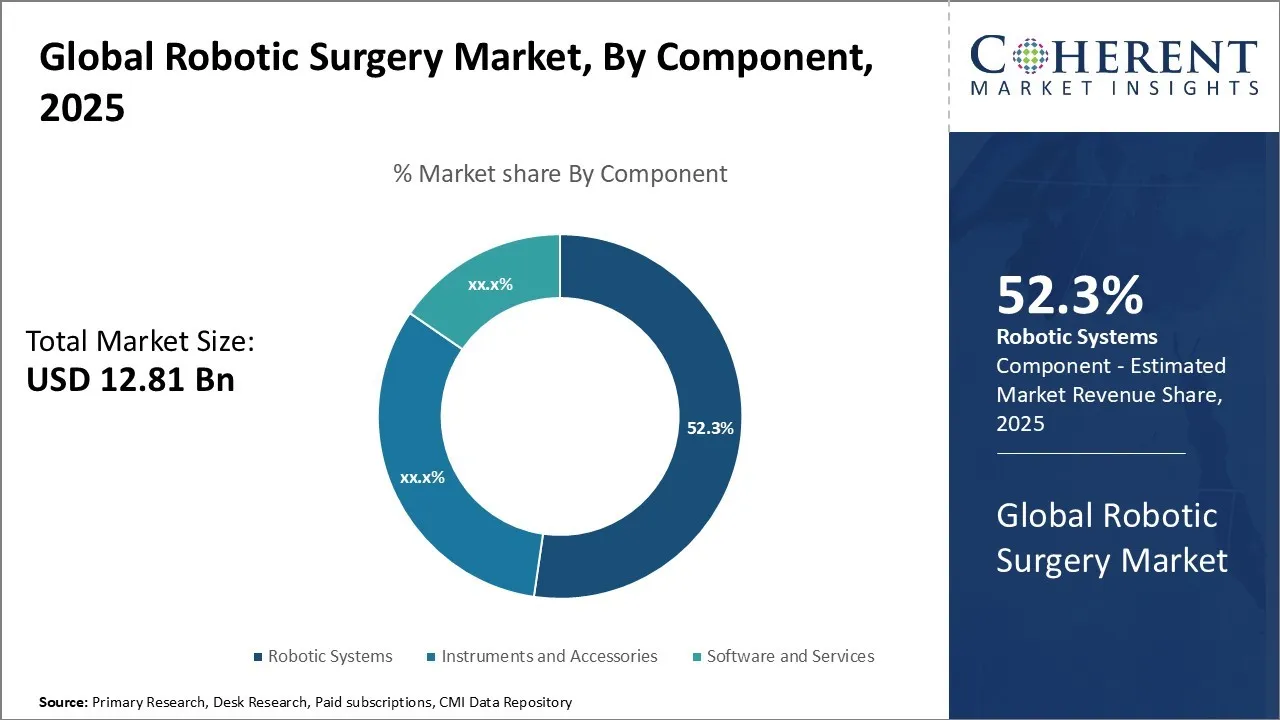
- Robotic systems segment is expected to account for 53.3% of the robotic surgery market share in 2026.
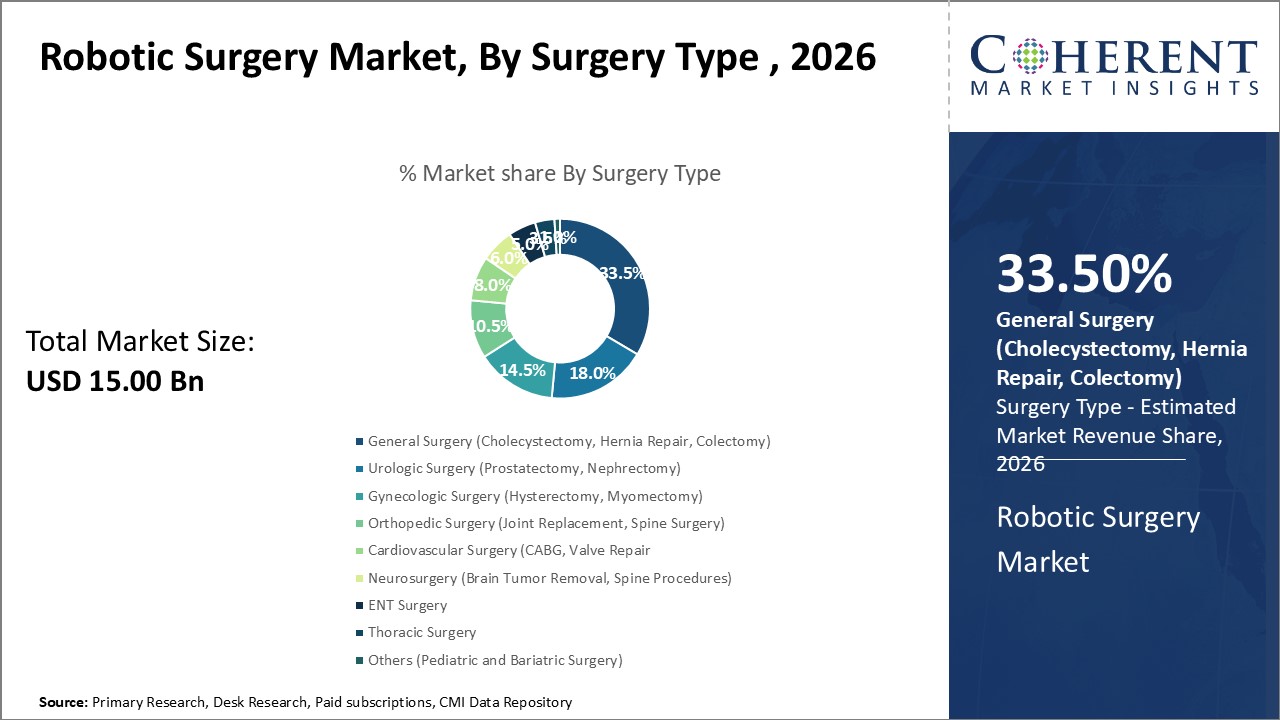
- General surgery segment is expected to capture 33.5% of the global robotic surgery market share in 2026.
- Robotic-assisted minimally invasive surgery segment is projected to hold 46.5% of the market share in 2026.
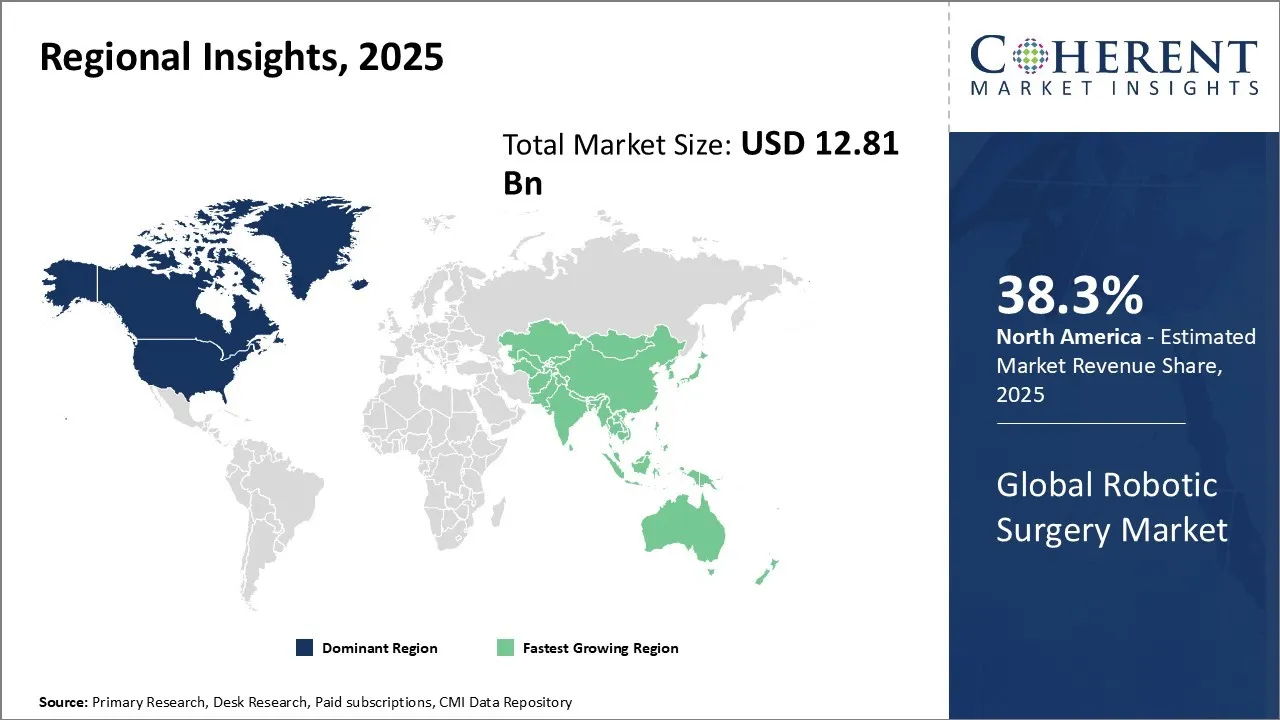
- North America is expected to lead the market, holding a share of 38.3% in 2026. Asia Pacific is anticipated to be the fastest-growing region, with an estimated market share of 24.3% in 2026.
Market Overview
Current market trends indicate a strong shift towards the integration of artificial intelligence and machine learning to enhance surgical precision and outcomes. Additionally, there is increased investment in developing compact and cost-effective robotic platforms, making robotic surgery more accessible to emerging markets. The growing prevalence of chronic diseases and a surge in geriatric populations are further accelerating the demand, positioning robotic surgery as a transformative solution in modern healthcare.
Currents Events and Its Impact
Current Events | Description and its Impact |
Rapid Integration of AI and Machine Learning |
|
WHO and Society of Robotic Surgery launch telesurgery initiative |
|
Segmental Insights
- Current Industry Events of 2026
- Market Size Estimation
- Regional Breakdown
- Competitive Landscape
- Customer Intelligence
- Segmental Analysis
- Pricing Analysis
- Key Market Drivers, Challenges & Future Trends
- Customized Insights Section
Robotic Surgery Market Insights, By Component - Robotic Systems Contribute the Highest Market Share Owing to Advanced Integration and Clinical Precision
The robotic systems will take over the market for robotic surgery by 2026 with a 53.3% market share, because they offer integrated solutions comprising advanced visualization, AI, and precision in one versatile surgical application. Moreover, the robotic systems are unlike standalone accessories or replacement parts, i.e., they are complete solutions where the capital equipment, visualization systems, surgical consoles, and various instruments are all under one umbrella.
The integrated systems facilitate the surgeons to execute intricate procedures with increased dexterity, precision, and control. Furthermore, the modular design of these systems allows the healthcare facilities that are aiming to upgrade their operative technologies to consider them as a versatile choice because of their adaptability to various types of surgeries.
Robotic Surgery Market Insights, By Surgery Type - General Surgery Leads Driven by Broad Procedural Applicability and Demand for Minimally Invasive Techniques
The global robotic surgery market is dominated by general surgery, with a 33.5% share in 2026, due to the diversity of procedures performed. The sector of general surgery is not only characterized by high volumes but also by the need for increasingly precise and less invasive surgical methods leading to faster recovery and lower rates of complications.
These operations account for the most commonly performed surgeries across the globe, thus generating a large and continuous demand for technology that assures precision and reduction of complications at the same time. Surgeons are offered with better visualization and maneuverability by robotic platforms, which are very advantageous in delicate abdominal procedures, often performed during general surgery.
Robotic Surgery Market Insights, By Technology - Robotic-Assisted Minimally Invasive Surgery Leads due to Enhanced Clinical Outcomes and Surgeon Control
Robotic-assisted minimally invasive surgery is expected to be the largest segment with a 46.5% share in 2026. Its leadership is propelled by the merger of robotic precision with the long-established clinical benefits of minimally invasive surgery. This technique decreases procedural invasiveness while maximizing the surgeon's precision, thus dramatically enhancing patient safety and recovery metrics.
In September 2024, ZEISS Medical Technology, a global leader in optical and digital surgical solutions, introduced the KINEVO 900 S at the CNS meeting as a major advancement in Robotic Surgery visualization. The system delivers enhanced 4K 3D digital imaging, AI-supported robotic functions and connected workflow tools to help neurosurgeons perform complex procedures with greater clarity, precision and efficiency.
Cost-Benefit and ROI (Return on Investment) Benchmarking: Robotic vs. Laparoscopic vs. Open Surgery
Category | Robotic Surgery | Laparoscopic Surgery | Open Surgery |
Initial Investment (Capex – Capital Expenditure) | Very high CAPEX due to robotic platform purchase and annual service. | Moderate CAPEX for laparoscopy towers, scopes, and energy devices. | Lowest CAPEX; minimal specialized equipment. |
Operating Cost (Opex – Operational Expenditure) | Highest OPEX from proprietary consumables, servicing, and team training. | Moderate OPEX from standardized minimally invasive instruments. | Lowest OPEX; uses basic surgical tools. |
Clinical Outcomes | Best precision; fewer SSIs (Surgical Site Infections) and lower conversion rates. | Strong MIS (Minimally Invasive Surgery) outcomes in routine cases. | Highest complication rates and SSIs. |
Hospital Stay (LOS – Length of Stay) | Shortest LOS across high-complexity surgeries. | Short LOS for most elective MIS procedures. | Longest LOS due to larger incisions. |
Procedure Efficiency (OR – Operating Room) | OR time longer initially; improves with volume. | Predictable OR time once skilled. | Longer OR time and recovery effort. |
Patient Demand | High adoption due to advanced technology appeal. | Moderate; standard modern MIS approach. | Low; avoided in elective patients when MIS options exist. |
Financial Return (ROI – Return on Investment) | Strong ROI only in high-volume centers with favorable reimbursement. | Most reliable ROI; quickest payback due to balanced cost and outcomes. | Weak ROI due to long LOS and high complication burden. |
Regional Insights
North America Robotic Surgery Market Analysis and Trends
North America is set to dominate the global robotic surgery market with 38.3% share in 2026, mainly due to top-class healthcare infrastructure, high expenditure, and fast adoption of minimally invasive technologies. The U.S. is the primary country leading the way with extensive use of robotic systems in all major surgical specialties, and there are companies like Intuitive Surgical, Medtronic, and Johnson & Johnson that are helping to support this.
In October 2026, Johnson & Johnson MedTech, a global surgical technology leader, announced new progress in Robotic Surgery by integrating NVIDIA Isaac for Healthcare to advance simulation-driven development of its MONARCH Platform for Urology. The company is using high-fidelity digital twins and AI-based virtual operating rooms to improve product innovation, workflow planning and clinical team training, helping future robotic systems deliver safer and more efficient surgical outcomes.
Asia Pacific Robotic Surgery Market Analysis and Trends
Asia Pacific is on track to become the fastest-growing region in the global robotic surgery market with share of 24.3% in 2026. The main factors behind this growth include rapid urbanization, improved healthcare awareness, and more healthcare infrastructure investments. Among the countries that stand to gain most from this transformation are China, India, Japan, and South Korea as they are gradually building their medical facilities and incorporating modern robotic systems to cater to the increasing demand for precision surgery.
Polices from the government that support the modernization of healthcare, like China’s “Healthy China 2030” initiative, are the leading instruments. Trade relations and partnerships between local companies and global players have evolved, thus, accelerating technology transfer and market penetration.
Global Robotic Surgery Market Outlook for Key Countries
U.S. Robotic Surgery Market Trends
The U.S. still tops the list of countries where robotic surgery is most commonly done and it is already a widespread practice in both public and private healthcare sectors. One major player in the market, Intuitive Surgical has invested in this area, constantly coming up with new robotic systems that can handle various surgical applications. The combination of the country’s regulatory environment that is favorable to the sector and the existing insurance reimbursement policies results in adoption rates that are very high.
In April 2026, Virtua Health, a major New Jersey health system, began a system-wide shift to Intuitive’s da Vinci 5 platform to strengthen its leadership in Robotic Surgery. The organization is the first in the Eastern U.S. to adopt the new system across all suitable operating rooms, aiming to deliver more precise, minimally invasive procedures with improved accuracy, enhanced visualization and better surgical ergonomics for a wide range of specialty surgeries.
Germany Robotic Surgery Market Trends
Germany robotic surgery market benefits from the country’s strong healthcare system and focus on innovative technologies in medicine. Also, government backing through innovation grants and easy-to-access reimbursement for robotic surgery have an effect on adoption rate positively. Siemens Healthineers and Carl Zeiss Meditec have contributed significantly with the development of precision surgical tools and imaging-integrated robotic platforms.
In September 2026, Universität des Saarlandes, a leading German research university, introduced a pin-free Robotic Surgery method that uses internal sensors and 3D mapping to guide orthopedic procedures with greater safety and precision while avoiding bone-anchored pins.
China Robotic Surgery Market Trends
China is quickly changing its healthcare system by integrating robotics in operations very fast. Government programs to increase the accessibility and quality of healthcare are at the forefront of this wave. The collaboration between multinational companies like Medtronic and local firms is a major factor for the technology being used and adapted to local conditions. More money is being put into healthcare infrastructure and patients are becoming more aware of the advantages of the less invasive techniques, which are the market drivers.
In June 2026, PLA General Hospital, a major Chinese military medical institution, reported a breakthrough in Robotic Surgery after its surgical team led by Professor Rong Liu performed the world’s first satellite-powered remote procedures over a distance of more than 5,000 kilometers.
Japan Robotic Surgery Market Trends
Japan keeps its position at the top for the use of advanced robotics in surgeries due to the country's innovation and good quality technology that also supports the growing elderly population requiring less invasive procedures. The continued adoption of the technology is made possible by the government’s regulatory policies and commitment to healthcare innovation. Among the players in the field, Olympus and Hitachi are the firms that have been actively contributing to the robotic surgery technologies, especially those that work in conjunction with imaging and AI capabilities.
In September 2026, HMI Medical, a major Malaysian healthcare group, introduced Japan’s hinotori robotic system at its Mahkota and Regency hospitals to expand access to advanced Robotic Surgery and offer patients safer, more precise minimally invasive procedures with faster recovery.
End User Feedback and Unmet Needs - Robotic Surgery Market
- End users value the precision, stability, and reduced surgeon fatigue offered by robotic systems, especially in high-complexity procedures. Large hospitals report smoother workflows and shorter operating times after adopting advanced multi-arm platforms. However, mid-size facilities in Asia frequently cite high system costs, long training cycles, and unreliable support as barriers. One center noted that downtime during peak hours often disrupts surgical schedules and affects patient flow.
- Unmet needs revolve around lower ownership costs, simpler training, modular system designs, and stronger real-time guidance tools. Meeting these expectations would accelerate adoption in price-sensitive markets, improve utilization rates, and strengthen customer retention. Companies that close these gaps can shape the next wave of robotic surgery growth through more accessible and adaptive solutions.
Market Players, Key Developments, and Competitive Intelligence
Key Developments
- On November 20, 2025, ARPA-H, a U.S. health innovation agency under HHS, launched its AIR program to drive major advances in Robotic Surgery by developing autonomous robots that can perform critical procedures without direct human control. The program focuses on expanding nationwide access to life-saving stroke treatment and accelerating microbot technologies that deliver less invasive and more affordable care to patients regardless of location.
- In September 2025, AIIMS Raipur, a leading government medical institute in India, launched Central India’s first public Robotic Surgery facility named Devhast to expand access to advanced minimally invasive care. The center uses the dual-console da Vinci Xi system and simulation platforms to improve surgical precision, support faster recovery and train postgraduate doctors, helping patients in Chhattisgarh and nearby states receive complex procedures without travelling to major metro hospitals.
- In October 2025, Apollo Hospitals Enterprises Ltd., a major Indian oncology network, launched a robotic pancreatic surgery programme to strengthen the role of Robotic Surgery in complex gastrointestinal cancer care. The center completed robotic Whipple procedures with enhanced precision, enabling faster recovery and early discharge for patients undergoing challenging pancreatic operations.
- In December 2024, Fortis Escorts Okhla, a leading Indian tertiary care institute, launched its next-generation surgical robot to advance robotic surgery and improve outcomes in cardiothoracic, urology and GI procedures. The new system supports minimally invasive operations with enhanced precision, faster recovery and reduced complications, helping patients in Delhi access world-class robotic-assisted care locally.
Top Strategies Followed by Global Robotic Surgery Market Players
- Competitors that have been in the market for a long time mainly control the sector by making large allocations of their budgets to research and development and are thus the ones who bring forth innovations that lead to the making of high-performance robotic surgical systems that have improved accuracy, dependability, and user-friendliness.
- Siemens Healthineers (through Corindus), Zimmer Biomet’s Rosa Robotics (high-end ortho robotics), and Smith & Nephew (Orthopedic robotics newline expansion) are examples of the highest tier. These firms not only use their financial might but also utilize direct clinical connections and skilled engineers to push multi-specialty robotic platforms along with global commercialization pipelines, which are quite strong.
- Mid-tier participants prefer a different approach to the issue of providing affordable robotic surgical solutions without reducing the performance and quality standard settings. By focusing on the cash-strapped healthcare providers and the markets that are budget-constrained, the players make sure that there is wider access to the technologies of robotic surgeries.
- Avatera Medical, Robocath, and Meere Company (Revo-i) are examples of the companies mentioned above. They have futuristic robotic systems at competitive prices targeting hospitals that need dependable but less capital-intensive solutions. They are working on local market penetration, less complex hardware, and business models of the pay-per-use or leasing type which are adaptable.
- The existing small-scale manufacturers of robotic surgery equipment generally limit their operations to specific niches by releasing products with either specialty or innovativeness that can deal with surgical needs or challenges, not being fully covered by the larger players. The smaller players keep themselves competitive to the giants’ market mainly by adopting the most advanced technologies like AI, machine learning, or miniaturization of components.
- Here are the companies EndoMaster, Surgical Automations, Vicarious Surgical, Freehand Surgical, and Distalmotion. These companies are specialized in areas such as single-port access, vision-guided instruments, compact robotic arms, or hybrid manual-robotic systems, which enable them to solve particular surgical issues faster than big players.
Market Report Scope
Global Robotic Surgery Market Report Coverage
| Report Coverage | Details | ||
|---|---|---|---|
| Base Year: | 2025 | Market Size in 2026: | USD 15.00 Bn |
| Historical Data for: | 2020 To 2024 | Forecast Period: | 2026 To 2033 |
| Forecast Period 2026 to 2033 CAGR: | 17.1% | 2033 Value Projection: | USD 45.29 Bn |
| Geographies covered: |
| ||
| Segments covered: |
| ||
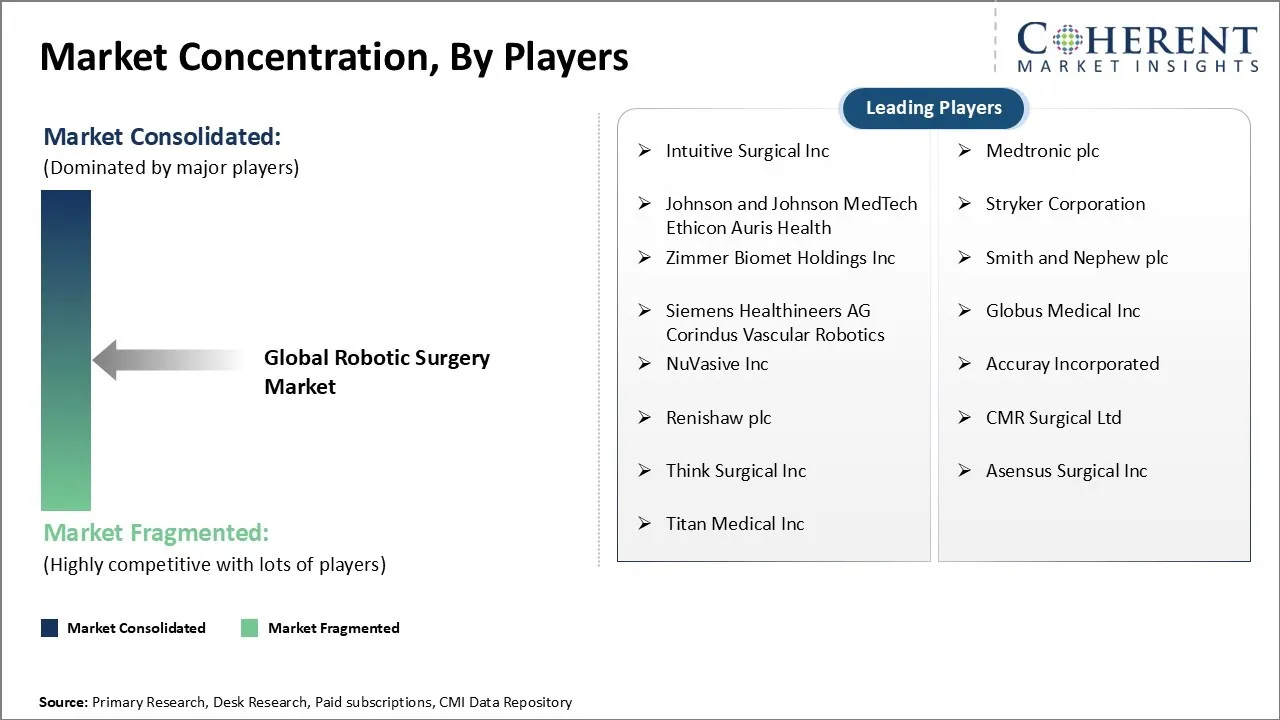
| Companies covered: | Intuitive Surgical Inc, Medtronic plc, Johnson and Johnson MedTech Ethicon Auris Health, Stryker Corporation, Zimmer Biomet Holdings Inc, Smith and Nephew plc, Siemens Healthineers AG Corindus Vascular Robotics, Globus Medical Inc, NuVasive Inc, Accuray Incorporated, Renishaw plc, CMR Surgical Ltd, Think Surgical Inc, Asensus Surgical Inc, and Titan Medical Inc | ||
| Growth Drivers: |
| ||
| Restraints & Challenges: |
| ||
Robotic Surgery Market Dynamics
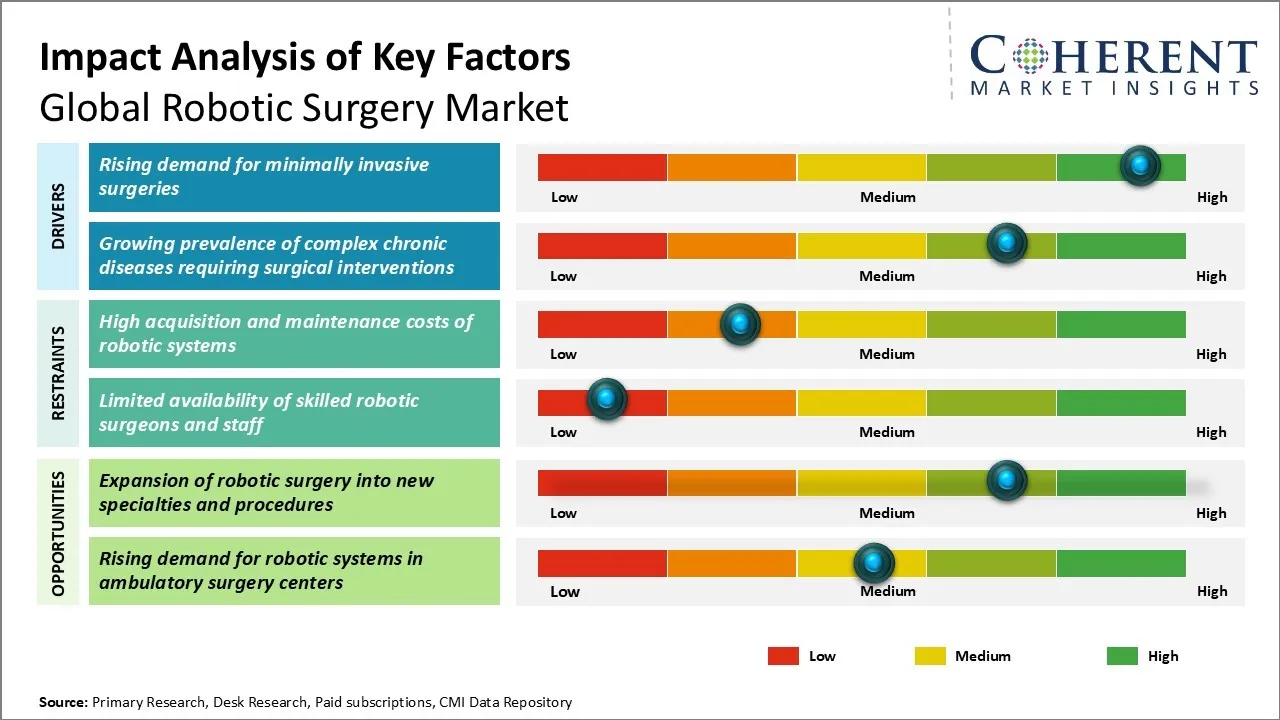
Robotic Surgery Market Driver - Rising Demand for Minimally Invasive Surgeries
The global rise in the acceptance of minimally invasive surgeries is the main factor driving the adoption of robotic surgical systems worldwide. Both patients and healthcare providers are choosing to have these procedures done that offer less trauma, less scarring, shorter hospital stays, and faster recovery times. Open surgeries do not only need to be cut open but also entail longer healing times and more complicated matters, thus the shift towards the new surgical technologies. The use of robots has improved the surgeon's precision, and the visualization of the operation area through high-definition 3D imaging has become superior, so the surgeon's hand can easily perform delicate tasks through smaller cuts.
In September 2025, Kokilaben Dhirubhai Ambani Hospital, a leading multispecialty center in Mumbai, India introduced the next-generation Toumai Robotic Surgery System in India, marking the country’s first installation of this advanced platform. The hospital stated that Toumai offers 3D HD visuals, tremor-filtered instruments and flexible multi-arm control that improve surgical precision and safety.
Robotic Surgery Market Opportunity - Expansion of Robotic Surgery into New Specialties and Procedures
The market for global robotic surgery is showing very good signs of growth, not only through the expansion of robotic technology into new medical specialties but also through the widening of the surgical procedures range. As for the medical specializations, urology and gynecology have been the biggest areas where robotic surgery was done initially, up till now, in other areas like cardio surgery, orthopedic surgery, thoracic surgery and general surgery, the demand is rising due to constant innovations in robotic platforms that make for better precision, lesser invasiveness and higher patient satisfaction. The use of new technologies such as imaging systems, greater instrument flexibility, and artificial intelligence integration is making it possible for surgeons to perform complex procedures that were very difficult or even impossible to be done using traditional techniques.
In July 2025, Lokmanya Hospitals Private Limited, a long-established healthcare group in Pune, India announced a major expansion after Unaprime Healthcare LLP, a growing healthcare investment firm, acquired an 84.5 percent stake to build Maharashtra’s leading multi-specialty hospital chain. Lokmanya Hospitals said the plan will increase its capacity from 300 beds to over 800 beds within four years and strengthen its Centers of Excellence in orthopedics, neurosciences, cardiac sciences, cancer care and trauma services.
Analyst Opinion (Expert Opinion)
- While the robotic surgery market continues to grow, a strong emphasis is placed on hospitals that want to obtain safer procedures, shorter recovery times, and more precise surgeries. The robots are making their way more into urology, gynecology, and orthopedics with their assistance in navigation, visualization, and multi-port systems. The cost and training issues are still there but the major conferences like ACS Clinical Congress, World Robotics Summit, and EAU Annual Congress are playing a very important role in establishing standards, sharing practical insights, and revealing the real integration issues that hospital decisions depend upon which in turn also influence the hospitals (the decisions to adopt robots or not).
- A consequence of the market maturity is the movement of industry and governments towards recent giant investments. Intuitive Surgical's global training expansion, Medtronic's deployment of Hugo RAS in Europe and Latin America, and CMR Surgical's collaborations with public hospitals are creating more opportunities for surgical robot access. Policy-driven programs, including Japan’s reimbursement updates and the U.A.E.’s national robotic surgery initiatives, reinforce long-term adoption and signal a shift toward mainstream, outcome-driven robotics.
Speak to the analyst
Want personalized insights?
Take the findings above to one of our principal consultants, or have the report rebuilt around the segments, geographies and competitors you actually track.
Market Segmentation
- Component Insights (Revenue, USD Bn, 2021 - 2033)
- Robotic Systems
- Capital Equipment (Complete Robotic Platforms)
- Robotic Arm Carts
- Surgical Consoles
- Visualization Systems
- Instruments and Accessories
- Surgical Instruments (e.g., Forceps, Scissors, Graspers)
- Endoscopes and Cameras
- Accessory Kits (e.g., Trocars, Tubes)
- Replacement Parts
- Software and Services
- Surgery Type Insights (Revenue, USD Bn, 2021 - 2033)
- General Surgery (Cholecystectomy, Hernia Repair, Colectomy)
- Urologic Surgery (Prostatectomy, Nephrectomy)
- Gynecologic Surgery (Hysterectomy, Myomectomy)
- Orthopedic Surgery (Joint Replacement, Spine Surgery)
- Cardiovascular Surgery (CABG, Valve Repair)
- Neurosurgery (Brain Tumor Removal, Spine Procedures)
- ENT Surgery
- Thoracic Surgery
- Others (Pediatric and Bariatric Surgery)
- Technology Insights (Revenue, USD Bn, 2021 - 2033)
- Robotic-Assisted Minimally Invasive Surgery
- Autonomous Robotics
- Teleoperated Robotics
- Conventional Laparoscopic Robotic Systems
- AI-Enabled and Data-Driven Robotic Platforms
- End User Insights (Revenue, USD Bn, 2021 - 2033)
- Hospitals
- Ambulatory Surgical Centers
- Specialty Clinics
- Diagnostic Labs
- Academic and Research Institutes
- Regional Insights (Revenue, USD Bn, 2021 - 2033)
- North America
- U.S.
- Canada
- Latin America
- Brazil
- Argentina
- Mexico
- Rest of Latin America
- Europe
- Germany
- U.K.
- Spain
- France
- Italy
- Russia
- Rest of Europe
- Asia Pacific
- China
- India
- Japan
- Australia
- South Korea
- ASEAN
- Rest of Asia Pacific
- Middle East
- GCC Countries
- Israel
- Rest of Middle East
- Africa
- South Africa
- North Africa
- Central Africa
- North America
- Key Players Insights
- Intuitive Surgical Inc
- Medtronic plc
- Johnson and Johnson MedTech Ethicon Auris Health
- Stryker Corporation
- Zimmer Biomet Holdings Inc
- Smith and Nephew plc
- Siemens Healthineers AG Corindus Vascular Robotics
- Globus Medical Inc
- NuVasive Inc
- Accuray Incorporated
- Renishaw plc
- CMR Surgical Ltd
- Think Surgical Inc
- Asensus Surgical Inc
- Titan Medical Inc
Sources
Primary Research Interviews
Industry Stakeholders List
- Robotics engineers
- Surgical system integrators
- Hospital procurement managers
- Biomedical equipment directors
- OR workflow specialists
- Clinical training coordinators
End Users List
- General surgeons
- Urologists
- Gynecologic surgeons
- Cardiothoracic surgeons
- Operating room nurses
- Surgical residents
Government and International Databases
- U.S. Food and Drug Administration (FDA)
- Centers for Medicare & Medicaid Services (CMS)
- National Institutes of Health (NIH)
- European Medicines Agency (EMA)
- World Health Organization (WHO)
- Organization for Economic Co-operation and Development (OECD)
Trade Publications
- Medical Device and Diagnostic Industry (MD+DI)
- Healthcare IT News
- Fierce Healthcare
- Becker’s Hospital Review
- DOTmed HealthCare Business News
- Journal of Medical Devices News
Academic Journals
- Journal of Robotic Surgery
- Surgical Endoscopy
- Annals of Surgery
- Journal of Minimally Invasive Surgery
- The Lancet Digital Health
- IEEE Transactions on Robotics
Reputable Newspapers
- The New York Times
- The Washington Post
- The Wall Street Journal
- The Guardian
- Financial Times
- Reuters
Industry Associations
- American College of Surgeons (ACS)
- Society of American Gastrointestinal and Endoscopic Surgeons (SAGES)
- Association for the Advancement of Medical Instrumentation (AAMI)
- International Federation of Robotics (IFR)
- European Association for Endoscopic Surgery (EAES)
- Association of periOperative Registered Nurses (AORN)
Public Domain Resources
- ClinicalTrials.gov
- U.S. Patent and Trademark Office (USPTO)
- OpenFDA database
- National Library of Medicine
- Eurostat
Proprietary Elements
- CMI Data Analytics Tool: Proprietary analytics tool to analyze real-time market trends, consumer behavior, and technology adoption in market
- Proprietary CMI Existing Repository of Information for Last 8 Years
Get access to 250+ pages report
Every segment, forecast, competitor profile and data table behind the analysis above — available for instant download.
- ESOMAR Member
- ISO 9001:2015 Certified
- D-U-N-S Registered
- GDPR & CCPA Compliant
Missing comfort of reading report in your local language? Find your preferred language:
Transform your Strategy with Exclusive Trending Reports
Frequently Asked Questions
The global robotic surgery market is estimated to be valued at USD 15.00 Bn in 2026 and is expected to reach USD 45.29 Bn by 2033.
The CAGR of the global robotic surgery market is projected to be 17.1% from 2026 to 2033.
Rising demand for minimally invasive surgeries and growing prevalence of complex chronic diseases requiring surgical interventions are the major factors driving the growth of the global robotic surgery market.
High acquisition and maintenance costs of robotic systems and limited availability of skilled robotic surgeons and staff are the major factors hampering the growth of the global robotic surgery market.
In terms of component, the robotic systems are estimated to dominate the market revenue share in 2026.
Intuitive Surgical Inc, Medtronic plc, Johnson and Johnson MedTech Ethicon Auris Health, Stryker Corporation, Zimmer Biomet Holdings Inc, Smith and Nephew plc, Siemens Healthineers AG Corindus Vascular Robotics, Globus Medical Inc, NuVasive Inc, Accuray Incorporated, Renishaw plc, CMR Surgical Ltd, Think Surgical Inc, Asensus Surgical Inc, and Titan Medical Inc are the major players.
North America is expected to lead the global robotic surgery market in 2026.