

Urology Device Market Size and Trends: 2026 to 2033
The global urology device market is estimated to be valued at USD 21,171.0Mn in 2026 and is expected to reach USD 29,889.2 Mn in 2033, exhibiting a compound annual growth rate (CAGR) of 5.0% from 2026 to 2033.
Key Takeaways
- Based on product type, the instrument segment is expected to lead the market share of 68.6% in 2026, driven by rising demand for diagnostic and therapeutic urology devices.
- Based on Disease, the kidney diseases segment is projected to hold the largest 37.4% share in 2026, due to high prevalence of kidney stones and urinary tract infections globally.
- Based on treatment, the minimally invasive/non-invasive treatment segment is anticipated to dominate 47.1% share in 2026, fueled by the adoption of robotic and laparoscopic surgeries.
- Based on end user, the hospitals and clinics segment is expected to account for the largest 69.6% share in 2026, supported by the increasing geriatric population and higher incidence of urologic conditions.
- Based on Region, North America is set to lead the global urology device market with 42.7% share in 2026. While, Asia Pacific is anticipated to be the fastest growing region.
Market Overview
The urology device market is experiencing strong growth due to the rise in burden of urologic conditions and increasing geriatric (aging) population around the world. Moreover, rise in demand or adoption of urology devices and research and development (R&D) in the field of urology is expected to boost the growth of the urology device market. However, factors such as high cost of urology devices and stringent rules and regulations are expected to hamper the market growth.
Current Events and Its Impact on the Urology Device Market
Current Events | and its impact |
Aging Global Population and Rising Urological Disorders |
|
AI Integration and Robotic Surgery Advancement |
|
Smart & Digital Innovations in the Urology Devices Market
Intelligent and digital innovations have taken over the global urology devices market in 2025 with integrations of intelligence, precision, and patient-centric functionality to meet evolving clinical and healthcare demands. In this market, smart urology devices refer to solutions integrated with advanced technologies such as AI-assisted diagnostics, robotic-assisted surgery, smart endoscopy, sensors, and real-time patient monitoring systems to bring improvement in clinical outcomes, safety, and efficiency.
The incidence of renal disorders, urological malignancies, and BPH is on the rise, along with aging populations. This is driving the adoption of technologically advanced devices in the field of urology. The need for cost-effective and minimally invasive solutions has also paved the way for the development of disposable instruments, single-use catheters, and portable monitoring devices.
For example, in October 2025, Johnson & Johnson MedTech announced the next step in its surgical robotics development for urology.
- Current Industry Events of 2026
- Market Size Estimation
- Regional Breakdown
- Competitive Landscape
- Customer Intelligence
- Segmental Analysis
- Pricing Analysis
- Key Market Drivers, Challenges & Future Trends
- Customized Insights Section
Segmental Insights
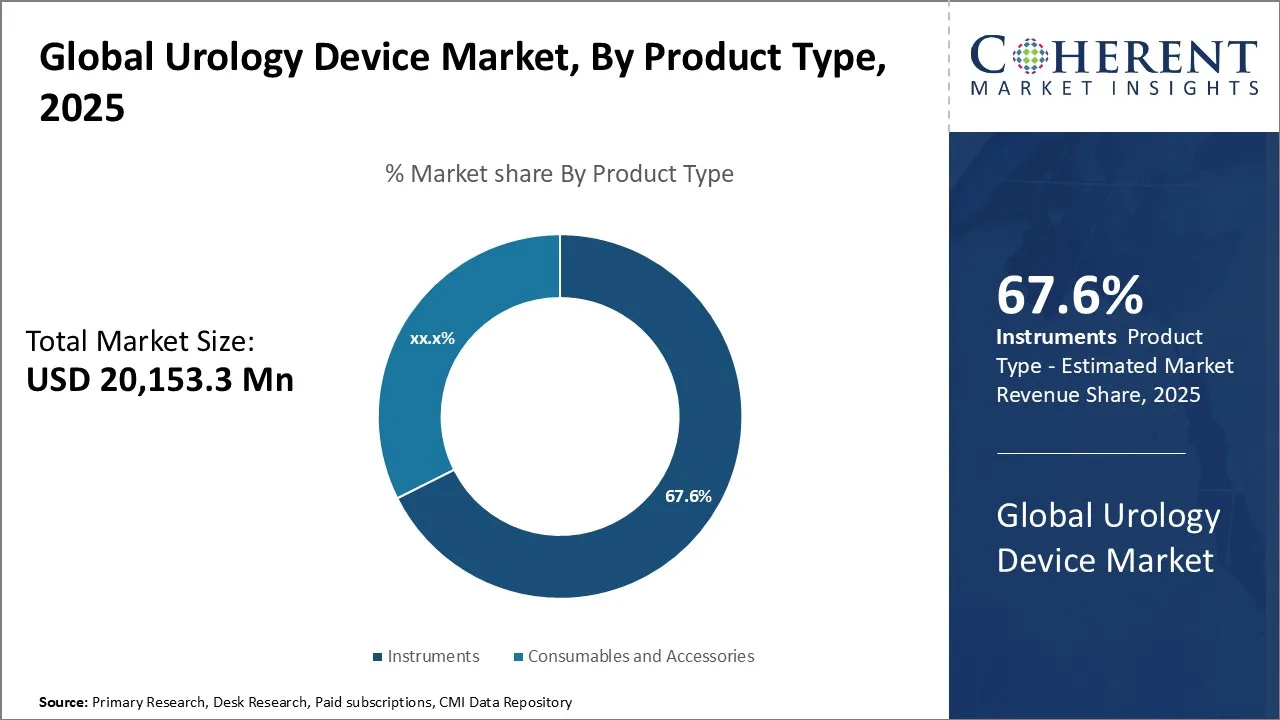
Urology Devices Market Insights, By Product Type - Instruments Lead Due to Rising Demand for Diagnostic and Therapeutic Devices
By product type, the segment of instruments forms 68.6% of the market share in 2026, growing with the increasing demand for diagnostic and therapeutic urology procedures. Surgical instruments, endoscopes, catheters, and lithotripsy are the primary interventions within urology. Their usage is on the rise due to the increasing prevalence of minimally invasive procedures, as these provide greater precision and result in superior patient outcomes.
They are needed for both routine and complex urology procedures, hence their importance to hospitals and clinics. While they enjoy higher cost-per-unit compared to consumables and accessories, long lifespan due to multiprocedure usage makes their utility long-lasting. Technological improvements like smart endoscopes and AI-assisted imaging devices will further boost their adoption.
For example, in March 2025, Johnson & Johnson MedTech extended its MONARCH robotic-assisted urology system portfolio with the addition of AI-enabled endoscopic tools to improve precision in the performance of kidney stone removal and prostate procedures.
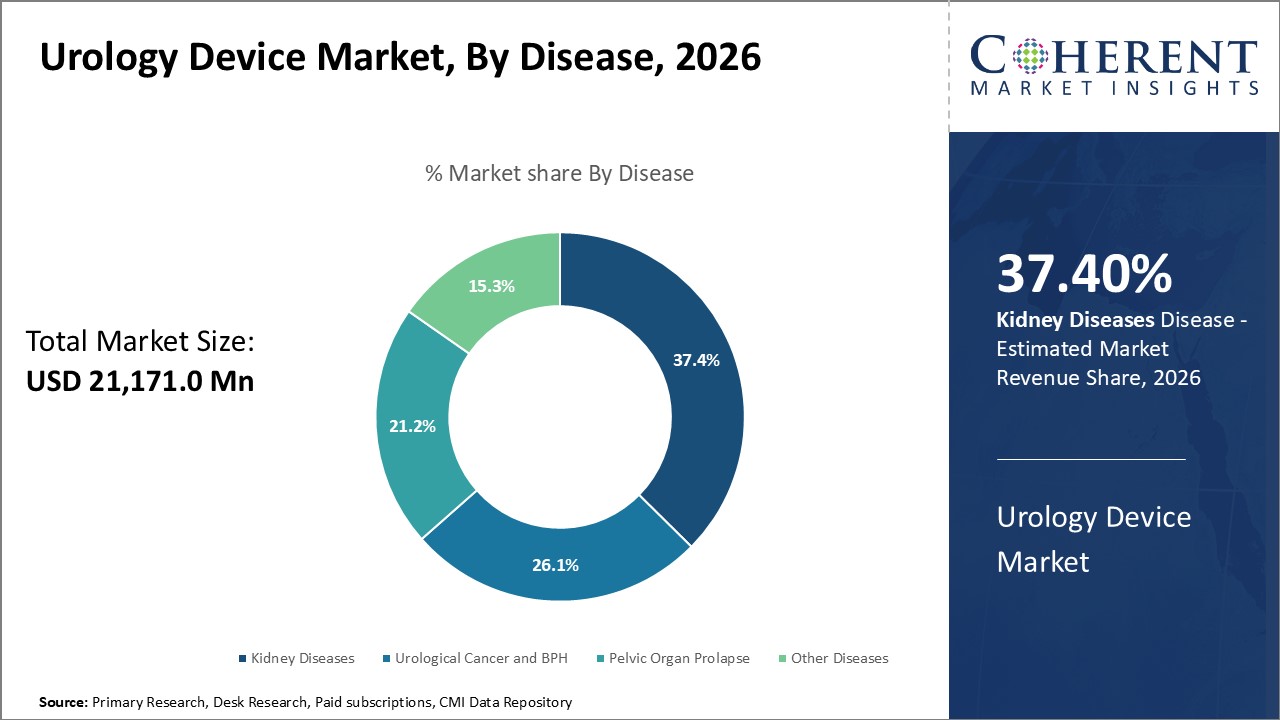
Urology Devices Market Insights, By Disease - Kidney Diseases Segment Dominates Owing to High Prevalence
In terms of disease, kidney diseases contribute 37.4% of the market share in 2026, owing to the rising prevalence of kidney stones, chronic kidney disease (CKD), and urinary tract infections globally. The high incidence drives demand for diagnostic, monitoring, and surgical devices tailored to renal care.
Advances in minimally invasive technologies include laser lithotripsy, robotic-assisted nephrolithotomy, and percutaneous nephrostomy devices that are improving treatment options. Many hospitals and clinics adopt such devices due to the advantages associated with quicker recovery times and better patient outcomes.
For example, in September 2025, GMCH Nagpur from India conducted the country's first robotic-assisted kidney transplant in a government facility, highlighting the increased demand and access to cutting-edge, kidney-focused urology devices.
Urology Devices Market Insights, By Treatment - Minimally Invasive/Non-invasive Treatment Segment Leads Due to Advanced Surgical Adoption
In terms of treatment, minimally invasive/non-invasive devices account for 47.1% share in 2026, fueled by the adoption of robotic and laparoscopic surgeries. These devices reduce procedural complications, shorten hospital stays, and allow faster patient recovery compared to traditional invasive surgeries.
Technological innovations in AI-assisted robotic surgery, smart endoscopes, and real-time monitoring sensors enhance the precision that leads to improved treatment outcomes. They are of special critical importance for delicate procedures in urology, including prostatectomy, nephrolithotomy, and bladder tumor removal.
Urology Devices Market Insights, By End User - Hospitals and Clinics Segment Dominates Due to Procedure Volume and Infrastructure
In terms of end users, hospitals and clinics contribute 69.6% of the market share in 2026, supported by high patient volume and advanced infrastructure. Hospitals are the primary centers for urology procedures, including diagnosis, minimally invasive surgeries, and post-operative care.
Clinics and specialty centers also contribute to the adoption of advanced instruments, robotic systems, and consumables by facilitating outpatient procedures and providing specialized treatments. Investment in training, AI-based surgical assistance, and robotic platforms ensures that operational efficiency is achieved and patient outcomes are enhanced.
For example, AIIMS Jodhpur organized RUFCON 2025 in February 2025, a demonstration of AI and robotic-assisted urology procedures for about 200 healthcare professionals, further reinforcing a hospital's central role in technology adoption.
Regional Insights
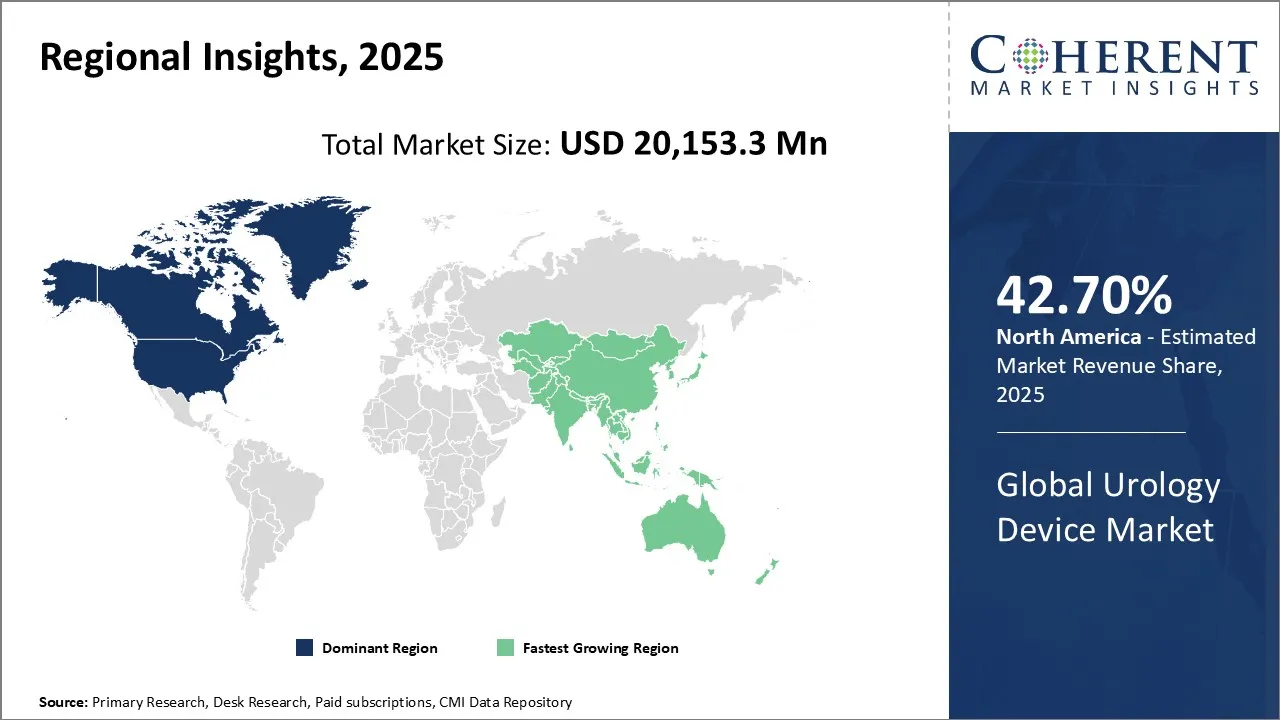
North America Urology Device Market Analysis & Trends
North America is set to lead the global urology devices market with 42.7% share in 2026, driven by strong demand from hospitals, clinics, and specialty healthcare centers. The region benefits from advanced healthcare infrastructure, high adoption of minimally invasive and robotic-assisted urology devices, and significant investments in research and development by major medical device companies. In particular, the U.S. has a highly established network of hospitals and surgical centers with advanced diagnostic and therapeutic equipment in the urology department.
For instance, in April 2026, Medtronic’s Hugo RAS system met safety and effectiveness endpoints in its U.S. clinical trial, and the company submitted Hugo for FDA urologic indication.
Asia Pacific Urology Devices Market Analysis & Trends
Asia Pacific is anticipated to be the fastest growing regional market for urology devices over the forecast period. Rapid urbanization, increasing healthcare spending, and growing awareness about urological disorders are driving market expansion in countries such as China, India, Japan, and South Korea. Rising prevalence of kidney diseases, urinary tract infections, and urological cancers, combined with an expanding geriatric population, is spurring demand for both diagnostic and therapeutic urology devices. Hospitals and clinics in the region are increasingly investing in minimally invasive and robotic-assisted technologies to meet rising patient demand and improve treatment outcomes.
For instance, in September 2026, idsMED introduced a new robotic urology system (from EDGE Medical) at the Indonesian Urological Association (ASMIUA) 2026 meeting, highlighting advancing adoption of robotic surgery in Indonesia.
Urology Device Market Outlook Country-Wise
U.S. Urology Device Market Trends
The U.S. urology devices market is exhibiting strong growth in 2026, with an increasingly widespread implementation of robotic-assisted surgeries, AI-enabled diagnostics, and minimally invasive instrumentation. The advanced imaging systems, smart endoscopes, and precision surgical tools are increasingly being integrated into hospitals and surgical centers to improve patient outcomes and reduce recovery time. Strong healthcare infrastructure, high per-capita spending on healthcare, and established reimbursement frameworks further accelerate demand for innovative urology solutions.
For instance, in April 2026, Medtronic announced that its Hugo™
China Urology Device Market Trends
China’s urology devices market is rapidly expanding in 2026, fueled by rising prevalence of kidney stones, BPH, and other urinary disorders, alongside an aging population. Hospitals across both urban and regional areas are adopting modern diagnostic and surgical tools, including endoscopes, laser lithotripsy systems, and robotic-assisted instruments. Moreover, government initiatives and support for healthcare infrastructure development and incentives for local manufacturing and promoting cost-effective solutions are driving the adoption at all tiers of care.
For instance, in March 2026, MicroPort MedBot’s Toumai SP Laparoscopic Surgical Robot received market approval from China’s regulatory authority National Medical Products Administration (NMPA) for clinical use, including in urology, gynecology and general surgery.
Market Report Scope
Urology Device Market Report Coverage
| Report Coverage | Details | ||
|---|---|---|---|
| Base Year: | 2025 | Market Size in 2026: | USD 21,171.0 Mn |
| Historical Data for: | 2020 To 2024 | Forecast Period: | 2026 To 2033 |
| Forecast Period 2026 to 2033 CAGR: | 5.0% | 2033 Value Projection: | USD 29,889.2 Mn |
| Geographies covered: |
| ||
| Segments covered: |
| ||
| Companies covered: | Stryker Corporation, Richard Wolf, Olympus Corporation, Medtronic, Karl Storz, Fresenius Medical Care, Dornier Medtech, Cook Medical, Boston Scientific, and Becton, Dickinson and Company (C.R. Bard). | ||
| Growth Drivers: |
| ||
| Restraints & Challenges: |
| ||
Urology Device Market Drivers
High incidence of urologic conditions to drive market growth
One of the key factors expected to augment the growth of the global urology device market during the forecast period is the growing incidence of urologic conditions worldwide. Such a high burden of urologic diseases leads to an increase in demand for urology devices, driving the market growth. According to the National Institute of Health (NIH), urinary tract infections (UTIs) are some of the most common bacterial infections, affecting around 150 million people each year worldwide.
Urology Device Market Opportunities
Rise in demand or adoption of urology devices across the world is expected to provide significant growth opportunities for players in the global urology device market. For instance, with the rise in prevalence or incidence of urologic diseases and increase in awareness among people, the demand for safe and effective urology devices is also increasing with a rapid pace. In January 2023, Cook Medical announced the launch of streamlined portfolio of urological bipolar electrodes in the U.S. to help physicians focus on treating patients with products they use frequently. The electrodes are for daily use in bladder and prostate procedures.
Analyst Opinion (Expert Opinion)
The global urology device market is entering a period of technological consolidation and precision-driven innovation. The adoption of robotic-assisted and AI-enabled systems is no longer incremental but is fast becoming the de facto standard in advanced healthcare institutions. Clinical data indicate that robotic-assisted procedures for prostatectomy and kidney stone removal reduce complication rates by over 30% compared to conventional laparoscopy, while patient recovery times are shortened by an average of 25%.
The aggressive expansion of robotic-assisted capabilities by hospitals and clinics in North America and China reflects demand-side pressure from patient expectations and supply-side availability of high-precision devices.
Ultimately, commercial and clinical leadership in the urology devices market is dictated by precision, intelligence, and workflow integration. The companies that can demonstrate enhanced procedural efficacy, safety, and patient satisfaction-supported by provable clinical outcomes-will define the leading edge of competition, while laggards will be at risk of marginalization in an increasingly evidence-based adoption and technologically differentiated environment.
Speak to the analyst
Want personalized insights?
Take the findings above to one of our principal consultants, or have the report rebuilt around the segments, geographies and competitors you actually track.
Urology Device Industry News
- In April 2025, Medtronic announced that the multi-center U.S. clinical study for its Hugo™ Robotic‑Assisted Surgery System met both primary safety and effectiveness endpoints (137‑patient IDE study), and submitted it to the U.S. regulator for urologic indication.
- In September 2025, Olympus announced a global distribution partnership with MacroLux Medical Technology Co., Ltd. for single‑use urology products (cystoscopes, ureteroscopes, suction access sheaths), expanding its urology portfolio.
- In July 2024, Richard Wolf entered into a partnership with Photocure ASA to develop and commercialize a next‑generation high-definition flexible blue‑light cystoscope (4K LED) for global markets, designed for improved detection and surveillance of bladder cancer.
Market Segmentation
- Product Type Insights (Revenue, USD Mn & KT, 2026 - 2033)
- Instruments
- Consumables and Accessories
- Disease Insights (Revenue, USD Mn & KT, 2026 - 2033)
- Kidney Diseases
- Urological Cancer and BPH
- Pelvic Organ Prolapse
- Other Diseases
- Treatment Insights (Revenue, USD Mn & KT, 2026 - 2033)
- Invasive Treatment
- Non-invasive Treatment
- End User Insights (Revenue, USD Mn & KT, 2026 - 2033)
- Hospitals and Clinics
- Dialysis Centres
- Other End Users
- Regional Insights (Revenue, USD Mn & KT, 2026 - 2033)
- North America
- U.S.
- Canada
- Latin America
- Brazil
- Argentina
- Mexico
- Rest of Latin America
- Europe
- Germany
- U.K.
- Spain
- France
- Italy
- Russia
- Rest of Europe
- Asia Pacific
- China
- India
- Japan
- Australia
- South Korea
- ASEAN
- Rest of Asia Pacific
- Middle East & Africa
- GCC Countries
- Israel
- Rest of Middle East & Africa
- North America
- Key Players Insights (Revenue, USD Mn, 2021 - 2033)
- Stryker Corporation
- Richard Wolf
- Olympus Corporation
- Medtronic
- Karl Storz
- Fresenius Medical Care
- Dornier Medtech
- Cook Medical
- Boston Scientific
- Becton, Dickinson, and Company (C.R. Bard)
Sources
Primary Research Interviews from the following stakeholders
Stakeholders
- Interviews with urology device manufacturers, hospital procurement heads, surgeons, diagnostic centers, distributors, and regulatory consultants across major regional markets.
Specific stakeholders
- R&D and product development heads at leading urology device companies (e.g., Medtronic, Olympus, Stryker, Richard Wolf, Boston Scientific)
- Procurement and supply chain managers at hospitals, clinics, and dialysis centers focusing on urology devices
- Senior urologists and surgeons providing clinical feedback on device efficacy, adoption, and patient outcomes
- Regulatory affairs specialists in medical device approval and compliance
- Biomedical engineers and instrumentation specialists at manufacturing and assembly facilities
- Innovation leads at healthcare technology startups focusing on AI, robotic-assisted urology devices, and minimally invasive instruments
- Clinical operations and quality control teams at diagnostic and therapeutic centers implementing new urology solutions
Databases
- U.S. Food and Drug Administration (FDA) – Device Approvals and Medical Device Databases
- European Medicines Agency (EMA) – Device and Clinical Trial Registrations
- China National Medical Products Administration (NMPA) – Medical Device Approvals
- India Central Drugs Standard Control Organization (CDSCO) – Device Registrations
- United Nations Comtrade Database – Medical Equipment Imports/Exports
- World Health Organization (WHO) – Global Health Technology Data
- Korea Health Industry Development Institute (KHIDI) – Medical Device Data
- Japan Medical Device Information (PMDA) – Regulatory and Approval Data
- gov – Urology Device Clinical Studies
- National Health Service (NHS) Digital – Device Adoption and Usage Reports
Magazines
- Urology Times
- Endourology Today
- Medical Device Network
- MedTech Insight
- Healthcare Technology Today
- Hospital Management Asia
- The Clinical Advisor – Urology Section
- Medtech Intelligence
Journals
- The Journal of Urology
- BJU International
- World Journal of Urology
- Urologic Clinics of North America
- International Journal of Urology
- Nature Reviews Urology
- Advances in Medical Device Technology
Newspapers
- The Wall Street Journal – Healthcare & MedTech
- The Economic Times – Medical Devices & Healthcare Industry
- Business Standard – Healthcare & Technology
- Financial Times – Medical Technology & Innovation
- Nikkei Asia – Health & Medical Devices
- The Hindu Business Line – Medical Devices & Hospitals
- South China Morning Post – Health Technology
- The Guardian – Healthcare Innovation & Policy
Associations
- American Urological Association (AUA)
- European Association of Urology (EAU)
- International Continence Society (ICS)
- Medical Device Manufacturers Association (MDMA)
- Asia Pacific Urological Association (APUA)
- Indian Medical Device Association (IMDA)
- Society of Urologic Oncology (SUO)
- European Society of Endourology (ESE)
- British Association of Urological Surgeons (BAUS)
- National Association of Medical Device Regulatory Professionals (NAMDRP)
Public Domain Sources
- U.S. FDA – Medical Device Safety Communications & Approvals
- European Commission – Medical Device Regulations & Reports
- Ministry of Health and Family Welfare (India) – Medical Device Policies
- China NMPA – Public Device Registration Information
- WHO – Global Health Technology Reports
- OECD – Health Technology and Medical Device Statistics
- gov – Urology Device Trials
- NHS Digital – Device Usage and Adoption Data
- PubMed – Publicly Accessible Clinical Study Results
Proprietary Elements
- CMI Data Analytics Tool,
- Proprietary CMI Existing Repository of information for last 8 years
Definition: Urology devices are used to diagnose and treat urologic diseases/disorders of both male and female urinary tract. Millions of people worldwide are affected by urinary tract system disorders, and women are more likely to be affected than men. Thus, there is an increase in demand for such devices across the world, driving the market growth.
Get access to 250+ pages report
Every segment, forecast, competitor profile and data table behind the analysis above — available for instant download.
- ESOMAR Member
- ISO 9001:2015 Certified
- D-U-N-S Registered
- GDPR & CCPA Compliant
Missing comfort of reading report in your local language? Find your preferred language:
Transform your Strategy with Exclusive Trending Reports
Frequently Asked Questions
The Urology Device Market is estimated to be valued at USD 21,171.0 Mn in 2026, and is expected to reach USD 29,889.2 Mn by 2033.
The CAGR of the Urology Device Market is projected to be 5.0% from 2026 to 2033.
Growing incidence of urologic conditions and increasing geriatric (aging) population around the world is fueling growth of the market.
In terms of product type, instruments is estimated to dominate the market revenue share in 2026.
High cost of urology devices and stringent rules & regulations are major factors restraining growth of the market.
Major players operating in the market are Stryker Corporation, Richard Wolf, Olympus Corporation, Medtronic, Karl Storz, Fresenius Medical Care, Dornier Medtech, Cook Medical, Boston Scientific, and Becton, Dickinson and Company (C.R. Bard).