

Anesthesia Machines Market Size and Forecast — 2026 - 2033
The Global Anesthesia Machines Market size is estimated to be valued at USD 4.8 billion in 2026 and is expected to reach USD 7.5 billion by 2033, exhibiting a compound annual growth rate (CAGR) of 6.1% from 2026 to 2033.
Overview
GE HealthCare, Dräger, and Mindray produce modern anesthesia machines designed for safe delivery of anesthetic gases and patient ventilation. These systems integrate ventilators, vaporizers, gas flow controls, and monitoring tools for oxygen, carbon dioxide, and airway pressure. Advanced models feature digital interfaces, automated safety checks, and electronic record systems. Portable units support field or ambulatory care, while high-end workstations suit complex surgeries. Overall, anesthesia machines ensure precise drug delivery, patient stability, and real-time monitoring in operating rooms and critical care settings.
Key Takeaways
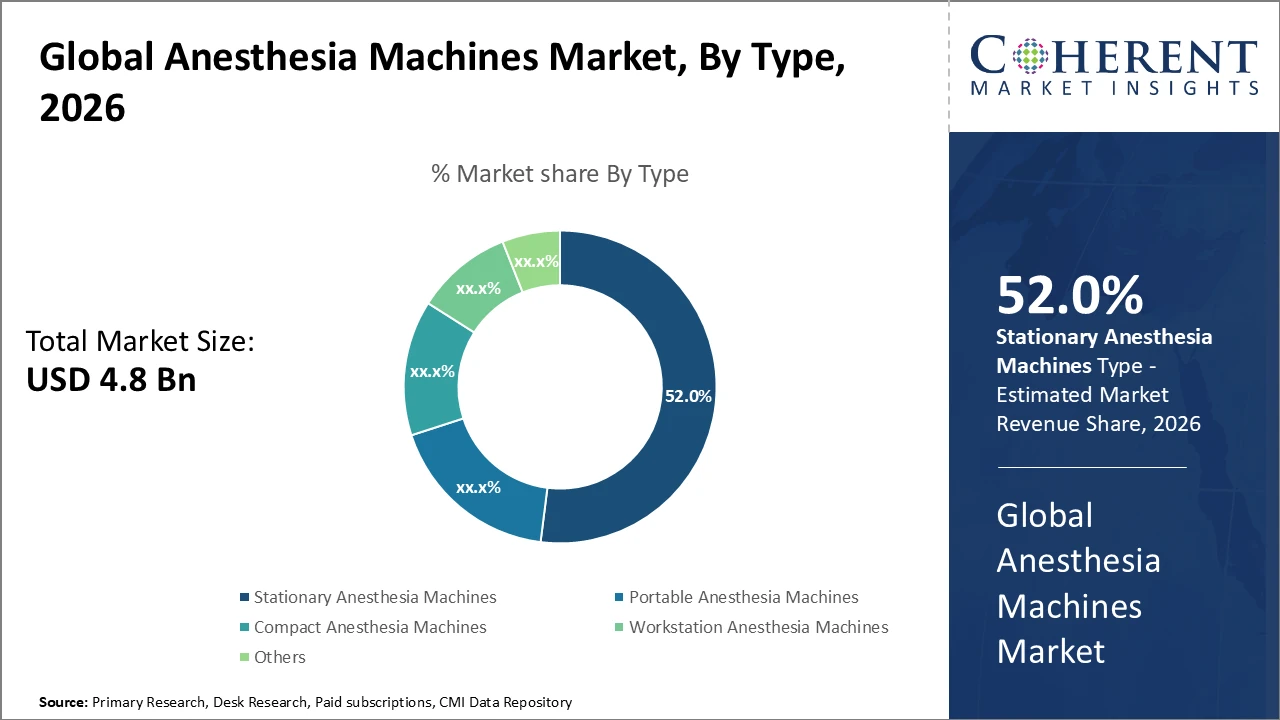
• Stationary anesthesia machines dominate the type segment, representing 52% of market share, driven by their comprehensive functionalities and higher adoption in large hospitals. Portable machines are witnessing rapid growth due to rising outpatient surgeries and ambulatory center expansions.
• Ventilator-integrated anesthesia machines lead the technology segment, accounting for over 40% market share, supported by their ability to ensure synchronized ventilation and anesthetic delivery, enhancing patient safety.
• Hospitals and ambulatory surgical centers dominate the end-user segment, as more than 65% of anesthesia machines are purchased by these facilities to meet increasing surgical demand and stringent safety regulations.
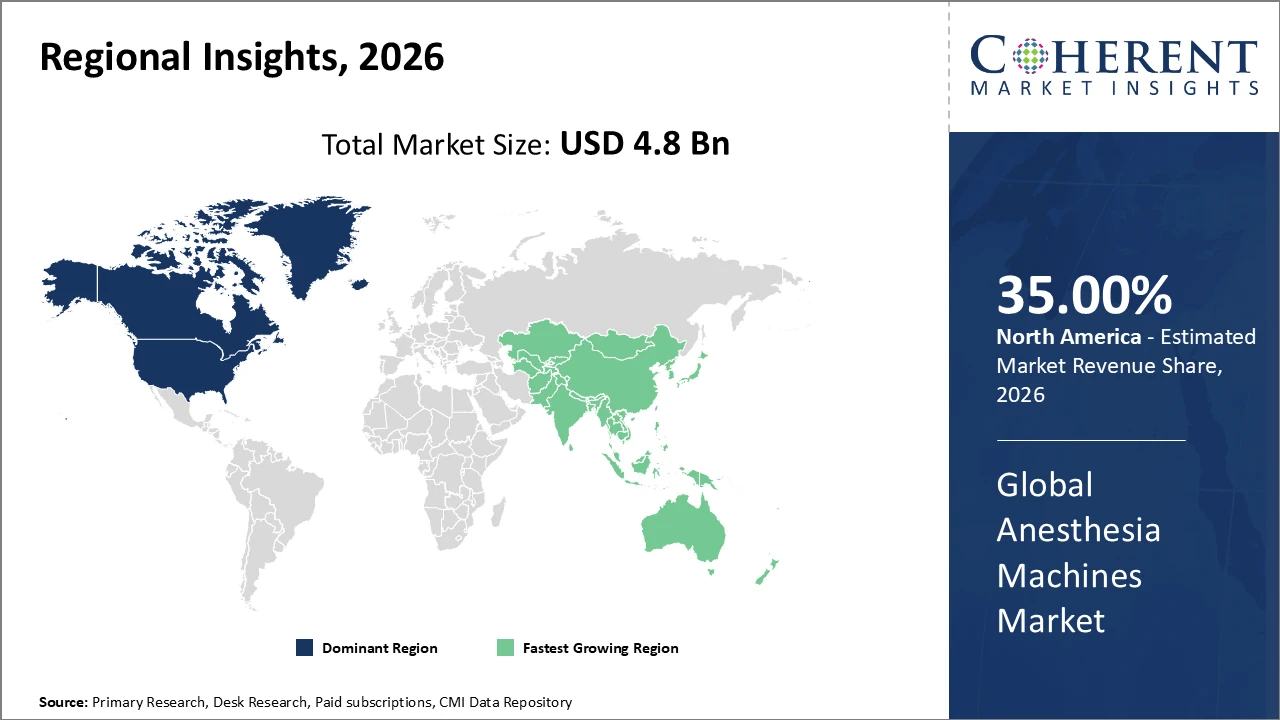
• North America maintains a commanding share of over 35% in the anesthesia machines market, fueled by high healthcare spending, advanced surgical infrastructure, and continuous innovation led by U.S.-based market players.
Anesthesia Machines Market Segmentation Analysis
Anesthesia Machines Market Insights, By Type
Stationary anesthesia machines dominate the market, holding around 52% of the total share due to their advanced features, integrated monitoring systems, and strong preference in large hospitals requiring comprehensive anesthetic support. These systems offer reliability, precision, and compatibility with complex surgical procedures. Portable anesthesia machines are the fastest-growing segment, driven by the rise of ambulatory surgical centers and the need for mobility in emergency and field settings. Compact machines cater to space-constrained facilities with essential functionalities. Workstation anesthesia machines enable high customization and automation, making them ideal for specialty clinics, while others include veterinary and research-specific anesthesia systems.
Anesthesia Machines Market Insights, By Technology
Ventilator-integrated anesthesia machines dominate the market, accounting for over 40% share due to their ability to combine mechanical ventilation with precise anesthetic delivery, improving respiratory management and patient safety during surgeries. These systems are widely adopted in advanced healthcare settings. AI-enabled anesthesia machines represent the fastest-growing segment, driven by capabilities such as predictive analytics, optimized drug dosing, and real-time monitoring that enhance clinical outcomes. Conventional machines remain relevant in cost-sensitive facilities by providing standard anesthesia functions. Noninvasive anesthesia delivery machines are an emerging subsegment focused on patient comfort, while others include hybrid and experimental anesthesia technologies under development.
Anesthesia Machines Market Insights, By End User
Hospitals and ambulatory surgical centers dominate the anesthesia machines market, contributing over 65% of total deployments due to high surgical volumes and strict regulatory requirements for patient safety. Hospitals remain the primary users because of their capacity to handle complex procedures, while ambulatory centers are experiencing rapid growth driven by cost efficiency and increasing patient preference for outpatient surgeries. Specialty clinics serve specific medical fields with customized anesthesia needs, showing moderate expansion. Research institutes represent a niche segment, using anesthesia machines for experimental and veterinary purposes, while other applications include defense services and mobile or field-based surgical units.
Anesthesia Machines Market Trends
The anesthesia machines market is undergoing significant transformation with the integration of Artificial Intelligence and digital health solutions, shifting from conventional systems to smart, connected devices.
Growing demand for portable and workstation anesthesia machines reflects evolving surgical practices, particularly with the rapid expansion of ambulatory surgery centers.
Rising environmental awareness is driving adoption of low-flow anesthetic technologies that reduce emissions of volatile anesthetic gases, especially across European healthcare systems.
Increasing collaboration between medical device manufacturers and healthcare providers is accelerating the development and deployment of customized anesthesia solutions tailored to specific clinical needs.
Anesthesia Machines Market Insights, By Geography
North America Anesthesia Machines Market Analysis and Trends
North America dominates the anesthesia machines market with a share of 35% due to its advanced healthcare infrastructure, high capital investment in medical equipment, and strong presence of leading manufacturers. The United States contributes the majority of regional revenue, supported by a high volume of elective and emergency surgical procedures. Well-established regulatory frameworks ensure patient safety and drive continuous technology upgrades. The region also demonstrates rapid adoption of innovative solutions such as AI-enabled anesthesia systems, integrated monitoring platforms, and digital operating room technologies. Strong R&D activity and early technology adoption further reinforce North America’s leadership position in the global market.
Asia Pacific Anesthesia Machines Market Analysis and Trends
Asia Pacific represents the fastest-growing region in the anesthesia machines market, driven by expanding healthcare access, supportive government reforms, and rising demand for medical tourism. Countries such as India and China are experiencing rapid hospital expansion and increased investment in advanced surgical technologies. Growing populations, improving healthcare infrastructure, and higher awareness of surgical safety are further accelerating demand. Additionally, the rise of private healthcare providers and foreign investments is strengthening market growth, contributing to a projected compound annual growth rate exceeding 7% across the region.
Anesthesia Machines Market Outlook for Key Countries
USA Anesthesia Machines Market Analysis and Trends
The United States anesthesia machines market is strongly influenced by a mature healthcare system with annual surgical volumes exceeding 60 million procedures as of 2025. Leading companies such as Dräger and GE HealthCare dominate the market with advanced anesthesia workstations featuring AI integration and smart monitoring capabilities, generating significant revenue. Strict regulatory standards focused on patient safety encourage continuous innovation and frequent equipment upgrades. Additionally, increased federal funding for surgical safety initiatives has boosted adoption of anesthesia machines, contributing to an estimated 8% market growth in 2026.
Germany Anesthesia Machines Market Analysis and Trends
Germany’s anesthesia machines market is experiencing stable growth driven by a strong healthcare system, strict regulatory standards, and rising surgical procedures linked to an aging population. Demand is increasing for advanced anesthesia workstations with integrated monitoring, digital connectivity, and improved safety features. Key trends include adoption of AI-enabled anesthesia systems, expansion of ambulatory surgical centers, and preference for compact and portable machines in outpatient care. Innovation is strongly supported by domestic manufacturers such as Dräger, which plays a global leadership role in anesthesia technology. Overall, Germany emphasizes precision, patient safety, and technological advancement in anesthesia care delivery.
Analyst Opinion
Increasing adoption of advanced ventilator-integrated anesthesia machines is a key supply-side driver, with over 45% of new machines in 2025 featuring ventilation modules, marking a 12% year-on-year increase from 2024 and improving patient safety and reliability.
Demand-side trends show rising import volumes, especially in emerging economies, with Asia Pacific imports growing 18% in 2026 as healthcare infrastructure expands to meet increasing surgical needs.
Expanding clinical applications across cardiac surgery, neurology, and pediatrics are boosting utilization, with 2025 data showing a 9% rise in complex anesthesia procedures in hospitals.
Pricing trends indicate moderate increases, with average selling prices rising 4.3% in 2024 due to integration of AI-enabled monitoring and eco-friendly gas delivery technologies.
- Current Industry Events of 2026
- Market Size Estimation
- Regional Breakdown
- Competitive Landscape
- Customer Intelligence
- Segmental Analysis
- Pricing Analysis
- Key Market Drivers, Challenges & Future Trends
- Customized Insights Section
Market Scope
| Report Coverage | Details | ||
|---|---|---|---|
| Base Year: | 2025 | Market Size in 2026: | USD 4.8 billion |
| Historical Data for: | 2020 To 2024 | Forecast Period: | 2026 To 2033 |
| Forecast Period 2026 to 2033 CAGR: | 6.1% | 2033 Value Projection: | USD 7.5 billion |
| Geographies covered: |
| ||
| Segments covered: |
| ||
| Companies covered: | GE Healthcare, Philips Healthcare, Medtronic plc, Smith Group plc, Penlon Ltd., Getinge AB, Schiller AG, Nihon Kohden Corporation, Atom Medical Corporation, Spacelabs Healthcare | ||
| Growth Drivers: |
| ||
Anesthesia Machines Market Growth Factors
The global anesthesia machines market is primarily driven by the rising number of surgical procedures, with an estimated 312 million surgeries performed worldwide in 2025, significantly increasing equipment demand. Integration of advanced technologies such as Artificial Intelligence and IoT enhances accuracy, monitoring, and efficiency, leading to higher adoption in modern healthcare facilities. Growing healthcare expenditure in emerging economies like India supports infrastructure expansion, including a 7% rise in hospital capital equipment spending in 2026. Strict regulatory standards for patient safety also drive replacement of outdated systems with advanced anesthesia machines globally.
Anesthesia Machines Market Development
In 2025, GE HealthCare launched an upgraded Aisys CS² anesthesia system with enhanced digital connectivity and AI-assisted ventilation control. The system introduced automated fresh gas flow optimization and real-time predictive monitoring, helping anesthesiologists maintain stable patient parameters during high-risk surgeries. Several tertiary hospitals in the United States adopted this platform to improve operating room efficiency and reduce manual intervention in anesthesia delivery workflows.
Key Players
Leading Companies of the Market
Philips Healthcare
GE Healthcare
Smith Group Plc
Medtronic plc
Getinge AB
Nihon Kohden Corporation
Penlon Ltd
Schiller AG
Spacelabs Healthcare
Atom Medical Corporation
Several leading market companies are increasingly focusing on strategic partnerships and product innovation to strengthen their position in the anesthesia machines market. For instance, Philips Healthcare collaborated with AI startups in 2025 to enhance its intelligent anesthesia solutions, leading to improved product capabilities and a 15% increase in market share within the smart anesthesia segment. Similarly, Dräger expanded its presence in the Asia Pacific region through localized manufacturing initiatives in 2024, reducing supply chain costs by 10% and significantly improving its competitive positioning in emerging healthcare markets.
Anesthesia Machines Market Future Outlook
The anesthesia machines market is expected to witness steady growth driven by rising surgical volumes, aging populations, and increasing prevalence of chronic diseases. The market is projected to grow at around 6–7% CAGR, reaching over USD 30 billion by 2033. Technological advancements such as AI integration, smart monitoring, and automated drug delivery are shaping future demand. Additionally, expansion of outpatient surgical centers and healthcare infrastructure in emerging regions will boost adoption. Strong emphasis on patient safety, efficiency, and digital connectivity will further accelerate innovation and replacement of older systems globally.
Anesthesia Machines Market Historical Analysis
The anesthesia machines market has evolved steadily over past decades alongside advances in Anesthesiology and surgical care. Early systems were basic gas delivery devices, but by the late 20th century, integration of ventilators and monitoring improved safety and efficiency. From 2010–2020, growth accelerated due to rising surgical procedures, aging populations, and expansion of hospital infrastructure in emerging economies. Leading manufacturers such as GE HealthCare, Dräger, and Mindray drove innovation with digital workstations. Overall, the market showed moderate but consistent growth, supported by technological upgrades and increasing focus on patient safety.
Sources
Primary Research Interviews:
Anesthesiologists, perioperative care specialists, and biomedical engineers working on anesthesia machine operation, safety systems, and clinical optimization
Procurement managers, hospital administrators, and surgical department heads in hospitals, ambulatory surgical centers, and specialty clinics using anesthesia machines
Product managers, R&D engineers, and clinical application specialists from medical device companies involved in anesthesia machine design, ventilator integration, and monitoring system development
Magazines:
Medical Design & Outsourcing – Innovations in anesthesia machine design, ventilation integration, and device engineering
Anesthesiology News – Clinical advancements, safety updates, and anesthesia technology trends
Healthcare Technology Report – Digital health integration and AI adoption in anesthesia systems
Journals:
Anesthesiology (American Society of Anesthesiologists) – Clinical research on anesthesia techniques and equipment performance
British Journal of Anaesthesia – Advances in anesthesia delivery systems and perioperative care
Journal of Clinical Anesthesia – Studies on anesthesia machine safety, monitoring, and patient outcomes
Newspapers:
The Wall Street Journal – Healthcare technology investments and anesthesia device market trends
Financial Times – Medical device industry growth and global healthcare infrastructure expansion
Reuters Health – Regulatory approvals, product launches, and anesthesia machine innovations
Bloomberg Healthcare – Market analysis of medical device companies and anesthesia equipment adoption trends
Associations:
American Society of Anesthesiologists (ASA) – Clinical guidelines, safety standards, and anesthesia practice updates
World Federation of Societies of Anaesthesiologists (WFSA) – Global anesthesia education and safety initiatives
Association for the Advancement of Medical Instrumentation (AAMI) – Standards and safety protocols for anesthesia machines
Association of Anaesthetists (UK) – Professional standards and global anesthesia
Get access to 250+ pages report
Every segment, forecast, competitor profile and data table behind the analysis above — available for instant download.
- ESOMAR Member
- ISO 9001:2015 Certified
- D-U-N-S Registered
- GDPR & CCPA Compliant
Missing comfort of reading report in your local language? Find your preferred language:
Transform your Strategy with Exclusive Trending Reports
Frequently Asked Questions
Leading companies include Dräger, GE HealthCare, Mindray, Philips, and Medtronic, each contributing significant market share through innovation, advanced product portfolios, and global expansion strategies.
The market size is projected to grow from USD 4.8 billion in 2026 to USD 7.5 billion by 2033, exhibiting a CAGR of 6.1% during the forecast period.
Hospitals and ambulatory surgical centers present the largest growth opportunity due to increasing surgical volumes, rising chronic disease burden, and strict requirements for continuous patient monitoring during anesthesia procedures.
The market is expected to shift toward AI-enabled and ventilator-integrated anesthesia machines, with increasing emphasis on eco-friendly anesthesia delivery systems and seamless integration with digital healthcare IT platforms for improved clinical decision-making.
The market is highly competitive, with companies focusing on innovation, partnerships, and product differentiation. Key challenges include pricing pressures, regulatory compliance complexity, and the high cost of advanced anesthesia technologies.
Common strategies include continuous product innovation, geographic expansion especially in Asia Pacific, strategic collaborations with healthcare providers, and strengthening aftersales service and maintenance networks to enhance customer retention and market penetration.