

Electronic Hearing Protection Devices Market Size and Trends- (2026-2033)
Electronic hearing protection devices market is estimated to be valued at USD 755.7 Mn in 2026 and is expected to reach USD 1,295.7 Mn by 2033, exhibiting a compound annual growth rate (CAGR) of 8.0% from 2026 to 2033.
Key Takeaways
- Based on Product Type, the Electronic Ear Plugs segment is expected to lead the market with 45% share in 2026, due to ease of use, compact design, and wide industrial adoption.
- Based on Noise Level, the 20–30 dB segment is expected to hold 50% share of the market in 2026, as it provides an optimal balance between protection and comfort for most users.
- Based on End User, the Commercial segment is projected to account for 65% share of the market in 2026, owing to high demand from occupational safety in manufacturing, construction, and defense sectors.
- Based on Region, North America is set to lead the electronic hearing protection devices market with 38% share in 2026. While, Asia Pacific is anticipated to be the fastest growing region.
Market Overview
Growing awareness among workers about occupational safety and hearing conservation practices is increasing the use of electronic hearing protection devices in various industries. Rising noise pollution in manufacturing units, construction units, and air units has led to the development of strong requirements for advanced ear protection devices that can provide occupational safety and awareness. Electronic ear plugs and ear muffs that are embedded with advanced features like real-time noise reduction, Bluetooth connectivity, and ergonomic design are being adopted at a fast pace by workers and common users.
Current Events and Its Impacts on the Electronic Hearing Protection Devices Market
Current Events | and its impact |
Technological Advancement in Active Noise Cancellation and AI Integration |
|
Evolving Global Workplace Safety Regulations and Standards |
|
Advanced Features in Electronic Hearing Protection Devices Market
- Advanced features in electronic hearing protection devices market in 2026, with intelligence, connectivity, and ergonomics. It is transforming various factors concerning requirements tied to evolving industrial, commercial, and recreational markets.
- In the hearing protection industry, more advanced hearing protection products would feature technologies such as real-time noise monitoring, Bluetooth connectivity, voice amplification, and adaptive noise filtration benefits that improve user safety and awareness capabilities in industrial settings, shooting ranges, motorsports, and live music environments.
- The trend of smart factories, increasing government regulations in workplaces regarding noise levels, and the rising popularity of recreational shooting sports have fueled the adoption of intelligent hearing protection devices. In addition, designed-for-comfort features such as lighter material, personalized fit, and water-resistance are boosting user adherence. Manufacturers are also utilizing rechargeable batteries, which decrease waste generated by disposables.
- For instance, in February 2025, SoundGear, a division of Starkey, launched Shield, a new digital hearing protection device designed to provide instant noise reduction with dynamic sound enhancement.
- Current Industry Events of 2026
- Market Size Estimation
- Regional Breakdown
- Competitive Landscape
- Customer Intelligence
- Segmental Analysis
- Pricing Analysis
- Key Market Drivers, Challenges & Future Trends
- Customized Insights Section
Segmental Insights
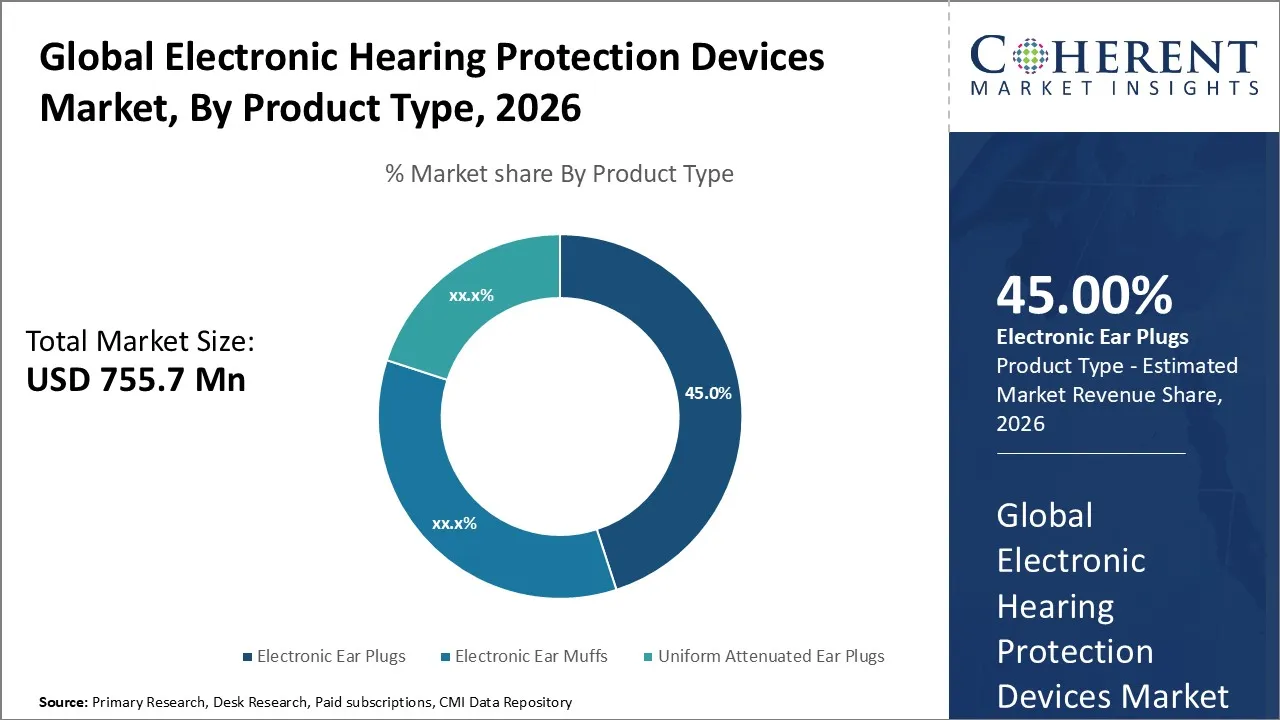
Electronic Hearing Protection Devices Market Insights, By Product Type – Electronic Ear Plugs dominate due to ease of use and compact design
Based on product, the Electronic Ear Plugs segment is expected to have the largest market share of 45% in 2026, followed by Disposable Ear Plugs, due to their lightweight and portable nature and extensive usage in industrial and recreation purposes. Disposable earplugs are convenient and inconspicuous hearing protection that allows a wearer to detect ambient sounds and hence are increasingly being used in various applications, including manufacturing facilities, construction sites, and shooting ranges, where a smaller noise-suppression device is needed.
For instance, in February 2025, Starkey SoundGear introduced “Shield”, an advanced earplug featuring real-time noise attenuation, ambient sound amplification, and Bluetooth connectivity for seamless communication. The launch highlighted the trend toward intelligent, high-performance hearing protection solutions.
Electronic Hearing Protection Devices Market Insights, By Noise Level – 20–30 dB segment preferred for balance of protection and comfort
Based on noise level, the 20–30 dB segment is estimated to contribute the highest market share of 50% in 2026, as it provides an optimal balance between noise reduction and situational awareness. Such a degree of attenuation is commonly adopted in industrial environments, construction zones, or shooting ranges where excessive levels of protection might adversely affect communication or security. Such devices may employ dynamic sound filtering techniques along with ergonomic designs for long-term use without discomfort.
For instance, in January 2025, AXIL Brands launched the MX Series earmuffs with Bluetooth audio, electronic amplification, and adaptive noise protection, emphasizing mid-range attenuation for comfort and safety.
Electronic Hearing Protection Devices Market Insights, By End User – Commercial/Industrial segment dominates due to occupational safety demand
By end user, the Commercial segment is expected to capture the major market share of 65% in 2026, driven by rigid workplace noise regulations and the high prevalence of hearing protection demand in manufacturing, construction, and defense sectors. Businesses are increasingly using electronic hearing protection devices to improve safety compliance along with maintaining the capacity for communication and operational efficiency.
For instance, in December 2025, AXIL Brands unveiled the MX II Series with SonicShieldX™ technology, offering adaptive noise reduction and mobile connectivity for industrial workers, reflecting the growing integration of digital intelligence into professional hearing protection solutions.
Regional Insights
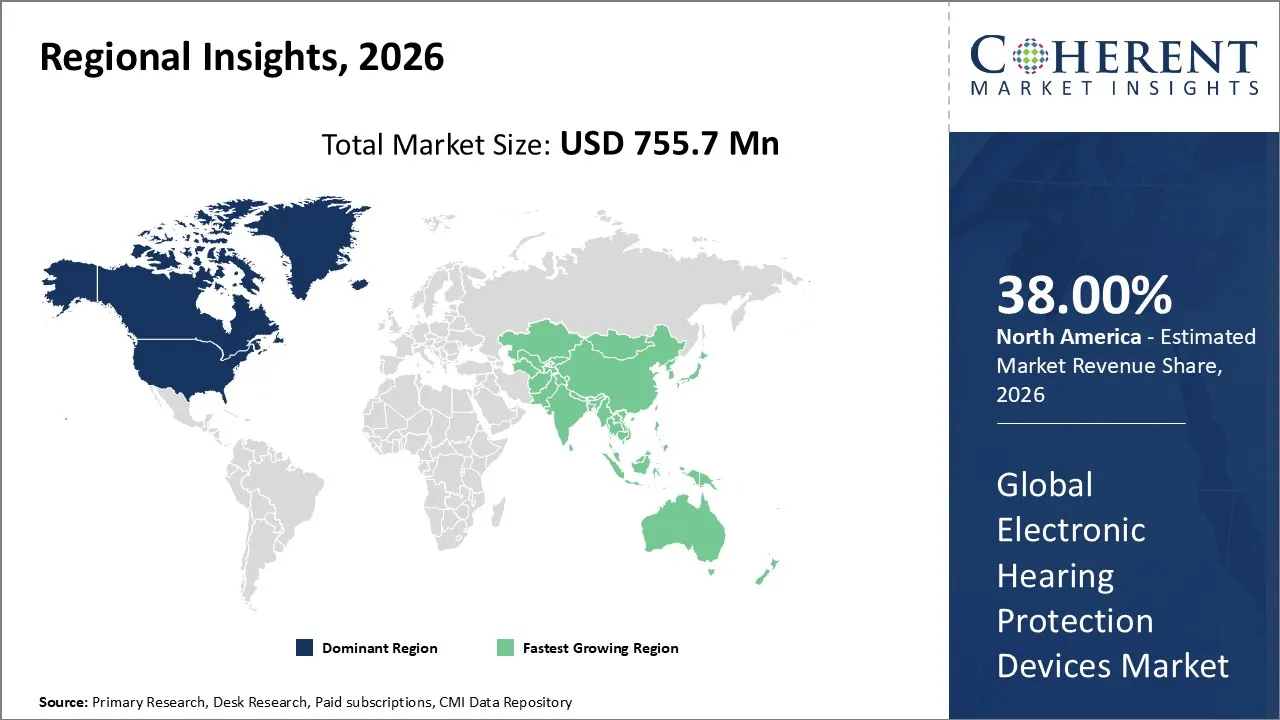
North America Electronic Hearing Protection Devices Market Analysis & Trends
North America is anticipated to lead the market for electronic hearing protection devices in the year 2026, with a projected market share of 38%. The growth of the market in this region can be attributed to a number of reasons, including a strong safety culture in the workplace, high awareness levels about hearing loss prevention, and adoption by the industrial and defense sectors, among others.
For instance, in January 2025, AXIL Brands announced the launch of the MX Series Earmuffs in North America. This line includes MX Passive, MX Electronic, and MX PRO models featuring Bluetooth wireless audio, automatic noise protection, and electronic hearing enhancement.
Asia Pacific Electronic Hearing Protection Devices Market Analysis & Trends
The Asia Pacific market has shown the highest growth rate in electronic hearing protection devices, and this can be attributed to an increase in industrialization, occupational safety awareness, and rising investments in infrastructure and sports like shooting and motorsports. China, India, Japan, and South Korea have shown significant growth in demand for sophisticated hearing protection devices in their industrial and business sectors.
For instance, In November 2025, audio technology leader Sennheiser introduced the SoundProtex Plus hearing protection product in India. Designed for everyday users, audiophiles, and travelers, this device combines high‑fidelity audio with effective sound filtering to safeguard hearing in loud environments such as concerts, air travel, and urban noise settings.
Electronic Hearing Protection Devices Market Outlook for Key Countries
Is the U.S. electronic hearing protection devices market booming due to regulations, industrial adoption, and advanced technology?
The U.S. electronic hearing protection devices market is growing significantly due to strong regulations regarding safety at the workplace, a growing need to overcome the effects of occupational hearing loss, and the ability to leverage cutting-edge noise-reduction technology. Industries such as manufacturing, construction, and the military are increasingly using electronic earplugs, earmuffs, as well as sound-adapting devices.
For instance, in February 2025, SoundGear launched its “Shield” electronic earplug in North America, offering real-time noise attenuation, ambient sound amplification, and Bluetooth connectivity for seamless communication. This product demonstrates how regulatory compliance, industrial safety needs, and technological innovation are fueling U.S. market growth.
Is Canada’s industrial safety push driving demand for electronic hearing protection devices?
Canada’s emphasis on occupational health and safety is boosting demand for electronic hearing protection devices across industrial and construction sectors. Companies are increasingly adopting digital earmuffs and ear plugs with adaptive sound filtering to comply with regulatory requirements and enhance worker safety.
For instance, in June 2025, AXIL Brands supplied its MX Series earmuffs to Canadian industrial clients, featuring Bluetooth audio, electronic amplification, and automatic noise attenuation. The launch reflects Canada’s rising need for intelligent hearing protection solutions that ensure both safety and communication in high-noise environments.
Is China’s industrial growth and wellness focus boosting hearing protection device adoption?
China's rapid industrialization, expanding infrastructure projects, and growing awareness of hearing health drive growth in the electronic hearing protection devices market. Devices with adaptive noise reduction and ambient sound amplification are being adopted both by industrial users and in recreational sectors like shooting sports.
For instance, in August 2025, Audeara partnered with Eastech (Huizhou) Co., Ltd. to launch advanced hearing protection devices in China, incorporating proprietary audio technology for both industrial and consumer applications. This move reflects the rising demand for hearing safety solutions aligned with China’s wellness and occupational health initiatives.
Market Report Scope
Electronic Hearing Protection Devices Market Report Coverage
| Report Coverage | Details | ||
|---|---|---|---|
| Base Year: | 2025 | Market Size in 2026: | USD 755.7 Mn |
| Historical Data for: | 2020 To 2024 | Forecast Period: | 2026 To 2033 |
| Forecast Period 2026 to 2033 CAGR: | 8.0% | 2033 Value Projection: | USD 1,295.7 Mn |
| Geographies covered: |
| ||
| Segments covered: |
| ||
| Companies covered: | Honeywell International Inc., Amplifon, Siemens Healthineers AG, Dynamic Ear Company, Hulfators Group, Centurion Safety Products Ltd., 3M, ADCO Hearing Products Inc., and EERS Global Technologies Inc. | ||
| Growth Drivers: |
| ||
| Restraints & Challenges: |
| ||
Market Dynamics
Electronic Hearing Protection Devices Market Driver
Rising awareness of hearing loss and workplace safety regulations
Increasing awareness of the long-term effects of noise-induced hearing loss, together with stringent occupational health and safety regulations in the manufacturing, construction, and defense industries, acts as a driver for growth in the electronic hearing protection devices market. Advanced earplugs and earmuffs with adaptive noise reduction, Bluetooth connectivity, and voice amplification are some recent investments by companies to ensure that workers are protected without compromising communication or productivity.
Electronic Hearing Protection Devices Market Opportunity
Integration of smart technology and connected devices
The market offers substantial growth opportunities with the use of smart and connected hearing protection products. The applications of advanced features such as real-time noise monitoring, connectivity with smartphones through mobile applications, adaptive sound filtering, and rechargeable batteries are expected to attract the industrial, recreational, as well as the consumer markets. Advances in the area of ergonomic designs that are lightweight with customized fittings and multifunctional products enabling users to protect their hearing while being aware of the situations would accelerate the adoption process.
Analyst Opinion (Expert Opinion)
- The electronic hearing protection devices market is rapidly evolving from a purely compliance-driven segment into a technology-led, user-centric industry. These modern devices are not just about noise blocking but are actively working on enhancing situational awareness with effective protection in industrial, recreational, and commercial applications. Companies are increasingly integrating features such as adaptive sound filtering, ambient sound amplification, enhancement of voice, and connectivity options into these devices to meet the demands of workers and consumers who require both protection and communication.
- North America remains a leading innovator, driven by strong industrial adoption and solid regulatory enforcements, while at the same time, Asia Pacific emerges as a high-growth region with manufacturers and end users embracing smart and multifunctional hearing protection devices, especially in industrial hubs and growing recreational markets.
- Ergonomics, comfort, and usability are emerging as biggest differentiation factors. There is a growing trend of users craving lightweight, adjustable, and re-useable devices that can be worn for an extended number of hours. There is also a trend of users choosing re-useable devices.
- The market is growing beyond mainstream industrial use. Recreational use in target sports, motor sports, and live music venues is driving demand for devices that combine protection with enhanced audio experiences. This shift indicates that the market is moving toward performance-driven adoption, where innovation, usability, and functionality dictate purchasing decisions more than regulatory compliance alone.
Speak to the analyst
Want personalized insights?
Take the findings above to one of our principal consultants, or have the report rebuilt around the segments, geographies and competitors you actually track.
Electronic Hearing Protection Devices Industry News
- In July 2025, Amplifon introduced a new commercial proposal designed to provide customers with clearer, more comprehensive information about its hearing services and devices across its markets.
- In February 2025, Amplifon actively promoted World Hearing Day 2025 by organizing hearing tests and educational prevention activities across universities, businesses, and public locations in several countries, highlighting the importance of hearing protection and early detection.
- In October 2024, 3M launched the WorkTunes™ Connect + Solar Hearing Protector, the first wireless Bluetooth hearing protector that uses flexible Powerfoyle™ solar cell technology for continuous charging from indoor and outdoor light.
Market Segmentation
- Product Type Insights (Revenue, USD Mn, 2026 - 2033)
- Electronic Ear Plugs
- Electronic Ear Muffs
- Uniform Attenuated Ear Plugs
- Noise Level Insights (Revenue, USD Mn, 2026 - 2033)
- 10-20 db
- 20-30 db
- >30 db
- End User Insights (Revenue, USD Mn, 2026 - 2033)
- Personal/Individual
- Commercial
- Regional Insights (Revenue, USD Mn, 2026 - 2033)
- North America
- U.S.
- Canada
- Latin America
- Brazil
- Argentina
- Mexico
- Rest of Latin America
- Europe
- Germany
- U.K.
- Spain
- France
- Italy
- Russia
- Rest of Europe
- Asia Pacific
- China
- India
- Japan
- Australia
- South Korea
- ASEAN
- Rest of Asia Pacific
- Middle East
- GCC Countries
- Israel
- Rest of Middle East
- Africa
- South Africa
- North Africa
- Central Africa
- North America
- Key Players Insights
- Honeywell International Inc.
- Amplifon
- Siemens Healthineers AG
- Dynamic Ear Company
- Hulfators Group
- Centurion Safety Products Ltd.
- 3M
- ADCO Hearing Products Inc.
- EERS Global Technologies Inc.
Sources
Primary Research Interviews
- Electronic Hearing Protection Device Manufacturers & Brand Managers
- Product Designers & Acoustic Engineers
- Industrial Safety Equipment Distributors
- Occupational Health & Safety Officers
- Construction, Manufacturing & Defense Sector Safety Managers
- Professional Shooting Range Operators & Recreational Shooting Experts
- Audiologists & Hearing Protection Specialists
- Others
Databases
- Bloomberg Terminal
- PitchBook
- Others
Magazines
- Occupational Health & Safety Magazine
- Industrial Safety & Hygiene News (ISHN)
- Hearing Review
- Safety+Health Magazine
- Noise & Vibration Worldwide
- Others
Journals
- International Journal of Audiology
- Journal of Occupational and Environmental Hygiene
- Applied Acoustics
- Hearing Research
- Journal of Safety Research
- Others
Newspapers
- Financial Times
- The Wall Street Journal
- Reuters
- Bloomberg News
- USA Today (Business/Safety Section)
- Others
Associations
- National Institute for Occupational Safety and Health (NIOSH)
- American Speech-Language-Hearing Association (ASHA)
- Hearing Industries Association (HIA)
- International Safety Equipment Association (ISEA)
- Others
Public Domain Sources
- NIOSH Publications & Guidelines
- OSHA Regulations & Reports
- U.S. Bureau of Labor Statistics (Occupational Safety Data)
- U.S. Consumer Product Safety Commission Reports
- WHO – Occupational Noise Exposure Guidelines
- Others
Proprietary Elements
- CMI Data Analytics Tool
- Proprietary CMI Existing Repository of Information for the Last 8 Years
Get access to 250+ pages report
Every segment, forecast, competitor profile and data table behind the analysis above — available for instant download.
- ESOMAR Member
- ISO 9001:2015 Certified
- D-U-N-S Registered
- GDPR & CCPA Compliant
Missing comfort of reading report in your local language? Find your preferred language:
Transform your Strategy with Exclusive Trending Reports
Frequently Asked Questions
The electronic hearing protection devices market is estimated to be valued at USD 755.7 Mn in 2026, and is expected to reach USD 1,295.7 Mn by 2033.
The CAGR of the electronic hearing protection devices market is projected to be 8.0% from 2026 to 2033.
Rising awareness about occupational noise-induced hearing loss, increasing adoption of smart hearing protection devices with Bluetooth connectivity and adaptive sound control, and growing recreational shooting and motorsports activities are key growth drivers.
High costs of advanced electronic hearing protection devices, lack of awareness in some developing regions, and limited availability of specialized products for niche applications may hinder market growth.
The Electronic Ear Plugs segment is expected to lead the market in 2026, owing to their compact design, ease of use, and wide industrial adoption.
Honeywell International Inc., Amplifon, Siemens Healthineers AG, Dynamic Ear Company, Hulfators Group, Centurion Safety Products Ltd., 3M, ADCO Hearing Products Inc., and EERS Global Technologies Inc. are key players.
North America is expected to lead the market in 2026 due to high industrial safety standards, strong brand presence, and widespread adoption of advanced hearing protection devices.