

U.S. IV Infusion Products Market Size and Share Analysis - 2026 To 2033
The U.S. IV infusion products market size is estimated to reach USD 9,501.4 Mn in 2026 and is projected to grow at a CAGR of 3.8% during the forecast period, reaching approximately USD 12,336.4 Mn by 2033. This is attributable to rising prevalence of chronic diseases, increasing number of surgical procedures, and growing demand for home healthcare services. A growing share of Americans have multiple chronic conditions: 42% live with two or more, and 12% have five or more.
Key Takeaways from the U.S. IV Infusion Products Market Report
- IV infusion pump segment is expected to account for the largest market revenue share of 40% in 2026 due to its high cost as well as rising use in critical care, oncology, and long-term infusion therapies. More than 5 Mn patients are admitted annually to intensive care units (ICUs) in the United States, highlighting the extensive use of infusion pumps for administering vasopressors, sedatives, analgesics, antibiotics, insulin, and other critical medications in high-acuity settings.
- Antibiotic/antiviral category will emerge as the leader in the IV infusion products market in the United States with a market share of 32% by 2026 due to the extensive use of intravenous antibiotics and antivirals. For instance, CDC statistics indicate that 1.7 Mn adults develop sepsis each year in the United States, which is a deadly disease that necessitates immediate treatment with intravenous antibiotics, thereby driving demand for IV infusion products.
- Hospitals are expected to remain the leading end users of IV infusion products across the U.S., holding a market share of 68% in 2026. This is mostly due to high patient volumes, increasing surgical procedures, intensive care requirements, and the treatment of chronic diseases. According to the American Hospital Association, U.S. hospitals recorded approximately 35.7 Mn inpatient admissions in 2024, driving demand for IV medications, fluids, and infusion-based therapies.
U.S. IV Infusion Products Market Overview
The U.S. IV infusion products market is expected to register moderate growth during the forecast period. This is primarily due to rising burden of chronic diseases, increasing number of hospitalizations and surgical procedures, growing demand for home healthcare services, and expanding elderly population requiring long-term intravenous therapies. In addition, technological advancements in infusion pumps and increasing use of intravenous administration for medications, fluids, and nutritional support are supporting market expansion in the nation.
Infusion products are medical devices used to deliver fluids, nutrients, and medications directly into a patient's body in controlled amounts. They are commonly used in hospitals, nursing homes, and home healthcare settings. Rising adoption of IV infusion products like infusion pump, needles, and catheters in healthcare and home care settings is boosting market growth in the U.S.
Increasing geriatric population is creating a conducive environment for the expansion of the IV infusion products market in the U.S. This is because older people are more prone to chronic illnesses and age-related health complications and often require continuous medication delivery, nutritional support, and fluid management through IV infusion products.
Rising surgical procedures and hospital admissions are expected to boost sales of IV infusion products across the U.S. during the forthcoming period. Increasing volumes of surgeries, emergency treatments, and critical care admissions require IV fluids, drug delivery systems, and infusion pumps for effective patient management.
Similarly, growth in specialty pharmaceuticals and biologics is fueling demand for IV infusion products in the U.S. The expanding use of biologics, monoclonal antibodies, immunotherapies, and specialty drugs has increased the need for precise infusion delivery systems. Many advanced therapies require controlled IV administration, supporting demand for smart infusion technologies.
Healthcare facilities are adopting needleless connectors and advanced catheter technologies to reduce bloodstream infections and needlestick injuries. This shift toward needleless and infection-control solutions is set to boost the U.S. IV infusion products market growth during the forecast period.
Segmental Insights
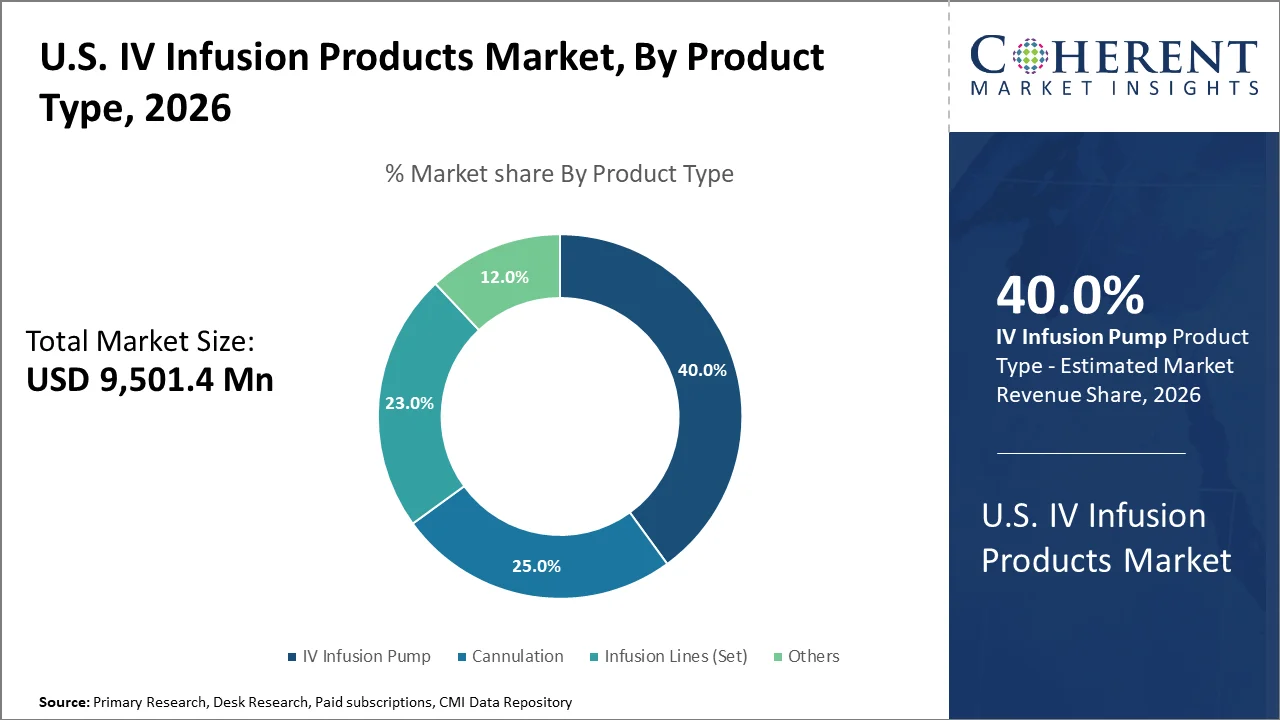
Which Product Type Dominates the U.S. IV Infusion Products Market?
IV Infusion Pumps Account for the Largest Market Share in 2026
According to Coherent Market Insights’ latest U.S. IV infusion products market analysis, IV infusion pumps segment is expected to lead the market, accounting for a revenue share of 40% in 2026. This dominance can be attributed to increasing adoption of advanced IV infusion pump technologies across hospitals, ambulatory surgical centers, and home healthcare settings.
IV infusion pumps provide precise and controlled delivery of fluids, medications, and nutrients, reducing the risk of dosage errors and improving patient safety. Rising prevalence of chronic diseases, such as cancer, diabetes, and cardiovascular disorders, is significantly increasing the demand for continuous and accurate drug administration, further driving adoption of infusion pumps.
According to the American Society of Health-System Pharmacists (ASHP), approximately 87.9% of U.S. hospitals had adopted smart infusion pumps by 2020. This shows their critical role in improving medication safety, reducing dosing errors, and supporting digital healthcare workflows.
Moreover, growing healthcare expenditure, expanding outpatient care services, and integration of smart features such as dose error reduction systems (DERS), wireless connectivity, and electronic health record (EHR) integration are boosting segment growth. Healthcare providers are increasingly investing in technologically advanced infusion pumps to enhance clinical efficiency, streamline workflows, and comply with stringent patient safety standards.
Leading companies are expanding their portfolios to capitalize on emerging opportunities as well as boost their overall sales. For instance, in April 2025, Such developments will also boost growth of the target segment in the coming years.
- Current Industry Events of 2026
- Market Size Estimation
- Regional Breakdown
- Competitive Landscape
- Customer Intelligence
- Segmental Analysis
- Pricing Analysis
- Key Market Drivers, Challenges & Future Trends
- Customized Insights Section
Which Application Leads the U.S. IV Infusion Products Industry?
Antibiotic/Antiviral Application to Lead the Market with One-Third Share in 2026
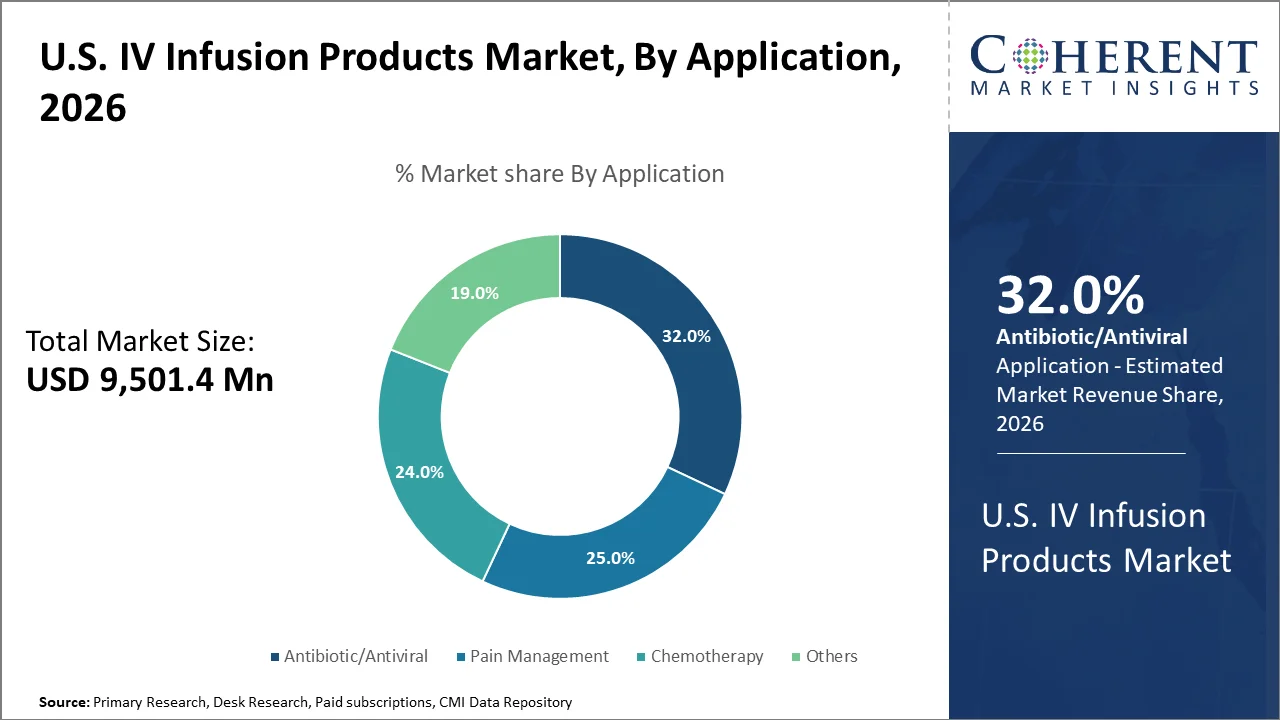
By application, antibiotic/antiviral segment is projected to lead the U.S. IV infusion products industry, accounting for a market share of 32% in 2026. This is mostly due to rising prevalence of infectious diseases, increasing hospital admissions requiring rapid antimicrobial therapy, and rising use of intravenous antibiotics and antivirals in critical care settings.
Increasing burden of hospital-treated infectious diseases is driving IV antibiotic use. According to the This rising burden of severe infections is expected to fuel demand for IV antibiotic and antiviral therapies, especially in hospitals where rapid and effective treatment is critical.
IV administration ensures faster drug delivery, improved bioavailability, and precise dosing, making it the preferred route for treating severe bacterial and viral infections. In addition, growing concerns over antimicrobial resistance, an aging population vulnerable to infections, and increasing number of surgical procedures are also driving demand for IV antibiotics and antiviral therapies across healthcare facilities in the United States.
U.S. IV Infusion Products Market Growth Drivers
Rising Prevalence of Chronic Diseases
Increasing prevalence of chronic diseases is providing a strong impetus for the growth of the U.S. IV infusion products market. There is a spike in cases of cancer, diabetes, autoimmune disorders, gastrointestinal diseases, and cardiovascular conditions across the U.S. For instance, according to the American Cancer Society, approximately 2.11 million new cancer cases are projected to be diagnosed in the U.S. in 2026. This growing burden of chronic diseases is expected to drive demand for IV infusion therapies and, consequently, IV infusion products. Many of these conditions require the long-term administration of medications, hydration therapy, parenteral nutrition, and biologics through infusion systems.
U.S. IV Infusion Products Market Opportunities
Expansion of Home Infusion Therapy
Increasing adoption of home infusion therapy is expected to create lucrative growth opportunities for the U.S. IV infusion products market during the forecast period. Healthcare providers are increasingly shifting treatment from hospitals and clinical settings to home-based care to reduce healthcare costs as well as improve patient convenience and enhance treatment outcomes. The rising use of portable infusion pumps and home-administered intravenous therapies for chronic diseases, infections, and nutritional support is driving demand for IV infusion devices, administration sets, catheters, and infusion solutions. As the preference for patient-centered and cost-effective care continues to grow, the home infusion therapy segment is expected to support market expansion.
U.S. IV Infusion Products Market Trends
Adoption of Smart Infusion Pumps
Increasing adoption of smart infusion pumps is a key growth-shaping trend in the U.S. IV infusion products market. Healthcare providers in the contemporary world are increasingly deploying smart pumps equipped with wireless connectivity, electronic health record (EHR) integration, and automated dosing capabilities. These systems enhance workflow efficiency, reduce medication errors, and improve patient safety, contributing to the growing demand for advanced IV infusion products.
Current Events and Their Impact on the U.S. IV Infusion Products Market
Current Event | Description and its Impact |
FDA Resolves U.S. IV Saline Shortage (2025) |
|
Supply Chain Strengthening After Hurricane Disruptions |
|
Who are the Major Companies in the U.S. IV Infusion Products Market?
Some of the major players in U.S. IV infusion products market are AngioDynamics Inc., Kimal, Terumo Corporation, Teleflex Inc., Becton Dickinson and Company, Cook Group, Nipro Corporation, ZOLL Medical Corporation, B. Braun Medical Inc., AdvaCare Pharma, PL Medical Co. LLC, Greiner Bio-One International GmbH, EMED Technologies Corporation, CODAN Companies, and Smiths Group plc.
Key Strategies Adopted by Industry Players
Top manufacturers of IV infusion products across the U.S. are adopting various organic and inorganic strategies to boost their revenue as well as gain a competitive edge in the industry. These include new product launches and approvals, new facility expansions, investments in R&D activities, partnerships, mergers, acquisitions, collaborations, and distribution agreements.
- In October 2025, Takeda announced the U.S. availability of its HyHub and HyHub Duo devices to simplify HYQVIA infusion preparation. The devices recently received U.S. FDA 510(k) clearance.
- In May 2025, Penlon introduced its latest line of infusion pumps under the Infusion System range. These infusion systems have been designed for providing clinicians with more safety and simplicity during the process of infusion management.
- In April 2025, ICU Medical introduced its new category of precision IV pumps. The launch followed FDA 510(k) clearance of the Plum Solo and Plum Duo Precision IV Pumps.
Market Report Scope
U.S. IV Infusion Products Market Report Coverage
| Report Coverage | Details | ||
|---|---|---|---|
| Base Year: | 2025 | Market Size in 2025: | USD 9,501.4 Mn |
| Historical Data for: | 2020 To 2024 | Forecast Period: | 2026 To 2033 |
| Forecast Period 2026 to 2033 CAGR: | 3.8% | 2033 Value Projection: | USD 12,336.4 Mn |
| Segments covered: |
| ||
| Companies covered: | AngioDynamics Inc., Kimal, Terumo Corporation, Teleflex Inc., Becton Dickinson and Company, Cook Group, Nipro Corporation, ZOLL Medical Corporation, B. Braun Medical Inc., AdvaCare Pharma, PL Medical Co. LLC, Greiner Bio-One International GmbH, EMED Technologies Corporation, CODAN Companies, and Smiths Group plc. | ||
| Growth Drivers: |
| ||
| Restraints & Challenges: |
| ||
Analyst Opinion (Expert Opinion)
- Rising burden of severe infections is increasing demand for IV therapy. At least 1.7 million adults in the U.S. develop sepsis each year, and rapid treatment often requires IV fluids and medications. This creates consistent demand for infusion products across hospitals and emergency care settings. Higher patient volumes support long-term growth in IV infusion products.
- Growth of home-based infusion care is expanding IV infusion products market opportunities. More patients are receiving IV medications, nutrition, and hydration therapies outside hospitals through portable infusion pumps. Increasing adoption of home healthcare is boosting demand for user-friendly and portable infusion products.
- Smart infusion pumps are improving patient safety. Modern infusion pumps include safety alarms and dose-error reduction features that help reduce medication administration errors. Healthcare providers are upgrading infusion systems, driving demand for advanced infusion technologies.
Speak to the analyst
Want personalized insights?
Take the findings above to one of our principal consultants, or have the report rebuilt around the segments, geographies and competitors you actually track.
Market Segmentation
- By Product Type Insights ( Revenue, USD Mn, 2021 - 2033)
- Cannulation
- Needles
- Catheter
- IV Infusion Pump
- Gravity Infusion Devices
- Volumetric Pump
- Syringe Pump
- Others
- Infusion Lines (Set)
- Gravity IV Set
- Gravity IV Set W/Needle Free Connector
- Pump IV Set
- Others
- Cannulation
- By Stop Cock Type Insights ( Revenue, USD Mn, 2021 - 2033)
- 3 Way Stopcock
- Vacuum Stopcocks
- Burette Stopcocks
- Others
- By Needle Free Connector Insights ( Revenue, USD Mn, 2021 - 2033)
- Standalone Connectors
- Needle-free Extension Sets
- By Infusion Site Insights ( Revenue, USD Mn, 2021 - 2033)
- Peripheral IV
- Medline IV
- Central IV
- By Application Insights ( Revenue, USD Mn, 2021 - 2033)
- Pain Management
- Antibiotic/Antiviral
- Chemotherapy
- Others
- By End User Insights ( Revenue, USD Mn, 2021 - 2033)
- Ambulatory Surgical Centers
- Clinics
- Home Care Settings
- Hospitals
- Others
Sources
Primary Research Interviews
- Hospital procurement managers
- Infusion therapy specialists
- Pharmacists
- Critical care physicians
- Ambulatory infusion center administrators
- Home healthcare providers
- Distributors
- Medical device manufacturers
Databases
- U.S. Food and Drug Administration (FDA)
- Centers for Medicare & Medicaid Services (CMS)
- Centers for Disease Control and Prevention (CDC)
- National Center for Health Statistics (NCHS)
- National Institutes of Health (NIH)
- PubMed
- ClinicalTrials.gov
- Healthcare Cost and Utilization Project (HCUP)
- SEER Program
- U.S. Census Bureau
Magazines
- Medical Product Outsourcing
- Healthcare Purchasing News
- Pharmacy Times
- Modern Healthcare
- Drug Topics
- Infection Control Today
Journals
- Journal of Infusion Nursing
- American Journal of Health-System Pharmacy
- Journal of Clinical Medicine
- The New England Journal of Medicine
- JAMA
- BMJ Open
- Journal of Vascular Access
Newspapers
- The Wall Street Journal
- USA Today
- The New York Times
- Los Angeles Times
- The Washington Post
Associations
- Infusion Nurses Society (INS)
- American Society of Health-System Pharmacists (ASHP)
- American Hospital Association (AHA)
- Association for Vascular Access (AVA)
- Healthcare Supply Chain Association (HSCA)
- National Home Infusion Association (NHIA)
Public Domain Sources
- U.S. Department of Health and Human Services (HHS)
- FDA Medical Device Databases
- CMS Open Data
- CDC Data & Statistics
- NIH Reports and Publications
- U.S. Census Bureau
- Agency for Healthcare Research and Quality (AHRQ)
- Government Accountability Office (GAO)
- Congressional Budget Office (CBO)
Proprietary Elements
- CMI Data Analytics Tool
- Proprietary CMI Existing Repository of Information for Last 10 Years
Get access to 250+ pages report
Every segment, forecast, competitor profile and data table behind the analysis above — available for instant download.
- ESOMAR Member
- ISO 9001:2015 Certified
- D-U-N-S Registered
- GDPR & CCPA Compliant
Missing comfort of reading report in your local language? Find your preferred language:
Transform your Strategy with Exclusive Trending Reports
Frequently Asked Questions
The U.S. IV Infusion Products Market is estimated to be valued at USD 9,501.4 Mn in 2026.
The U.S. IV Infusion Products Market value is expected to reach USD 12,336.4 Mn by 2033.
The U.S. IV Infusion Products Market is poised to exhibit a CAGR of 3.8% from 2026 to 2033.
Major growth factors include increasing cases of chronic diseases, expansion of home infusion therapy, and new product launches and approvals.
IV infusion pumps segment is set to lead the market with a revenue share of 40% in 2026.
Some major companies in the U.S. IV Infusion Products Market include AngioDynamics Inc., Kimal, Terumo Corporation, Teleflex Inc., Becton Dickinson and Company, Cook Group, Nipro Corporation, ZOLL Medical Corporation, B. Braun Medical Inc., AdvaCare Pharma, PL Medical Co., LLC, Greiner Bio-One International GmbH, EMED Technologies Corporation, CODAN Companies, and Smiths Group plc.