

Global Nursing Pads Market Size and Forecast – 2026 To 2033
The Global Nursing Pads Market is estimated to be valued at USD 335.8 Mn in 2026 and is expected to reach USD 491.7 Mn by 2033, growing at a compound annual growth rate (CAGR) of 5.60% from 2026 to 2033. Market growth is supported by greater emphasis on breastfeeding continuity, postpartum hygiene, workplace lactation management, and convenient solutions for breast-milk leakage. Product development is increasingly centered on thinner absorbent cores, breathable skin-contact layers, improved leak barriers, secure adhesive positioning, and reusable materials, enabling manufacturers to address both convenience-focused and sustainability-conscious mothers.
Expansion of maternity-care services and digital access to breastfeeding products is also widening adoption in emerging economies. In August 2026, the World Health Organization reiterated that infants should be exclusively breastfed for the first six months and that breastfeeding should continue for up to two years or beyond, reinforcing the long-term need for practical lactation-support and leakage-management products throughout the breastfeeding journey
Key Takeaways in the Global Nursing Pads Market
- Disposable Nursing Pads are estimated to expand at a 6.0% CAGR during 2026–2033 and are expected to hold 61.8% of the global nursing pads market in 2026, reflecting strong preference for hygienic, individually wrapped, no-laundry protection during frequent early-postpartum leakage. In August 2026, Lansinoh continued offering Stay Dry disposable pads in 36-, 60-, and 100-pad packs, reinforcing convenience-led repeat purchasing.
- Cotton segment is estimated to grow at a 5.4% CAGR during 2026–2033 and account for 34.8% of the global nursing pads market in 2026, supported by softness, breathability, absorbency, and strong suitability for sensitive skin. In August 2026, Natracare continued selling nursing pads with certified organic cotton next to the skin and without perfumes, dyes, or petroleum-based plastics, illustrating material-led differentiation.
- Contoured Nursing Pads are estimated to record a 5.9% CAGR during 2026–2033 and are expected to capture 46.8% of the global nursing pads market in 2026, as anatomical fit improves discretion, stability, and comfort under clothing. In July 2024, Philips issued Avent breast-pad specifications citing an average 2 mm thickness, discreet contoured shape, honeycomb top sheet, and two adhesive strips, directly validating low-profile design priorities.
- North America is estimated to advance at a 4.9% CAGR during 2026–2033 and is expected to represent 34.6% of the global nursing pads market in 2026, supported by high breastfeeding participation, developed maternal-care retail, and broad e-commerce access. In July 2026, the CDC released 2023–2024 breastfeeding-initiation data covering 3,167 U.S. counties or equivalents, underscoring a large addressable user base for leakage-management accessories.
- Asia Pacific is estimated to post a 7.2% CAGR during 2026–2033 and is expected to account for 27.7% of the global nursing pads market in 2026, benefiting from expanding breastfeeding support, urban retail access, and a large maternal population. In August 2024, UNICEF reported that exclusive breastfeeding in South Asia reached 60% in 2024, strengthening the user pool for breastfeeding-support products over longer feeding periods.
Segmental Insights
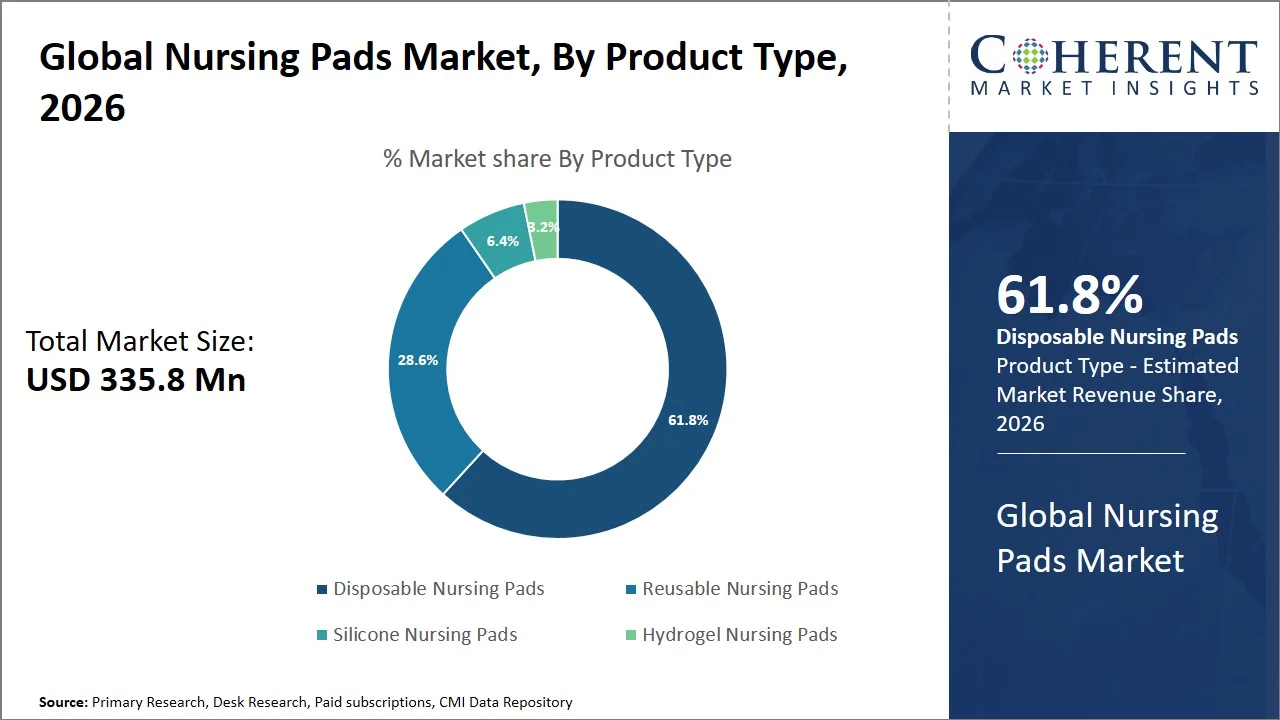
Why Do Disposable Nursing Pads Dominate the Global Nursing Pads Market?
Disposable Nursing Pads are expected to hold 61.8% of the global nursing pads market in 2026, leading product type demand because they solve the highest-frequency leakage need with immediate, hygienic replacement rather than washing and drying cycles. Their individually wrapped format suits hospitals, maternity bags, workplaces, travel, and overnight use, while multilayer absorbent cores and leak guards allow manufacturers to combine thin profiles with high fluid retention. For retailers, repeat consumption supports faster inventory rotation and multiple pack-size strategies, giving disposable formats wider shelf and e-commerce presence than reusable alternatives. In August 2024, Medela launched its Ultra-breathable Disposable Nursing Pads, designed to absorb up to 50 times their weight, with side leak guards and a 1.6 mm profile; the company also placed the product through Amazon, Target, and Walmart, demonstrating how product engineering and mass retail availability reinforce disposable-pad commercialization.
- Current Industry Events of 2026
- Market Size Estimation
- Regional Breakdown
- Competitive Landscape
- Customer Intelligence
- Segmental Analysis
- Pricing Analysis
- Key Market Drivers, Challenges & Future Trends
- Customized Insights Section
Why Does Cotton Represent the Largest Material Type in the Global Nursing Pads Market?
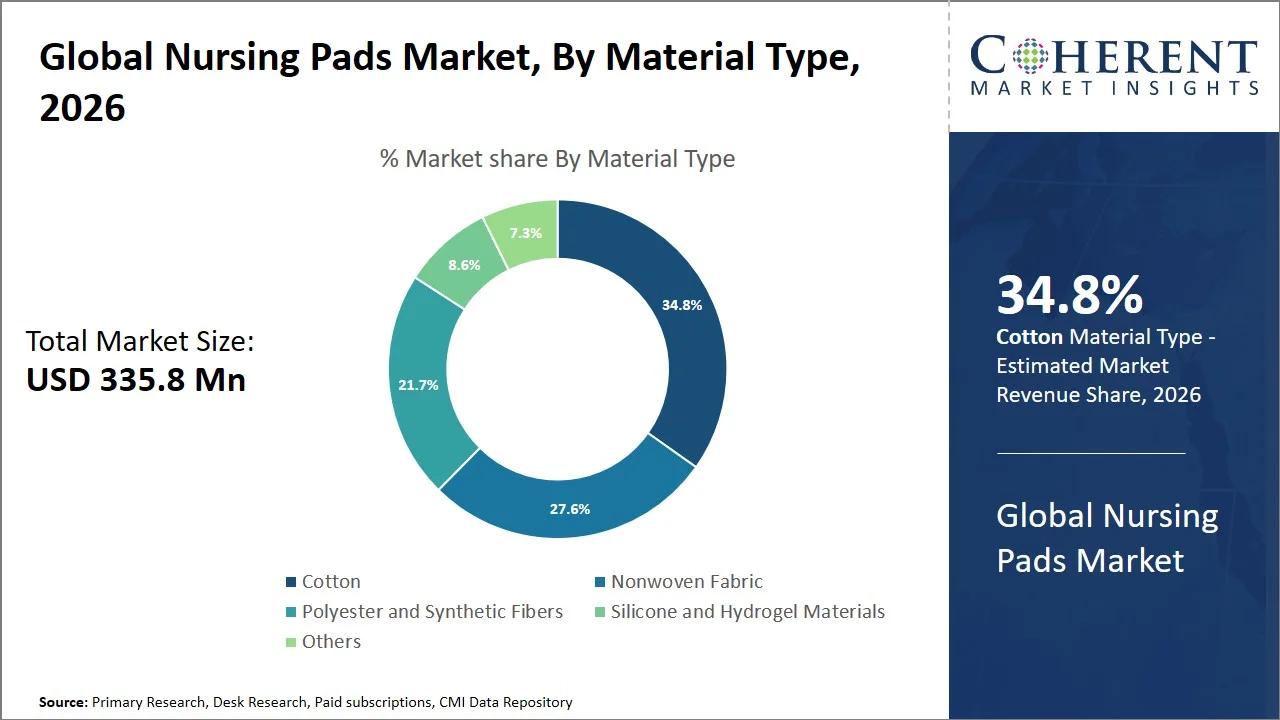
Cotton is expected to account for 34.8% of the global nursing pads market in 2026, making it the largest material segment because prolonged skin contact places softness, breathability, and material familiarity ahead of purely synthetic performance attributes for many buyers. Cotton can be used as a skin-facing layer or within reusable constructions, allowing suppliers to serve sensitive-skin, natural-material, and sustainability-oriented propositions without abandoning absorbency requirements. Its established textile processing base also supports scalable sourcing, stitching, finishing, and private-label manufacturing across maternity-care portfolios. For brands, certified cotton creates a tangible differentiation route through fiber provenance and material claims rather than relying only on pad thickness or pack size. In October 2025, ICEA issued a GOTS scope certificate to Mila Fair Clothings covering breast pads made from 95% organic cotton and 5% elastane, evidencing certified cotton capability within personal-care hygiene manufacturing.
Why Do Contoured Nursing Pads Dominate the Design Type Segment of the Global Nursing Pads Market?
Contoured Nursing Pads are expected to capture 46.8% of the global nursing pads market in 2026, leading design preferences because a shaped profile addresses fit, movement, and visibility simultaneously rather than treating absorbency as the only performance criterion. Curved construction follows the breast more closely, helping distribute the pad inside a bra, reduce bunching, and keep absorbent surfaces aligned during routine movement. This makes the format especially relevant for mothers returning to work, travelling, or wearing fitted clothing, where discretion and positional stability influence repeat purchase. For manufacturers, contouring supports premiumization through three-dimensional forming, thinner edge profiles, adhesive placement, and differentiated core geometry. In April 2025, Tata 1mg updated its listing for EcommerceHub disposable nursing pads featuring an ultra-thin contoured round shape, a wide adhesive strip, and two securing strips, illustrating how fit engineering is being commercialized alongside leak protection.
Current Events and their Impact
Current Event | Description and Its Impact |
November 2025 – U.S. HHS reports results from the Newborn Supply Kit program |
|
June 2024 – Pennsylvania House passes maternal and newborn supply-kit legislation including nursing pads |
|
September 2023 – European Commission establishes updated EU Ecolabel criteria covering nursing pads |
|
Global Nursing Pads Market Dynamics
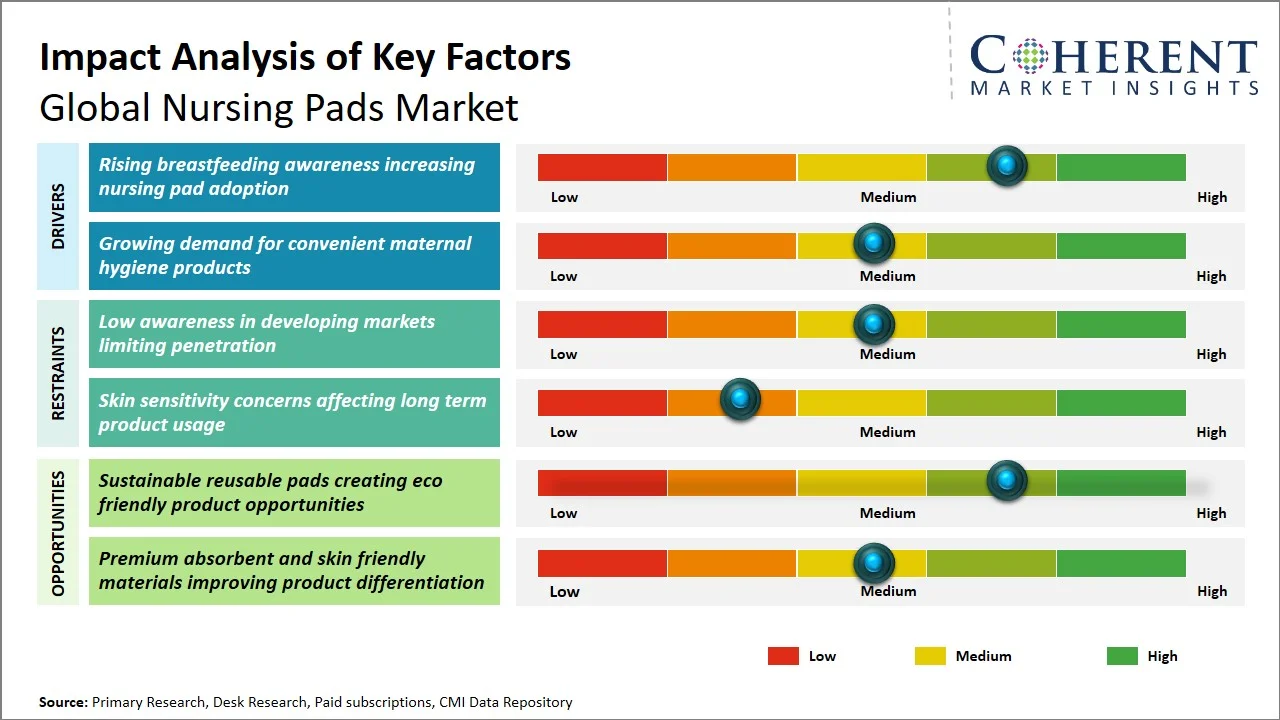
Market Drivers
Rising breastfeeding awareness increasing nursing pad adoption
Rising breastfeeding awareness increasing nursing pad adoption operates through a longer and more informed breastfeeding journey: mothers who receive structured guidance are more likely to recognize milk leakage as a manageable lactation issue and purchase protective accessories instead of discontinuing breastfeeding because of discomfort or inconvenience. This benefits nursing-pad brands, pharmacies, maternity retailers, lactation clinics, and online maternal-care platforms. In July 2026, India’s Ministry of Women and Child Development announced World Breastfeeding Week activities focused on early initiation, exclusive breastfeeding for six months, and continued breastfeeding thereafter, expanding public education around sustained lactation and the accessory needs that accompany it.
Growing demand for convenient maternal hygiene products
Growing demand for convenient maternal hygiene products is shifting purchasing toward nursing pads that combine rapid absorption, discreet wear, secure positioning, and portable individual packaging. The commercial mechanism is practical: working mothers and mothers managing feeding outside the home need a product that can be changed quickly without washing, drying, or carrying bulky accessories. This favors brands with thin multilayer construction, reliable adhesives, and broad pharmacy or e-commerce availability. In March 2025, Vega published product guidance around its individually packed disposable breast pads, highlighting five-layer absorption, leak protection, breathability, and portability for breastfeeding mothers managing leakage away from home.
Emerging Market Trends
Thinner Performance Architecture Is Replacing Bulk as the Design Benchmark
Performance engineering is moving beyond simply adding absorbent bulk. Product development is increasingly centered on thinner cores, faster lateral liquid distribution, breathable barriers, edge leak control, and body-conforming geometry that reduce visibility under clothing while maintaining dryness. This changes the basis of competition from basic absorbency to comfort-per-millimeter and wear-time reliability. Manufacturers with expertise in nonwovens, superabsorbent polymers, embossing, and laminated backsheet design should benefit, while low-cost undifferentiated pads may face margin pressure as buyers become more sensitive to fit, skin feel, and discreetness.
Postpartum-Care Bundling Is Reframing Nursing Pads as an Ecosystem Purchase
Nursing pads are increasingly being merchandised as one component of a broader postpartum and breastfeeding-care routine rather than as an isolated hygiene purchase. Bundling with nipple-care products, nursing bras, pumps, milk-storage products, and recovery kits can increase basket value and reduce customer-acquisition costs because the same buyer is purchasing multiple needs within a short postpartum window. This favors maternal-care platforms and brands with adjacent portfolios, while single-product suppliers may need private-label partnerships, bundle-ready packaging, or retail collaborations to retain visibility as purchase decisions become more ecosystem-based.
Regional Insights
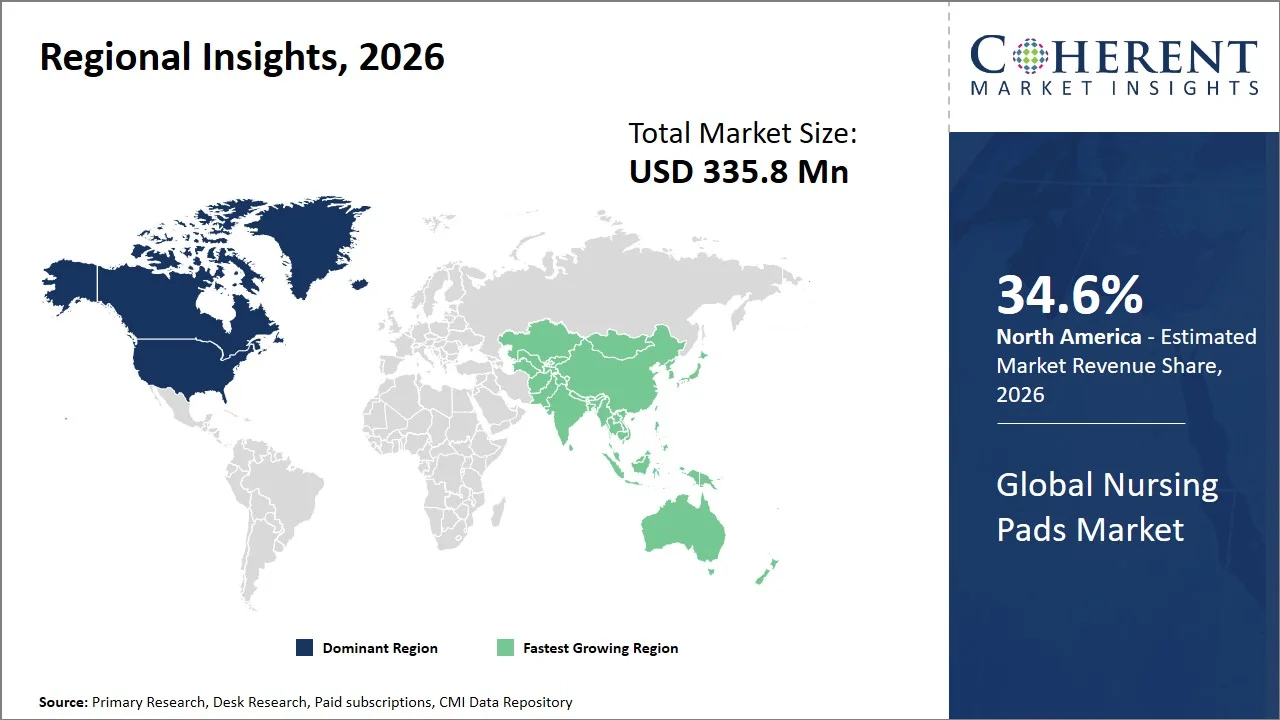
Why Does North America Dominate the Global Nursing Pads Market?
North America is expected to account for 34.6% of the global nursing pads market in 2026, supported by high monetization of breastfeeding accessories, strong postpartum purchasing power, and routine use of purpose-built maternal hygiene products rather than improvised alternatives. The region also benefits from broad access to pharmacies, mass retailers, maternity specialists, and direct-to-consumer channels, allowing brands to sell disposable, reusable, organic-cotton, and premium thin-profile pads across multiple price points. Longer protected leave periods in Canada and workplace lactation protections in the U.S. extend the period during which mothers actively manage milk leakage, supporting repeat purchases beyond the immediate post-delivery stage. In May 2026, Employment and Social Development Canada reported that 92.2% of mothers receiving Employment Insurance maternity benefits in 2024–25 used the full 15 weeks available, indicating sustained post-birth time in which breastfeeding-support products remain commercially relevant.
Why Is Asia Pacific Emerging as the Fastest-Growing Region in the Global Nursing Pads Market?
Asia Pacific is expected to hold 27.7% of the global nursing pads market in 2026 and emerge as the fastest-growing region as breastfeeding support becomes more formalized while maternal-care purchasing shifts toward organized retail and digital channels. Growth is increasingly coming from conversion: urban mothers who previously relied on basic absorbent materials are gaining access to purpose-designed disposable, reusable, and skin-sensitive nursing pads through pharmacies, marketplaces, hospitals, and baby-care platforms. Local manufacturing also enables lower entry-price packs, while developed markets such as Japan and Australia support premium comfort and discreetness. In September 2025, Australia’s Department of Health published an evaluation of the National Breastfeeding Helpline and LiveChat, finding the services vital, efficient, cost-effective, and highly valued, including repeated consumer use. Stronger professional breastfeeding support can extend product-use occasions for leakage-management accessories throughout lactation.
Global Nursing Pads Market Outlook for Key Countries
Why Is the U.S. a Key Market for the Global Nursing Pads Market?
The U.S. is a key market for the global nursing pads market because breastfeeding frequently continues after mothers resume employment, making leakage protection a workplace as well as household requirement. That usage pattern favors individually wrapped, adhesive-backed, thin disposable pads that can be carried, changed, and discarded discreetly during the workday. The country’s pharmacy, mass-merchandise, maternity-specialty, and e-commerce ecosystem also gives consumers broad access to value packs and premium hypoallergenic or reusable alternatives. Federal workplace requirements additionally support continued milk expression, extending the commercial relevance of nursing accessories beyond maternity leave. In April 2026, the U.S. Department of Labor found that a Tulsa medical center violated the PUMP Act by restricting breast-milk expression breaks and required policy changes. The enforcement demonstrates that workplace lactation accommodation remains an active compliance requirement, supporting continued need for portable leakage-management products among working mothers.
Why Is Japan Important in the Global Nursing Pads Market?
Japan is important in the global nursing pads market because its maternal-care category is shaped more by product quality, discretion, and convenience than by birth-volume expansion. Mothers returning to structured work environments create demand for ultra-thin pads that remain stable inside clothing, while high expectations around hygiene favor individually wrapped products, soft skin-contact layers, and dependable leakage barriers. Japan’s mature drugstore and baby-care retail network further supports replenishment and comparison between disposable and reusable formats. Suppliers therefore compete on fit, comfort, packaging efficiency, and material performance rather than solely on unit price. In September 2025, Japan’s Children and Families Agency conducted its Infant and Young Child Nutrition Survey across approximately 6,000 households, examining breastfeeding awareness and guidance together with parental employment and childcare-leave conditions. This linkage between feeding behavior and working patterns is directly relevant to nursing-pad usage occasions and product design priorities.
Why Is India Important in the Global Nursing Pads Market?
India is important in the global nursing pads market because growth is being created by the intersection of breastfeeding promotion, expanding institutional maternity care, and wider access to specialized postpartum products through e-commerce and pharmacies. Demand remains highly price-sensitive, allowing small disposable packs, value multipacks, washable cotton pads, and locally produced alternatives to coexist rather than one format replacing another. Urban working mothers increasingly value discreet leakage protection, while hospitals and lactation-support programs introduce first-time mothers to structured breastfeeding management. This creates scope for segmentation by affordability, absorbency, and reusability instead of premium positioning alone. In August 2026, the National Health Mission’s Mothers’ Absolute Affection program continued to specify breastfeeding counselling through hospitals, ASHAs, ANMs, community meetings, and lactation-management centers. Such health-system reach broadens awareness of sustained breastfeeding practices and strengthens the potential consumer base for practical breast-leakage management products.
Why Is Germany a Strategic Country in the Global Nursing Pads Market?
Germany is a strategic country in the global nursing pads market because it supports a high-value maternal-care segment where product safety, textile quality, absorbency performance, and sustainability carry greater commercial weight than pure volume. Pharmacies, drugstores, online retailers, and baby-care chains provide access to disposable and reusable pads, while familiarity with environmentally differentiated hygiene products supports premium cotton, washable, low-plastic, and certified-material propositions. Demographic contraction nevertheless limits aggressive volume assumptions, requiring suppliers to compete through value per user, product differentiation, and repeat purchasing. In July 2026, Germany’s Federal Statistical Office confirmed 654,241 births in 2025 and reported that mothers averaged 30.5 years at the birth of their first child. The figures indicate a sizeable but mature annual postpartum customer cohort, making premiumization, material quality, and customer retention more credible commercial strategies than dependence on birth-led volume expansion.
Why Is Brazil an Important Growth Market for the Global Nursing Pads Market?
Brazil is an important growth market for the global nursing pads market because breastfeeding is strongly embedded within public maternal-health programs while modern pharmacy and digital retail channels are widening access to specialized postpartum products. Longer breastfeeding duration increases the period during which leakage may require management, but affordability remains central, favoring economical disposable packs and reusable options alongside premium breathable products. Brazil’s warm climate also increases the commercial importance of soft, breathable skin-contact materials and moisture management for extended daytime wear. Regional suppliers can compete through accessible pricing, pharmacy availability, and localized product education. In August 2026, Brazil’s Ministry of Health reported that exclusive breastfeeding reached 57% among babies up to six months monitored through primary healthcare in 2025. This sustained breastfeeding base creates a direct usage foundation for nursing pads and related lactation accessories across both public-health-supported and commercially served maternal-care populations.
Product Innovation & Performance Priorities
The global nursing pads market is increasingly differentiated by leakage protection, comfort, discreetness, skin compatibility, and sustainability. Manufacturers are refining absorbent structures, materials, fit, and reusable formats to address varied breastfeeding needs.
Priority | Product Development Focus | Consumer / Market Relevance |
Absorbency Without Bulk | Thin multilayer absorbent cores | Supports discreet, extended wear and stronger premium positioning. |
Leakage-Control Design | Side barriers and moisture-locking layers | Improves protection, user confidence, and repeat purchasing. |
Skin Comfort | Breathable, soft, moisture-wicking surfaces | Supports sensitive-skin and comfort-focused products. |
Anatomical Fit | Contoured shapes and secure adhesive placement | Improves stability and reduces visibility under clothing. |
Natural Materials | Cotton, organic fibers, and reduced-synthetic constructions | Strengthens natural, skin-friendly, and sustainability positioning. |
Reusable Formats | Washable, durable multilayer designs | Addresses lower-waste and value-conscious consumers. |
Product Differentiation | Heavy-leakage, overnight, sensitive-skin, and workplace-use variants | Creates clearer use-case positioning and portfolio expansion opportunities. |
How Are Stage-Specific Leakage Solutions Creating New Growth Opportunities in the Global Nursing Pads Market?
Stage-specific leakage management offers a relatively underdeveloped growth opportunity in the global nursing pads market. Most products are sold as universal solutions, even though leakage intensity, breast size, feeding frequency, night use, return-to-work routines, and skin sensitivity vary substantially across the breastfeeding journey. Suppliers can capture this gap by building light-flow, heavy-flow, overnight, sensitive-skin, and high-discretion variants supported by clearer fit and replacement guidance. Digital channels can use short diagnostic quizzes or purchase-history signals to steer mothers toward the appropriate pad configuration and replenish it as needs change. Commercially, this creates room for premium pricing without depending solely on organic-material or reusable positioning. Participation will require flexible manufacturing, multiple absorbency-core specifications, differentiated contour tooling, reliable adhesive systems, and disciplined SKU management. Established brands have an advantage in trust and distribution, but specialist entrants can compete effectively through focused product architecture, direct-to-consumer education, and rapid iteration around user feedback. This also supports more disciplined channel segmentation globally.
Market Players, Key Development, and Competitive Intelligence
Key Developments
- In February 2025, kozekoze made its Nipple Diaper commercially available, introducing an absorbent disposable postpartum bra for severe breast leakage. The format competes with conventional nursing pads by integrating absorption directly into a wearable garment, highlighting substitution risk from broader leak-management systems rather than pad-only innovation.
- In January 2025, Tenghua completed initial construction of a new Shaoguan factory and installed high-speed hygiene-film production equipment. Because its PE and breathable films are used in nursing-pad leakage barriers, the investment expands upstream material capacity and can improve customization, supply responsiveness, and scalable backsheet sourcing for pad manufacturers.
- In May 2024, Kyte Baby launched reusable bamboo-terry nursing pads as part of its maternal-care assortment. The move broadened competition beyond conventional disposable formats by combining washable use, soft textile positioning, and coordinated maternity styling, strengthening the role of apparel-led brands in breastfeeding-accessory purchasing.
Competitive Landscape
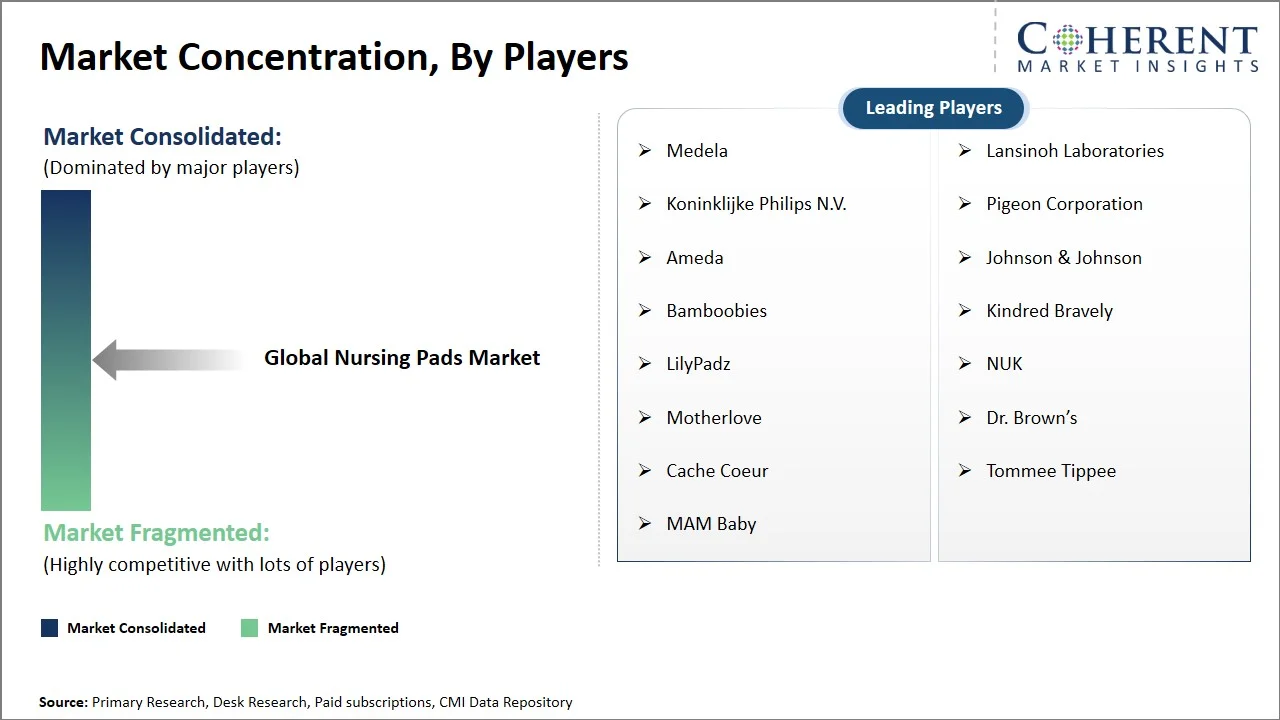
The global nursing pads market is fragmented, with multinational maternal-care brands, regional hygiene manufacturers, reusable-textile specialists, contract manufacturers, and retailer private labels competing across overlapping price tiers. Competitive advantage depends less on scale alone than on absorbency-to-thickness performance, skin-contact quality, fit reliability, cost discipline, supply continuity, certification, and channel access. Regional suppliers remain relevant where localized pricing, pack sizes, and private-label responsiveness matter.
Key focus areas include
- Absorbency-to-thickness performance: Maintaining leak protection while reducing bulk can differentiate premium and everyday products.
- Skin-contact quality: Softness, breathability, material safety, and controlled chemical inputs increasingly influence brand positioning.
- Fit and attachment reliability: Contour stability, adhesive effectiveness, and low visibility under clothing shape repeat-purchase satisfaction.
- Raw-material security: Stable sourcing of nonwovens, absorbent polymers, pulp, adhesives, and barrier films protects manufacturing continuity.
- Private-label capability: Flexible pack sizes, rapid formulation changes, and OEM responsiveness help suppliers access retailers without building consumer brands.
- Certification and quality assurance: Traceability, performance testing, and documented material compliance strengthen retailer and institutional acceptance.
- Channel coverage: Pharmacies, baby-care specialists, supermarkets, marketplaces, and direct-to-consumer platforms require different assortment and pricing strategies.
- Manufacturing economics: Yield improvement, core optimization, material utilization, and SKU discipline become important where private-label products intensify price competition.
Market Report Scope
Nursing Pads Market Report Coverage
| Report Coverage | Details | ||
|---|---|---|---|
| Base Year: | 2025 | Market Size in 2026: | USD 335.8 Mn |
| Historical Data for: | 2020 To 2024 | Forecast Period: | 2026 To 2033 |
| Forecast Period 2026 to 2033 CAGR: | 5.60% | 2033 Value Projection: | USD 491.7 Mn |
| Geographies covered: |
| ||
| Segments covered: |
| ||
| Companies covered: | Medela, Lansinoh Laboratories, Koninklijke Philips N.V., Pigeon Corporation, Ameda, Johnson & Johnson, Bamboobies, Kindred Bravely, LilyPadz, NUK, Motherlove, Dr. Brown’s, Cache Coeur, Tommee Tippee, MAM Baby | ||
| Growth Drivers: |
| ||
| Restraints & Challenges: |
| ||
Analyst Opinion (Expert Opinion)
- Market leadership is likely to polarize between efficient large-scale suppliers serving private-label and mainstream channels and specialist brands capable of defending premium pricing through demonstrable comfort, material quality, and use-case differentiation. The strategically vulnerable position will be the undifferentiated middle, where products carry branded costs without offering enough functional distinction to resist retailer price comparison or substitution.
- The most consequential disruption could be a gradual shift from nursing pads as separate consumables toward leak-management functionality integrated directly into nursing bras and postpartum apparel. If integrated textiles achieve dependable absorption, wash durability, comfort, and discreetness, conventional pad replacement frequency could face pressure. Textile engineering, garment fit expertise, washable barrier construction, and hybrid absorbent systems would consequently become more strategically valuable across the maternal-care ecosystem.
- Suppliers should prioritize verified skin-contact materials, dependable core-to-backsheet performance, dual sourcing of critical inputs, and product architectures tied to identifiable leakage or lifestyle needs. Margin discipline will be important where retailers compress mainstream pricing, while excessive SKU proliferation without meaningful functional separation should be avoided. Regional partnerships can improve regulatory adaptation and fulfillment economics, but investment should remain concentrated on attributes buyers can readily understand, experience, and repurchase.
Speak to the analyst
Want personalized insights?
Take the findings above to one of our principal consultants, or have the report rebuilt around the segments, geographies and competitors you actually track.
Market Segmentation
- Product Type Insights (Revenue, USD Mn, 2021 - 2033)
- Disposable Nursing Pads
- Reusable Nursing Pads
- Silicone Nursing Pads
- Hydrogel Nursing Pads
- Material Type Insights (Revenue, USD Mn, 2021 - 2033)
- Cotton
- Nonwoven Fabric
- Polyester and Synthetic Fibers
- Silicone and Hydrogel Materials
- Others
- Design Type Insights (Revenue, USD Mn, 2021 - 2033)
- Contoured Nursing Pads
- Flat Nursing Pads
- Adhesive Nursing Pads
- Others
- Distribution Channel Insights (Revenue, USD Mn, 2021 - 2033)
- Online Retail
- Pharmacies and Drugstores
- Supermarkets and Hypermarkets
- Baby Care Specialty Stores
- Others
- Regional Insights (Revenue, USD Mn, 2021 - 2033)
- North America
- U.S.
- Canada
- Latin America
- Brazil
- Argentina
- Mexico
- Rest of Latin America
- Europe
- Germany
- U.K.
- Spain
- France
- Italy
- Russia
- Rest of Europe
- Asia Pacific
- China
- India
- Japan
- Australia
- South Korea
- ASEAN
- Rest of Asia Pacific
- Middle East
- GCC Countries
- Israel
- Rest of Middle East
- Africa
- South Africa
- North Africa
- Central Africa
- North America
Sources
Primary Research Interviews
- Nursing pad manufacturers, maternal-care brands, absorbent hygiene companies, distributors, retailers, pharmacies, and e-commerce sellers
- Lactation consultants, maternity-care professionals, product developers, textile specialists, and hygiene industry experts
Stakeholders
- Disposable and reusable nursing pad manufacturers
- Nonwoven, cotton, absorbent polymer, adhesive, and packaging suppliers
- Pharmacies, baby-care retailers, supermarkets, online platforms, and private-label companies
End-use Sectors
- Maternal and postpartum care
- Breastfeeding and lactation support
- Hospital and maternity care
- Retail and e-commerce maternal hygiene
Regulatory and Industry Bodies
- U.S. Food and Drug Administration
- European Commission
- World Health Organization
- National maternal and breastfeeding health authorities
- Consumer product and textile safety agencies
Databases
- UN Comtrade and ITC Trade Map
- Government import-export and customs databases
- Company annual reports and product portfolios
- Maternal-care, hygiene, textile, and retail industry databases
Magazines and Journals
- Nonwovens Industry
- Happi
- International Journal of Nursing Studies
- Maternal & Child Nutrition
- Journal of Human Lactation
Associations
- International Lactation Consultant Association
- World Alliance for Breastfeeding Action
- EDANA
- INDA
- National breastfeeding and maternal-care associations
Public Domain Sources
- Breastfeeding and maternal-health publications
- Nursing pad product launches and innovation announcements
- Regulatory and safety guidelines
- Hygiene-material and postpartum-care publications
Key Standards and Regulations
- Absorbent hygiene product safety requirements
- Textile and skin-contact material standards
- Product labeling and consumer safety regulations
- Organic and sustainability certifications
- Quality-management standards for hygiene-product manufacturing
Proprietary Elements
- CMI Data Analytics Tool
- Proprietary CMI Existing Repository of information for the last 10 years
Get access to 250+ pages report
Every segment, forecast, competitor profile and data table behind the analysis above — available for instant download.
- ESOMAR Member
- ISO 9001:2015 Certified
- D-U-N-S Registered
- GDPR & CCPA Compliant
Missing comfort of reading report in your local language? Find your preferred language:
Frequently Asked Questions
The CAGR of global nursing pads market is projected to be 5.60% from 2026 to 2033.
The global nursing pads market is estimated to be valued at USD 335.8 Mn in 2026 and is expected to reach USD 491.7 Mn by 2033.
The report provides detailed analysis of market dynamics, regional opportunities, competitive positioning, product innovation, company strategies, recent developments, and the overall industry outlook.
The report helps manufacturers, investors, distributors, retailers, and healthcare product companies evaluate market opportunities, understand competitive positioning, assess customer requirements, and support market-entry or expansion strategies.
Yes. The report evaluates major market participants, competitive strategies, product positioning, innovation priorities, distribution approaches, and recent company developments to help clients benchmark competitors and identify strategic gaps.
The report is relevant for nursing pad manufacturers, maternal-care brands, absorbent hygiene product companies, raw-material suppliers, distributors, retailers, private-label manufacturers, healthcare companies, investors, and organizations assessing opportunities in breastfeeding and postpartum-care products.
Rising breastfeeding awareness increasing nursing pad adoption and growing demand for convenient maternal hygiene products are the major factors driving the growth of global nursing pads market.