

Global Occupant Monitoring System Market Size and Forecast – 2026 To 2033
The global occupant monitoring system market is expected to grow from USD 1.52 Bn in 2026 to USD 5.48 Bn by 2033, at a compound annual growth rate (CAGR) of 20.1% over 2026–2033. An occupant monitoring system is the sensing and software layer that tells a vehicle who is inside, where each person sits, how they are restrained and whether anyone has been left behind. It combines interior cameras, 60 GHz radar, ultra-wideband sensing and seat-based sensors with algorithms that classify occupants, check seatbelt routing and trigger alerts or restraint adjustments. The scope here covers occupant-facing functions only; driver monitoring is treated as a separate market. Ratings and rules are turning these functions from options into scored requirements. Euro NCAP's Occupant Monitoring Protocol, version 1.2 awards up to 30 points across seatbelt usage, occupant classification and occupant presence, and its child presence detection evaluation bulletin explains how direct-sensing systems are verified. For wider context, readers can review the child presence detection system market and the advance driver assistance system market.
The first results under the new framework show how fast suppliers and automakers are moving. In its July 8, 2026 release, Euro NCAP reported that the BMW iX3 and ZEEKR 7GT had become the first cars to earn five stars under the 2026 protocols, and its detailed findings showed that cabin monitoring, child presence alerts and seatbelt sensing differed from one car to the next. In the United States, NHTSA's April 6, 2026 interim final rule moved the compliance date for front and rear seat belt warnings to September 1, 2028, which keeps belt-status sensing on automakers' roadmaps even with the added lead time.
Key Takeaways of the Global Occupant Monitoring System Market
- The camera-based segment is expected to account for 50.0% of the global occupant monitoring system market share in 2026. One interior camera can classify occupants, read posture and check belt routing, so it serves several scored functions at once. On June 15, 2026, Seeing Machines announced two new Japanese automaker programs for its driver and occupant monitoring software, with initial lifetime value of about USD 11 million and production from 2028.
- The occupant classification and out-of-position detection segment is expected to hold 38.0% of the global market. Airbag logic depends on knowing who is in the seat and how they are positioned. On July 17, 2026, Smart Eye announced an additional order from a major global automaker to add interior sensing features to three car models, intended to improve their Euro NCAP scores.
- Passenger cars are expected to hold 82.0% of the global market. Cars are built in far larger numbers than any other vehicle, and the rating programs that reward cabin sensing test passenger cars. On March 23, 2026, Mobileye announced that a leading U.S. automaker will integrate its driver monitoring system into future vehicles, within an in-cabin platform that also covers occupant monitoring.
- Europe is expected to lead the market in 2026 with a share of 36.0%. The region hosts Euro NCAP and the strictest in-cabin rating criteria. On June 10, 2026, FORVIA announced a major European program for a rear-view mirror integrating an occupant and driver monitoring camera, with production starting in June 2029.
- Asia Pacific is expected to account for 27.8% of the market in 2026 and to be the fastest-growing region. Large vehicle output and new regional rating protocols are widening the base. On July 9, 2026, ASEAN NCAP issued a technical bulletin introducing its child presence detection assessment under the 2026–2030 protocol.
Segmental Insights
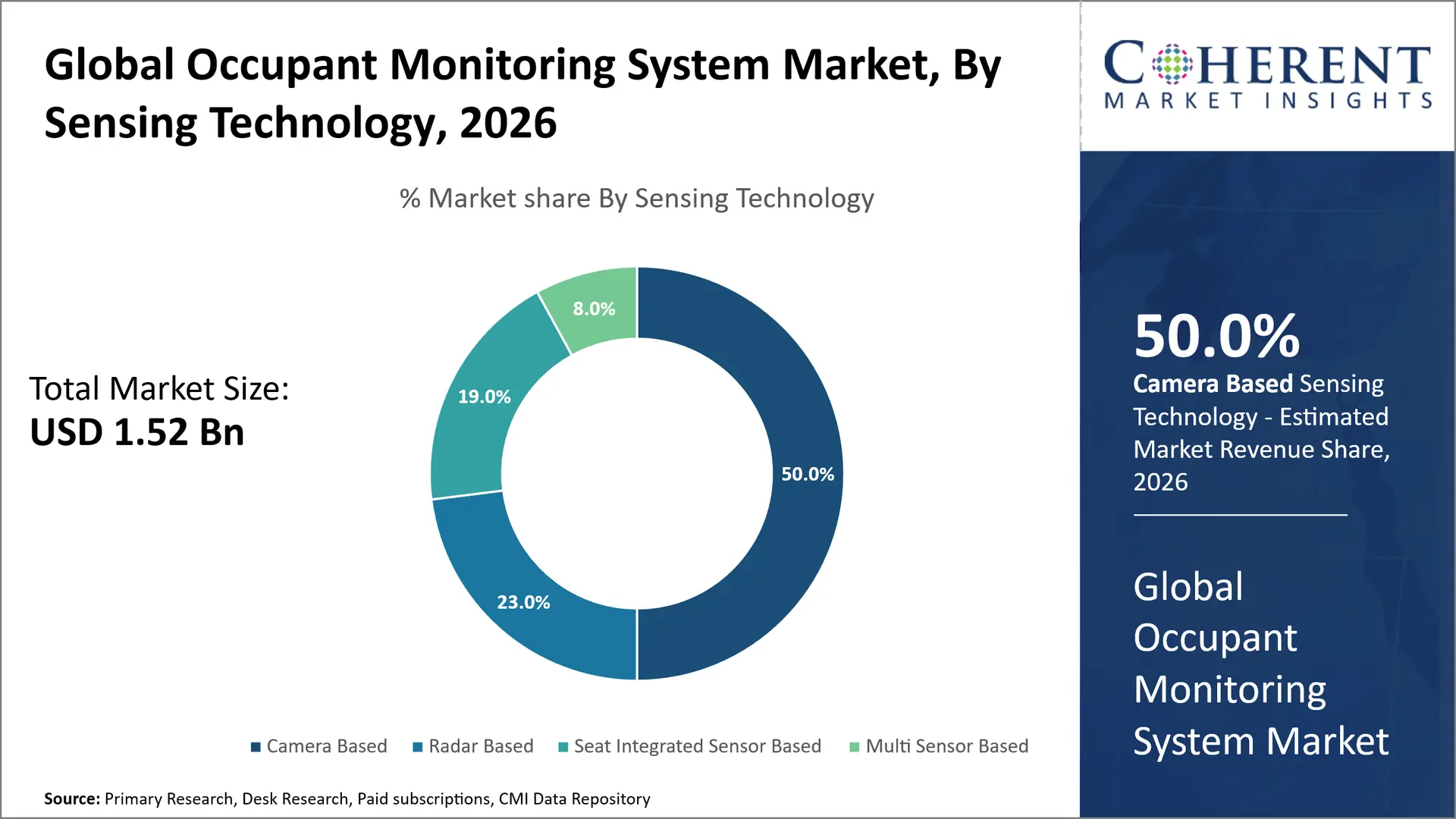
Why Do Camera-Based Systems Dominate the Global Occupant Monitoring System Market?
In terms of sensing technology, camera-based systems are expected to account for 50.0% of the global market in 2026. A near-infrared or RGB-IR camera in the mirror, roof console or overhead module sees the whole front and rear cabin. Software on top of the image stream can estimate occupant size, detect posture, recognize child seats and read how a belt crosses the body. Automakers already fit interior cameras for driver monitoring, so adding occupant functions means adding software and widening the field of view rather than adding a new sensor. That reuse keeps the cost per function low, and every software release can add detection cases through over-the-air updates.
On January 6, 2026, Smart Eye announced that its driver and occupant monitoring software is pre-integrated on Renesas' R-Car X5H, the flagship chip of the R-Car Gen 5 family. The software runs as ASIL-B-compliant code in a protected environment next to ADAS and infotainment workloads, and it is included in Renesas' RoX Whitebox SDK so automakers can switch on in-cabin sensing during early platform evaluation.
- Current Industry Events of 2026
- Market Size Estimation
- Regional Breakdown
- Competitive Landscape
- Customer Intelligence
- Segmental Analysis
- Pricing Analysis
- Key Market Drivers, Challenges & Future Trends
- Customized Insights Section
Why Does Occupant Classification and Out-of-Position Detection Lead the Application Segment?
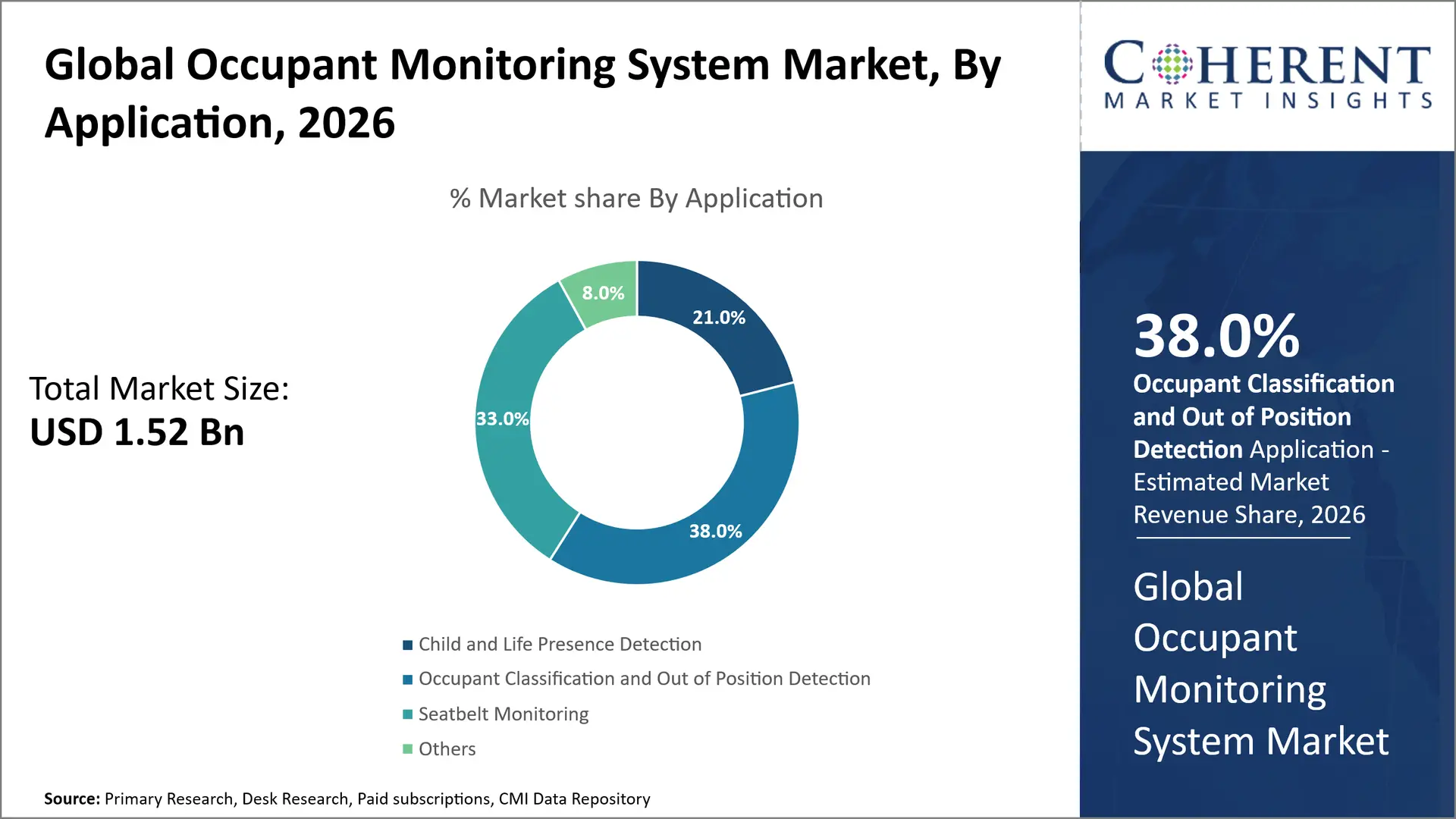
In terms of application, occupant classification and out-of-position detection is expected to account for 38.0% of the global market in 2026. This function decides how the restraint system behaves in a crash. It identifies whether the front seat holds an adult, a child, a child seat or an object, estimates stature and detects when a person leans too close to the airbag. Euro NCAP gives occupant classification 10 points: 4 for passenger airbag status, 2 for out-of-position detection and 4 for stature classification. As the output feeds directly into airbag deployment, it is specified early in a vehicle program and tends to come with higher software value than a simple presence alert.
On June 8, 2026, Aptiv launched Advanced Occupancy Classification, which it described as the industry's first occupant detection system powered entirely by an interior camera. The system classifies adults, children, infants in carriers and objects, and Aptiv reported that it can lower system cost by up to 40% by removing in-seat hardware. The company also reported that the same camera can support more than 15 additional safety and comfort functions.
Why Do Passenger Cars Lead the Vehicle Type Segment?
In terms of vehicle type, passenger cars are expected to account for 82.0% of the global market in 2026. Passenger cars make up the large majority of global light vehicle production, and Euro NCAP, C-NCAP and other rating programs assess them directly. Sedans, SUVs and crossovers are where automakers add cabin sensing first, because a five-star rating carries marketing weight with buyers. Rising fitment of interior cameras and radar modules in these cars gives suppliers the volume to spread development cost.
On August 4, 2026, NXP announced that its Trimension NCJ29D6 family will be deployed across the BMW Group fleet, starting with selected 2026 vehicle programs. The single-chip ultra-wideband solution handles digital key access and also detects a living being left behind in the car through subtle motion patterns.
Global Occupant Monitoring Regulatory and Rating Framework
Framework | Region | Occupant Monitoring Focus | Nature |
Euro NCAP Occupant Monitoring Protocol v1.2 | Europe | 30 points across seatbelt usage, occupant classification and occupant presence; child presence detection must use direct sensing of movement or breathing | Rating (voluntary, commercially decisive) |
NHTSA FMVSS No. 208 seat belt reminder rule | United States | Seat belt warning for front and rear seating positions, which needs reliable belt and occupant status sensing | Mandatory regulation |
C-NCAP 2027 Edition Protocol | China | Domestic rating reference that Chinese automakers and suppliers design cabin features against | Rating (voluntary) |
ASEAN NCAP child presence detection bulletin | Southeast Asia | Technical assessment of child presence detection under the 2026–2030 protocol | Rating (voluntary) |
Current Events and their Impact
Current Events | Description and its Impact |
Euro NCAP Publishes Results for Four Cars Under 2026 Protocols (September 2, 2026) |
|
China's C-NCAP Releases 2027 Edition Protocol (April 20, 2026) |
|
Global Occupant Monitoring System Market Dynamics
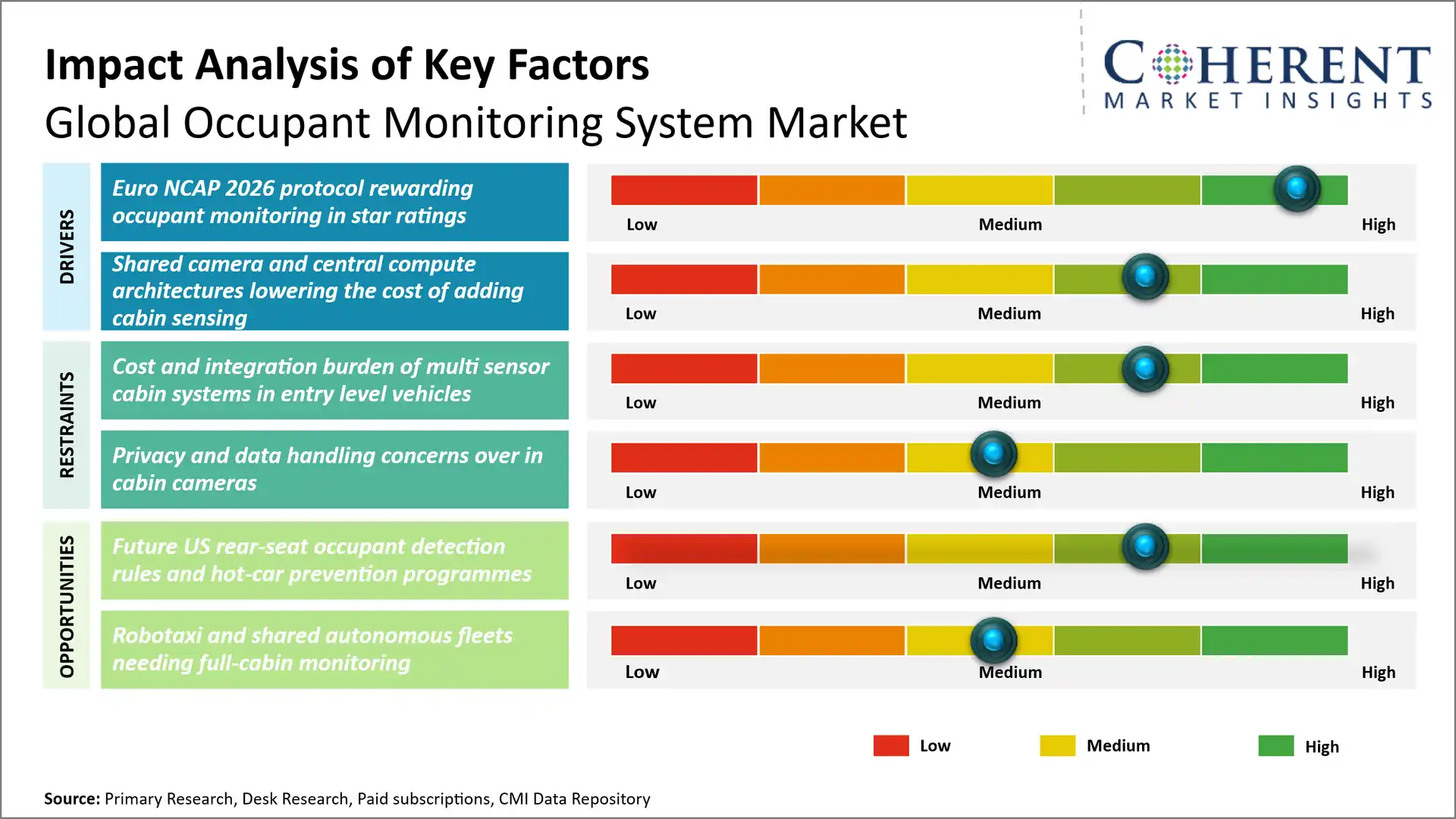
Market Drivers
Euro NCAP 2026 protocol rewarding occupant monitoring in star ratings
The 2026 framework turned cabin sensing into a scored safety function. Occupant monitoring is worth up to 30 points, and child presence detection must rely on direct sensing, such as detecting movement or breathing, to earn credit. Seatbelt routing, rear-seat occupancy, airbag status, out-of-position detection and stature classification each carry points of their own. With a five-star rating a major selling point in Europe, automakers are adding sensors to platforms that already carry driver monitoring, and suppliers are selling upgrades into programs they already hold. The protocol also makes performance auditable, since systems are evaluated through manufacturer dossiers and laboratory checks.
On April 28, 2026, Smart Eye announced an additional order from a major Japanese automaker to add its Interior Sensing AI to two vehicle programs that already used its driver monitoring software. Production is scheduled for mid-2027 and the order is estimated at no less than USD 6 million. The company described it as the third automaker choosing cabin monitoring from Smart Eye and reported it expects more customers to add interior sensing to existing programs.
Shared camera and central compute architectures lowering the cost of adding cabin sensing
Dedicated cabin hardware has been the main barrier for mainstream models. Automakers are now running occupant functions on interior cameras and processors that are already in the vehicle. One camera or one mirror module can serve driver and occupant functions together, and a central computer can host the software for each. This reduces sensors, wiring and roof cut-outs and brings cabin sensing within reach of volume models. Single-chip radar does the same job for presence detection by replacing several seat and ultrasonic sensors.
On January 6, 2026, Gentex presented a mirror-integrated driver and in-cabin monitoring system at CES 2026, with new features such as cognitive state recognition, vital signs monitoring and post-crash communications. The system includes 2D and structured-light 3D cabin monitoring for detecting passengers, behavior and objects, and processing can sit in the mirror, in a stand-alone module or in a centralized domain controller. On January 6, 2025, Texas Instruments introduced the AWRL6844, a single-chip 60 GHz radar sensor that supports occupancy monitoring for seat belt reminders, child presence detection and intrusion detection with on-chip AI, designed to replace several older sensing technologies.
Emerging Trends
- Camera-radar fusion for fuller cabin awareness: Suppliers are pairing cameras with 60 GHz radar so each sensor covers the other's blind spots. A camera reads posture and belt routing, while radar detects breathing under blankets and in footwells.
- Impact: Fused systems reduce false alarms and miss cases, which matters for direct-sensing child presence credit.
- Relevance to the market: It supports demand for fusion software and multi-sensor modules, and it favors suppliers with both camera and radar capability.
- Mirror-integrated driver and occupant modules: Interior mirror modules host the optics for driver and occupant monitoring in one unit. On August 13, 2026, Smart Eye announced a new mirror-integrated interior sensing program with a global automaker, secured with a global Tier 1 supplier. The automaker had previously selected Smart Eye's occupant monitoring software for a different camera position, and Smart Eye's interior sensing technology has now been selected for 18 car models from four automakers.
- Impact: One module replaces separate cameras and cut-outs, which lowers tooling and wiring cost.
- Relevance to the market: It widens addressable volume among automakers that want a single hardware platform across models.
- Infrared illumination and camera-friendly interior materials: As cabin cameras take on more tasks, suppliers are tuning the light and the materials they look at. On April 29, 2026, ams OSRAM introduced its OSLON Black IR:6 C-Series of 940 nm infrared LEDs, designed for camera-based driver monitoring, occupant monitoring and child presence detection with reduced red glow.
- Impact: Better illumination improves image quality in the dark without distracting occupants.
- Relevance to the market: It raises component content per vehicle and supports accuracy across lighting conditions.
Regional Insights
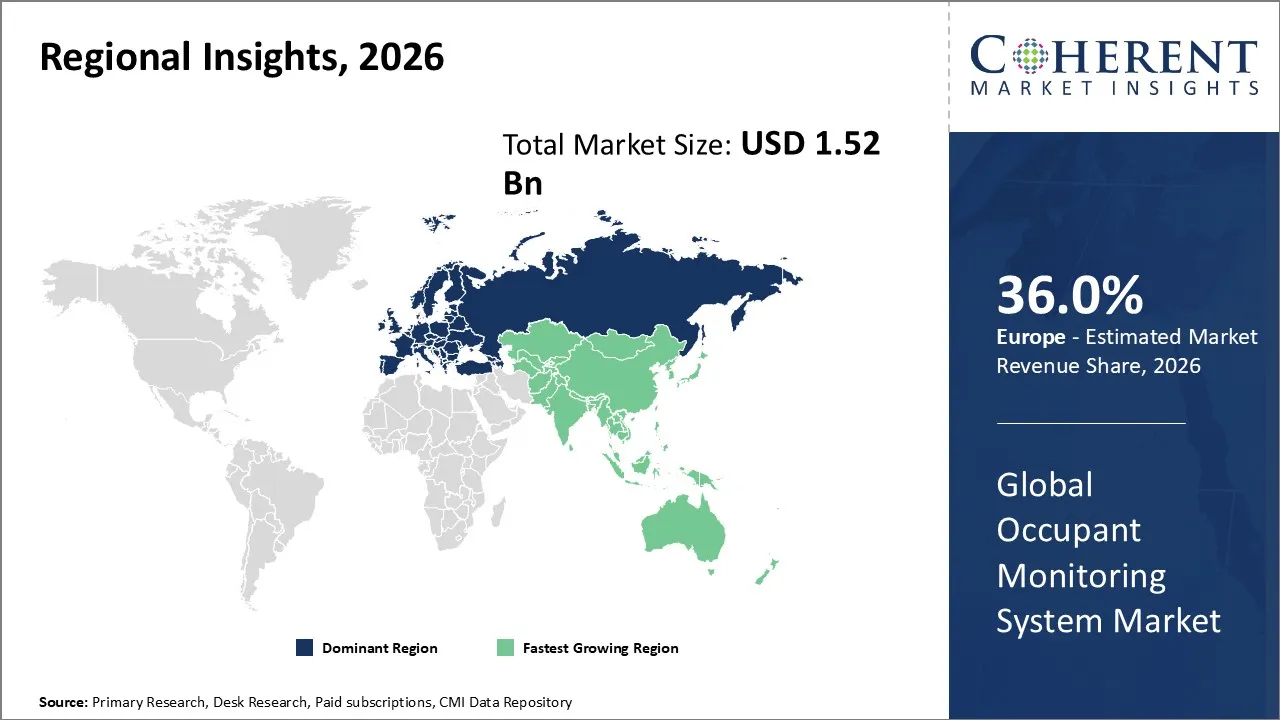
Why Does Europe Lead the Global Occupant Monitoring System Market?
Europe is expected to account for a market share of 36.0% in 2026. The region hosts Euro NCAP, whose occupant monitoring protocol is the most detailed rating framework for cabin sensing, and the European General Safety Regulation already requires driver monitoring, so interior cameras are widely fitted. Germany, the U.K. and France have premium and volume automakers that treat a five-star rating as a commercial requirement, and the region has a deep base of Tier 1 suppliers and sensing specialists. Suppliers headquartered in Europe, such as Valeo, Bosch, Aumovio and Smart Eye, are building interior sensing portfolios around these rating criteria.
Why Is Asia Pacific the Fastest-Growing Region in the Occupant Monitoring System Market?
Asia Pacific is expected to account for 27.8% of the global market in 2026. and to register the fastest growth over the forecast period. China combines very high vehicle output with a domestic base of camera, millimetre-wave radar and ultra-wideband suppliers and a fast model-launch cycle that carries cabin features as standard. Japan and South Korea add demand through premium and fleet programs, India is moving interior monitoring into mainstream electric SUVs, and ASEAN NCAP is bringing child presence assessment into Southeast Asian markets. On February 4, 2026, Mahindra & Mahindra and indie Semiconductor announced a driver and occupant monitoring system for the XEV 9e and BE 6 electric SUVs, pairing indie's CABIN EYE software with Mahindra's camera hardware.
Global Occupant Monitoring System Market Outlook for Key Countries
Is the U.S. the Largest Market for Occupant Monitoring Systems?
The U.S. occupant monitoring system market is projected to reach USD 0.41 Bn in 2026, the largest of any country. The country has the world's largest base of light vehicles, strong supplier presence in radar, camera and restraint systems, and a regulatory agenda built around belt use and hot-car prevention. NHTSA published an interim final rule on April 6, 2026 under FMVSS No. 208 that sets September 1, 2028 as the compliance date for the seat belt warning requirements, with optional early compliance. The earlier January 3, 2025 final rule had set September 1, 2026 for front seats and September 1, 2027 for rear seats.
Is China the Main Engine of Growth in Asia Pacific?
China's occupant monitoring system market is projected to reach USD 0.19 Bn in 2026, the largest in Asia Pacific. Demand rests on large production volumes, smart-cabin features that Chinese automakers add as standard, and a local supply chain spanning cameras, 60 GHz radar and ultra-wideband sensing. Chinese brands are also earning five-star results under Euro NCAP's 2026 protocols, as shown by the AION UT and Leapmotor B05, which strengthens their export position.
Why Is Germany a Key Market for Occupant Monitoring Systems in Europe?
Germany's market is projected to reach USD 0.18 Bn in 2026, the largest in Europe. Its premium automakers adopt new rating criteria early, and Tier 1 suppliers such as Bosch and Aumovio develop camera and radar interior sensing in the country. Premium vehicle volumes also carry more cabin features per car, which lifts value per vehicle.
Japan Occupant Monitoring System Market Analysis and Trends
Japan's market is projected to reach USD 0.08 Bn in 2026. Domestic suppliers have long experience with radar-based child presence detection, and Japanese automakers are awarding interior sensing programs to software specialists through Tier 1 partners, with Seeing Machines and Smart Eye both reporting Japanese awards in 2026.
U.K. Occupant Monitoring System Market Analysis and Trends
The U.K. market is projected to reach USD 0.09 Bn in 2026. Consumers pay close attention to Euro NCAP results, and domestic driver monitoring requirements are bringing interior cameras into new vehicles, which creates the platform on which occupant functions can be added.
Global Occupant Monitoring System Market – Key Platforms and Technical Specifications
Platform | Producer | Main Features and Uses |
Interior sensing solutions | Bosch | Wide-angle occupant monitoring camera classifies adults and children and detects belt misuse; 60 GHz cabin sensing radar detects vital signs and occupant position. Camera and radar can be combined to raise robustness. |
In-cabin 4D imaging radar | Vayyar Imaging | Single-chip radar covering three seating rows and detecting up to eight occupants; the company states it supports up to 7.5 Euro NCAP points across child presence, seat belt reminder, occupant status, eCall and airbag functions. |
XENSIV 60 GHz radar sensors | Infineon Technologies | One sensor can cover a five-seat cabin for child presence detection, with classification of life forms as adult or child; also used for seat occupancy and vital sign sensing. |
AWRL6844 mmWave radar | Texas Instruments | Single-chip 57–64 GHz FMCW radar with four transmitters and four receivers, on-chip AI accelerator and DSP; supports occupancy monitoring for seat belt reminders, child presence detection and intrusion detection. |
Mirror-integrated cabin monitoring | Gentex Corporation | 2D and structured-light 3D cabin monitoring for passengers and objects, with driver monitoring, cognitive state recognition and vital sign monitoring in the interior mirror. |
Cabin Sensing | Aumovio | Camera-radar sensor fusion for child and occupant presence detection, object detection and intrusion detection, plus well-being functions based on vital signs. |
Interior Sensing AI | Smart Eye | Software combining driver and occupant monitoring for centralized in-vehicle compute. |
Child presence detection and occupant monitoring | Aisin Corporation | Millimetre-wave radar child presence detection developed since 2008, with an occupant monitoring camera that works with the driver monitoring system and radar. |
How Could Future U.S. Rear-Seat Occupant Detection Rules and Hot-Car Prevention Programmes Create Opportunities?
The 2021 infrastructure law directed NHTSA to require a rear-seat alert system, and as of June 2026 the proposed rule had not been published, according to a statement from the law's Senate sponsor. If a rule is issued, every new light vehicle would need a rear-seat reminder or occupant detection function, and suppliers with direct-sensing radar and camera products would gain an immediate addressable market. Systems built for Euro NCAP's child presence criteria can be reused with limited changes, which spreads development cost across regions. Hot-car safety programmes by advocacy groups also keep demand visible to automakers ahead of any mandate.
What Role Do Robotaxi and Shared Autonomous Fleets Play?
With no driver on board, fleet operators need to know who is in the vehicle, whether belts are fastened, whether an item has been left behind and whether the cabin is clear at the end of a trip. Full-cabin monitoring using cameras, radar and seat sensing becomes an operating need rather than a convenience. This opens higher-value, multi-sensor programs for suppliers, and it favors software that can report cabin state to a fleet back office.
Market Players, Key Development, and Competitive Landscape
Key Developments
- On September 15, 2026, Murata and Smart Eye announced a demonstration of camera-radar sensor fusion for in-cabin sensing, pairing Murata's automotive-grade 60 GHz radar with Smart Eye's interior sensing software for driver monitoring, occupant monitoring and child presence detection. The demonstration was planned for InCabin/AutoSens.
- On January 5, 2026, Valeo and Seeing Machines announced their joint in-cabin monitoring solutions for CES 2026 in Las Vegas, combining Valeo's system integration with Seeing Machines' driver and occupant monitoring software.
- On October 7, 2025, OmniVision announced the OX05C, a 5-megapixel global shutter HDR image sensor for in-cabin driver and occupant monitoring that supports both functions with a single camera. The company reported mass production in 2026.
- On June 17, 2025, HARMAN announced the asset acquisition of Cipia, a provider of driver and occupancy monitoring systems, adding Cipia's computer vision and AI technology to its Ready Care in-cabin portfolio.
Competitive Landscape
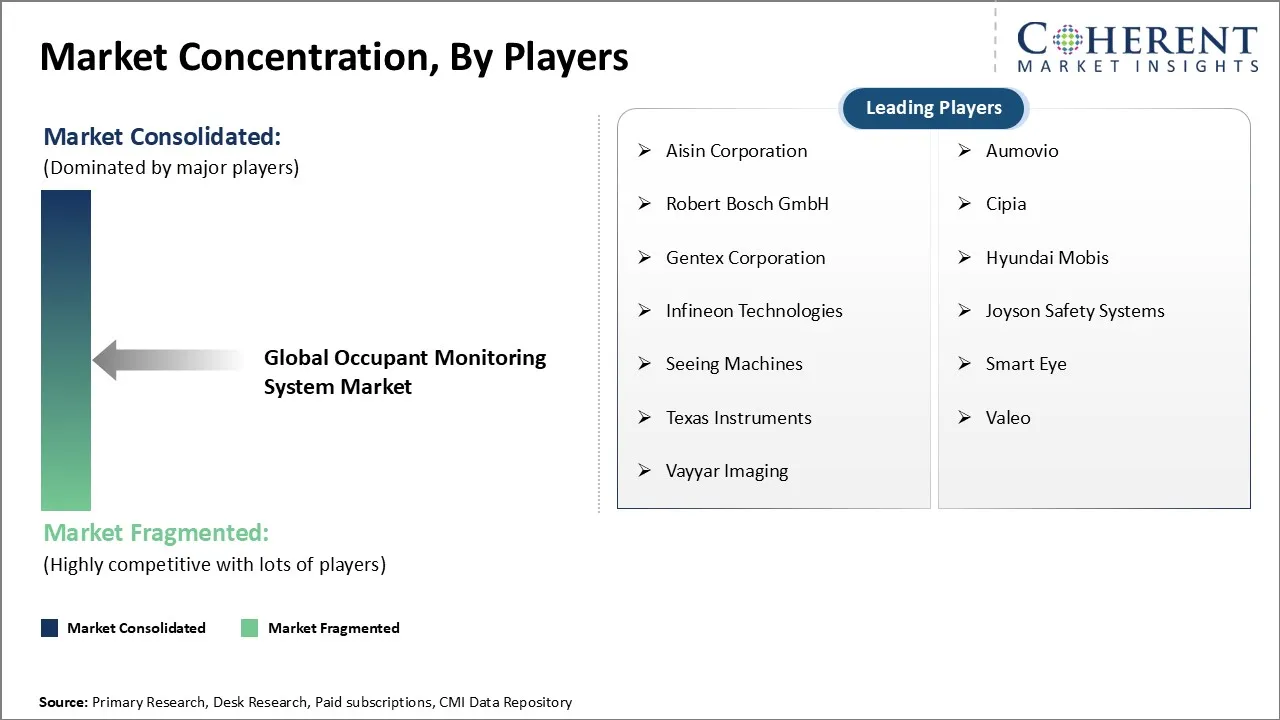
The market is moderately consolidated. Global Tier 1 suppliers such as Bosch, Valeo, Aumovio, Hyundai Mobis, Aisin and Joyson Safety Systems fold cabin sensing into broader safety and cockpit programs. Specialists such as Smart Eye, Seeing Machines, Vayyar Imaging and Cipia compete on software, radar and chip-level platforms, and semiconductor suppliers including Infineon Technologies and Texas Instruments supply the radar sensors on which many systems depend. Competition centers on meeting rating criteria at lower cost, so partnerships between software specialists, radar makers and Tier 1 integrators are common. The Valeo and Seeing Machines pairing and the Murata and Smart Eye collaboration are examples. Consolidation is also visible, as shown by HARMAN's acquisition of Cipia's assets.
Top Companies and Notable Products
Company | Notable Products | Focus |
Aisin Corporation | Child presence detection radar; occupant monitoring camera | mmWave radar CPD developed since 2008, working with driver monitoring. |
Aumovio | Cabin Sensing | Camera-radar fusion for occupant presence, object and intrusion detection. |
Robert Bosch GmbH | Occupant monitoring camera; cabin sensing radar | Classification of adults and children and radar life presence detection. |
Cipia | Cabin Sense; Driver Sense | Computer vision software; core assets acquired by HARMAN on June 17, 2025. |
Gentex Corporation | Full Display Mirror with in-cabin monitoring | 2D and structured-light 3D cabin monitoring integrated in the mirror. |
Market Report Scope
Occupant Monitoring System Market | |||
Report Coverage | Details | ||
Base Year | 2025 | Market Size in 2026: | USD 1.52 Bn |
Historical Data For: | 2020 To 2024 | Forecast Period: | 2026 To 2033 |
Forecast Period 2026 To 2033 CAGR: | 20.1% | 2033 Value Projection: | USD 5.48 Bn |
Geographies covered: |
| ||
Segments covered: |
| ||
Companies covered: | Aisin Corporation, Aumovio, Robert Bosch GmbH, Cipia, Gentex Corporation, Hyundai Mobis, Infineon Technologies, Joyson Safety Systems, Seeing Machines, Smart Eye, Texas Instruments, Valeo, Vayyar Imaging | ||
Growth Drivers: |
| ||
Restraints & Challenges: |
| ||
Analyst Opinion (Expert Opinion)
- Euro NCAP scoring and the move to shared camera and central compute architectures are the two forces most likely to set the pace for cabin sensing. Suppliers that offer one platform covering driver and occupant functions on the automaker's existing compute are best placed, and the repeated add-on orders to existing driver monitoring programs in 2026 point in that direction.
- Growth will meet friction from the cost and integration burden of multi-sensor cabin systems in entry-level vehicles and from privacy and data-handling concerns over in-cabin cameras. Local processing of sensor data, clear data policies and radar that does not capture images will help keep consumer trust.
Speak to the analyst
Want personalized insights?
Take the findings above to one of our principal consultants, or have the report rebuilt around the segments, geographies and competitors you actually track.
Market Segmentation
- Sensing Technology Insights (Revenue, USD Billion, 2021 - 2033)
- Camera Based
- Radar Based
- Seat Integrated Sensor Based
- Multi Sensor Based
- Application Insights (Revenue, USD Billion, 2021 - 2033)
- Child and Life Presence Detection
- Occupant Classification and Out of Position Detection
- Seatbelt Monitoring
- Others
- Vehicle Type Insights (Revenue, USD Billion, 2021 - 2033)
- Passenger Cars
- Light Commercial Vehicles
- Medium and Heavy Commercial Vehicles
- System Architecture Insights (Revenue, USD Billion, 2021 - 2033)
- Integrated Driver and Occupant Monitoring
- Standalone Occupant Monitoring
- Regional Insights (Revenue, USD Billion, 2021 - 2033)
- North America
- U.S.
- Canada
- Latin America
- Brazil
- Argentina
- Mexico
- Rest of Latin America
- Europe
- Germany
- U.K.
- Spain
- France
- Italy
- Russia
- Rest of Europe
- Asia Pacific
- China
- India
- Japan
- Australia
- South Korea
- ASEAN
- Rest of Asia Pacific
- Middle East
- GCC Countries
- Israel
- Rest of Middle East
- Africa
- South Africa
- North Africa
- Central Africa
- North America
- Key Players Insights
- Aisin Corporation
- Aumovio
- Robert Bosch GmbH
- Cipia
- Gentex Corporation
- Hyundai Mobis
- Infineon Technologies
- Joyson Safety Systems
- Seeing Machines
- Smart Eye
- Texas Instruments
- Valeo
- Vayyar Imaging
Sources
Primary Research Interviews
- Automaker Safety and Interior Systems Engineers
- Tier 1 Interior Sensing and Restraint System Suppliers
- Occupant Monitoring Software Developers
- Radar, Camera and Image Sensor Suppliers
- Mobility Fleet and Robotaxi Operators
- Vehicle Safety Testing and Rating Laboratories
Magazines
- Automotive News
- Automotive World
- Automotive Interiors World
- ADAS & Autonomous Vehicle International
- Just Auto
- EE Times
Journals
- SAE International Journal of Transportation Safety
- SAE International technical papers on occupant detection and restraint systems
- IEEE Transactions on Intelligent Transportation Systems
- IEEE Sensors Journal
- Accident Analysis & Prevention
Associations
- Euro NCAP
- Global NCAP
- ASEAN NCAP
- China Automotive Technology and Research Center (C-NCAP)
- SAE International
- European Automobile Manufacturers’ Association (ACEA)
Public Domain Sources
- Euro NCAP: Occupant Monitoring Protocol v1.2 and child presence detection evaluation bulletin, 2026
- U.S. National Highway Traffic Safety Administration (NHTSA): FMVSS No. 208 seat belt reminder rule, 2025-2026
- ASEAN NCAP: child presence detection technical bulletin, 2026
- United Nations Economic Commission for Europe (UNECE): vehicle safety regulations
- U.S. Securities and Exchange Commission (SEC): company annual filings
- Company press releases
Proprietary Elements
- CMI Data Analytics Tool
- Proprietary CMI Existing Repository of information for last 10 years
Get access to 250+ pages report
Every segment, forecast, competitor profile and data table behind the analysis above — available for instant download.
- ESOMAR Member
- ISO 9001:2015 Certified
- D-U-N-S Registered
- GDPR & CCPA Compliant
Frequently Asked Questions
The global occupant monitoring system market is valued at USD 1.52 Bn in 2026 and is expected to reach USD 5.48 Bn by 2033.
The CAGR of the global occupant monitoring system market is projected to be 20.1% from 2026 to 2033.
The Euro NCAP 2026 protocol rewarding occupant monitoring in star ratings, and shared camera and central compute architectures lowering the cost of adding cabin sensing, are the major factors driving market growth.
The cost and integration burden of multi-sensor cabin systems in entry-level vehicles, and privacy and data-handling concerns over in-cabin cameras, are the major factors hampering market growth.
In terms of sensing technology, camera-based systems are expected to dominate the market, with a revenue share of 50.0% in 2026.
An occupant monitoring system is the sensing and software layer that detects who is inside a vehicle, where each person sits, how they are restrained and whether anyone has been left behind. It supports child and life presence detection, occupant classification, out-of-position detection and seatbelt monitoring. Driver monitoring is a separate function and is not part of this market.
Integrated systems share one camera or mirror module between driver and occupant functions, so the automaker adds software rather than new hardware. Standalone systems use dedicated sensors, such as a roof-mounted radar or seat sensors, for occupant functions only.