

Global Child Presence Detection System Market Size and Forecast – 2026 To 2033
The global child presence detection system market is expected to grow from USD 245 Mn in 2026 to USD 1,180 Mn by 2033, registering a compound annual growth rate (CAGR) of 18% from 2026 to 2033. The global child presence detection system market is driven by growing consumer awareness about child safety and heatstroke prevention. In September 2025, Evenflo partnered with Safe Kids Worldwide during Child Passenger Safety Week to promote correct child restraint use and educate caregivers about the dangers of pediatric vehicular heatstroke through nationwide inspection events, public awareness campaigns, and community outreach programs.
Key Takeaways of the Global Child Presence Detection System Market
- The sensors segment is expected to account for 39.0 % of the global child presence detection system market share in 2026. Expanding integration of advanced driver and occupant monitoring technologies are driving the growth of the segment. On December 23, 2024, Seeing Machines entered a collaboration with Mitsubishi Electric Mobility Corporation to pursue joint growth opportunities for Seeing Machines’ leading driver and occupant monitoring system technology.
- The passenger cars segment is estimated to capture 51.0 % of the market share in 2026. Increasing production of connected and premium vehicles equipped with smart safety features is majorly driving the growth of the segment. On July 22, 2025, Volvo unveiled the ES90, the next-generation all-electric flagship sedan. The new model is based on an EV-dedicated architecture and comes with Hugin Core, a next-generation intelligent computing platform developed in partnership with Nvidia and Qualcomm.
- The radar-based detection segment is estimated to capture 34.0 % of the market share in 2026. Growing adoption of radar in electric and autonomous vehicles is driving the growth of the segment. On January 22, 2025, Arbe Robotics announced deeper integration of its 4D imaging radar with the NVIDIA DRIVE ecosystem, enabling high-resolution environmental perception for autonomous electric vehicles and supporting advanced sensor fusion with cameras and LiDAR for Level 2+ to Level 4 automated driving.
- North America is expected to dominate the child presence detection system market in 2026 with a market share of 37.0 %. Increasing demand for AI-powered cabin monitoring platforms in North America is driving the growth of the regional market. On January 5, 2026, Valeo and Seeing Machines jointly showcased their next-generation AI-powered In-Cabin Monitoring Solution (ICMS) at CES 2026, integrating driver monitoring, occupant monitoring, child presence detection, and distraction analysis for North American vehicle programs and future software-defined vehicles.
- Asia Pacific is expected to account for 31.0 % of the market share in 2026 and is projected to record the fastest growth over the forecast period. Expansion of child safety regulations across Asia Pacific is driving the growth of the regional market. On April 26, 2026, Geely rolled out the upgraded Zeekr vehicle platforms that have incorporated interior sensing and occupant monitoring functionalities to respond to the expanding intelligent vehicle safety framework in China and the growing demand for kid protection technology in connected vehicles.
- Transition toward 4D imaging radar for occupant detection: Automotive companies are moving to adopt 4D imaging radar that is able to detect micro-movements such as breathing and small body movements with high accuracy, enabling reliable detection of children under blankets, in rear-facing child seats, and in low-visibility conditions.
- Integration of child presence detection with comprehensive in-cabin monitoring systems: Vehicle OEMs are integrating child presence detection with driver monitoring, occupant classification, seatbelt monitoring, and interior sensing into unified cabin monitoring platforms, reducing hardware complexity while enhancing overall vehicle safety capabilities.
Segmental Insights
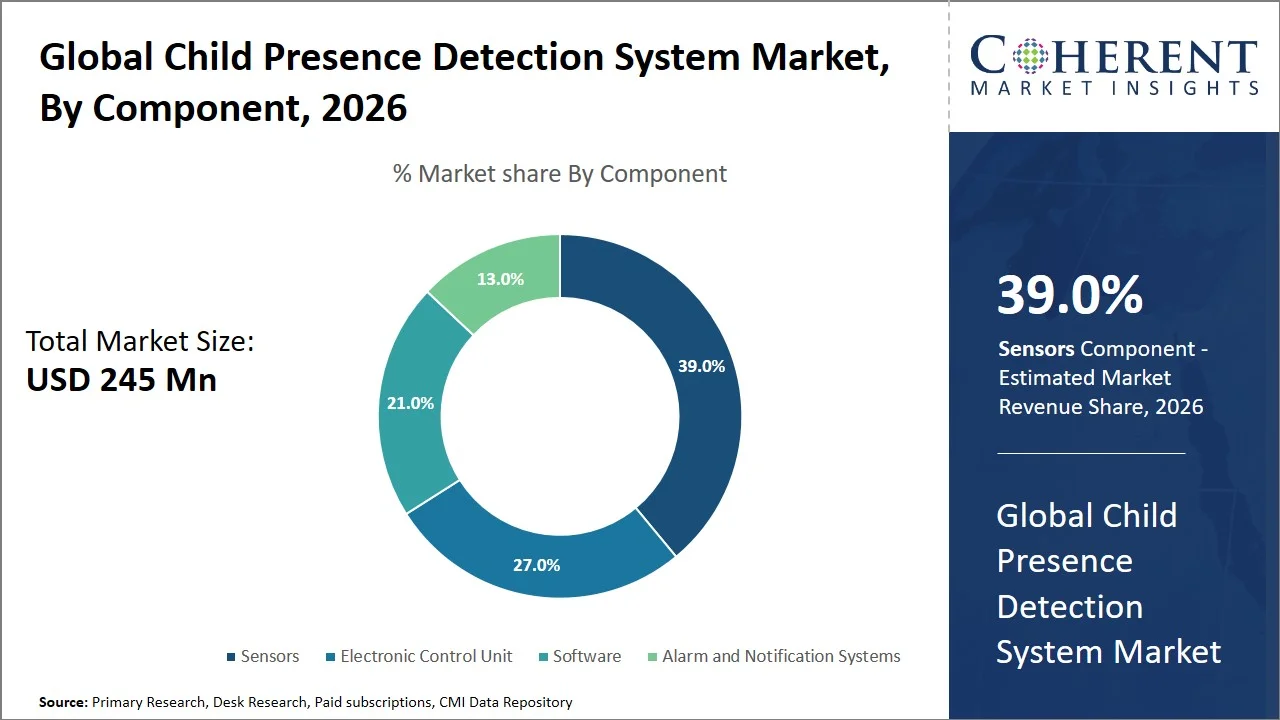
Why Do Sensors Dominate the Global Child Presence Detection System Market?
The sensors segment is expected to account for 39.0% of the global child presence detection system market share in 2026. Based on the component segment, the sensors sub-segment is dominating the worldwide kid presence detection system market owing to the extensive implementation of advanced sensing technologies. Radar, ultrasonic, pressure and infrared sensors enable highly accurate detection of child occupants, detecting movement, breathing patterns and seat occupancy even if a child is asleep or covered by blankets. Vehicle sensors are the basic hardware component for achieving ever stricter car safety rules and improving occupant protection. Sensors are capable of reliably detecting in real time under changing illumination and environmental circumstances. On February 6, 2025, Infineon announced the XENSIV 60 GHz radar sensor platform for automotive in-cabin sensing, allowing occupant breathing, seat occupancy and child presence identification with a single radar sensor while lowering system complexity for vehicle makers.
- Current Industry Events of 2026
- Market Size Estimation
- Regional Breakdown
- Competitive Landscape
- Customer Intelligence
- Segmental Analysis
- Pricing Analysis
- Key Market Drivers, Challenges & Future Trends
- Customized Insights Section
Why are Passenger Cars the Most Crucial Vehicle Type?
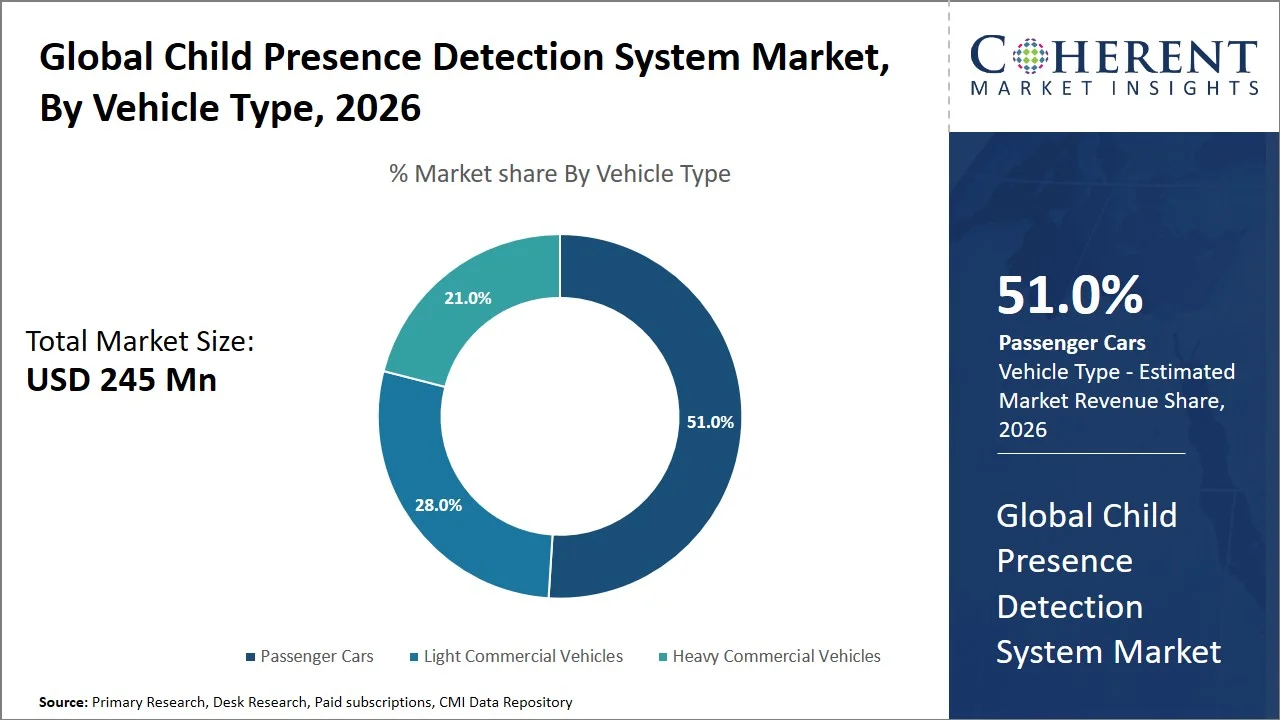
The passenger cars segment is expected to account for 51.0% of the global child presence detection system market share in 2026. The increasing implementation of mandatory occupant safety technologies in passenger cars is the key factor driving the segment growth in the global child presence detection system market. Passenger cars represent the largest segment of vehicles used for family transportation, making them the primary focus of regulations mandating child presence detection and advanced occupant monitoring systems. Therefore, the automotive industry is working towards the integration of radar sensors, cameras, and intelligent cabin monitoring technologies in passenger vehicles to improve child safety, comply with the changing safety regulations, and improve the overall vehicle safety ratings. On June 10, 2025, Volvo Cars unveiled a world-first safety upgrade, a multi-adaptive safety belt designed to further enhance safety for everyone in real-world traffic situations. Debuting in the upcoming fully electric Volvo EX60, the new safety belt is designed to better protect people by adapting to traffic variations with real-time data from the car’s advanced sensors.
Radar-Based Detection Segment Dominates the Global Child Presence Detection System Market
The radar-based detection segment is expected to account for 34.0% of the global child presence detection system market share in 2026. The main reason for the wide use of radar-based technology is that it can accurately detect the presence of children by non-contact sensing even if they are covered by blankets or sitting in rear-facing child seats. Radar also picks up the small chest motions linked to breathing, something camera-based systems cannot do. It works well in all lighting circumstances, ensuring consistent performance day and night. This degree of reliability, coupled with adherence to evolving automobile safety criteria, has made radar-based detection the technology of choice for next-generation kid presence detection systems. On January 13, 2026, HARMAN International, the automotive technology leader and subsidiary of Samsung Electronics Co., Ltd., announced new safety capabilities for the latest generation of its Ready Care and Ready Aware products, delivering integrated in-cabin monitoring paired with sight beyond sight awareness to help improve safety performance and support NCAP requirements.
Current Events and their Impact
Current Events | Description and its Impact |
European Union - General Safety Regulation (GSR II) |
|
United States - Hot Cars Act (Legislative Proposal) and FMVSS Development |
|
Global Child Presence Detection System Market Dynamics
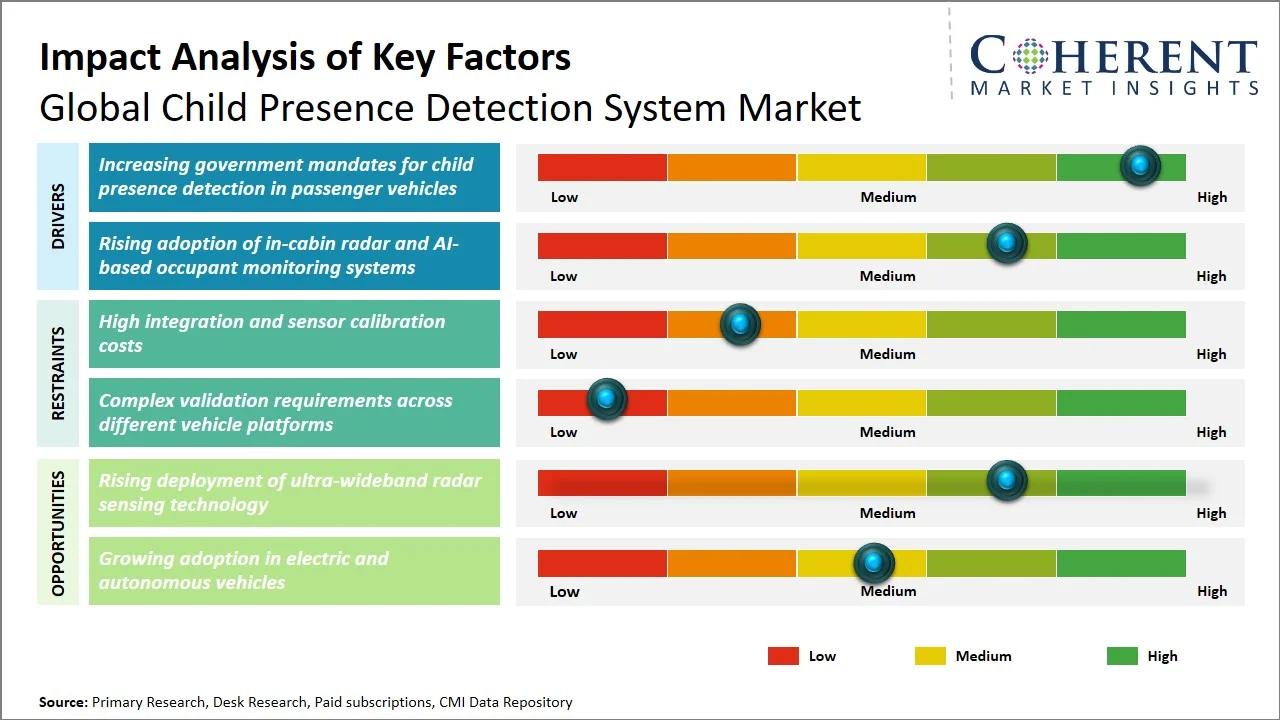
Market Drivers
- Increasing government mandates for child presence detection in passenger vehicles: Governments in Europe, North America and certain areas of Asia are increasing vehicle safety regulations to limit the number of fatalities caused by children being left in parked vehicles. Regulatory initiatives, consumer safety assessment programs and evolving automotive safety standards have resulted in the fitting of child presence detection systems as standard in new passenger vehicles. These rules are encouraging the adoption of radar sensors, cabin monitoring cameras, and smart occupant detection technologies and driving OEM investment in advanced in-cabin safety platforms across premium and mass-market car segments. For example, the CoSmA (Contactless Smart Occupant Detection) solution from Continental is engineered to address the latest Euro NCAP 2025 Child Presence Detection (CPD) assessment requirements, assisting European OEMs in addressing evolving passenger vehicle safety standards.
- Rising adoption of in-cabin radar and AI-based occupant monitoring systems: Automotive manufacturers are increasingly deploying in-cabin radar and AI-based occupant monitoring systems for highly accurate detection of children, adults and pets at a wide range of operating conditions. The AI algorithms examine data from the radar, cameras and other cabin sensors to recognize the position of the occupants, their movement and breathing patterns while minimizing false alerts. Increasing integration of these smart monitoring platforms with advanced driver assistance systems and software-defined vehicle architectures is enhancing overall cabin safety and driving considerable growth of kid presence detection system market. On December 18, 2025, Bosch announced it will unveil its new AI extension platform, an AI-enabled high performance computing unit at CES 2026. The new AI extension platform enables existing cockpit systems to be quickly and easily upgraded with advanced AI functions. This makes the driving experience more comfortable, intuitive, and safer for all vehicle occupants.
Emerging Trends
- Growing use of AI-powered sensor fusion technologies: Advanced artificial intelligence algorithms are being deployed to combine data from radar, cameras, ultrasonic sensors, and seat occupancy sensors, thus reducing false alarms, improving the accuracy of occupant recognition, and differentiating between children, adults, pets, and inanimate objects.
- Expansion driven by global automotive safety regulations and software-defined vehicles: Child presence detection systems are increasingly being fitted as standard on new vehicle platforms as safety regulations become stricter and software-defined vehicle architectures enable over-the-air updates which improve detection algorithms, system performance and regulatory compliance over time without the need for hardware replacement.
Regional Insights
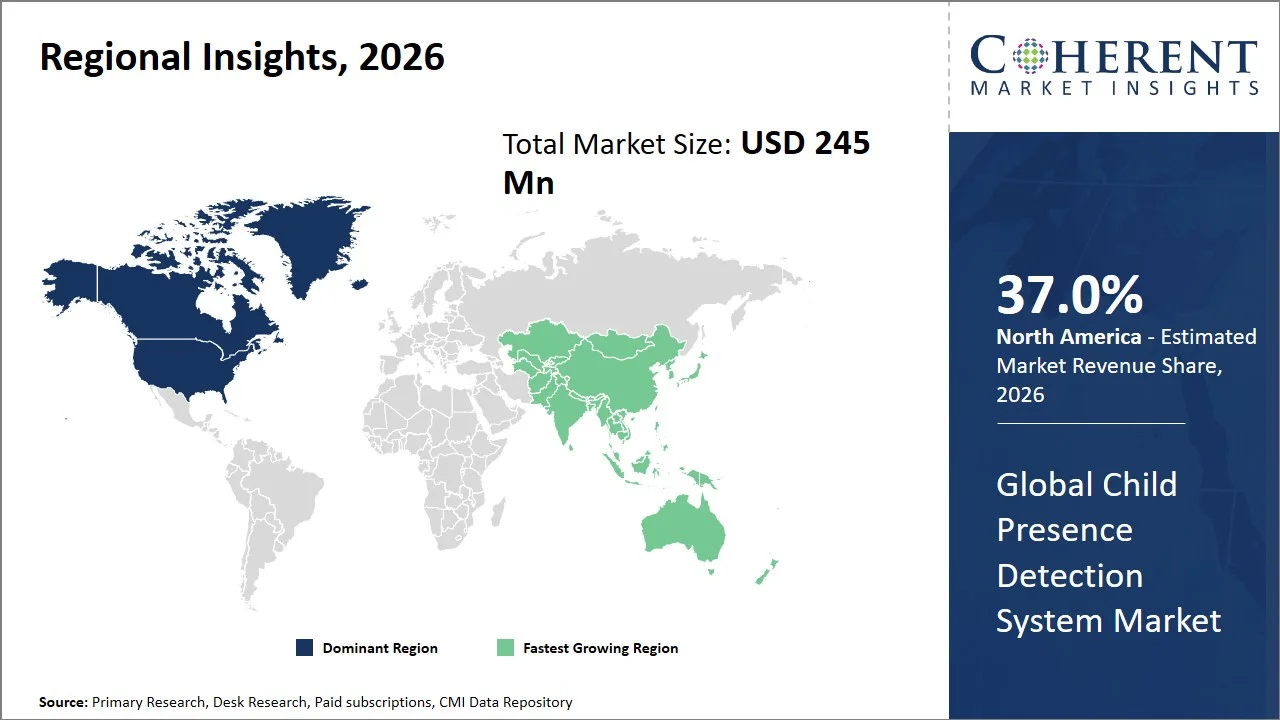
Why is North America a Strong Market for Child Presence Detection Systems?
North America is expected to account for a market share of 37.0% in 2026. North America is leading the deployment of child presence detection systems owing to the fast adoption of advanced sensing technologies in the cabin by the key car manufacturers and strong regulatory impetus. In the U.S., automakers including General Motors, Ford, Tesla, Stellantis, Rivian and Lucid have increased their deployment, with many adding rear-seat reminder systems and sophisticated occupant monitoring capabilities across a variety of vehicle platforms.
Continental, Magna International, Aptiv and Veoneer have strong engineering and production capabilities in the region, supporting OEM development of radar-based cabin monitoring solutions. National Highway Traffic Safety Administration estimates that dozens of children die annually from heatstroke after being left in vehicles, prompting increased investment in intelligent occupant detection technologies. The region is also witnessing growing adoption of 60 GHz and 77 GHz interior radar sensors supplied by companies such as Infineon Technologies, NXP Semiconductors, and Texas Instruments for next-generation passenger vehicles.
Why Does the Asia Pacific Child Presence Detection System Market Exhibit High Growth?
Asia Pacific is projected to account for 31.0% of the global child presence detection system market share in 2026 and is expected to register the fastest growth. Asia Pacific is experiencing rapid expansion due to its position as the world's largest automotive manufacturing hub and increasing deployment of intelligent cockpit technologies. Premium EVs and connected vehicle platforms in China, Japan and South Korea are adopting child presence detection, while key suppliers including Denso, Hyundai Mobis, Bosch, Continental and Forvia are ramping up production of cabin monitoring modules across the region. Chinese automakers like as BYD, Geely, Li Auto, NIO, XPeng and GAC are ramping up the adoption of in-cabin radar and AI-based occupant monitoring in new energy cars. In Japan, the automotive electronics ecosystem is robust, while South Korea has semiconductor manufacturing lead. Regional development is further bolstered with localized manufacture of radar chipsets, image processors, and AI-enabled electronic control units.
Global Child Presence Detection System Market Outlook for Key Countries
Why is the U.S. Emerging as a Major Hub in the Child Presence Detection System Market?
The U.S. represents one of the most advanced markets for child presence detection technologies due to early commercialization of occupant monitoring systems and widespread collaboration between OEMs and semiconductor companies. General Motors rolled out Rear Seat Reminder across a variety of its Chevrolet, GMC, Buick and Cadillac models, and Ford expanded advanced cabin monitoring capabilities across a number of its SUV and pickup platforms. The major suppliers of automotive radar processors and sensing platforms utilized for occupant detection applications are Texas Instruments, NXP Semiconductors, Qualcomm and Infineon. Rivian and Lucid are employing software-defined car designs that allow over-the-air updates to cabin safety features, which means the algorithms used to detect occupants can keep getting better. The country also has considerable automotive research efforts, including AI-based sensor fusion, with organizations like SAE International and renowned automotive technology labs.
Is China the Next Growth Engine for the Child Presence Detection System Market?
China has become an important growth center for the kid presence detection systems due to the rapid development of intelligent electric vehicles and local semiconductor capabilities. Millimeter-wave radar, driver monitoring systems and AI-powered cabin sensing are being added by carmakers including BYD, NIO, XPeng, Li Auto, Geely, Changan and GAC to their premium cars. Meanwhile, domestic providers such as Huawei Intelligent Automotive Solution, Desay SV, Joyson Electronics and HiRain Technologies are ramping up local production of intelligent cockpit systems and radar modules. The adoption of GB 44495-2024 has further facilitated the incorporation of high-end occupant monitoring systems into passenger vehicles. Also, the country has a large-scale manufacture of electronic control units and automobile radar sensors, which reduces reliance on imported safety components.
Germany Child Presence Detection System Market Analysis and Trends
Germany is still a global technology hotspot for kid presence detection, with significant automobile manufacturers and Tier-1 suppliers. Mercedes-Benz, BMW, Volkswagen Group, Audi and Porsche are incorporating advanced occupant monitoring systems into premium car platforms with internal radar, infrared cameras and AI-enabled sensing technologies. Continental, Bosch, Forvia, ZF and Hella continue to invest in next generation cabin electronics and radar development in Germany. Euro NCAP safety evaluation standards have led German OEMs to speed the introduction of child presence detection devices to attain improved vehicle safety ratings. Research in the automobile sector has also been a catalyst for innovation in radar imaging and intelligent occupant monitoring by organizations like as the Fraunhofer Institutes and renowned technical universities.
Japan Child Presence Detection System Market Analysis and Trends
The Japan child presence detection system market is underpinned by deep competence in automotive electronics, precise sensors and functional safety engineering. Toyota, Honda, Nissan, Mazda and Subaru are adding more intelligent cabin monitoring systems to their hybrid, electric and premium passenger cars. Denso, Panasonic Automotive, Alps Alpine and Pioneer are developing high-reliability sensing platforms, radar modules and electronic control systems for occupant monitoring applications. The most advanced sensor fusion of radar, cameras and seat occupancy sensors, used by Japanese manufacturers, highlight extraordinarily low false-alarm rates. Its expertise in automotive semiconductor packaging and functional safety certification has allowed for speedy commercialization of extremely reliable kid presence detection solutions.
South Korea Child Presence Detection System Market Analysis and Trends
South Korea has emerged as a major innovation center through strong collaboration between vehicle manufacturers and electronics companies. Hyundai Motor, Kia, and Hyundai Mobis are integrating child presence detection with advanced driver monitoring and digital cockpit platforms across new vehicle launches. Hyundai Mobis has commercialized interior radar systems capable of detecting infant breathing and subtle body movement to support compliance with changing international vehicle safety standards. Samsung Electronics and LG Electronics have high-end automotive semiconductors, imaging technologies and AI processors that improve the performance of occupant monitoring. Also, South Korea has a large domestic production base for automotive memory chips, radar integrated circuits, and software-defined vehicle technologies, enabling rapid implementation of intelligent cabin safety systems.
Global Child Presence Detection System Market - Radar Sensor Adoption Rate By Country (2025)
Country | Estimated Radar Sensor Adoption Rate in New Passenger Vehicles (2025) |
China | 68% |
Germany | 64% |
South Korea | 61% |
Japan | 58% |
U.S. | 56% |
Sweden | 52% |
France | 49% |
U.K. | 46% |
Italy | 41% |
India | 18% |
How is the Rising Deployment of Ultra-Wideband Radar Sensing Technology Creating New Growth Opportunities in the Global Child Presence Detection System Market?
The increasing adoption of ultra-wideband (UWB) radar sensing technology is opening up lucrative growth avenues by making it feasible to achieve very accurate newborn detection (via micro-motion analysis) such as chest movement because of breathing without the need for direct visual contact. Automotive manufacturers are increasingly evaluating UWB radar operating in the 6-10 GHz spectrum with 60 GHz and 77 GHz in-cabin radar to improve detection accuracy in challenging scenarios such as rear-facing child seats, covered occupants and dark vehicle interiors while dramatically reducing false alarms caused by bags or other objects.
Additionally, the technology enables OEMs to provide simultaneous occupant localization, posture recognition and intrusion detection with one sensing module, allowing the combination of multiple cabin safety functions on one hardware platform. This multi-function capability reduces wiring complexity, electronic control unit requirements and vehicle weight while enabling software defined vehicles to improve child presence detection performance with over-the-air algorithm updates, creating new opportunities for semiconductor manufacturers, radar module suppliers and automotive Tier-1 companies developing next-generation intelligent cabin monitoring systems.
On January 30, 2026, Hyundai Motor Company and Kia Corporation announced the development of Vision Pulse, a groundbreaking driver safety technology. Utilizing ultra-wide band (UWB) signals, this pioneering technology accurately pinpoints the position of obstacles around a vehicle in real time, significantly improving driving safety.
Market Players, Key Development, and Competitive Landscape
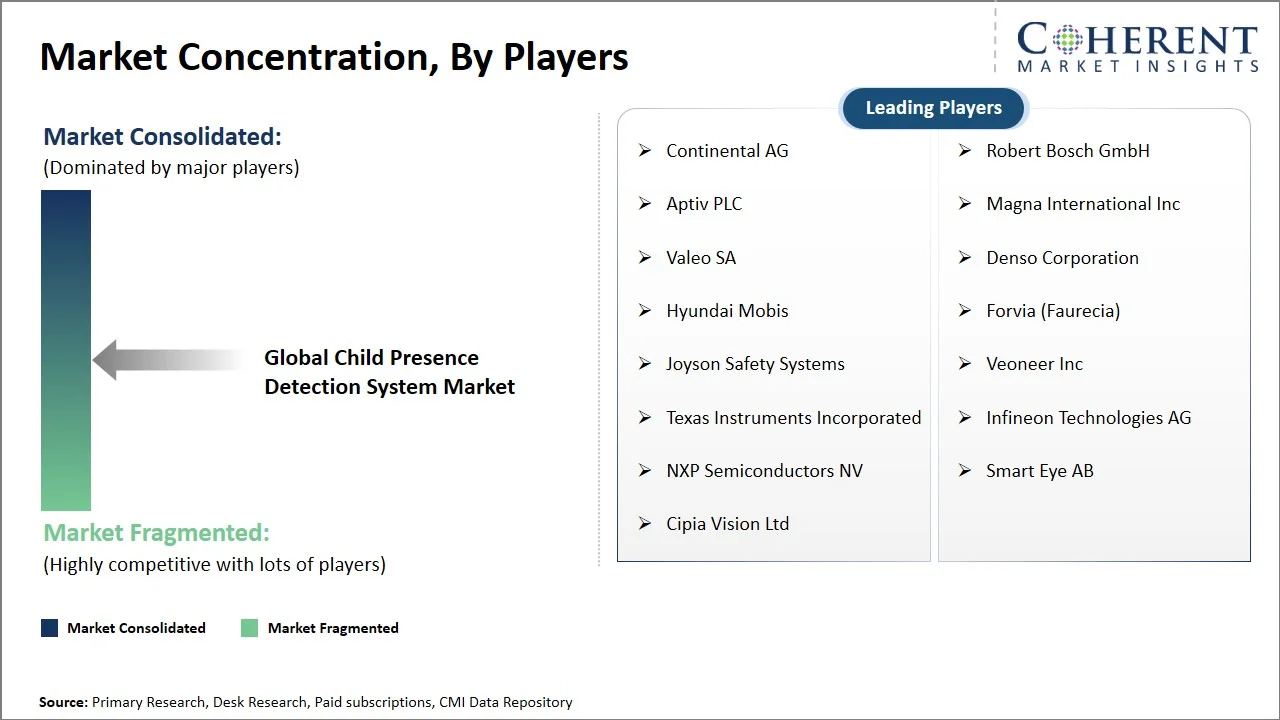
Key Developments
- On June 17, 2025, HARMAN International announced the asset acquisition of Cipia, a leading provider of driver and occupancy monitoring systems for the global automotive industry. The acquisition marks a strategic expansion of HARMAN’s in-cabin experience portfolio and builds on the companies’ successful collaboration on next-generation sensing technologies.
- On April 30, 2025, Smart Eye, the leading developer of DMS technology for the automotive industry, received a new order for its AIS product, a complete hardware and software monitoring system for small-volume car manufacturers, commercial vehicles, and the automotive aftermarket.
Competitive Landscape
The global child presence detection system market is characterized by competition among automotive Tier-1 suppliers, semiconductor companies, and AI software developers that are expanding integrated cabin sensing portfolios rather than standalone child detection products. Continental AG and Robert Bosch GmbH are focused on the integration of interior radar with driver and occupant monitoring systems, to provide full-fledged in-cabin safety platforms to European OEMs. Aptiv PLC and Magna International are working to improve software-defined vehicle architectures, enabling kid presence detection functionalities to be updated via over-the-air software upgrades.
Hyundai Mobis has commercialized interior radar that can detect newborn breathing, and is providing the technology for next-generation Hyundai and Kia automobiles. Smart Eye AB and Cipia Vision are integrating AI-based occupant recognition with video analytics to increase detection accuracy. Semiconductor companies including NXP Semiconductors, Infineon Technologies, and Texas Instruments are concentrating on automotive-grade radar chipsets and signal processors that enable higher-resolution occupant sensing with lower power consumption, positioning themselves as key technology providers for future intelligent cabin platforms.
Market Report Scope
Child Presence Detection System Market Report Coverage
| Report Coverage | Details | ||
|---|---|---|---|
| Base Year: | 2025 | Market Size in 2026: | USD 245 Mn |
| Historical Data for: | 2020 To 2024 | Forecast Period: | 2026 To 2033 |
| Forecast Period 2026 to 2033 CAGR: | 18% | 2033 Value Projection: | USD 1,180 Mn |
| Geographies covered: |
| ||
| Segments covered: |
| ||
| Companies covered: | Continental AG, Robert Bosch GmbH, Aptiv PLC, Magna International Inc, Valeo SA, Denso Corporation, Hyundai Mobis, Forvia (Faurecia), Joyson Safety Systems, Veoneer Inc, Texas Instruments Incorporated, Infineon Technologies AG, NXP Semiconductors NV, Smart Eye AB, and Cipia Vision Ltd | ||
| Growth Drivers: |
| ||
| Restraints & Challenges: |
| ||
Analyst Opinion (Expert Opinion)
- The future of the industry is expected to be shaped by the convergence of child presence detection, occupant monitoring, and driver monitoring into unified cabin intelligence systems rather than independent safety features. As software-defined vehicles become mainstream, OEMs are likely to rely on centralized computing platforms that continuously improve occupant detection algorithms through over-the-air updates, making software capability as important as sensing hardware.
- The strongest growth opportunities are expected in radar-based detection, passenger cars, and China, where domestic electric vehicle manufacturers including BYD, Geely, Li Auto, and XPeng are rapidly increasing the integration of intelligent cockpit technologies. Additional opportunities are expected in Europe as premium vehicle manufacturers continue adopting high-resolution interior radar to satisfy increasingly stringent vehicle safety assessment requirements.
- To obtain a competitive advantage, market participants should focus on multi-function radar platforms that can simultaneously enable kid presence detection, occupant categorization, intrusion detection, and driver monitoring through a single sensing architecture. Companies that create long-term development partnerships with vehicle OEMs, pour investment into AI-based sensor fusion software and build automotive-grade radar chipsets that are able to achieve low false-alarm performance will be better positioned to win designs for future vehicle platforms.
Speak to the analyst
Want personalized insights?
Take the findings above to one of our principal consultants, or have the report rebuilt around the segments, geographies and competitors you actually track.
Market Segmentation
- Component Insights (Revenue, USD Million, 2021 - 2033)
- Sensors
- Electronic Control Unit
- Software
- Alarm and Notification Systems
- Vehicle Type Insights (Revenue, USD Million, 2021 - 2033)
- Passenger Cars
- Light Commercial Vehicles
- Heavy Commercial Vehicles
- Technology Insights (Revenue, USD Million, 2021 - 2033)
- Radar-Based Detection
- Ultrasonic Sensors
- Camera-Based Systems
- Pressure Sensors
- Hybrid Detection Systems
- Regional Insights (Revenue, USD Million, 2021 - 2033)
- North America
- U.S.
- Canada
- Latin America
- Brazil
- Argentina
- Mexico
- Rest of Latin America
- Europe
- Germany
- U.K.
- Spain
- France
- Italy
- Russia
- Rest of Europe
- Asia Pacific
- China
- India
- Japan
- Australia
- South Korea
- ASEAN
- Rest of Asia Pacific
- Middle East
- GCC Countries
- Israel
- Rest of Middle East
- Africa
- South Africa
- North Africa
- Central Africa
- North America
- Key Players Insights
- Continental AG
- Robert Bosch GmbH
- Aptiv PLC
- Magna International Inc
- Valeo SA
- Denso Corporation
- Hyundai Mobis
- Forvia (Faurecia)
- Joyson Safety Systems
- Veoneer Inc
- Texas Instruments Incorporated
- Infineon Technologies AG
- NXP Semiconductors NV
- Smart Eye AB
- Cipia Vision Ltd
Sources
Primary Research Interviews
- Automotive OEM Manufacturers
- Child Safety Technology Developers
- Vehicle Sensor & Detection System Suppliers
- Regulatory & Compliance Authorities
Magazines
- Automotive Technology International Magazine
- Child Safety & Protection Magazine
- Sensor Technology Review Magazine
- Automotive Design & Production Magazine
Journals
- Journal of Automotive Safety and Energy
- IEEE Transactions on Vehicular Technology
- Journal of Child Health and Safety Research
Associations
- National Highway Traffic Safety Administration (NHTSA)
- Society of Automotive Engineers (SAE International)
- European Automobile Manufacturers' Association (ACEA)
- Child Safety Network International
Public Domain Sources
- U.S. Department of Transportation (DOT) Official Reports
- World Health Organization (WHO) Child Safety Publications
- European Commission Road Safety Data Portal
- National Safety Council (NSC) Public Reports
Proprietary Elements
- CMI Data Analytics Tool
- Proprietary CMI Existing Repository of Information for Last 10 Years
Get access to 250+ pages report
Every segment, forecast, competitor profile and data table behind the analysis above — available for instant download.
- ESOMAR Member
- ISO 9001:2015 Certified
- D-U-N-S Registered
- GDPR & CCPA Compliant
Missing comfort of reading report in your local language? Find your preferred language:
Transform your Strategy with Exclusive Trending Reports
Frequently Asked Questions
The global child presence detection system market is expected to stand at USD 245 Mn in 2026 and is expected to reach USD 1,180 Mn by 2033.
The CAGR of the global child presence detection system market is projected to be 18% from 2026 to 2033.
Increasing government mandates for child presence detection in passenger vehicles and rising adoption of in-cabin radar and AI-based occupant monitoring systems are the major factors driving the growth of the global child presence detection system market.
High integration and sensor calibration costs and complex validation requirements across different vehicle platforms are the major factors hampering the growth of the global child presence detection system market.
In terms of component, the sensors segment is estimated to dominate the market revenue share in 2026.
Yes, they are increasingly integrated with driver monitoring and occupant monitoring systems.
Yes, radar-based systems function effectively regardless of lighting conditions.