

Global Optical Interconnect Market Size and Forecast – 2026 To 2033
The global optical interconnect market is expected to grow from USD 20.00 Bn in 2026 to USD 57.50 Bn by 2033, registering a compound annual growth rate (CAGR) of 12.6% from 2026 to 2033. The global optical interconnect market is driven by increasing adoption of 800 Gigabit Ethernet and 1.6 Terabit optical technologies. On April 1, 2025, Jabil Inc. announced the launch of its 1.6T transceivers, which can transmit data at rates up to 1.6 Terabits per second. These transceivers join Jabil’s expanding portfolio of photonics products to meet the accelerating demand for AI/ML workloads, high-performance computing (HPC), cloud computing, and high-speed data center interconnects.
Key Takeaways of the Global Optical Interconnect Market
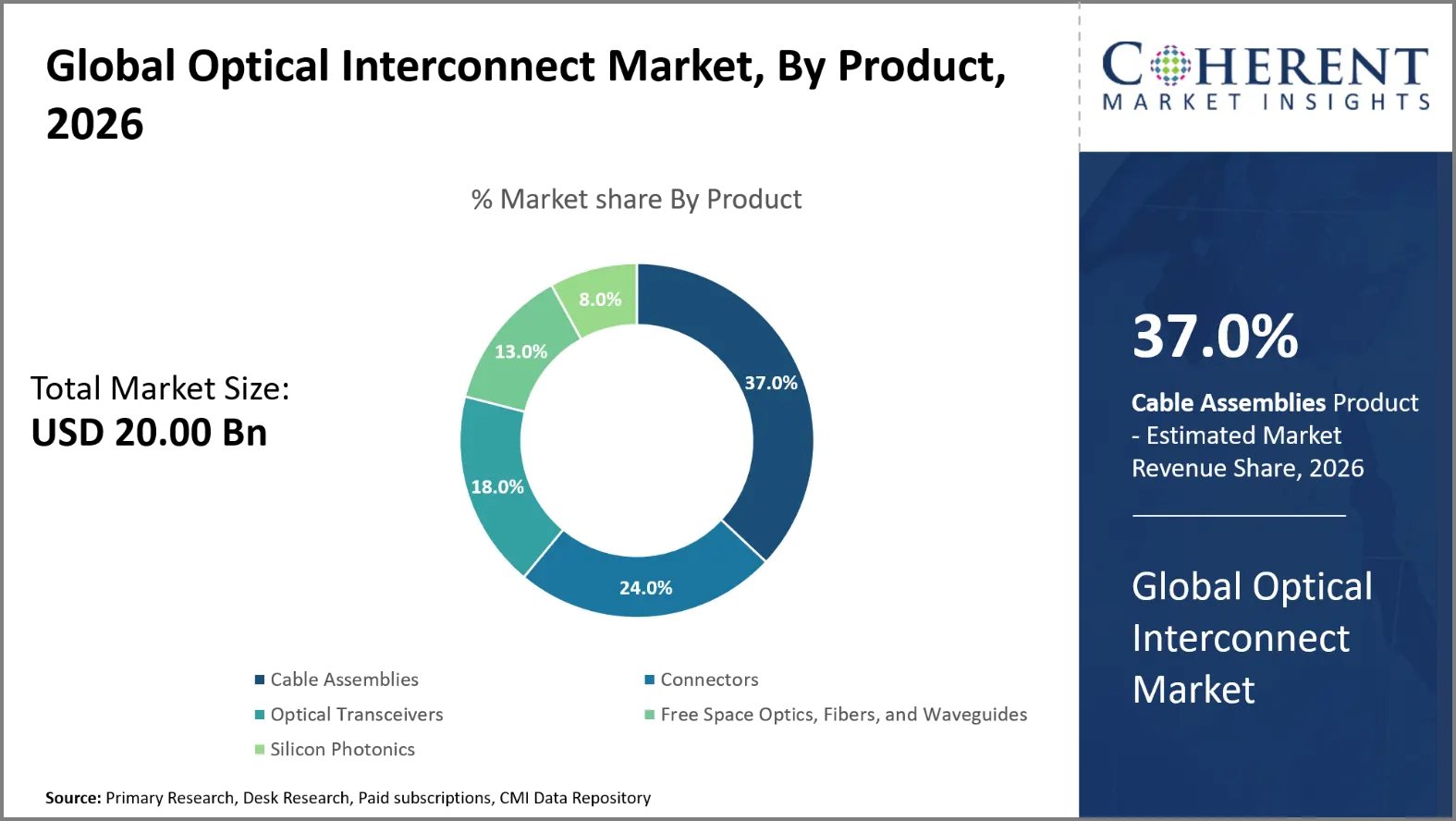
- The Cable Assemblies segment is expected to account for 37.0% of the global optical interconnect market share in 2026. Rising demand for energy-efficient data center interconnects is driving the growth of the segment. On February 26, 2026, Ciena introduced its Vesta 200 6.4T CPX optical engine. The solution targets co-packaged optics and supports 200-gigabit-per-lane operation for advanced switching application-specific integrated circuits.
- The Metro and Long-Haul Optical Interconnect segment is estimated to capture 46.0% of the market share in 2026. Growing deployment of fifth-generation mobile networks and fiber-optic infrastructure is majorly driving the growth of the segment. On March 13, 2025, Nokia secured a network modernization contract with Vodafone Idea. The agreement covers high-capacity Internet Protocol and Multiprotocol Label Switching backhaul across multiple Indian telecommunications circles. Nokia will deploy equipment from its 7750 Service Router and 7250 Interconnect Router series.
- The Single-Mode Fiber segment is estimated to capture 58.0% of the market share in 2026. Increasing use of silicon photonics in high-performance computing is driving the growth of the segment. On May 4, 2026, GlobalFoundries launched its SCALE co-packaged optics solution. The platform uses silicon photonics to connect advanced artificial intelligence computing systems with high-bandwidth optical links.
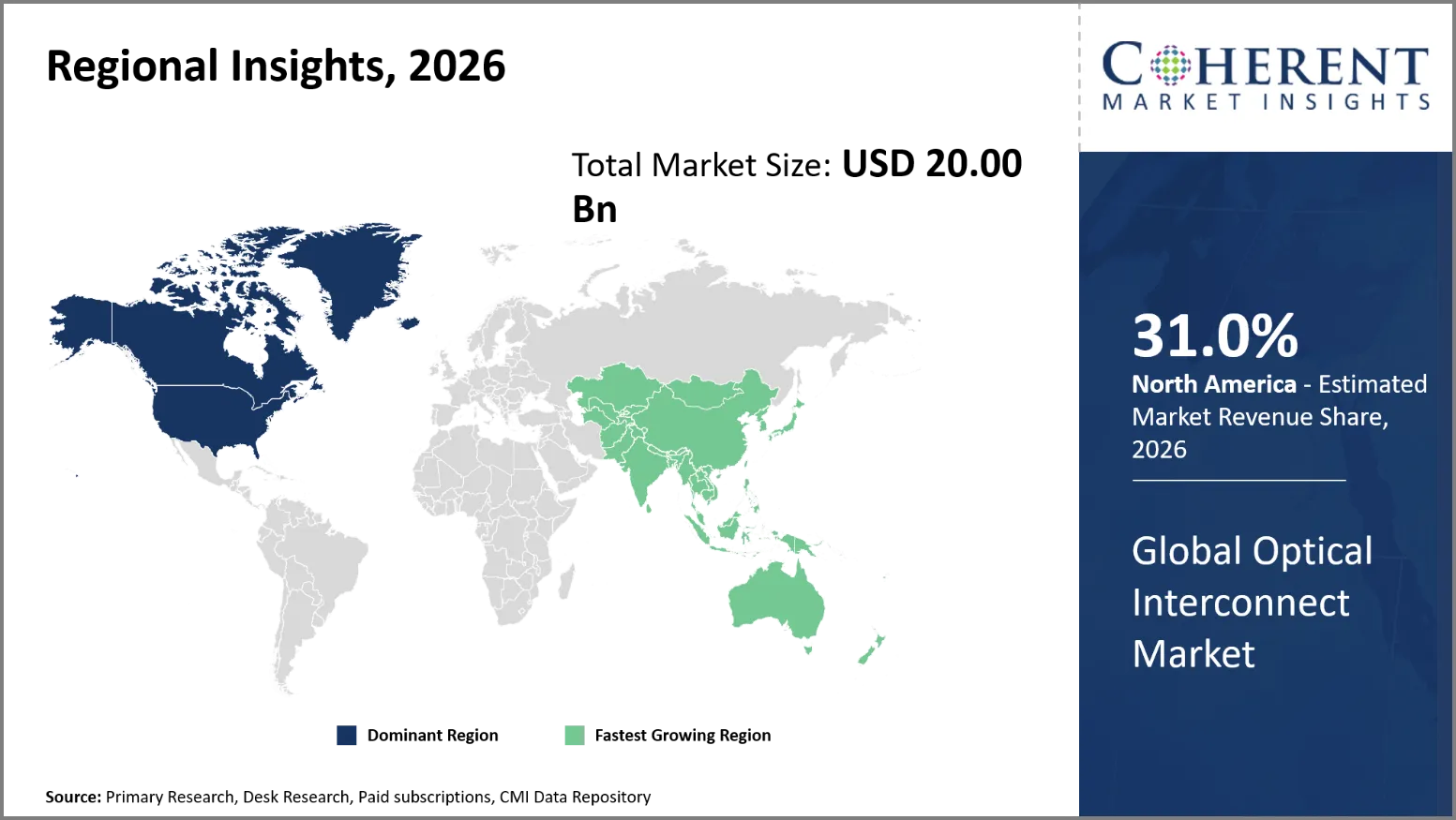
- North America is expected to dominate the optical interconnect market in 2026 with a market share of 31.0%. Rising investments in cloud networking and distributed computing infrastructure in North America is driving the growth of the regional market. On January 27, 2026, Corning Incorporated and Meta Platforms, Inc. announced a multiyear, up to USD 6 billion agreement to accelerate the buildout of the most advanced data centers in the United States to support Meta’s apps, technologies, and AI ambitions. Under the agreement, Corning will supply Meta with its newest innovations in optical fiber, cable, and connectivity solutions
- Asia Pacific is expected to account for 20.0% share in 2026. Growing demand for optical connectivity in high-performance computing systems in Asia Pacific is driving the growth of the regional market. On July 27, 2026, Nautilus Technologies, Internet Initiative Japan, Tokyo Electric Power Grid, Chubu Electric Power Grid, Fujitsu, and 1FINITY announced a joint proof-of-concept project in Japan. The experiment connects graphics processing units at separate locations using optical fiber and optical networking systems.
Segmental Insights
Why Does Cable Assemblies Dominate the Global Optical Interconnect Market?
The cable assemblies segment is expected to account for 37.0% of the global optical interconnect market share in 2026. Cable assemblies are the dominant product as they offer solid pre-terminated connections for high-speed data transfer. They make installation easier, decrease difficulties with connector compatibility, and promote consistency of deployment throughout data centers, telecommunications networks, and enterprise infrastructure. Hyperscale data centers need optical cable assemblies to connect servers, switches, storage devices and high-performance computing clusters. They come in a variety of lengths, connection combinations and fiber kinds to enable a variety of network designs. The rise of artificial intelligence workloads and cloud computing investments continue to support the high-density optical cabling need.
On March 27, 2025, Corning Incorporated launched the Corning GlassWorks AI Solutions, a one-stop shop of tailored data center technologies and services to enable operators develop the dense fiber infrastructure required for generative AI. The end-to-end portfolio offers industry leading cable and connectivity solutions with best-in-class network planning, design and deployment assistance.
- Current Industry Events of 2026
- Market Size Estimation
- Regional Breakdown
- Competitive Landscape
- Customer Intelligence
- Segmental Analysis
- Pricing Analysis
- Key Market Drivers, Challenges & Future Trends
- Customized Insights Section
Why is Metro and Long-Haul Optical Interconnect the Most Preferred Interconnect Level?
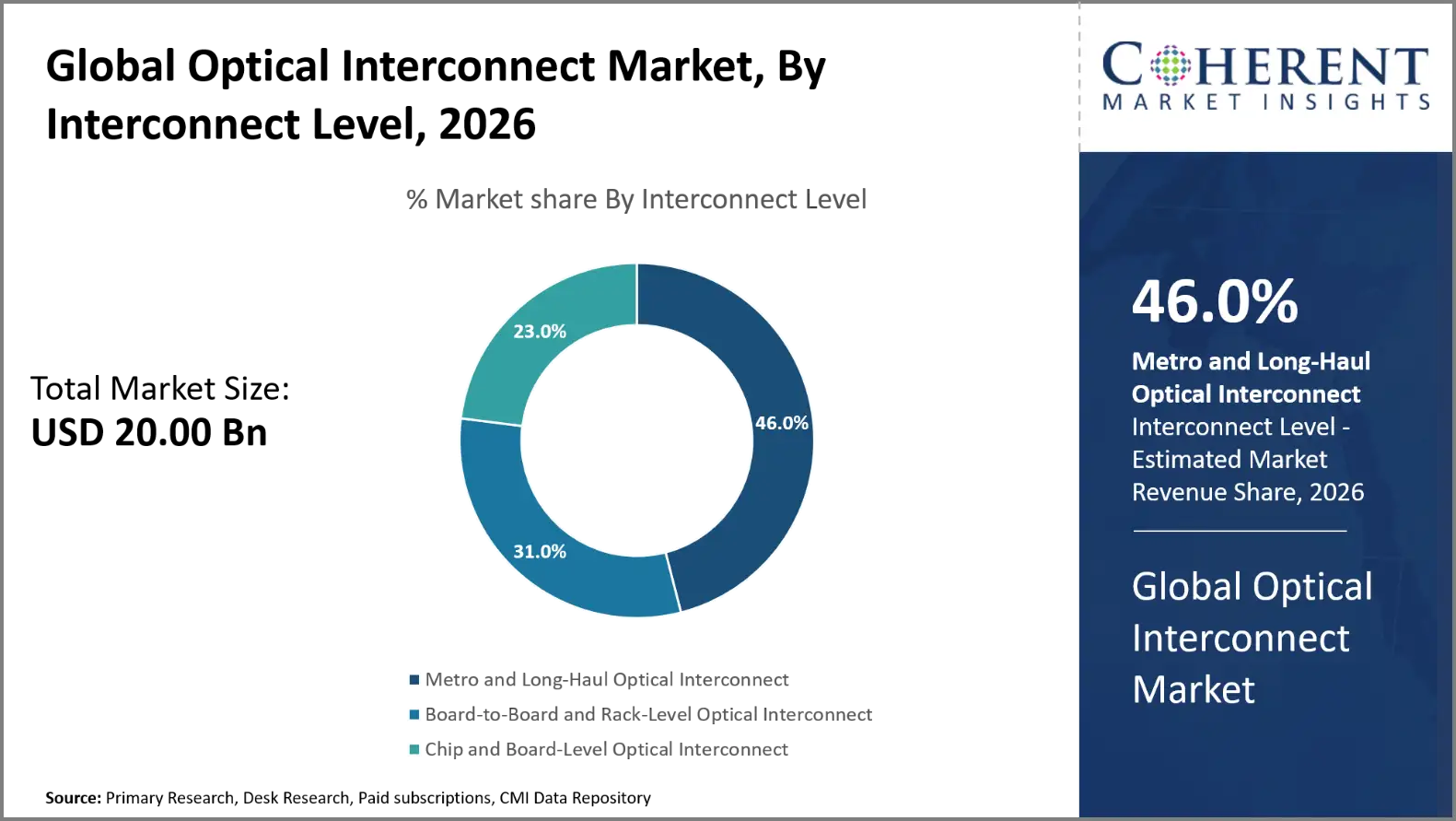
The metro and long-haul optical interconnect segment is expected to account for 46.0% of the global optical interconnect market share in 2026. Metro and long-haul optical interconnects remain vital for delivering massive data quantities between cities, regions, and national telecommunications networks. These systems support high-capacity links to data centers, internet exchange points, telecom facilities and cloud infrastructure. The optical fiber offers large bandwidth, minimal attenuation and good scalability across long distances. Operators can multiplex several data channels across individual fiber strands using dense wavelength-division multiplexing. These connections are in increasing demand, driven by rising video traffic, cloud services, artificial intelligence infrastructure, and interregional data transfers.
On December 4, 2025, Constl, a subsidiary of Space World Group, deployed Ciena’s WaveLogic 6 Extreme (WL6e) solution. This follows a successful live trial in which Constl achieved a 1 Tbps line rate on a single optical channel using WL6e across the 1,450 km Mumbai-Chennai route, one of the busiest and most critical corridors for the digital infrastructure provider, without the need for regeneration.
Single-Mode Fiber Dominates the Global Optical Interconnect Market
The single-mode fiber segment is expected to account for 58.0% of the global optical interconnect market share in 2026. Single mode fiber is the dominating player in the Global Optical Interconnect Market as it provides high bandwidth transmission over longer distance with low signal attenuation. Suitable for high-speed telephony and data transmission over metropolitan, regional and long-haul networks. Its compact core minimizes modal dispersion. Telecom operators opt for single mode fiber for backbone infrastructure, fiber to the home connections and high-capacity transport systems. It is used by data center operators for longer links between buildings and facilities. Wavelength-division multiplexing, along with advances in coherent optical transmission, further increases its capacity and efficiency.
On November 10, 2025, Prysmian announced the launch of the BendBrightXS 160µm single-mode optical fiber, the first of its kind in the world. This discovery allows the cables to be thinner and to hold more fibers together, a crucial factor for current digital networks. Miniaturized, high-density cables enable network operators to cram more data-carrying fibers into constrained places.
Current Events and their Impact
Current Events | Description and its Impact |
European Union Gigabit Infrastructure Act Regulation (EU) 2024/1309 |
|
India's Telecommunications Act, 2023, and Telecommunications (Right of Way) Rules, 2024. |
|
Optical Interconnect Market Dynamics
Market Drivers
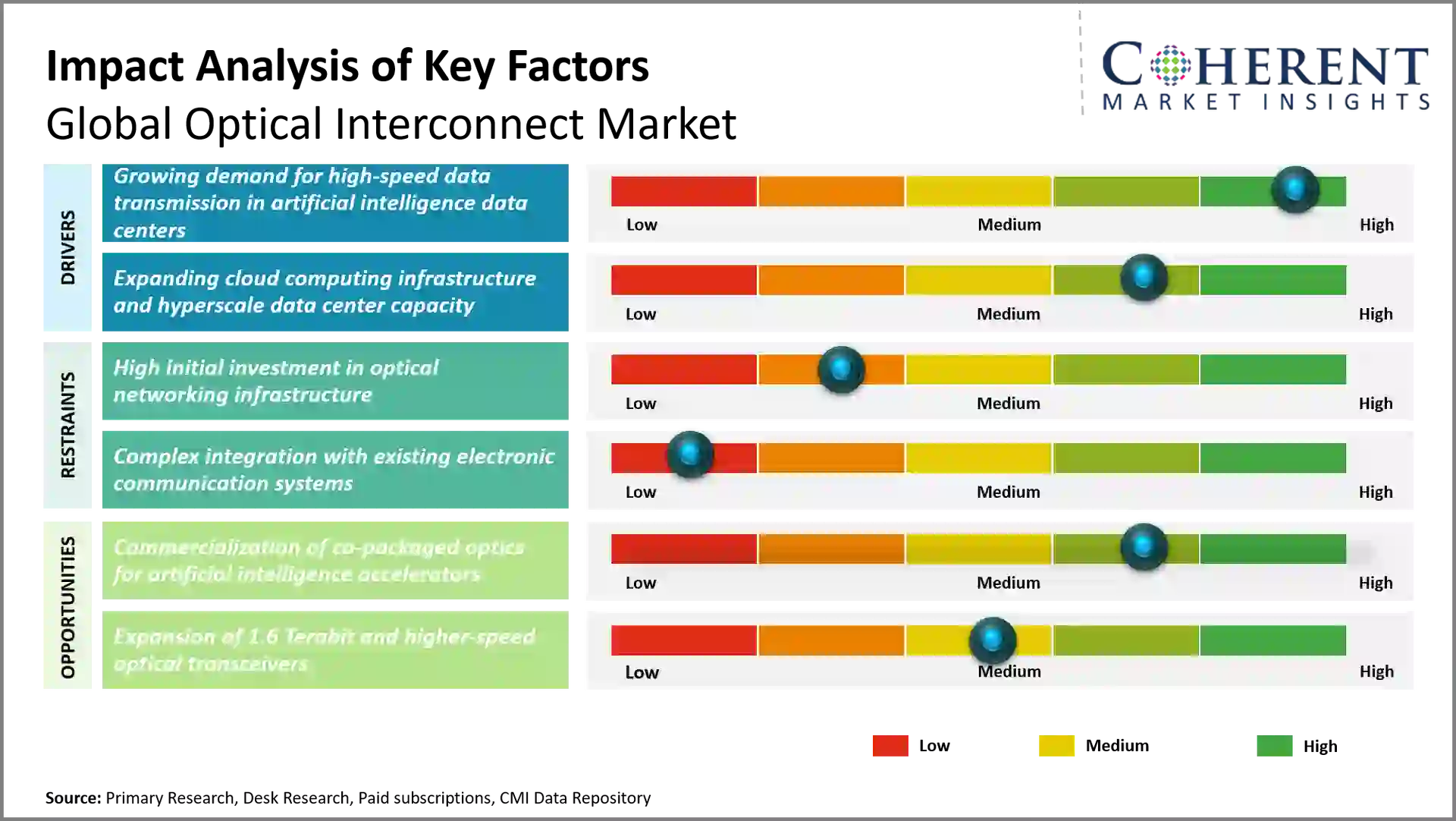
- Growing demand for high-speed data transmission in artificial intelligence data centers: The growing usage of artificial intelligence is boosting the demand for high-speed optical interconnects in data centers. Generative AI models require substantial connectivity between graphics processing units, accelerators, memory systems and high-performance computing servers. Optical interconnects provide high bandwidth, low loss and efficient data transfer among these integrated systems. As accelerator clusters grow, operators are looking to high-speed optical transceivers, fiber assembly and innovative optical switching technologies. They assist reduce network congestion and provide faster model training and inference. Demand for sophisticated optical connection is further fueled by the usage of 800 Gigabit Ethernet and next-generation 1.6 Terabit Ethernet systems.
- On September 22, 2025, Ciena announced that it has entered into a final deal to buy Nubis Communications. Nubis specializes in ultra-compact, low-power, high-performance optical and electrical interconnects designed for AI workloads, and will add to Ciena’s portfolio and contribute valuable talent to further address a broader set of opportunities inside the data center.
- Expanding cloud computing infrastructure and hyperscale data center capacity: Growing cloud computing infrastructure is driving demand for optical interconnect solutions in hyperscale data centers and distributed computing facilities. Cloud service providers are constantly adding server capacity to run enterprise applications, data storage, analytics and artificial intelligence workloads. These facilities require reliable optical interconnects between servers, switches, storage systems and the buildings where they are located. Optical fiber provides high bandwidth, immunity to electromagnetic interference, and scalable network designs. Also, hyperscale operators modify network fabrics to accommodate growing traffic and to increase operational efficiency.
- On October 14, 2025, Google announced its largest investment in India, of around USD 15 billion over the next five years (2026-2030). This investment would construct Google’s first Artificial Intelligence (AI) hub in the country based out of the bustling city of Visakhapatnam (Vizag), Andhra Pradesh.
Market Restraints
- High Initial Deployment and Infrastructure Costs: Deployment of optical interconnects requires a large investment in optical transceivers, fiber assembly, switching equipment, and installation. And, beyond the cost of upgrading old infrastructure, there’s the cost of compatibility testing, qualified technicians, and operational disruptions that strain the financial resources of smaller data center operators and telecommunications providers.
- Thermal Management and Integration Complexity: In the advanced computing environment, high-density optical interconnects have issues on thermal management, signal integrity and integration. Higher transmission speeds need close alignment of components, more effective cooling and stringent testing, which could increase maintenance needs and complicate large-scale upgrades to the network.
Emerging Trends
- Adoption of 800 Gigabit and 1.6 Terabit Optical Connectivity: Data centers are embracing higher-speed optical interconnects to meet growing network traffic and artificial intelligence workloads. They increase bandwidth density, relieve transmission bottlenecks and enable scalable communication across high-performance computer infrastructure.
- Co-Packaged Optics and Silicon Photonics Integration: Optical technology is being placed closer to switching and computing processors to reduce electrical transmission distances. Co-packaged optics and silicon photonics can boost bandwidth density, reduce power consumption, and enable innovative networking designs in AI data centers.
- Expansion of Linear Pluggable Optics and Advanced Transceivers: Data center operators are looking at new optical transceiver architectures that balance power efficiency, cost and network flexibility. Linear pluggable optics and improved modulation techniques can help ease the system design and enable larger data speeds and dense interconnect installations.
- Growing Adoption of Optical Circuit Switching: There is a growing interest in using optical circuit switching to interconnect massive artificial intelligence computing clusters. They can help increase bandwidth efficiency across hungry data center workloads by creating direct optical links between network endpoints to avoid wasteful electrical switching.
Regional Insights
Why is North America a Strong Market for Optical Interconnect?
North America is expected to account for a market share of 31.0% in 2026. These include hyperscale artificial intelligence infrastructure, inter-data center networking, and domestic optical component production in North America. In May 2026, NVIDIA and Corning announced a cooperation to ramp up U.S. production capacity for optical connection. Corning is planning three new plants in Texas and North Carolina. The investment will be on advanced optical connectivity for artificial intelligence infrastructure. Data center operators also need high speed optical transceivers, fiber assemblies and switching links between geographically spread facilities. Demand for coherent optical transport and dense fiber connectivity is being fueled by cross-region cloud services and large-scale computing clusters. Growing digital infrastructure in Canada is also driving regional demand, particularly for data center and telecom network connectivity.
Why Does Asia Pacific Optical Interconnect Market Exhibit High Growth?
Asia Pacific is expected to register the fastest growth with a CAGR of 13.5% over the forecast period. Asia Pacific is projected to account for 20.0% of the global optical interconnect market in 2026. Asia Pacific combines large-scale telecommunications deployment, electronics manufacturing, and rapidly expanding artificial intelligence infrastructure. China, Japan and South Korea bring unique expertise in optical networking, photonics and semiconductor technology. In 2025, China’s Ministry of Industry and Information Technology initiated 10-gigabit optical network experimental projects. These pilots serve residential communities, factories and industrial parks. Regional providers also manufacture optical transceivers, fiber components and high-speed networking gear. South Korea meets the demand with semiconductor production and modern computing, while Japan supplies the specialist optical devices. These interconnected industrial ecosystems support component innovation, supply-chain development, and deployment of higher-capacity optical infrastructure.
Global Optical Interconnect Market Outlook for Key Countries
Why is U.S. Emerging as a Major Hub in the Optical Interconnect Market?
The U.S. market is developing through artificial intelligence accelerator clusters, domestic optical manufacturing and high-capacity linkages between hyperscale campuses. NVIDIA and Corning announced a multiyear cooperation in May 2026 to increase U.S. optical connectivity manufacturing by a factor of 10. The proposal involves three new sites in Texas and North Carolina and more than 3,000 employments. The demand for optical links that allow dense computing architectures is driving this expenditure. High-speed optical networking needs technology from companies like Broadcom, Coherent and Lumentum. Another growth factor is the demand for strengthening the domestic supply chains of photonic components required for the advanced computing infrastructure.
Is China the Next Growth Engine for the Optical Interconnect Market?
The China optical interconnect market is driven by the statewide fiber deployment, the domestic telecoms equipment manufacturing sector and government-driven high-speed network projects. At the end of 2025, China's major telecommunications providers had deployed some 74.99 million kilometers of optical cable lines and 938,000 data center racks. The Ministry of Industry and Information Technology also introduced 10-gigabit optical network pilots covering factories, residential communities, and industrial parks. China Mobile has developed a 400-gigabit all-optical backbone connecting more than 135 cities. These deployments support demand for optical transmission equipment, fiber assemblies, and domestic transceiver manufacturing.
Germany Optical Interconnect Market Analysis and Trends
The optical interconnect market in Germany is growing due to industrial automation, business fiber upgrades and the need for dependable connectivity across production facilities. At the end of 2025, Deutsche Telekom reported 21 million lines on the basis of fiber optics. Wholesale fiber-based broadband connections made up 75.6% of its wholesale lines. These deployments drive demand for optical distribution equipment, connectors and fiber assemblies throughout enterprise and telecoms networks. Germany’s automotive industries, industrial automation plants and engineering enterprises also demand a reliable data connection for connected production systems. Frankfurt is a hub for internet exchange and data centers as well as interfacility optical connectivity and high-capacity network equipment.
Japan Optical Interconnect Market Analysis and Trends
Japan’s optical connectivity business is advancing with photonics research, energy-efficient networking and distributed computing infrastructure. In 2025, NTT successfully demonstrated automated configuration of optical wavelength circuits operating at terabit-class rates. The demo connected equipment with optical transceivers with 400-gigabit, 800-gigabit, and 1.2-terabit links. NTT is also working on its Innovative Optical and Wireless Network strategy, which leverages photonic technology to boost capacity, latency and energy efficiency. These innovations are driving demand for sophisticated optical engines, photonic devices, and high-speed transceivers. Japan’s precise manufacturing ecosystem promotes the development of components for future generation optical communication systems.
South Korea Optical Interconnect Market Analysis and Trends
Growth in South Korea's optical interconnect market is fueled by semiconductor production, investment in artificial intelligence computing, and sophisticated telecommunications infrastructure. As part of its national artificial intelligence infrastructure strategy, the Ministry of Science and Information and Communications Technology has suggested high-performance links between data centers. The organization wants to create an artificial intelligence computing hub and champion next-generation network technologies. Nearby, Samsung Electronics and SK Hynix are bolstering the semiconductor ecosystem with state-of-the-art memory manufacture for AI accelerators. These computer systems need high bandwidth links between processors, memory and networking equipment. South Korea’s dense telecommunications infrastructure and research capabilities also help the development of innovative optical components and energy-efficient data center networks.
Global Optical Interconnect Market - Regional Broadband Infrastructure (2025)
Region/Country | Broadband Infrastructure Indicator | Data | Relevance to Optical Interconnect |
North America - U.S. | Fiber-to-the-home deployment | 98.3 million fiber passings by year-end 2025 | Expands fiber access and supports data center connectivity |
North America - Canada | Fiber broadband reach | 14.5 million fiber passings in 2025, covering nearly 75% of households | Strengthens fiber backhaul and regional network infrastructure |
Europe | Fiber-to-the-premises coverage | 74.1% of households by mid-2025 | Supports migration toward high-capacity fiber broadband |
Asia Pacific | Population living within 10 km of a fiber-optic node | Approximately 25% based on the International Telecommunication Union’s regional infrastructure assessment | Indicates remaining opportunities for fiber network expansion |
India | Optical fiber cable deployed under BharatNet | 694711 kilometers by October 2025 | Extends rural broadband infrastructure and increases fiber backhaul requirements |
How is Commercialization of Co-Packaged Optics for Artificial Intelligence Accelerators Creating New Growth Opportunities in the Optical Interconnect Market?
The optical interconnect market is witnessing new growth potential with the commercialization of co-packaged optics that bring optical engines closer to artificial intelligence accelerators and switching application-specific integrated circuits. This topology minimizes the need for power-hungry electrical connections between circuit boards and hence mitigates bandwidth and energy constraints in large accelerator clusters. Some of these industry efforts include NVIDIA’s silicon photonics networking endeavors and Broadcom’s co-packaged optics platforms to commercialize optical connection for artificial intelligence infrastructure. These innovations provide chances for optical engine suppliers, silicon photonics makers, laser manufacturers, fiber array vendors and precision-packaging organizations. Commercial acceptance will hinge on manufacturing yield, temperature control, serviceability, and interaction with current network topologies.
In 2025, Broadcom achieved a significant commercialization milestone when it announced that Meta was testing its co-packaged optics technology for one million cumulative 400-gigabit-equivalent port device hours with no link failures. In August 2026, NVIDIA stated that the Spectrum-X Ethernet Photonics had started production, increasing the odds that it will be used in next-generation artificial intelligence networks.
Market Players, Key Development, and Competitive Intelligence
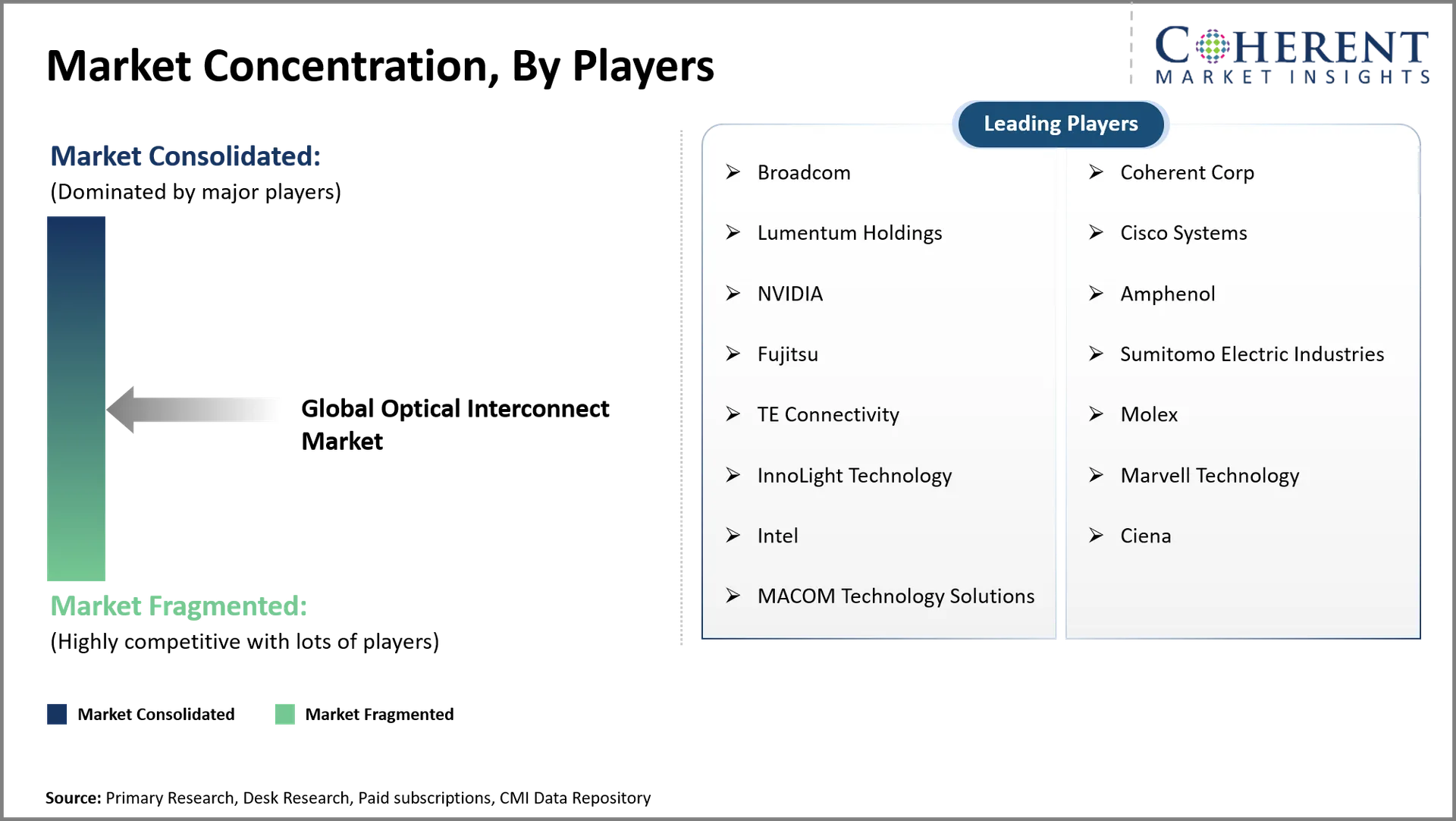
Key Developments
- On March 16, 2026, 3M announced a major planned expansion of U.S. manufacturing capacity for its 3M Expanded Beam Optical (EBO) interconnect technology, a high-performance optical connectivity solution engineered to improve deployment speed, reliability, and operational efficiency within next-generation AI data centers.
- On March 9, 2026, Applied Optoelectronics Inc., a leading provider of advanced optical and HFC networking products that power AI, announced it received its first volume order for its 1.6T data center transceivers from one of its long-term major hyperscale customers to boost its network bandwidth for AI workloads.
- On March 9, 2026, STMicroelectronics announced it is entering high-volume production for its state-of-the-art silicon photonics-based PIC100 platform used by hyper scalers for optical interconnect for data centers and AI clusters. The 800G and 1.6T PIC100 transceivers enable higher bandwidth, lower latency, and greater energy efficiency as AI workloads surge.
Competitive Landscape
Competition in the optical transceivers, silicon photonics, laser sources, fiber assemblies, and co-packaged optics are the factors influencing the global optical interconnect market. Broadcom is pushing integrated switching with its Tomahawk 6-Davisson platform that combines 102.4-terabit-per-second switching capability and co-packaged optics. NVIDIA partners with optical component and manufacturing partners to build photonics-based networking with Spectrum-X and Quantum-X platforms. Coherent's new integrated optics portfolio, PhotonLink, supports co-packaged optics, near-packaged optics, and chip-to-chip connectivity. Lumentum is developing high-end lasers and optical components, while Corning is increasing fiber and optical connectivity manufacturing capacity.
Top Manufacturers and Notable Products in the Optical Interconnect Market
Manufacturer | Notable Product | Key features |
Broadcom | Sian3 Optical DSP | Supports 800G and 1.6T transceivers, single-mode fiber transmission, and improved power efficiency |
Ciena | WaveLogic 6 Extreme | Supports 1.6 Tb/s coherent transmission, high-capacity optical transport, and metro or long-haul networks |
Coherent | 1.6T Optical Transceivers | Supports high-bandwidth data center links and high-speed optical communication |
Lumentum | Optical Transceivers | Supports high-capacity optical transport, wavelength-division multiplexing, and data center interconnects |
Corning | Single-Mode Fiber and High-Density Cable Assemblies | Provides low-attenuation transmission, dense fiber routing, and scalable data center connectivity |
Market Report Scope
Global Optical Interconnect Market Report Coverage | |||
Report Coverage | Details | ||
Base Year | 2025 | Market Size in 2026: | USD 20.00 Bn |
Historical Data For: | 2020 To 2024 | Forecast Period: | 2026 To 2033 |
Forecast Period 2026 To 2033 CAGR: | 12.60% | 2033 Value Projection: | USD 57.50 Bn |
Geographies covered: |
| ||
Segments covered: |
| ||
Companies covered: | Broadcom, Coherent Corp, Lumentum Holdings, Cisco Systems, NVIDIA, Amphenol, Fujitsu, Sumitomo Electric Industries, TE Connectivity, Molex, InnoLight Technology, Marvell Technology, Intel, Ciena, MACOM Technology Solutions | ||
Growth Drivers: |
| ||
Restraints & Challenges: |
| ||
Analyst Opinion (Expert Opinion)
- The future of the optical interconnect market will increasingly depend on bandwidth density, energy efficiency, and reliable connectivity inside artificial intelligence infrastructure. Co-packaged optics should gain traction as electrical interconnect limitations constrain increasingly powerful accelerator clusters. Pluggable transceivers will remain important where replaceability and operational flexibility matter. Near-packaged optics may provide an intermediate architecture for operators seeking shorter electrical paths without fully integrating optics into switch packages. Optical circuit switching also offers opportunities for dynamically connecting large computing clusters. Suppliers that solve thermal management, optical alignment, and field maintenance challenges will be better positioned for commercial adoption.
- The strongest opportunities will emerge in co-packaged optics, silicon photonics, 800-gigabit and 1.6-terabit transceivers, and high-density fiber assemblies. Artificial intelligence data centers represent a priority application because accelerator clusters require extensive connections between processors and network switches. The U.S. offers opportunities in hyperscale infrastructure and domestic optical manufacturing. China presents opportunities in telecommunications equipment and large-scale fiber deployment. Japan offers strengths in photonic components and precision optical manufacturing. South Korea provides opportunities through semiconductor production and advanced computing infrastructure. Suppliers should align product portfolios with the distinct technical requirements of these national markets.
- Market participants should prioritize manufacturing yields, interoperability, thermal reliability, and scalable component production. Optical engine suppliers should establish partnerships with switch designers, semiconductor manufacturers, and data center infrastructure providers. Cable assembly manufacturers should develop high-density, low-loss products compatible with advanced transceivers and co-packaged optics systems. Component suppliers should also qualify products for demanding operating environments and simplify testing, replacement, and fault isolation. Companies entering optical circuit switching should demonstrate measurable improvements in network utilization and power efficiency.
Speak to the analyst
Want personalized insights?
Take the findings above to one of our principal consultants, or have the report rebuilt around the segments, geographies and competitors you actually track.
Market Segmentation
- Product Insights (Revenue, USD Billion, 2021 - 2033)
- Cable Assemblies
- Connectors
- Optical Transceivers
- Free Space Optics, Fibers, and Waveguides
- Silicon Photonics
- Interconnect Level Insights (Revenue, USD Billion, 2021 - 2033)
- Metro and Long-Haul Optical Interconnect
- Board-to-Board and Rack-Level Optical Interconnect
- Chip and Board-Level Optical Interconnect
- Fiber Mode Insights (Revenue, USD Billion, 2021 - 2033)
- Single-Mode Fiber
- Multimode Fiber
- Application Insights (Revenue, USD Billion, 2021 - 2033)
- Data Communication
- Telecommunications
- Distance Insights (Revenue, USD Billion, 2021 - 2033)
- Less Than 10 Kilometers
- 11-100 Kilometers
- More Than 100 Kilometers
- Regional Insights (Revenue, USD Billion, 2021 - 2033)
- North America
- U.S.
- Canada
- Latin America
- Brazil
- Argentina
- Mexico
- Rest of Latin America
- Europe
- Germany
- U.K.
- Spain
- France
- Italy
- Russia
- Rest of Europe
- Asia Pacific
- China
- India
- Japan
- Australia
- South Korea
- ASEAN
- Rest of Asia Pacific
- Middle East
- GCC Countries
- Israel
- Rest of Middle East
- Africa
- South Africa
- North Africa
- Central Africa
- North America
Sources
Primary Research Interviews
- Optical Component Manufacturers
- Data Center Infrastructure Specialists
- Telecommunication Network Providers
- Semiconductor & Photonics Technology Experts
Magazines
- Lightwave Magazine
- Photonics Spectra
- IEEE Spectrum
- Fiber Optic Technology Magazine
Journals
- Journal of Lightwave Technology (IEEE/OSA)
- Optics Express (Optica Publishing Group)
- Journal of Optical Communications and Networking
Associations
- Optical Internetworking Forum (OIF)
- The Optoelectronics Industry Development Association (OIDA)
- International Electrotechnical Commission (IEC)
- Fiber Optic Association (FOA)
Public Domain Sources
- U.S. Federal Communications Commission (FCC) Reports
- European Commission – Digital Economy Reports
- National Institute of Standards and Technology (NIST)
- International Telecommunication Union (ITU) Publications
Proprietary Elements
- CMI Data Analytics Tool
- Proprietary CMI Existing Repository of Information for the last 10 years
Get access to 250+ pages report
Every segment, forecast, competitor profile and data table behind the analysis above — available for instant download.
- ESOMAR Member
- ISO 9001:2015 Certified
- D-U-N-S Registered
- GDPR & CCPA Compliant
Frequently Asked Questions
The global optical interconnect market is expected to stand at USD 20.00 Bn in 2026 and is expected to reach USD 57.50 Bn by 2033.
The CAGR of the global optical interconnect market is projected to be 12.6% from 2026 to 2033.
Growing demand for high-speed data transmission in artificial intelligence data centers and Expanding cloud computing infrastructure and hyperscale data center capacity are the major factors driving the growth of the global optical interconnect market.
High initial investment in optical networking infrastructure and Complex integration with existing electronic communication systems are the major factors hampering the growth of the global optical interconnect market.
In terms of product, cable assemblies segment is estimated to dominate the market revenue share in 2026.
Artificial intelligence increases demand for high-bandwidth optical links connecting graphics processing units, accelerators, memory systems, and network switches.
Hyperscale data centers require extensive optical connectivity to link computing servers, storage infrastructure, switching systems, and geographically distributed facilities.