

Otoscope Market Size and Share Analysis- 2026 To 2033
The Otoscope Market size is anticipated to grow at a CAGR of 4.1%, with USD 204.1 Mn in 2026 and is expected to reach USD 270.4 Mn in 2033. The primary drivers are largely defined by the rising prevalence of ear-related disorders, increasing adoption of digital and video otoscopes, growing demand for routine ear examinations, and wider deployment of advanced diagnostic devices across hospitals, ENT clinics, primary care centers, and ambulatory settings. According to the World Health Organization (WHO), as of March 2026, more than 1.5 billion people globally live with some degree of hearing loss, while around 430 Mn people require rehabilitation for disabling hearing loss.
Key Takeaways
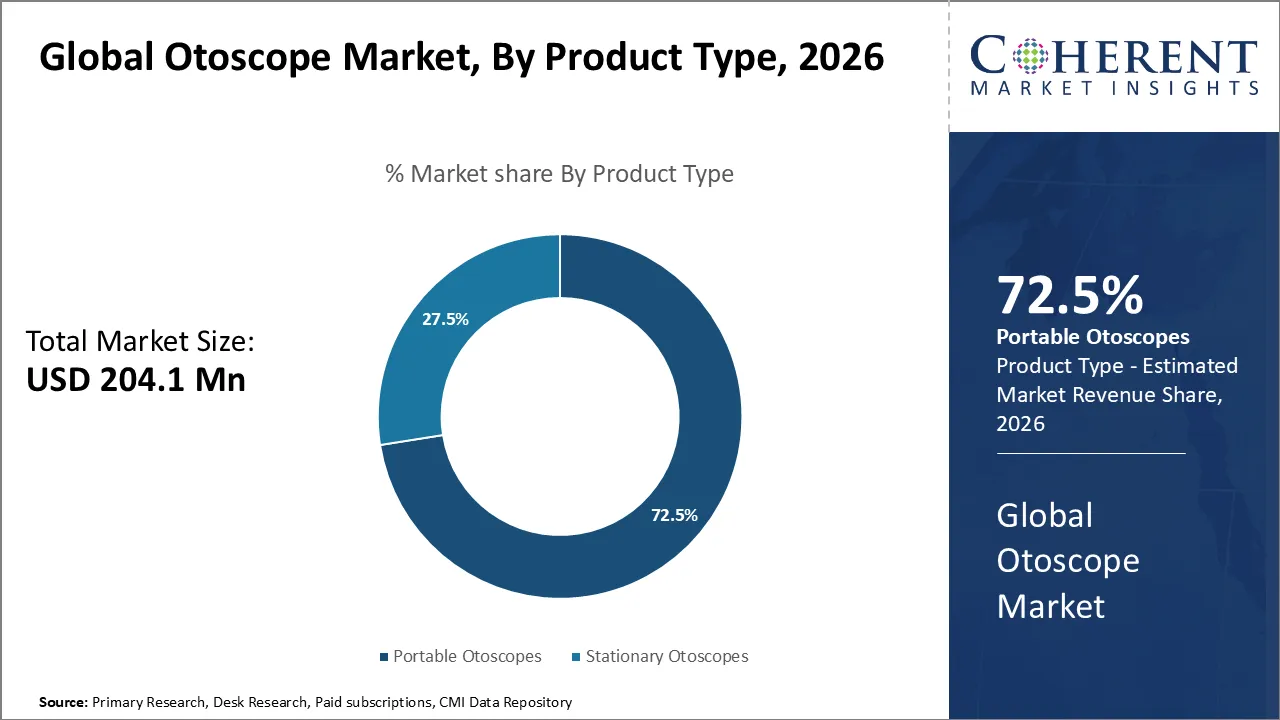
- The portable otoscopes segment is likely to dominate the market with 72.5% in 2026. The segment’s growth is owing to the ease of point-of-care examination, portability across hospital and outpatient settings, increasing use by primary-care professionals, and growing adoption of handheld digital imaging systems. WHO notes that ear examination and basic ear and hearing care interventions can be provided by trained non-specialist healthcare providers in both clinical and community settings, supporting demand for portable examination devices.
- The rechargeable battery segment is expected to lead with 44.0% in 2026. The segment’s growth is owing to the preference for reusable handheld diagnostic instruments, lower dependence on disposable batteries, frequent otoscope use in clinical settings, and increasing adoption of charging-based examination systems.
- The conventional (lens) otoscope segment is expected to account for the largest share of 52.0% in 2026. The segment continues to benefit from its established use in routine ear examination, relatively low acquisition cost, widespread physician familiarity, and extensive installed base. A 2024 systematic review and meta-analysis reported that telemedicine-enabled otoscopes achieved a pooled 82% sensitivity and 95% specificity for diagnosing ear diseases, highlighting the increasing clinical viability of digital otoscopy.
- The hospitals segment is set to dominate the market with 61.5% in 2026. The segment’s growth is owing to the high volume of ENT examinations, availability of specialist departments, increasing diagnosis of hearing and ear disorders, and greater procurement of diagnostic examination devices. WHO also reported in 2026 that approximately 95.1 Mn children aged 5–19 years live with hearing loss worldwide. Pediatric ear disorders frequently require examination of the external auditory canal and tympanic membrane, supporting otoscope utilization across hospital pediatric and ENT departments.
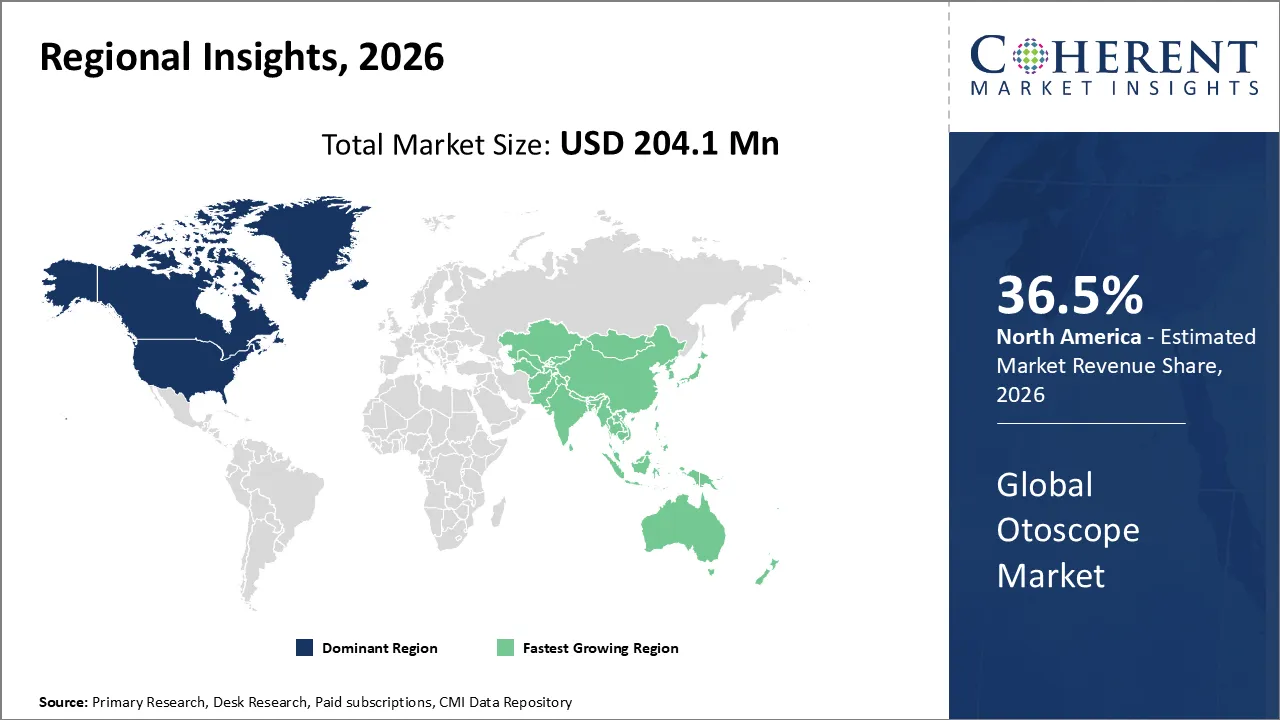
- North America is expected to acquire the prominent share of 36.5% in 2026. The region’s growth is attributed to its developed healthcare infrastructure, high adoption of advanced diagnostic technologies, high penetration of digital and video otoscopes, and increasing usage of telemedicine-enabled ear examination. In a 2024 clinical study on digital otoscopy, it was found that digital otoscopic video led to the correct diagnosis in 79% of cases and that specialists thought that remote consultation could substitute an in-person visit in 59% of patients.
Market Drivers
Artificial Intelligence and Smartphone-Connected Otoscopy are Improving Diagnostic Capabilities
The Otoscope Market is witnessing rapid innovation driven by developments in artificial intelligence, smartphone connectivity, and image-processing technologies. Smartphone-connected otoscopes can take high-resolution images that can be analyzed remotely or via AI-assisted diagnostic systems, potentially aiding earlier identification of middle-ear disorders and enhancing clinical decision-making.
A peer-reviewed 2024 study developed a smartphone-based deep learning system with 41,664 digital otoscopic images. In testing, the system was 99.0% sensitive and 95.2% specific in distinguishing normal from abnormal otoscopic images. It also identified earwax plugs with 100% sensitivity and 97.7% specificity, although diagnostic performance varied across other specific middle-ear conditions, and further clinical validation was recommended.
Expansion of Community and Primary-Care Ear Screening is Increasing Demand for Portable Otoscopes
Another major driving factor of the Otoscope Market is the growing focus on early detection of hearing and ear disorders through community and primary-care programs. Portable and digital otoscopes can complement hearing-screening programs by enabling trained healthcare professionals to visualize the ear canal and tympanic membrane prior to referral to a specialist.
In June 2026, the World Health Organization launched a mobile hearing screening application, WHOears, to be used by trained healthcare workers in community and primary healthcare settings. Many people still do not have access to basic hearing testing, WHO said, and designed the initiative to allow systematic screening and timely referral.
Current Events and Their Impact on the Otoscope Market
Current Event | Description and its Impact |
WHO Launches WHOears to Expand Community and Primary-Care Hearing Screening (2026) |
|
FDA Issues Updated Human Factors and Usability Engineering Guidance for Medical Devices (August 2026) |
|
- Current Industry Events of 2026
- Market Size Estimation
- Regional Breakdown
- Competitive Landscape
- Customer Intelligence
- Segmental Analysis
- Pricing Analysis
- Key Market Drivers, Challenges & Future Trends
- Customized Insights Section
Segmental Insights
Why are Portable Otoscopes Acquiring the Largest Market Share?
On the basis of product type, the portable otoscopes segment is projected to account for the largest Otoscope Market share of 72.5% in 2026. The segment’s growth is owing to portability, ease of use at the point of care, lower space requirements, and increasing deployment across primary care, ENT clinics, emergency departments, community screening, and telemedicine settings.
A 2026 peer-reviewed prospective study evaluated a portable pen-shaped otoscope at a tertiary referral center and included 19 patients covering 28 ears. The researchers specifically highlighted that conventional otologic equipment can face limitations related to portability, cost, and patient comfort, supporting the clinical utility of compact portable devices.
In February 2025, JEDMED Corporation and Otologic Technologies announced a partnership to launch what the companies described as the world’s first AI-enabled digital otoscope. The announcement was made on February 13, 2025 and combines JEDMED’s portable digital otoscopy platform with Otologic Technologies’ artificial-intelligence-based ear-disease diagnostic technology.
Why are Rechargeable Battery Otoscopes Acquiring the Largest Market Share?
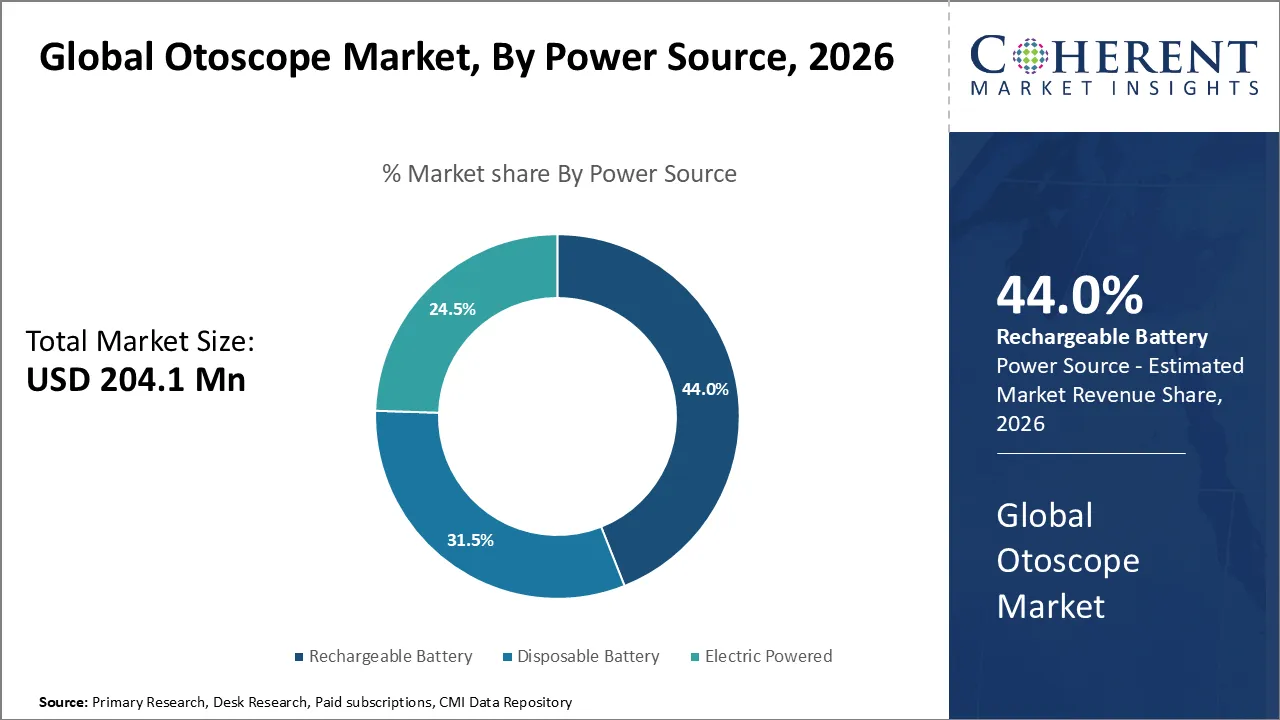
On the basis of power source, the rechargeable battery segment is expected to lead the Otoscope Market with 44.0% in 2026. The segment’s growth is owing to repeated clinical use, reduced dependence on disposable batteries, compatibility with charging stations, greater convenience for high-frequency examinations, and increasing preference for reusable handheld diagnostic instruments in hospitals and ENT clinics.
Regulatory attention to rechargeable battery safety is also increasing. In December 2024, the U.S. FDA recognized UL 2054, which covers primary and secondary rechargeable batteries used as power sources and establishes requirements intended to reduce fire and explosion risks. This supports increased standardization and safety assurance of rechargeable power systems integrated into portable medical devices.
In April 2025, HEINE Optotechnik documented its new BETA X Otoscope platform, which includes USB-C rechargeable operation, charging-station compatibility, a charge-status indicator, and an automatic switch-off function.
Why are Conventional (Lens) Otoscopes Acquiring the Largest Market Share?
On the basis of modality, the conventional (lens) otoscope segment is expected to account for the largest Otoscope Market share of 52.0% in 2026. The segment’s growth is owing to its long-established role in routine ear examination, relatively simple operation, lower acquisition cost, wide physician familiarity, and extensive installed base across hospitals, primary-care facilities, and ENT practices.
A clinical diagnostic-accuracy study involving 176 patients and 352 tympanic membranes found that the conventional otoscope achieved 96.3% sensitivity, 98.8% specificity, and 98.6% overall accuracy for detecting tympanic membrane perforation when compared with microscopy as the reference standard.
In July 2025, Baxter continued commercial promotion of its Welch Allyn MacroView Plus Otoscope, describing it as its latest diagnostic otoscope for routine ear examinations. The device retains a direct optical viewing system while offering a viewing area approximately 2.5–3 times larger than a standard otoscope, together with long-lasting LED illumination.
Why do Hospitals Hold the Largest Market Share?
On the basis of end user, the hospitals segment is projected to dominate the Otoscope Market with 61.5% in 2026. The segment’s growth is owing to the high volume of ENT and pediatric consultations, emergency presentations involving ear disorders, availability of specialist physicians, established diagnostic infrastructure, and frequent use of otoscopes for routine physical examinations and follow-up assessments.
WHO data on ear and hearing care delivery in the African Region show that 86% of surveyed countries provide ear and hearing care services at the secondary-care level, compared with only 47% at the primary-care level. This demonstrates the continuing concentration of ear-care services within higher-level healthcare facilities and supports strong utilization of otoscopic equipment in hospital and specialist settings.
Otoscope Market Trends
- Increased integration of telemedicine and remote consultation is creating more demand for connected otoscopes that can send ear images or videos to be analyzed outside the traditional ENT setting. A 2025 peer-reviewed study of 45 otology outpatients found that patient self-recorded digital otoscopy yielded diagnostically useful images for selected conditions, while clinician-recorded digital otoscopy yielded correct diagnoses in 63.5% of cases. Digital otoscopes could support remote consultations when used by general practitioners and nurses, the study concluded.
- Growing use of low-cost smartphone-guided otoscopes for pediatric telehealth expands the scope of otoscopy beyond the traditional hospital and clinic settings. A future pediatric study in 2026 found that 88% of caregivers found a low-cost digital otoscope easy to use and 100% indicated they would be willing to pay for a similar device for telehealth applications. Around 50% of caregiver-captured images were rated good or excellent by a blinded otolaryngologist.
- The increasing focus on community and primary-care hearing screening is encouraging greater deployment of portable otoscopes alongside hearing assessment technologies. In June 2026, WHO launched the WHOears app for trained health-care providers working in community and primary-care settings. Those who fail the screening are referred for further hearing assessment, providing additional opportunities for subsequent otoscopic examination and diagnostic evaluation.
Regional Insights
North America Dominates Owing to Advanced Diagnostic Infrastructure and High Adoption of Ear Screening Technologies
North America is expected to account for the prominent 36.5% share of the Otoscope Market in 2026. The region’s dominance is owing to its established hospital and primary-care infrastructure, widespread routine physical examinations, strong penetration of premium handheld diagnostic equipment, and increasing adoption of digital and smartphone-connected otoscopes across ENT, pediatric, emergency, and telehealth settings.
The underlying need for ear examination remains substantial in the U.S. According to the U.S. CDC, in April 2026, approximately 11% of U.S. workers had hearing difficulty and around 8% experienced tinnitus. Moreover, about 27 million workers had been exposed to hazardous occupational noise during the preceding year, supporting continued demand for hearing assessment and subsequent clinical ear examination.
In April 2026, U.S.-based virtual care company TytoCare announced that it had received FDA De Novo classification for the first model of its Tyto Insights for ENT Suite, creating a new U.S. regulatory category for an “ear, nose, and throat image analyzer.
Asia Pacific Otoscope Market Trends
Asia Pacific is expected to witness the fastest growth in the Otoscope Market over the forecast period. The region’s growth is owing to its large untreated ear-disease population, expansion of primary and community-based ear care, growing pediatric screening programs, improving healthcare infrastructure, and increasing deployment of affordable portable diagnostic devices across densely populated emerging economies.
The scale of unmet demand is particularly significant. In March 2025, the World Health Organization reported that approximately 400 million people in its South-East Asia Region experience hearing problems, with the number projected to increase to around 660 million by 2050 if current trends continue.
High Clinical Utilization and Digital Otoscopy Adoption are Supporting the Otoscope Market in the United States
The U.S. Otoscope Market is expected to register a steady CAGR during the forecast period owing to the heavy burden of ear disorders, strong ENT and pediatric care infrastructure, routine use of otoscopy in outpatient settings and increasing integration of digital otoscopes with telehealth and smartphone-based examination.
A 2024 U.S. epidemiological study using a nationwide healthcare claims database covering more than 148 million unique patients estimated the prevalence of chronic suppurative otitis media at 0.46%, with approximately 81.1% of identified patients aged 0–10 years. The concentration of ear disease among young children supports continued demand for otoscopic examination across pediatric, primary-care, and ENT practices.
Government Expansion of Ear and Hearing Care Infrastructure is Accelerating the China Otoscope Market
The China Otoscope Market is expected to witness strong growth over the forecast period. The growth is owing to the country’s expanding ENT healthcare infrastructure, increasing newborn and elderly hearing screening, stronger integration of ear care into primary healthcare, and government efforts to improve diagnosis and treatment of common ear diseases such as otitis media, tinnitus, sudden hearing loss, and other hearing disorders.
In March 2025, the Chinese government reported that China had more than 600,000 grassroots healthcare institutions across towns, communities, and villages, supported by over 5 million healthcare workers.
Who are the Major Companies in Otoscope Industry
Some of the major key players in Otoscope Market are Welch Allyn, Inc., Orlvision GmbH, SyncVision Technology Corporation, Spengler SA, Olympus Corporation, Inventis SRL, Rudolf Riester GmbH, Heine Optotechnik, Luxamed GmbH & Co. KG, Dino-Lite, 3M, and CellScope, Inc.
Key News
- In January 2026, Baxter launched a 2026 U.S. trade-up program for its latest Welch Allyn physical-exam tools, including the MacroView Plus Otoscope. The program promotes wider-view optical examination, long-life LED illumination, and digital image capture when paired with the iExaminer SmartBracket and app.
- In January 2026, SyncVision announced its participation at MD&M West 2026 in Anaheim, California, where its portfolio includes the iO1 Elite digital otoscope and SyncKit telemedicine solution. This supports the company’s continued commercialization of digital otoscopy and connected examination systems in North America.
Market Report Scope
Osmium Market Report Coverage
Report Coverage | Details | ||
Base Year: | 2025 | Market Size in 2026: | USD 204.1 Mn |
Historical Data for: | 2020 to 2024 | Forecast Period: | 2026 to 2033 |
CAGR: | 4.1% | 2033 Value Projection: | USD 270.4 Mn |
Geographies covered: |
| ||
Segments covered: |
| ||
Companies covered: | Welch Allyn, Inc., Orlvision GmbH, SyncVision Technology Corporation, Spengler SA, Olympus Corporation, Inventis SRL, Rudolf Riester GmbH, Heine Optotechnik, Luxamed GmbH & Co. KG, Dino-Lite, 3M, and CellScope, Inc. | ||
Growth Drivers: |
| ||
Restraints & Challenges: |
| ||
Analyst Opinion
- The Otoscope Market is increasingly shifting from conventional visual examination toward connected and digitally assisted ear diagnostics. This transition is being supported by the expansion of telemedicine-enabled otoscopes, smartphone connectivity, and remote specialist review. A recent systematic review demonstrated that telemedicine-enabled otoscopes had 82% sensitivity and 95% specificity for diagnosing ear diseases, and use by community health workers had 97% specificity, demonstrating strong potential for decentralized ear care.
- The market is also benefiting from the expansion of community and primary-care hearing screening which is increasing the number of patients who need further ear examination. In June 2026, WHO launched WHOears, a standardized hearing-screening app for trained health-care workers in community and primary-care settings. WHO states that people who fail screening should be referred for further hearing assessment, creating additional opportunities for otoscopic evaluation at downstream points of care.
- Digital integration is expected to be the key source of product differentiation over the forecast period, particularly among portable and handheld devices. FDA listings updated in September 2026 show Welch Allyn/Baxter continuing to register a broad otoscope portfolio that includes Digital MacroView, MacroView Plus iExaminer Kit, Pocket LED Otoscopes, and portable diagnostic sets, while its iExaminer application is separately listed as a Class II image digitizer for otoscope use. This demonstrates how established manufacturers are increasingly combining traditional otoscopy with digital image capture and software-enabled workflows.
Speak to the analyst
Want personalized insights?
Take the findings above to one of our principal consultants, or have the report rebuilt around the segments, geographies and competitors you actually track.
Market Segmentation
- By Product Type (Revenue, USD Mn, 2021-2033)
- Stationary Otoscopes
- Portable Otoscopes
- By Power Source (Revenue, USD Mn, 2021-2033)
- Rechargeable Battery
- Disposable Battery
- Electric Powered
- By Modality (Revenue, USD Mn, 2021-2033)
- Conventional (Lens) Otoscope
- Wired Digital Otoscope
- Wireless Digital Otoscope
- By End User (Revenue, USD Mn, 2021-2033)
- Hospitals
- ENT Clinics
- Others
- Global Otoscope Market, By Region (Revenue, USD Mn, 2021-2033)
- North America
- U.S.
- Canada
- Latin America
- Brazil
- Mexico
- Argentina
- Rest of Latin America
- Europe
- Germany
- U.K.
- France
- Italy
- Spain
- Russia
- Rest of Europe
- Asia Pacific
- China
- India
- Japan
- Australia
- South Korea
- ASEAN
- Rest of Asia Pacific
- Middle East
- GCC
- Israel
- Rest of Middle East
- Africa
- South Africa
- Central Africa
- North Africa
- North America
Sources
Primary Research Interviews
- ENT specialists and otolaryngologists
- Audiologists and hearing-care professionals
- Pediatricians and primary-care physicians
- Hospital procurement and medical equipment managers
- Otoscope manufacturers and product development teams
- Medical device distributors and channel partners
- Telehealth and digital otoscopy solution providers
- Key opinion leaders (KOLs) in ear and hearing care
Databases
- World Health Organization (WHO)
- U.S. Centers for Disease Control and Prevention (CDC)
- U.S. Food and Drug Administration (FDA)
- Centers for Medicare & Medicaid Services (CMS)
- National Institutes of Health (NIH) / PubMed
- Organisation for Economic Co-operation and Development (OECD)
- Eurostat
- World Bank
Magazines
- ENTtoday
- The Hearing Review
- AudiologyOnline
- MedTech Dive
- Medical Device and Diagnostic Industry (MD+DI)
- Medical Device Network
Journals
- Otology & Neurotology
- JAMA Otolaryngology–Head & Neck Surgery
- The Laryngoscope
- Ear and Hearing
- International Journal of Pediatric Otorhinolaryngology
- BMC Ear, Nose and Throat Disorders
- International Journal of Audiology
Newspapers
- The New York Times
- The Guardian
- The Wall Street Journal
- Financial Times
- Reuters
- The Economic Times
Associations
- American Academy of Otolaryngology–Head and Neck Surgery (AAO-HNS)
- American Academy of Audiology (AAA)
- American Speech-Language-Hearing Association (ASHA)
- ENT UK
- International Federation of ORL Societies (IFOS)
- MedTech Europe
- Advanced Medical Technology Association (AdvaMed)
Public Domain Sources
- Company Annual Reports and Investor Presentations
- Company Product Catalogues and Product Launch Announcements
- FDA Device Registrations, 510(k), and De Novo Databases
- WHO Ear and Hearing Care Publications
- CDC Hearing Loss and Ear Disease Statistics
- Government Healthcare and Hospital Utilization Databases
- Peer-reviewed Clinical and Diagnostic Accuracy Studies
- Telemedicine and Digital Otoscopy Research Publications
- Patent Databases such as WIPO, USPTO, and Google Patents
- Regulatory and Medical Device Standards Publications
Proprietary Elements
- CMI Data Analytics Tool
- Proprietary CMI Existing Repository of Information for the Last 10 Years
Get access to 250+ pages report
Every segment, forecast, competitor profile and data table behind the analysis above — available for instant download.
- ESOMAR Member
- ISO 9001:2015 Certified
- D-U-N-S Registered
- GDPR & CCPA Compliant
Missing comfort of reading report in your local language? Find your preferred language:
Transform your Strategy with Exclusive Trending Reports
Frequently Asked Questions
The Otoscope Market is expected to reach USD 270.4 Mn in 2033, increasing from USD 204.1 Mn in 2026.
Major players operating in the global Otoscope Market include Welch Allyn, Inc., Orlvision GmbH, SyncVision Technology Corporation, Spengler SA, Olympus Corporation, Inventis SRL, Rudolf Riester GmbH, Heine Optotechnik, Luxamed GmbH & Co. KG, Dino-Lite, 3M, and CellScope, Inc.
The high cost of advanced digital and video otoscopes and limited access to ENT specialists in emerging regions are among the key factors hampering market growth.
The increasing prevalence of ear and hearing disorders and rising adoption of digital and video otoscopes are key factors driving growth of the Otoscope Market.
The Otoscope Market is anticipated to grow at a CAGR of 4.1% between 2026 and 2033.
Among regions, North America is expected to account for the largest share of the global Otoscope Market, with approximately 36.5% in 2026.
An otoscope is a medical diagnostic instrument used to examine the ear canal and tympanic membrane or eardrum. It is commonly used to assess ear infections, inflammation, earwax buildup, tympanic membrane abnormalities, and other ear-related conditions.