

Global Payment Security Market Size and Forecast – 2026 To 2033
The Global Payment Security Market is estimated to be valued at USD 36.48 Bn in 2026 and is expected to reach USD 82.17 Bn by 2033, growing at a compound annual growth rate (CAGR) of 12.3% from 2026 to 2033. Growth is supported by expanding digital payments, instant transactions, e-commerce, and Cloud based payment infrastructure, which increase requirements for fraud detection, authentication, encryption, tokenization, and compliance management.
Regulatory and industry security standards are also compelling merchants, processors, banks, and service providers to strengthen protection of payment-account data. In March 2025, PCI DSS v4.x future-dated security requirements became effective, expanding mandatory controls applicable to organizations handling payment data and reinforcing investment in payment-security technologies.
Key Takeaways of the Global Payment Security Market
- Fraud Detection and Prevention is projected to grow at 13.4% CAGR during 2026–2033 and capture 31.8% of the global payment security market in 2026. Its lead reflects the need for real-time transaction scoring, behavioral analytics, and adaptive controls against account takeover and card-not-present fraud. In February 2024, Mastercard introduced Decision Intelligence Pro, using generative AI to strengthen transaction-risk assessment.
- Cloud-based Payment Security is expected to expand at 14.1% CAGR during 2026–2033 and account for 64.7% of the market in 2026. Cloud deployment reduces infrastructure burden while enabling centralized fraud controls, rapid rule updates, scalable analytics, and faster integration across payment environments. In January 2024, ACI Worldwide confirmed Co-op had migrated its payments software to the cloud, improving scalability, security, and data protection.
- Large Enterprises are projected to register 11.8% CAGR during 2026–2033 and represent 61.8% of the market in 2026. Their dominance reflects larger transaction volumes, multi-market operations, stricter governance requirements, and stronger budgets for advanced fraud, identity, tokenization, and compliance platforms. In May 2025, Stripe reported its payments foundation model raised card-testing detection on large businesses from 59% to 97%.
- North America is expected to expand at 11.6% CAGR during 2026–2033 and account for 36.8% of the global payment security market in 2026. Its leadership is supported by dense digital-payment usage, sophisticated banking infrastructure, established security vendors, and active supervisory attention to payment fraud. In June 2025, U.S. federal banking regulators sought industry input on actions to mitigate payments-fraud risks.
- Europe is projected to grow at 14.0% CAGR during 2026–2033 and hold 27.6% of the market in 2026, making it the fastest-growing region. Growth is supported by digital finance adoption, stronger operational-resilience obligations, and security spending across regulated financial ecosystems. In January 2025, the EU’s Digital Operational Resilience Act became applicable across the financial sector.
Segmental Insights
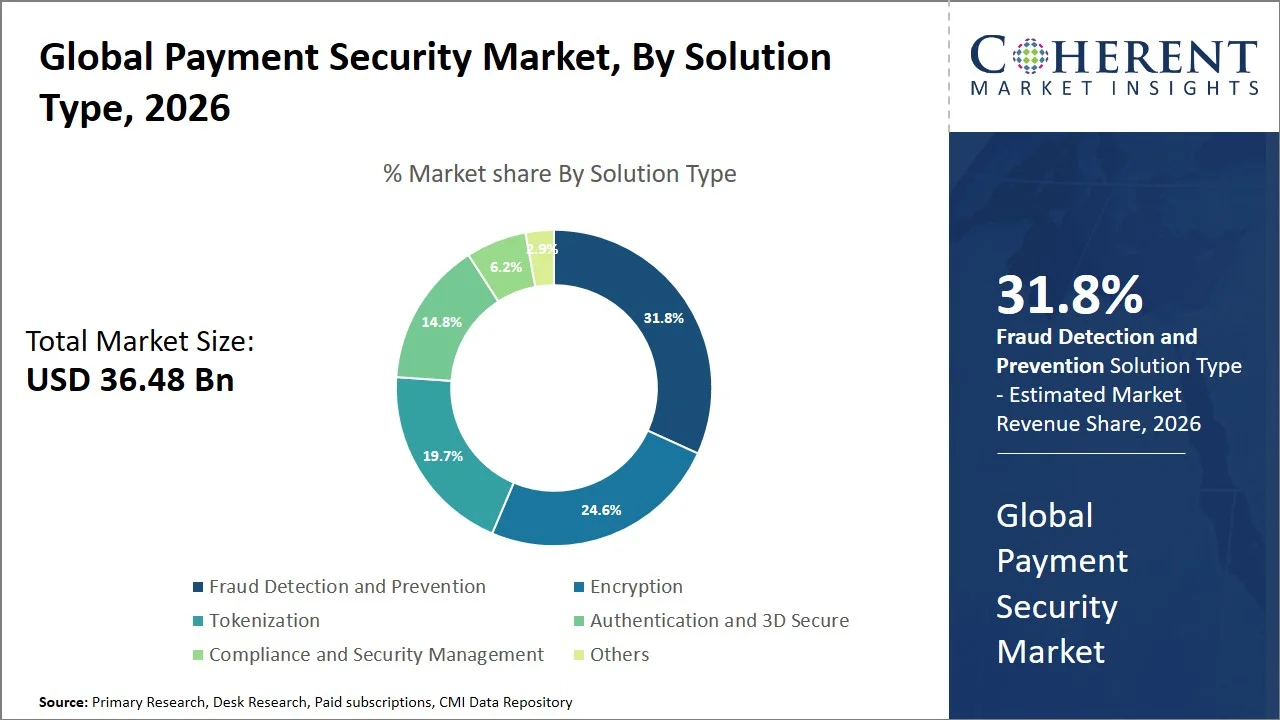
Why Does Fraud Detection and Prevention Dominate the Global Payment Security Market?
Fraud Detection and Prevention is the leading solution type and expected to capture 31.8% of the global payment security market in 2026, because payment providers increasingly require controls that can evaluate transaction, beneficiary, device, and behavioral risk before funds move. Unlike encryption or tokenization, fraud platforms address the decision layer, helping banks, merchants, processors, and payment service providers detect scams, account takeover, card fraud, and anomalous transfers across multiple channels. Real-time payments further increase the value of low-latency scoring because recovery becomes harder after settlement. For vendors, differentiation increasingly depends on network intelligence, cross-channel visibility, targeted intervention, and lower false positives rather than rule volume alone. In January 2026, NICE Actimize launched the Actimize Insights Network to provide financial institutions with real-time counterparty-risk signals for identifying suspicious transfers and supporting targeted intervention before payment completion.
- Current Industry Events of 2026
- Market Size Estimation
- Regional Breakdown
- Competitive Landscape
- Customer Intelligence
- Segmental Analysis
- Pricing Analysis
- Key Market Drivers, Challenges & Future Trends
- Customized Insights Section
Why Does Cloud Based Represent the Largest Deployment Type in the Global Payment Security Market?
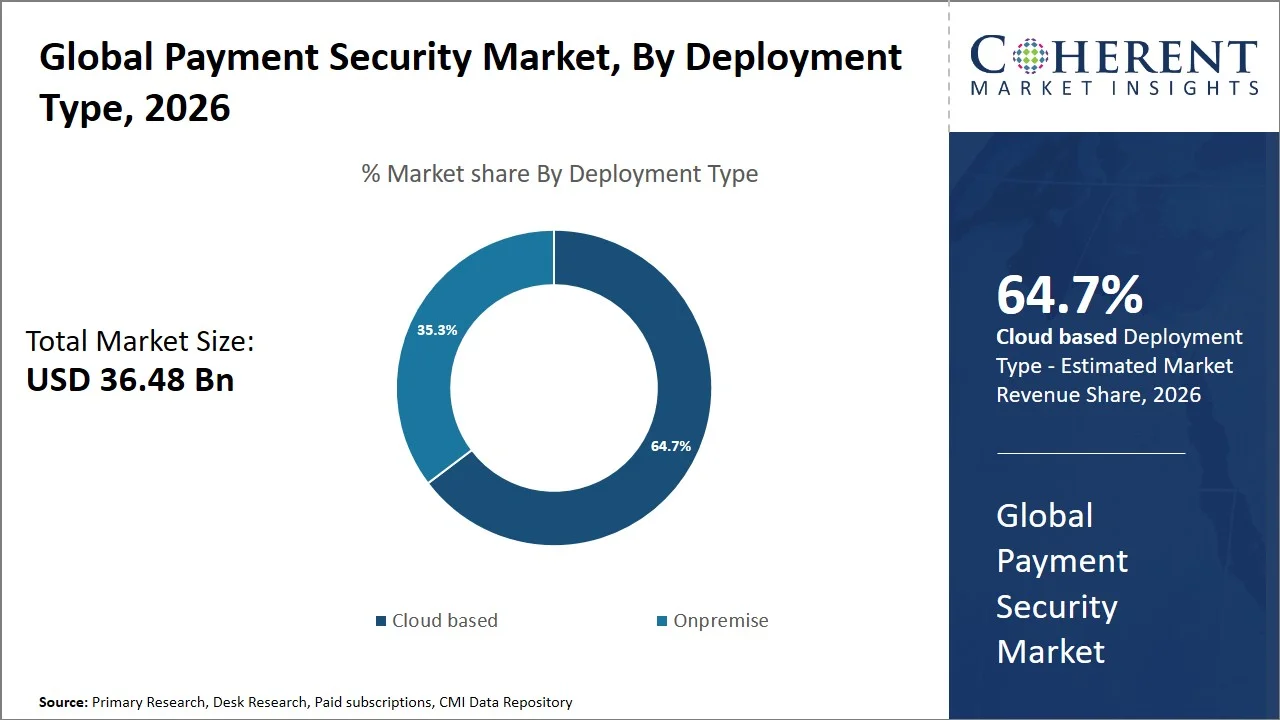
Cloud based deployment is expected to account for 64.7% of the global payment security market in 2026, making it the largest deployment model because payment workloads require elastic processing, rapid geographic expansion, centralized policy management, and resilient security infrastructure. Cloud delivery allows acquirers, processors, payment facilitators, networks, and banks to scale cryptographic operations without continually provisioning dedicated payment hardware at each location. It also supports faster integration with digital payment applications and can reduce operational dependence on separate data centers and locally managed hardware security modules. Commercially, this model favors providers that combine security controls with high availability, compliance support, and usage-based infrastructure economics. In June 2025, AWS expanded AWS Payment Cryptography to its Mumbai and Osaka regions, enabling latency-sensitive payment applications to use managed cryptographic operations and PCI PIN-assessed key management closer to regional cloud workloads.
Why Does Banking, Financial Services and Insurance Dominate the End user Segment of the Global Payment Security Market?
Banking, Financial Services and Insurance is expected to hold 28.6% of the global payment security market in 2026. It leads End user demand because financial institutions sit directly at the authorization, account, settlement, and beneficiary-risk layers of payment activity. Banks must secure corporate transfers, card payments, digital banking, instant payments, and treasury workflows while maintaining customer access and transaction speed. This creates demand for integrated fraud scoring, authentication, sanctions screening, payment controls, and beneficiary intelligence embedded within core banking and cash-management environments. Financial institutions also possess extensive transaction histories that can improve model calibration and risk decisions, giving security platforms strong operational value when integrated with payment workflows. In May 2025, J.P. Morgan Payments introduced Account Confidence Score, an AI- and machine-learning-based indicator that evaluates beneficiary risk before a payment is initiated within its global cash-management platform.
Current Events and their Impact
Current Event | Description and Its Impact |
October 2024 – UK APP Scam Reimbursement Requirement Takes Effect |
|
November 2025 – EU Reaches Provisional Agreement on PSR and PSD3 Anti-Fraud Rules |
|
Global Payment Security Market Dynamics
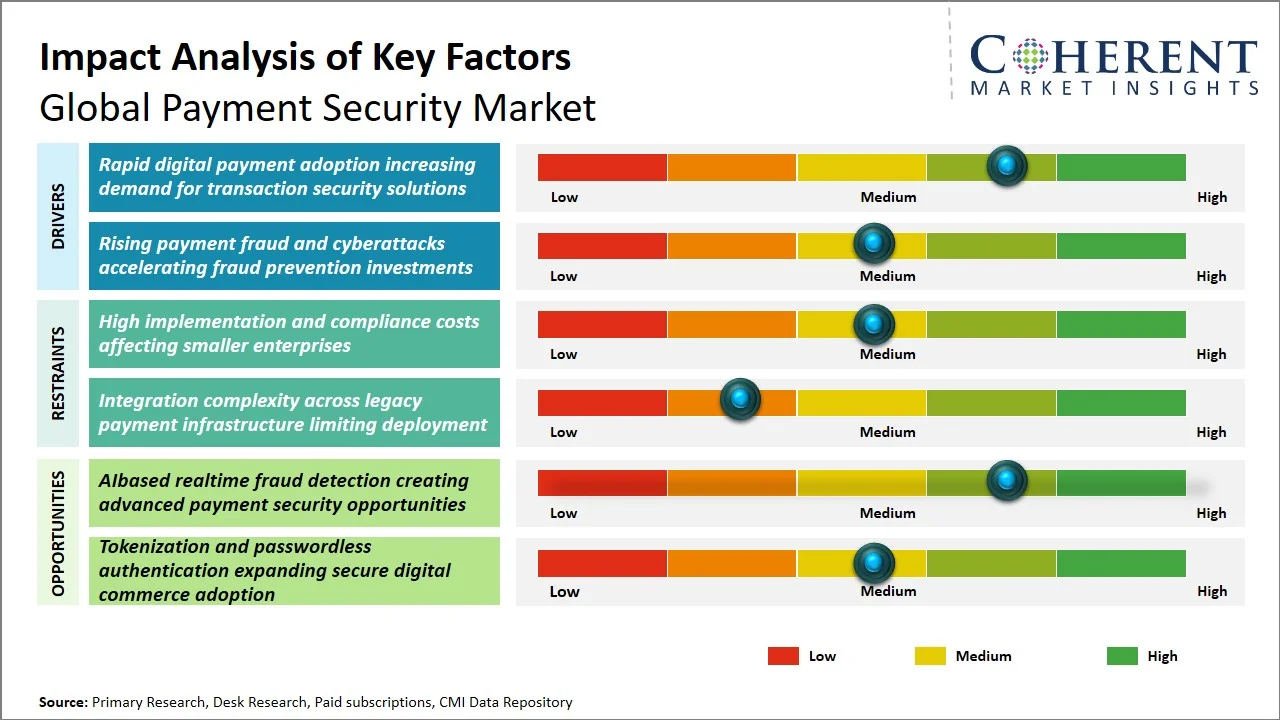
Key Market Drivers
- Rapid digital payment adoption increasing demand for transaction security solutions: Digital payment adoption is widening the number of transaction endpoints, delegated users, devices, and payment journeys that must be authenticated without creating checkout friction. This expands demand for payment security platforms that combine risk-based authentication, encryption, device intelligence, transaction monitoring, and policy controls across mobile, account-to-account, card, and wallet transactions. Banks, payment service providers, gateways, merchants, and security vendors benefit because each new digital use case creates additional requirements for identity assurance and transaction-level protection. Commercially, providers that secure new payment experiences without materially increasing abandonment can become embedded deeper in payment infrastructure. In August 2024, the Reserve Bank of India proposed “Delegated Payments” through UPI, allowing a primary user to authorize another individual to transact from the primary user’s bank account, illustrating how broader digital-payment access creates new authorization and control requirements.
- Rising payment fraud and cyberattacks accelerating fraud prevention investments: Payment fraud is shifting from straightforward credential theft toward scams, social engineering, account takeover, synthetic identities, automated testing, and attacks that exploit legitimate authorization flows. This changes security spending from periodic rule updates toward continuous transaction intelligence, behavioral analysis, network monitoring, and coordinated disruption capabilities. Financial institutions, merchants, acquirers, processors, and fraud-technology specialists benefit from demand for faster detection and lower false-positive rates, while providers dependent on static rules face mounting performance pressure. The commercial priority is increasingly to stop fraud before authorization rather than absorb chargebacks, reimbursement costs, operational reviews, and customer attrition afterward. In March 2025, Visa formally unveiled its Scam Disruption Practice, stating that the specialist unit had prevented more than USD 350 million in attempted fraud during 2024 by combining technology with human-led investigation and ecosystem coordination.
Emerging Market Trends
- Identity-led adaptive decisioning is replacing transaction-only screening: Payment security is shifting toward continuous identity assessment using account history, device reputation, behavioral signals, authentication strength, and transaction context. This allows banks and merchants to apply stronger controls only where risk is elevated. Adaptive decisioning should increasingly connect fraud detection, authentication, and customer-experience workflows, favoring integrated platforms over fixed-rule or single-channel systems.
- Payment security is becoming embedded in orchestration and authorization optimization: Security is increasingly integrated with payment routing, authentication, token management, retry logic, and authorization decisions. Buyers are favoring platforms that balance fraud prevention, approval rates, processing costs, and compliance within one operating layer. This shift should benefit processors, orchestration providers, and integrated security vendors while increasing pressure on standalone tools with limited interoperability.
Regional Insights
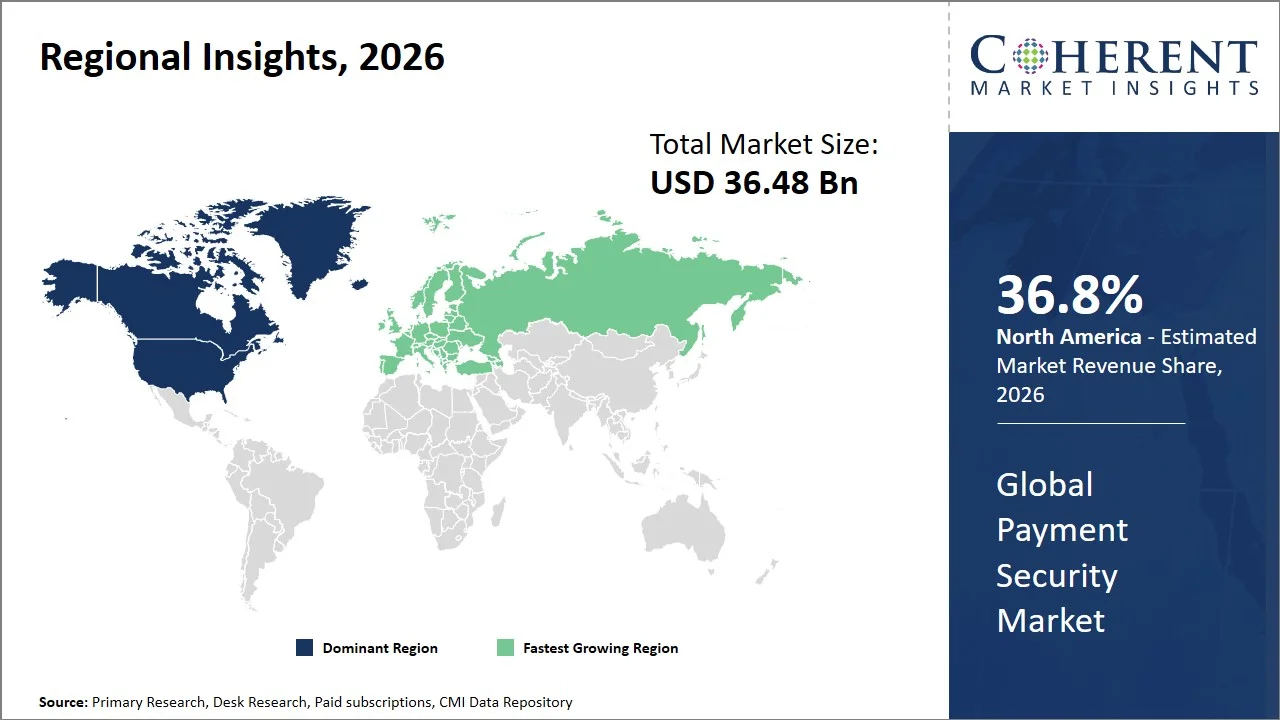
Why Does North America Dominate the Global Payment Security Market?
North America is expected to account for 36.8% of the global payment security market in 2026, supported by high card and digital-payment penetration, mature banking infrastructure, extensive e-commerce activity, and strong enterprise spending on fraud prevention, tokenization, encryption, and authentication. The region also benefits from dense participation by payment processors, cybersecurity vendors, financial institutions, and cloud providers, shortening deployment cycles for advanced security platforms. Real-time payment modernization is further increasing demand for transaction-level fraud controls that operate before funds are released. In July 2026, Payments Canada reported that its Real-Time Rail had entered industry solution assurance testing, including mandatory Centralized Fraud Services that analyze transactions in real time. This reinforces the regional shift toward infrastructure-level fraud prevention rather than relying only on individual institution controls.
Why Is Europe Emerging as the Fastest-Growing Region in the Payment Security Market?
Europe is expected to hold 27.6% of the global payment security market in 2026 and emerge as the fastest-growing region as banks and payment service providers adapt security architecture to instant payments, account-to-account transfers, stronger authentication, and beneficiary verification requirements. The region's fragmented banking landscape also creates demand for interoperable security tools that can operate across borders and payment schemes while supporting regulatory compliance. Expansion of instant credit transfers increases the need to prevent authorized payment fraud before settlement becomes irreversible. In March 2025, the Eurosystem confirmed that it would offer a Verification of Payee service for payment service providers across SEPA, enabling payers to check recipient account details before initiating transfers. This supports commercial demand for beneficiary validation, identity controls, fraud scoring, and transaction-monitoring technologies across European payment flows.
Global Payment Security Market Outlook for Key Countries
Why Is the U.S. a Key Market for the Payment Security Market?
The U.S. is estimated to account for 30.7% of the global payment security market in 2026, reflecting its large card-payment economy, extensive e-commerce base, high concentration of banks and fintech platforms, and broad adoption of Cloud based fraud and identity-security tools. Demand is particularly strong where merchants and payment providers must balance fraud reduction with authorization rates and low checkout friction. Federal migration toward electronic disbursement also expands the number of transactions requiring secure identity verification, tokenization, and fraud screening. In September 2025, the U.S. Treasury highlighted the federal transition toward electronic payments beginning September 30, 2025, while emphasizing payment-fraud prevention as part of that shift. The move increases the strategic importance of secure digital payout infrastructure and reinforces U.S. demand for scalable protection across government, banking, and consumer-payment environments.
Why Is India Important in the Global Payment Security Market?
India is estimated to represent 5.4% of the global payment security market in 2026, supported by the scale of UPI, expanding merchant acceptance, mobile-first consumer behavior, and the rapid movement of low-value transactions into digital channels. The security opportunity extends beyond banks as payment apps, acquirers, merchants, and fintech platforms increasingly require device binding, authentication, fraud monitoring, transaction-risk scoring, and secure API controls to protect very high transaction volumes. In May 2026, NPCI reported that UPI processed approximately 23.2 billion transactions during the month across 720 live banks. That operating scale makes improvements in fraud detection, authentication efficiency, and false-positive reduction commercially significant. As UPI expands across merchant, recurring, and cross-border use cases, India should remain important for vendors capable of delivering low-latency protection at national-scale payment volumes.
Why Does China Support Growth in the Payment Security Market?
China is estimated to hold 10.2% of the global payment security market in 2026, supported by its large digital-commerce ecosystem, widespread mobile-payment use, major non-bank payment platforms, and growing regulatory emphasis on operational resilience and user protection. Security demand centers on transaction traceability, account protection, merchant monitoring, data security, anti-fraud controls, and secure processing across high-volume payment networks. The regulatory framework also raises the compliance threshold for payment institutions, favoring vendors with strong risk-management and infrastructure-security capabilities. In May 2024, China's Regulation on the Supervision and Administration of Non-bank Payment Institutions took effect, requiring payment institutions to maintain systems and technologies supporting continuity, security, accuracy, and traceability while strengthening risk-management obligations. These requirements reinforce long-term spending on secure payment infrastructure and compliance-oriented payment-security platforms.
Why Is Germany a Strategic Country in the Payment Security Market?
Germany is estimated to account for 6.2% of the global payment security market in 2026, supported by a sophisticated banking system, strong card infrastructure, expanding instant-payment use, and enterprise demand for high-assurance authentication and data protection. German buyers operate within strict European security and privacy frameworks, favoring payment-security solutions that combine technical controls with auditable compliance and reliable processing. The shift from cash toward cards and instant transfers is widening the transaction environment that banks, merchants, processors, and fintech providers must secure. In July 2026, Deutsche Bundesbank reported approximately 14.5 billion card payments in Germany during 2025, while SEPA instant credit transfers more than doubled year on year to around 680 million transactions. The changing payment mix supports continued investment in fraud monitoring, authentication, tokenization, and real-time transaction security.
Why Is Brazil an Important Growth Market for the Payment Security Market?
Brazil is estimated to represent 2.8% of the global payment security market in 2026, making it a strategically important Latin American growth market as Pix, mobile banking, e-commerce, and digital merchant payments become embedded in everyday transactions. The speed and irrevocability of instant payments create strong demand for fraud intelligence, device controls, transaction monitoring, account-risk identification, and recovery workflows. Brazil's central-bank-led payment infrastructure also gives security requirements broad reach across banks and payment institutions. In July 2024, Banco Central do Brasil announced additional Pix security measures requiring stronger controls for transactions initiated from previously unregistered devices, including lower transaction and daily limits until the device is registered. This illustrates how Brazil is embedding fraud prevention directly into payment rules, increasing demand for technologies that support real-time risk decisions without undermining user convenience.
Technology Adoption Landscape in the Global Payment Security Market
Technology | Adoption Level | Key Application Area | Business Impact |
Real-time Machine-learning Transaction Risk Scoring | High | Card, wallet, and account-to-account payment authorization | Enables low-latency assessment of transaction risk, improves fraud-decision precision, and reduces dependence on manual review. |
Network Tokenization | High | Card-on-file, recurring payments, e-commerce, and mobile wallets | Replaces exposed payment credentials with controlled tokens, strengthening credential lifecycle management and reducing sensitive-data exposure. |
EMV 3-D Secure Risk-based Authentication | High | Card-not-present e-commerce authentication | Allows low-risk transactions to progress with limited friction while escalating suspicious transactions for stronger authentication. |
Point-to-Point Encryption with Hardware Security Module Key Management | High | Card-present POS and payment-data protection | Protects cardholder information from capture through secure decryption while strengthening cryptographic control and compliance management. |
Behavioral Biometrics and Device Intelligence | Medium | Account takeover, automated attacks, card testing, and scam-risk detection | Adds passive behavioral and device-level signals that help identify anomalies without requiring repeated customer challenges. |
FIDO and Passkey-based Payment Authentication | Medium | Passwordless account access, wallet authorization, and payment confirmation | Reduces exposure to credential reuse and phishing while creating a stronger cryptographic link between the legitimate user, device, and payment action. |
How Are Cross-Rail Scam Intelligence and Beneficiary Verification Creating New Growth Opportunities in the Global Payment Security Market?
A high-potential opportunity lies in extending payment security beyond card fraud into real-time account-to-account transfers, digital wallets, open-banking payments, and cross-border instant-payment corridors. These environments require security systems that can identify mule accounts, suspicious beneficiaries, manipulated customers, device anomalies, and coordinated scam patterns before funds become difficult to recover. Banks, payment service providers, fintech platforms, marketplaces, and remittance operators represent priority customers because they increasingly need controls that work across multiple payment rails rather than separate fraud engines for each channel. Vendors can capture this opportunity by combining beneficiary verification, behavioral signals, shared intelligence, transaction graph analysis, and configurable intervention workflows in API-based platforms. Successful participation will require low-latency infrastructure, strong data-governance capabilities, explainable decisioning, and integrations with payment networks and account providers. The opportunity should favor specialist fraud vendors and established payment-security providers that can build cross-institution intelligence while supporting jurisdiction-specific privacy, liability, and authentication requirements. This creates room for premium services around risk orchestration and managed fraud operations.
Market Players, Key Development, and Competitive Landscape
Key Developments
- In January 2025, Adyen launched Adyen Uplift, an AI-powered payment optimization suite that combines risk-based intelligence with automated payment and fraud-management decisions. The solution is important for the global payment security market because it demonstrates a shift from independent fraud rules toward integrated decisioning that considers security, payment acceptance, and processing economics together, increasing pressure on stand-alone fraud products to provide stronger orchestration and performance integration.
- In April 2025, Bluefin added network tokenization capabilities to its ShieldConex Tokenization as a Service and Orchestration platforms, enabling merchants to provision payment tokens issued by card networks alongside vaultless tokenization and PCI-validated point-to-point encryption. This is important for the global payment security market because enterprises can consolidate multiple credential-protection mechanisms within a common architecture while maintaining flexibility across processors, acquirers, gateways, and omnichannel payment environments.
- In February 2025, Entrust launched its NFC Issuer Wallet Solution for iOS, enabling European financial institutions to develop branded NFC payment wallets within their banking applications. This is important for the global payment security market because issuer-controlled digital payment environments create additional requirements for secure card digitization, authentication, credential management, and trusted payment authorization while giving financial institutions greater control over the security architecture surrounding mobile payment interactions.
Competitive Landscape
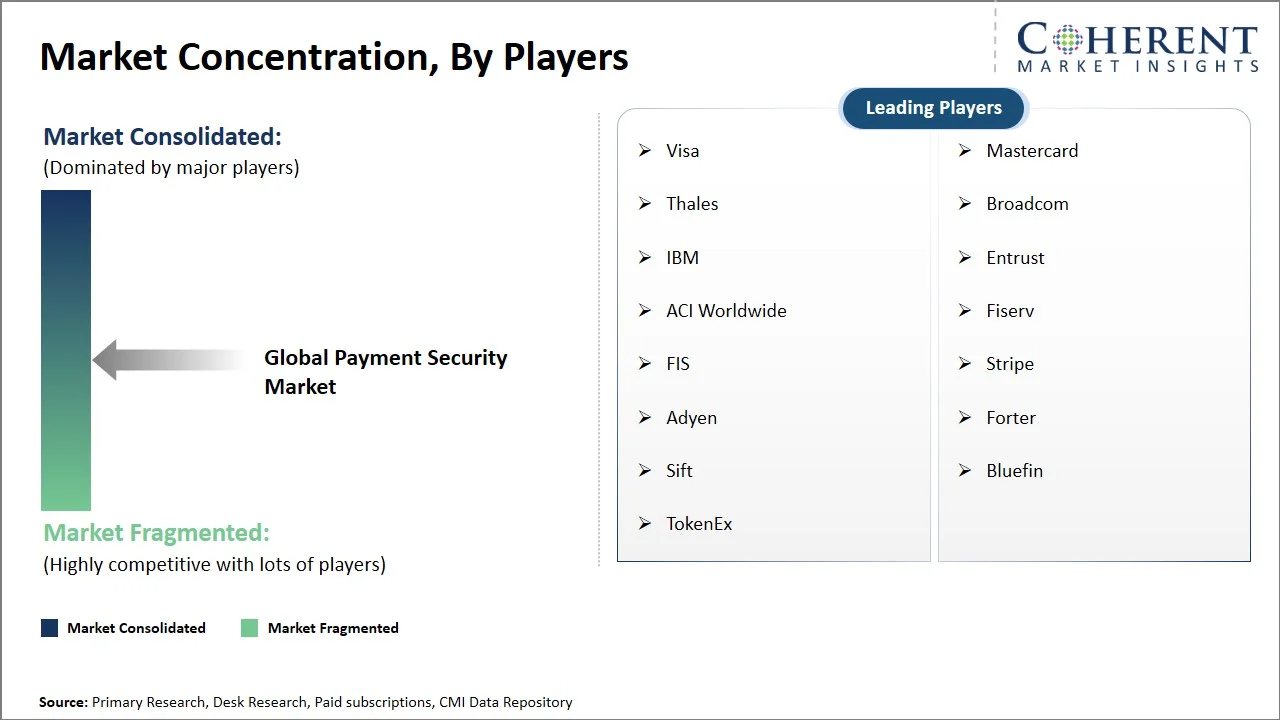
The global payment security market is fragmented, although concentration is higher in network-scale payment infrastructure than in specialist fraud detection, authentication, tokenization, encryption, and compliance niches. Competition spans payment networks, processors, cybersecurity providers, identity-security specialists, fraud-management platforms, encryption vendors, and regional technology firms. Buyers increasingly assess suppliers on decision accuracy, false-positive control, processing latency, integration depth, payment-rail coverage, regulatory readiness, data governance, platform reliability, total cost of ownership, and technical support. Regional specialists remain relevant where domestic payment rails, local fraud patterns, data-residency requirements, and regulatory frameworks require customized capabilities.
Key focus areas include
- Fraud-decision quality: Vendors must improve detection accuracy without creating unnecessary transaction rejection or customer friction.
- Integration and interoperability: API depth and compatibility with processors, gateways, banks, merchant systems, and multiple payment rails are increasingly important procurement criteria.
- Credential security: Tokenization, encryption, cryptographic key management, and secure credential lifecycle capabilities support differentiation in data-intensive payment environments.
- Compliance readiness: Auditable controls, configurable authentication policies, reporting capabilities, and data-governance support can shorten buyer implementation cycles.
- Pricing and total cost of ownership: Customers evaluate security expenditure against fraud losses, manual-review costs, integration burden, chargebacks, and payment acceptance performance.
- Operational reliability: Low-latency decisioning, service availability, resilient infrastructure, and rapid fraud-rule or model updates are essential for payment-critical deployments.
- Regional localization and customer support: Local payment-method expertise, data-handling requirements, language support, and responsive fraud operations help specialist providers defend regional accounts.
Market Report Scope
Payment Security Market Report Coverage
| Report Coverage | Details | ||
|---|---|---|---|
| Base Year: | 2025 | Market Size in 2026: | USD 36.48 Bn |
| Historical Data for: | 2020 To 2024 | Forecast Period: | 2026 To 2033 |
| Forecast Period 2026 to 2033 CAGR: | 12.3% | 2033 Value Projection: | USD 82.17 Bn |
| Geographies covered: |
| ||
| Segments covered: |
| ||
| Companies covered: | Visa, Mastercard, Thales, Broadcom, IBM, Entrust, ACI Worldwide, Fiserv, FIS, Stripe, Adyen, Forter, Sift, Bluefin, TokenEx | ||
| Growth Drivers: |
| ||
| Restraints & Challenges: |
| ||
Analyst Opinion (Expert Opinion)
- Global payment security leadership is likely to shift from selling individual security tools toward managing overall payment-risk economics. Buyers will increasingly assess how security affects fraud losses, legitimate transaction acceptance, investigation effort, and operating efficiency. This favors managed decisioning and outcome-focused models while pressuring vendors that provide software without continuous optimization.
- Agent-initiated commerce could require payment security systems to distinguish between trusted customers and authorized software agents acting for them. As agents initiate purchases, subscriptions, or delegated payments, capabilities such as cryptographic agent identity, intent verification, authorization boundaries, and revocation controls may become essential between identity management and payment authorization.
- Payment-security providers should prioritize cross-rail intelligence, explainable risk decisioning, privacy-preserving data collaboration, model governance, and configurable regulatory controls. Partnerships with financial institutions and payment infrastructure providers can strengthen access to quality risk signals. Vendors should avoid overinvestment in commoditized standalone features and focus on interoperable platforms that support new payment methods efficiently.
Speak to the analyst
Want personalized insights?
Take the findings above to one of our principal consultants, or have the report rebuilt around the segments, geographies and competitors you actually track.
Market Segmentation
- Solution Type Insights (Revenue, USD Bn, 2021 - 2033)
- Fraud Detection and Prevention
- Encryption
- Tokenization
- Authentication and 3D Secure
- Compliance and Security Management
- Others
- Deployment Type Insights (Revenue, USD Bn, 2021 - 2033)
- Cloud based
- On premise
- Organization Size Insights (Revenue, USD Bn, 2021 - 2033)
- Large Enterprises
- Small and Medium Enterprises
- End User Insights (Revenue, USD Bn, 2021 - 2033)
- Banking Financial Services and Insurance
- Retail and Ecommerce
- IT and Telecommunications
- Healthcare
- Travel and Hospitality
- Government and Public Sector
- Others
- Distribution Channel Insights (Revenue, USD Bn, 2021 - 2033)
- Direct Sales
- Indirect Sales
- Regional Insights (Revenue, USD Bn, 2021 - 2033)
- North America
- U.S.
- Canada
- Latin America
- Brazil
- Argentina
- Mexico
- Rest of Latin America
- Europe
- Germany
- U.K.
- Spain
- France
- Italy
- Russia
- Rest of Europe
- Asia Pacific
- China
- India
- Japan
- Australia
- South Korea
- ASEAN
- Rest of Asia Pacific
- Middle East
- GCC Countries
- Israel
- Rest of Middle East
- Africa
- South Africa
- North Africa
- Central Africa
- North America
- Key Players Insights
- Visa
- Mastercard
- Thales
- Broadcom
- IBM
- Entrust
- ACI Worldwide
- Fiserv
- FIS
- Stripe
- Adyen
- Forter
- Sift
- Bluefin
- TokenEx
Sources
Primary Research Interviews
- Payment networks, banks, payment processors, gateways, fintechs, and fraud-prevention vendors
- Merchants, e-commerce platforms, cybersecurity providers, tokenization and authentication specialists
- Payment consultants, compliance professionals, risk managers, and industry experts
Stakeholders
- Payment security solution providers and cybersecurity companies
- Banks, card networks, PSPs, acquirers, issuers, fintechs, and digital-wallet providers
- Merchants, enterprises, government organizations, and payment infrastructure operators
End-use Sectors
- Banking, Financial Services and Insurance
- Retail and E-commerce
- IT and Telecommunications
- Healthcare, Travel and Hospitality
- Government and Public Sector
Regulatory and Government Bodies
- U.S. Federal Reserve, FTC, CFPB, and NIST
- European Commission, ECB, EBA, and ENISA
- UK FCA and Payment Systems Regulator
- Reserve Bank of India and NPCI
- People's Bank of China and national data-security authorities
Databases
- BIS, World Bank, IMF, OECD, and ECB payment statistics
- Federal Reserve Payments Study and national payment-system databases
- World Bank Global Findex
- Company filings, annual reports, patents, cybersecurity and payment-fraud databases
Magazines and Journals
- Journal of Payments Strategy & Systems
- IEEE Security & Privacy
- Computers & Security
- Journal of Cybersecurity
- Payments Dive and Finextra
Associations
- PCI Security Standards Council
- EMVCo
- FIDO Alliance
- Electronic Transactions Association
- Merchant Risk Council
- GSMA
Public Domain Sources
- Payment transaction volumes, digital-payment adoption, and fraud-loss statistics
- Company annual reports, security documentation, product specifications, and technical whitepapers
- Cybersecurity incidents, data-breach disclosures, regulatory filings, patents, partnerships, and technology launches
Key Standards and Regulations
- PCI DSS and PCI payment-security standards
- EMV and EMV 3-D Secure specifications
- PSD2/Strong Customer Authentication and evolving EU payment-services requirements
- DORA requirements for financial-sector digital resilience
- ISO/IEC 27001, NIST Cybersecurity Framework, and data-protection requirements
- Tokenization, encryption, authentication, and secure payment-data handling standards
Proprietary Elements
- CMI Data Analytics Tool, Proprietary CMI Existing Repository of information for the last 10 years
Get access to 250+ pages report
Every segment, forecast, competitor profile and data table behind the analysis above — available for instant download.
- ESOMAR Member
- ISO 9001:2015 Certified
- D-U-N-S Registered
- GDPR & CCPA Compliant
Missing comfort of reading report in your local language? Find your preferred language:
Transform your Strategy with Exclusive Trending Reports
Frequently Asked Questions
The CAGR of global payment security market is projected to be 12.3% from 2026 to 2033.
The global payment security market is estimated to be valued at USD 36.48 billion in 2026 and is expected to reach USD 82.17 billion by 2033.
Payment security solutions are widely used for protecting e-commerce transactions, mobile payments, digital banking, card payments, recurring payments, and real-time account-to-account transactions from fraud, unauthorized access, and data theft.
Cloud-based payment security solutions are gaining adoption because they offer scalability, centralized security management, faster deployment, easier integration with digital payment platforms, and continuous security updates without requiring extensive on-premise infrastructure.
Banking, financial services and insurance, retail and e-commerce, IT and telecommunications, healthcare, travel and hospitality, and government organizations are major users of payment security solutions due to their large volumes of digital and financial transactions.
Real-time fraud detection, behavioral analytics, network tokenization, biometric authentication, device intelligence, risk-based authentication, payment encryption, and adaptive transaction decisioning are shaping the future of payment security by improving fraud prevention while reducing unnecessary payment friction.
Rapid digital payment adoption increasing demand for transaction security solutions and Rising payment fraud and cyberattacks accelerating fraud prevention investments are the major factor driving the growth of global payment security market.