

Global Payment Orchestration Platform Market Size and Forecast – 2026 To 2033
The global payment orchestration platform market is expected to grow from USD 2.85 Bn in 2026 to USD 10.30 Bn by 2033, registering a compound annual growth rate (CAGR) of 12% from 2026 to 2033. The global payment orchestration platform market is driven by the growing demand for higher payment authorization rates. On March 20, 2025, Checkout.com announced that its Intelligent Acceptance product, an AI-powered engine designed to help enterprise businesses boost their payment performance, has generated over USD 10 billion in additional merchant revenue.
Key Takeaways of the Global Payment Orchestration Platform Market
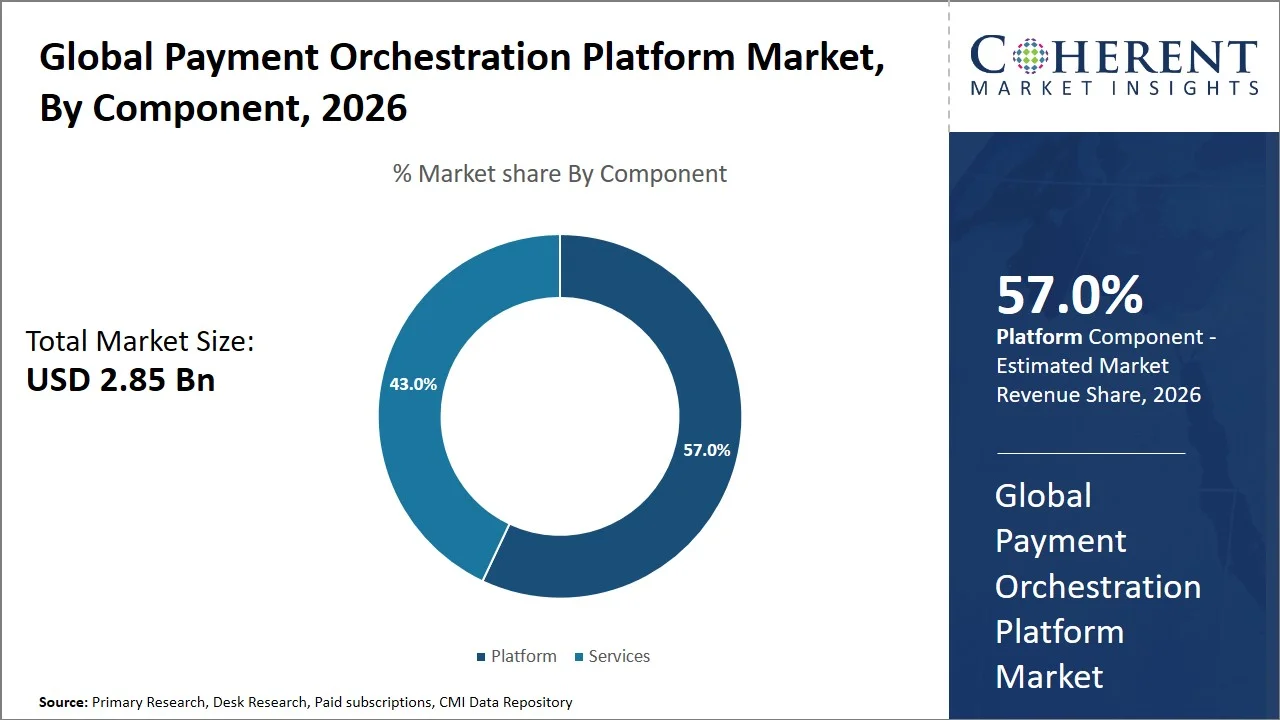
- The platform segment is expected to account for 57.0 % of the global payment orchestration platform market share in 2026. Increasing adoption by marketplaces and platform businesses is driving the growth of the segment. On April 2, 2025, Adyen announced that Temu selected its unified payments platform to support the rapidly expanding global marketplace.
- The cloud segment is estimated to capture 61.0 % of the market share in 2026. Rising demand for centralized payment management is majorly driving the growth of the segment. On July 1, 2026, Adyen announced that it had acquired Talon.One to combine loyalty, incentives and payments into a unified commerce platform, providing merchants with a single point of control for payment, customer interaction and checkout operations.
- The e-commerce segment is estimated to capture 26.0 % of the market share in 2026. Increasing digital wallet and alternative payment method adoption is driving the growth of the segment. On April 16, 2025, eBay entered a strategic relationship with Checkout.com. Through this relationship, eBay is expanding its worldwide payments platform to create frictionless commerce experiences for its customers.
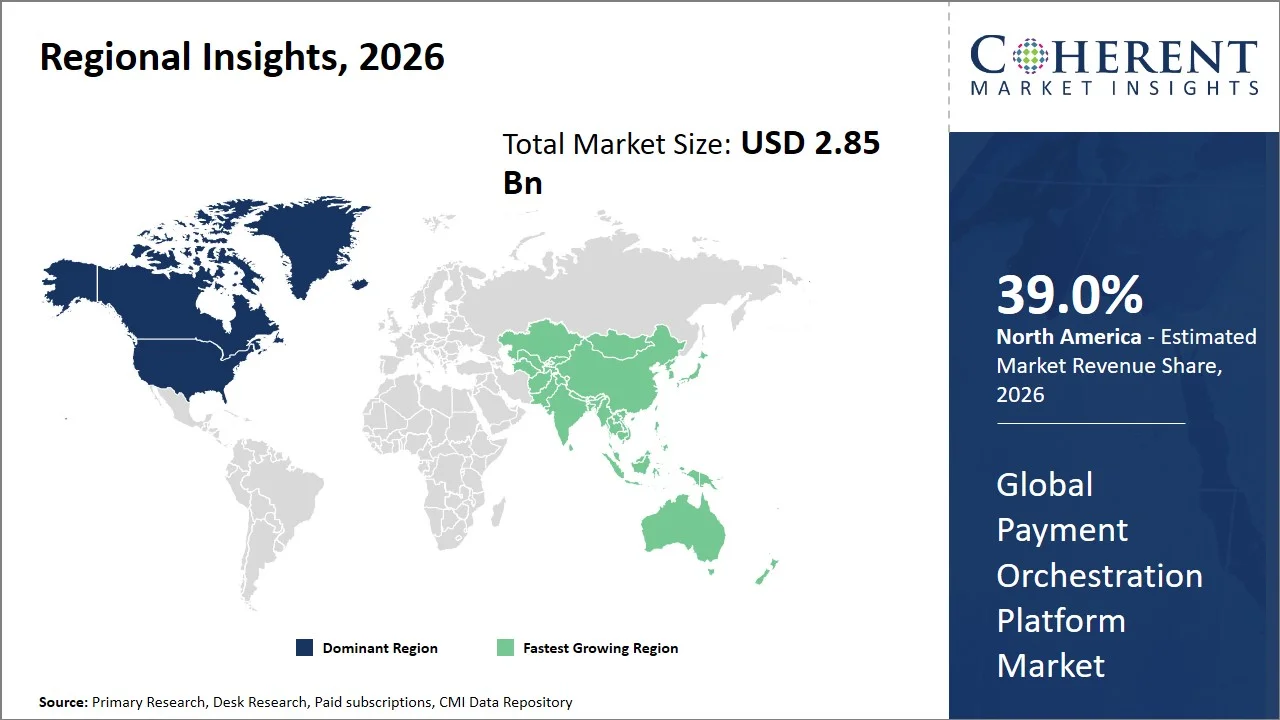
- North America is expected to dominate the payment orchestration platform market in 2026 with a market share of 39.0 %. Integration with real time payment networks in North America is driving the growth of the regional market. On June 26, 2025, The Clearing House increased the RTP network transaction limit from USD 1 million to USD 10 million, enabling financial institutions and payment providers to support high-value real-time B2B transactions and accelerating enterprise adoption of instant payment infrastructure.
- Asia Pacific is expected to account for 27.0 % share in 2026 and is projected to record the fastest growth over the forecast period. Increasing demand from omnichannel retail environments across Asia Pacific is driving the growth of the regional market. On January 28, 2026, HitPay debuted Borderless QR, providing merchants in Singapore with a single integration to take QR payments from GrabPay, WeChat Pay, PromptPay, GCash and DuitNow.
- AI Driven Intelligent Payment Routing and Authorization Optimization: Payment orchestration platforms are increasingly leveraging artificial intelligence to dynamically route transactions to the most suitable payment service provider based on issuer performance, transaction value, geography, currency, and historical approval rates. This enhances authorization success, lowers processing costs, and minimizes failed transactions for global merchants.
- Expansion of Alternative Payment Methods and Real Time Payment Integration: Platforms are quickly adding support for digital payments and wallets, account-to-account payments, Buy Now Pay Later solutions, local payment methods and instant payment networks. Merchants can use orchestration platforms to offer localized payment experiences, while managing all payment methods from a single interface.
Segmental Insights
Why Does Platform Dominate the Global Payment Orchestration Platform Market?
The platform segment is expected to account for 57.0% of the global payment orchestration platform market share in 2026. The platform category is dominating the worldwide payment orchestration platform market owing to the fact that it offers centralized payment administration across a number of payment gateways, acquirers and alternative payment methods with a single integration. This allows companies to optimize transaction routing, enhance payment authorization rates, simplify compliance monitoring and quickly onboard new payment providers without significant development efforts. Payment orchestration platforms offer scalability, operational efficiency, and flexibility, making them the backbone of managing complex digital payment ecosystems as organizations expand worldwide and meet varied client payment preferences. On January 12, 2026, Checkout.com announced it has received approval for its Merchant Acquirer Limited Purpose Bank (MALPB) charter from the Georgia Department of Banking and Finance. This critical regulatory milestone puts Checkout.com in the position to move forward to operate a MALPB in the US, marking the transition to operational execution.
- Current Industry Events of 2026
- Market Size Estimation
- Regional Breakdown
- Competitive Landscape
- Customer Intelligence
- Segmental Analysis
- Pricing Analysis
- Key Market Drivers, Challenges & Future Trends
- Customized Insights Section
Why is Cloud the Most Preferred Deployment?
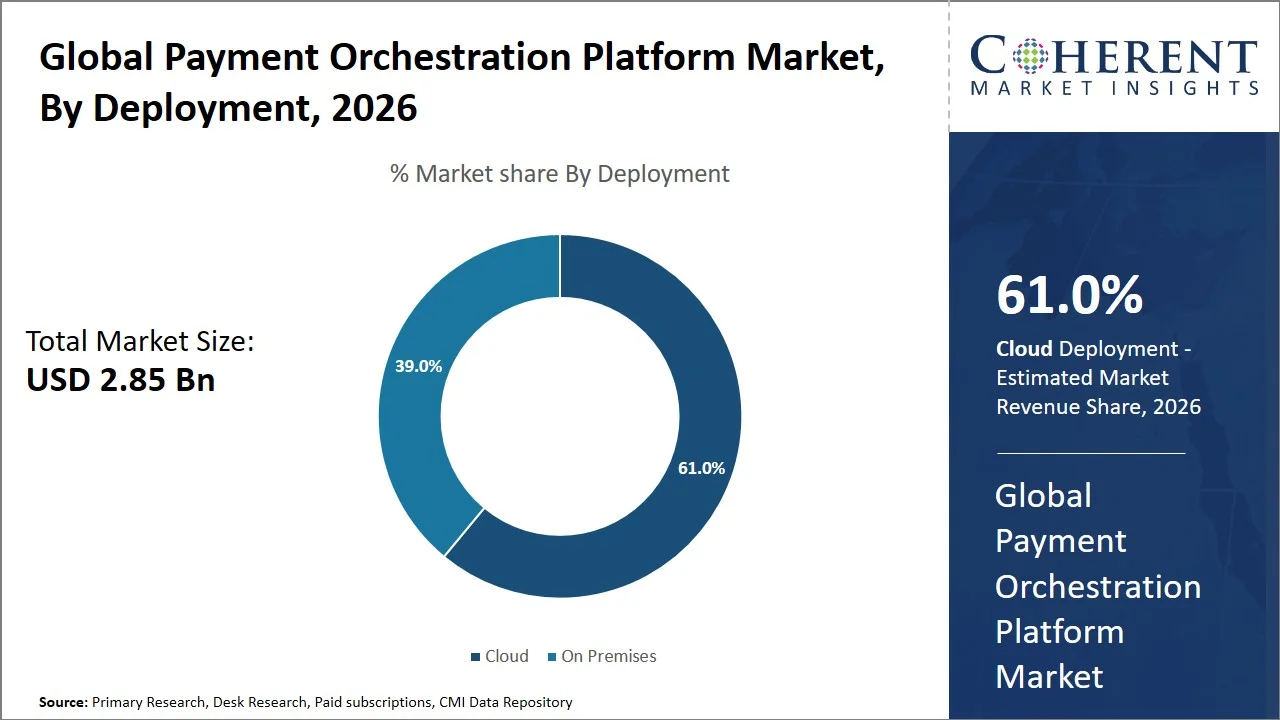
The cloud segment is expected to account for 61.0% of the global payment orchestration platform market share in 2026. Cloud deployment is the ideal deployment strategy as it allows for quick scaling and easy integration with numerous payment gateways, acquirers, fraud management systems and other payment methods without the need for a large on premises infrastructure. Cloud based payment orchestration platforms also allow for continuous software updates, high availability and faster deployment of new payment capabilities, enabling businesses to respond quickly to changing consumer preferences, regulatory requirements and global expansion initiatives, while reducing operational complexity and infrastructure costs. On April 1, 2026, Spreedly announced its Spring Release 2026, featuring Checkout Phase 2. The cloud-based architecture includes support for more than 120 payment gateways and international and local payment methods, enabling merchants to quickly expand their payment capabilities without significant redevelopment.
E-Commerce Dominates the Global Payment Orchestration Platform Market
The e-commerce segment is expected to account for 26.0% of the global payment orchestration platform market share in 2026. The e-commerce application segment is expected to lead the global payment orchestration platform market during the forecast period owing to the increasing need for online merchants to seamlessly manage multiple payment gateways, local payment methods, currencies, and fraud prevention tools to maximize transaction success across the global markets. Payment orchestration platforms are an essential component of today’s digital commerce operations that allow e-commerce merchants to improve payment authorization rates, lower cart abandonment caused by payment failures, and deliver a frictionless checkout experience across websites and mobile applications. On June 18, 2026, Microsoft selected Checkout.com to power digital payments for flagship goods in the EMEA area. This means Checkout.com will power card acceptance for a number of Microsoft business lines including Xbox, Microsoft 365 and Microsoft Azure.
Current Events and their Impact
Current Events | Description and its Impact |
European Union – Payment Services Regulation (PSR) and Payment Services Directive 3 (PSD3) Package |
|
United Kingdom - National Payments Vision (2024) |
|
Global Payment Orchestration Platform Market Dynamics
Market Drivers
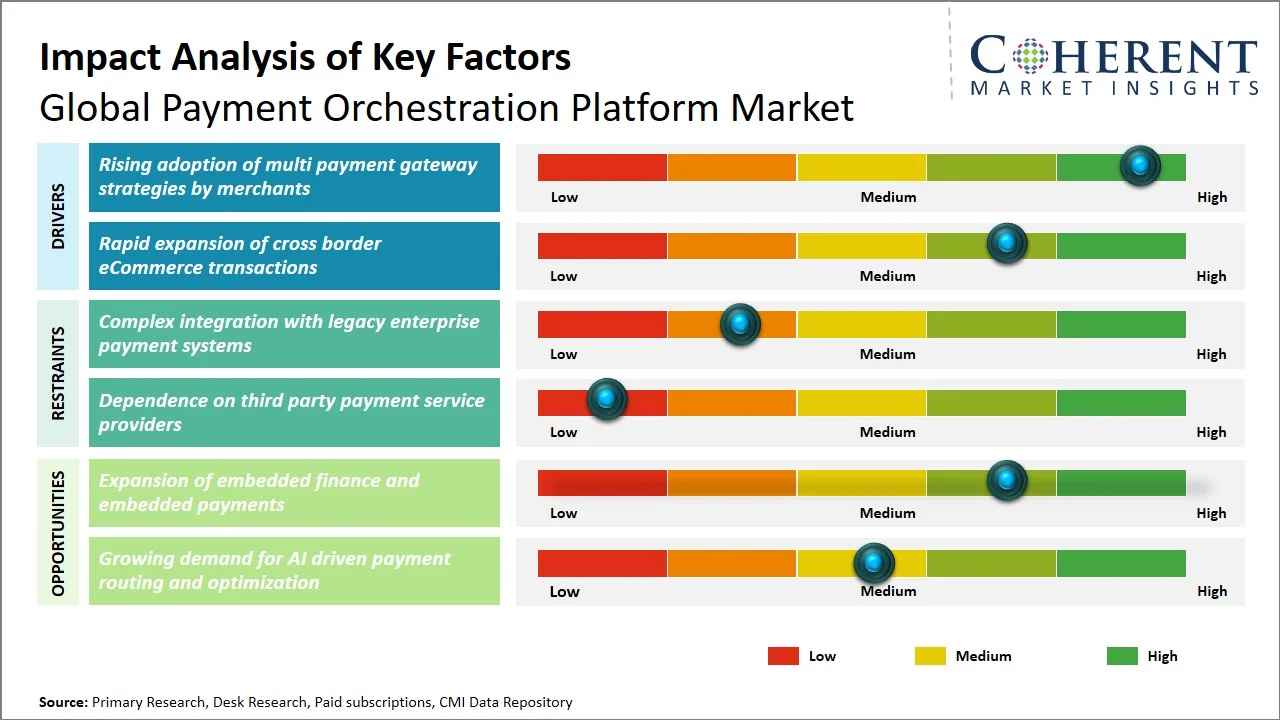
- Rising adoption of multi payment gateway strategies by merchants: Merchants are increasingly using multi payment gateway strategies to enhance payment resilience, boost transaction approval rates and minimize reliance on a single payment provider. Payment orchestration technologies enable businesses to route transactions intelligently based on gateway performance, issuer response, transaction fees, geography and payment method availability through a single interface. This decreases payment failures, downtime during gateway outages, and helps merchants to onboard new payment providers quickly. Payment orchestration is a critical component of modern digital commerce infrastructure. On July 4, 2025, Checkout.com opened in Canada, expanding its footprint across North America. This strategic move highlights Checkout.com’s dedication to the market, which was the company’s fastest growing region worldwide in 2024.
- Rapid expansion of cross border eCommerce transactions: The rapid growth of cross border eCommerce is driving demand for payment orchestration platforms that can support multiple currencies, regional payment methods, local acquiring partners and country specific compliance requirements from a single platform. As businesses grow globally, they need seamless payment experiences that allow for customized checkout options while optimizing authorization rates across multiple markets. Payment orchestration platforms bring together a variety of payment providers, provide smart routing and help merchants extend their global operations more efficiently and improve customer conversion rates. This simplifies these difficulties. On March 3, 2025, Nium, the leading global infrastructure for real-time cross-border payments, announced a strategic partnership with G2 Travel. The wholesale tour operator will use Nium’s virtual card payment solution to pay hotel partners globally. The partnership adds more local currencies to G2 Travel’s offering and makes supplier payments faster, more efficient, and more secure.
Emerging Trends
- Growing Adoption of Tokenization and Network Token Management: Payment orchestration providers are enhancing token management features by supporting network tokens, card lifecycle management, and secure credential vaults. This increases payment security, improves recurring payment success rates, and helps businesses comply with evolving PCI DSS and regional data protection regulations.
- Unified Cross Border Payment and Multi Acquirer Management: Global enterprises are increasingly leveraging payment orchestration platforms to manage multiple acquirers, payment gateways, currencies and regional compliance requirements through a single platform. This trend is driving higher operational efficiency, better payment resiliency and faster expansion into international markets.
Regional Insights
Why is North America a Strong Market for Payment Orchestration Platforms?
North America is expected to account for a market share of 39.0% in 2026. North America is the largest geographical market, owing to the existence of global payment technology providers such as Stripe, PayPal, Worldpay, BlueSnap and Spreedly, and a very sophisticated digital commerce environment. The number of payment methods continues to grow as big retailers and enterprise merchants implement payment orchestration to handle various acquirers, optimize authorization rates and support digital wallets like Apple Pay, Google Pay and PayPal. “Account-to-account payments through open banking initiatives and RTP networks have been robustly adopted in the region, and merchants are deploying AI-enabled payment routing to minimize transaction failures. Major travel companies, subscription platforms, and SaaS providers headquartered in the U.S. and Canada rely on orchestration platforms to manage global payment acceptance across hundreds of local payment methods and currencies.
Why Does Asia Pacific Payment Orchestration Platform Market Exhibit High Growth?
Asia Pacific is projected to account for 27.0% of the global payment orchestration platform market in 2026 and expected to register the fastest growth. Asia Pacific is experiencing the fastest adoption of payment orchestration due to the diversity of local payment methods and rapid growth of cross-border digital commerce. Merchants operating across markets integrate payment orchestration to support Alipay, WeChat Pay, UPI, PayPay, GrabPay, GCash, Kakao Pay, PromptPay, and other domestic payment systems through a single platform. Countries like Singapore, Japan, Australia, India and Southeast Asian nations are growing their real-time payment infrastructure, driving need for intelligent payment routing and multi-acquirer connection. Global payment providers continue expanding partnerships with regional banks and fintech companies to simplify payment acceptance across fragmented payment ecosystems.
Global Payment Orchestration Platform Market Outlook for Key Countries
Why is the U.S. Emerging as a Major Hub in the Payment Orchestration Platform Market?
The U.S. is the world’s biggest market with one of the most sophisticated payment processing infrastructures in the world. The country hosts some of the largest payment orchestration providers, including Stripe, PayPal, Spreedly, BlueSnap and Gr4vy, with large operations supporting enterprise merchants across retail, travel, SaaS and digital marketplaces. The growth of digital wallets, subscription billing, BNPL and real-time payment networks has increased the need for orchestration platforms to optimize payment authorization and reduce processing costs. More and more large organizations are opting for payment orchestration, combining it with fraud protection platforms, CRM systems, ERP software and cloud commerce platforms to simplify the management of worldwide payments.
Is China the Next Growth Engine for the Payment Orchestration Platform Market?
China’s market is dominated by mobile-first digital payments, with Alipay and WeChat Pay widely used in retail and e-commerce. As international merchants expand into China, they’re turning more and more to payment orchestration platforms to combine local payment methods and keep the ability to centrally handle payments across their worldwide operations. Orchestration solutions are used by cross-border e-commerce exporters supporting numerous international gateways, currencies and acquiring partners. The rising cross-border payment connection and the continuous growth of digital yuan pilot programs are prompting payment technology providers to enhance localized payment capabilities for Chinese merchants and international businesses.
Germany Payment Orchestration Platform Market Analysis and Trends
Germany is a prominent European market with a strong enterprise software ecosystem, substantial e-commerce penetration and rigorous regulatory environment under PSD2 and the emerging PSD3 framework. Merchants are increasingly turning to payment orchestration to handle SEPA payments, PayPal, Klarna, Sofort, Giropay alternatives and international card networks via a single infrastructure. European markets are seeing investment in centralized payment management from leading automobile makers, industrial enterprises, airlines and digital merchants seeking to optimize authorization performance. Enterprise adoption of sophisticated payment orchestration platforms has been spurred by strong demand for PCI DSS compliance, tokenization and secure payment authentication.
U.K. Payment Orchestration Platform Market Analysis and Trends
The U.K. has become one of the most important payment orchestration markets in Europe thanks to London’s concentration of fintech startups and global payment technology providers like Checkout.com, Primer, APEXX Global and BR-DGE. Open Banking Limited has made account-to-account payments mainstream, and merchants are now combining numerous payment methods with traditional card processing. “Large online retailers, travel companies and digital subscription businesses use payment orchestration to improve payment resiliency, optimize gateway selection and simplify expansion into European and international markets. Continued innovation in real-time payments and embedded finance is further increasing demand for orchestration systems.
India Payment Orchestration Platform Market Analysis and Trends
India is becoming a strategically important payment orchestration market because of the rapid expansion of UPI, digital commerce, and merchant digitization. Payment orchestration providers increasingly integrate UPI, RuPay, credit cards, debit cards, net banking, and digital wallets within a single platform while supporting multiple acquiring banks for higher transaction success rates. Large payment service providers and fintech businesses are investing in intelligent routing, tokenization, recurring payment management and RBI-compliant payment infrastructure. The proliferation of online marketplaces, food delivery apps, trip booking portals, and subscription-based businesses is boosting the demand for scalable payment orchestration solutions to effectively manage the complex digital payment landscape in India.
Global Payment Orchestration Platform Market - Multi-Payment Gateway Adoption Rate by Industry
Industry | Estimated Multi-Payment Gateway Adoption Rate (2025) |
E-commerce & Marketplaces | 91% |
Travel & Hospitality | 87% |
SaaS & Subscription Services | 84% |
Digital Goods & Gaming | 81% |
Retail & Omnichannel Commerce | 78% |
Financial Services & FinTech | 75% |
Food Delivery & Quick Commerce | 73% |
Healthcare | 66% |
Media & Entertainment | 64% |
Education & EdTech | 59% |
How is the Expansion of Embedded Finance and Embedded Payments Creating New Growth Opportunities in the Payment Orchestration Platform Market?
The rapid growth of embedded finance and embedded payments is creating big opportunities for growth for payment orchestration platforms, enabling software vendors, marketplaces, mobility providers, healthcare platforms, travel booking portals and B2B procurement platforms to embed native payment capabilities directly into their applications, without the need for standalone payment experiences. Payment orchestration platforms allow these businesses to connect to multiple payment service providers, local acquiring banks, digital wallets, BNPL providers, and real-time payment networks via a single API, automatically routing transactions based on geography, issuer performance, payment method availability, and processing costs.
SaaS platforms with invoicing and payment collections, ride-hailing applications with instant driver payouts, B2B marketplaces with split payments between multiple vendors, and travel platforms with multi-currency settlements all require orchestration capabilities to deliver seamless embedded payment experiences. Embedded finance ecosystems are expanding across retail, logistics, healthcare, insurance and enterprise software and payment orchestration providers are discovering new revenue streams, including transaction routing, token management, recurring billing, payout orchestration and cross-border payment optimization.
On January 21, 2025, Highnote stated that it raised USD 90 million in Series B fundraising and simultaneously launched into merchant acquisition enabling organizations and digital platforms to embed both payment acceptance and card issuing through a single financial infrastructure.
Market Players, Key Development, and Competitive Landscape
Key Developments
- On February 4, 2025, Stripe, a financial infrastructure platform for businesses, announced that it has completed its acquisition of Bridge, strengthening its stablecoin payment infrastructure and expanding cross-border payment capabilities for enterprise merchants using its payment orchestration ecosystem.
- On September 25, 2024, Checkout.com, a leading digital payments company, announced several new product innovations at its global enterprise customer event, Thrive, held in Barcelona, Spain. The company offers a suite of modular payment solutions that help businesses reduce the complexity and cost of payment processing while increasing performance and revenues.
Competitive Landscape
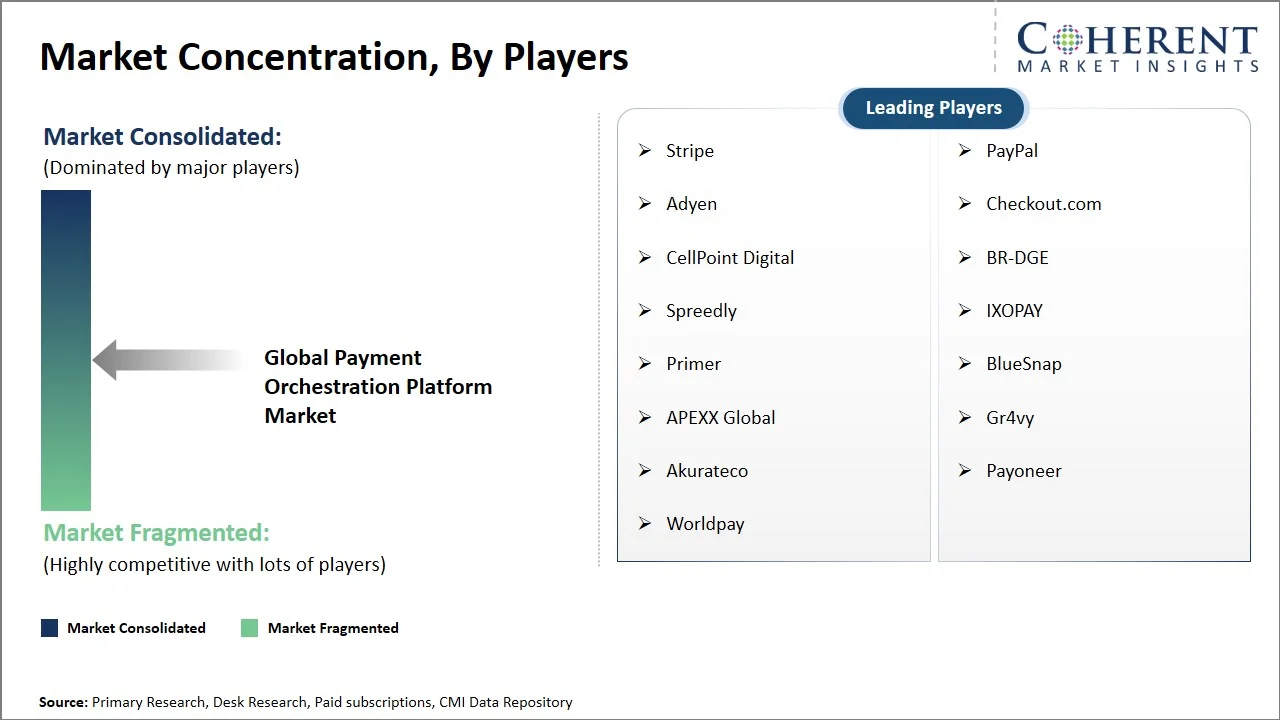
The worldwide payment orchestration platform market is competitive with the presence of specialist orchestration providers and global payment technology businesses concentrating on intelligent routing, multi-acquirer connection, integrated payments, and AI-driven payment optimization. Stripe is also improving its orchestration capabilities with its Optimized Checkout Suite and adaptive payment routing and Adyen is using its one global payments platform to offer unified acquiring, tokenization and risk management for multinational merchants.
Checkout.com has expanded its intelligent payment routing and local acquiring coverage across Europe, the Middle East and Asia to increase authorisation rates for commercial customers. The differentiating factor of Primer is its no-code payment architecture which allows merchants to quickly connect with many payment providers. Spreedly provides universal payment connectivity and network tokenization across hundreds of payment gateways and payment services. IXOPAY, CellPoint Digital, BR-DGE, APEXX Global and Gr4vy continue to invest in cloud-native orchestration, real-time analytics, fraud optimization and embedded financial capabilities with a strong focus on supporting airlines, travel businesses, SaaS platforms, marketplaces and global merchants.
Market Report Scope
Payment Orchestration Platform Market Report Coverage
| Report Coverage | Details | ||
|---|---|---|---|
| Base Year: | 2025 | Market Size in 2026: | USD 2.85 Bn |
| Historical Data for: | 2020 To 2024 | Forecast Period: | 2026 To 2033 |
| Forecast Period 2026 to 2033 CAGR: | 12% | 2033 Value Projection: | USD 10.30 Bn |
| Geographies covered: |
| ||
| Segments covered: |
| ||
| Companies covered: | Stripe, PayPal, Adyen, Checkout.com, CellPoint Digital, BR-DGE, Spreedly, IXOPAY, Primer, BlueSnap, APEXX Global, Gr4vy, Akurateco, Payoneer, Worldpay | ||
| Growth Drivers: |
| ||
| Restraints & Challenges: |
| ||
Analyst Opinion (Expert Opinion)
- The future of the industry is expected to be driven by AI-powered payment decision engines that automatically select the optimal gateway, acquirer, and payment method based on real-time issuer behavior, fraud risk, processing costs, and regional payment preferences. Payment orchestration platforms are likely to evolve into comprehensive payment infrastructure layers integrating fraud prevention, token management, embedded finance, recurring billing, and real-time payment networks rather than functioning solely as gateway management solutions.
- The greatest opportunities are expected to emerge in cloud-based payment orchestration platforms serving e-commerce and SaaS applications in the United States and India, where merchants increasingly require multi-acquirer connectivity, UPI and real-time payment integration, subscription billing, and embedded payment capabilities. Additional high-growth potential is anticipated in Southeast Asia and the Middle East as enterprises expand cross-border commerce and adopt localized payment methods through unified orchestration platforms.
- Market participants are expected to gain a competitive advantage by expanding local acquiring partnerships, strengthening AI-driven payment routing, and supporting a broader portfolio of regional payment methods through a single API. Investments in network tokenization, embedded finance infrastructure, account-to-account payment capabilities, and advanced payment analytics, together with compliance support for evolving regulations such as PSD3 and regional real-time payment frameworks, are likely to differentiate providers competing for large enterprise and multinational merchant contracts.
Speak to the analyst
Want personalized insights?
Take the findings above to one of our principal consultants, or have the report rebuilt around the segments, geographies and competitors you actually track.
Market Segmentation
- Component Insights (Revenue, USD Billion, 2021 - 2033)
- Platform
- Services
- Deployment Type Insights (Revenue, USD Billion, 2021 - 2033)
- Cloud
- On-Premise
- Application Insights (Revenue, USD Billion, 2021 - 2033)
- E-Commerce
- Travel and Hospitality
- Retail
- BFSI
- Healthcare
- Media and Entertainment
- SaaS and Subscription Businesses
- Regional Insights (Revenue, USD Billion, 2021 - 2033)
- North America
- U.S.
- Canada
- Latin America
- Brazil
- Argentina
- Mexico
- Rest of Latin America
- Europe
- Germany
- U.K.
- Spain
- France
- Italy
- Russia
- Rest of Europe
- Asia Pacific
- China
- India
- Japan
- Australia
- South Korea
- ASEAN
- Rest of Asia Pacific
- Middle East
- GCC Countries
- Israel
- Rest of Middle East
- Africa
- South Africa
- North Africa
- Central Africa
- North America
- Key Players Insights
- Stripe
- PayPal
- Adyen
- Checkout.com
- CellPoint Digital
- BR-DGE
- Spreedly
- IXOPAY
- Primer
- BlueSnap
- APEXX Global
- Gr4vy
- Akurateco
- Payoneer
- Worldpay
Sources
Primary Research Interviews
- Directors of Payments at global e-commerce companies
- Heads of Digital Payments at retail enterprises
- Payment Operations Managers at multinational merchants
- Chief Information Officers of fintech companies
Magazines
- Electronic Payments International
- Banking Technology Magazine
- Global Banking & Finance Review
Journals
- International Journal of Bank Marketing
- Journal of Financial Services Research
- Electronic Commerce Research
- Electronic Commerce Research and Applications
Associations
- Payments Orchestration Association
- Electronic Transactions Association (ETA)
- Merchant Risk Council (MRC)
- European Payments Council (EPC)
Public Domain Sources
- European Central Bank (ECB)
- Consumer Financial Protection Bureau (CFPB)
- European Banking Authority (EBA)
- U.S. Federal Trade Commission (FTC)
- World Bank
Proprietary Elements
- CMI Data Analytics Tool
- Proprietary CMI Existing Repository of Information for the Last 10 Years
Get access to 250+ pages report
Every segment, forecast, competitor profile and data table behind the analysis above — available for instant download.
- ESOMAR Member
- ISO 9001:2015 Certified
- D-U-N-S Registered
- GDPR & CCPA Compliant
Missing comfort of reading report in your local language? Find your preferred language:
Transform your Strategy with Exclusive Trending Reports
Frequently Asked Questions
The global payment orchestration platform market is expected to stand at USD 2.85 Bn in 2026 and is expected to reach USD 10.30 Bn by 2033.
The CAGR of the global payment orchestration platform market is projected to be 12% from 2026 to 2033.
Rising adoption of multi payment gateway strategies by merchants and rapid expansion of cross border eCommerce transactions are the major factors driving the growth of the global payment orchestration platform market.
Complex integration with legacy enterprise payment systems and dependence on third party payment service providers are the major factors hampering the growth of the global Payment Orchestration Platform market.
In terms of component, the platform segment is estimated to dominate the market revenue share in 2026.
Tokenization enhances payment security by replacing sensitive card data with secure digital tokens.
Yes, they are specifically designed to manage multiple gateways and acquirers from a single platform.