

3D Audio Market Size and Share Analysis - Growth Trends and Forecast (2026 - 2033)
The global 3D audio market is estimated to be valued at USD 14,812 Mn in 2026 and is expected to grow at a CAGR of 16.0% during the forecast period (2026-2033), reaching USD 41,890 Mn by 2033. This growth can be attributed to increasing adoption of immersive audio technologies across gaming, virtual reality (VR), augmented reality (AR), entertainment, automotive, and consumer electronics industries.
Key Takeaways from the 3D Audio Market Report
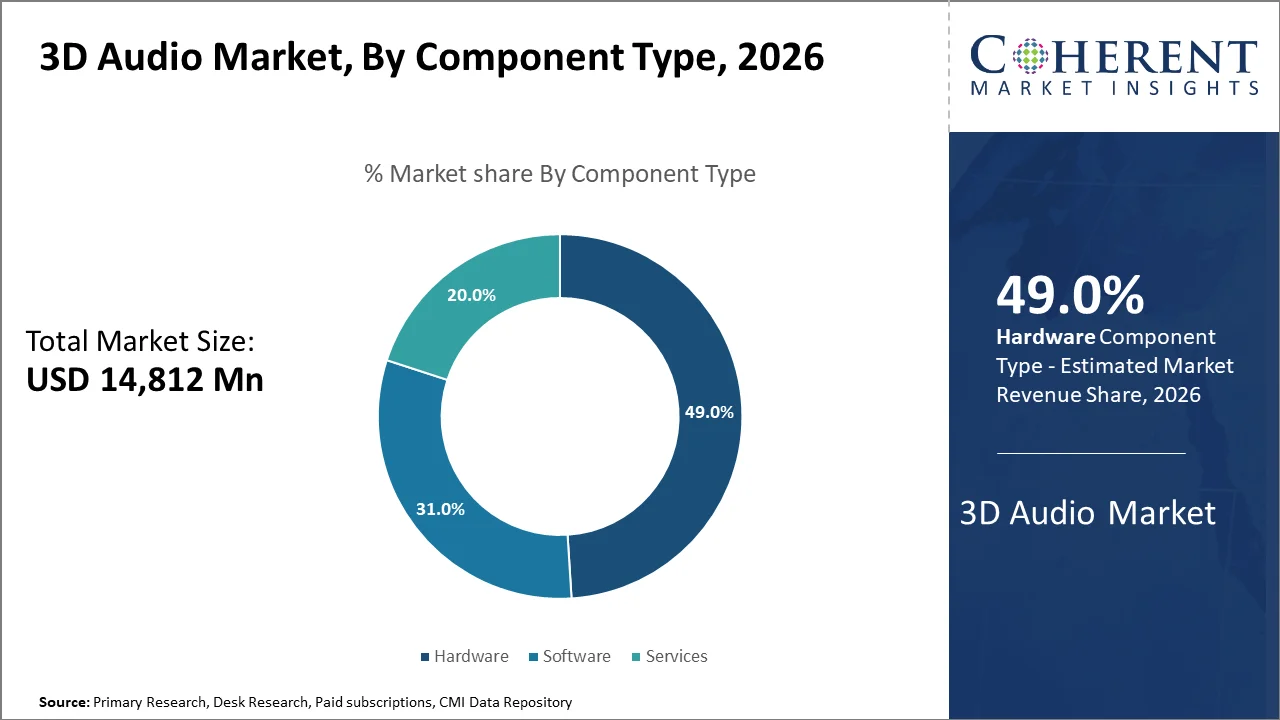
- Hardware segment is projected to lead the market with a share of 49% in 2026 due to rising demand for spatial audio-enabled headphones, soundbars, speakers, gaming headsets, and automotive audio systems. For example, Apple stated that more than half of its worldwide Apple Music subscriber base was listening to Spatial Audio, showing rising consumer adoption of immersive audio experiences.
- Personal/in-house segment is set to account for the largest market share of 64% in 2026 due to rapid consumer adoption of spatial audio-enabled earbuds, streaming platforms, gaming ecosystems, and smart entertainment systems. For instance, Spotify reported that more than 675 Mn people used its platform monthly in 2025, highlighting the massive scale of at-home audio consumption and the growing demand for immersive listening technologies and premium spatial audio-enabled consumer devices.
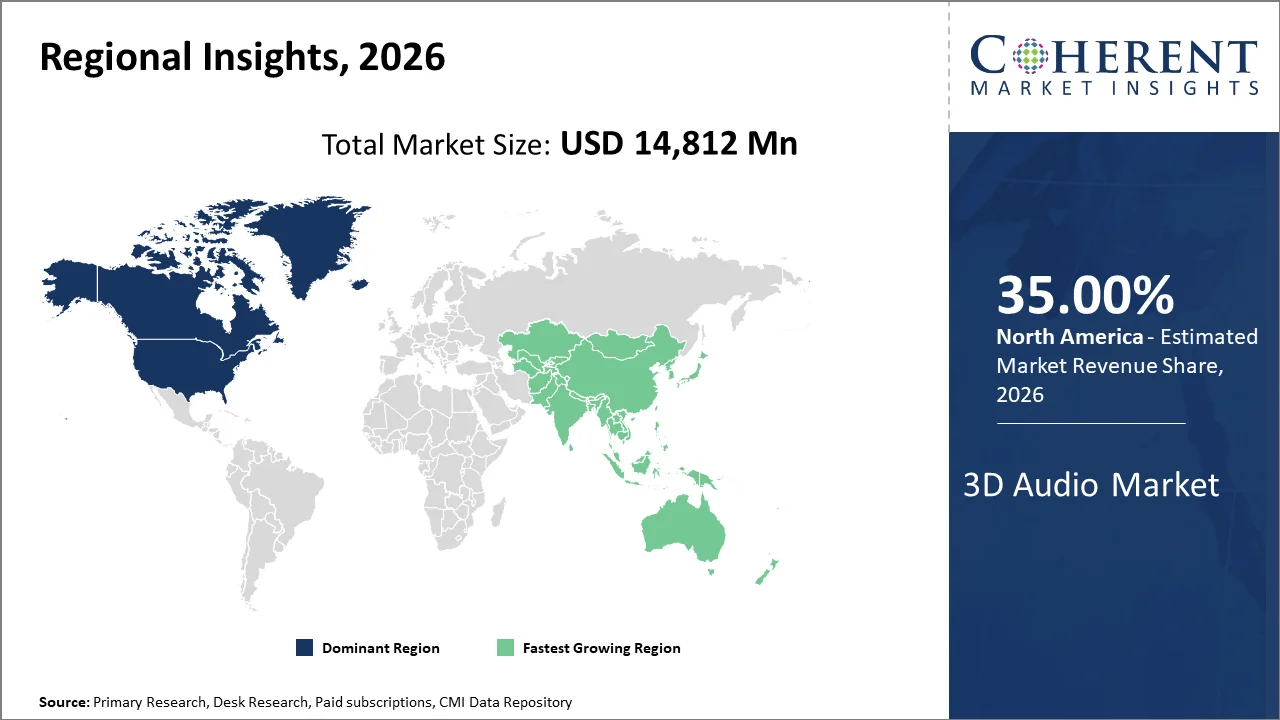
- North America is expected to dominate the global 3D audio industry with a share of 35% in 2026, owing to rising demand for premium audio devices, rapid expansion of gaming and entertainment ecosystem, and growing adoption of immersive audio technologies. For instance, the
- Asia Pacific 3D audio market is poised to exhibit the fastest CAGR of 18.5% during the forecast period, thanks to rising gaming population, strong electronics manufacturing base, expanding VR/AR adoption, increasing premium smartphone penetration. For instance, Niko Partners reported that Asia accounted for more than 1.5 billion gamers in 2024, supporting rising demand for immersive gaming audio technologies and spatial audio-enabled consumer devices across the region.
3D Audio Market Overview
The global 3D audio market is projected to register strong growth during the assessment period. This is mostly due to rising demand for immersive entertainment experiences, increasing adoption of spatial audio in gaming and virtual reality applications, and growing integration of advanced audio technologies in consumer electronics, automobiles, and streaming platforms.
The application of 3D audio in games, movies, virtual reality (VR), and other forms of interaction is quite common due to its capability to deliver a more immersive sound experience to the audience. The idea behind the 3D audio is to deliver an experience closer to natural sound, which helps people identify sounds that are at various distances and directions from the source. In comparison with the traditional surround sound system, 3D audio provides a more immersive experience.
The global 3D audio market is expected to grow rapidly during the forecast period, thanks to continuous advancements in audio technologies across industries such as gaming, cinema, virtual reality, and live virtual events. 3D audio manufacturers are increasingly focusing on product innovations, including motion tracking integration and spatial audio modules, to enhance sound quality and improve user immersion.
Hardware innovation is set to boost growth of the 3D audio industry during the forthcoming period by enabling more widespread adoption of spatial audio technologies. Many headphones, earbuds, smartphones, smart TVs, and soundbars now support spatial audio features like Dolby Atmos. As the technology becomes cheaper and better, it is moving beyond high-end devices and reaching more everyday users.
Expansion into automotive and smart environments is opening new revenue streams for the 3D audio market. Automotive infotainment systems increasingly use spatial audio for navigation alerts, voice assistance, and in-car entertainment. Similarly, some smart home and premium audio devices are beginning to incorporate more immersive and directional sound experiences. Advances in AI and audio processing technologies are also supporting market growth. AI is improving how 3D audio is created, processed, and delivered by enabling more efficient spatialization and reducing manual production effort in certain workflows.
Segmental Insights
Which Component Type Leads the 3D Audio Market?
Hardware Segment to Account for the Largest Market Share
According to Coherent Market Insights’ latest 3D audio market analysis, hardware segment is set to lead the market, accounting for a share of 49% in 2026. This dominance is mostly due to rising demand for advanced audio devices such as headphones, soundbars, speakers, and home theater systems. Similarly, growing adoption of immersive audio technologies in gaming, entertainment, and consumer electronics applications is boosting growth of the target segment.
For instance, Since the PS5 supports Tempest 3D AudioTech for immersive gaming experiences, the expanding installed base of next-generation gaming consoles is driving demand for spatial audio-enabled gaming headsets and home entertainment systems.
Consumers across the world are increasingly adopting 3D audio systems to enhance their entertainment experiences with realistic and immersive sound quality. Rising spending on premium audio equipment, along with rapid expansion of VR/AR and gaming industries, is also supporting hardware segment growth.
- Current Industry Events of 2026
- Market Size Estimation
- Regional Breakdown
- Competitive Landscape
- Customer Intelligence
- Segmental Analysis
- Pricing Analysis
- Key Market Drivers, Challenges & Future Trends
- Customized Insights Section
Which End-Use Segment Accounts for the Largest 3D Audio Market Share?
Personal/In-house Segment to Hold Largest Revenue Share in 2026
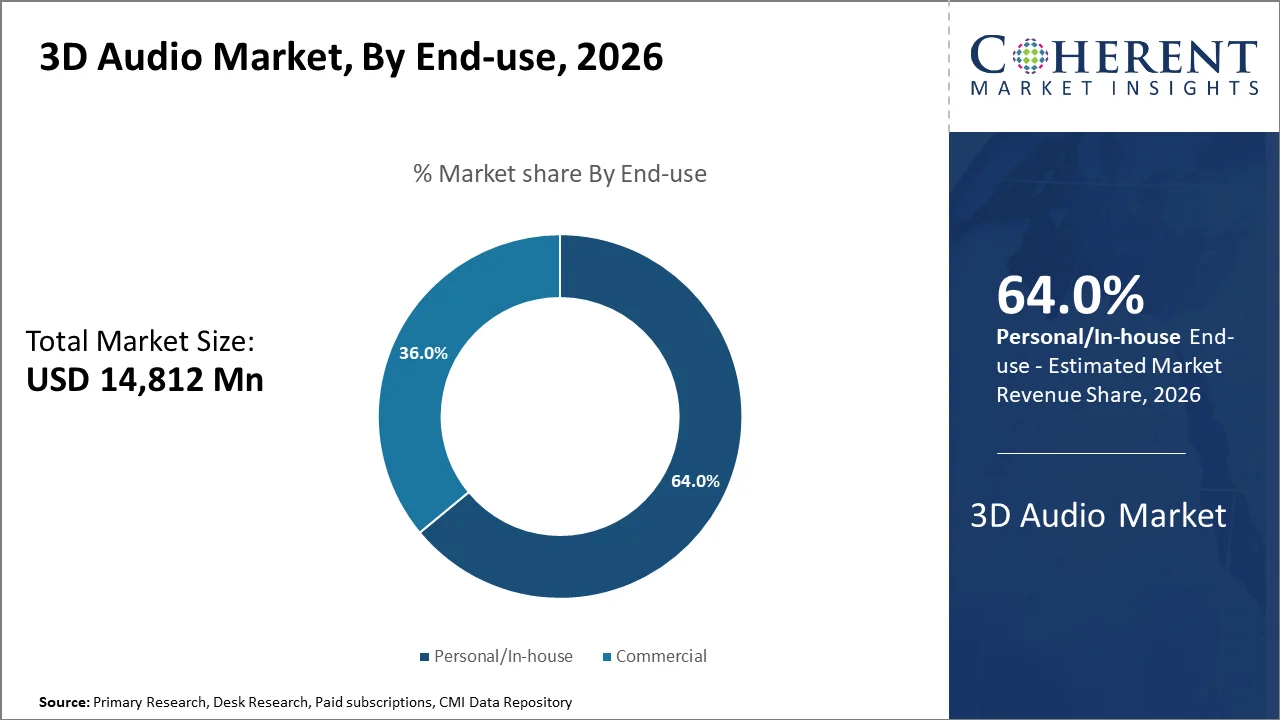
By end use, personal/in-house segment is expected to account for a 64% share of the 3D audio market in 2026. This can be attributed to rising consumer demand for immersive audio experiences across gaming, music streaming, movies, and virtual reality applications. Increasing adoption of advanced audio-enabled devices such as smartphones, headphones, earbuds, home theater systems, and gaming consoles is also supporting segment growth. In addition, growing popularity of spatial audio technologies among individual consumers and rising spending on premium entertainment systems are expected to boost the target segment during the forecast period.
3D Audio Market Growth Drivers
Rising Demand for Immersive Entertainment Experiences
Increasing consumer preference for realistic and immersive audio-visual experiences is driving growth of the 3D audio market. Gaming, movies, and streaming platforms are increasingly adopting spatial audio to enhance realism. For instance, 3D audio improves positional sound accuracy, such as footsteps and the direction of gunfire in games. Similarly, OTT platforms and music streaming services are integrating formats like Dolby Atmos and other spatial audio technologies to enhance the listening experience.
3D Audio Market Opportunities
Expansion of Gaming, Esports, and Interactive Media
Gaming is becoming a strong growth engine for the 3D audio industry. Competitive gamers benefit significantly from positional audio cues, such as footsteps and directional sound, which enhance gameplay awareness and performance. As a result, game developers are increasingly adopting spatial and object-based audio technologies to improve immersion. Growth of esports, cloud gaming, and cross-platform game engines is also supporting the integration of advanced audio solutions. Thus, expansion of gaming and esports industries is expected to create lucrative growth opportunities for the 3D audio market during the forecast period.
3D Audio Market Trends
Rapid Growth of AR/VR and XR Ecosystems
Rising adoption of virtual reality (VR), augmented reality (AR), and extended reality (XR) technologies is a key growth-shaping trend in the 3D audio market. As immersive platforms evolve, spatial audio has become essential for delivering realistic and interactive environments where sound dynamically adapts to user movement as well as positioning. This capability is increasingly important in gaming, training simulations, and immersive media experiences.
In enterprise applications such as defense, healthcare, aviation, and education, 3D audio enhances situational awareness and improves realism in virtual environments. As XR device adoption continues to rise, spatial audio is increasingly recognized as a core component of immersive system architecture rather than an optional enhancement, accelerating its integration across both consumer and enterprise ecosystems.
Current Events and Their Impact on the 3D Audio Market
Current Event | Description and its Impact |
Expansion of Dolby Atmos Across Streaming Platforms |
|
Sony Expands Spatial Audio Hardware Portfolio in 2026 |
|
Regional Insights
North America Remains at the Epicenter of 3D Audio Market Growth
North America is expected to lead the global 3D audio market, accounting for an estimated 35% share in 2026. This can be attributed to rising adoption of premium audio technologies, high penetration of streaming platforms, and rapid growth in gaming and OTT entertainment. Increasing use of spatial audio in music, movies, and gaming ecosystems, especially through devices such as headphones, smart speakers, and home theater systems, is also boosting North America 3D audio market.
In addition, the integration of spatial audio technologies such as Dolby Atmos into streaming services and consumer devices enhances immersive listening experiences. This improves user engagement and further supports market expansion in the region.
Rising Mobile Adoption and Gaming Expansion Boosting Growth in Asia Pacific
Asia Pacific is expected to emerge as the fastest growing market for 3D audio technology, exhibiting a CAGR of 18.5% during the forecast period. This is mostly due to rising smartphone penetration, expanding gaming communities, increasing demand for affordable immersive entertainment solutions, and continuous advancements in 3D audio technology. The smartphone market in the United States was one of the largest in the world, with smartphone sales forecast to reach over 105 billion U.S. dollars in 2025.
Rising popularity of immersive music and gaming experiences delivered through spatial audio platforms like Sony’s 360 Reality Audio, which provides object-based sound for a more realistic listening experience Sony 360 Reality Audio, is boosting market growth in the region. In addition, Apple’s Spatial Audio feature has significantly increased consumer awareness of 3D sound through AirPods and Apple Music integration, helping drive mainstream adoption of spatial audio in personal devices.
3D Audio Market Outlook – Country-wise
U.S. 3D Audio Market Trends
The U.S. is expected to remain a leading market for 3D audio solutions during the forecast period. This is due to rising demand for immersive entertainment, high streaming adoption, and advanced gaming ecosystems. Increasing use of spatial audio in platforms such as music streaming, OTT video, and gaming, along with increasing integration in headphones, smart speakers, and automotive infotainment systems, is also supporting market expansion in the nation. OTT video streaming was widely adopted in the United States, with over 80% of Americans using streaming services for television viewing. U.S. households typically subscribed to multiple platforms, and the country's OTT market generated more than $150 billion in revenue.
China 3D Audio Market Forecast
China is emerging as a highly lucrative pocket for 3D audio solution providers, supported by rapid smartphone penetration, a massive gaming user base, and strong expansion of digital entertainment platforms. Rising demand for immersive audio in mobile gaming, short video platforms, and music streaming services, along with increasing investment in smart device ecosystems, is also fueling market growth in China.
Who are the Key Players in the 3D Audio Market?
Some of the major players in 3D Audio Market are 3D Sound Labs, Auro Technologies Inc., Comhear Inc., Core Sound LLC (TeraMic), DearVR, Dolby Labs, DTS Inc. (Xperi Corporation), Dysonics, Fraunhofer, Hooke Audio, ISONO Sound, OSSIC, Sennheiser Electronic GmbH & Co., VisiSonics Corporation (Realspace 3D), and Waves Audio Ltd.
Key Strategies Adopted by Industry Players
Leading 3D audio companies are adopting various organic and inorganic strategies to expand their customer base as well as boost their sales. These include new product launches, mergers, partnerships, acquisitions, distribution agreements, and facility expansions. Companies are also concentrating on using cutting-edge technologies like artificial intelligence (AI), spatial computing, and immersive sound processing in order to develop a competitive edge.
- In January 2025, Samsung Electronics and Google introduced Eclipsa Audio at CES 2025 in Las Vegas. Eclipsa Audio is a new 3D audio technology designed to create a more immersive sound experience.
- In January 2024, NEWAURO and Eastech Group showcased AURO-Scene virtual immersive audio technology at CES 2024 in Las Vegas. AURO-Scene is designed to deliver immersive and spatial audio experiences using virtual sound technology.
Market Report Scope
3D Audio Market Report Coverage
| Report Coverage | Details | ||
|---|---|---|---|
| Base Year: | 2025 | Market Size in 2026: | USD 14,812 Mn |
| Historical Data for: | 2020 To 2024 | Forecast Period: | 2026 To 2033 |
| Forecast Period 2026 to 2033 CAGR: | 16.0% | 2033 Value Projection: | USD 41,890 Mn |
| Geographies covered: |
| ||
| Segments covered: |
| ||
| Companies covered: | 3D Sound Labs, Auro Technologies Inc., Comhear Inc., Core Sound LLC (TeraMic), DearVR, Dolby Labs, DTS Inc. (Xperi Corporation), Dysonics, Fraunhofer, Hooke Audio, ISONO Sound, OSSIC, Sennheiser Electronic GmbH & Co., VisiSonics Corporation (Realspace 3D), and Waves Audio Ltd. | ||
| Growth Drivers: |
| ||
| Restraints & Challenges: |
| ||
Analyst Opinion (Expert Opinion)
- Gaming and VR are the strongest drivers of 3D audio market growth, because spatial sound helps players detect direction, distance, and movement in immersive environments.
- Streaming platforms and mobile ecosystems are expanding usage, as services like Apple Music, Netflix, and YouTube increasingly support spatial or surround-style audio formats.
- Advances in hardware are driving faster adoption, as headphones, earbuds, soundbars, and car infotainment systems now include spatial audio technologies such as Dolby Atmos and binaural sound rendering.
Speak to the analyst
Want personalized insights?
Take the findings above to one of our principal consultants, or have the report rebuilt around the segments, geographies and competitors you actually track.
Market Segmentation
- By Component Type Insights (Revenue, USD Mn, 2021 - 2033)
- Hardware
- Loudspeakers
- Headphones
- Microphones/Mic
- Sound Bars
- Others
- Software
- Services
- Hardware
- By End-use Insights (Revenue, USD Mn, 2021 - 2033)
- Personal/In-house
- Mobile Devices
- Home Theater
- Gaming
- Commercial
- Automobile
- Cinema
- Music
- Gaming
- VR Concerts
- Others
- Personal/In-house
- By Region Insights (Revenue, USD Mn, 2021 - 2033)
- North America
- U.S.
- Canada
- Latin America
- Brazil
- Argentina
- Mexico
- Rest of Latin America
- Europe
- Germany
- U.K.
- Spain
- France
- Italy
- Russia
- Rest of Europe
- Asia Pacific
- China
- India
- Japan
- Australia
- South Korea
- ASEAN
- Rest of Asia Pacific
- Middle East
- GCC Countries
- Israel
- Rest of Middle East
- Africa
- South Africa
- North Africa
- Central Africa
- North America
Sources
Primary Research interviews
- Interviews with industry experts, audio engineers, product managers from consumer electronics companies, VR/AR developers, gaming studios, cinema sound technicians, and automotive infotainment system designers.
Databases
- U.S. Census Bureau
- World Bank Data
- UN Comtrade Database
- OECD Statistics
- IEEE DataPort
- Google Dataset Search
- Statista Public Data (non-research reports)
- Company annual filings databases
Magazines
- Wired, IEEE Spectrum
- TechCrunch
- Sound & Vision
- Mix Magazine
- Rolling Stone (technology and audio sections)
- Digital Audio Magazine
- Billboard (audio technology coverage)
Journals
- Journal of the Audio Engineering Society
- IEEE Transactions on Audio, Speech, and Language Processing
- Applied Acoustics Journal
- Multimedia Systems Journal
- International Journal of Human-Computer Interaction
Newspapers
- The New York Times (Technology section)
- The Guardian (Tech)
- Financial Times (Technology)
- The Wall Street Journal (Tech & Media)
- The Economic Times (Technology)
- Nikkei Asia (Electronics & Innovation coverage)
Associations
- Audio Engineering Society (AES)
- Institute of Electrical and Electronics Engineers (IEEE)
- Society of Motion Picture and Television Engineers (SMPTE)
- Consumer Technology Association (CTA)
- International Telecommunication Union (ITU)
Public Domain sources
- Government technology reports
- FCC publications
- European Commission digital strategy reports
- Open-access research papers
- University repositories
- Patent databases (USPTO, WIPO)
- Publicly available whitepapers from OEMs and electronics manufacturers
Proprietary Elements
- CMI Data Analytics Tool
- Proprietary CMI Existing Repository of information for last 10 years
Get access to 250+ pages report
Every segment, forecast, competitor profile and data table behind the analysis above — available for instant download.
- ESOMAR Member
- ISO 9001:2015 Certified
- D-U-N-S Registered
- GDPR & CCPA Compliant
Missing comfort of reading report in your local language? Find your preferred language:
Transform your Strategy with Exclusive Trending Reports
Frequently Asked Questions
The global market is estimated to be valued at USD 14,812 Mn in 2026.
The global 3D Audio Market value is expected to reach USD 41,890 Mn by 2033.
The global 3D Audio Market is poised to exhibit a steady CAGR of 16.0% from 2026 to 2033.
Major growth factors include rising demand for immersive entertainment experiences and increasing adoption of spatial audio in gaming and virtual reality applications.
Hardware segment is expected to lead the market with a share of 49% in 2026.
Some major companies in the 3D Audio Market include 3D Sound Labs, Auro Technologies Inc., Comhear Inc., Core Sound LLC (TeraMic), DearVR, Dolby Labs, DTS Inc. (Xperi Corporation), Dysonics, Fraunhofer, Hooke Audio, ISONO Sound, OSSIC, Sennheiser Electronic GmbH & Co., VisiSonics Corporation (Realspace 3D), and Waves Audio Ltd.
North America, with 35% share in 2026, is set to lead the market during the forecast period.