

Machine Translation Market Size and Trends
The Global machine translation market is estimated to be valued at USD 710.4 Mn in 2026 and is expected to reach USD 1,089.5 Mn by 2033, exhibiting a compound annual growth rate (CAGR) of 6.3% from 2026 to 2033.
Key Takeaways
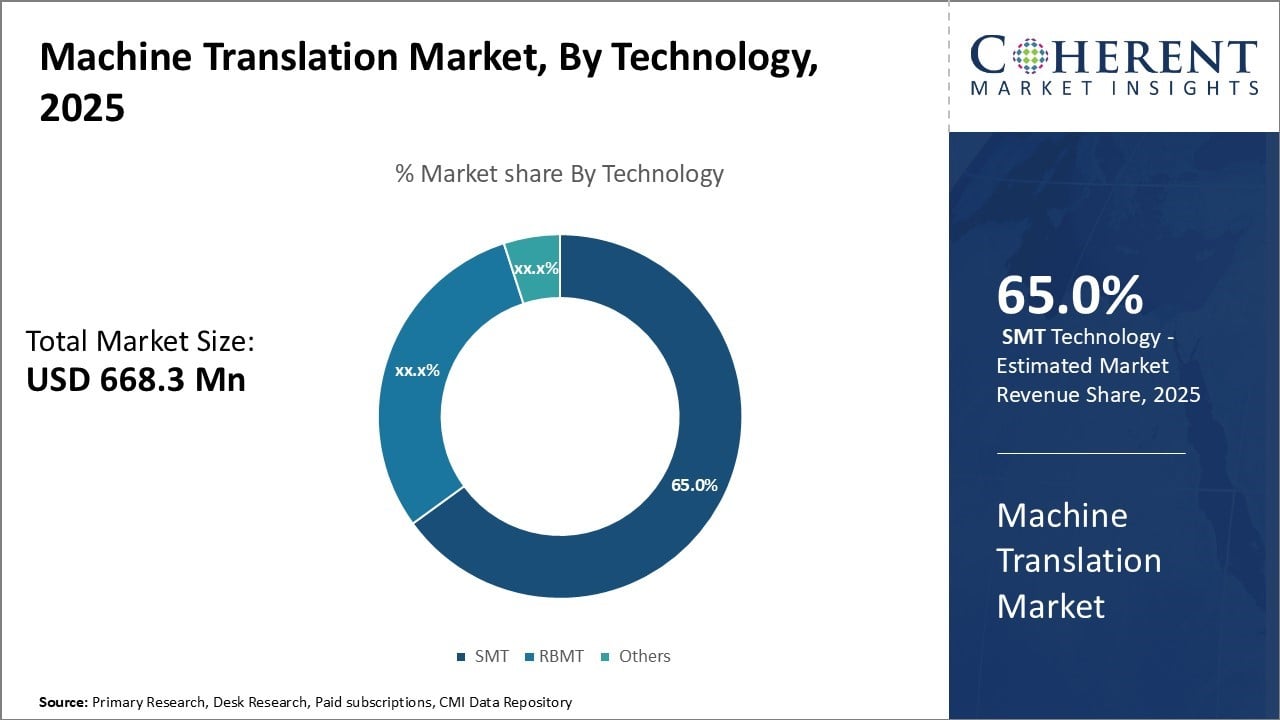
- Based on technology, the statistical machine translation (SMT) segment is projected to account for 66% of the market share in 2026, driven by its continuous improvement and expanded use across different applications.
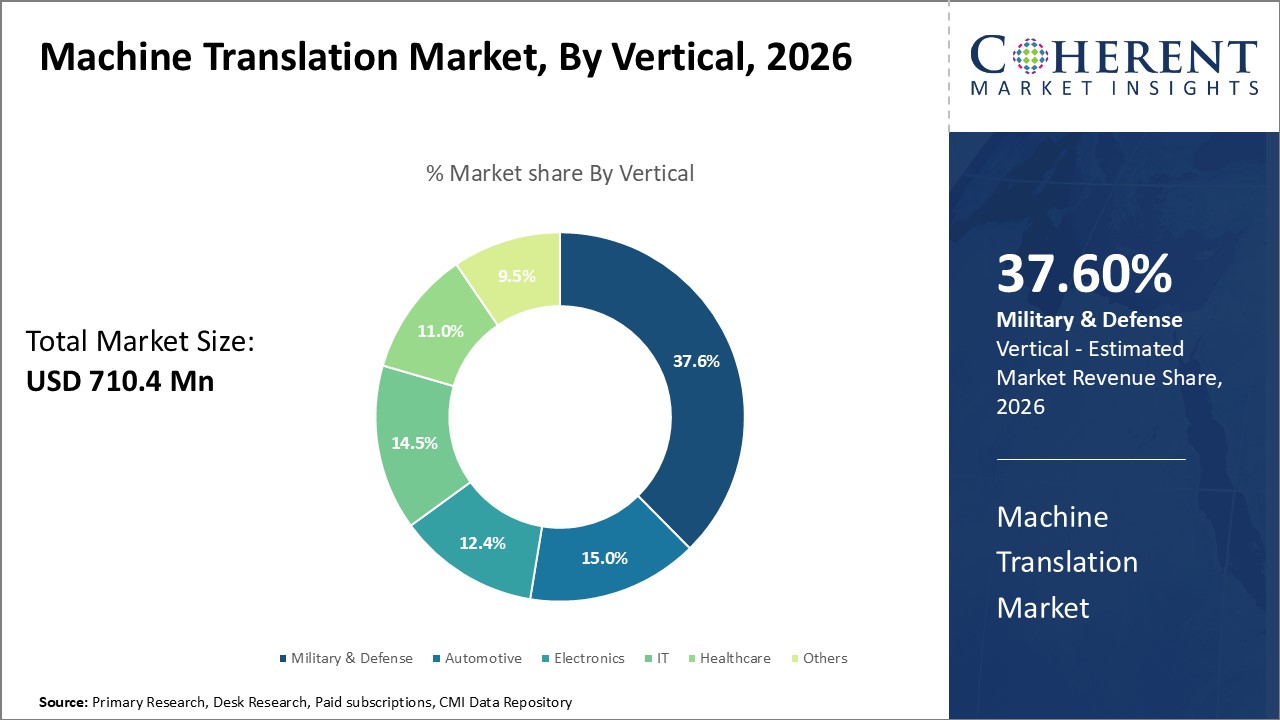
- Based on vertical, the military & defense segment is expected to hold 37.6% of the market share in 2026, largely attributed to its vital requirement for foreign language capabilities and security.
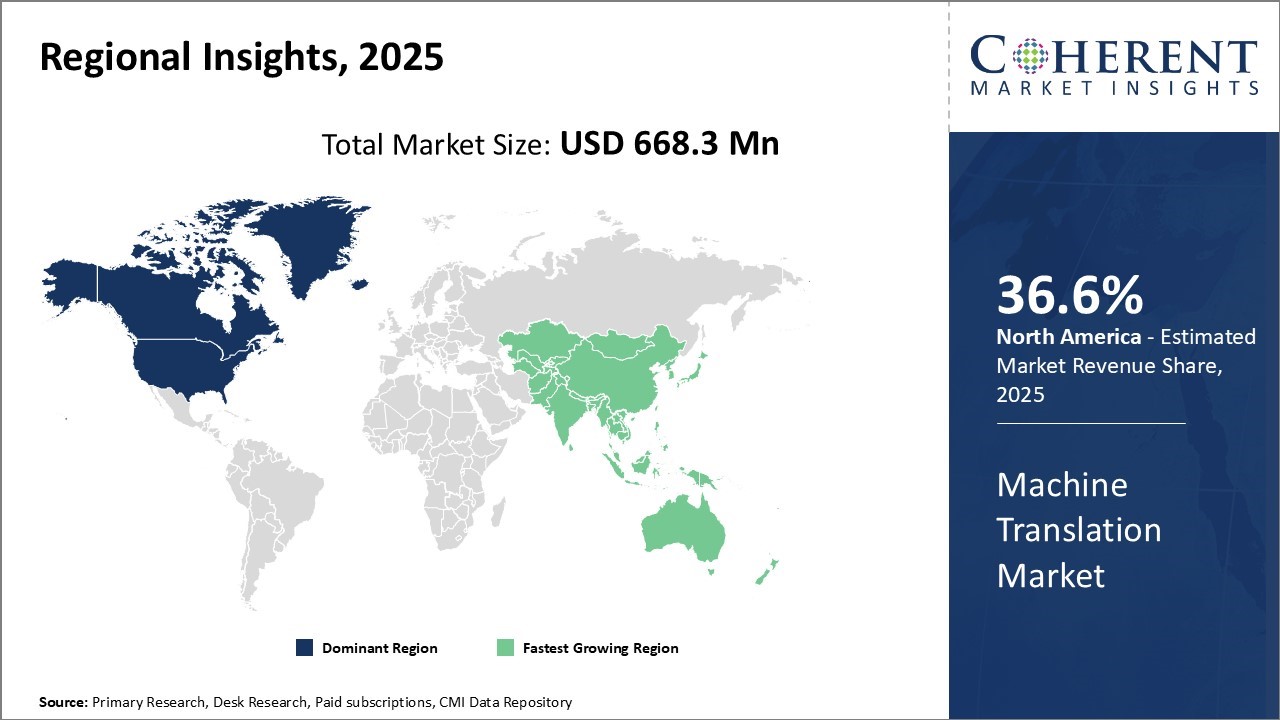
- Based on region, North America is projected to lead the global machine translation market in 2026 with a 36. 6% share, driven by presence of leading technology companies. While, Asia Pacific is considered as the fastest growing region during the forecast period due to the rapid urbanization, increasing skincare awareness and rising demand for natural and effective moisturizing ingredient.
Market Overview
Machine translation technologies help businesses reduce costs by streamlining multilingual communication and collaboration requirements across borders. The increasing demand for language services and rising adoption of machine translation tools in eCommerce and travel & hospitality industries are major factors driving the market growth.
With advances in artificial intelligence and natural language processing, machine translation solutions are getting more powerful and deliver more contextual and human-like translations. Major technology players are investing heavily in building neural networks and synthetic data with the goal of achieving human parity in machine translation capabilities.
Current Event and their Impact on the Machine Translation Market
Current Events | Description and its Impact |
EU Regulatory Shifts (Geopolitical/Regional) |
|
U.S.-China Tech Decoupling (Macro/Geopolitical) |
|
Role of Artificial Intelligence (AI) in Machine Translation Market
The integration of artificial intelligence is revolutionizing the machine translation by enabling systems to understand and generate more accurate and natural-sounding translation. AI-powered translation systems leverage large datasets of translated text to learn patterns and relationships between languages, resulting in improved translation quality and efficiency. Machine translation with artificial intelligence tool speeds up the translation process and helps millions of people understand content in the form of texts in various languages.
In November 2024, Rome-based AI language solutions provider launched Lara, an advanced translation AI that approaches the quality of top-tier professional translators. Trained over 1.2 million GPU hours using NVIDIA's platform, Lara leverages a curated dataset of 25 million real-world translations, incorporating human feedback to enhance accuracy and contextual understanding.
- Current Industry Events of 2026
- Market Size Estimation
- Regional Breakdown
- Competitive Landscape
- Customer Intelligence
- Segmental Analysis
- Pricing Analysis
- Key Market Drivers, Challenges & Future Trends
- Customized Insights Section
Segmental Analysis
Machine Translation Market Insights, By Technology
SMT contributes the highest share of the market Owing to its continuous improvements and expanded application scope
Statistical machine translation (SMT) has emerged as the leading technology in the global machine translation market and is estimated to account for 66% share in 2026 due to its continuous improvement and expanded use across different applications over the years. Statistical Machine Translation (SMT) works by analyzing large collections of human-translated text to identify patterns and learn how to translate between languages. It then uses these patterns to translate new text. The growth of SMT has been driven by the increasing availability of parallel text data, which enhances the models' understanding of linguistic patterns and nuances. Advances in deep learning and neural networks have significantly improved SMT performance by enabling models to better grasp contextual meaning and generate more natural translations. SMT is also preferred for its flexibility and scalability, handling high volumes of content across various industries.
For instance, in December 2024, a study published by the Cornell University demonstrated phrase-based SMT outperformed transformer-based NMT for the Persian-Hindi language pair in moderate-resource scenarios. The SMT model achieved a BLEU score of 66.32, significantly surpassing the NMT's score of 53.7. This finding underscores SMT's potential efficacy for structurally similar languages with limited parallel corpora.
Machine Translation Market Insights, By Vertical
Military & Defense contributes the highest share of the market driven by critical needs for foreign language capabilities and security
The military & defense vertical is estimated to capture 37.6% share of the global machine translation market in 2026 owing to its vital requirements for foreign language capabilities and security. Geopolitical complexities have increased the military's need to continuously monitor open-source intelligence in diverse local languages. Simultaneously, cross-border joint operations and multinational alliances have driven demand for real-time translation tools to facilitate rapid collaboration and coordination in conflict zones.
Machine translation has become indispensable for critical military tasks, such as analyzing enemy communications, identifying local threats, and detecting potential insurgents online. It allows security forces to negotiate, interrogate, and issue warnings in local languages without relying on human interpreters, which can introduce risks and delays. Furthermore, automated translation safeguards operational security by removing intermediaries from sensitive exchanges and enables rapid scaling of monitoring capabilities across languages.
In November 2024, Rabdan Academy introduced a pioneering program titled "Specialised Translation in Defence and Security," aimed at training Emirati nationals in simultaneous and consecutive interpretation within military and security contexts. Such programs are positively influencing the machine translation market forecast.
Regional Insights
North America Machine Translation Market Analysis and Trends
North America has established itself as the dominant region in the global machine translation market and is estimated to account for 36.6% share in 2026. With the presence of leading technology companies like Google, Microsoft, and IBM headquartered in the U.S., the region enjoys strong industry expertise and capacity for investment in research and development. These companies have immensely helped establish the region's dominance through continuous innovation and launches of new machine translation technologies.
Strong focus on analytics and AI by U.S.-based companies has positioned them at the forefront of developing human-level machine translation capabilities. Furthermore, collaboration between private players and research institutes like MIT has supported advances in neural machine translation and other emerging technologies.
In January 2026, Shogakukan introduced "NOVELOUS," a new app for iOS and Android that offers light novel series and manga to readers in the United States. The app features AI-powered translation for its English versions.
Asia Pacific Machine Translation Market Analysis and Trends
The Asia Pacific region is witnessing the fastest growth and shows promising potential to challenge the dominance of North America in the coming years. Countries like China and India offer low-cost destinations for machine translation services and growing international businesses are significantly driving the demand. For example, Chinese technology giants are rapidly scaling their machine translation offerings to cater to the multilingual requirements of expanding domestic and international consumer bases.
The large population and global talent pool in countries like India is attracting language services providers to establish captives and nearshore delivery centers. This is contributing towards greater adoption and export opportunities for Asia Pacific-based machine translation vendors. In January 2026, Xiaohongshu (RedNote) launched a new translation feature enabling real-time Chinese-English and English-Chinese translations, along with explanations of common internet slang, available after updating the app. This is further accelerating the machine translation market demand.
Machine Translation Market Outlook Country-wise
The United States Machine Translation Market Trends
The U.S. machine translation market is characterized by robust IT & telecommunications, military and defense, and healthcare industries necessitating efficient multilingual communication. U.S. comprises of diverse population, a globalized economy and the need for improved access to government business services, further contribute the demand for machine translation market in the United States. 56% of businesses in the United State demand for bi/multilingual speakers which is expected to increase in the next 5 years. A study conducted by the Center for Immigration found that 67.3 million residents in the United States speak a language other than English in their homes.
In May 2024, Smartling, Inc., a leader in AI-powered translation technology, unveiled its AI Translation Toolkit, an end-to-end solution designed to augment translation workflows. This toolkit enables users to leverage advanced AI features within the Smartling LanguageAI™ Platform, enhancing the capabilities of their own language service providers.
China Machine Translation Market Trends
China machine translation market has experienced significant growth, fueled b the expansion of e-commerce platforms into rural areas and increased demanded for localized services. China is increasing its engagement in international trade and investment have created a high demand for translation services, particularly for technical and legal documents. For Instance, in April 2026, SeaPRwire, a leading Public Relations Communication Platform in Asia, has announced the introduction of an AI-supported multilingual news translation tool. This innovative tool, developed in collaboration with Asia Presswire aims to expand the reach of press releases by enabling instant translation into multiple languages, allowing companies to effectively connect with a broader global audience.
Japan Machine Translation Market Trends
Japan continues to be a key market for machine translation market, driven by its large population of non-native speakers and the adoption of machine translation in various sectors. According to the Immigration Services Agency, Japan’s foreign population was 3,768,977 as of the end of 2024, rising by 357,985, or 10.5%, year on year. For instance, in November 2024, Central Japan City introduced Automatic Translation Screens in 134 Locations to enhance communication with foreign residents, a central Japanese city announced plans to install automatic translation screens in 134 municipal facilities. These plexiglass screens will display real-time translations of conversations, aiming to bridge language gaps between city officials and non-Japanese speakers.
India Machine Translation Market Trends
India machine translation market is characterized by a strong government initiative such as the National Translation Mission and the National AI Strategy, aiming to make knowledge accessible in multiple languages. Translation is crucial in a country like India which is culturally and linguistically diverse. For instance, in September, 2024, Union Home Minister Amit Shah unveiled 'Bharatiya Bhasha Anubhag' at the 4th Akhil Bharatiya Rajbhasha Sammelan in New Delhi. This initiative by the Department of Official Language under the Ministry of Home Affairs introduces a universal translation system facilitating instant translation of official communications between the Centre and states—from Hindi or English to regional languages and vice versa. Such initiatives are propelling the machine translation market share.
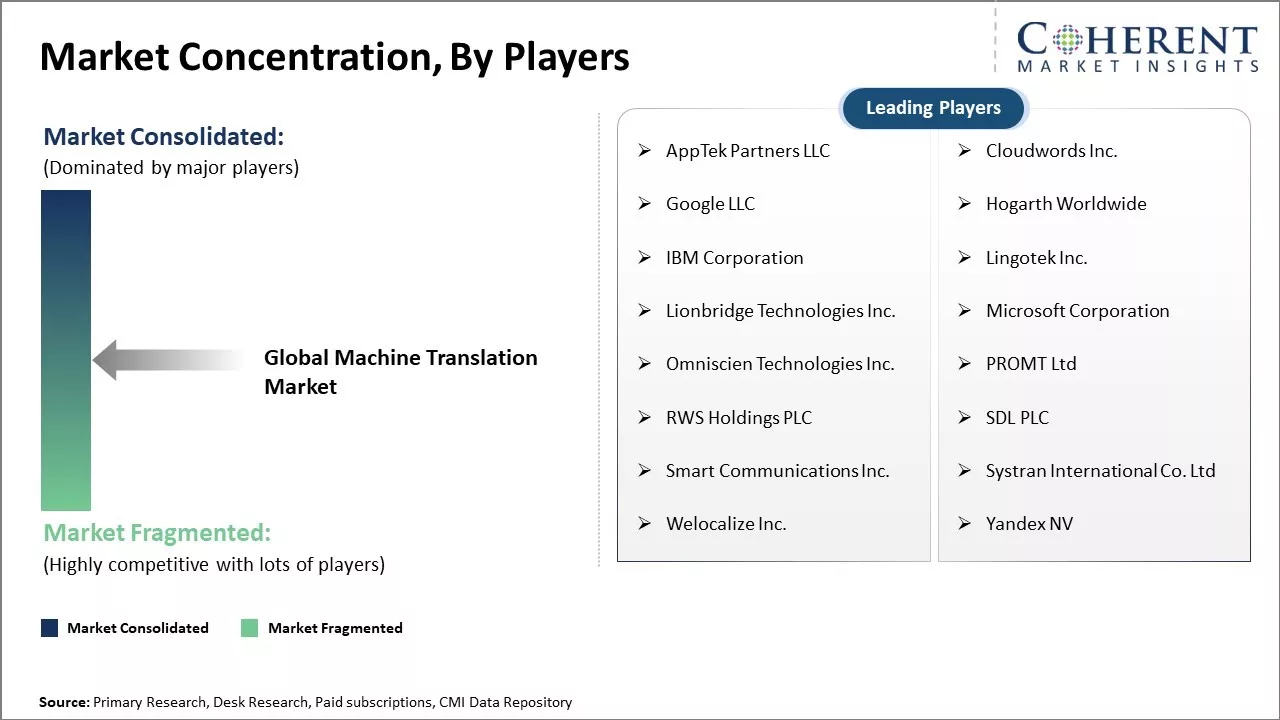
Market Concentration and Competitive Landscape
Recent Developments
- In April 2025, Alexa Translations introduced INFINITE, an AI-driven translation platform tailored for high-stakes legal and financial documents. Leveraging Large Language Models (LLMs) and Retrieval-Augmented Generation (RAG) technology, INFINITE delivers tone-accurate and contextually fluent translations, adapting to each organization's specific terminology and style. It is designed for professionals in regulated industries, the platform aims to reduce risk, enhance speed, and improve operational efficiency.
- In November 2024, nbabel, a Lisbon and San Francisco-based AI translation startup, launched a new AI-powered translation app aimed at streamlining multilingual communication for businesses. The app integrates neural machine translation with human post-editing to enhance accuracy and efficiency.
- In February 2023, RWS introduced its TrainAI brand, which offers clients comprehensive end-to-end services for collecting, annotating, and validating AI data in any language and at any scale. TrainAI builds on RWS's extensive experience providing machine translation and AI training data services to help the world's largest organizations improve the quality of their machine learning models and AI applications.
- In January 2023, Siemens announced an expanded digitalization portfolio for the Indian machine tool industry to improve value and profitability for customers. The expanded portfolio includes solutions that enable machine tool manufacturers and users to design, build, and optimize machines and components more quickly, adapt flexibly to market needs, and boost productivity across various industries.
Market Report Scope
Machine Translation Market Report Coverage
| Report Coverage | Details | ||
|---|---|---|---|
| Base Year: | 2025 | Market Size in 2026: | USD 710.4 Mn |
| Historical Data for: | 2020 To 2024 | Forecast Period: | 2026 To 2033 |
| Forecast Period 2026 to 2033 CAGR: | 6.3% | 2033 Value Projection: | USD 1,089.5 Mn |
| Geographies covered: |
| ||
| Segments covered: |
| ||
| Companies covered: | AppTek Partners LLC, Cloudwords Inc., Google LLC, Hogarth Worldwide, IBM Corporation, Lingotek Inc., Lionbridge Technologies Inc., Microsoft Corporation, Omniscien Technologies Inc., PROMT Ltd, RWS Holdings PLC, SDL PLC, Smart Communications Inc., Systran International Co. Ltd, Welocalize Inc., and Yandex NV | ||
| Growth Drivers: |
| ||
| Restraints & Challenges: |
| ||
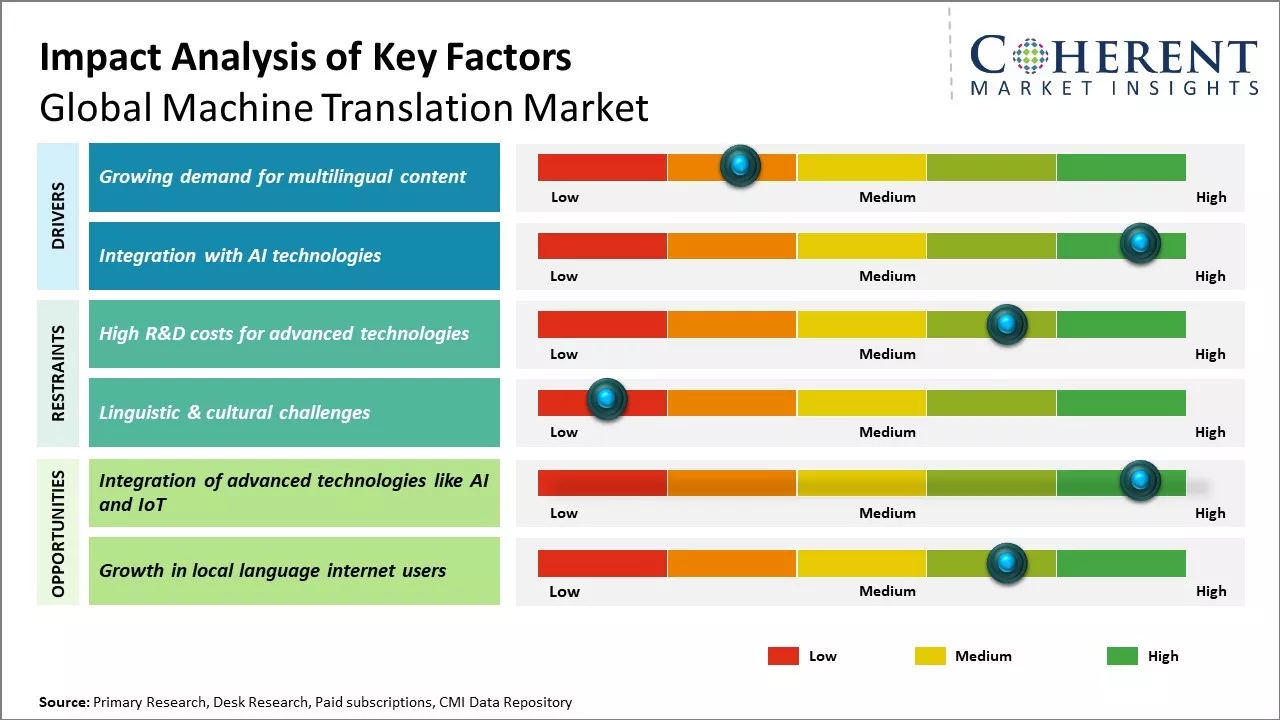
Machine Translation Market Driver
Growing demand for multilingual content
With the ongoing trend of globalization and expansion of businesses across international markets, there has been a significant rise in the demand for multilingual content. Organizations are realizing the importance of catering to a diverse, global customer base and providing content in their local languages in order to improve customer experience and increase sales from new geographic regions. However, manually translating content into dozens of different languages requires huge investments of time and resources. This is where machine translation tools have proven immensely useful for businesses. Machine translation solutions allow organizations to automate the translation process and produce multilingual content at scale in a cost-effective manner. The quality of machine translation has improved substantially in recent times due to advances in deep learning and artificial intelligence techniques.
Integration with AI technologies
Artificial intelligence is enhancing the capabilities of machine translation systems and opening up exciting new applications. By leveraging large language models, neural networks, and other AI techniques, modern machine translation platforms can achieve human-level accuracy for many language pairs. They can also automatically detect the context and intent of text to generate more natural translations. Heavy integration with AI is allowing machine translation to evolve from static document translation to advanced use cases such as the translation of voice commands, interactive conversations, and video/audio content. Chatbots, virtual assistants, and AI assistants powered by translation are becoming more pervasive. Industries like e-commerce and customer service are implementing AI-powered translation solutions for seamless multilingual customer support through various channels.
Analyst Opinion (Expert Opinion)
The Machine Translation Market Is Reaching a Maturity Crisis, dnot a Growth Peak
The machine translation (MT) market is entering a phase of maturity-driven turbulence, not unbridled growth. Contrary to popular optimism around generative AI, the core bottlenecks in domain-specific accuracy, cultural nuance, and data privacy are becoming increasingly pronounced — and MT vendors are not adapting fast enough.
While tools like Google Translate and DeepL claim near-human fluency, real-world application metrics tell a more nuanced story. A 2024 Stanford HAI study revealed that even leading MT engines achieve only 78% semantic fidelity in technical domains like legal and medical — unacceptable in regulated environments. Amazon Web Services’ own MT failures in real-time multilingual customer support for AWS Support in 2023, where mis-translations led to SLA violations, underscores the brittle trust enterprises place in generic MT models.
More concerning is the overreliance on LLMs for translation. While LLM-based MT (e.g., OpenAI's GPT-4 or Meta’s SeamlessM4T) has made leaps in low-resource language coverage, they trade precision for fluency. For example, GPT-4 achieves fluent translation of informal Chinese dialects, but introduces factual hallucinations in technical documents — a critical flaw in legal, defense, or pharmaceutical sectors.
Data sovereignty is the Achilles' heel of cloud-based MT. European clients in sectors like healthcare and public administration increasingly reject U.S.-hosted MT APIs over GDPR concerns. Germany’s Bundesamt für Sicherheit in der Informationstechnik (BSI) publicly advised against cloud MT use in public services in late 2024, prompting Siemens to shift its MT stack in-house.
Meanwhile, Asian markets like Japan and South Korea continue to underutilize MT in enterprise workflows due to corporate linguistic conservatism. Japanese firms still invest heavily in human post-editing layers, citing MT’s inability to capture formality tiers and industry-specific keigo. Nikkei’s 2025 internal benchmark showed human-edited output scoring 31% higher on clarity and brand tone in financial translation.
The future of MT doesn’t lie in flashy, all-purpose models, but in vertically integrated, small-language-pair, domain-trained engines. Startups like XL8.ai and Veritone are outperforming Big Tech in media subtitling and courtroom transcription, thanks to hyper-targeted training datasets and hybrid workflows.
Bottom line: MT has plateaued in consumer-grade translation but is falling short where the money is regulated, high-stakes enterprise communication. The next phase of this market will be shaped not by breadth, but by depth, security, and linguistic fidelity. Vendors that fail to prioritize these over vanity benchmarks will be pushed to the margins.
Speak to the analyst
Want personalized insights?
Take the findings above to one of our principal consultants, or have the report rebuilt around the segments, geographies and competitors you actually track.
Market Segmentation:
- By Technology (Revenue, USD Mn, 2021 - 2033)
- RBMT
- SMT
- Others
- By Vertical (Revenue, USD Mn, 2021 - 2033)
- Automotive
- Military & Defense
- Electronics
- IT
- Healthcare
- Others
Regional Insights (Revenue, USD Mn, 2021 - 2033)
- North America
- U.S.
- Canada
- Latin America
- Brazil
- Argentina
- Mexico
- Rest of Latin America
- Europe
- Germany
- U.K.
- Spain
- France
- Italy
- Russia
- Rest of Europe
- Asia Pacific
- China
- India
- Japan
- Australia
- South Korea
- ASEAN
- Rest of Asia Pacific
- Middle East
- GCC Countries
- Israel
- Rest of Middle East
- Africa
- South Africa
- North Africa
- Central Africa
- North America
- Key Players Insights
- AppTek Partners LLC
- Cloudwords Inc.
- Google LLC
- Hogarth Worldwide
- IBM Corporation
- Lingotek Inc.
- Lionbridge Technologies Inc.
- Microsoft Corporation
- Omniscien Technologies Inc.
- PROMT Ltd
- RWS Holdings PLC
- SDL PLC
- Smart Communications Inc.
- Systran International Co. Ltd
- Welocalize Inc.
- Yandex NV
Sources
Primary Research Interviews from the following stakeholders:
Stakeholders:
- Interviews with AI/ML engineers, NLP researchers, translation software developers, localization project managers, and enterprise IT heads across global markets.
Databases:
- UNESCO Institute for Statistics – Digital Language Education
- WIPO PatentScope – Patents on Machine Translation and NLP technologies
- Eurostat – ICT Sector and AI adoption data
- U.S. Bureau of Economic Analysis – Digital Services Exports
- OECD AI Policy Observatory
- Chinese Academy of Sciences – Research Publications on NLP/MT
- National Science Foundation (NSF) – U.S. AI Research Investments
- India’s MeitY – Language Technology Initiatives (e.g., Bhashini)
- AI Watch (EU) – Monitoring AI use cases in language and content
Magazines:
- IEEE Spectrum – AI & NLP Features
- Language Technology News
- TechCrunch AI Section
- The Decoder (AI Language Tech section)
- VentureBeat – AI & NLP Innovations
- Multilingual Magazine
- Slator (Technology and Language Industry updates)
- InfoQ – Machine Learning & AI
Journals:
- Journal of Machine Translation (Springer)
- Computational Linguistics (MIT Press)
- IEEE Transactions on Artificial Intelligence
- Natural Language Engineering (Cambridge University Press)
- Transactions of the Association for Computational Linguistics (TACL)
- Machine Learning (Springer)
- Language Resources and Evaluation
Newspapers:
- The Wall Street Journal – AI and Technology Business
- The New York Times – AI and Ethics Columns
- Financial Times – Language Tech and Globalization Reports
- The Hindu – Technology & Digital India
- South China Morning Post – AI and Localization
- The Economic Times – Emerging Tech and AI Regulation
Associations:
- Association for Computational Linguistics (ACL)
- European Language Resource Association (ELRA)
- Asia-Pacific Association for Machine Translation (AAMT)
- International Association for Machine Translation (IAMT)
- Internet Society – Multilingual Internet Taskforce
- Unicode Consortium
- Common Locale Data Repository (CLDR)
- W3C Multilingual Web Group
Public Domain Sources:
- National Institute of Standards and Technology (NIST) – AI Benchmarks
- European Commission – Language Equality and AI Strategy
- MeitY (Government of India) – Bhashini & Digital India Language Tech
- U.S. Department of State – Multilingual Digital Diplomacy
- Ministry of Industry and Information Technology (China) – AI and MT initiatives
- EU Language Grid (European Language Technology Infrastructure)
- U.S. Department of Education – EdTech and Language Tools
Proprietary Elements:
- CMI Data Analytics Tool, and Proprietary CMI Existing Repository of information for last 8 years
*Definition: The global machine translation market includes companies that develop machine translation software and applications to translate text and documents from one human language to another. This market involves translation technologies using artificial intelligence and deep neural networks to automatically analyze large amounts of bilingual text and learn how to construct high-quality translations. The machine translation solutions in this market are enabling faster, more accurate, and more cost-effective translation across various industries like e-commerce, travel & tourism, healthcare, and education on a global scale.
Get access to 250+ pages report
Every segment, forecast, competitor profile and data table behind the analysis above — available for instant download.
- ESOMAR Member
- ISO 9001:2015 Certified
- D-U-N-S Registered
- GDPR & CCPA Compliant
Missing comfort of reading report in your local language? Find your preferred language:
Transform your Strategy with Exclusive Trending Reports
Frequently Asked Questions
The Machine Translation Market is estimated to be valued at USD 710.4 Mn in 2026, and is expected to reach USD 1,089.5 Mn by 2033.
The CAGR of the Machine Translation Market is projected to be 6.3% from 2026 to 2033.
Growing demand for multilingual content and integration with AI technologies are the major factors driving the growth of the global machine translation market.
High R&D costs for advanced technologies and linguistic & cultural challenges are the major factors hampering the growth of global machine translation market.
In terms of Technology, SMT is estimated to dominate the market in 2026.
AppTek Partners LLC, Cloudwords Inc., Google LLC, Hogarth Worldwide, IBM Corporation, Lingotek Inc., Lionbridge Technologies Inc., Microsoft Corporation, Omniscien Technologies Inc., PROMT Ltd, RWS Holdings PLC, SDL PLC, Smart Communications Inc., Systran International Co. Ltd, Welocalize Inc., and Yandex NV are the major players.
North America is expected to lead the global machine translation market in 2026.