

Polydimethylsiloxane (PDMS) Market Size and Forecast – 2026 to 2033
The Polydimethylsiloxane (PDMS) Market is anticipated to grow at a CAGR of 5.7% with USD 1.9 Bn in 2026 and is expected to reach USD 3.1 Bn in 2033. The Polydimethylsiloxane (PDMS) Market is growing as automotive, electronics, healthcare, personal care, and construction industries increasingly adopt silicone-based products. Silicone coatings and tire compounds can reduce aerodynamic drag and rolling resistance, potentially improving fuel efficiency by up to 6%.
Key Takeaways
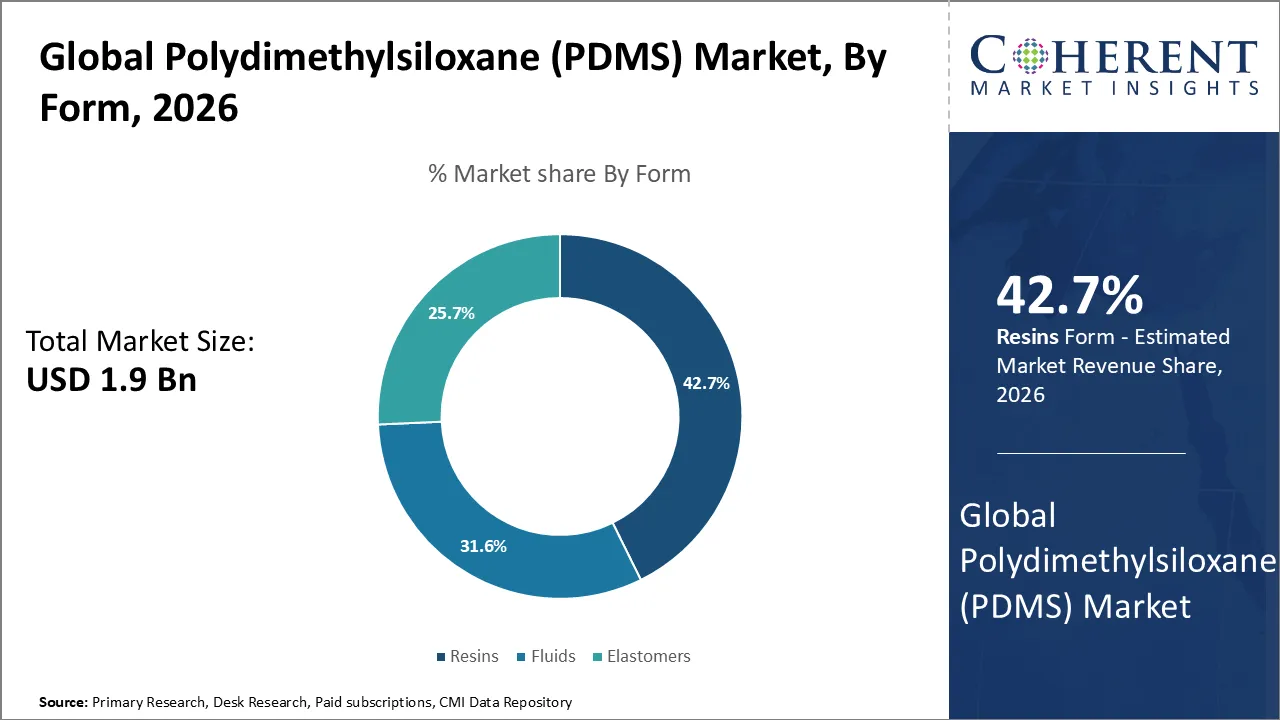
- Resins hold the largest market share of 42.7% in 2026 owing to the growing demand from the automotive industry. Resins are essential materials in automotive manufacturing, supporting the production of various vehicle components.
- Surfactants expected to hold largest market share of 38.7% in 2026 owing to its growth of personal care and cosmetics. According to our research, the global personal care products industry is expected to surpass USD 800 Bn by 2033.
- Food & Beverages acquired the largest market share of 43.6% in 2026 owing to its increasing demand for efficient foam control.
- 39.2%North America is expected to acquire the dominant share of in 2026 owing to the demand from healthcare and medical applications. Medical-grade polydimethylsiloxane (PDMS) is a highly purified, biocompatible silicone widely used in medical devices and drug-delivery applications.
Current Events and Their Impact on the Polydimethylsiloxane (PDMS) Market
Current Event | Description and its Impact |
EU REACH Restriction on D4, D5 and D6 Takes Effect – June 2026 |
|
U.S. FDA Quality Management System Regulation Becomes Effective – February 2026 |
|
Segmental Insights
- Current Industry Events of 2026
- Market Size Estimation
- Regional Breakdown
- Competitive Landscape
- Customer Intelligence
- Segmental Analysis
- Pricing Analysis
- Key Market Drivers, Challenges & Future Trends
- Customized Insights Section
Why is Resins Acquiring the Largest Market Share?
Resins hold the largest market share of 42.7% in 2026. Resins represent a key application area in the Polydimethylsiloxane (PDMS) market, as industries increasingly demand high-performance materials for construction, automotive, electronics, and industrial applications. Manufacturers use PDMS-based resins in protective coatings, adhesives, sealants, encapsulation, and specialty formulations because they provide excellent thermal stability, flexibility, weather resistance, chemical resistance, and electrical insulation. Infrastructure development, expanding electronics production, growing automotive applications, and the need for durable, lightweight materials continue to drive resin consumption and broaden the use of PDMS-based products across industries. For instance, in June 2026, iGM Resins launched Photomer SC91, a new photoactive resin technology that it says represents a significant advancement in UV and LED curing systems.
Surfactants Expected to Hold Largest Market Share
Surfactants expected to hold largest market share of 38.7% in 2026 owing to its expansion of coatings, paints, and inks. Surfactants support the growth of the Polydimethylsiloxane (PDMS) market as manufacturers seek effective solutions for wetting, spreading, emulsification, and foam control. Companies use silicone-based surfactants extensively in personal care, agriculture, coatings, polyurethane foams, and industrial formulations to improve surface performance and formulation stability. Growing cosmetic consumption, expanding construction and automotive activities, rising polyurethane foam production, and increasing use of agricultural chemicals continue to strengthen demand. Manufacturers also develop specialty silicone surfactants for diverse applications, further expanding PDMS usage.
Which End Use Industry Segment dominates the market?
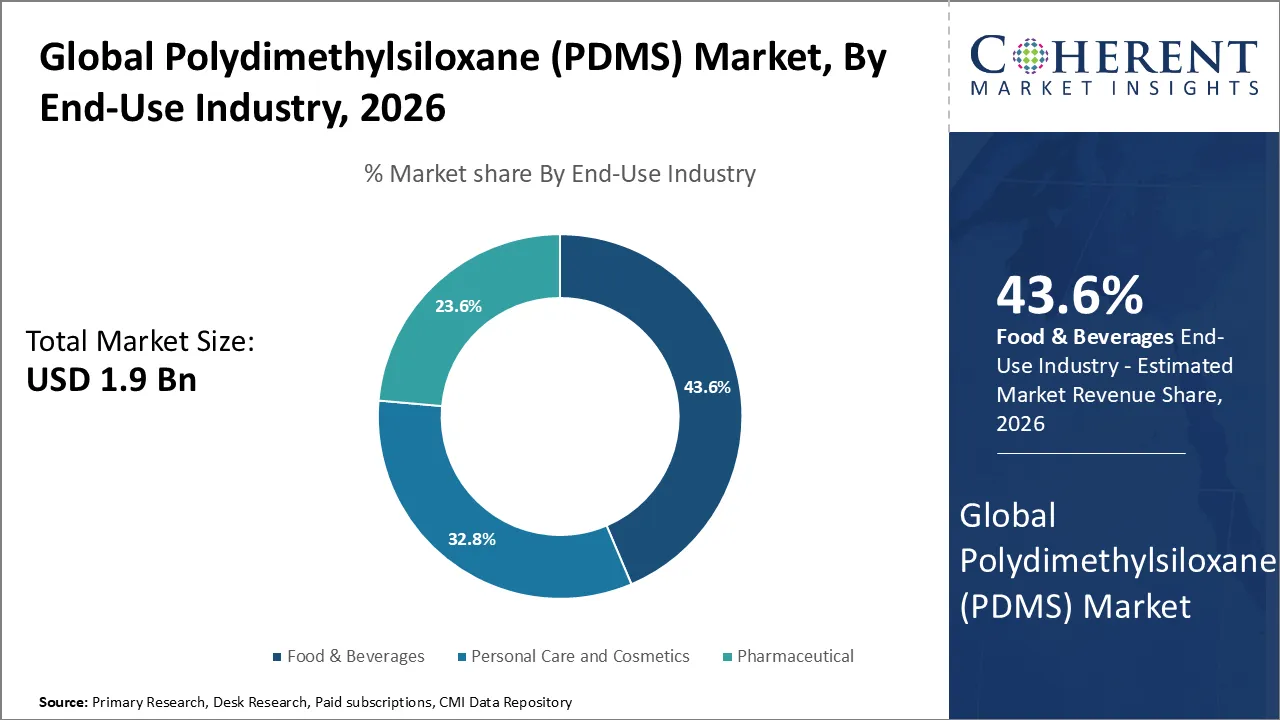
Food & Beverages acquired the largest market share of 43.6% in 2026. The food and beverage industry drives the Polydimethylsiloxane (PDMS) market by increasing demand for effective foam-control solutions in food processing and manufacturing. Food producers use PDMS as an antifoaming agent in edible oil processing, beverages, confectionery, and other processed foods to enhance operational efficiency and maintain consistent production. Growing consumption of packaged and convenience foods, expanding processing facilities, greater automation, and the need for efficient manufacturing processes continue to encourage manufacturers to adopt PDMS across the food and beverage industry.
Polydimethylsiloxane (PDMS) Market Trends
- Rising demand for high-performance silicone materials: PDMS is used across automotive, electronics, healthcare, construction and industrial applications because of its flexibility, thermal stability, chemical resistance and water-repellent characteristics. The expansion of electric vehicles provides a measurable downstream opportunity: global electric-car sales exceeded 20 million in 2025, representing about 25% of new-car sales, according to the IEA. The increasing number of EVs creates additional applications for silicone materials in electrical insulation, sealing, protection and thermal-management systems.
- Expansion of silicone-based surfactants and specialty formulations: PDMS and related silicone materials are used as deposition aids and other functional ingredients in pesticide formulations. The U.S. EPA's Inert Ingredient Database specifically lists dimethylpolysiloxane (CAS 63148-62-9) as a deposition aid. This provides an official example of PDMS-related materials being used to improve the performance of agricultural formulations rather than simply serving as a conventional silicone fluid.
- Regulatory pressure on cyclic siloxanes is reshaping PDMS formulations: EU Regulation 2024/1328 introduced restrictions on D4, D5 and D6, with major provisions applying from 6 June 2026. The regulation does not ban PDMS itself and provides an exemption when D4/D5/D6 are used as monomers in silicone-polymer production. However, specified downstream mixtures and applications are subject to concentration limits. This increases the importance of high-purity PDMS, residual-siloxane control and analytical testing for manufacturers supplying regulated European markets.
Regional Insights
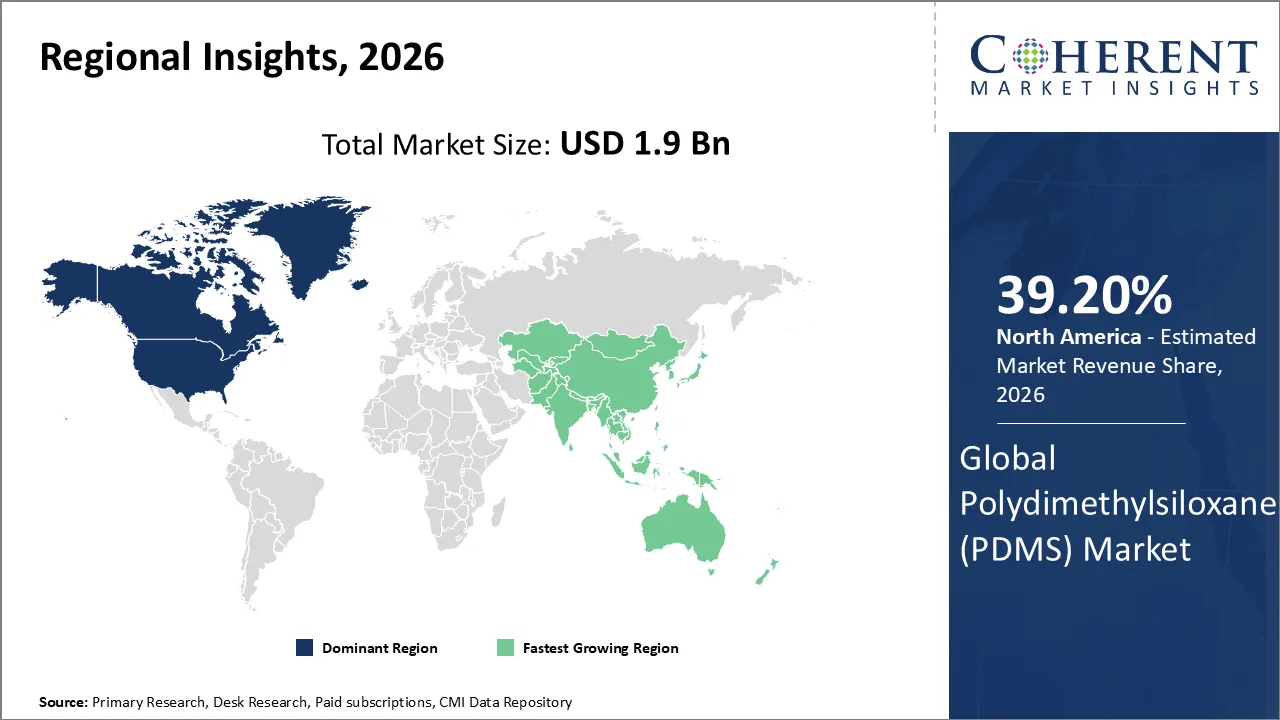
North America dominates owing to presence of established silicone and chemical manufacturers
North America is expected to acquire the dominant share of 39.2% in 2026. North American industries drive the Polydimethylsiloxane (PDMS) market through strong demand from automotive, construction, electronics, healthcare, personal care, and industrial manufacturing. Manufacturers incorporate PDMS into sealants, coatings, lubricants, electrical insulation, medical products, and specialty formulations because it delivers thermal stability, flexibility, chemical resistance, and durability. Expanding electronics production, infrastructure development, automotive manufacturing, and demand for high-performance materials continue to increase regional consumption. Established chemical manufacturers and advanced research capabilities also promote the development and adoption of specialty PDMS products.
Asia Pacific Polydimethylsiloxane (PDMS) Market Trends
Asia Pacific’s PDMS market continues to grow as rapid industrialization expands electronics and semiconductor manufacturing and increases automotive production across China, India, Japan, South Korea, and Southeast Asia. Construction and infrastructure development drive demand for PDMS in sealants, coatings, and waterproofing applications. The expanding personal care and cosmetics industries further increase silicone-fluid consumption. Healthcare and medical-device manufacturing also create new opportunities, while industries increasingly use PDMS for processing, lubrication, insulation, and thermal management applications.
United States Polydimethylsiloxane (PDMS) Market Trends
Strong demand across healthcare, electronics, automotive, construction, personal care, and industrial sectors drives the United States polydimethylsiloxane (PDMS) market. Medical-device manufacturers use PDMS in catheters, implants, wound-care products, and drug-delivery systems because of its biocompatibility and stability. Polydimethylsiloxane (PDMS) is widely used to fabricate microfluidic devices suitable for cell culture. Semiconductor and electronics producers increase demand for high-purity PDMS in encapsulation and thermal-management applications. Automotive manufacturers use silicone for battery sealing and insulation as vehicle electrification expands. Construction companies also rely on PDMS-based sealants, coatings, and waterproofing materials for durability and performance.
China Polydimethylsiloxane (PDMS) Market Trends
China’s PDMS market benefits from strong demand across the electronics, automotive, construction, and consumer-product sectors. Semiconductor manufacturers, 5G infrastructure developers, and electronics producers increasingly use PDMS for thermal management, insulation, encapsulation, and protective applications. Growing electric-vehicle production further boosts demand for silicone-based sealing and thermal-management materials. With over 70% of global production in 2024, China continues to be the world's center for the production of electric vehicles. Infrastructure expansion, urbanization, and construction activity drive the use of PDMS in sealants and coatings. China’s established silicone supply chain, expanding manufacturing capacity, and investments in advanced materials continue to support market growth.
Who are the Major Companies in Polydimethylsiloxane (PDMS) Industry
Some of the major key players in Polydimethylsiloxane (PDMS) are The Dow Chemical Company, Wacker Chemie AG, Elkem Silicones, Hubei Xin Sihai Chemical Co., Momentive, Shin-Etsu Chemical Co., Alfa Aesar, Thermo Fisher Scientific, Merck KGaA, and Fisher Scientific International Inc.
Key News
- In December 2025, a South Korean research team discovered a ship coating method that reduces marine biofouling and ice formation without the need of hazardous agents. The researchers created a 'LEP gel' by infusing a low-viscosity oil into a PDMS resin containing entangled long-chain free polymers.
Market Report Scope
Polydimethylsiloxane (PDMS) Market Report Coverage
Report Coverage | Details | ||
Base Year: | 2025 | Market Size in 2026: | USD 1.9 Bn |
Historical Data for: | 2020 to 2024 | Forecast Period: | 2026 to 2033 |
Forecast Period 2026 to 2033 CAGR: | 5.7% | 2033 Value Projection: | USD 3.1 Bn |
Geographies covered: |
| ||
Segments covered: |
| ||
Companies covered: | The Dow Chemical Company, Wacker Chemie AG, Elkem Silicones, Hubei Xin Sihai Chemical Co., Momentive, Shin-Etsu Chemical Co., Alfa Aesar, Thermo Fisher Scientific, Merck KGaA, and Fisher Scientific International Inc. | ||
Analyst Opinion
- China’s PDMS demand is increasingly tied to high-value electronics and new-energy applications rather than traditional construction alone. In 2024, electronics accounted for 21.3% of China’s polysiloxane consumption, while electrical and new-energy applications represented 19.1%, according to industry data. This shift matters because PDMS-based silicone materials provide thermal stability, electrical insulation, encapsulation, and protection in increasingly compact electronic systems. China’s semiconductor, consumer-electronics, photovoltaic, and EV supply chains therefore create a deeper structural demand base for higher-performance PDMS grades.
- China’s scale advantage is becoming difficult for competing supply chains to replicate. By the end of 2025, Chinese polysiloxane production reached 2.53 million tonnes, while production capacity reached 3.19 million tonnes per year, representing more than half of global capacity according to the China Association of Market Information–Silicon. China also recorded 349,000 tonnes of net polysiloxane exports in 2024, demonstrating that domestic producers increasingly serve overseas customers rather than merely replacing imports. In my view, this gives Chinese PDMS producers significant advantages in feedstock integration, manufacturing scale, and supply reliability.
- The key market issue is no longer simply volume expansion; it is the industry’s ability to move toward specialty-grade PDMS. Chinese polysiloxane capacity reached 2.822 million tonnes in 2024, while output reached 2.295 million tonnes, but industry data also indicate that higher-value products still rely partly on imports and that lower-end capacity faces oversupply. This creates a clear strategic divide: commodity PDMS producers remain exposed to price competition, whereas manufacturers supplying electronics, medical devices, EV components, and other technically demanding applications can capture greater value through purity, consistency, formulation expertise, and application-specific performance.
- New-energy vehicles are strengthening PDMS demand through functionality, not just vehicle volumes. Silicone materials serve applications such as battery encapsulation, electrical wiring, sealing, and thermal management, making electrification particularly relevant to PDMS consumption. Industry analysis identifies transportation and energy as important emerging silicone applications in China, while healthcare and electronics are also gaining importance. We therefore view China’s transition toward EVs, advanced electronics, and renewable-energy equipment as a more meaningful long-term demand driver for specialty PDMS than conventional construction consumption.
Speak to the analyst
Want personalized insights?
Take the findings above to one of our principal consultants, or have the report rebuilt around the segments, geographies and competitors you actually track.
Market Segmentation
- By Form (Revenue, USD Bn, 2021-2033)
- Fluids
- Elastomers
- Resins
- By Application (Revenue, USD Bn, 2021-2033)
- Surfactants
- Antifoaming agents
- Lubricants
- Medical devices
- Others (Hydraulic Fluids and Heat Transfer Fluids)
- By End-Use Industry (Revenue, USD Bn, 2021-2033)
- Food & Beverages
- Personal Care and Cosmetics
- Pharmaceutical
- By Region (Revenue, USD Bn, 2021-2033)
- North America
- U.S.
- Canada
- Latin America
- Brazil
- Mexico
- Argentina
- Rest of Latin America
- Europe
- Germany
- U.K.
- France
- Italy
- Spain
- Russia
- Rest of Europe
- Asia Pacific
- China
- India
- Japan
- Australia
- South Korea
- ASEAN
- Rest of Asia Pacific
- Middle East
- GCC
- Israel
- Rest of Middle East
- Africa
- South Africa
- Central Africa
- North Africa
- North America
Sources
Primary Research interviews
- PDMS and silicone manufacturers
- Raw-material and silicone-polymer producers
- Electronics and semiconductor manufacturers
- Automotive component manufacturers
- Medical-device manufacturers
- Food-processing companies and formulation specialists
- Personal-care and cosmetics manufacturers
- Distributors and specialty-chemical suppliers
- Industry experts, procurement managers, R&D professionals, and application engineers
Databases
- U.S. National Library of Medicine – PubChem
- U.S. Environmental Protection Agency – Chemical Data Reporting (CDR)
- U.S. EPA – Chemical and Products Database (CPDat)
- U.S. Food and Drug Administration – Substances Added to Food database
- FDA – Food Contact Substances database
- European Chemicals Agency (ECHA) databases
- NIST Chemistry WebBook and polymer-related databases
- U.S. Department of Energy – PAC Chemical Database
- OECD chemical and environmental databases
- UN Comtrade database
- Eurostat database
- U.S. International Trade Commission trade database
Magazines
- Chemical & Engineering News
- Chemical Week
- European Coatings Journal
- Cosmetics & Toiletries
- Silicone Elastomers Magazine
- Rubber News
- Plastics Technology
- Automotive News
- Electronic Engineering Times
Journals
- Journal of Applied Polymer Science
- Polymer
- Macromolecules
- ACS Applied Materials & Interfaces
- Industrial & Engineering Chemistry Research
- Materials Science and Engineering
- Journal of Polymer Science
- Polymer International
- Journal of Biomedical Materials Research
- Food Chemistry
- Journal of Colloid and Interface Science
Newspapers
- Reuters
- Financial Times
- The Wall Street Journal
- Nikkei Asia
- South China Morning Post
- China Daily
- The Economic Times
- The Times of India
Associations
- American Chemistry Council (ACC)
- Global Silicones Council
- European Silicone Centre
- China Association of Market Information–Silicon
- China Petroleum and Chemical Industry Association
- Semiconductor Industry Association (SIA)
- European Semiconductor Industry Association
- Society of Automotive Engineers (SAE)
- Plastics Industry Association
- American Cleaning Institute (ACI)
- Personal Care Products Council
- International Organization for Standardization (ISO)
Public Domain sources
- U.S. FDA regulatory databases and 21 CFR
- U.S. EPA chemical and environmental databases
- European Chemicals Agency (ECHA)
- PubChem
- National Institute of Standards and Technology (NIST)
- U.S. Geological Survey (USGS)
- U.S. Department of Energy
- U.S. Census Bureau
- U.S. International Trade Commission
- Eurostat
- UN Comtrade
- World Bank
- OECD
- International Energy Agency (IEA)
- National statistical agencies of China, India, Japan, South Korea, the U.S., Canada, and European countries
- Government customs and trade-statistics databases
- Scientific and technical publications available through public repositories
Proprietary Elements
- CMI Data Analytics Tool
- Proprietary CMI Existing Repository of information for last 10 years
Get access to 250+ pages report
Every segment, forecast, competitor profile and data table behind the analysis above — available for instant download.
- ESOMAR Member
- ISO 9001:2015 Certified
- D-U-N-S Registered
- GDPR & CCPA Compliant
Missing comfort of reading report in your local language? Find your preferred language:
Transform your Strategy with Exclusive Trending Reports
Frequently Asked Questions
The PDMS market is driven by increasing adoption across electronics, automotive, healthcare, personal care, construction, food processing, and industrial applications.
Resins hold the largest share of the PDMS market, accounting for 42.7% in 2026.
Automotive manufacturers use PDMS-based resins because they provide flexibility, thermal resistance, weather resistance, chemical durability, and electrical insulation.
Surfactants are expected to account for the largest application share, at 38.7% in 2026.
Food & Beverages represents the largest end-use industry segment, with a 43.6% share in 2026.