

Global Polyglycolic Acid Market Size and Forecast – 2026 To 2033
The Global Polyglycolic Acid Market is estimated to be valued at USD 189.4 Mn in 2026 and is expected to reach USD 535.3 Mn by 2033, exhibiting a compound annual growth rate (CAGR) of 14.8% from 2026 to 2033. Market expansion is supported by the use of polyglycolic acid in absorbable surgical products, dissolvable oilfield components, high-barrier packaging, drug-delivery systems, and tissue-engineering structures.
Its high mechanical strength and controlled hydrolytic degradation allow manufacturers to develop products that provide temporary performance before being absorbed or dissolved. In 2025, the European Chemicals Agency (ECHA) chemical information database confirms polyglycolic acid as a hydrolytically degradable polymer widely evaluated for biodegradable and controlled-release applications, reinforcing its growing adoption across industrial and environmental material systems.
Key Takeaways of the Global Polyglycolic Acid Market
- Fibers are expected to lead the global polyglycolic acid market with a 39.6 % share in 2026 because polyglycolic acid can be spun, braided, and knitted into strong structures that retain handling performance before predictable hydrolysis. This supports high-value sutures, meshes, and resorbable devices. In February 2025, an FDA 510(k) summary described BD’s Phasix ST Umbilical Hernia Patch as a fully resorbable mesh co-knitted with polyglycolic acid fibers.
- Industrial grade is expected to account for 57.8 % of the market share in 2026, supported by its fit with high-volume applications requiring mechanical strength, controlled dissolution, and practical cost-performance rather than implant-grade purity. Oilfield components are a major commercialization route. In January 2024, a peer-reviewed study developed polyglycolic acid -containing degradable elastomer composites specifically for dissolvable hydraulic-fracturing plugs.
- High molecular weight is expected to hold 66.4 % of the market share in 2026 because longer chains improve entanglement, melt strength, tensile integrity, and dimensional stability across fibers, films, devices, and downhole components. In March 2026, research published by the American Chemical Society found that high-molecular-weight polyglycolic acid samples showed enhanced chain entanglement and prolonged polymer-chain relaxation during shear processing.
- North America is expected to represent 37.8 % of the market share in 2026, reflecting established medical-device procurement, active shale-completion programs, and application-specific technical support for degradable polymers. In May 2026, Kureha reported record polyglycolic acid sales volume and higher revenue after gains in medium- to high-temperature U.S. oilfields, demonstrating commercially scaled regional adoption.
- Asia Pacific is expected to hold 34.6 % of the market share in 2026 and expand the fastest as producers localize polymer technology, medical-material supply, and downstream conversion capacity. Integrated chemical groups can shorten qualification cycles and reduce import dependence. In July 2025, Sinopec reported that Yangzi Petrochemical’s pilot-scale key technology for medical polyglycolic acid had been successfully placed into production in China.
Segmental Insights
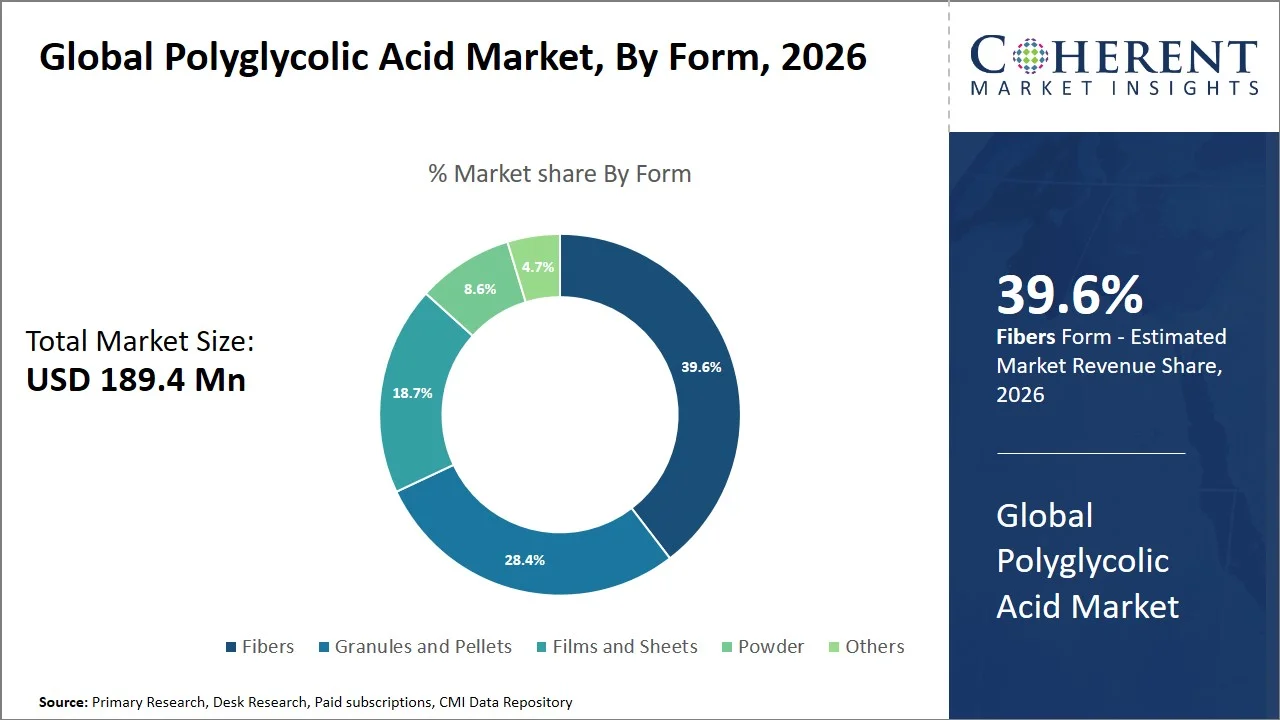
Why Do Fibers Dominate the Global Polyglycolic Acid Market?
Fibers are expected to capture 39.6% of the global polyglycolic acid market in 2026 because they support a wide range of standardized, frequently replenished surgical products. Monofilament and multifilament formats can be converted into multiple diameters, lengths, coatings, and needle combinations, allowing device manufacturers to serve diverse soft-tissue closure procedures from a common polymer-processing platform. Demand is reinforced by hospitals’ preference for sterile, ready-to-use absorbable products that avoid a separate removal procedure. On the supply side, established extrusion, drawing, annealing, and packaging lines enable repeatable tensile performance and scalable SKU production. This favors resin suppliers and fiber converters able to maintain moisture control and lot consistency. In May 2026, the U.S. Food & Drug Administration granted substantial-equivalence clearance to Medtronic’s Trexon Monofilament Synthetic Absorbable Suture for general soft-tissue approximation and ligation.
- Current Industry Events of 2026
- Market Size Estimation
- Regional Breakdown
- Competitive Landscape
- Customer Intelligence
- Segmental Analysis
- Pricing Analysis
- Key Market Drivers, Challenges & Future Trends
- Customized Insights Section
Why Does Industrial Grade Represent the Largest Grade in the Global Polyglycolic Acid Market?
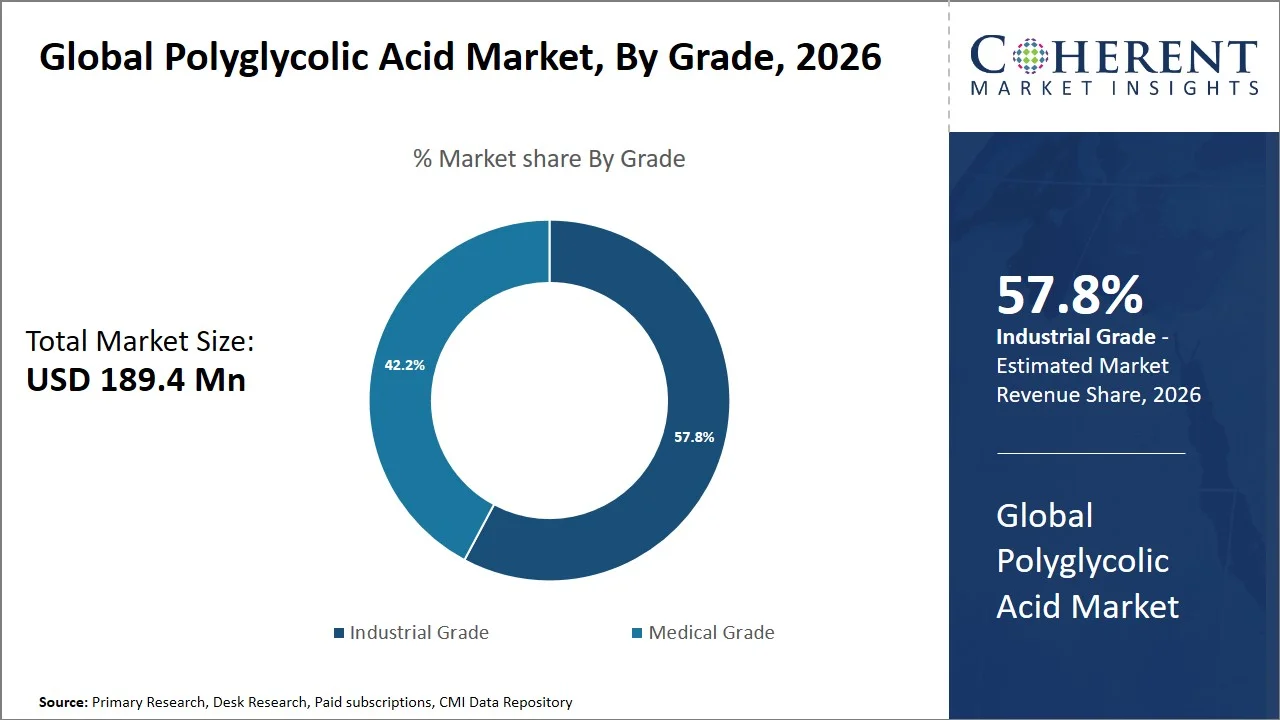
Industrial grade is expected to represent 57.8% of the global polyglycolic acid market in 2026 because non-implant applications permit broader formulation freedom and larger-volume procurement than tightly regulated medical uses. Compounders can reinforce polyglycolic acid, add degradation catalysts, and tailor component geometry according to well temperature, fluid chemistry, pressure, and required dissolution time. These capabilities are particularly valuable for soluble bridge plugs, where temporary structural reliability must be balanced against intervention-free removal after stimulation. Industrial buyers therefore purchase performance-engineered compounds rather than purity alone, creating opportunities for resin manufacturers, additive suppliers, molders, and oilfield-tool producers. In June 2025, a Polymer Composites study from researchers affiliated with Sinopec evaluated glass-fiber-reinforced polyglycolic acid for soluble bridge plugs and found that reinforcement materially improved tensile, flexural, and impact properties, while catalyst addition was used to regulate degradation.
Why Does High Molecular Weight Dominate the Molecular-Weight Category of the Global Polyglycolic Acid Market?
High molecular weight is expected to account for 66.4% of the global polyglycolic acid market in 2026 because converters require sufficient melt resistance to maintain shape and continuity during extrusion, drawing, film formation, and component molding. Longer effective chain structures improve processing stability, helping manufacturers reduce filament breaks, sheet defects, dimensional variation, and material loss during high-temperature conversion. This process-yield advantage is commercially important because polyglycolic acid has a relatively narrow thermal-processing window and moisture-sensitive behavior. Buyers consequently value grades supported by rheological data, controlled drying, and consistent molecular-weight distribution. In July 2024, Elsevier B.V. research published in Reactive and Functional Polymers that chain-extending polyglycolic acid with aliphatic diisocyanate and an epoxy oligomer increased complex melt viscosity by two orders of magnitude, widened the processing window, and improved strength and toughness.
Current Events and their Impact
Current Event | Description and Its Impact |
February 2025 – EU Packaging and Packaging Waste Regulation entered into force |
|
December 2025 – FDA recognized ASTM F1925-24 for resorbable implant polymers |
|
February 2026 – U.S. FDA Quality Management System Regulation became effective |
|
Global Polyglycolic Acid Market Dynamics
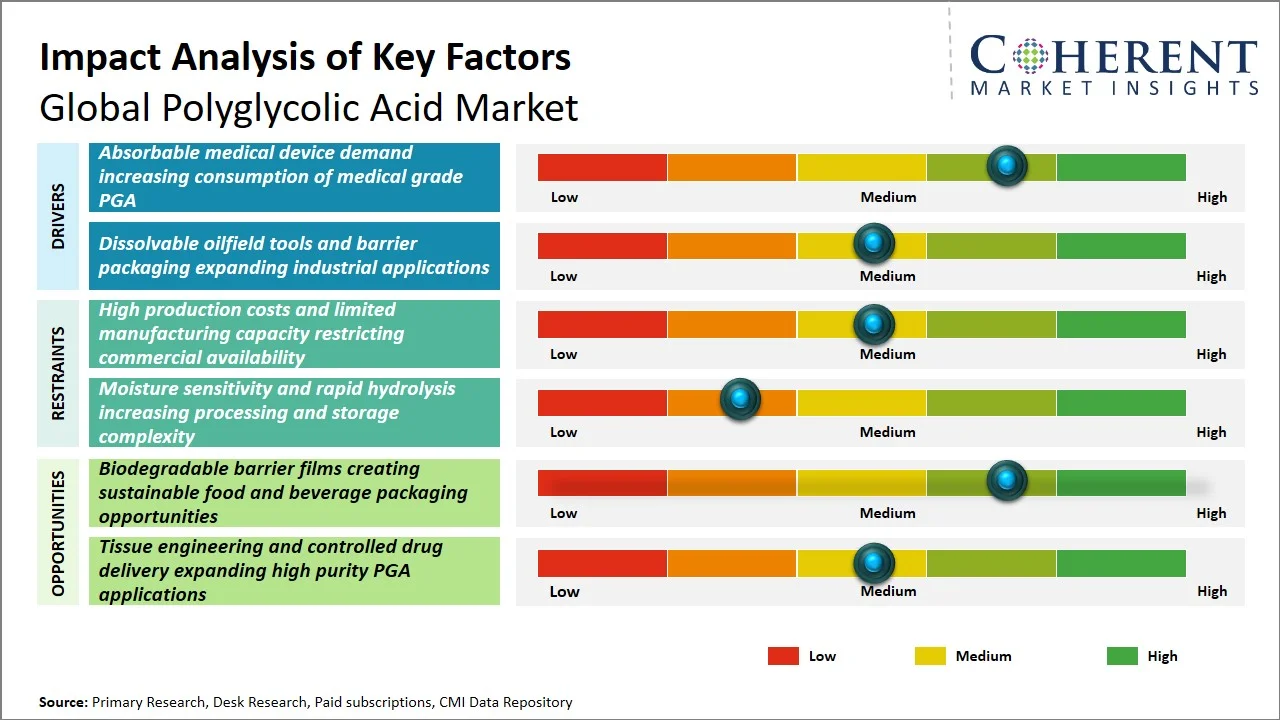
Key Market Drivers
- Absorbable medical device demand increasing consumption of medical grade PGA: Medical-grade polyglycolic acid benefits when device developers move beyond conventional braided sutures into meshes, reinforcement structures, and specialty closure systems. The polymer’s high initial strength, predictable hydrolysis, and compatibility with textile conversion allow manufacturers to engineer temporary support that disappears after healing. Demand therefore extends through resin producers, fiber spinners, suture manufacturers, contract converters, and regulated device OEMs. Commercially, every cleared device can create recurring requirements for tightly controlled molecular weight, residual monomer, sterilization compatibility, and lot traceability, supporting higher-value supply agreements rather than commodity purchasing. In October 2025, the U.S. Food & Drug Administration recorded substantial-equivalence clearance for Internacional Farmacéutica’s Calypso and Odysseus PGLA90 absorbable surgical sutures under the synthetic polyglycolic-acid suture classification, widening the available portfolio of glycolide-rich closure products.
- Dissolvable oilfield tools and barrier packaging expanding industrial applications: Polyglycolic acid-based downhole components create value by maintaining mechanical integrity during fracturing and then hydrolyzing in wellbore fluids, reducing or eliminating milling, retrieval, and associated rig time. This converts polymer performance directly into completion economics, especially where long laterals, restricted access, or complex multistage designs raise intervention risk. Resin suppliers, compounders, billet extruders, precision machinists, frac-plug designers, and oilfield service providers benefit when operators qualify polyglycolic acid for cones, seats, balls, and temporary isolation components. The strategic requirement is not simply faster dissolution; suppliers must tune strength retention against temperature, salinity, pressure, and exposure time. In March 2022, an ACS Omega study reported field trials of polyglycolic acid -containing dissolvable frac plugs across eight wells; the plugs passed deformed casing sections, withstood fracturing pressures, and self-dissolved after operations.
Emerging Market Trends
- Hybrid Bioresorbable Architectures Replace Single-Material Design: polyglycolic acid is increasingly being used within multi-material medical structures rather than as a standalone polymer. Combining POLYGLYCOLIC ACID fibers, meshes, or sheets with hydrogels, biological matrices, elastomers, or slower-resorbing polymers allows manufacturers to balance strength, flexibility, tissue interaction, and degradation timing. This favors suppliers offering validated material combinations and application-ready systems, while standard resin producers may face greater pricing pressure.
- Qualification Is Shifting Toward Process and Lot-Level Predictability: polyglycolic acid buyers are placing greater emphasis on moisture control, molecular-weight consistency, thermal history, impurities, packaging, and storage conditions because these factors affect processing and degradation performance. Suppliers with controlled polymerization, validated drying, analytical testing, and strong quality documentation are likely to secure longer-term customer relationships. Specialized distributors and converters will also become more important in maintaining material quality throughout the supply chain.
Regional Insights
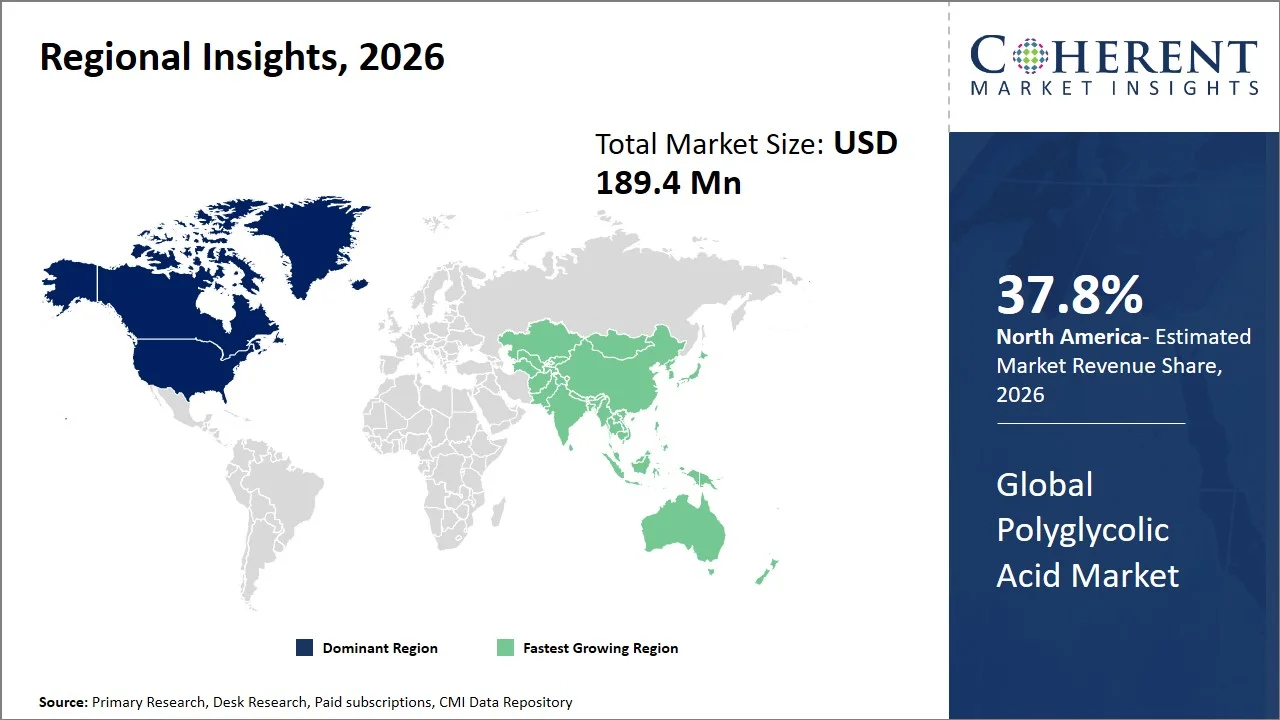
Why Does North America Dominate the Global Polyglycolic Acid Market?
North America is expected to hold 37.8% of the global polyglycolic acid market in 2026 because the region combines a mature surgical-device approval system with hospitals that routinely procure absorbable closure and reinforcement products. Medical OEMs benefit from established contract manufacturing, sterilization, clinical evaluation, and specialty distribution networks, which shorten commercialization after regulatory clearance. The region also supports premium material grades because suppliers must document biocompatibility, tensile retention, degradation behavior, and manufacturing consistency. This creates durable qualification relationships for polyglycolic acid resin, fiber, and device-component producers globally. In April 2024, the U.S. Food and Drug Administration granted 510(k) clearance to Meril Endo Surgery’s PINION POLYGLYCOLIC ACID-PCL knotless absorbable suture, confirming continued entry of glycolide-based wound-closure technologies into the region’s regulated surgical market.
Why Is Asia Pacific Emerging as the Fastest-Growing Region in the Global Polyglycolic Acid Market?
Asia Pacific is expected to represent 34.6% of the global polyglycolic acid market in 2026 and emerge as the fastest-growing region as polymer production, medical-device manufacturing, packaging conversion, and unconventional energy activity become increasingly localized. Regional companies can integrate glycolide production, polymerization, fiber spinning, molding, and finished-device assembly, reducing import exposure and accelerating customer qualification. Expanding hospital infrastructure and export-oriented medical manufacturing support medical-grade consumption, while domestic oilfield and high-barrier packaging applications broaden industrial demand. Standards are also improving material comparability for buyers and processors. In April 2024, China’s State Administration for Market Regulation published GB/T 43953-2024, the national standard for fully biodegradable polyglycolic acid, with implementation beginning in November 2024, providing a clearer technical reference for regional production and commercialization.
Global Polyglycolic Acid Market Outlook for Key Countries
Why is the U.S. a Key Market for the Global Polyglycolic Acid Market?
The U.S. is a key country in the global polyglycolic acid market because it offers two commercially distinct demand channels: regulated bioabsorbable medical products and high-intensity unconventional oil and gas operations. Hospitals, surgical-device companies, and specialist converters support medical-grade fibers and components, while shale operators create demand for industrial polyglycolic acid parts that retain strength during completion and subsequently dissolve. The country’s extensive testing, machining, and oilfield-service ecosystem enables suppliers to customize degradation time for specific temperature, salinity, and pressure conditions. Procurement therefore rewards proven performance and technical support rather than resin price alone. In March 2026, the U.S. Energy Information Administration reported that crude oil production reached a record 13.6 million barrels per day in 2025, with the Permian producing 6.6 million barrels per day, sustaining a large addressable base for intervention-reducing completion tools.
Why Does China Support Growth in the Global Polyglycolic Acid Market?
China supports growth in the global polyglycolic acid market through its combination of chemical manufacturing scale, downstream polymer processing, large medical-device supply chains, and expanding unconventional hydrocarbon development. Domestic producers can serve fibers, films, molded parts, and degradable oilfield components through integrated industrial clusters, while local customers provide the volumes needed to improve plant utilization. In oil and gas applications, deeper and more complex wells increase the commercial value of temporary components that reduce milling, retrieval, and well-intervention requirements. This creates opportunities for industrial-grade polyglycolic acid compounders and precision tool manufacturers. In December 2025, China National Petroleum Corporation reported that its domestic shale-oil production had exceeded seven million tons for the year, marking a new stage of scaled development and supporting continued demand for advanced completion materials capable of improving operating efficiency.
Why is Japan Important in the Global Polyglycolic Acid Market?
Japan is important in the global polyglycolic acid market because its medical-technology sector specializes in high-performance bioabsorbable materials for procedures where handling precision, controlled resorption, and documented quality are essential. Japanese manufacturers have developed polyglycolic acid into reinforcement felt, dural substitutes, sheets, tubes, and other surgeon-oriented formats rather than limiting commercialization to standard sutures. This application breadth creates demand for tightly controlled fibers and nonwoven structures and supports premium pricing based on clinical usability. Close links among material science, device engineering, hospitals, and regulatory teams also aid incremental product refinement. In October 2024, Gunze published its Integrated Report 2024 and highlighted a medical business organized through a seamless research-to-sales structure; its official medical portfolio includes NEOVEIL polyglycolic acid reinforcement products and Japan-specific polyglycolic acid-based dural materials.
Why is Germany a Strategic Country in the Global Polyglycolic Acid Market?
Germany is a strategic country in the global polyglycolic acid market because it combines advanced surgical manufacturing, strong hospital purchasing standards, precision textile conversion, and access to the wider European medical-device market. German buyers place substantial weight on validated quality systems, sterilization compatibility, traceability, and compliance with EU medical-device requirements, favoring established suppliers of absorbable sutures and implantable components. Domestic production also supports export distribution across Europe, where local clinical relationships and surgeon conversion programs can create recurring demand. The country’s engineering base is additionally relevant for specialized extrusion and fiber-processing equipment. In March 2025, Advanced Medical Solutions reported continued growth for its RESORBA absorbable and non-absorbable suture ranges in the core German market and improved product supply following operational measures at its Nuremberg facility, underscoring Germany’s established manufacturing and customer base.
Why is South Korea an Important Growth Market for the Global Polyglycolic Acid Market?
South Korea is an important growth market for the global polyglycolic acid market because it possesses domestic expertise across biodegradable monomers, polymer synthesis, absorbable suture materials, finished medical devices, and export-quality manufacturing. This vertical capability reduces dependence on imported intermediates and enables producers to control purity, molecular characteristics, processing performance, and documentation. Korean companies also serve overseas OEMs, allowing domestic polyglycolic acid capacity to benefit from demand beyond the local hospital system. Continued investment in minimally invasive surgery, wound closure, and bioresorbable medical platforms should support higher-value product development. In November 2025, Samyang Biopharm was spun off from Samyang Holdings; the company’s official R&D profile identifies bioabsorbable surgical sutures, polymer synthesis, manufacturing processes, and medical-device applications as core capabilities, indicating a more focused organizational platform for biodegradable-material commercialization.
Technology Adoption Landscape in the Global Polyglycolic Acid Market
Technology | Adoption Level | Key Application Area | Business Impact |
Ring-Opening Polymerization of Glycolide | High | High-molecular-weight medical and industrial POLYGLYCOLIC ACID resin | Enables controlled molecular weight, purity, crystallinity, and scalable output required for demanding fibers, films, and molded components. |
Melt Spinning and Multifilament Braiding | High | Absorbable sutures, reinforcement fibers, meshes, and textile implants | Produces repeatable tensile strength, flexibility, knot performance, and handling characteristics for regulated medical applications. |
Multilayer Co-Extrusion and Film Orientation | Medium | Oxygen-barrier films, sheets, bottles, and packaging laminates | Allows thin POLYGLYCOLIC ACID barrier layers to improve package performance while limiting material use, although layer adhesion and recyclability require careful engineering. |
Precision Extrusion, Molding, and CNC Machining | Medium | Frac-plug cones, seats, balls, anchors, and dissolvable downhole components | Supports tight tolerances and customized strength-retention profiles, improving pressure reliability and reducing intervention-related completion costs. |
Electrospinning and Nonwoven Scaffold Fabrication | Medium | Tissue-engineering scaffolds, nerve-support materials, tendon repair, and wound management | Creates highly porous structures with controllable fiber architecture, expanding POLYGLYCOLIC ACID’s role in regenerative devices and composite biomaterials. |
Additive Manufacturing of Bioresorbable Structures | Low | Customized implants, research scaffolds, prototypes, and drug-delivery constructs | Accelerates design iteration and patient-specific development, but commercialization remains constrained by thermal sensitivity, moisture control, and validation requirements. |
How are Application-Ready Intermediate Forms Creating New Growth Opportunities in the Global Polyglycolic Acid Market?
A high-potential opportunity lies in supplying polyglycolic acid as application-ready intermediates rather than only as resin granules. Medical and industrial customers often require dried filament, braided yarn, nonwoven sheet, extruded rod, precision-machined preforms, or controlled-particle powder before the material can enter device assembly or oilfield-tool production. Building these conversion layers would lower customers’ processing risk, shorten qualification work, and make polyglycolic acid accessible to companies that lack specialized high-temperature, moisture-controlled equipment. Suppliers can capture the opportunity through toll conversion, jointly validated processing windows, small-lot prototyping, and scalable contract manufacturing. Premiumization would come from dimensional consistency, documented thermal history, controlled packaging, and application-specific testing. Participation requires drying and handling infrastructure, analytical quality control, traceable production, and engineering teams able to translate end-use conditions into intermediate specifications. The opportunity should favor vertically integrated resin producers and specialist converters, while also giving focused entrants a route into the market without constructing full polymerization capacity.
Market Players, Key Development, and Competitive Landscape
Key Developments
- In March 2025, Atreon Orthopedics announced expanded FDA clearance for the ROTIUM Bioresorbable Wick across tendon-repair procedures. The resorbable scaffold incorporates polyglycolic acid fibers with poly(lactide-co-caprolactone) fibers and is designed to support tendon protection and tissue remodeling. This is important for the global polyglycolic acid market because it broadens polyglycolic acid consumption beyond wound closure into orthopedic bioaugmentation and regenerative repair.
- In July 2024, Mochida Pharmaceutical announced U.S. 510(k) clearance for ReFeel, a nerve cuff composed of sodium alginate and polyglycolic acid nonwoven fabric. polyglycolic acid provides flexibility and mechanical strength while the alginate component supports an environment suitable for peripheral-nerve repair. This is important for the global polyglycolic acid market because it extends nonwoven polyglycolic acid demand into nerve-regeneration and advanced tissue-support applications.
- In May 2024, TELA Bio received Special 510(k) clearance covering minor modifications to its OviTex PRS Permanent and Short-Term Resorbable devices. The short-term resorbable configuration combines ovine extracellular matrix with polyglycolic acid reinforcement to maintain structure during the initial healing phase. This is important for the global polyglycolic acid market because it demonstrates the continued regulatory progression of polyglycolic acid-reinforced biological matrices in reconstructive surgery.
Competitive Landscape
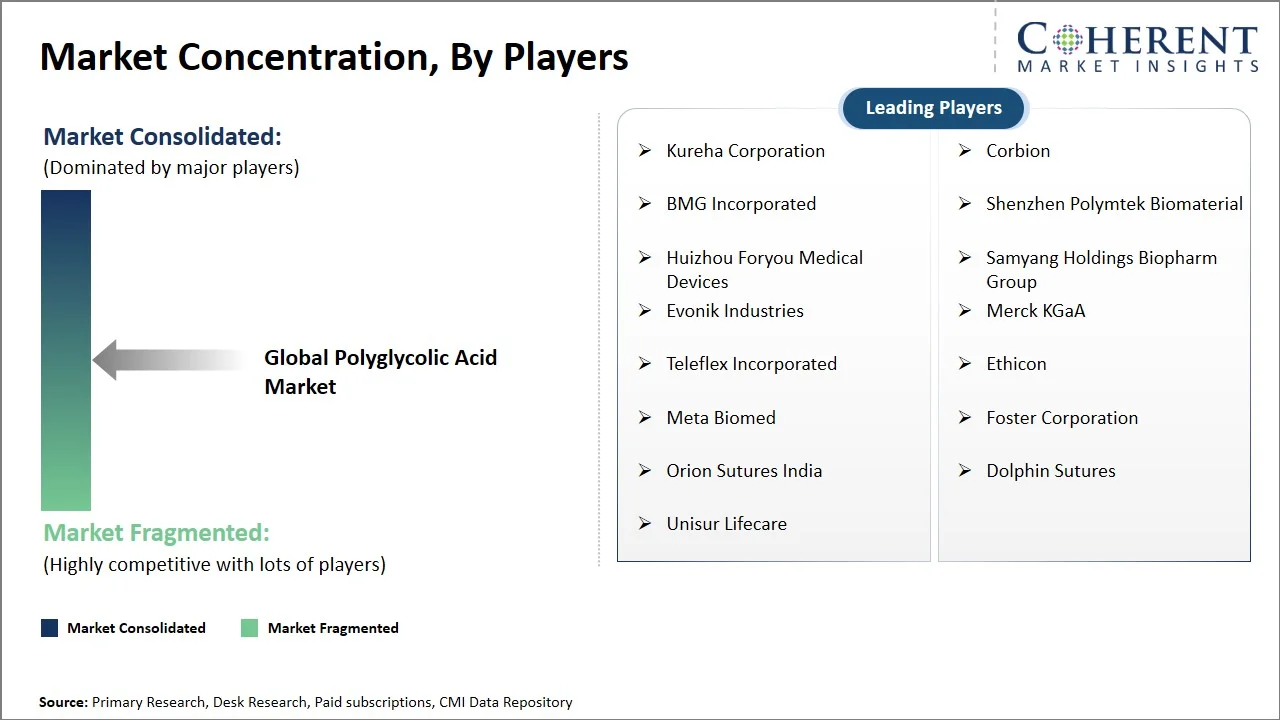
The global polyglycolic acid market is moderately consolidated at the polymer-production level but more fragmented across downstream conversion and applications. Entry barriers arise from glycolide purification, polymerization control, moisture-sensitive processing, intellectual property, and customer qualification requirements. Competition extends beyond resin price to molecular-weight consistency, degradation predictability, medical-grade documentation, conversion capabilities, and supply assurance. Regional compounders, textile processors, medical-device specialists, packaging converters, and oilfield-tool companies remain influential because they adapt polyglycolic acid to highly specific operating environments and customer performance criteria.
Key focus areas include
- Resin quality and reproducibility: Control of molecular weight, crystallinity, residual monomer, and impurities directly affects processing stability and product performance.
- Application-specific grade development: Suppliers compete by calibrating strength retention, hydrolysis rate, melt behavior, and dimensions for individual medical, packaging, and oilfield uses.
- Manufacturing and supply reliability: Customers prefer producers capable of maintaining stable output, moisture-controlled logistics, and reliable long-term delivery schedules.
- Regulatory and quality support: Medical customers value biocompatibility records, traceable production, validated processes, change-control systems, and submission-ready technical documentation.
- Downstream conversion capability: Fiber spinning, braiding, film extrusion, nonwoven fabrication, molding, and precision machining allow suppliers to capture greater value than resin-only competitors.
- Technical collaboration: Joint development with device OEMs, converters, and oilfield-service companies can embed suppliers early in product specifications and reduce substitution risk.
- Intellectual property and process knowledge: Proprietary polymerization methods, degradation-control techniques, composite designs, and processing windows create defensible barriers to market entry.
Market Report Scope
Polyglycolic Acid Market Report Coverage
| Report Coverage | Details | ||
|---|---|---|---|
| Base Year: | 2025 | Market Size in 2026: | USD 189.4 Mn |
| Historical Data for: | 2020 To 2024 | Forecast Period: | 2026 To 2033 |
| Forecast Period 2026 to 2033 CAGR: | 14.8% | 2033 Value Projection: | USD 535.3 Mn |
| Geographies covered: |
| ||
| Segments covered: |
| ||
| Companies covered: | Kureha Corporation, Corbion, BMG Incorporated, Shenzhen Polymtek Biomaterial, Huizhou Foryou Medical Devices, Samyang Holdings Biopharm Group, Evonik Industries, Merck KGaA, Teleflex Incorporated, Ethicon, Meta Biomed, Foster Corporation, Orion Sutures India, Dolphin Sutures, and Unisur Lifecare | ||
| Growth Drivers: |
| ||
| Restraints & Challenges: |
| ||
Analyst Opinion (Expert Opinion)
- The global polyglycolic acid market leadership is likely to depend increasingly on ownership of application evidence rather than polymer capacity alone. Suppliers that build proprietary relationships between resin characteristics, processing conditions, degradation behavior, and final-product performance will be able to participate earlier in customer design decisions. This could shift value toward companies offering material-selection guidance, qualification protocols, engineering support, and lifecycle documentation.
- Purchasing decisions may move from material-price comparison toward measurable procedure and operating economics. Medical-device buyers will increasingly assess whether polyglycolic acid-based systems simplify surgery or improve recovery workflows, while oilfield customers will evaluate avoided intervention, equipment use, and completion delay. This transition could pressure resin-led business models and favor participants capable of proving end-use value through testing, field data, and customer-specific performance models.
- Market participants should prioritize secure glycolide sourcing, moisture-controlled production, application testing, and partnerships with qualified converters. Commercial investment should concentrate on products with clearly defined performance windows and customers prepared to complete technical qualification. Companies should avoid building undifferentiated capacity without committed downstream demand, as processing complexity, alternative resorbable polymers, regulatory costs, and customer concentration could weaken utilization and margins.
Speak to the analyst
Want personalized insights?
Take the findings above to one of our principal consultants, or have the report rebuilt around the segments, geographies and competitors you actually track.
Market Segmentation
- Form Insights (Revenue, USD Mn, 2021 - 2033)
- Fibers
- Granules and Pellets
- Films and Sheets
- Powder
- Others
- Grade Insights (Revenue, USD Mn, 2021 - 2033)
- Industrial Grade
- Medical Grade
- Molecular Weight Insights (Revenue, USD Mn, 2021 - 2033)
- High Molecular Weight
- Low Molecular Weight
- Application Insights (Revenue, USD Mn, 2021 - 2033)
- Medical Sutures and Devices
- Oil and Gas Extraction Tools
- Barrier Packaging
- Drug Delivery and Tissue Engineering
- Others
- Regional Insights (Revenue, USD Mn, 2021 - 2033)
- North America
- U.S.
- Canada
- Latin America
- Brazil
- Argentina
- Mexico
- Rest of Latin America
- Europe
- Germany
- U.K.
- Spain
- France
- Italy
- Russia
- Rest of Europe
- Asia Pacific
- China
- India
- Japan
- Australia
- South Korea
- ASEAN
- Rest of Asia Pacific
- Middle East
- GCC Countries
- Israel
- Rest of Middle East
- Africa
- South Africa
- North Africa
- Central Africa
- North America
- Key Players Insights
- Kureha Corporation
- Corbion
- BMG Incorporated
- Shenzhen Polymtek Biomaterial
- Huizhou Foryou Medical Devices
- Samyang Holdings Biopharm Group
- Evonik Industries
- Merck KGaA
- Teleflex Incorporated
- Ethicon
- Meta Biomed
- Foster Corporation
- Orion Sutures India
- Dolphin Sutures
- Unisur Lifecare
Sources
Primary Research Interviews
- POLYGLYCOLIC ACID resin, glycolide monomer, medical-grade polymer, industrial-grade polymer, copolymer, and specialty-compound manufacturers
- POLYGLYCOLIC ACID fiber, yarn, film, sheet, granule, pellet, powder, molded-component manufacturers
- Glycolic acid, glycolide, catalysts, additives, coatings, and packaging-material suppliers
- Absorbable suture, mesh, scaffold, drug-delivery, and implant manufacturers
- Dissolvable frac plug, bridge plug, and downhole-tool manufacturers
- Packaging-film, container, and laminate manufacturers
- Hospitals, oilfield service firms, packaging converters, and pharma developers
- Executives across R&D, regulatory, procurement, manufacturing, QA, and sales functions
Stakeholders
- polyglycolic acid resin producers, glycolide manufacturers, and polymer compounders
- Medical- and industrial-grade polyglycolic acid suppliers, fiber spinners, film extruders, and molders
- Chemical, catalyst, additive, and coating suppliers
- Polymerization, extrusion, spinning, and molding equipment providers
- Medical-device OEMs, tissue-engineering firms, hospitals, and CMOs
- Oilfield-tool OEMs, drilling contractors, and E&P operators
- Packaging converters, food & pharma packaging firms, and brand owners
- Distributors, regulators, testing labs, and logistics providers
End-use Sectors
- Absorbable sutures, meshes, wound-closure devices, and implant supports
- Tissue engineering and regenerative medicine applications
- Controlled drug-delivery systems and implantable platforms
- Dissolvable oilfield plugs, balls, and isolation components
- Barrier films, multilayer packaging, bottles, and containers
- Research polymers, prototypes, and additive-manufactured structures
Regulatory and Government Bodies
- U.S. FDA, EPA, OSHA, NIST, ITC
- European Commission, ECHA, Eurostat, national authorities
- China NMPA, SAMR, MEE, customs and statistics bureaus
- Japan MHLW, PMDA, METI
- South Korea MFDS, KATS
- Health Canada, India CDSCO, Brazil ANVISA
- ISO, ASTM, USP, European Pharmacopoeia bodies
Databases
- FDA 510(k), MAUDE, EUDAMED, PMDA, NMPA, CDSCO records
- gov, WHO ICTRP, PubMed, Scopus, Web of Science
- UN Comtrade, ITC Trade Map, WTO, Eurostat, USITC
- National statistics bureaus and customs databases
- ECHA, EPA CompTox, PubChem, OECD eChemPortal
- Patent databases (WIPO, USPTO, Espacenet)
- Company filings, catalogs, pricing, and shipment data
Magazines and Journals
- Biomaterials, Acta Biomaterialia, Advanced Healthcare Materials
- Polymer journals (Macromolecules, Polymer Degradation and Stability)
- Drug delivery and pharmaceutics journals
- Petroleum engineering and SPE publications
- Packaging and sustainable materials journals
- Medical device and plastics industry magazines
Associations
- Society for Biomaterials, Controlled Release Society
- Society of Plastics Engineers, PlasticsEurope, European Bioplastics
- Society of Petroleum Engineers, API, IOGP
- MedTech Europe, AdvaMed, MDMA
- ISO, ASTM, USP, ISPE, PDA
- Packaging and plastics industry associations
Public Domain Sources
- Technical data sheets, safety data sheets, and product catalogues
- Mechanical, thermal, and degradation property data
- Medical-device regulatory clearances and clinical studies
- Oilfield performance reports and dissolution studies
- Packaging barrier and lifecycle data
- Trade, customs, and shipment records
- Company reports, patents, and press releases
- Procurement and pricing records
Key Standards and Regulations
Medical Devices
- FDA 21 CFR 878.4493 (GAM sutures)
- EU MDR 2017/745
- ISO 13485, ISO 14971, ISO 10993 series
- USP and European Pharmacopoeia standards
- ASTM F1925 (where applicable)
Oil & Gas Tools
- ISO 14310, API 11D1
- API Q1, ISO 9001
- Operator-specific qualification standards
Packaging & Food Contact
- FDA food-contact regulations
- EU 1935/2004, EU 10/2011, EU 2025/40
- National food-contact safety laws
Polymer Testing
- ISO 527, 178, 179, 1133, 11357, 11358
- ASTM D638, D790, D256, D1238, D3418, D570
- ISO 14855, ASTM D5338 (biodegradation)
- ISO 9001, 14001, 45001, 17025
- REACH, TSCA, and global chemical regulations
Proprietary Elements
- CMI Data Analytics Tool, Proprietary CMI Existing Repository of information for last 10 years.
Get access to 250+ pages report
Every segment, forecast, competitor profile and data table behind the analysis above — available for instant download.
- ESOMAR Member
- ISO 9001:2015 Certified
- D-U-N-S Registered
- GDPR & CCPA Compliant
Missing comfort of reading report in your local language? Find your preferred language:
Transform your Strategy with Exclusive Trending Reports
Frequently Asked Questions
The CAGR of the global polyglycolic acid market is projected to be 14.8% from 2026 to 2033.
The global polyglycolic acid market is estimated to be valued at USD 189.4 million in 2026 and is expected to reach USD 535.3 million by 2033.
Absorbable medical device demand increasing consumption of medical grade polyglycolic acid and dissolvable oilfield tools and barrier packaging expanding industrial applications are the major factors driving the growth of the global polyglycolic acid market.
Polyglycolic acid is primarily used in absorbable surgical products, dissolvable oilfield tools, barrier packaging, drug-delivery systems, and tissue-engineering applications.
Industrial grade leads the market due to its extensive use in dissolvable downhole components, barrier materials, and other performance-oriented industrial applications.
High molecular weight polyglycolic acid dominates because it provides the melt strength, mechanical integrity, and processing stability required for fibers, films, molded components, and medical devices.
High production costs and limited manufacturing capacity restricting commercial availability and moisture sensitivity and rapid hydrolysis increasing processing and storage complexity are the major factors hampering the growth of the global polyglycolic acid market.