

Global Portable Gas Detector Market Size and Forecast – 2026 To 2033
The global portable gas detector market is expected to grow from USD 3.00 Bn in 2026 to USD 4.60 Bn by 2033, registering a compound annual growth rate (CAGR) of 5.1% from 2026 to 2033. The global portable gas detector market is driven by increasing oil and gas exploration and production activity. On March 21, 2025, Shell approved the Gato do Mato deepwater project in Brazil's Santos Basin. The development targets production of up to 120,000 barrels per day and requires an FPSO.
Key Takeaways of the Global Portable Gas Detector Market
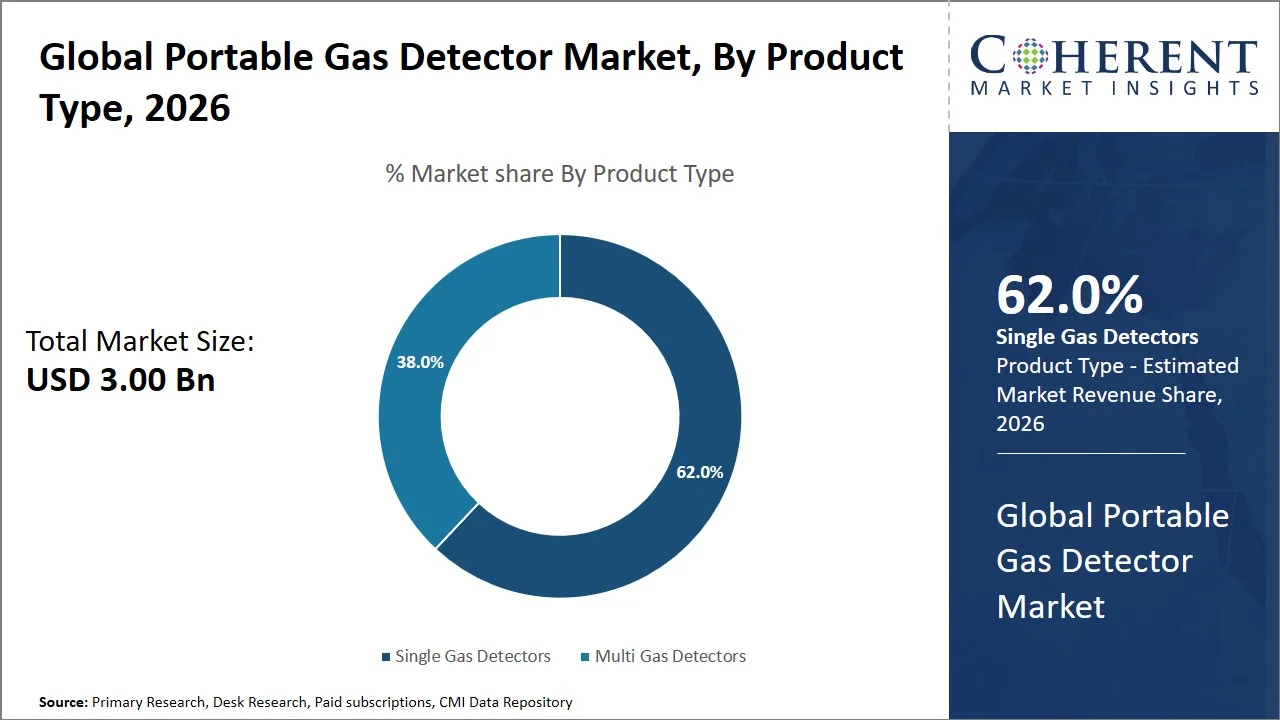
- The Single Gas Detectors segment is expected to account for 62.0 % of the global portable gas detector market share in 2026. Expansion of mining operations is driving the growth of the segment. On March 6, 2025, Rio Tinto approved a USD 1.8 billion investment for the Brockman Syncline 1 project in Western Australia. The project will process up to 34 million tons of iron ore annually.
- The Electrochemical segment is estimated to capture 39.0 % of the market share in 2026. Growing chemical and petrochemical production is majorly driving the growth of the segment. On November 3, 2025, SABIC commissioned expansions at Petrokemya and Ibn Zahr in Saudi Arabia. The projects added approximately one million metric tons of annual MTBE production capacity.
- The Carbon Monoxide segment is estimated to capture 29.0 % of the market share in 2026. Increasing confined space safety requirements is driving the growth of the segment. In September 2025, MSA Safety introduced the ALTAIR io 6 Multigas Detector for confined-space monitoring and sampling. It combines six-gas detection, cellular connectivity, and an integrated pump.
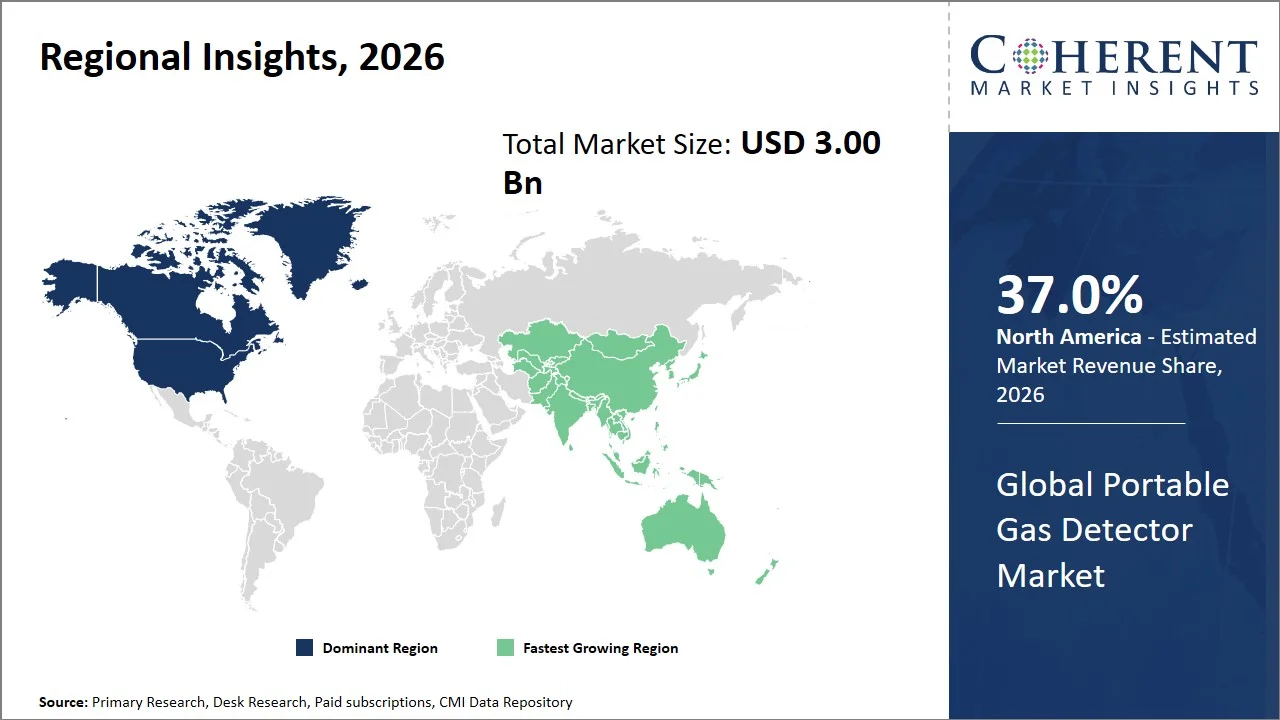
- North America is expected to dominate the portable gas detector market in 2026 with a market share of 37.0 %. Increasing use of IoT enabled detectors in North America is driving the growth of the regional market. In February 2025, Industrial Scientific secured International Electrotechnical Commission Explosion protection certification for its Ventis Pro5 multi-gas monitor.
- Asia Pacific is expected to account for 29.0 % share in 2026. Growing adoption of AI-enabled alarm analytics in Asia Pacific is driving the growth of the regional market. On June 10, 2026, IntelliView Technologies partnered with Bangkok-based SDA Group to expand its edge-based AI leak-detection solutions across Thailand and Southeast Asia.
Segmental Insights
Why Does Single Gas Detectors Dominate the Global Portable Gas Detector Market?
The single gas detectors segment is expected to account for 62.0% of the global portable gas detector market share in 2026. Single gas detectors are best used when workers are exposed to one principal gas hazard during typical industrial operations. Honeywell Lightweight units, easy to operate and numerous sorts of alarms. Designed with practicality in mind, the sensor, battery and filter are easy to change. It is capable of detecting gasses such as carbon monoxide, hydrogen sulfide, oxygen and ammonia. easy maintenance and mobility enable extensive personal monitoring in dangerous workplaces. On June 23, 2025, Teledyne launched the PS DUO portable detector, while continuing to position the Protégé ZM as its zero-maintenance single-gas monitor. The Protégé ZM is available for oxygen, hydrogen sulfide, carbon monoxide, and sulfur dioxide. It provides two years of continuous detection without routine calibration or battery charging.
- Current Industry Events of 2026
- Market Size Estimation
- Regional Breakdown
- Competitive Landscape
- Customer Intelligence
- Segmental Analysis
- Pricing Analysis
- Key Market Drivers, Challenges & Future Trends
- Customized Insights Section
Why is Electrochemical the Most Crucial Sensor Technology?
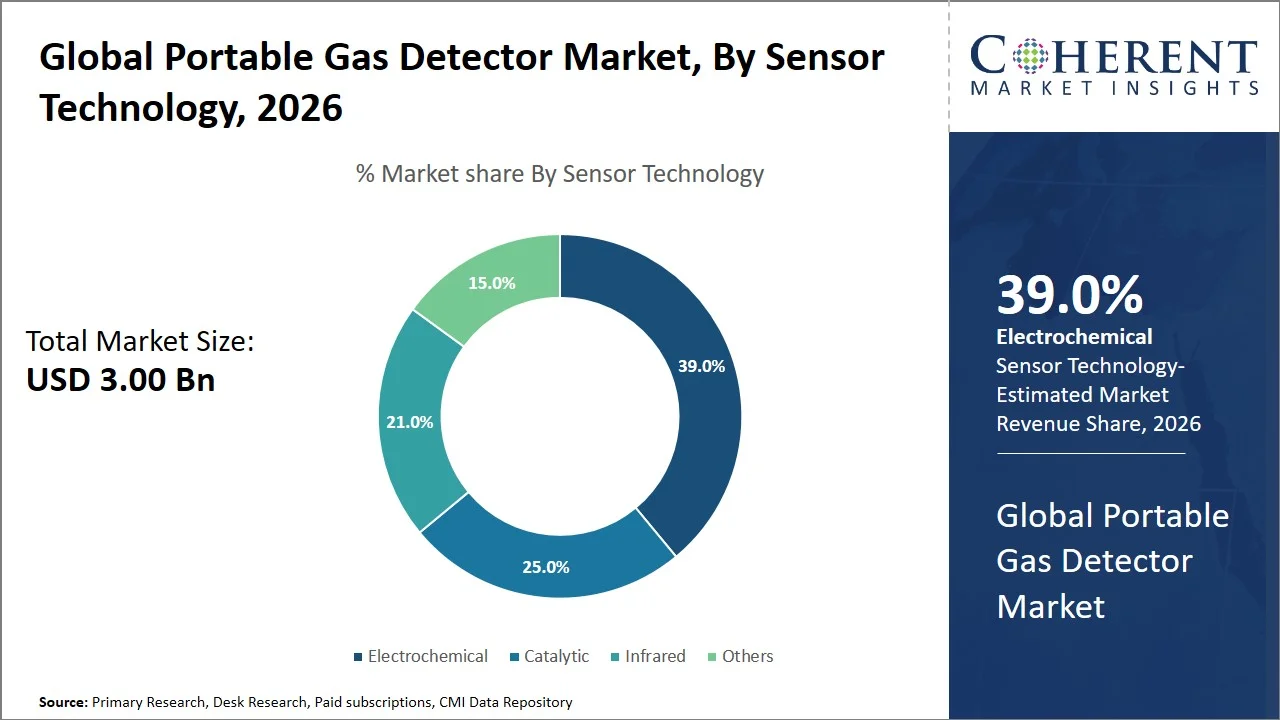
The electrochemical segment is expected to account for 39.0% of the global portable gas detector market share in 2026. Electrochemical sensors offer high sensitivity detection of harmful gasses at comparatively low concentrations. They may selectively respond and hence can be used for monitoring gasses including carbon monoxide, hydrogen sulfide, oxygen and ammonia. Compact sensor architecture enables manufacturers to integrate them into lightweight portable detectors. Low power consumption also ensures that battery powered monitoring equipment can run for extended periods of time. These qualities make electrochemical sensing very useful for personal security applications in industrial locations. For example, in June 2025, Shenzhen ProSense Technology launched their button-type electrochemical hydrogen sulfide sensor at Sensors Converge 2025. The sensor uses a solid electrolyte and supports zero-power monitoring through natural diffusion. ProSense also introduced the FC-CO-5000 carbon monoxide sensor with Underwriters Laboratories 2075 certification.
Carbon Monoxide Dominates the Global Portable Gas Detector Market
The carbon monoxide segment is expected to account for 29.0% of the global portable gas detector market share in 2026. Carbon monoxide is a common workplace hazard because it can accumulate from incomplete combustion processes. It is generated by engines, furnaces, generators, boilers, and other fuel-burning equipment. Carbon monoxide is colorless and odorless hence portable detection is crucial to protect workers. Personal detectors can signal immediately when concentrations reach harmful levels of exposure. These requirements support high demand for detection of carbon monoxide in industrial and occupational situations. On 23 September, 2025, Crowcon debuted their IQ range of connected portable detectors. The UnoIQ especially provides single gas protection for threats such as carbon monoxide. It can run for up to 65 days on a single battery charge and can be modified to detect two gasses.
Current Events and their Impact
Current Events | Description and its Impact |
United States Occupational Safety and Health Administration - Hazard Communication Standard Final Rule |
|
United States Occupational Safety and Health Administration - Permit Required Confined Spaces Standard |
|
Portable Gas Detector Market Dynamics
Market Drivers
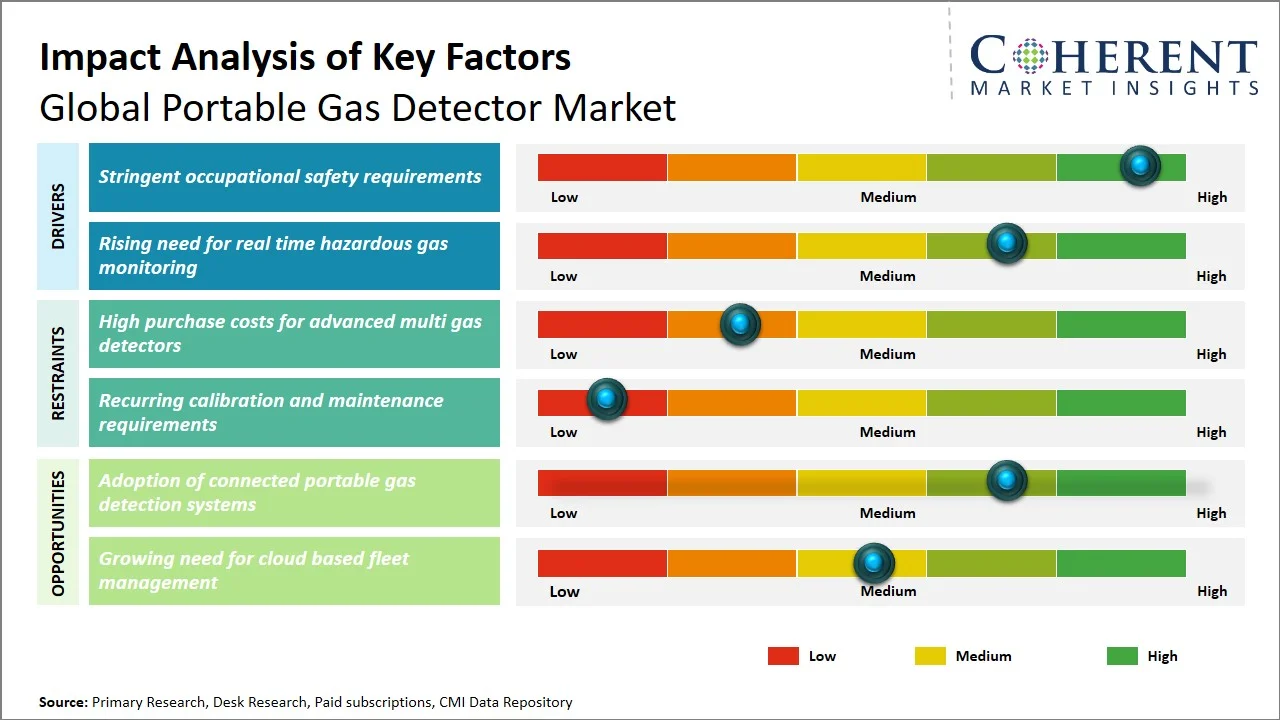
- Stringent occupational safety requirements: Strict occupational safety requirements are leading to an increase in the usage of portable gas detectors in hazardous workplaces. Employers are required by regulations to identify and control personnel exposures to hazardous, flammable, and oxygen deficient atmospheres. Many confined space procedures require air testing prior to personnel entering potentially dangerous situations. This means that sectors like oil and gas, mining, chemicals and utilities need to have reliable personal monitoring equipment. These rules stimulate the deployment of portable detectors to workers to perform continuous assessment of air hazards. At the 2025 National Safety Council Safety Congress in September 2025, Honeywell demonstrated its latest portable gas-detection technologies. Rugged reliability, easy-to-use operation, compliant performance and service support were highlighted by the corporation. It also offers detector fleet management and real-time worker exposure monitoring with its Safety Suite.
- Rising need for real time hazardous gas monitoring: Real time hazardous gas monitoring is becoming more relevant in industrial situations with changing atmospheric conditions. Portable detectors give instant readings and alarms when unsafe levels of gas are found. Workers can act promptly by abandoning places where there is danger or by following the set emergency procedures. Connected detectors can also send readings to managers to enhance oversight of worker safety. This feature allows for more widespread use in confined locations, industrial facilities, emergency response, and maintenance activities. On June 1, 2026, Industrial Scientific introduced iNet Insights to give safety professionals real-time safety intelligence. Designed to transform workflow intelligence into results, iNet Insights delivers performance to the next level with an accessible UI, robust data engine and useful insights.
Emerging Trends
- Connected Worker Safety Systems: Bluetooth, wireless connectivity and cloud services are becoming more common in portable detectors for centralized monitoring. This allows supervisors to receive worker alerts, check exposure records and manage multiple devices over geographically distributed industrial plants.
- Miniaturization And Wearable Detection: Manufacturers are creating smaller and lighter detectors that enhance worker comfort over long shifts. Wearable designs for harsh industrial conditions are increasingly being fitted with vibration alerts, rechargeable batteries, wireless communication and ruggedized housings.
- Advanced Sensor Technologies: New detectors are more and more using better electrochemical, infrared, photoionization and laser sensing technology. These advances improve the sensitivity, selectivity, reaction time and reliability of measurements of hazardous, combustible and oxygen-related dangers in the atmosphere.
- Artificial Intelligence Enabled Monitoring: AI is being widely investigated for analyzing gas detection data and recognizing aberrant exposure patterns. Predictive maintenance, fewer false alarms and helping safety teams uncover repeat gas dangers in the workplace are some of the applications of advanced analytics.
Regional Insights
Why is North America a Strong Market for Portable Gas Detector?
North America is expected to account for a market share of 37.0% in 2026. North America is characterized by strict confined-space laws and modern industrial safety operations. U.S. Occupational Safety and Health Administration requires an atmospheric test before entry into a permit-required confined area. The U.S. Occupational Safety and Health Administration requires atmospheric testing before permit-required confined-space entry. Testing covers oxygen concentration, flammable gases, vapors, and toxic contaminants. Likewise, atmospheric testing of confined spaces like manholes and utility infrastructure is required in Canada. Therefore, oil refineries, wastewater facilities, chemical plants and utility operators need portable detectors to protect workers. Another driver of regional growth is the rising use of connected worker technology. Bluetooth-enabled detectors can send worker alarms and instrument status to centralized safety platforms. These capabilities are particularly relevant for large industrial facilities managing distributed maintenance teams.
Why Does Asia Pacific Portable Gas Detector Market Exhibit High Growth?
Asia Pacific is expected to register the fastest growth with a CAGR of 6.3% over the forecast period. Asia Pacific is projected to account for 29.0% of the global portable gas detector market in 2026. Asia Pacific is experiencing strong demand from expanding mining, chemicals, manufacturing, and infrastructure operations. China requires specified underground mine workers to carry portable methane alarm instruments. India maintains government approval lists covering portable detectors for coal and metal mining applications. Japan has regulations for atmospheric measurement of oxygen deficit and hydrogen sulfide dangers Australia is likewise tightening workplace exposure limits for airborne pollutants. These requirements create diverse detection needs across mining, chemical processing, utilities, and construction. Growing investment in hydrogen production is creating an additional application for portable gas detection. Semiconductor manufacturing expansion is also increasing requirements for monitoring toxic and specialty gases.
Global Portable Gas Detector Market Outlook for Key Countries
Why is U.S. Emerging as a Major Hub in the Portable Gas Detector Market?
The U.S. portable gas detector market benefits from detailed federal requirements governing atmospheric monitoring in hazardous workplaces. Occupational Safety and Health Administration regulations require direct-reading instruments for many confined-space applications. Employers must test for oxygen, combustible atmospheres and any harmful pollutants before admission. Oil and gas activities also have risks such as hydrogen sulfide, hydrocarbon fumes, and oxygen-deficient conditions. Thus, portable monitoring equipment is required by refineries, wastewater treatment plants, grain facilities, and chemical industries. Another distinct growth driver is tied to worker safety. Detectors with Bluetooth capability can communicate alarms and equipment status in real time to supervisors. This allows for quicker emergency response over big industrial complexes.
Is China the Next Growth Engine for the Portable Gas Detector Market?
Stringent methane monitoring rules for underground coal mining operations are proving advantageous to China. The 2025 Coal Mine Safety Regulations require certain underground staff to carry portable methane alert gadgets. Workers covered include mine operators, safety personnel, blasters and electrical workers. Mines have to cross-check the portable methane readings with those from the fixed monitoring systems. Differences outside the allowable limits demand safety judgments based on the higher reading. China’s industrial production is a further driver for detector applications in chemical, manufacturing and energy sectors. Equipment manufacture climbed by 9.2% in 2025, while high-technology manufacturing grew by 9.4%. These industrial expansions create additional requirements for workplace gas monitoring.
Germany Portable Gas Detector Market Analysis and Trends
Germany benefits from its extensive chemical manufacturing and industrial processing infrastructure. North Rhine-Westphalia contains major chemical clusters requiring monitoring of toxic and combustible substances. Ludwigshafen hosts one of Europe's largest integrated chemical production sites. Industrial maintenance activities create recurring requirements for portable monitoring during plant shutdowns and confined-space work. German technology suppliers also provide sophisticated multi-gas instruments for industrial applications worldwide. Dräger portable detectors monitor oxygen, flammable gasses and a variety of dangerous gasses. The robust industrial automation network in Germany also supports the integration of detectors with digital safety systems. The development of hydrogen infrastructure also brings with it requirements for the detection of hydrogen leaks in production, storage and transport.
Japan Portable Gas Detector Market Analysis and Trends
Japan benefits from stringent controls for oxygen deficiency and hydrogen sulfide exposure in enclosed workplaces. The Oxygen Deficiency Hazard Prevention Ordinance requires oxygen measurements before certain workplace activities begin. Specific operations also require hydrogen sulfide measurements. Employers must preserve atmospheric measurement records for three years. Japan recorded two oxygen-deficiency incidents involving four workers during 2025. Hydrogen sulfide poisoning caused five incidents involving ten workers during the same year. These incidents reinforce demand for reliable atmospheric monitoring equipment. Semiconductor manufacturing is another distinct growth factor because Japanese facilities handle specialty gases under tightly controlled environments. Portable detectors therefore support both worker protection and operational safety across advanced manufacturing.
India Portable Gas Detector Market Analysis and Trends
India has strong portable detector demand from underground coal mining and expanding industrial operations. The Directorate General of Mines Safety maintains approval records for portable gas detection equipment used in mines. Approved equipment includes Dräger Pac 7000 detectors for carbon monoxide and oxygen monitoring. Industrial Scientific Ventis MX4 detectors are also included among approved multi-gas instruments. Dräger X-am 2500 and X-am 5600 models have approvals covering coal and metal mining applications. India's expanding refining, petrochemical, steel, and construction sectors provide additional applications. Increasing underground mining activity creates particularly strong requirements for methane, carbon monoxide, oxygen, and hydrogen sulfide detection.
Global Portable Gas Detector Market - Detector Connectivity Comparison by Manufacturer (2025)
Manufacturer | Representative Portable Detector | Connectivity | Communication Technology | Cloud / Software Platform |
MSA Safety | ALTAIR io 4 | Integrated cellular and Bluetooth | LTE-M, 2G fallback, Bluetooth Low Energy | MSA Grid |
Blackline Safety | G8 | Direct cellular | 4G LTE cellular | Blackline Live |
Industrial Scientific | Ventis Pro5 | Cellular, Wi-Fi, satellite, peer-to-peer | Cellular and wireless communication | iNet Now |
Dräger | X-am 5800 | Bluetooth through gateway | Bluetooth, Wi-Fi, LTE, wired internet | Gas Detection Connect |
Crowcon Detection Instruments | UnoIQ | Bluetooth and NFC | Bluetooth Low Energy, NFC | Crowcon Connect |
How is Adoption of Connected Portable Gas Detection Systems Creating New Growth Opportunities in the Portable Gas Detector Market?
Connected portable gas detection systems are creating new opportunities by converting individual detectors into continuously monitored worker-safety devices. Honeywell BW Solo uses Bluetooth Low Energy connectivity to provide real-time worker safety visibility and transmit detector data into Safety Suite. Blackline Safety G8 combines gas detection, GPS positioning, radio communication, and direct-to-cloud data streaming. Its system can transmit high-gas, STEL, TWA, fall, no-motion, and emergency alerts with worker location information. Blackline Live also provides live sensor readings, device locations, compliance records, and historical exposure information. That gives vendors the chance to sell software and monitoring on a recurrent basis together with the hardware. Connected platforms can also enable predictive exposure analysis, faster emergency response, remote calibration tracking and automatic compliance documentation. This functionality turns portable detectors from periodic measuring devices into always-connected safety infrastructure.
Market Players, Key Development, and Competitive Landscape
Key Developments
- On January 14, 2026, Teledyne Technologies Incorporated announced the acquisition of DD-Scientific Holdings Limited and its subsidiary DD-Scientific Limited. DD-Scientific develops and manufactures high-performance gas sensors for critical applications in industries that demand absolute accuracy.
- On March 12, 2025, ION Science launched the ARA-X4 as a new four-gas compliance detector. ION Science’s ARA-X4 4-gas compliance monitor is designed for use as a safety device to be worn throughout daily shifts within a range of industry sectors, tailored to detect multiple gas hazards such as oxygen enrichment or depletion, toxic gases, and combustible gases.
Competitive Landscape
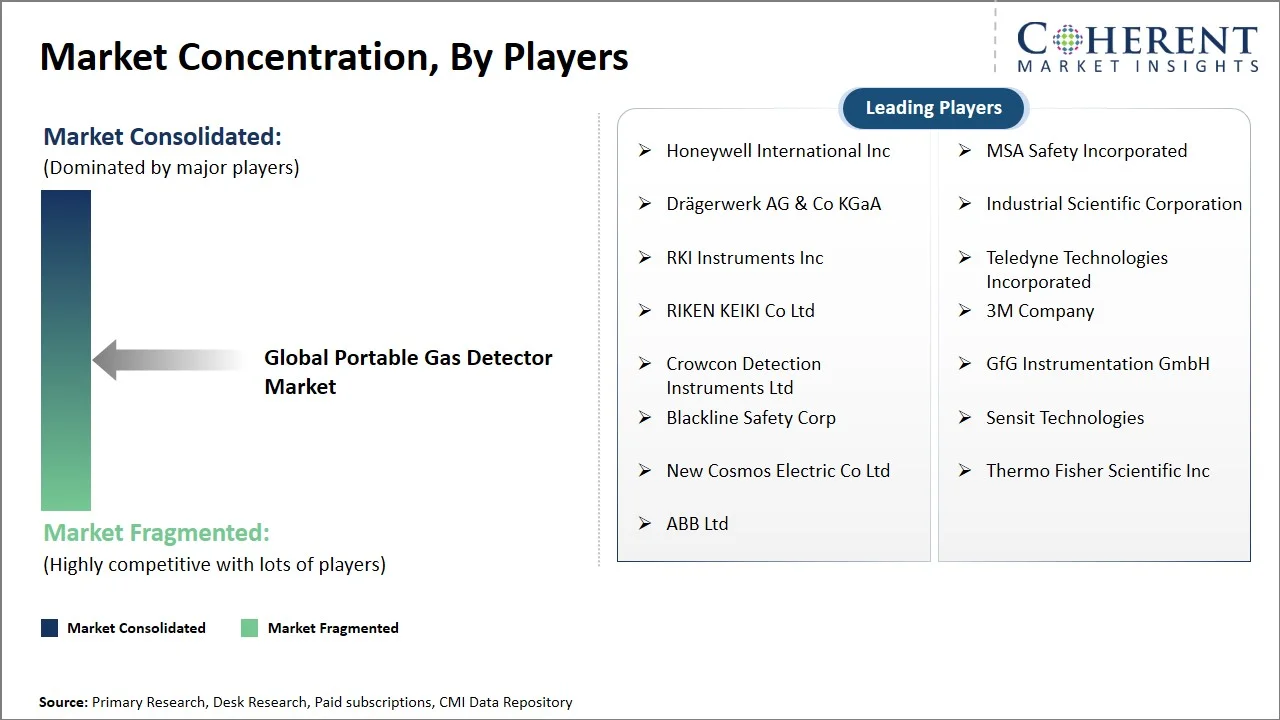
The competitive landscape is shifting from standalone detectors toward connected safety ecosystems. Honeywell International Inc. focuses on serviceability and digital fleet management through the BW Solo and Safety Suite. BW Solo provides Bluetooth Low Energy connectivity and worker-status visibility. Safety Suite also supports centralized detector data management and compliance-record automation. Blackline Safety Corp. is pursuing a stronger connected-worker strategy with its G8 platform. Launched in January 2026, G8 combines gas detection, communication, location tracking, and cloud connectivity. It supports detection of up to five gases using more than 20 sensor cartridges.
Drägerwerk AG & Co. KGaA is emphasizing integrated hardware and software through Gas Detection Connect. Its X-am and Pac devices can connect with live monitoring and asset-management functions. MSA Safety Incorporated is similarly integrating cellular connectivity through the ALTAIR io 4 and its Grid platform. The device can stream detector data to the cloud and manage large device fleets remotely.
Market Report Scope
Portable Gas Detector Market Report Coverage
| Report Coverage | Details | ||
|---|---|---|---|
| Base Year: | 2025 | Market Size in 2026: | USD 3.00 Bn |
| Historical Data for: | 2020 To 2024 | Forecast Period: | 2026 To 2033 |
| Forecast Period 2026 to 2033 CAGR: | 5.1% | 2033 Value Projection: | USD 4.60 Bn |
| Geographies covered: |
| ||
| Segments covered: |
| ||
| Companies covered: | Honeywell International Inc, MSA Safety Incorporated, Drägerwerk AG & Co KGaA, Industrial Scientific Corporation, RKI Instruments Inc, Teledyne Technologies Incorporated, RIKEN KEIKI Co Ltd, 3M Company, Crowcon Detection Instruments Ltd, GfG Instrumentation GmbH, Blackline Safety Corp, Sensit Technologies, New Cosmos Electric Co Ltd, Thermo Fisher Scientific Inc, ABB Ltd | ||
| Growth Drivers: |
| ||
| Restraints & Challenges: |
| ||
Analyst Opinion (Expert Opinion)
- The future of portable gas detection will increasingly center on connected multi-gas platforms rather than isolated alarm devices. Maximum opportunity should emerge in multi-gas detectors supporting confined-space entry and continuous worker monitoring. Blackline G8 demonstrates this direction by combining five-gas detection, cellular connectivity, location tracking, and emergency communication. Hydrogen detection should become another important product-development priority as hydrogen production and storage infrastructure expands. Manufacturers should therefore develop modular sensor cartridges supporting changing gas combinations without replacing entire devices.
- The strongest application opportunity should remain hazardous industrial workplaces requiring continuous visibility of worker exposure. Oil refineries, chemical plants, underground mines, wastewater facilities, and confined-space maintenance provide particularly suitable environments. Connected detectors can transmit alarms, locations, gas readings, and equipment status to centralized teams. Dräger already provides live monitoring, asset management, calibration information, and alarm notifications through Gas Detection Connect. Players should therefore prioritize cloud connectivity, cellular communication, GPS positioning, and automated compliance records.
- Companies seeking an edge should combine detector hardware with recurring software and service capabilities. Honeywell's Safety Suite already connects portable detector data with compliance-record management. MSA Safety enables cloud-based configuration and data streaming through the ALTAIR io 4 and Grid. Competitive differentiation should increasingly come from sensor interchangeability, battery endurance, ruggedness, automatic firmware updates, and cybersecurity. Integration with permit-to-work, workforce management, and emergency-response systems should also be prioritized.
Speak to the analyst
Want personalized insights?
Take the findings above to one of our principal consultants, or have the report rebuilt around the segments, geographies and competitors you actually track.
Market Segmentation
- Product Type Insights (Revenue, USD Billion, 2021 - 2033)
- Single Gas Detectors
- Multi Gas Detectors
- Sensor Technology Insights (Revenue, USD Billion, 2021 - 2033)
- Electrochemical
- Catalytic
- Infrared
- Others
- Gas Type Insights (Revenue, USD Billion, 2021 - 2033)
- Carbon Monoxide
- Hydrogen Sulfide
- Oxygen
- Combustible Gases
- Volatile Organic Compounds
- Ammonia
- Carbon Dioxide
- Others
- Application Insights (Revenue, USD Billion, 2021 - 2033)
- Personal Monitoring
- Confined Space Entry
- Leak Detection
- Area Monitoring
- Emergency Response
- Industrial Inspection
- Regional Insights (Revenue, USD Billion, 2021 - 2033)
- North America
- U.S.
- Canada
- Latin America
- Brazil
- Argentina
- Mexico
- Rest of Latin America
- Europe
- Germany
- U.K.
- Spain
- France
- Italy
- Russia
- Rest of Europe
- Asia Pacific
- China
- India
- Japan
- Australia
- South Korea
- ASEAN
- Rest of Asia Pacific
- Middle East
- GCC Countries
- Israel
- Rest of Middle East
- Africa
- South Africa
- North Africa
- Central Africa
- North America
- Key Players Insights
- Honeywell International Inc
- MSA Safety Incorporated
- Drägerwerk AG & Co KGaA
- Industrial Scientific Corporation
- RKI Instruments Inc
- Teledyne Technologies Incorporated
- RIKEN KEIKI Co Ltd
- 3M Company
- Crowcon Detection Instruments Ltd
- GfG Instrumentation GmbH
- Blackline Safety Corp
- Sensit Technologies
- New Cosmos Electric Co Ltd
- Thermo Fisher Scientific Inc
- ABB Ltd
Sources
Primary Research Interviews
- Gas Detection Equipment Manufacturers
- Industrial Safety Officers & HSE Managers
- Oil & Gas Industry Procurement Specialists
- Mining & Construction Site Safety Consultants
Magazines
- Occupational Health & Safety Magazine
- Gas Technology Magazine
- Industrial Safety & Hygiene News (ISHN)
- EHS Today Magazine
Journals
- Journal of Hazardous Materials
- Journal of Occupational and Environmental Hygiene
- Sensors and Actuators B: Chemical (Elsevier)
Associations
- International Safety Equipment Association (ISEA)
- American Industrial Hygiene Association (AIHA)
- Industrial Gas Detection Association (IGDA)
- National Fire Protection Association (NFPA)
Public Domain Sources
- U.S. Occupational Safety and Health Administration (OSHA) Publications
- European Agency for Safety and Health at Work (EU-OSHA) Reports
- U.S. Environmental Protection Agency (EPA) Reports
- International Labour Organization (ILO) Safety Standards & Publications
Proprietary Elements
- CMI Data Analytics Tool
- Proprietary CMI Existing Repository of Information for the Last 10 Years
Get access to 250+ pages report
Every segment, forecast, competitor profile and data table behind the analysis above — available for instant download.
- ESOMAR Member
- ISO 9001:2015 Certified
- D-U-N-S Registered
- GDPR & CCPA Compliant
Missing comfort of reading report in your local language? Find your preferred language:
Frequently Asked Questions
The global portable gas detector market is expected to stand at USD 3.00 Bn in 2026 and is expected to reach USD 4.60 Bn by 2033.
The CAGR of the global portable gas detector market is projected to be 5.1% from 2026 to 2033.
Connected detectors transmit alarms, worker locations, gas readings, and device information to centralized platforms.
Bluetooth enables short-range communication between detectors, smartphones, gateways, and safety-management platforms.
Cellular connectivity enables remote transmission of worker alarms and detector information over wider areas.
Mining operations require portable monitoring for methane, oxygen deficiency, carbon monoxide, and other hazardous gases.
Expanding hydrogen production and storage creates additional requirements for hydrogen leak detection.