

Global Portable Stove Market Size and Forecast – 2026 To 2033
The global portable stove market is expected to grow from USD 670 Mn in 2026 to USD 1,024 Mn by 2033, registering a compound annual growth rate (CAGR) of 5.6% from 2026 to 2033. The market is driven by growing popularity of backpacking and hiking. On March 25, 2025, REI Co-op introduced its new spring backpacking line designed to help people explore. From essential gear to an innovative modular bear canister, REI Co-op’s spring product lineup is built for the trail.
Key Takeaways of the Global Portable Stove Market
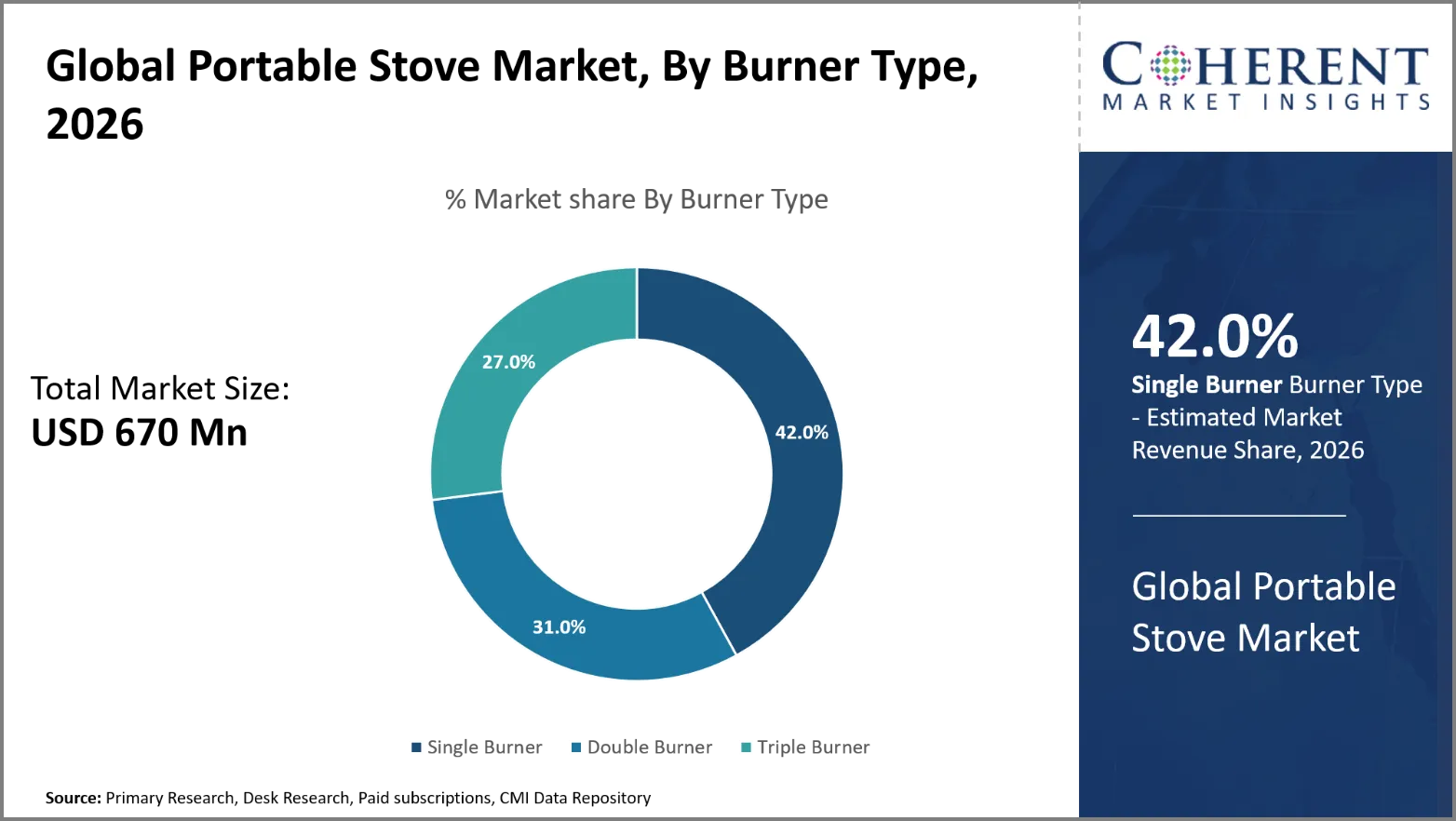
- The Single Burner segment is expected to account for 42.0% of the global portable stove market share in 2026. Expansion of vehicle accessible camping is driving the growth of the segment.
- The Backpacking Stoves segment is estimated to capture 39.0% of the market share in 2026. Increasing demand for compact cooking equipment is majorly driving the growth of the segment. In 2025, GSI Outdoors introduced the Selkirk 270 Butane Stove as part of its new compact cooking range. The stove uses a stable die-cast cooking base for larger cookware.
- The Propane segment is estimated to capture 31.0% of the market share in 2026. Greater availability through online retail is driving the growth of the segment. For instance, Amazon India reported strong camping-product demand in 2025, particularly across Madhya Pradesh.
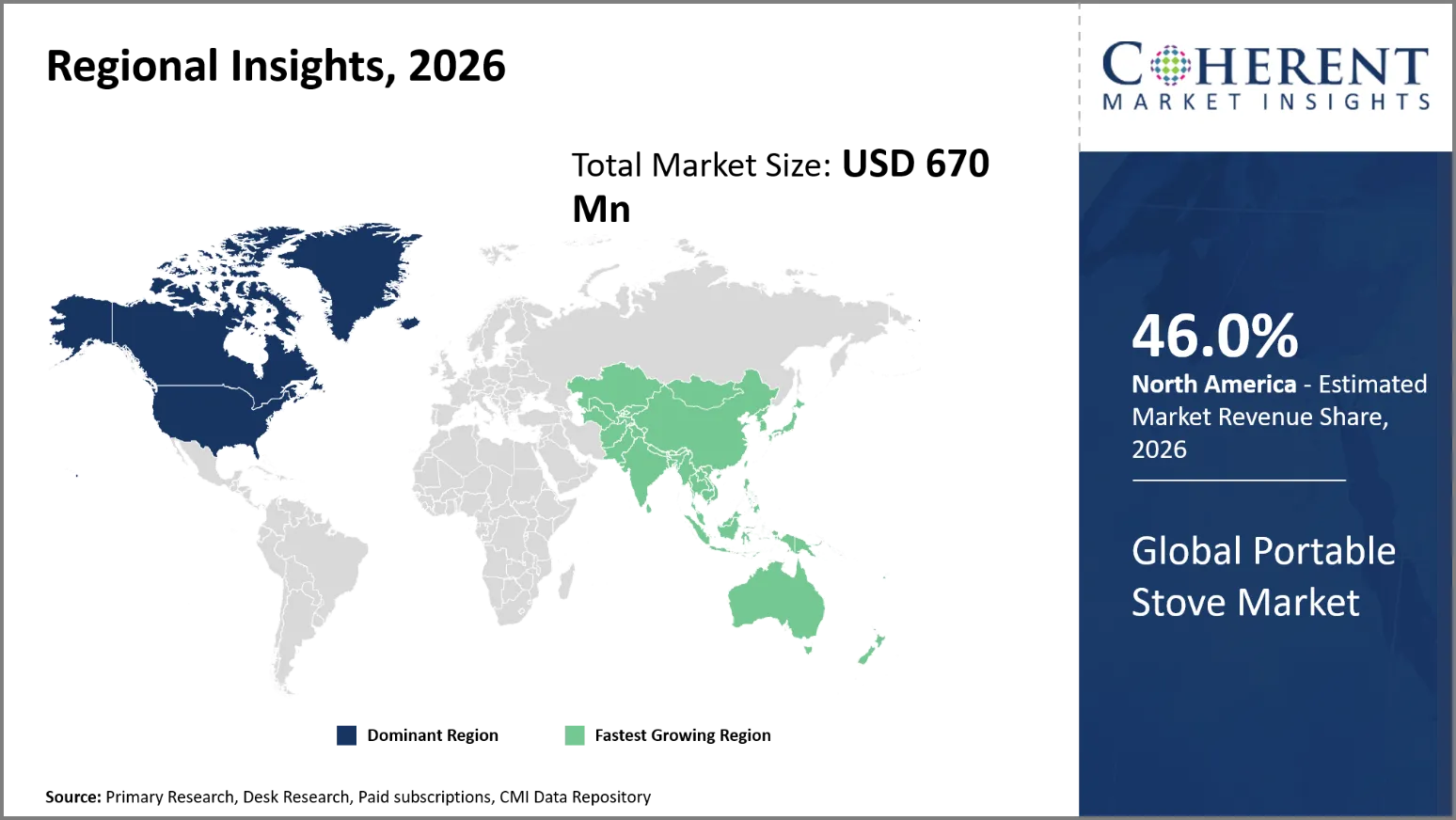
- North America is expected to dominate the portable stove market in 2026 with a market share of 46.0%. Growing preference for multi fuel flexibility in North America is driving the growth of the regional market. For example, Mountain Safety Research continued promoting its WhisperLite International system in 2025-2026, supporting white gas, kerosene, and unleaded gasoline.
- Asia Pacific is expected to account for 22.0% share in 2026. Increasing demand for fuel efficient stove designs in Asia Pacific is driving the growth of the regional market. On April 11, 2024, Primus introduced the Ulti stove system for demanding outdoor conditions. Its catalytic burner produces approximately 3,000 watts of infrared heat across the burner surface.
Segmental Insights
Why Does Single Burner Dominate the Global Portable Stove Market?
The single burner segment is expected to account for 42.0% of the global portable stove market share in 2026. The single burner stoves are common because of their compactness, inexpensive cost and simple operation for outdoor cooking. Their light-weight design is perfect for backpacking, hiking, camping and emergency cooking needs. Single burner devices are often less expensive than multi burner equivalents since less material is necessary. Their small size means they may be easily transported, stored and set up in many different outdoor conditions. These benefits make single burner stoves a good choice for casual users and avid outdoor enthusiasts. In March 2025, Jetboil introduced the redesigned Flash 1.0, retaining its compact single-burner format. The upgraded model had a ceramic-encased ignition system and a modified pot-locking mechanism. 13 ounces and about 90 seconds of boiling time make it perfect for speedy cooking outside.
- Current Industry Events of 2026
- Market Size Estimation
- Regional Breakdown
- Competitive Landscape
- Customer Intelligence
- Segmental Analysis
- Pricing Analysis
- Key Market Drivers, Challenges & Future Trends
- Customized Insights Section
Why is Backpacking Stoves the Most Preferred Product Type?
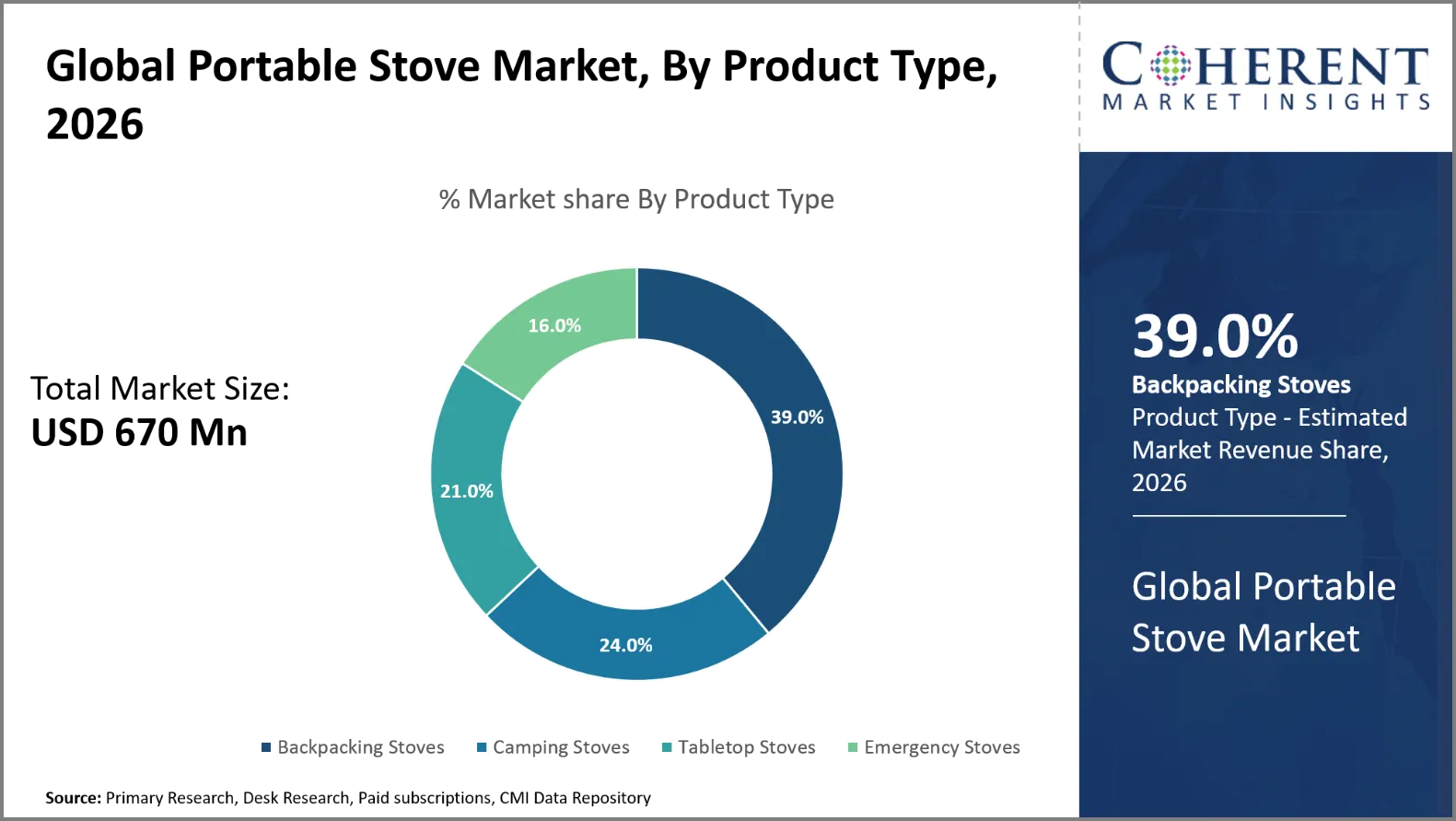
The backpacking stoves segment is expected to account for 39.0% of the global portable stove market share in 2026. Backpacking stoves are favored as their lightweight structure allows for easy transporting during outdoor activities. Small enough to put in a backpack or camp gear. It helps customers to save fuel when on a long trekking and camping adventures. Quick setup also makes it easy to prepare meals at remote outdoor areas. These features make backpacking stoves perfect for hikers, trekkers and outdoor enthusiasts. For example, MSR’s PocketRocket 2 continued to garner great market attention in 2025. The stove weighs about 2.6 ounces and is designed for one and two-person cooking arrangements. Its compact burner and folding supports make it suitable for backpacking equipment kits. The model was featured in major 2025 outdoor retail promotions.
Propane Dominates the Global Portable Stove Market
The propane segment is expected to account for 31.0% of the global portable stove market share in 2026. Propane enables accessible fuel availability for camping, outdoor cooking and disaster preparedness applications. Its pressurized configuration allows for dependable stove performance under a variety of outside circumstances. Propane also offers continuous heat output for boiling, heating and meal prep. Users can store compatible propane cylinders for reuse in outdoor cooking. These practical benefits make them a good candidate for widespread use by campers and outdoor leisure users. On June 19, 2026, Primus announced the Moto Stove for vehicle camping and rooftop-tent users. The two-burner system provides 4,400 watts per burner and uses separate flame controls. Its compact design targets campers wanting stronger propane cooking capabilities without carrying conventional household equipment.
Current Events and their Impact
Current Events | Description and its Impact |
European Union Gas Appliances Regulation (EU) 2016/426 |
|
European Union Market Surveillance Regulation (EU) 2019/1020 |
|
Portable Stove Market Dynamics
Market Drivers
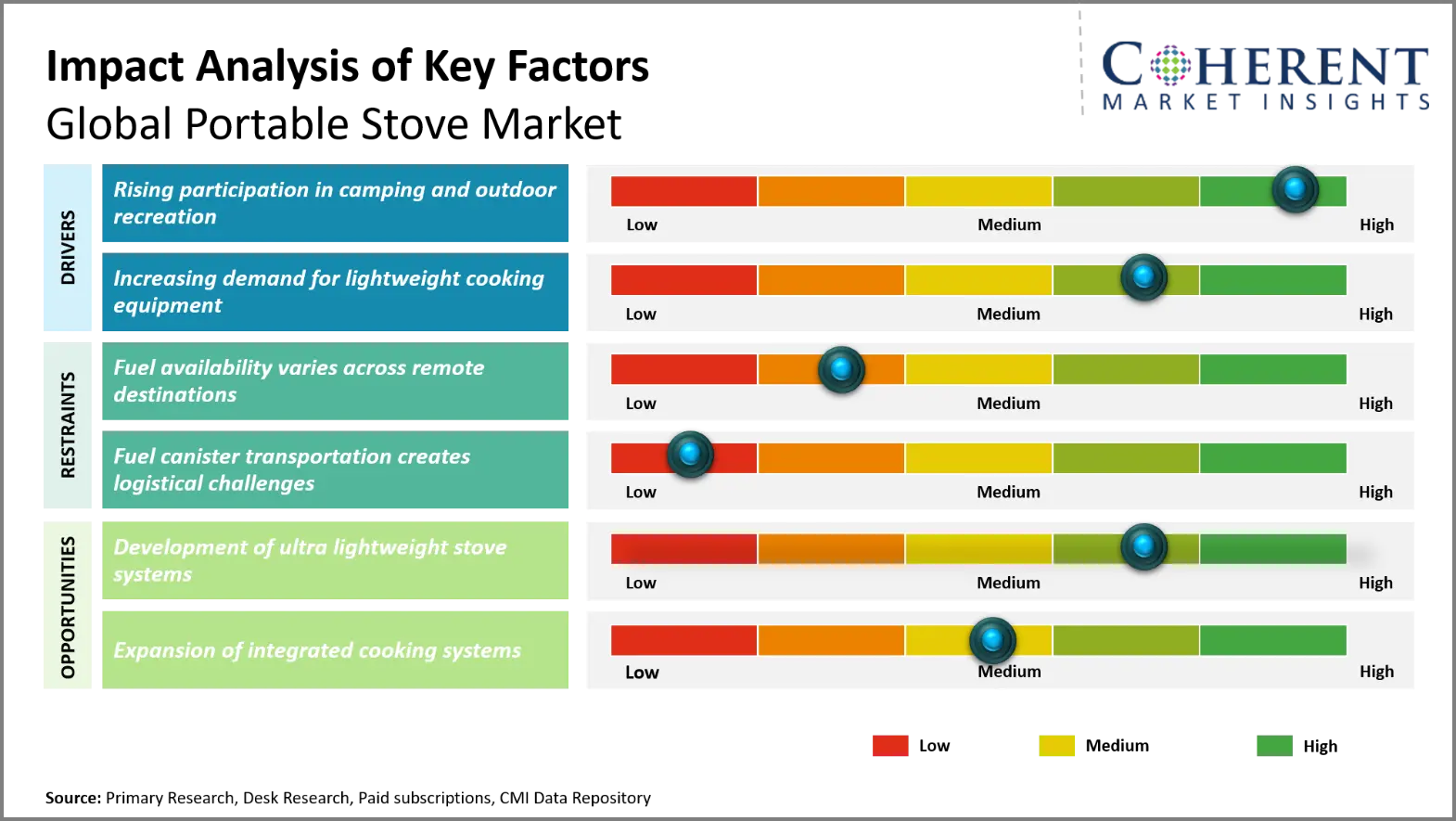
- Rising participation in camping and outdoor recreation: Increasing engagement in camping and outdoor recreation is driving demand for portable cooking equipment. More and more people are selecting leisure activities such as camping, hiking, trekking and recreational travel. Portable stoves are an easy way to cook at campsites and distant spots in the outdoors. The growth of outdoor activity is also prompting manufacturers to produce multi-purpose, small cooking equipment. This larger participant pool helps to sustain demand for portable stoves in the primary outdoor recreation markets. On May 20, 2025, Hipcamp expanded its U.S. campsite inventory, reaching more than 500,000 available campsites. The extension brought public-land sites to private farms, ranches, and recreational vehicle campsites. The bigger stock means more options for campers in national parks, woods and other outdoor destinations.
- Increasing demand for lightweight cooking equipment: The need for lightweight cooking equipment is increasing as outdoor enthusiasts want mobility and ease. Backpackers and hikers need equipment that reduces the weight they have to carry for lengthy periods of outdoor activity. Compact portable stoves offer practical cooking capability in a small pack footprint. To combat this, producers are using lighter materials, more compact buildings and integrated cooking systems. These trends are increasing the need for portable lightweight stoves for trekking and recreational camping. On July 20, 2026, Sea to Summit announced the launch of the XLite Cook Set for backpackers and minimalist campers. The five-piece kit weighs just over 17 oz. and includes a foldable two-liter pot. Its nested structure minimizes packed volume while maintaining numerous cooking and serving components.
Emerging Trends
- Ultra-Lightweight Stove Development: Manufacturers are developing light weight metals and compact constructions to lower the load to carry for backpackers, hikers and long-distance trekkers looking for an effective outdoor cooking option.
- Integrated Cooking Systems: Integrated stove systems are garnering interest as they combine burners, cookware, wind protection, and heat exchange components in compact containers to improve cooking efficiency and simplify transportation of equipment.
- Multi-Fuel Compatibility: Increasingly, portable stoves are compatible with several fuel types allowing outdoor users to adjust cooking equipment to multiple destinations, climates and fuel availability situations for camping, trips and emergency preparedness activities.
- Improved Ignition Technologies: Manufacturers are implementing reliable piezoelectric and electronic igniting technologies to enable the operation of stoves, minimize preparation time, and increase convenience for consumers utilizing portable cooking and food service equipment during outdoor recreational activities.
Regional Insights
Why is North America a Strong Market for Portable Stove?
North America is expected to account for a market share of 46.0% in 2026. The region benefits from established camping infrastructure and strong vehicle accessible camping participation. The U.S. recorded 42.3 million vehicle accessible campers during 2025. More than two million new campers joined within one year. Camping also overlaps strongly with hiking, fishing, and birding activities. Canada adds significant demand through national park camping and backcountry recreation. Parks Canada recorded 882,045 camping nights during fiscal 2024-25. Banff National Park recorded 4.515 million visitors during 2025. Front country campgrounds recorded 292,033 site nights. These participation patterns support demand for compact propane and backpacking stoves.
Why Does Asia Pacific Portable Stove Market Exhibit High Growth?
Asia Pacific is expected to register the fastest growth with a CAGR of 7.1% over the forecast period. The region is projected to account for 22.0% of the global portable stove market in 2026. Asia Pacific benefits from rapidly expanding outdoor recreation across China, Japan, India, and Southeast Asia. Camping-related activity in China amounted to USD 318.75 billion in 2024. There are about 730 youth outdoor camps open in 2024, according to the National Sports Administration. These camps enrolled around 6.55 million youths. Japan has a long tradition of camping and many manufacturers of specialist outdoor equipment. Family-oriented camping and hiking participation is also growing in China. Guangxi recorded a 50% annual increase in campground searches during the 2025 Tomb-Sweeping Festival.
Global Portable Stove Market Outlook for Key Countries
Why is U.S. Emerging as a Major Hub in the Portable Stove Market?
The U.S. benefits from exceptionally broad participation across camping formats and outdoor activities. Vehicle accessible camping reached 42.3 million participants during 2025. Participation increased by more than five percent during that year. More than 2 million additional campers joined compared with the previous year. Camping also acts as an entry point into hiking, fishing, and birding. Approximately 93% of campers participate in additional outdoor activities. This cross-activity behavior supports demand for compact stoves across family camping, backpacking, and recreational travel. Casual campers are particularly important because they continue expanding the consumer base.
Is China the Next Growth Engine for the Portable Stove Market?
Organized camping and outdoor lifestyle participation are growing quickly in China. Camping searches in Guangxi surged 50% year over year during the 2025 Tomb-Sweeping Festival. Outdoor equipment retailers in Nanning say their revenue grew annually for the last three years. One merchant saw a 30 percent year-over-year revenue gain in camping and hiking. China’s camping activity hit 2139.7 billion yuan in 2024, according to the National Sports Administration. Nearly 730 youth outdoor camps served approximately 6.55 million young participants.
Japan Portable Stove Market Analysis and Trends
Japan offers strong opportunities because camping is supported by an established outdoor recreation culture. The Japan Camping Association continues promoting sustainable camping through its Vision 2025 program. Its 2025 programs are focused on climate issues and environmental responsibility. The group also emphasizes the control of psychological, physical and environmental risks for campers. Japan’s specialized equipment ecosystem reinforces demand for compact cooking systems. Companies like Snow Peak and Soto Outdoors have produced lightweight outdoor cooking items. With Japan’s hilly topography, hiking and trekking with portable cooking equipment is also possible. Compact canister stoves suit these activities because transportation efficiency remains important for hikers.
Canada Portable Stove Market Analysis and Trends
Canada benefits from extensive national parks, campground infrastructure, and strong participation in nature-based recreation. Parks Canada recorded 23.2 million visitors during fiscal 2024–25. Its administered campgrounds recorded 882,045 camping nights during the same period. Banff National Park recorded a record 4.515 million visitors during 2025. Front country campgrounds generated 292,033 site nights. Jasper National Park recorded 438,800 front country campers during 2025. Backcountry camping also recovered to 12,300 campers. These conditions support demand for reliable stoves suited to extended camping and backcountry travel.
India Portable Stove Market Analysis and Trends
India offers increasing potential in hiking, mountain tourism and growing engagement in outdoor leisure. The Himalayan states have many trekking destinations and need lightweight cooking equipment for multi-day trekking trips. Trekking ecosystems have been set up in Uttarakhand, Himachal Pradesh, Sikkim and Jammu and Kashmir. Portable stoves are especially handy where trekkers need independent cooking appliances away from established facilities. Adventure tourism businesses are increasingly combining trekking and camping experiences. Demand for compact outdoor equipment is also supported by younger travelers' greater involvement. Weekend camping near major cities is becoming more popular, which increases demand. These conditions favor lightweight gas and integrated stove systems for short outdoor trips.
Global Portable Stove Market - Integrated Cooking System Adoption by Region (2025)
Region | Estimated Adoption |
North America | 35% |
Europe | 28% |
Asia Pacific | 23% |
Latin America | 8% |
Middle East and Africa | 6% |
Global Portable Stove Market - Premium Stove Feature Adoption by Region (2025)
Region | Estimated Premium Feature Adoption |
North America | 38% |
Europe | 32% |
Asia Pacific | 26% |
Latin America | 18% |
Middle East and Africa | 15% |
How is Development of Ultra Lightweight Stove Systems Creating New Growth Opportunities in the Portable Stove Market?
Development of ultra lightweight stove systems is creating growth opportunities by reducing pack weight without sacrificing cooking performance. SOTO’s WindMaster weighs 67 grams with its TriFlex support and delivers 3,260 watts of output. MSR’s PocketRocket Deluxe weighs 83 grams and boils one liter in 3.3 minutes. These products combine lightweight construction with pressure regulation, wind resistance, and reliable ignition. This engineering allows manufacturers to sell to fastpacking, ultralight backpacking and long-distance trekking consumers who want to shed equipment weight. On April 14, 2026, Katadyn introduced the Optimus Gemini II, using a fold-flat structure weighing 760 grams. Although heavier than ultralight backpacking stoves, its design substantially reduces bulk compared with conventional dual-burner equipment. The launch shows lightweight engineering expanding beyond single-burner systems.
Market Players, Key Development, and Competitive Intelligence

Key Developments
- On February 23, 2026, Jetboil launched the TrailCook stove system with 1.2-liter and 2.0-liter configurations. The system adds precision simmering, sautéing, and stir-frying capabilities to compact outdoor cooking. This expands Jetboil's focus beyond rapid boiling toward full meal preparation.
- On July 4, 2025, Primus launched the Micron Stove III, positioning it as its lightest and most packable stove. The stove weighs only 58 grams and targets users prioritizing minimum pack weight. This launch strengthens Primus's position in ultralight backpacking equipment.
Competitive Landscape
SOTO, Jetboil, MSR, and Primus are leading the competitive field, each with their own performance advantages. SOTO specializes in ultralight burners, Wind resistance and pressure adjustment using WindMaster technology. The WindMaster with TriFlex support weighs 67 grams and stands up well in windy circumstances. Jetboil’s integrated systems are intended for ultralight backpackers and the Stash tips the scales at 7.1 ounces. The Stash fits inside its pot and brings water to a boil in 2.5 minutes. Primus’ Essential Trail range blends lightweight construction, stability and fuel efficiency. Its Essential Trail Stove weighs 112 grams and delivers 2,500 watts. These strategies show increasing competition around weight reduction, wind performance, integrated packing, and cooking speed.
Global Portable Stove Market Report Coverage | |||
Report Coverage | Details | ||
Base Year | 2025 | Market Size in 2026: | USD 670 Mn |
Historical Data For: | 2020 To 2024 | Forecast Period: | 2026 To 2033 |
Forecast Period 2026 To 2033 CAGR: | 5.60% | 2033 Value Projection: | USD 1,024 Mn |
Geographies covered: |
| ||
Segments covered: |
| ||
Companies covered: | The Coleman Company, Inc, Mountain Safety Research, Jetboil, Inc, Camp Chef, Primus AB, Snow Peak, Inc, Kovea Co, Ltd, Soto Outdoors, Inc, GSI Outdoors, Optimus, BioLite, Inc, Fire-Maple, Trangia, Vargo Outdoors, Iwatani Corporation | ||
Growth Drivers: |
| ||
Restraints & Challenges: |
| ||
Analyst Opinion (Expert Opinion)
- It is expected that portable stoves will shift toward lighter systems with stronger performance under demanding outdoor conditions. Burner efficiency, ignition reliability, and wind resistance will become more important alongside weight reduction. Integrated cooking systems should gain attention because they combine burners, cookware, and compact storage. Jetboil already demonstrates this direction through its nesting Stash system. SOTO is also strengthening this segment through lightweight construction and regulator technology.
- The strongest opportunity should concentrate on backpacking stoves, integrated systems, and ultralight applications. The U.S. should remain important because of its large outdoor recreation base. Asia Pacific offers tremendous opportunity, particularly China and Japan. China can support demand through growing camping and outdoor engagement. Japan already has an ecosystem for outdoor equipment that creates potential for premium compact equipment. Hence manufacturers should focus on lightweight equipment for multi-day treks and fastpacking.
- Players looking for an edge should be generating measurable performance gains, not simply reducing product weight. The example of this strategy is SOTO with the combination of 67-gram structure, wind resistance and constant production. Jetboil is a minimal weight system with built in cookware and quick boiling. Primus focuses on stability, precision flame control and compact packing. Companies should also expand compatible accessories, fuel efficiency features, and modular cookware systems.
Speak to the analyst
Want personalized insights?
Take the findings above to one of our principal consultants, or have the report rebuilt around the segments, geographies and competitors you actually track.
Market Segmentation
- Burner Type Insights (Revenue, USD Million, 2021 - 2033)
- Single Burner
- Double Burner
- Triple Burner
- Product Type Insights (Revenue, USD Million, 2021 - 2033)
- Backpacking Stoves
- Camping Stoves
- Tabletop Stoves
- Emergency Stoves
- Fuel Type Insights (Revenue, USD Million, 2021 - 2033)
- Propane
- Butane
- Isobutane
- Liquid Fuel
- Wood
- Alcohol
- Technology Type Insights (Revenue, USD Million, 2021 - 2033)
- Conventional
- Piezoelectric Ignition
- Integrated Cooking Systems
- Application Insights (Revenue, USD Million, 2021 - 2033)
- Camping
- Hiking
- Backpacking
- Hunting
- Emergency Preparedness
- Commercial Outdoor Cooking
- Regional Insights (Revenue, USD Million, 2021 - 2033)
- North America
- U.S.
- Canada
- Latin America
- Brazil
- Argentina
- Mexico
- Rest of Latin America
- Europe
- Germany
- U.K.
- Spain
- France
- Italy
- Russia
- Rest of Europe
- Asia Pacific
- China
- India
- Japan
- Australia
- South Korea
- ASEAN
- Rest of Asia Pacific
- Middle East
- GCC Countries
- Israel
- Rest of Middle East
- Africa
- South Africa
- North Africa
- Central Africa
- North America
Sources
Primary Research Interviews
- Portable Stove Manufacturers & OEMs
- Outdoor & Camping Equipment Retailers
- Fuel Cartridge Suppliers & Distributors
- Outdoor Recreation & Adventure Tourism Operators
Magazines
- Outdoor Retailer Magazine
- Camping & Hiking World Magazine
- Backpacker Magazine
- Adventure Travel & Outdoor Gear Review
Journals
- Journal of Outdoor Recreation and Tourism
- International Journal of Consumer Studies
- Journal of Sustainable Energy & Environment
Associations
- Outdoor Industry Association (OIA)
- Specialty Food Equipment Manufacturers Association (SFEMA)
- Camping & Outdoor Leisure Association (COLA)
- European Outdoor Group (EOG)
Public Domain Sources
- U.S. Consumer Product Safety Commission (CPSC) – Safety Standards for Portable Stoves
- World Trade Organization (WTO) – Trade Statistics for Cooking Equipment
- U.S. Census Bureau – Manufacturing & Trade Data
- European Commission – Product Safety & Market Surveillance Reports
Proprietary Elements
- CMI Data Analytics Tool
- Proprietary CMI Existing Repository of information for last 10 years
Get access to 250+ pages report
Every segment, forecast, competitor profile and data table behind the analysis above — available for instant download.
- ESOMAR Member
- ISO 9001:2015 Certified
- D-U-N-S Registered
- GDPR & CCPA Compliant
Missing comfort of reading report in your local language? Find your preferred language:
Frequently Asked Questions
The global portable stove market is expected to stand at USD 670 Mn in 2026 and is expected to reach USD 1,024 Mn by 2033.
The CAGR of the global portable stove market is projected to be 5.6% from 2026 to 2033.
Rising participation in camping and outdoor recreation and Increasing demand for lightweight cooking equipment are the major factors driving the growth of the global portable stove market.
Fuel availability varies across remote destinations and Fuel canister transportation creates logistical challenges are the major factors hampering the growth of the global portable stove market.
In terms of burner type, single burner segment is estimated to dominate the market revenue share in 2026.
Their compact dimensions and lightweight construction reduce equipment burden during extended outdoor journeys.
Wind resistance helps maintain flame stability and cooking performance during exposed outdoor conditions.