

Global Kitchenware Market Size and Forecast – 2026 To 2033
The Global Kitchenware Market is estimated to be valued at USD 85.74 Bn in 2026 and is expected to reach USD 130.63 Bn by 2033, exhibiting a compound annual growth rate (CAGR) of 6.2% from 2026 to 2033. This growth is supported by rising consumer interest in home cooking, increasing disposable incomes, expanding urban households, and stronger preference for durable, health-safe, and premium kitchenware products.
Demand is also shifting toward cookware and utensils that combine functionality, aesthetics, and compatibility with modern kitchens. In July 2025, Cumin Co. launched India’s first 100% toxin-free enamel cast iron cookware range, including tawas, skillets, and Dutch ovens, reflecting growing consumer preference for safe, long-lasting, and design-forward kitchenware products.
Key Takeaways of the Global Kitchenware Market
- By product type, cookware is expected to dominate the global kitchenware market with 32.6 % share in 2026, supported by frequent household replacement cycles, broader product innovation, and consumer preference for multifunctional pans, pots, and premium everyday cooking formats. In January 2025, Groupe SEB announced the Tefal and Paul Bocuse premium cookware collection, including frypans, woks, saucepans, and stewpot formats.
- By material, stainless steel is expected to lead with 34.8 % of the market share in 2026, as buyers prioritize durability, food safety perception, induction compatibility, and long product life across both residential and commercial kitchens. In April 2026, Ninja expanded its EverClad stainless steel cookware range in the U.K., highlighting tri-ply construction and non-toxic positioning to compete with established premium cookware brands.
- The mass segment is expected to hold the largest market share of 52.4 % in 2026, reflecting strong demand for affordable, functional, and design-led kitchen essentials across organized retail and online channels. In September 2023, Target launched Figmint, its first owned kitchen brand, with more than 250 kitchenware items and prices starting at USD 3.
- Asia Pacific is expected to remain the dominant region with 31.6 % share in 2026, supported by urban households, rising middle-class spending, and localization of kitchen products for regional cooking habits. In June 2025, Tefal expanded its India kitchen range at Tefal Première in New Delhi, including cookware, pressure cookers, blenders, and air fryers tailored for Indian homes.
- Europe is expected to be the fastest-growing region with 29.4 % share in 2026, helped by premium cookware adoption, sustainability-led product replacement, and demand for locally made durable kitchenware. In February 2026, Le Monde reported that French cookware specialist, Cristel planned a second production site to support rising demand for stainless steel cookware and export growth.
- Sustainable Material Transition: Kitchenware brands are increasingly moving toward recyclable metals, coating alternatives, reusable storage formats, and longer-life product designs. This trend is reshaping sourcing strategies, supplier selection, and product positioning, as manufacturers balance environmental claims with performance, safety, and affordability. Brands that can combine durability with credible sustainability narratives are likely to capture stronger retailer preference and consumer loyalty.
- Omnichannel Brand Expansion: Kitchenware is shifting from purely utility-based purchasing to experience-led buying across e-commerce, modern retail, quick commerce, and brand-owned channels. Companies are using bundled assortments, influencer-led cooking content, and seasonal product drops to improve conversion. This strengthens private labels and premium brands alike, while increasing competitive pressure on mid-tier players with limited digital visibility.
Segmental Insights
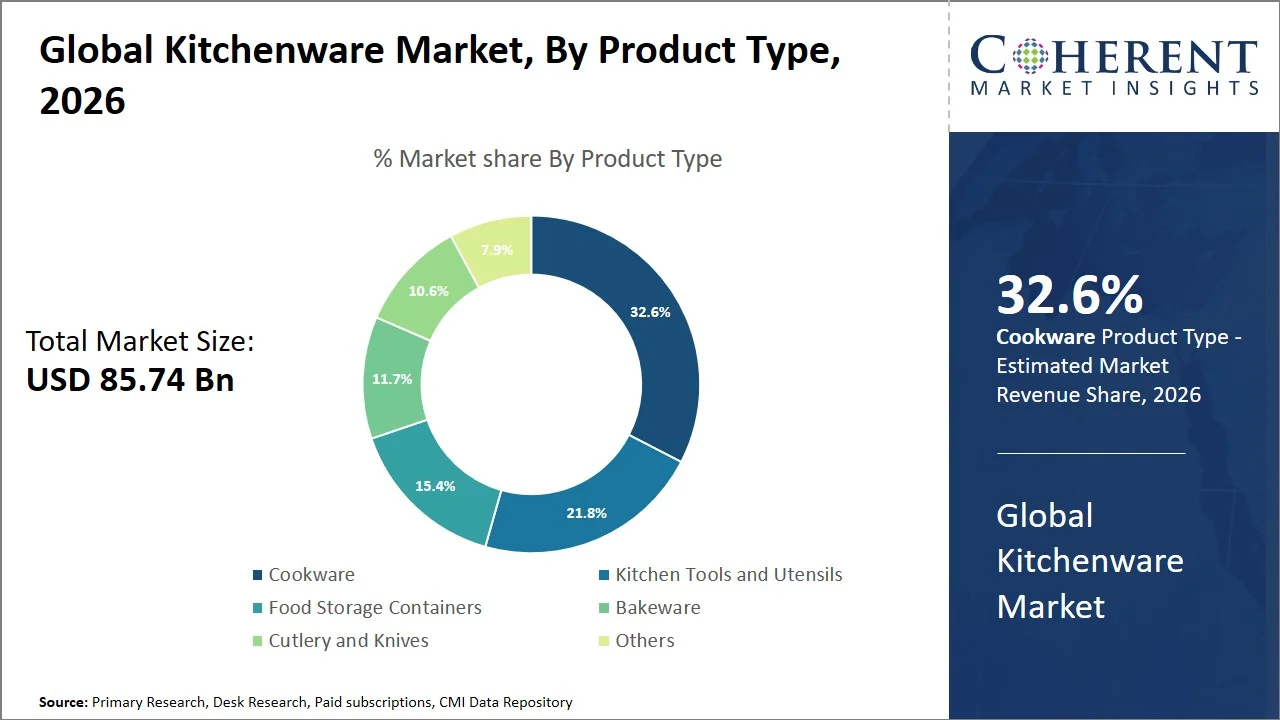
Why Does Cookware Dominate the Global Kitchenware Market?
Cookware is expected to dominate the global kitchenware market with 32.6% share in 2026, as it remains the most frequently used and functionally essential category across everyday meal preparation. The segment benefits from continuous household demand for frypans, saucepans, casseroles, stockpots, pressure cookers, and specialty cookware suited to different cooking styles. On the supply side, brands are strengthening value through heat-retention materials, non-stick innovation, stackable designs, and oven-to-table formats that improve convenience and presentation. Cookware also has strong relevance across residential kitchens, hospitality kitchens, catering services, and foodservice environments where performance and durability directly affect cooking efficiency. In March 2025, Le Creuset introduced its Gourmand Collection, including cocottes, braisers, skillets, oval bakers, and rectangular bakers designed for individual and shareable dishes. (Source: Le Creuset)
- Current Industry Events of 2026
- Market Size Estimation
- Regional Breakdown
- Competitive Landscape
- Customer Intelligence
- Segmental Analysis
- Pricing Analysis
- Key Market Drivers, Challenges & Future Trends
- Customized Insights Section
Why Does Stainless Steel Represent the Largest Material Segment in the Global Kitchenware Market?
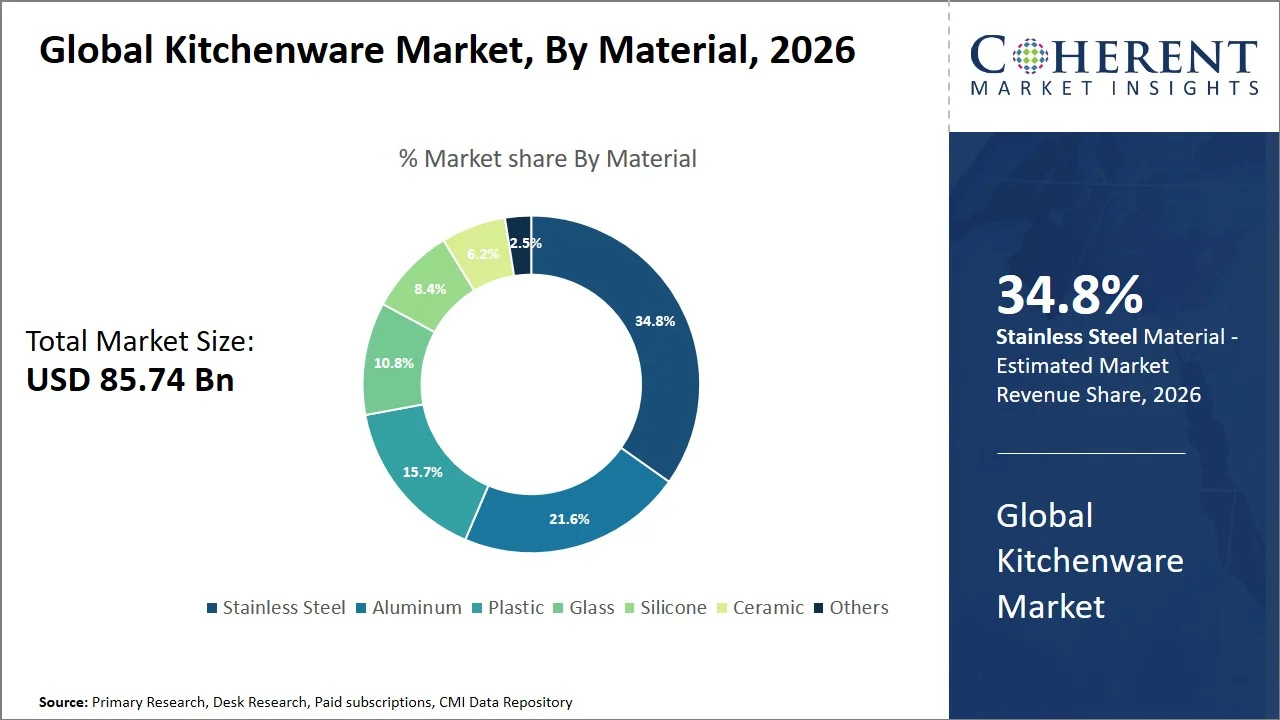
Stainless steel is expected to represent the largest material segment with 34.8% share in 2026, owing to its broad usability across cookware, kitchen tools, utensils, cutlery, containers, and commercial kitchen equipment. Its dominance is linked to corrosion resistance, long service life, easy cleaning, and suitability for high-frequency use in both home and professional kitchens. Demand is reinforced by consumers seeking durable products that reduce replacement frequency, while commercial buyers prefer stainless steel for hygiene, strength, and operational consistency. Manufacturers also benefit from stainless steel’s compatibility with precision forming, polishing, cladding, and modular product design. In July 2025, Fissler made its Essential line available, including stainless steel kitchen accessories such as whisks, spatulas, and ladles positioned as functional, durable, entry-level kitchen products. (Source: Fissler GmbH)
Why Does Mass Dominate the Global Kitchenware Market?
Kitchenware purchases are strongly related to affordability, replacement requirements, and for the first time in a household's life and are expected to be driven by mass price in 2026, accounting for 52.4% of the global market. Consumers usually purchase several low-to-mid-priced items in each category from cookware to utensils, storage containers, and knives, which is why it is important that they can easily find products that work in each category at their price point. The segment is especially relevant for rental homes, new kitchens, students, budget-conscious families, and small food businesses In February 2025, TTK Prestige announced plans to expand its retail footprint by up to 30% over the next four years, focusing on both metropolitan and smaller towns to strengthen its presence in the mass kitchenware segment.
Global Kitchenware Market Dynamics
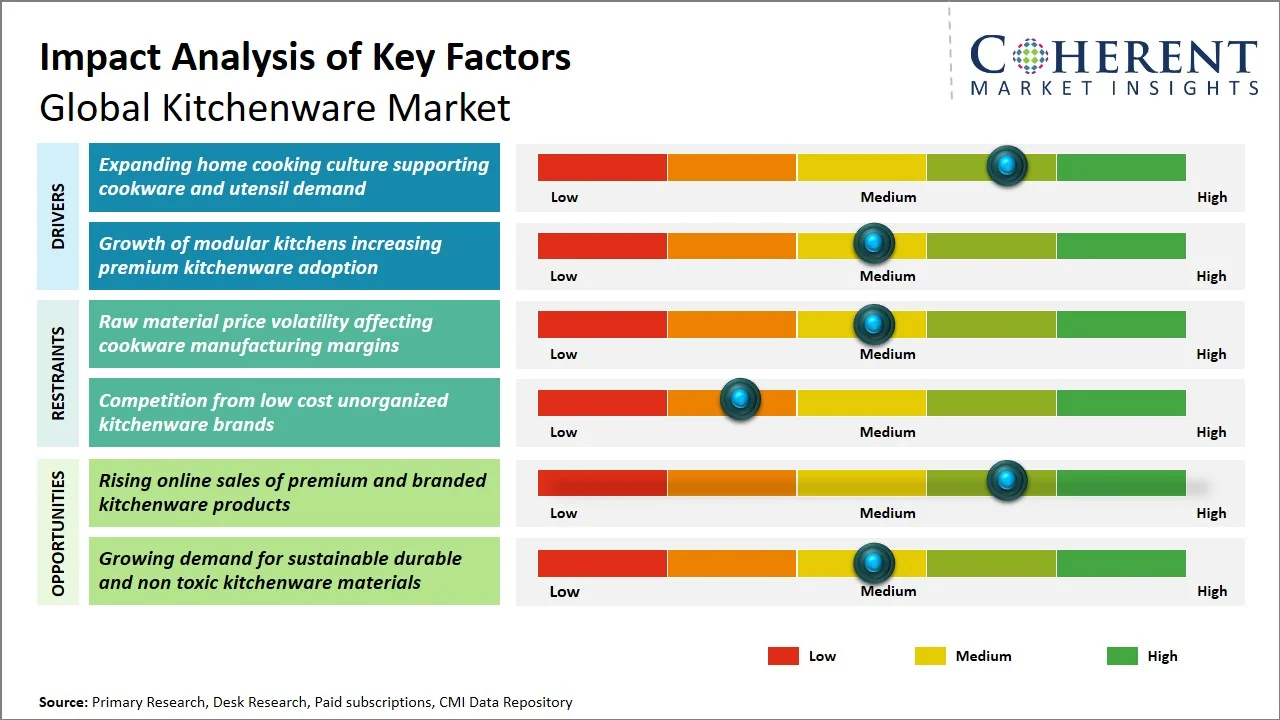
Key Market Drivers
- Expanding Home Cooking Culture Supporting Cookware and Utensil Demand: The culture of home cooking is changing the way people buy kitchenware items from simple replacement to performance based and lifestyle oriented. Cookware is in demand to support easy food preparation, improved cooking, pleasing aesthetics and storage, while prep tools, utensils, bakeware and storage are being sought to promote frequent meal preparation, healthier cooking and pleasing aesthetics in the kitchen. This is benefiting multi-piece cookware sets, induction-compatible pots and pans, precision utensils, and durable everyday tools that can handle regular household use. The driver is particularly strong in residential kitchens, where consumers are upgrading from fragmented low-cost products to coordinated, long-life formats. In January 2026, Meyer Corporation U.S. introduced KitchenAid Stonewash Stainless Steel 5-Ply Clad Cookware, positioned around professional-grade performance, 5-ply construction, induction compatibility, oven safety, and premium kitchen aesthetics.
- Growth of Modular Kitchens Increasing Premium Kitchenware Adoption: The expansion of modular kitchens is increasing demand for kitchenware that fits organized, space-optimized, and design-coordinated cooking environments. As consumers invest in cabinetry, pull-out drawers, worktops, wall storage, and integrated kitchen layouts, they also seek matching cookware, utensil organizers, storage containers, cutlery systems, and countertop products that align with premium interiors. This strengthens the adoption of space-saving kitchenware, stackable containers, drawer-friendly tools, and design-led stainless steel or glass products. Supply-side innovation is also improving through modular hardware, flat-pack formats, soft-close drawer systems, and flexible storage infrastructure. In May 2025, Blum launched PLICOBOX at interzum 2025, a new box system developed with EGGER featuring an innovative folding base, easy assembly, modern finishes, and space-efficient packaging for furniture and storage applications.
Emerging Market Trends
- Shift Toward Health-Safe and Chemically Safer Kitchenware: Materials in cookware, food storage, bakeware and utensils are becoming more of a concern, particularly for materials that are in direct contact with food. This trend is driving up demand for stainless steel, cast iron, borosilicate glass, ceramic coated surfaces, silicone accessories, BPA free or PFA free alternatives. The trend has been driving manufacturers to redesign coatings, enhance material traceability and to communicate safety claims more transparently. Retailers will also be likely to focus on product lines where the issues of food-contact safety, temperature and durability are clearly identified and met. This can have a meaningful effect on the bottom line since a safety-focused positioning means brands can be premium without taking on the risk of regulatory issues, recalls or reputation loss.
- Space-Efficient and Aesthetic Kitchenware Becoming a Core Purchase Criterion: Urban households, compact apartments, and modular kitchen layouts are making space efficiency a major factor in kitchenware purchasing. There is a growing demand for stackable cookware, nesting bowls, multi-purpose equipment, collapsible silicone items, thin storage bins and coordinated utensil sets that streamline kitchen clutter and enhance the look of the kitchen. It is moving brands towards making kitchenware a functional and interior design item. Product development is headed in the direction of smaller shapes, more integrated designs, less color diversity and cookware that would be visible on an open shelf or countertop. In practice, this enables increased basket value via combinations of products, co-ordinated collections of items such as cookware, tools, storage and serving items, and assortments of items.
Current Events and their Impact
Current Events | Description and its Impact |
January 2025 – EU Ban on BPA in Food Contact Materials |
|
January 2025 – Minnesota PFAS Restriction Covering Cookware |
|
March 2025 – U.K. Product Recall for Cast Iron Cookware |
|
Regional Insights
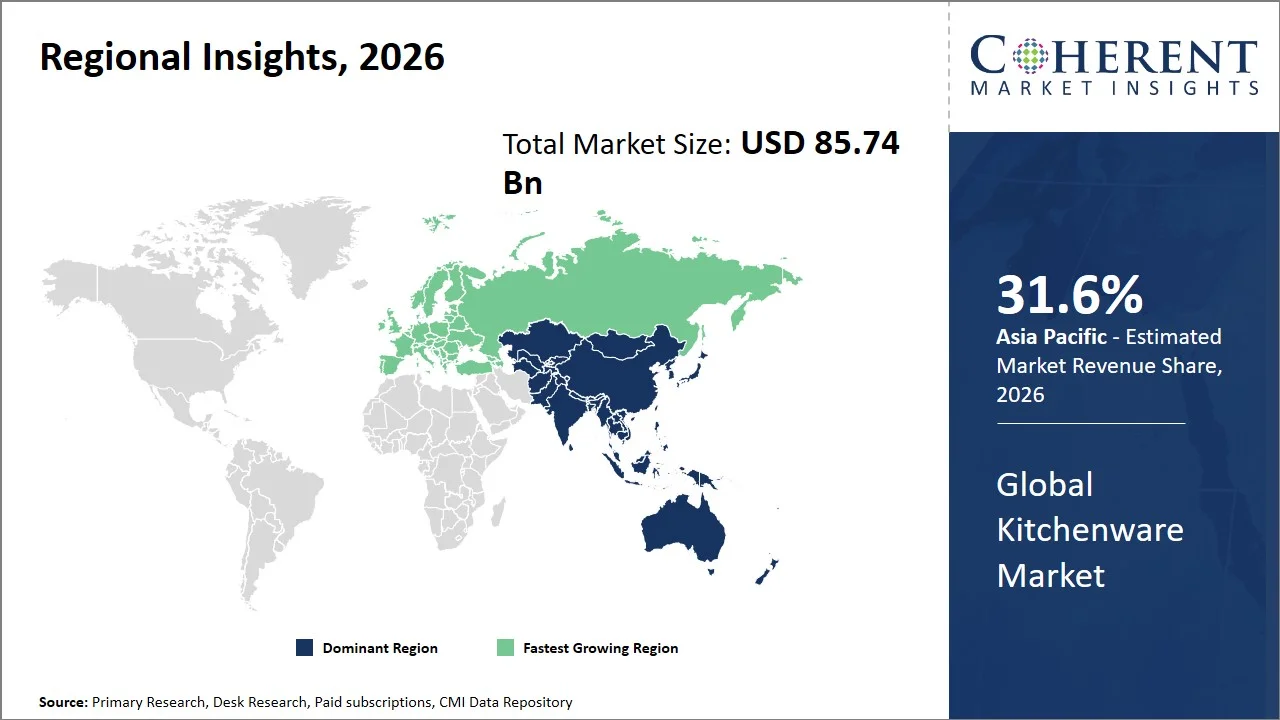
Why Does Asia Pacific Dominate the Global Kitchenware Market?
Asia Pacific is expected to dominate the global kitchenware market with 31.6% share in 2026, supported by a large residential consumer base, expanding urban households, and strong local manufacturing ecosystems for cookware, utensils, knives, storage containers, and small kitchen products. The region benefits from country-specific cooking formats such as woks, pressure cookers, steamers, kadhais, and multi-use cookware, which sustain repeat purchases across both mass and premium categories. Supply-side strength is reinforced by established production clusters in China, India, and Southeast Asia, enabling competitive pricing and faster retail replenishment. In April 2026, Zhejiang Supor’s Annual Report 2025 confirmed its cookware and kitchen tools portfolio, including woks, pressure cookers, frying pans, steamers, knives, spatulas, kitchen gadgets, and crispers, supported by multiple R&D and manufacturing bases across China and Vietnam. (Source: Zhejiang Supor)
Why is Europe Emerging as the Fastest-Growing Region in the Global Kitchenware Market?
Europe is expected to emerge as the fastest-growing region with 29.4% share in 2026, supported by premium kitchen upgrades, stronger sustainability expectations, and consumer preference for durable, design-led, and safer food-contact products. The region’s kitchenware demand is increasingly shaped by urban apartments, compact kitchens, induction cooking, and replacement of conventional non-stick products with stainless steel, ceramic, cast iron, and recycled-material formats. European retailers also place high emphasis on certifications, packaging quality, product traceability, and aesthetic merchandising, which encourages value-added product launches. In January 2026, Resto Kitchenware announced its participation at Ambiente 2026 in Frankfurt, highlighting cookware made with recycled materials and space-saving kitchen solutions, reflecting Europe’s shift toward sustainable and compact household formats. (Source: Resto Kitchenware)
Global Kitchenware Market Outlook for Key Countries
Why is the U.S. a Key Market for the Global Kitchenware Market?
The U.S. is a key market for global kitchenware due to its mature retail infrastructure, strong specialty kitchenware chains, high online penetration, and consumer willingness to spend on performance-oriented cookware and design-led home products. Demand is supported by home cooking, outdoor cooking, kitchen remodeling, and growing interest in non-toxic cookware, stainless steel, carbon steel, cast iron, and premium bakeware. The country is also important for brand building because successful products often scale through department stores, specialty retailers, D2C platforms, and chef-led endorsements. In July 2025, Made in Cookware launched an exclusive collection with Crate & Barrel, making stainless, CeramiClad, carbon steel cookware, and design-forward formats available online and in 36 U.S. stores nationwide.
Why is India Important in the Global Kitchenware Market?
India is important in the global kitchenware market because it combines a high-volume residential consumer base with growing premiumization across urban households. Traditional cooking habits sustain strong demand for pressure cookers, kadhais, tawas, utensils, stainless steel containers, and storage products, while organized retail and e-commerce are expanding access to branded kitchenware in smaller cities. India is also becoming more relevant as a manufacturing and export hub, supported by precision engineering, cost competitiveness, and rising local production of stainless steel, aluminum, ceramic-coated, and tri-ply cookware. In February 2025, Tramontina announced a joint venture with Aequs to form Aequs Cookware Pvt. Ltd. in India, producing premium cookware and consumer goods for both Indian and global distribution.
Why Does China Support Growth in the Global Kitchenware Market?
China supports growth in the global kitchenware market through its large-scale manufacturing base, broad raw material processing ecosystem, and strong domestic consumption environment. The country is a major production center for cookware, kitchen tools, storage containers, thermos products, plastic kitchenware, stainless steel products, and small kitchen appliances. Its supplier networks provide scale advantages in molding, metal forming, coating, polishing, packaging, and export logistics, making China central to global kitchenware sourcing. Domestic demand also remains relevant due to urban households, apartment living, and foodservice expansion. In January 2026, China’s National Bureau of Statistics reported that 2025 retail sales of goods reached USD 6523.26 billion, while catering industry income reached USD 853.37 billion, supporting demand for household and professional kitchen products.
Why is Germany a Strategic Country in the Global Kitchenware Market?
Germany is a strategic country in the global kitchenware market because it anchors Europe’s premium manufacturing, precision engineering, and quality-led kitchenware positioning. German brands are strongly associated with knives, stainless steel cookware, pressure cookers, kitchen tools, and long-life household products. The country’s relevance is also supported by advanced metallurgy, product safety expectations, design discipline, and strong trade-fair infrastructure through Frankfurt-based consumer goods platforms. German consumers and retailers tend to value durability, functionality, sustainability, and certified quality, making the country an important test market for premium product formats. In June 2026, ZWILLING listed its Spectrum Santoku knife as made in Germany and developed using special-formula RCF steel with a reduced carbon-footprint positioning, reinforcing Germany’s premium sustainable cutlery leadership.
Why is Brazil an Important Growth Market for the Global Kitchenware Market?
Brazil is an important growth market for global kitchenware due to its strong domestic cooking culture, established housewares manufacturing base, and regional distribution relevance across Latin America. Demand is supported by household cooking, grilling culture, hospitality consumption, and preference for durable cookware, knives, utensils, tableware, and food preparation products. Brazil also contributes through globally active brands that manufacture kitchenware and housewares domestically while expanding exports and regional operations. This strengthens Brazil’s role not only as a consumer market but also as a production and brand-origin market. In March 2026, Tramontina announced international expansion through a new plant in Mexico and its own office in Argentina, strengthening the global and Latin American reach of the Brazil-origin housewares and kitchenware group.
Technology Adoption Landscape in the Global Kitchenware Market
Technology | Adoption Level | Key Application Area | Business Impact |
Induction-Compatible Multi-Layer Cookware | High | Stainless steel and aluminum-clad cookware | Improves energy transfer, broadens cooktop compatibility, and supports premium pricing. |
Ceramic and PFAS-Free Coating Systems | High | Frypans, bakeware, saucepans, and griddles | Supports safety-led positioning and helps brands respond to chemical compliance pressure. |
Borosilicate Glass Processing | Medium | Food storage containers, ovenware, and bakeware | Enhances thermal shock resistance, durability, and consumer confidence in plastic alternatives. |
Modular and Stackable Product Design | High | Storage containers, cookware sets, prep bowls, and utensils | Improves space efficiency and strengthens relevance in compact urban kitchens. |
Precision Metal Forming and Cladding | Medium | Cookware, cutlery, utensils, and commercial kitchenware | Improves consistency, heat performance, product life, and manufacturing scalability. |
Digital Kitchen Planning and Assisted Selling Tools | Medium | Kitchenware merchandising, kitchen design, and bundled retail selling | Enables better product matching, higher-value baskets, and stronger omnichannel conversion. |
How are Space-Saving, Health-Safe, and Design-Coordinated Kitchenware Formats Creating New Growth Opportunities in the Global Kitchenware Market?
The strongest growth opportunity lies in kitchenware that combines food-contact safety, compact storage, and premium visual appeal. Consumers are no longer purchasing cookware, storage containers, utensils, and cutlery only as functional items; they increasingly expect products to fit modern kitchen layouts, reduce clutter, support healthier cooking, and complement interior aesthetics. This creates room for manufacturers to develop coordinated product ecosystems across cookware sets, drawer-compatible utensils, nesting containers, stackable bakeware, and countertop-ready storage solutions. The opportunity is commercially important because it allows brands to move beyond price-led competition and capture higher margins through bundled assortments, material differentiation, and lifestyle positioning. Suppliers that can deliver durable stainless steel, glass, silicone, ceramic-coated, and modular products at scalable cost will be better placed to serve residential, hospitality, and specialty retail channels. The opportunity is especially relevant in urban markets where kitchen space, safety perception, and organized living strongly influence purchase decisions.
Market Players, Key Development, and Competitive Intelligence
Key Developments
- In January 2026, Tramontina announced that it would present its latest consumer goods releases at the leading trade fair in Germany, including eight cookware lines such as Ampezzo, an enameled cast iron line. This supports premiumization and global export positioning in cookware.
- In April 2025, GreenPan’s Spectra hybrid cookware highlighted Thermobond Technology, combining 3-ply stainless steel, etched stainless patterning, and PFAS-free ceramic non-stick for searing, durability, and easy release. This reflects the market shift toward high-performance, safer, and induction-ready cookware formats.
- In May 2024, IKEA launched HEMKOMST, MIDDAGSMAT, and HUSKNUT cookware with sol-gel ceramic non-stick coating. The company stated that this range supports its broader plan to phase out PTFE from cookware and bakeware by 2026, strengthening the demand for safer non-stick alternatives.
Competitive Landscape
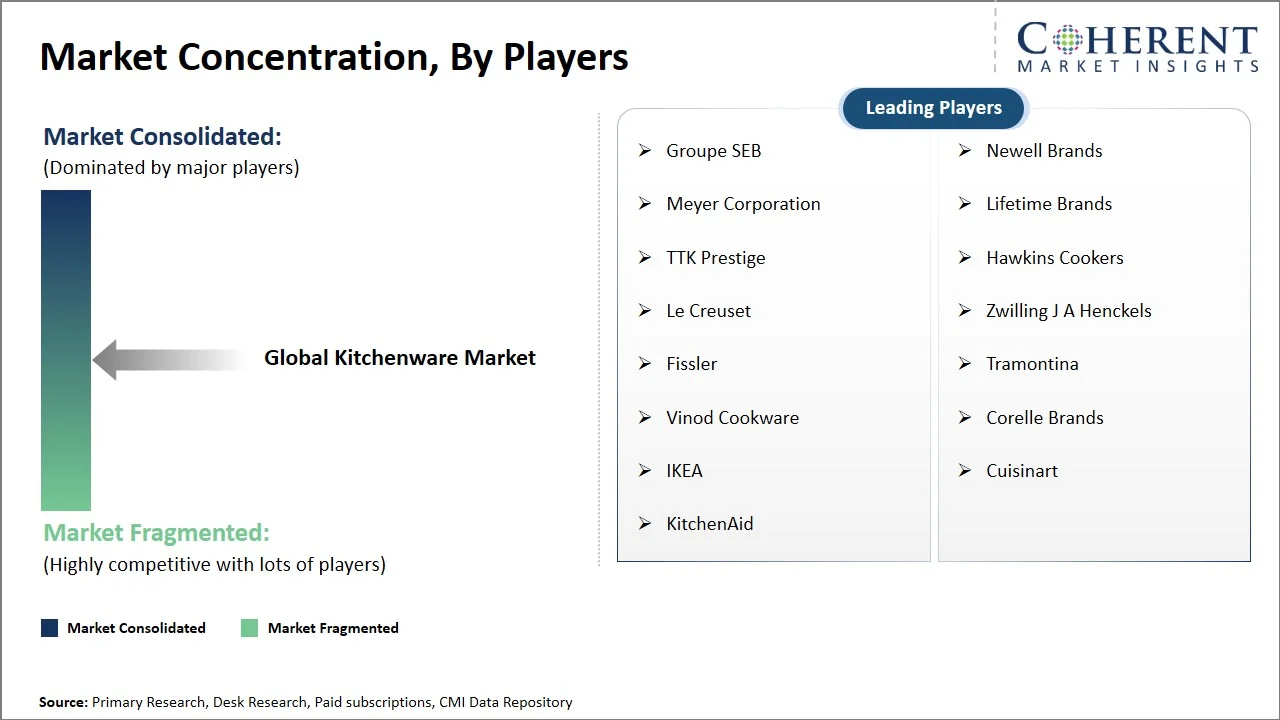
The global kitchenware market is moderately fragmented, with competition across multinational cookware brands, regional utensil manufacturers, private-label retailers, premium design-led brands, and specialized suppliers of storage, cutlery, bakeware, and tools. Companies compete on material quality, safety perception, pricing, design, durability, and distribution reach, while e-commerce and modern retail are increasing visibility for both established and challenger brands.
Key focus areas include
- Product quality and differentiation: Focus on durability, heat performance, finish quality, ergonomic design, and food-contact safety.
- Technology adoption and process efficiency: Investment in cladding, coating, precision molding, polishing, and automated finishing to improve consistency.
- Pricing and cost competitiveness: Mass-market brands compete through value packs, bundled sets, private labels, and high-volume sourcing.
- Capacity expansion and supply reliability: Manufacturers prioritize stable access to metals, glass, plastics, silicone, coatings, and packaging materials.
- Certifications, compliance, and quality control: Food-contact testing, migration limits, material declarations, and chemical safety documentation are becoming more important.
- Distribution network and customer reach: Omnichannel presence across supermarkets, specialty stores, marketplaces, brand websites, and department stores supports scale.
- Sustainable and specialty positioning: Recyclable materials, PFAS-free claims, plastic-reduction formats, and long-life products support premiumization.
- Partnerships and supplier agreements: Retailers and brands rely on OEMs, coating suppliers, material processors, and contract manufacturers for differentiated product lines.
Market Report Scope
Kitchenware Market Report Coverage
| Report Coverage | Details | ||
|---|---|---|---|
| Base Year: | 2025 | Market Size in 2026: | USD 85.74 Bn |
| Historical Data for: | 2020 To 2024 | Forecast Period: | 2026 To 2033 |
| Forecast Period 2026 to 2033 CAGR: | 6.2% | 2033 Value Projection: | USD 130.63 Bn |
| Geographies covered: |
| ||
| Segments covered: |
| ||
| Companies covered: | Groupe SEB, Newell Brands, Meyer Corporation, Lifetime Brands, TTK Prestige, Hawkins Cookers, Le Creuset, Zwilling J A Henckels, Fissler, Tramontina, Vinod Cookware, Corelle Brands, IKEA, Cuisinart, and KitchenAid | ||
| Growth Drivers: |
| ||
| Restraints & Challenges: |
| ||
Analyst Opinion (Expert Opinion)
- The global kitchenware market is expected to remain structurally attractive over the forecast period, supported by residential replacement demand, modular kitchen adoption, premium cooking habits, and growing preference for safer food-contact materials. Cookware, stainless steel products, and mass-priced assortments will remain central to volume growth, while premium formats will support margin expansion.
- The strongest growth pockets are likely to emerge in Asia Pacific through household formation and urban kitchen upgrades, while Europe will benefit from premiumization, sustainability-led replacement, and stricter product safety expectations. Product categories with high adoption potential include induction-compatible cookware, PFAS-free non-stick alternatives, glass storage containers, modular utensils, and space-saving kitchen organization products.
- Key risks include coating compliance uncertainty, raw material price volatility, counterfeit or low-quality imports, and consumer hesitation around premium pricing. Market players should focus on certified material safety, practical design innovation, retail-ready product bundles, and omnichannel merchandising. Companies that combine compliance, affordability, durability, and aesthetic appeal will be best positioned to gain competitive advantage.
Speak to the analyst
Want personalized insights?
Take the findings above to one of our principal consultants, or have the report rebuilt around the segments, geographies and competitors you actually track.
Market Segmentation
- Product Type Insights (Revenue, USD Bn, 2021 - 2033)
- Cookware
- Kitchen Tools and Utensils
- Food Storage Containers
- Bakeware
- Cutlery and Knives
- Others
- Material Insights (Revenue, USD Bn, 2021 - 2033)
- Stainless Steel
- Aluminum
- Plastic
- Glass
- Silicone
- Ceramic
- Others
- Price Range Insights (Revenue, USD Bn, 2021 - 2033)
- Mass
- Premium
- Luxury
- End User Insights (Revenue, USD Bn, 2021 - 2033)
- Residential
- Commercial
- Institutional
- Regional Insights (Revenue, USD Bn, 2021 - 2033)
- North America
- U.S.
- Canada
- Latin America
- Brazil
- Argentina
- Mexico
- Rest of Latin America
- Europe
- Germany
- U.K.
- Spain
- France
- Italy
- Russia
- Rest of Europe
- Asia Pacific
- China
- India
- Japan
- Australia
- South Korea
- ASEAN
- Rest of Asia Pacific
- Middle East
- GCC Countries
- Israel
- Rest of Middle East
- Africa
- South Africa
- North Africa
- Central Africa
- North America
- Key Players Insights
- Groupe SEB
- Newell Brands
- Meyer Corporation
- Lifetime Brands
- TTK Prestige
- Hawkins Cookers
- Le Creuset
- Zwilling J A Henckels
- Fissler
- Tramontina
- Vinod Cookware
- Corelle Brands
- IKEA
- Cuisinart
- KitchenAid
Source
Primary Research Interviews
- Cookware manufacturers producing stainless steel, aluminum, cast iron, ceramic-coated, non-stick, tri-ply, and induction-compatible cookware
- Kitchen tools and utensils manufacturers producing spatulas, ladles, tongs, peelers, graters, whisks, measuring tools, and prep tools
- Food storage container manufacturers producing plastic, glass, stainless steel, silicone, and airtight storage products
- Bakeware manufacturers producing baking trays, cake molds, muffin pans, loaf pans, oven-safe glassware, and silicone bakeware
- Cutlery and knife manufacturers producing kitchen knives, chef knives, knife sets, scissors, sharpeners, and chopping tools
- Raw material suppliers providing stainless steel, aluminum, glass, plastics, silicone, ceramics, coatings, and packaging materials
- Non-stick coating, ceramic coating, enamel, and surface-treatment technology suppliers
- Kitchenware importers, exporters, wholesalers, and regional distributors
- Organized retail chains, department stores, supermarkets, hypermarkets, and specialty kitchenware retailers
- E-commerce platforms, D2C kitchenware brands, and online marketplace sellers
- Hotel, restaurant, café, catering, and institutional kitchen procurement managers
- Interior designers, modular kitchen companies, kitchen consultants, and home improvement specialists
- Quality testing laboratories, food-contact safety experts, certification agencies, and compliance consultants
- Industry experts, market consultants, trade associations, and supply-chain specialists
Stakeholders
- Cookware manufacturers: Groupe SEB, Meyer Corporation, TTK Prestige, Hawkins Cookers, Le Creuset, Fissler, Tramontina, Vinod Cookware, Lodge Cast Iron, All-Clad, GreenPan, Made In Cookware
- Kitchen tools, utensils, and cutlery companies: Zwilling J A Henckels, Wüsthof, Victorinox, OXO, Cuisinart, KitchenAid, Lifetime Brands, Joseph, Fiskars Group
- Food storage and container companies: Tupperware, LocknLock, Sistema, Rubbermaid, Pyrex, Corelle Brands, IKEA, OXO, Brabantia
- Bakeware and ovenware companies: Nordic Ware, Wilton Brands, Pyrex, Le Creuset, Lodge Cast Iron, USA Pan, Emile Henry
- Retailers and private-label players: IKEA, Walmart, Target, Costco, Amazon, Williams-Sonoma, Crate & Barrel, Home Depot, Tesco, Carrefour, Aldi, Lidl
- Raw material suppliers: stainless steel producers, aluminum producers, glass manufacturers, silicone suppliers, plastic resin producers, ceramic material suppliers, and coating chemical companies
- End-use sectors: residential households, hotels, restaurants, cafés, catering companies, institutional kitchens, cloud kitchens, hostels, hospitals, schools, and corporate cafeterias
- Supporting ecosystem: contract manufacturers, OEM/ODM kitchenware suppliers, packaging companies, logistics providers, testing laboratories, compliance consultants, and kitchen design firms
- Regulatory and certification bodies: U.S. Food and Drug Administration, European Food Safety Authority, European Commission, U.K. Office for Product Safety and Standards, Bureau of Indian Standards, China SAMR, ISO, ASTM International, NSF International, and UL Solutions
Databases
- U.S. Census Bureau – household formation, retail sales, consumer spending, and trade data
- U.S. Bureau of Economic Analysis – personal consumption expenditure and household goods spending data
- U.S. Consumer Product Safety Commission – product safety recalls and consumer goods safety data
- U.S. Food and Drug Administration – food-contact material regulations and safety guidance
- European Commission – food contact materials, BPA restrictions, PFAS rules, circular economy, and product safety regulations
- Eurostat – household expenditure, retail trade, imports, exports, and consumer goods data
- U.K. Office for Product Safety and Standards – product recalls, safety notices, and compliance guidance
- Bureau of Indian Standards – kitchenware, stainless steel utensils, pressure cooker, and product quality standards
- Ministry of Commerce and Industry, India – trade, manufacturing, and export/import data
- China National Bureau of Statistics – retail sales, household consumption, manufacturing output, and catering industry data
- China General Administration of Customs – kitchenware exports, metal products, plastics, glassware, and household goods trade data
- UN Comtrade Database – import/export analysis for cookware, kitchen tools, cutlery, glassware, plastic containers, and housewares
- ITC Trade Map – global trade flows for kitchenware, cookware, utensils, tableware, cutlery, and household goods
- OECD Data – household consumption, urbanization, and retail indicators
- World Bank Data – income levels, urban population, household expenditure, and consumer market indicators
Magazines / Industry Publications
- Housewares Magazine
- HomeWorld Business
- Gourmet Insider
- Tableware International
- Kitchenware News & Housewares Review
- Retail Dive
- Modern Retail
- Retail Gazette
- Progressive Grocer
- Foodservice Equipment & Supplies
- Hotel Management
- Restaurant Business
- Hospitality Net
- Home Furnishings News
- Furniture Today
- Packaging Europe
- Sustainable Plastics
- Plastics News
- Metal Bulletin
- Aluminium Insider
Journals
- Journal of Food Science
- Food Control
- Food Packaging and Shelf Life
- Journal of Food Engineering
- Materials Today: Proceedings
- Materials & Design
- Surface and Coatings Technology
- Progress in Organic Coatings
- Journal of Materials Science
- Journal of Cleaner Production
- Resources, Conservation and Recycling
- Sustainability
- International Journal of Consumer Studies
- Journal of Retailing and Consumer Services
- International Journal of Hospitality Management
- British Food Journal
- Packaging Technology and Science
- Polymer Testing
- Applied Surface Science
- Ceramics International
Credible News Sources
- Financial Times – consumer spending, retail strategy, premium goods, and global trade
- The Wall Street Journal – household products, retail, consumer demand, and supply-chain developments
- CNBC – consumer trends, retail sales, home goods, and discretionary spending
- Bloomberg – global consumer goods, commodity costs, and manufacturing trends
- The New York Times – consumer lifestyle, home cooking, and retail trends
- The Guardian – consumer safety, sustainability, and household products
- The Economic Times – India kitchenware, retail, manufacturing, and consumer goods updates
- Business Standard – India retail, housewares, and manufacturing developments
- The Hindu BusinessLine – consumer goods, stainless steel, trade, and retail industry updates
- China Daily – China retail, manufacturing, consumer goods, and export updates
- The Japan Times – Japanese retail, household products, and consumer lifestyle trends
- Korea Herald – South Korean household goods, retail, and consumer product updates
Associations
- International Housewares Association
- Home Improvement Research Institute
- International Association of Culinary Professionals
- National Restaurant Association
- Foodservice Equipment Distributors Association
- Specialty Food Association
- The Consumer Goods Forum
- EuroCommerce
- British Retail Consortium
- Retailers Association of India
- Confederation of All India Traders
- Federation of Indian Export Organisations
- China National Light Industry Council
- China Household Electrical Appliances Association
- Japan Housewares Association
- Korea International Trade Association
- ASTM International
- NSF International
- International Organization for Standardization
- European Committee for Standardization
Public Domain Sources
- U.S. Food and Drug Administration – food-contact material safety, packaging, coatings, and compliance guidance
- U.S. Consumer Product Safety Commission – product recalls, safety alerts, and consumer product injury data
- U.S. Census Bureau – household formation, retail trade, and demographic data
- U.S. Bureau of Economic Analysis – consumer spending and personal consumption expenditure data
- European Commission – food contact material regulations, BPA restrictions, PFAS controls, circular economy rules, and product safety policy
- European Food Safety Authority – food-contact chemical safety assessments and scientific opinions
- Eurostat – household consumption, retail sales, trade flows, and urbanization indicators
- U.K. Office for Product Safety and Standards – product safety alerts, recalls, and compliance notices
- Bureau of Indian Standards – quality standards for pressure cookers, utensils, stainless steel products, and consumer goods
- Ministry of Commerce and Industry, India – imports, exports, manufacturing, and trade policy information
- China National Bureau of Statistics – retail sales, consumer goods, catering industry, and manufacturing data
- China SAMR – consumer product quality supervision, food-contact product safety, and regulatory notices
- UN Comtrade – global trade data for cookware, cutlery, utensils, glassware, plastics, and household products
- ITC Trade Map – import/export flows for kitchenware, housewares, cookware, and related consumer products
- World Bank – disposable income, urbanization, population, and household consumption indicators
- OECD – consumer expenditure, household goods, and retail market indicators
Proprietary Elements
- CMI Data Analytics Tool, Proprietary CMI Existing Repository of information for last 10 years.
Get access to 250+ pages report
Every segment, forecast, competitor profile and data table behind the analysis above — available for instant download.
- ESOMAR Member
- ISO 9001:2015 Certified
- D-U-N-S Registered
- GDPR & CCPA Compliant
Missing comfort of reading report in your local language? Find your preferred language:
Transform your Strategy with Exclusive Trending Reports
Frequently Asked Questions
The CAGR of the global kitchenware market is projected to be 6.2% from 2026 to 2033.
The global kitchenware market is estimated to be valued at USD 85.74 billion in 2026 and is expected to reach USD 130.63 billion by 2033.
In terms of end user, the residential segment is expected to hold the largest market share in 2026, supported by rising household cooking, kitchen upgrades, and higher spending on branded kitchenware.
Raw material price volatility affecting cookware manufacturing margins and competition from low-cost unorganized kitchenware brands are the major factors hampering the growth of the global kitchenware market.
In terms of product type, cookware is estimated to dominate the market revenue share in 2026.
The major trends include rising demand for non-toxic and PFAS-free cookware, increasing preference for space-saving kitchenware, and growing adoption of premium, design-led kitchen products.
The key opportunity lies in developing durable, health-safe, and modular kitchenware products that support modern cooking habits, compact urban kitchens, and premium home improvement spending.