

Global Sports Protective Equipment Market Size and Forecast – 2026 to 2033
Global Sports Protective Equipment Market is estimated to be valued at USD 11.50 Bn in 2026 and is expected to reach USD 18.09 Bn by 2033, exhibiting a compound annual growth rate (CAGR) of 6.7% from 2026 to 2033.
Key Takeaways of the Global Sports Protective Equipment Market
- Head and headgear segment is expected to account for the largest market share of 39.7% in 2026.
- Online is a leading distribution segment with an anticipated market share for 57.9% market share in 2026.
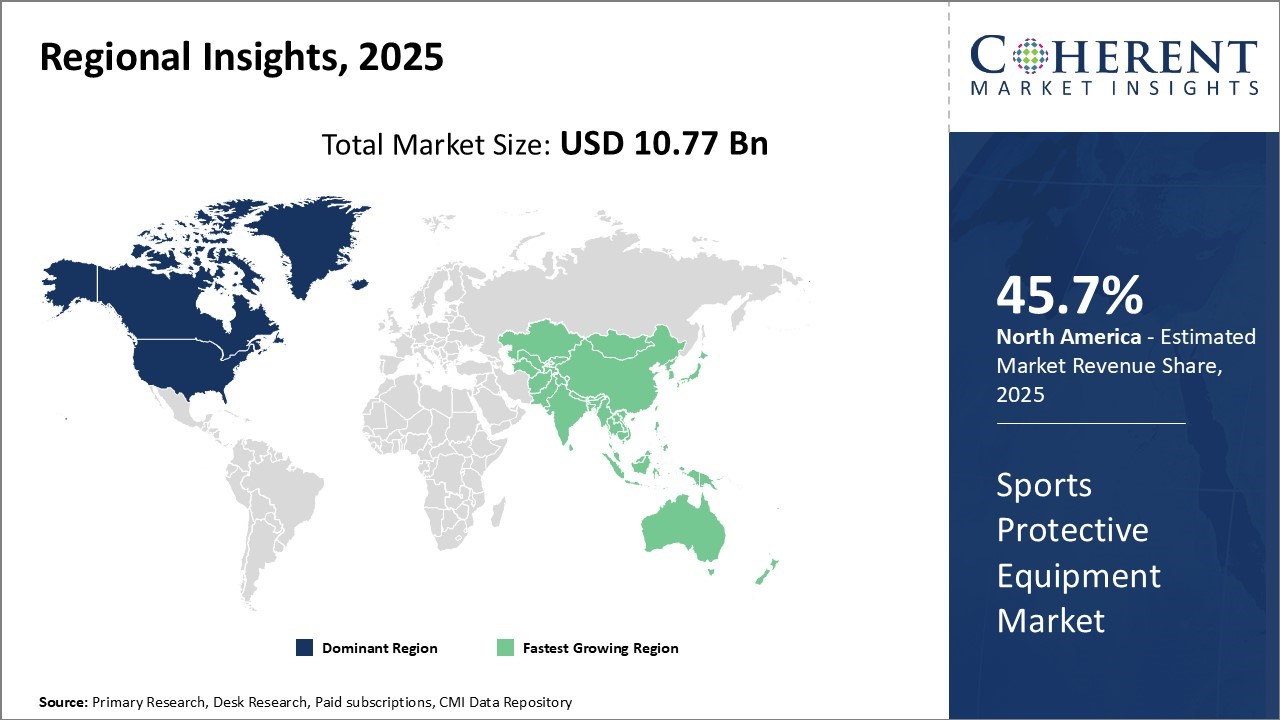
- North America is a leading market for sports protective equipment with an anticipated market share of 45.7% market share in 2026.
- The Asia Pacific region is expected to exhibit the fastest growth and register a market share of 36.9% in 2026.
Market Overview
Growing popularity of sports and increasing awareness regarding benefits of wearing protective gear during physical activities is expected to drive demand for sports protective equipment. Additionally, continuous innovation supported by technology to produce lightweight, comfortable, and functional sports gear without compromising on protection will further aid the market expansion. Development of high-performance materials is anticipated to make sports protective equipment more flexible and durable, thus enhancing athlete performance and safety. Rising disposable incomes especially in developing regions of the world provide impetus to participation in sports and related purchases of protective accessories.
Current Events and their Impact on the Global Sports Protective Equipment Market
Current Events | Description and its impact |
Geopolitical Trade Tensions |
|
Supply Chain Disruptions |
|
Market Trends
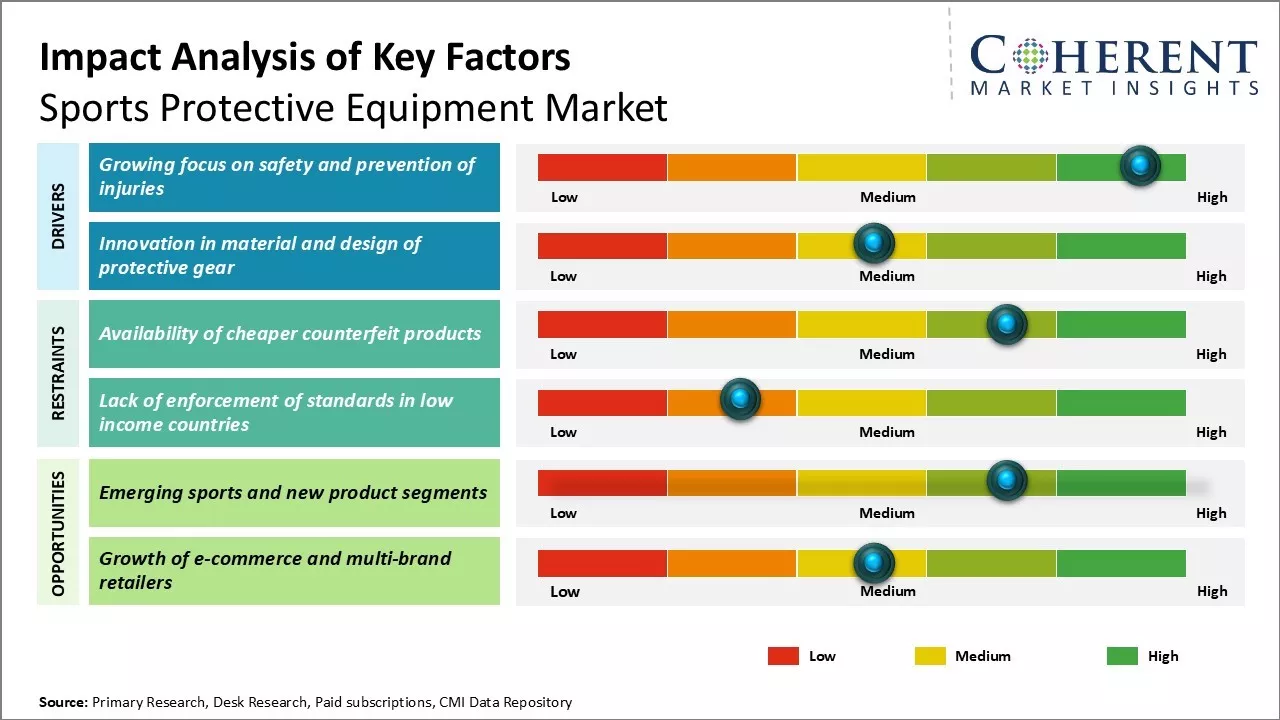
- Growing Focus on Safety and Prevention of Injuries
With increasing awareness about safety and health, people are paying more attention towards preventing injuries while engaging in sports and recreational activities. There has been a considerable rise in sports such as football, rugby, cricket, and many extreme adventure sports over the past decade. While sports offer numerous health benefits, they can potentially lead to severe injuries if not played cautiously. Participants require protective gear especially for high-risk areas of the body like the head, spine, and joints to minimize the chances of enduring long-term damage.
Many amateur and professional leagues have also made protective clothing mandatory to participate to reduce on-field collisions and injuries. Coaches and parents are encouraging young athletes to wear good quality safety equipment right from the start to inculcate a safety-first culture. For instance, the NFL made it mandatory during the 2022 preseason for certain high-contact positions to wear padded helmet covers called Guardian Caps during practices. According to the league, this resulted in a 52% reduction in concussion rates among those players, reinforcing the effectiveness of protective gear in injury prevention.
In the 2024 NFL season, the league allowed players to wear Guardian Caps—soft padded helmet covers—in regular-season games for the first time (they were previously only used in practices). This change, along with retired older helmet models, helped contribute to a 17% drop in concussions compared to 2023, the lowest rate recorded in NFL history.
- Innovation in Safety & Materials
The global market for sports protective equipment is experiencing substantial expansion, driven by a worldwide increase in participation across various sports and recreational pursuits. A heightened awareness concerning injury prevention, coupled with continuous advancements in material science and smart technologies, are significant factors contributing to this growth.
Innovations, such as the integration of sensors for real-time impact monitoring and the development of lightweight, highly impact-resistant materials, are considerably improving product performance. These developments are boosting consumer demand for protective gear across a wide spectrum of athletic activities, ranging from traditional contact sports to newer, more extreme endeavors.
For instance, in January 2024, World Rugby mandated the use of smart mouthguards embedded with real‑time impact sensors for all elite-level players during matches and training. These devices trigger a sideline alert to medical staff when impacts exceed preset thresholds, integrating directly into the Head Injury Assessment (HIA) protocol. This initiative supports individualized injury tracking and proactive wellness monitoring across major international competitions.
Market Opportunity: Emerging Sports and New Product Segments
The global sports protective equipment market is poised to benefit significantly from the emergence of new types of sports and the development of innovative product segments. With the rising popularity of extreme adventure sports, there is growing demand for specialized protective gear for knees, elbows and helmets. Likewise, the evolution of gear for winter sports, racquet sports, water sports and others present sizable opportunities.
Manufacturers need to closely track the evolving participation trends and design products customized for newer categories. Focusing on both niche sectors and mainstream segments, sports protective equipment companies can extract substantial growth opportunities in the coming years. For instance, in October 2023, a U.S.-based company, G‑Form, launched Terra knee and elbow guards featuring RE ZRO, a recyclable and biodegradable material, aimed at mountain bikers and extreme cyclists. This launch reflects how brands are targeting niche adventure sports with sustainable.
- Current Industry Events of 2026
- Market Size Estimation
- Regional Breakdown
- Competitive Landscape
- Customer Intelligence
- Segmental Analysis
- Pricing Analysis
- Key Market Drivers, Challenges & Future Trends
- Customized Insights Section
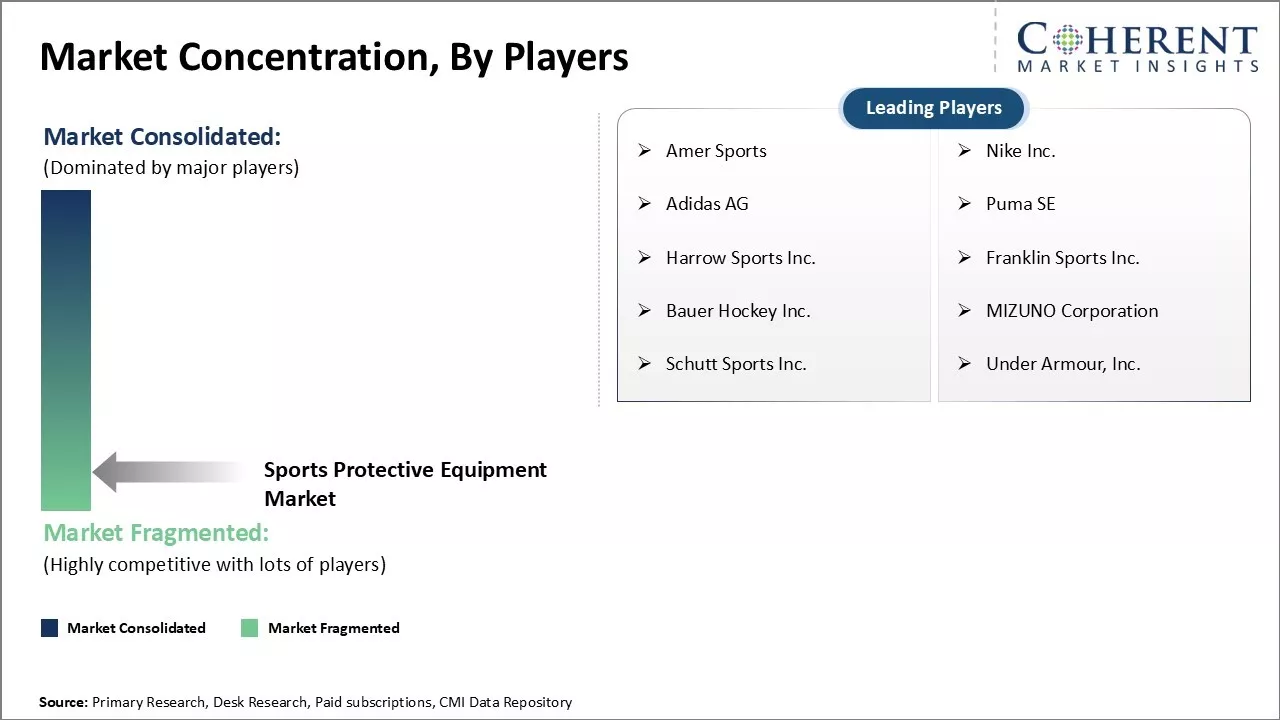
Market Concentration and Competitive Landscape
Segmental Insights
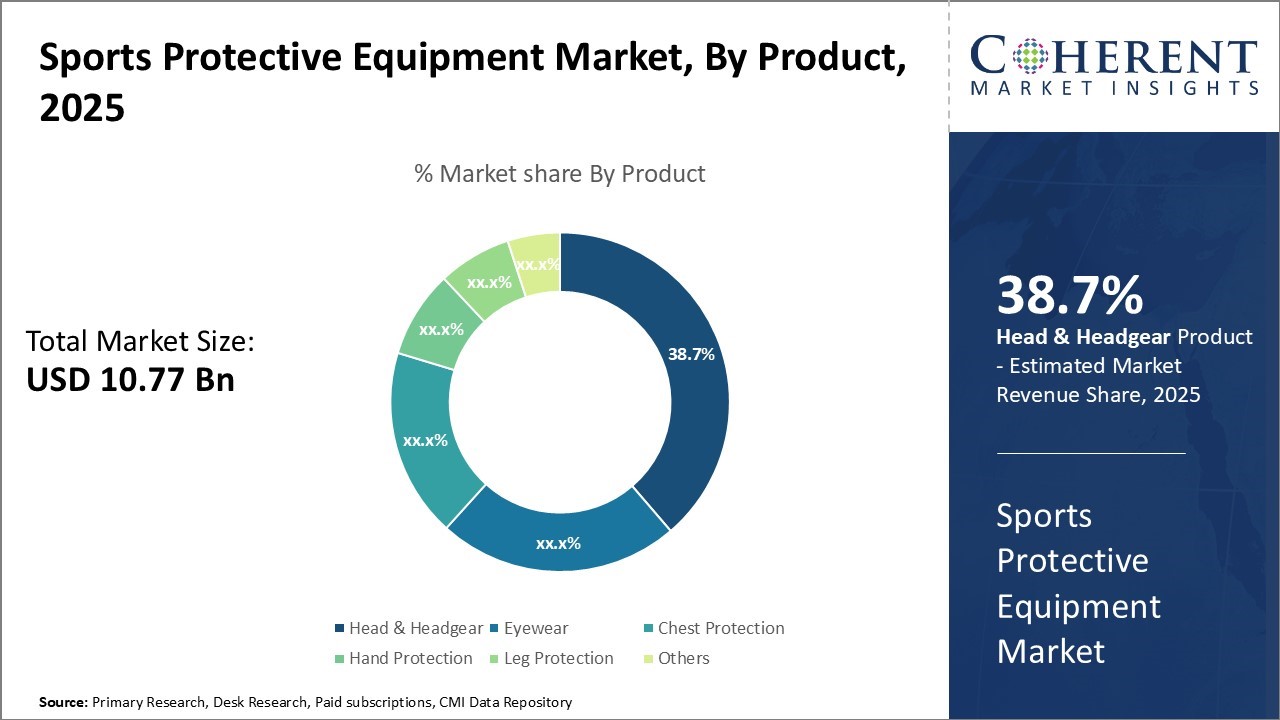
Global Sports Protective Equipment Market Insights, By Product - Head & Headgear Segment Leads Due to Increasing Safety Consciousness
By Product Insights, head and headgear segment is expected to account for the largest market share of 39.7% in 2024.
The popularity of American football, rugby, hockey and lacrosse is growing. These sports require additional gears and safety wherein head injuries are common. Moreover, these sports require specialized helmets, mouth guards and headgear to protect athletes from grave injuries. Stringent safety regulations pertaining to player safety also encourages the use of safety gears. Besides, the rising disposable incomes allow consumers to spend more on protective equipment.
Manufacturers are further promoting safety through innovative designs that provide enhanced coverage, ventilation and comfort without compromising on protection. Multi-impact helmets certified for football, lacrosse etc. are gaining traction. Cutting-edge visor technologies also attract enthusiasts.
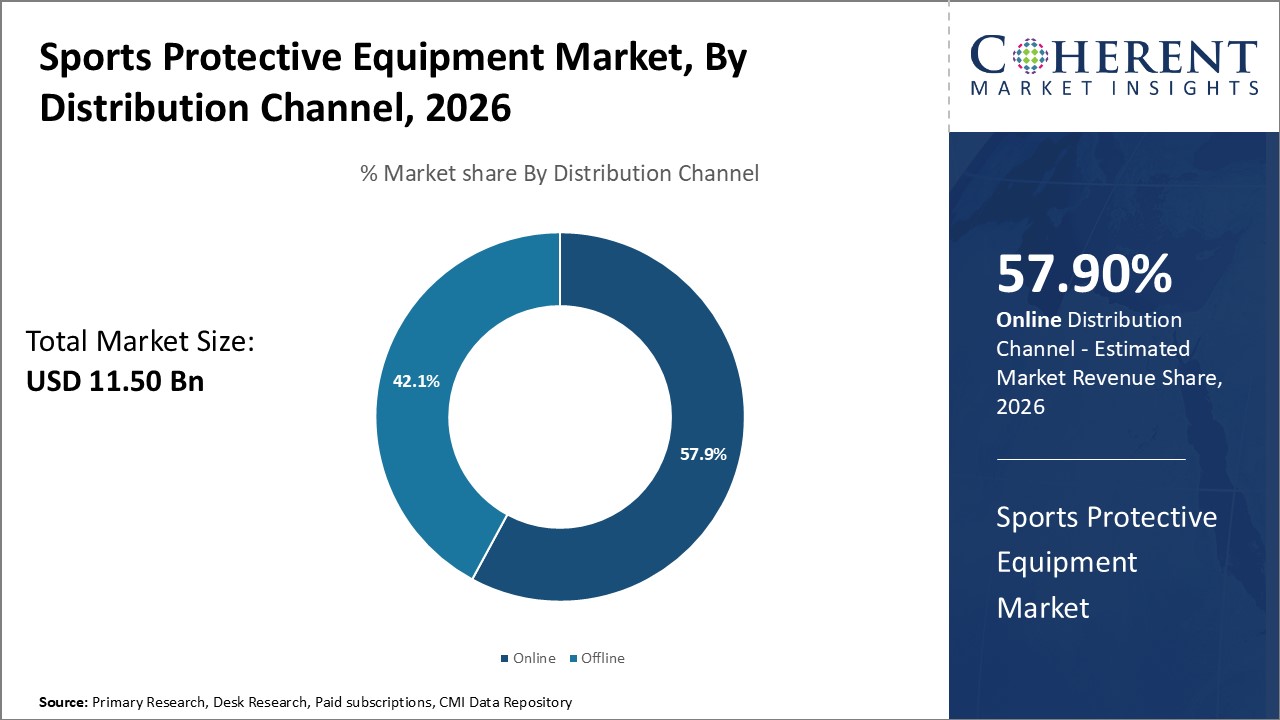
Global Sports Protective Equipment Market Insights, By Distribution Channel - Online Channel Maintains Dominance Driven by Growth of E-Commerce
The online segment enjoys a significant market share and is expected to account for 57.9% market share in 2026. Expanding internet and smartphone penetration worldwide has boosted the adoption of e-commerce shopping. Consumers, especially younger demographics, prefer convenience of online platforms to research products, read reviews and make purchases from the comfort of their homes. This is benefitting sports brands in reaching a wider audience beyond geographical limitations.
Regional Insights
North America Sports Protective Equipment Market Trends and Analysis
North America is a dominant market for sports protective equipment and is expected to value at 45.7% market share in 2026. The dominance in the sports protective equipment market can be attributed to the large presence of sports leagues and organized sports culture.
Countries like the U.S. have robust participation across various amateur and professional sports. This drives significant demand for protective gear from both individual consumers and sporting institutions. Additionally, North America is home to many leading brands that invest heavily in product innovation.
In 2024, the NFL expanded its use of Guardian Caps soft-shell helmet covers after seeing a 50% drop in concussions during practices since their introduction. This innovation reflects how major North American sports leagues are prioritizing advanced protective gear, driving demand and setting industry standards.
Asia Pacific Sports Protective Equipment Market Trends and Analysis
The Asia Pacific region is expected to exhibit the fastest growth and register a market share of 36.9% in 2026. Rapid economic development and rising living standards have boosted discretionary spending on fitness, sports, and leisure activities.
Countries like China and India are seeing tremendous enthusiasm for both domestic and Western sports. This consumer base is still largely untapped, allowing gear manufacturers opportunities for expansion.
Government initiatives to promote active lifestyles and develop grassroots programs also support the market's ascent. For Instance, in 2026, the Indian government mandated that all new two‑wheelers must include two ISI‑certified helmets, one for the rider and one for the pillion. This directive aims to boost safety and drive demand for certified protective helmets and gear across the country.
Sports Protective Equipment Market Outlook for Key Countries
U.S. Sports Protective Equipment Market Trends
The U.S. sports protective equipment market is experiencing a shift towards customizable designs also gives consumers more options to find the perfect fit and fulfillment of individual play styles. Athletes and recreational sports players alike are demanding equipment that allows for a greater range of motion and flexibility without compromising on protection. This trend is being driven by a growing emphasis on player comfort and performance. Equipment manufacturers are responding by engineering new materials and designs that can meet rigorous safety standards while offering an enhanced experience for the end user.
For instance, Schutt Sports helmets (2026) now feature SUREFIT Air Liners, an adjustable air-bladder system that lets athletes dial in precise fit and comfort. Plus, they incorporate D3O impact zones a smart material that remains soft until impact, then stiffens to dissipate force offering enhanced protection and flexibility.
China Sports Protective Equipment Market Trends
Manufacturers of sports protective gear in China are leveraging this increased health-consciousness among consumers to broaden their product range as well as marketplace. They are innovating with advanced materials and technologies to develop high-quality, comfortable and affordable equipment for diverse applications across different sports. For example, several brands have launched next-generation protective gear made of lightweight composite materials for activities like cycling, skateboarding and winter sports.
Some are also offering customizable options to suit individual body types and preferences. This has attracted more users toward established brands and encouraged sports participation further. For instance, Fbshelmet, a major China-based OEM supplier, offers advanced custom composite helmets made with carbon and basalt fiber, tailored for cycling, skiing, skateboarding, and adventure sports. These helmets offer personalized fit, lightweight protection, vibrant aesthetics, and come certified to international standards like CE, CPSC, and ASTM.
Germany Sports Protective Equipment Market Trends
As more amateur and professional sports leagues and competitions are organized across the country, the demand for standard-certified protective gear is also growing. According to the DFB, total membership rose from approximately 7.06 million in 2021 to 7.17 million in 2022, marking an increase of around 110,000 members in one year. By the 2023–24 season, total membership surpassed 8 million, reflecting a year-on-year growth of nearly 4%, with both player and supporter participation contributing to the rise. This has spurred sales of comfortable yet protective football boots, shin guards, and gloves. The market is projected to further expand due to the codification of safety standards by governing bodies for new sports.
Brazil Sports Protective Equipment Market Trends
The rising popularity of various sporting activities in Brazil has been one of the key factors influencing the sports protective equipment market trends in the country. With more people taking up sports such as football, volleyball, basketball, and others for leisure and professional purposes, the demand for suitable protective gear has seen a steady uptick over the past few years. Youth engagement in sports has been particularly encouraging, with government initiatives aimed at promoting fitness and health among citizens. For instance, in 2026, Brazil’s Paralympic Committee secured a record sponsorship of R$160 million (approximately USD 28 million) from Loterias Caixa. These funds support grassroots programs and boost demand for adaptive protective equipment for Paralympic teams.
Japan Sports Protective Equipment Market Trends
One of the key trends influencing the Japan sports protective equipment market is the growing popularity and participation in various extreme and adventure sports among the younger population. Sports like mountain biking, snowboarding, and skateboarding have witnessed significant rise in amateur participation over the past few years. This has driven demand for specialized protective gear like helmets, pads, guards tailored for such high intensity impact sports. For example, many snowboarding helmet brands now offer strong polycarbonate exteriors with thermo-formed EPS liners that absorb impact energy very effectively.
Market Report Scope
Sports Protective Equipment Market Report Coverage
| Report Coverage | Details | ||
|---|---|---|---|
| Base Year: | 2025 | Market Size in 2026: | USD 11.50 Bn |
| Historical Data for: | 2020 To 2024 | Forecast Period: | 2026 To 2033 |
| Forecast Period 2026 to 2033 CAGR: | 6.7%2033 Value Projection: | USD 18.09 Bn | |
| Geographies covered: |
| ||
| Segments covered: |
| ||
| Companies covered: | Amer Sports, Nike Inc., Adidas AG, Puma SE, Harrow Sports Inc., Franklin Sports Inc., Bauer Hockey Inc., MIZUNO Corporation, Schutt Sports Inc., and Under Armour, Inc. | ||
| Growth Drivers: |
| ||
| Restraints & Challenges: |
| ||
Global Sports Protective Equipment Industry News
- In April 2025, Riddell acquired Xenith assets, consolidating two major football helmet manufacturers and strengthening Riddell's market position in protective equipment innovation. This acquisition enhances Riddell's technological capabilities and expands its product portfolio in the competitive football equipment segment.
- In January 2025, The Denver Broncos launched the "All In. All Covered." initiative, distributing over 15,000 Riddell Axiom smart helmets to all 277 Colorado high schools at no cost. This USD 12 million investment represents the largest community investment in franchise history and demonstrates institutional commitment to youth sports safety.
- In October 2024, Bauer Hockey expanded its partnership with Hockey Canada, becoming the official team apparel partner while continuing to supply protective equipment including helmets, visors, face masks, neck guards, and gloves for national teams. The three-year agreement extends through the 2026 Olympic and Paralympic Winter Games.
- In December 2024, Under Armour partnered with ISC Sport to target young athletes in team sports by providing customized sportswear solutions, aiming to strengthen its brand presence in amateur and school-level competitions.
- In April 2024, NFL expanded the use of Guardian Caps during training camps, demonstrating significant reductions in head injuries
Emerging Applications in the Market
- Smart protective gear with embedded sensors and biometric monitoring like helmets from Veo Technologies and Shockbox is an emerging application, particularly for real-time concussion risk detection in youth sports where adoption is currently low but potential is high.
- Extreme sports mountain biking, skateboarding, snowboarding are seeing innovation in lightweight, multi-impact protective equipment from brands like Triple Eight and Poc Sports, targeting a niche but rapidly growing market.
Analyst View
- The industry's innovative edge is undeniably sharp, with significant strides in smart technology transforming protective gear from passive barriers to active performance enhancers. For instance, advanced helmet designs incorporating sophisticated impact absorption mechanisms are fundamentally reshaping athlete safety.
- A clear divergence in consumer behavior dictates market strategy: the discerning adult demographic, prioritizing advanced features and personalized fit, continues to drive demand for premium products. This contrasts with the burgeoning youth segment, which while growing rapidly, often seeks more accessible entry-level protection.
- The retail landscape is undergoing a decisive shift; while brick-and-mortar stores retain their importance for initial fit and expert consultation, the accelerated growth of online distribution channels points to a future where convenience and broad selection will increasingly capture consumer spend.
Global Manufacturing Footprint of Leading Sports Protective Gear Brands
- Nike Inc. produces over 100 million units of protective gear annually from hubs in Vietnam, Indonesia, China, and the U.S., with major output from Vietnamese facilities.
- Adidas AG manufactures football shin guards, goalkeeper gear, and compression wear primarily in Vietnam, China, and Germany, using modular lines for scalable production.
- Under Armour produces much of its apparel, footwear, and accessories including general sports gear across manufacturing hubs located in Vietnam, China, Jordan, India, and Indonesia.
- Amer Sports (Wilson/Salomon) produces baseball catcher's gear and protective eyewear in Thailand, while custom football helmets are made in Chicago, U.S.
- Bauer Hockey LLC is a leading manufacturer of ice hockey protective equipment, with the Quebec, Canada plant alone producing 70% of their global supply and capable of 15,000 units daily.
Market Segmentation
- By Product Insights (Revenue, USD Bn, 2021 2033)
- Head & Headgear
- Eyewear
- Chest Protection
- Hand Protection
- Leg Protection
- Others
- By Distribution Channel Insights (Revenue, USD Bn, 2021 2033)
- Online
- Offline
- Regional Insights (Revenue, USD Bn, 2021 2033)
- North America
- U.S.
- Canada
- Latin America
- Brazil
- Argentina
- Mexico
- Rest of Latin America
- Europe
- Germany
- U.K.
- Spain
- France
- Italy
- Russia
- Rest of Europe
- Asia Pacific
- China
- India
- Japan
- Australia
- South Korea
- ASEAN
- Rest of Asia Pacific
- Middle East
- GCC Countries
- Israel
- Rest of Middle East
- Africa
- South Africa
- North Africa
- Central Africa
- Key Players Insights (Revenue, USD Bn, 2021 - 2033)
- Amer Sports
- Nike Inc.
- Adidas AG
- Puma SE
- Harrow Sports Inc.
- Franklin Sports Inc.
- Bauer Hockey Inc.
- MIZUNO Corporation
- Schutt Sports Inc.
- Under Armour, Inc.
Sources
Stakeholders
- Sports Equipment Manufacturers
- Retailers and Distributors of Sports Protective Gear
- Professional Athletes and Coaches
- Sports Safety Regulatory Authorities
- Others
Magazines
- Sports Technology Magazine
- Athletic Business
- Sports Insight Magazine
- Others
Journals
- Journal of Sports Sciences
- Sports Engineering
- International Journal of Sports Medicine
- Others
Newspapers
- The Wall Street Journal (Sports Section)
- The Guardian (Sports Section)
- The New York Times (Sports Section)
- Financial Times (Sports Industry)
- Others
Associations
- National Sporting Goods Association (NSGA)
- International Sports Engineering Association (ISEA)
- Sports Safety International
- American Society for Testing and Materials (ASTM) - Sports Equipment Standards
- Others
Public Domain Sources
- World Health Organization (WHO) - Sports Injury Reports
- Centers for Disease Control and Prevention (CDC) - Sports Safety Data
- Global Sports Safety Organization Publications
- Government Sports Ministries/Public Health Departments
- Others
Proprietary Elements
- CMI Data Analytics Tool
Get access to 250+ pages report
Every segment, forecast, competitor profile and data table behind the analysis above — available for instant download.
- ESOMAR Member
- ISO 9001:2015 Certified
- D-U-N-S Registered
- GDPR & CCPA Compliant
Missing comfort of reading report in your local language? Find your preferred language:
Transform your Strategy with Exclusive Trending Reports
Frequently Asked Questions
The sports protective equipment market is estimated to be valued at USD 11.50 Bn in 2026, and is expected to reach USD 18.09 Bn by 2033.
The CAGR of the Sports Protective Equipment Market is projected to be 6.7% from 2026 to 2033.
Growing focus on safety and prevention of injuries and Innovation in material and design of protective gear are the major factor driving the growth of Sports Protective Equipment Market.
Availability of cheaper counterfeit products and lack of enforcement of standards in low-income countries are the major factor hampering the growth of Sports Protective Equipment Market.
In terms of Product, Head & Headgear is estimated to dominate the market revenue share in 2026.
Amer Sports, Nike Inc., Adidas AG, Puma SE, Harrow Sports Inc., Franklin Sports Inc., Bauer Hockey Inc., MIZUNO Corporation, Schutt Sports Inc., and Under Armour, Inc. are the major players.
North America is expected to lead the Sports Protective Equipment Market in 2026.