

Home Entertainment Market Size and Trends Forecast
The home entertainment market is estimated to be valued at USD 21.00 Bn in 2026 and is expected to reach USD 33.29 Bn by 2033, exhibiting a compound annual growth rate (CAGR) of 6.8% from 2026 to 2033.
Key Takeaways of the Home Entertainment Market
- By product type, the televisions segment is estimated to contribute 30.3% share of the market in 2026.
- By application, the residential segment is estimated to contribute the highest market share of 68.4% in 2026.
- The online retail segment is anticipated to comprise 47.7% of the market share in 2026.
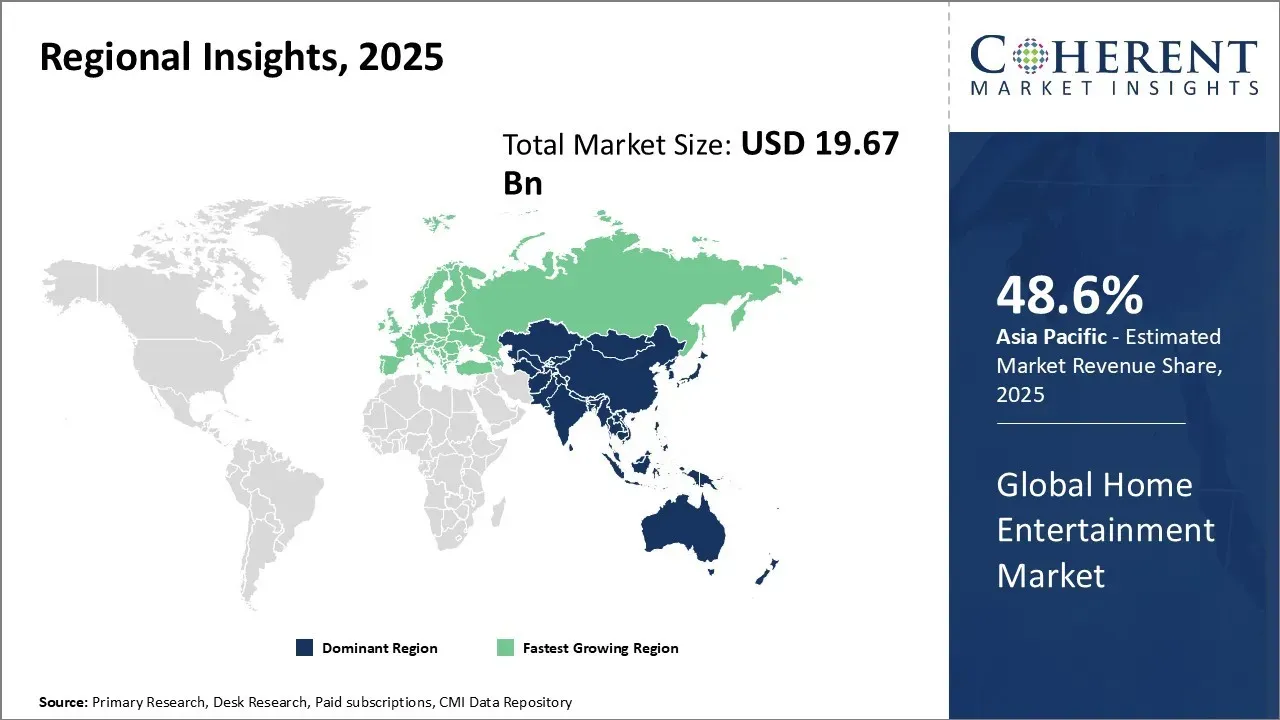
- Asia Pacific is projected to lead the global market with a 48.6% share, followed by the Europe region with a 28.8% share in 2026.
Market Overview
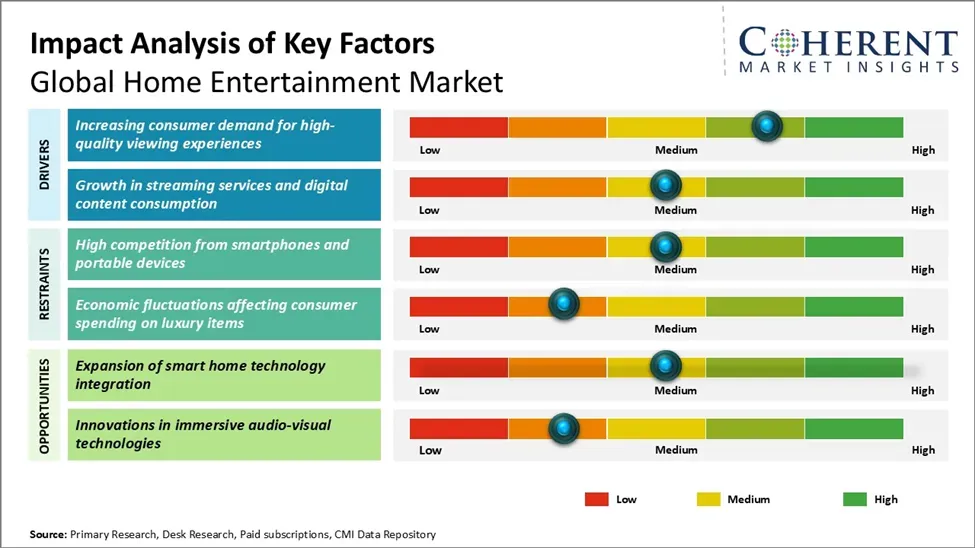
The global home entertainment market has been witnessing the increasing adoption of advanced technologies in recent years. Factors such as rising demand for UHD/4K devices and proliferation of over the top media services and video streaming platforms have been driving the demand for enhanced home entertainment devices and experiences. Growing preference for in-house content consumption and improving high-speed internet connectivity are further expected to propel the market growth over the forecast period.
However, threat from other entertainment avenues and growing popularity of mobile/out-of-home entertainment may challenge the market growth to a certain extent.
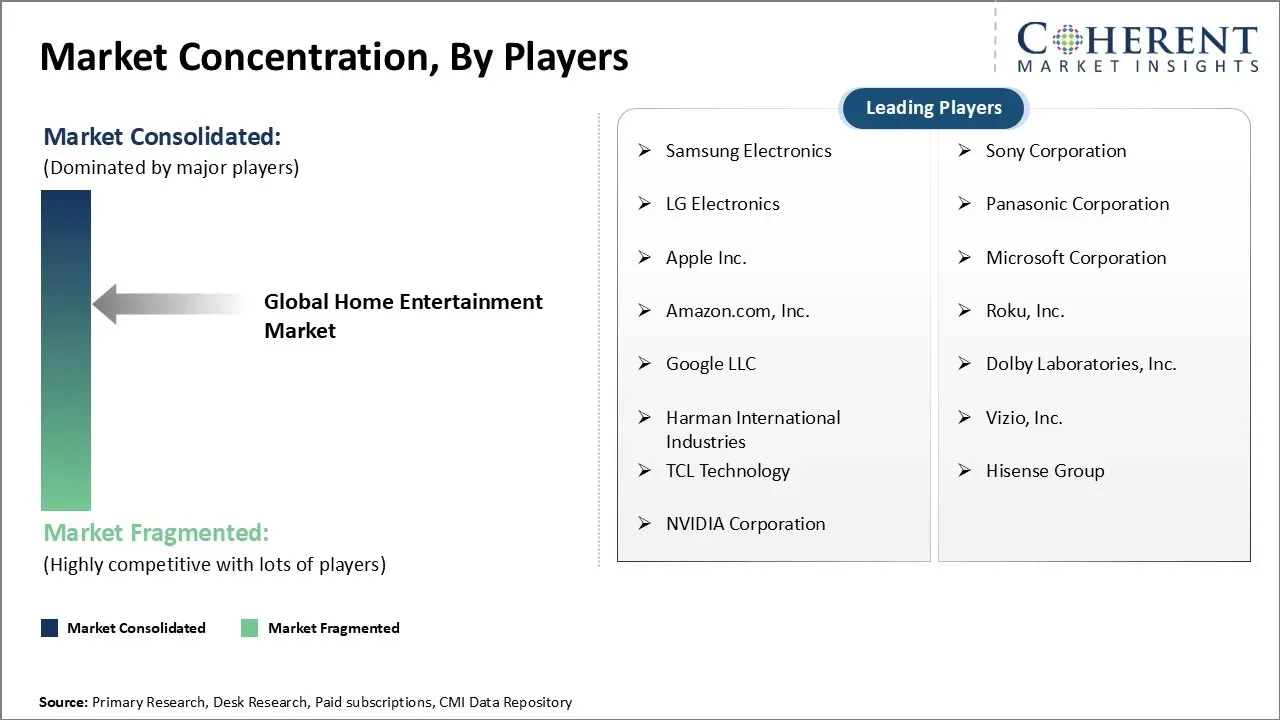
Market Concentration and Competitive Landscape
Current Events and their Impact on the Home Entertainment Market
Current Events | Description and its impact |
Global Supply Chain Disruptions |
|
Regulatory Shifts in Key Markets |
|
- Current Industry Events of 2026
- Market Size Estimation
- Regional Breakdown
- Competitive Landscape
- Customer Intelligence
- Segmental Analysis
- Pricing Analysis
- Key Market Drivers, Challenges & Future Trends
- Customized Insights Section
Market Trends
Increasing Adoption of Smart TVs and Connected Devices
The increasing adoption of smart TVs and connected devices such as computers and streaming boxes is significantly propelling the expansion of the home entertainment market by fundamentally transforming how consumers access and consume media content. Additionally, the widespread use of connected devices like computers, tablets, and smartphones further amplifies this trend by allowing users to access digital content anytime and anywhere, fostering a more personalized and flexible entertainment experience.
For instance, according to the United States Census Bureau, in June 2024, most U.S. households had at least one type of computer (95%) and had a broadband internet subscription (90%) in 2021, an increase from 2018 (92% and 85%, respectively).
High Competition from Smartphones and Portable Devices
The global market faces high competition from advanced smartphones and portable devices that offer seamless entertainment options. Many consumers now prefer using their smartphones and tablets to watch videos, play games, or listen to music instead of traditional TVs or gaming consoles at homes. Streaming apps and cloud-based services have made content easily accessible on mobile devices. This has reduced the dependency on fixed home entertainment appliances and systems. Younger generations in particular are spending more time on their smartphones for entertainment on the go.
Segmental Insights
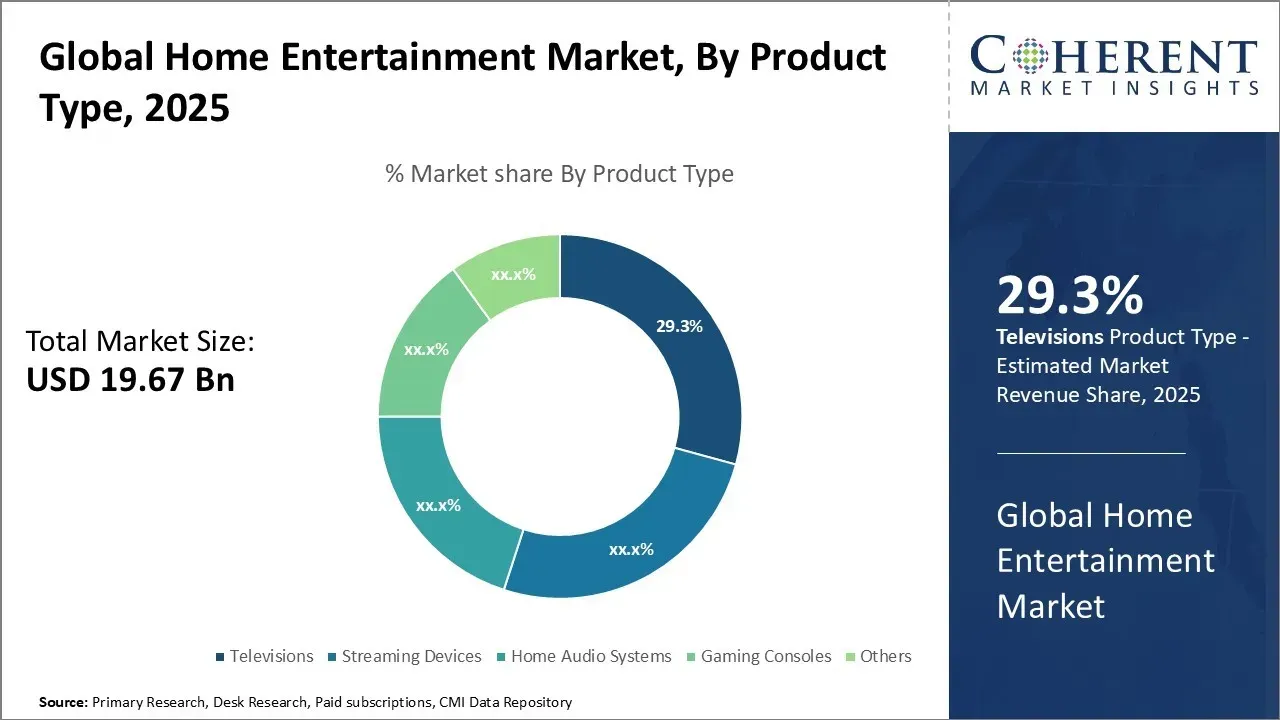
Home Entertainment Market Insights, By Product Type: Improved Home Entertainment Experience Drives the Televisions Segment Growth
In terms of product type, the televisions segment is estimated to contribute 30.3% share of the market in 2026, owing to people's preference for television as a primary medium for home entertainment.
Televisions offer the largest screen size available for viewing movies, sports, and other content at home in high picture quality. Advancements in television technology, such as 4K/Ultra HD resolution and large screen sizes above 55 inches, have enhanced the overall viewing experience. Content in these high resolutions can be experienced like never before on big screen televisions.
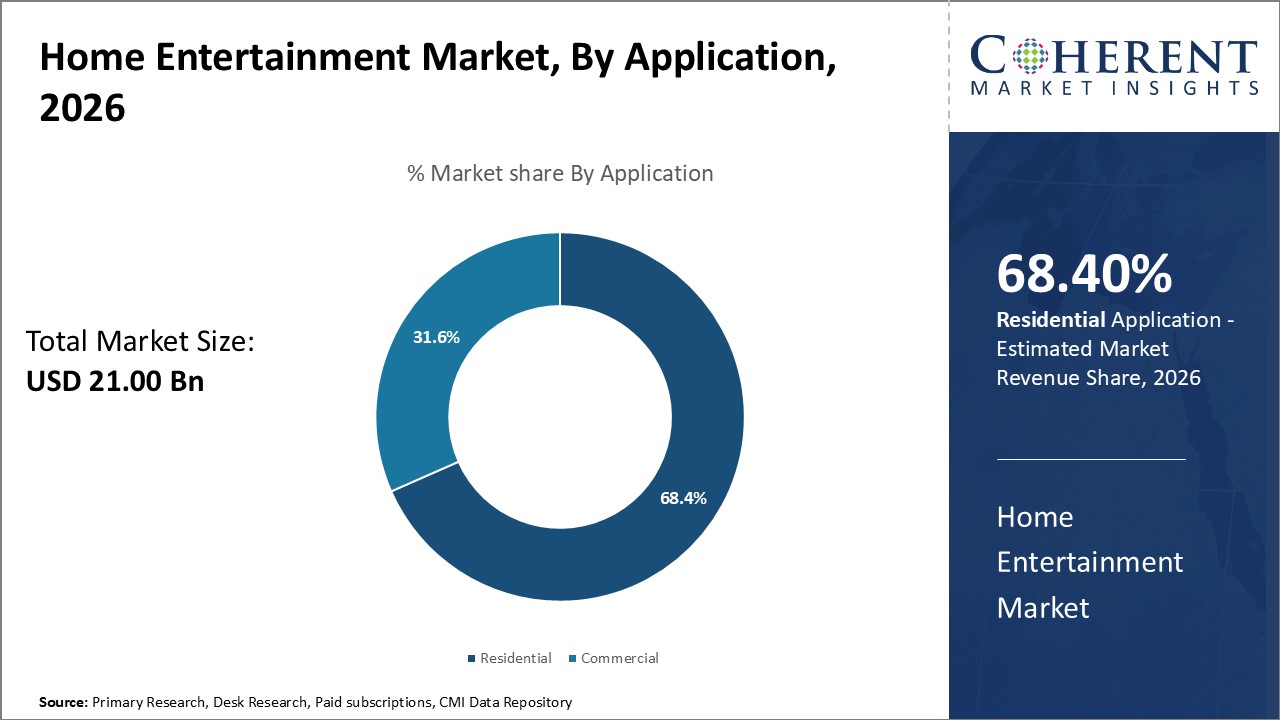
Home Entertainment Market Insights, By Application: Residential Segment is Propelling the Market, due to High Preference for Experience Economy
In terms of application, the residential segment is estimated to contribute 68.4% share of the market in 2026, owing to changing consumer preferences for experience economy.
People increasingly want meaningful experiences and ways to relax and entertain themselves at home. Home entertainment devices allow families to spend quality time together enjoying movies, sports, gaming, and others in the comfort of their living rooms. Devices catered for the residential segment provide easy to use and unified solutions for multi-room content access.
Home Entertainment Market Insights, By Distribution Channel: Ease and Convenience are Uplifting Online Retail Share
In terms of distribution channel, the online retail segment is estimated to account for 47.7% of the market share in 2026, propelled by consumers' growing preference for convenience.
E-commerce platforms simplify the shopping experience by offering extensive product ranges, customer reviews, and attractive deals with just a few clicks. These platforms also address key consumer concerns by ensuring fast delivery services and hassle-free returns. Many retailers have introduced virtual product demonstrations and trial services, enhancing the online shopping experience.
Emerging Innovations in the Home Entertainment Market
- Smart Home Sensors Integrated with AI
- Startups are spearheading advanced solutions such as smart home sensors integrated with AI. Companies like Anthropic develop AI safety methods to improve virtual assistants. Its research could influence how users control entertainment devices or access information through conversational interfaces. Meanwhile, Anthropic’s work in general AI safety enhances responsible development.
- Use of Eco-friendly Products and Materials
- Some startups focus on eco-friendly products and materials. Encharter creates specialized acoustics using recycled wood fibers instead of plastics. Its sustainable speakers appeal to green consumers while reducing electrical waste. Discarded Technologies also contributes by refurbishing used electronics for resale, diverting e-waste from landfills.
Impacts of Artificial Intelligence (AI) on the Home Entertainment Market
Artificial Intelligence (AI) is revolutionizing the home entertainment market by transforming how content is created, delivered, and consumed.
- Sony’s launch of the Vision-S AI-powered television highlights how companies are embedding AI at the product level to enhance viewer experience. This smart TV uses AI to analyze viewing habits, ambient lighting, and even room acoustics to automatically adjust picture and sound quality in real-time. Such AI-driven enhancements ensure optimal viewing conditions that adapt seamlessly to both user preferences and environmental factors.
- Amazon’s Alexa exemplifies how AI enhances functionality in smart home entertainment. Alexa integrates with various streaming services, enabling users to control their media through voice commands, search for content, adjust volume, and even receive personalized suggestions without needing manual input. By streamlining user interaction, Amazon has improved accessibility and convenience, making entertainment more intuitive and integrated within a connected home environment.
Regional Insights
Asia Pacific Home Entertainment Market Analysis and Trends
The Asia Pacific region is expected to dominate the market with a 48.6% share by the end of 2026. This leadership is driven by factors such as robust consumer spending, the rapid adoption of smart home technologies, and the strong presence of leading industry players in the region.
For instance, the Asia Pacific Digital Transformation report by the International Telecommunication Union (ITU) highlighted in 2022 that internet usage in the region reached approximately 60% of the population, emphasizing an underlying infrastructure readiness for adopting smart home technologies.
Europe Home Entertainment Market Analysis and Trends
Europe is projected to hold a 28.8% share of the market by the end of 2026. The region is experiencing rapid growth, establishing itself as a significant player in the industry. Factors such as swift modernization, growing disposable incomes, and expanding internet and smartphone usage are driving demand in countries like Germany and the U.K. Additionally, the presence of local OTT service providers and the affordability of devices are attracting a broad consumer base.
For instance, according to a report by GSMA, published in January 2026, almost 80% of Europe’s population subscribe to mobile internet services. 520 million people in Europe (88% of the population) subscribed to a mobile service. Mobile internet adoption is also widespread, reaching 79% of the population, which amounts to 471 million users. This represents an increase of more than 150 million people over the past decade.
U.S. Home Entertainment Market Analysis and Trends
The U.S. home entertainment market growth is driven by the increasing adoption of streaming services and smart home technologies. The launch of new streaming platforms has further fueled consumer interest in home entertainment solutions, leading to increased sales of advanced home entertainment products.
China Home Entertainment Market Analysis and Trends
China is experiencing rapid growth in the home entertainment sector, primarily due to rising disposable incomes and urbanization. For instance, according to the Mintel 2023, the market is projected to grow by 10% in 2023, driven by the popularity of smart TVs and home theater systems.
Germany Home Entertainment Market Analysis and Trends
Germany home entertainment market is characterized by a strong focus on high-quality audio and video systems. The introduction of new audio technologies, such as Dolby Atmos, has enhanced the home viewing experience. There's a significant shift towards digital streaming platforms like Netflix, Amazon Prime Video, and Disney+, influencing consumers to invest in smart TVs and advanced home entertainment systems.
India Home Entertainment Market Analysis and Trends
The Indian home entertainment market is experiencing significant growth, propelled by increased internet penetration, affordable smart devices, and supportive government initiatives. A key contributor to this expansion is JioCinema, a streaming platform owned by Reliance Industries. JioCinema has secured agreements with major content providers, enhancing its offerings to cater to diverse consumer preferences.
Pricing Analysis of the Home Entertainment Market
- Entry-level LED TVs priced under USD 600 dominate emerging markets.
- Regional Pricing Variance: The U.S. and Europe often showcase higher prices due to import duties and higher retail margins. Asia Pacific markets, including China and India, have become more price competitive due to local manufacturing.
- Accessories (controllers, VR headsets):
- Controllers: USD 60-USD 70 (Standard wireless)
- VR headsets (Oculus Quest 2): USD 299 – USD 499
- Premium gaming headphones: USD 100 – USD 300+
- Factors Influencing Consumer Pricing Sensitivity:
- Technological features: OLED or QLED technology can increase price by 30-100% compared to LED.
- Brand strength: Premium brands (Sony, Bose, Sonos) charge 20-50% more for equivalent specs.
- Connected features: Smart TV functionality, voice assistants add USD 50-USD 200.
- Currency fluctuations: Impact prices notably in Latin America and Africa.
- Inflation: Pushes short-term prices upward globally.
Market Report Scope
Home Entertainment Market Report Coverage
| Report Coverage | Details | ||
|---|---|---|---|
| Base Year: | 2025 | Market Size in 2026: | USD 21.00 Bn |
| Historical Data for: | 2020 To 2024 | Forecast Period: | 2026 To 2033 |
| Forecast Period 2026 to 2033 CAGR: | 6.8% | 2033 Value Projection: | USD 33.29 Bn |
| Geographies covered: |
| ||
| Segments covered: |
| ||
| Companies covered: | Samsung Electronics, Sony Corporation, LG Electronics, Panasonic Corporation, Apple Inc., Microsoft Corporation, Amazon.com, Inc., Roku, Inc., Google LLC, Dolby Laboratories, Inc., Harman International Industries, Vizio, Inc., TCL Technology, Hisense Group, and NVIDIA Corporation | ||
| Growth Drivers: |
| ||
| Restraints & Challenges: |
| ||
Home Entertainment Industry News
- In April 2025, Samsung Electronics America introduced its 2025 audio lineup, including new soundbars in the flagship Q-series and B-series.
- In April 2025, Sony unveiled the 2025 line-up of BRAVIA Theatre home audio products, meticulously crafted to bring the best out of the cinematic experience with immersive surround sound engineered to perfectly suit the home cinema setup. The new BRAVIA Theatre line-up addresses the differences between cinema and home viewing environments.
- In May 2025, LG Electronics (LG) launched its 2025 QNED evo lineup, reinforcing its presence in the premium LCD TV segment. Marking a significant leap forward for LCD TVs, the new QNED evo TVs feature various color solutions, Mini LED technology, the latest α (Alpha) AI processor, top-tier gaming performance and the versatile webOS platform.
- In January 2025, Panasonic introduced 2025 flagship Z95B series OLED TV with enhanced brightness, Re-designed audio, and Fire TV built in enhancements
Analyst View
- The home entertainment market is undergoing a significant transformation driven by rapid technological advancements and evolving consumer preferences. Increasing demand for smart TVs, gaming consoles, and streaming devices is fueling the adoption of home entertainment systems. The proliferation of high-speed internet has further boosted the consumption of digital content, enabling seamless streaming of movies, music, and live events. Convenience and personalized content are key drivers, as consumers seek immersive experiences within the comfort of their homes.
- However, the market faces certain restraints such as rising costs of premium content licensing and growing concerns over data privacy and security. Additionally, intense competition among streaming platforms can lead to market fragmentation, potentially confusing consumers and impacting subscription growth. Despite these challenges, opportunities abound in emerging technologies including virtual reality (VR) and augmented reality (AR), which promise to redefine interactive entertainment.
- Overall, the home entertainment market is poised for dynamic evolution as technological integration and consumer demand continue to reshape how people engage with entertainment at home.
Market Segmentation
- Product Type Insights (Revenue, USD Bn, 2021 - 2033)
- Televisions
- Streaming Devices
- Home Audio Systems
- Gaming Consoles
- Others
- Application Insights (Revenue, USD Bn, 2021 - 2033)
- Residential
- Commercial
- Distribution Channel Insights (Revenue, USD Bn, 2021 - 2033)
- Online Retail
- Specialty Stores
- Supermarkets/Hypermarkets
- Others
- Regional Insights (Revenue, USD Bn, 2021 - 2033)
- North America
- U.S.
- Canada
- Latin America
- Brazil
- Argentina
- Mexico
- Rest of Latin America
- Europe
- Germany
- U.K.
- Spain
- France
- Italy
- Russia
- Rest of Europe
- Asia Pacific
- China
- India
- Japan
- Australia
- South Korea
- ASEAN
- Rest of Asia Pacific
- Middle East
- GCC Countries
- Israel
- Rest of Middle East
- Africa
- South Africa
- North Africa
- Central Africa
- Key Players Insights
- Samsung Electronics
- Sony Corporation
- LG Electronics
- Panasonic Corporation
- Apple Inc.
- Microsoft Corporation
- Amazon.com, Inc.
- Roku, Inc.
- Google LLC
- Dolby Laboratories, Inc.
- Harman International Industries
- Vizio, Inc.
- TCL Technology
- Hisense Group
- NVIDIA Corporation
Sources
Primary Research Interviews
- Home Entertainment Device Manufacturers
- Streaming Service Providers
- Content Creators & Distributors
- Retailers & E-commerce Platforms
- Others
Magazines
- Variety
- The Hollywood Reporter
- Home Cinema Choice
- Digital Trends
- Others
Journals
- Journal of Consumer Electronics
- International Journal of Digital Television
- Journal of Media Economics
- Journal of Broadcasting & Electronic Media
- Others
Newspapers
- The Wall Street Journal
- The New York Times – Technology Section
- Financial Times – Media & Entertainment
- The Guardian – Technology
- Others
Associations
- Consumer Technology Association (CTA)
- Entertainment Technology Association (ETA)
- Digital Entertainment Group (DEG)
- National Association of Broadcasters (NAB)
- Others
Public Domain Sources
- Government Census Data
- World Bank Data on Digital Media Usage
- International Telecommunication Union (ITU) Reports
- United Nations Conference on Trade and Development (UNCTAD)
- Others
Proprietary Elements
- CMI Data Analytics Tool – Home Entertainment Market
- CMI Existing Repository of Information for the Last 8 Years
*Definition: The home entertainment market encompasses all hardware (TVs, audio systems, gaming consoles, streaming devices) and digital platforms used for at-home audiovisual and interactive entertainment. It includes traditional and modern content formats, devices, and distribution channels. It’s driven by technological advancement, streaming adoption, enhanced connectivity, and rising consumer demand for immersive in-home experiences.
Get access to 250+ pages report
Every segment, forecast, competitor profile and data table behind the analysis above — available for instant download.
- ESOMAR Member
- ISO 9001:2015 Certified
- D-U-N-S Registered
- GDPR & CCPA Compliant
Missing comfort of reading report in your local language? Find your preferred language:
Transform your Strategy with Exclusive Trending Reports
Frequently Asked Questions
The global home entertainment market is estimated to be valued at USD 19.67 Bn in 2025 and is expected to reach USD 30.82 Bn by 2032.
The CAGR of the global home entertainment market is projected to be 6.6% from 2025 to 2032.
Increasing consumer demand for high-quality viewing experiences and growth in streaming services and digital content consumption are the major factors driving the market growth for home entertainment.
High competition from smartphones and portable devices and economic fluctuations affecting consumer spending on luxury items are the major factors hampering the market growth for home entertainment.
In terms of product type, the televisions segment is estimated to dominate the market revenue share in 2025.
Samsung Electronics, Sony Corporation, LG Electronics, Panasonic Corporation, Apple Inc., Microsoft Corporation, Amazon.com, Inc., Roku, Inc., Google LLC, Dolby Laboratories, Inc., Harman International Industries, Vizio, Inc., TCL Technology, Hisense Group, and NVIDIA Corporation are the major players in the home entertainment market.
Asia Pacific is expected to lead the home entertainment market in 2025.