

Global Pottery Ceramics Market Size and Forecast – 2026 To 2033
The global pottery ceramics market is estimated to be valued at USD 13.65 Bn in 2026 and is expected to reach USD 19.86 Bn by 2033, growing at a compound annual growth rate (CAGR) of 5.5% from 2026 to 2033. Market expansion is supported by consumer spending on aesthetically differentiated tableware, decorative ceramics, planters, and coordinated home collections, alongside replacement demand from hotels, restaurants, and cafés.
Manufacturers are also strengthening product value through distinctive glazes, contemporary forms, mix-and-match collections, and more efficient ceramic production processes. In 2025, Villeroy & Boch expanded its Manufacture ceramic collection with five new items featuring modern black-and-white finishes and versatile bowl formats, reflecting continued investment in design-led tableware aligned with evolving dining and home-styling preferences.
Key Takeaways of the Global Pottery Ceramics Market
- Tableware and Kitchenware is estimated to expand at a 5.7% CAGR during 2026–2033 and is expected to hold 39.8% of the global pottery ceramics market in 2026. Its leadership reflects everyday replacement demand, broad price-point availability, gifting relevance, and recurring household dining use. In September 2025, IKEA launched a 12-piece Gustaf Westman collection featuring porcelain plates and cups, underscoring design-led refresh cycles in ceramic table settings.
- Stoneware is estimated to register a 5.9% CAGR during 2026–2033 and is expected to capture 34.6% of the market in 2026. The material combines chip resistance, heat retention, everyday usability, and glaze-driven aesthetics, allowing manufacturers to serve both functional and premium dining occasions. In October 2025, Le Creuset highlighted its Heritage Rectangular Casserole crafted in high-fired stoneware, reinforcing stoneware’s crossover between cooking, serving, and presentation.
- Household is estimated to grow at a 5.6% CAGR during 2026–2033 and is expected to account for 52.8% of the market in 2026. The segment benefits from frequent use across dining, food preparation, home entertaining, gifting, and decorative placement, creating multiple purchase occasions within the same consumer base. In October 2025, Fiskars Group reported Wedgwood’s Bacchus Collection spanning tableware, a collectible art piece, and home décor.
- Asia Pacific is estimated to advance at a 5.8% CAGR during 2026–2033 and is expected to represent 34.7% of the global market in 2026. Its scale reflects dense ceramic clusters, export-oriented manufacturing, and deep cultural use of porcelain and pottery. In September 2025, the Hunan Provincial Government announced the Liling International Ceramic Industry Expo with more than 300 participating enterprises, highlighting regional production and trade depth.
- Europe is estimated to register 6.4% CAGR during 2026–2033 and is expected to hold 30.6% of the global market in 2026, making it the fastest-growing region. Expansion is supported by premium design heritage, hospitality demand, sustainability-led product differentiation, and trade measures that improve competitive conditions for regional producers. In February 2026, the European Commission amended anti-dumping measures covering ceramic tableware and kitchenware imports from China.
Segmental Insights
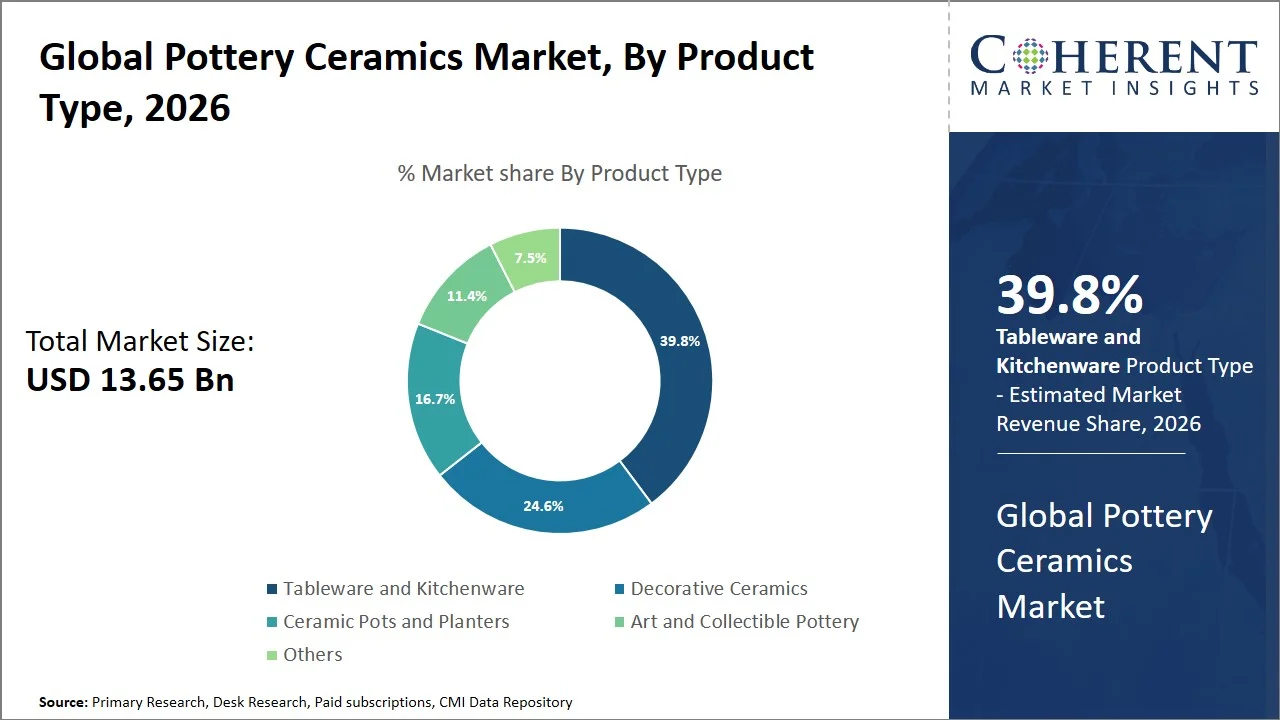
Why Does Tableware and Kitchenware Dominate the Global Pottery Ceramics Market?
Tableware and Kitchenware is expected to hold 39.8% of the global pottery ceramics market in 2026 because it addresses the market’s broadest set of recurring use occasions, spanning everyday dining, beverage service, food preparation, serving, gifting, and professional foodservice. Standardized plates, bowls, mugs, platters, and oven-to-table formats also support efficient batch production, coordinated collections, and straightforward replacement purchasing. For hotels and restaurants, stackability, edge strength, glaze durability, and food-presentation flexibility make ceramic ware operationally important rather than purely decorative. For manufacturers, the segment supports portfolio extensions across shapes, colors, and price tiers without changing the core ceramic manufacturing platform. In February 2026, Churchill introduced its Spring 2026 tableware collection, including hand-decorated designs, vitrified stoneware, and new hospitality-focused shapes engineered for professional performance.
- Current Industry Events of 2026
- Market Size Estimation
- Regional Breakdown
- Competitive Landscape
- Customer Intelligence
- Segmental Analysis
- Pricing Analysis
- Key Market Drivers, Challenges & Future Trends
- Customized Insights Section
Why Does Stoneware Represent the Largest Material Type in the Global Pottery Ceramics Market?
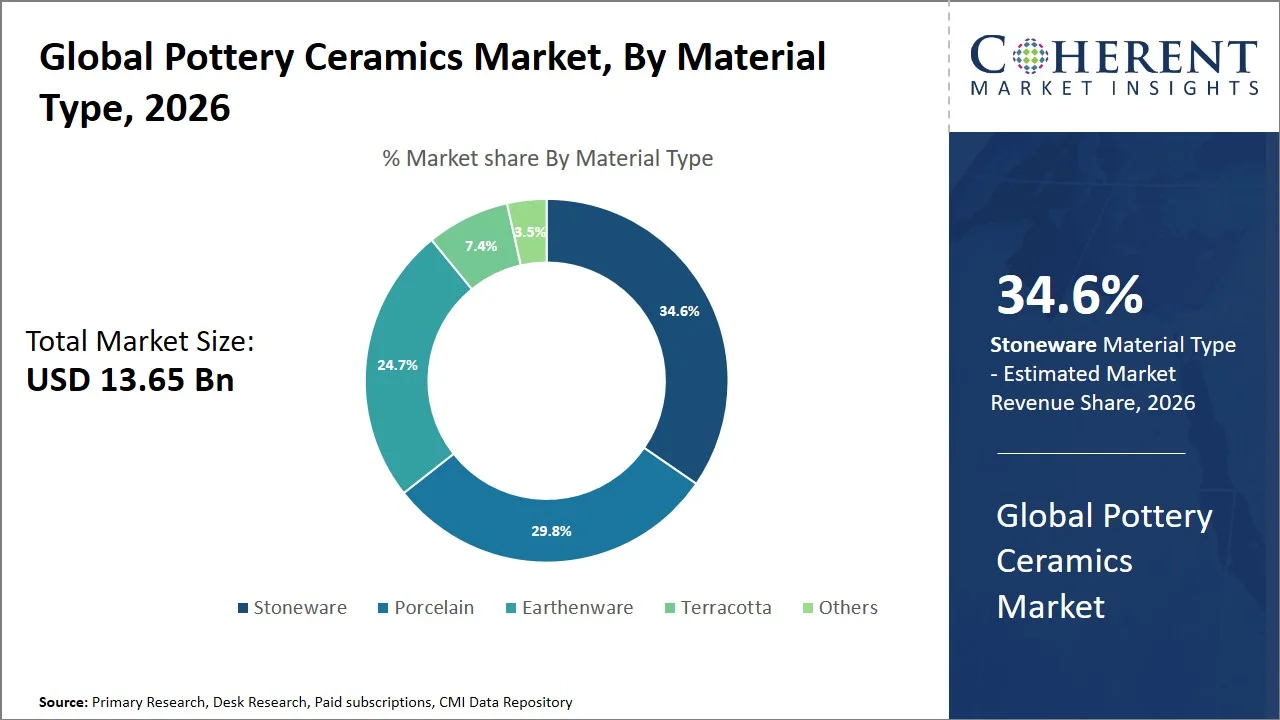
Stoneware is expected to represent 34.6% of the global pottery ceramics market in 2026 because its dense fired body combines everyday durability with the tactile, handcrafted appearance increasingly used in contemporary pottery design. The material performs well across plates, bowls, mugs, serving pieces, bakeware, and decorative home products, giving producers broad SKU flexibility from a common material platform. Reactive glazes and natural surface variation also allow manufacturers to create premium-looking differentiation while retaining repeatable industrial production. Its microwave, dishwasher, oven, and freezer compatibility strengthens household utility and supports longer replacement cycles. Commercially, stoneware enables brands to bridge functional mass-market products and higher-value design collections. In February 2024, Portmeirion detailed its Minerals stoneware collection, produced from organic Iberian clay with at least 90% recycled materials and a once-fired process intended to reduce energy use.
Why Does Household Dominate the Application Segment of the Global Pottery Ceramics Market?
Household is expected to account for 52.8% of the global pottery ceramics market in 2026 because residential buyers purchase ceramics across several independent needs, including daily table settings, cookware and serve ware, planters, decorative objects, gifting, and seasonal home refreshes. This creates a wider consumer purchase base than hospitality or interior-design projects, which are more concentrated and specification-led. Household ceramics also benefit from omnichannel availability, allowing branded producers and smaller pottery labels to sell coordinated collections through specialty retail, department stores, marketplaces, and direct-to-consumer channels. Design rotation further supports repeat purchases without requiring functional obsolescence. For suppliers, the segment rewards assortment breadth, accessible pricing, and lifestyle merchandising. In June 2026, H&M Group and Solar Club launched a nine-piece home assortment made partly from stoneware clay, including tableware designed around shared breakfasts and long dinners.
Current Events and their Impact
Current Event | Description and Its Impact |
Benelux Introduces Stricter Lead and Cadmium Limits – November 2024 |
|
Canada Updates Glazed Ceramics Regulatory Terminology – June 2026 |
|
Global Pottery Ceramics Market Dynamics
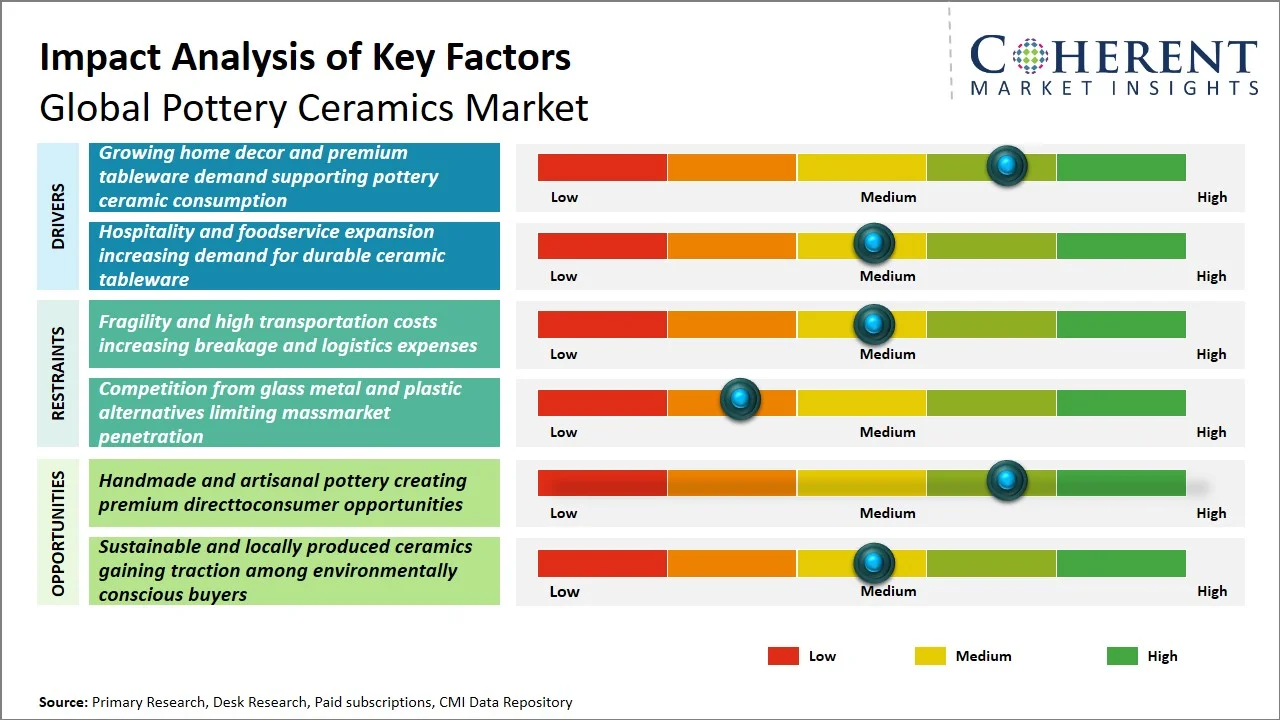
Key Market Drivers
- Growing home decor and premium tableware demand supporting pottery ceramic consumption: Consumers increasingly use ceramics as part of interior styling, entertaining, gifting, and premium dining, supporting demand beyond basic replacement. This allows manufacturers to differentiate through shapes, finishes, colors, and decorative designs while improving value realization across tableware and décor collections. In February 2025, Porcel officially released its Royal Bloom porcelain collection at Ambiente 2025 in Frankfurt, positioning the range around sophisticated table composition and refined design, illustrating continued supplier investment in premium tabletop aesthetics.
- Hospitality and foodservice expansion increasing demand for durable ceramic tableware: Hotels, restaurants, and cafés require recurring replacement and procurement of plates, bowls, cups, and serving pieces designed for intensive use. Suppliers offering chip resistance, stackability, dishwasher compatibility, consistent sizing, and reliable replenishment are better positioned for contract demand. In January 2026, Hilton reported that it had added nearly 800 hotels and 100,000 rooms during 2025 and had more than 520,000 rooms under development, indicating a substantial future procurement base for hospitality operating supplies, including commercial tableware.
Emerging Market Trends
- Modular Mix-and-Match Collections Replacing Fixed Dinnerware Sets: Pottery ceramic brands are shifting from rigid matched sets toward modular plates, bowls, mugs, serving pieces, and decorative items that consumers can combine gradually. This supports personalized tablescapes, repeat purchases, and easier seasonal collection updates. Manufacturers can extend proven shapes through new glazes and finishes, while retailers benefit from refreshing selected items without replacing entire assortments.
- Small-Batch Customization Reshaping Supplier Economics: Digital decoration, flexible forming, and faster sampling are making smaller customized ceramic runs more commercially practical. Suppliers can tailor motifs, branding, colors, and finishes for boutique retailers, hospitality projects, gifting, and limited-edition collections. Manufacturers with strong artwork preparation, color control, rapid sampling, and flexible kiln scheduling should gain an advantage as buyers increasingly seek differentiated products without committing to large production volumes.
Regional Insights
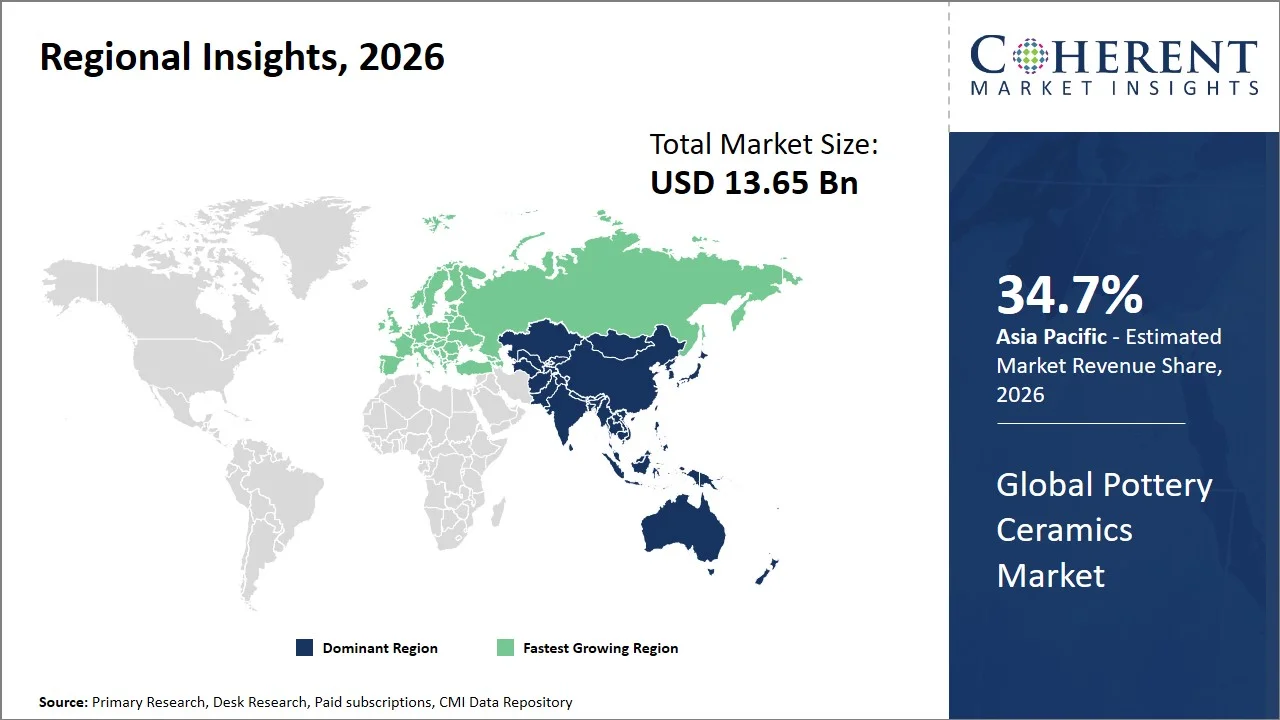
Why Does Asia Pacific Dominate the Global Pottery Ceramics Market?
Asia Pacific is expected to account for 34.7% of the global pottery ceramics market in 2026, supported by its combination of large-scale ceramic manufacturing, established pottery clusters, broad household consumption, and strong export capability. China provides deep production capacity across porcelain, stoneware, tableware, and decorative ceramics, while Japan and India contribute premium craftsmanship, traditional pottery formats, and design-led products. The region also benefits from dense retail networks, expanding urban households, hospitality activity, and cross-border sourcing. These factors allow suppliers to serve both value-oriented and premium buyers efficiently. In April 2026, Aichi Prefecture highlighted the 65th Father of Seto Pottery Festival, where visitors could view, purchase, and experience Seto ware through pottery vendors and hands-on workshops, reinforcing the continuing commercial relevance of established ceramic clusters.
Why Is Europe Emerging as the Fastest-Growing Region in the Global Pottery Ceramics Market?
Europe is expected to hold 30.6% of the global pottery ceramics market in 2026 and emerge as the fastest-growing region as buyers place greater value on design differentiation, durable tableware, craftsmanship, and sustainably positioned home products. The region’s producers compete through premium glazing, contemporary forms, limited collections, heritage branding, and manufacturing modernization rather than price alone. Strong hospitality demand, specialty retail, interior-focused purchasing, and export-oriented brands further support higher-value pottery ceramics. This creates room for premiumization across household, interior-decoration, and HoReCa applications. In February 2025, Portuguese producer Mesa Ceramics received two German Design Awards for its AKIKO and KAZE ceramic stoneware collections; Portugal’s COMPETE 2030 also highlighted support for a new factory dedicated to ceramic stoneware tableware and dinnerware, illustrating investment in design-led production capacity.
Global Pottery Ceramics Market Outlook for Key Countries
Why Is the U.S. a Key Market for the Global Pottery Ceramics Market?
The U.S. is expected to account for an estimated 19.8% of the global pottery ceramics market in 2026, indicating a large replacement market for dinnerware, serve ware, decorative ceramics, planters and collectible pottery. Demand is supported by strong household purchasing, wedding and gifting occasions, restaurant and hospitality procurement and wide availability across specialty stores, department stores and e-commerce. Consumers also support a thriving premium niche for domestic design and artisan ceramics, allowing brands to differentiate themselves thru heritage, seasonal colors and limited editions. In May 2025, Lenox Corporation announced a three-year expansion plan for the U.S. that included a new West Coast fulfillment hub, upgrades to its Maryland distribution center, and expansion of its American design team. These signals continued investment in domestic tabletop distribution, design capability and omnichannel market coverage.
Why Does China Support Growth in the Global Pottery Ceramics Market?
China is expected to account for an estimated 15.9% of the global pottery ceramics market in 2026, supported by deep ceramic production capacity, specialized kiln clusters, skilled labor, raw-material availability, and substantial domestic consumption. Jingdezhen, Dehua, Liling, Longquan, and other production centers enable suppliers to address everyday tableware, porcelain, decorative ceramics, artistic pottery, and premium heritage products. Large manufacturers coexist with smaller studios and cultural-creative brands, creating coverage across mass retail, exports, gifting, tourism, and collector demand. Export infrastructure further reinforces China’s role as a global sourcing base. In August 2025, China’s National Intellectual Property Administration highlighted seven porcelain geographical indications and reported that Liling’s ceramic industry exceeded USD 10.38 billion in annual value, with products reaching more than 150 countries and regions.
Why Is India Important in the Global Pottery Ceramics Market?
India is expected to hold a 5.2% share of the global pottery ceramics market in 2026, supported by urban household formation, festive and gifting purchases, home décor spending, hospitality expansion, and a large artisan manufacturing base. Production clusters such as Khurja, Jaipur, Gorakhpur, and Nizamabad support distinct offerings across glazed tableware, terracotta, decorative pottery, and handcrafted ceramics. India also has a cost-competitive SME base capable of supplying domestic retailers, exporters, and direct-to-consumer brands. Policy support for traditional clusters can further improve affordability and formal market participation. In October 2025, India’s Press Information Bureau stated that Khurja ceramics employed around 20,000–25,000 artisans and workers, while a GST reduction from 12% to 5% was expected to make these products 6–7% cheaper, strengthening domestic and export competitiveness.
Why Is Japan a Strategic Country in the Global Pottery Ceramics Market?
Japan is expected to capture an estimated 4.4% of the global pottery ceramics market in 2026, supported by the strong integration of ceramics into dining, tea service, gifting, hospitality, and interior aesthetics. Production centers such as Seto, Arita, Mino, Kutani, and Mashiko sustain a differentiated supply base ranging from functional household ware to premium collectible pottery. Japanese producers benefit from consumer appreciation for craftsmanship, glaze quality, compact design, and product longevity, while tourism adds demand for region-specific ceramic goods. Innovation is also extending traditional ceramics into sustainability-oriented applications. In January 2025, the Government of Japan highlighted DG TAKANO’s nanotechnology-based surface treatment for ceramic dishware, developed to remove food residue with water and reduce reliance on detergent, illustrating how Japanese producers are combining ceramic products with resource-efficiency technology.
Why Is the UAE an Important Growth Market for the Global Pottery Ceramics Market?
The UAE is expected to account for an estimated 0.9% of the global pottery ceramics market in 2026, with its commercial importance exceeding its absolute share because of concentrated hospitality, luxury residential development, tourism, and premium retail. Hotels, restaurants, cafés, catering operators, and interior designers create recurring procurement opportunities for ceramic tableware, serving pieces, decorative ceramics, and planters, while an international consumer base supports varied design preferences. The country’s position as a Gulf trading and re-export hub also benefits imported European and Asian ceramic brands. In May 2026, the Dubai Media Office reported that UAE hotels hosted more than 32 million guests in 2025, generated 100 million hotel nights, and operated approximately 217,000 rooms. This hospitality scale provides a substantial addressable procurement base for ceramic tableware and décor suppliers.
Technology Adoption Landscape in the Global Pottery Ceramics Market
Technology | Adoption Level | Key Application Area | Business Impact |
Computer-Controlled Kiln Firing Profiles | High | Stoneware, porcelain, earthenware and tableware firing | Improves firing consistency, controls temperature curves, lowers defect variability, and supports reproducible glaze outcomes. |
Roller-Head Forming and Pressure Casting | High | Plates, bowls, cups, pots and standardized ceramic forms | Raises production throughput and dimensional consistency while reducing dependence on fully manual shaping. |
Digital Ceramic Printing and Decoration | Medium | Customized tableware, decorative ceramics and branded collections | Enables shorter design runs, faster pattern changes, personalization, and lower setup barriers for specialized collections. |
Automated Glaze Spraying and Controlled Application | Medium | Tableware, planters and decorative ceramic surfaces | Improves coating consistency, controls glaze consumption, reduces finishing variability, and supports repeatable surface quality. |
Spectrophotometric Color Control and Optical Defect Inspection | Medium | Glaze matching, decoration control and final quality assurance | Reduces shade variation and visual rejects while strengthening consistency across production batches and replacement orders. |
Ceramic Additive Manufacturing / 3D Printing | Low | Prototypes, complex art pottery, molds and customized forms | Shortens prototype development and enables geometries that are difficult to produce through conventional forming, but economics still restrict large-volume use. |
How Are Design-Led Ceramic Planters and Indoor-Outdoor Living Applications Creating New Growth Opportunities in the Global Pottery Ceramics Market?
Ceramic planters and design-led indoor-outdoor living products create an underdeveloped route beyond conventional dining products. Urban apartments, balconies, hospitality terraces, premium residential projects, garden centers, and interior designers create demand for planters that combine decorative value with drainage, durability, coordinated sizing, and indoor-outdoor styling. Suppliers can capture this opportunity by building modular planter families, pairing ceramics with stands or irrigation accessories, and offering finishes that coordinate with broader décor collections. Commercial success will require larger-form manufacturing capability, crack and weather resistance, efficient protective packaging, and distribution systems that can manage heavier, breakable products. Regional specialists and vertically integrated ceramic producers may be particularly well positioned because they can combine design flexibility with local logistics. New entrants should prioritize differentiated form, finish, and application functionality rather than competing through commodity pots alone. Dedicated specification support for architects, landscapers, and hospitality procurement teams could also convert project-based demand into repeat collection orders.
Market Players, Key Development, and Competitive Landscape
Key Developments
- In October 2025, RAK Porcelain Group acquired BANKOOK DESIGN CHAMBRE, S.L., owner of Spanish tableware brand Cookplay. The transaction combines Cookplay’s sculptural design positioning with RAK Porcelain’s industrial manufacturing and international distribution capabilities. This is important for the global pottery ceramics market because it demonstrates how larger ceramic manufacturers can acquire design-led brands to strengthen premium portfolios and access hospitality and home-dining customers through broader geographic networks.
- In September 2025, Steelite-Utopia opened a flagship hospitality tabletop showroom in central London, bringing together tableware, glassware, cutlery, buffet products, and bespoke solutions in a dedicated customer environment. This is important for the global pottery ceramics market because physical specification centers allow chefs, hotel operators, designers, and procurement teams to evaluate ceramic products together with complete tabletop systems, strengthening consultative B2B selling and cross-category specification opportunities.
- In June 2025, Denby marked the fifteenth anniversary of its Halo ceramic collection with new pieces and associated collection activity centered on the established reactive-glaze design. This is important for the global pottery ceramics market because extending established pottery franchises allows manufacturers to generate fresh purchasing occasions without abandoning recognizable shapes, glaze identities, or installed household collections, supporting lifecycle management and repeat customer engagement.
Competitive Landscape
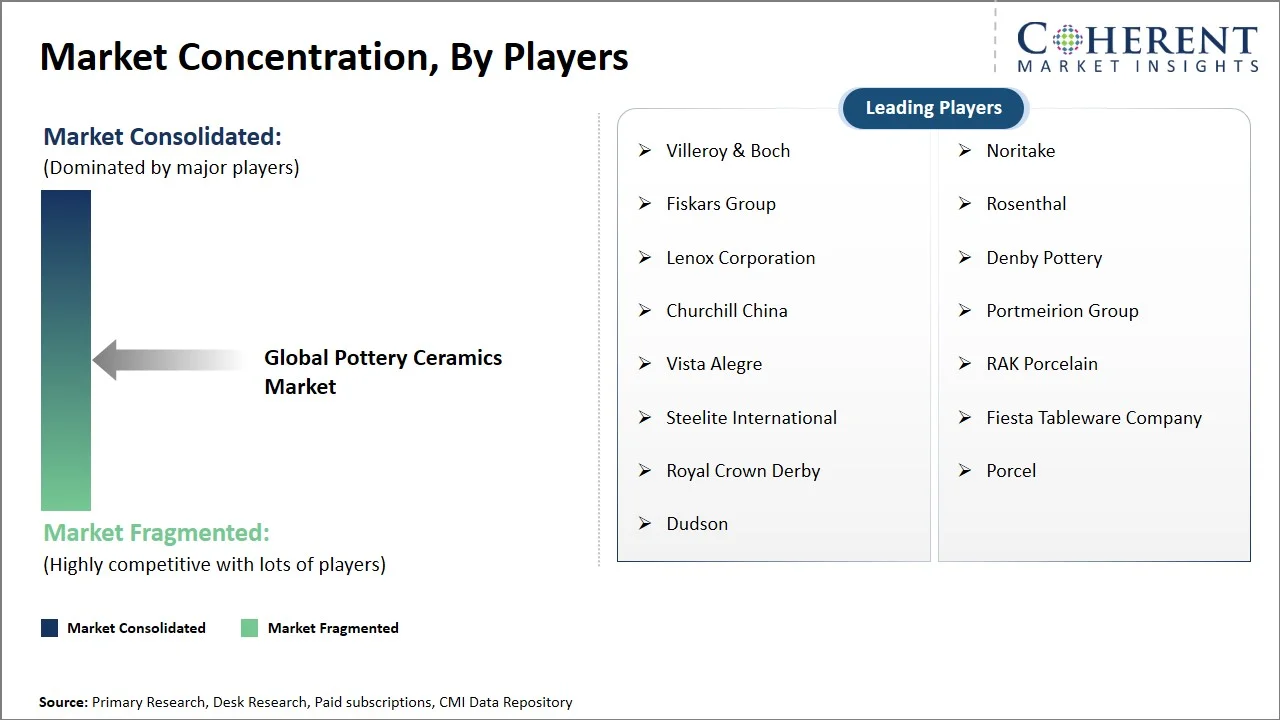
The global pottery ceramics market is fragmented, comprising global lifestyle brands, premium porcelain manufacturers, hospitality specialists, regional producers, craft studios, and private-label suppliers. Competition centers on design differentiation, product quality, manufacturing consistency, pricing, supply reliability, and distribution reach. Large manufacturers benefit from scale and broad portfolios, while smaller players compete through craftsmanship, distinctive glazing, and customization. Strong product identity combined with reliable supply remains critical for maintaining competitiveness.
Key focus areas include
- Design and glaze differentiation: Distinctive forms, textures, reactive finishes, and recognizable collection architecture support premium positioning.
- Replacement continuity: Hospitality and long-life household collections benefit from dependable availability of matching pieces over extended periods.
- Flexible production economics: Manufacturers able to switch efficiently between standard runs and smaller customized batches can serve a wider customer base.
- Food-contact quality assurance: Migration testing, glaze control, and documentation capabilities are increasingly important for export-oriented tableware suppliers.
- Private-label capability: Retailers and hospitality distributors value suppliers that can adapt decoration, packaging, specifications, and branding without excessive minimum volumes.
- Supply reliability: Stable clay, glaze, firing, packaging, and logistics capacity helps protect buyers from inconsistent deliveries and batch variation.
- Channel-specific assortment strategy: Consumer retail, hospitality procurement, gifting, décor, and gardening channels require different pricing, packaging, replenishment, and merchandising models.
Market Report Scope
Pottery Ceramics Market Report Coverage
| Report Coverage | Details | ||
|---|---|---|---|
| Base Year: | 2025 | Market Size in 2026: | USD 13.65 Bn |
| Historical Data for: | 2020 To 2024 | Forecast Period: | 2026 To 2033 |
| Forecast Period 2026 to 2033 CAGR: | 5.5% | 2033 Value Projection: | USD 19.86 Bn |
| Geographies covered: |
| ||
| Segments covered: |
| ||
| Companies covered: | Villeroy & Boch, Noritake, Fiskars Group, Rosenthal, Lenox Corporation, Denby Pottery, Churchill China, Portmeirion Group, Vista Alegre, RAK Porcelain, Steelite International, Fiesta Tableware Company, Royal Crown Derby, Porcel, Dudson | ||
| Growth Drivers: |
| ||
| Restraints & Challenges: |
| ||
Analyst Opinion (Expert Opinion)
- Market leadership is likely to shift toward companies managing broader ceramic portfolios across multiple use occasions, price tiers, and buyer groups. Faster assortment renewal, reusable product forms, and coordinated collection planning should become more valuable than maintaining large but slowly changing catalogs. Producers that closely connect design, manufacturing, and channel merchandising will be better positioned.
- Flexible digital decoration could reshape ceramic design economics by making smaller production runs and exclusive designs more commercially viable. Artwork libraries, licensed motifs, customized finishes, and faster sampling may become stronger competitive assets. Manufacturers dependent on long standardized runs could face pressure as buyers increasingly seek differentiated products and limited-edition collections.
- Market participants should prioritize flexible forming and decoration, glaze-safety testing, faster sampling, and resilient raw-material sourcing. Premium gifting, customized commercial projects, and differentiated household collections offer stronger value potential than commodity whiteware. Companies should remain cautious about adding fixed kiln capacity without secure demand, as energy costs, breakage, freight expenses, and price competition can weaken margins
Speak to the analyst
Want personalized insights?
Take the findings above to one of our principal consultants, or have the report rebuilt around the segments, geographies and competitors you actually track.
Market Segmentation
- Product Type Insights (Revenue, USD Bn, 2021 - 2033)
- Tableware and Kitchenware
- Decorative Ceramics
- Ceramic Pots and Planters
- Art and Collectible Pottery
- Others
- Material Type Insights (Revenue, USD Bn, 2021 - 2033)
- Stoneware
- Porcelain
- Earthenware
- Terracotta
- Others
- Application Insights (Revenue, USD Bn, 2021 - 2033)
- Household
- Hotels Restaurants and Cafes
- Interior Decoration
- Gardening and Landscaping
- Others
- Distribution Channel Insights (Revenue, USD Bn, 2021 - 2033)
- Specialty Stores
- Online Retail
- Supermarkets and Hypermarkets
- Department Stores
- Direct Sales
- Others
- Regional Insights (Revenue, USD Bn, 2021 - 2033)
- North America
- U.S.
- Canada
- Latin America
- Brazil
- Argentina
- Mexico
- Rest of Latin America
- Europe
- Germany
- U.K.
- Spain
- France
- Italy
- Russia
- Rest of Europe
- Asia Pacific
- China
- India
- Japan
- Australia
- South Korea
- ASEAN
- Rest of Asia Pacific
- Middle East
- GCC Countries
- Israel
- Rest of Middle East
- Africa
- South Africa
- North Africa
- Central Africa
- North America
- Key Players Insights
- Villeroy & Boch
- Noritake
- Fiskars Group
- Rosenthal
- Lenox Corporation
- Denby Pottery
- Churchill China
- Portmeirion Group
- Vista Alegre
- RAK Porcelain
- Steelite International
- Fiesta Tableware Company
- Royal Crown Derby
- Porcel
- Dudson
Sources
Primary Research Interviews
- Pottery ceramic, porcelain, stoneware, earthenware, and terracotta manufacturers
- Tableware, decorative ceramic, planter, and art pottery producers
- Raw material, glaze, pigment, kiln, forming, and ceramic printing suppliers
- Retailers, distributors, hotels, restaurants, interior designers, landscapers, and industry experts
Stakeholders
- Clay, kaolin, feldspar, glaze, pigment, and ceramic ink suppliers
- Ceramic product and tableware manufacturers
- Equipment, packaging, logistics, import, export, and distribution companies
- Specialty stores, e-commerce platforms, hospitality buyers, and household consumers
End-use Sectors
- Household dining and kitchenware
- Hotels, restaurants, and cafés
- Interior decoration
- Gardening and landscaping
- Art, collectibles, and gifting
Regulatory and Government Bodies
- U.S. FDA and U.S. International Trade Commission
- European Commission and national market-surveillance authorities
- UK Food Standards Agency
- Health Canada
- China National Health Commission
- Bureau of Indian Standards
- Japan Ministry of Health, Labour and Welfare
- National food-contact, product-safety, customs, and environmental authorities
Databases
- UN Comtrade
- Eurostat Comext
- USITC DataWeb
- International Trade Centre Trade Map
- World Integrated Trade Solution
- WIPO PATENTSCOPE and Espacenet
- Company annual reports, product catalogues, and patent filings
Magazines and Journals
- Ceramic Review
- Ceramic World Review
- Journal of the American Ceramic Society
- Journal of the European Ceramic Society
- Ceramics International
- Journal of Asian Ceramic Societies
Associations
- Cerame-Unie
- The American Ceramic Society
- European Ceramic Society
- British Ceramic Confederation
- European Federation of Ceramic Table- and Ornamentalware Industries
- National pottery and ceramic manufacturing associations
Public Domain Sources
- Product catalogues and technical specifications
- Stoneware, porcelain, earthenware, terracotta, and glaze information
- Retail pricing and online product availability
- Import-export and customs records
- Hospitality, residential, home décor, and gardening activity
- Food-contact safety, lead and cadmium migration, and compliance records
- Patents, annual reports, product launches, and manufacturing expansions
Key Standards and Regulations
- ISO 6486 series – Lead and cadmium release from ceramic foodware
- ISO 5644 – Porcelain tableware specifications and testing
- EU Regulation (EC) No. 1935/2004
- Council Directive 84/500/EEC on ceramic food-contact articles
- U.S. FDA requirements for lead and cadmium in ceramicware
- Canada Glazed Ceramics and Glassware Regulations
- China GB 4806.4 standard for ceramic food-contact products
- National product-safety, labeling, food-contact, and environmental regulations
Proprietary Elements
- CMI Data Analytics Tool, Proprietary CMI Existing Repository of information for the last 10 years
Get access to 250+ pages report
Every segment, forecast, competitor profile and data table behind the analysis above — available for instant download.
- ESOMAR Member
- ISO 9001:2015 Certified
- D-U-N-S Registered
- GDPR & CCPA Compliant
Missing comfort of reading report in your local language? Find your preferred language:
Transform your Strategy with Exclusive Trending Reports
Frequently Asked Questions
The CAGR of global pottery ceramics market is projected to be 5.5% from 2026 to 2033.
The global pottery ceramics market is estimated to be valued at USD 13.65 billion in 2026 and is expected to reach USD 19.86 billion by 2033.
Pottery ceramics are widely used in household dining, hotels, restaurants and cafés, interior decoration, gardening and landscaping, gifting, and collectible art applications.
Stoneware, porcelain, earthenware, and terracotta are the major materials used in pottery ceramics, with selection depending on durability, appearance, firing characteristics, and intended application.
Pottery ceramic products are primarily distributed through specialty stores, online retail platforms, supermarkets and hypermarkets, department stores, and direct sales channels.
Key trends include mix-and-match tableware collections, small-batch customization, distinctive glazing and surface finishes, sustainable production practices, digital ceramic decoration, and growing integration of pottery ceramics with modern home décor and lifestyle concepts.
Growing home decor and premium tableware demand supporting pottery ceramic consumption and Hospitality and foodservice expansion increasing demand for durable ceramic tableware are the major factor driving the growth of global pottery ceramics market.