

Online Home Decor Market Analysis & Forecast
Online Home Decor Market is estimated to be valued at USD 134.52 Bn in 2026 and is expected to reach USD 288.22 Bn in 2033, exhibiting a compound annual growth rate (CAGR) of 11.5% from 2026 to 2033.
Key Takeaways
- According to Product Type, The Kitchenware Category is anticipated to account for the largest share of 21% for the Online Home Decor market in 2026.
- According to region, North America holds the largest market share of 39% for Online Home Decor market growth by 2026.
Market Overview
The Online Home Decor Market Size is expanding due to the convenience of online buying, growing customer demand for individualized and beautiful interiors, and growing e-commerce adoption. The growth is driven by rising disposable incomes, growth of the real estate sector, and increasing penetration of online shopping. The online home decor market is segmented by product type, price range, distribution channel, end user, material type, and region. By product type, the furniture segment is expected to dominate the market during the forecast period due to growing demand for customized and modular furniture.
Current Events and Its Impact on the Online Home Decor Market
Event | Description and Impact |
Shift Toward Modern, Minimalist Design |
|
E-commerce Expansion and Digital Adoption |
|
Pricing Analysis
The online home decor market is characterized by competitive and dynamic pricing strategies, driven by intense competition among numerous players and the need to cater to a broad consumer base. Retailers often employ tiered pricing models—such as “good-better-best” ranges to appeal to both budget-conscious shoppers and those seeking premium, high-quality items.
The ability to easily compare prices across platforms empowers consumers and puts downward pressure on prices, while premium segments leverage transparency and traceability to justify higher price points. However, high return rates for large items and logistics complexities can impact profit margins, prompting retailers to refine their pricing strategies to maintain profitability while remaining attractive to consumers.
- Current Industry Events of 2026
- Market Size Estimation
- Regional Breakdown
- Competitive Landscape
- Customer Intelligence
- Segmental Analysis
- Pricing Analysis
- Key Market Drivers, Challenges & Future Trends
- Customized Insights Section
Integration of New Technologies
Technological advancements are transforming the online home decor market, with augmented reality (AR) and virtual reality (VR) emerging as key tools for enhancing the customer experience. These technologies allow shoppers to visualize products in their own spaces before making a purchase, reducing uncertainty and increasing confidence in buying decisions.
E-commerce platforms are also leveraging artificial intelligence (AI) for personalized recommendations and improved customer service. The integration of these digital tools not only differentiates brands in a crowded market but also addresses challenges such as the lack of a physical “touch-and-feel” experience, making online shopping more interactive and engaging for consumers.
Consumer Feedback and Unmet Demand
- Consumer feedback plays a crucial role in shaping the offerings and strategies of online home decor retailers. Shoppers increasingly seek unique, personalized, and customizable products that reflect their individual styles, driving demand for a diverse range of options.
- However, unmet demands persist, particularly regarding the ability to physically assess products before purchase and challenges related to shipping fragile or oversized items.
- High return rates indicate ongoing consumer concerns about product quality and suitability, highlighting opportunities for retailers to improve product descriptions, imagery, and customer support.
- Addressing these unmet needs through better visualization tools, enhanced logistics, and more transparent policies can help build trust and foster loyalty in the online home decor market.
Segmental Insights

Online Home Decor Market Insights, By Product Type
In terms of product type, the kitchen segment is expected to contribute largest share of 21.0% for the Online Home Decor market trends in 2026. The kitchenware segment is a significant and fast-growing part of the online home decor market, driven by rising consumer interest in home cooking, culinary exploration, and aesthetically pleasing kitchen arrangements.
E-commerce platforms have made kitchenware more accessible, offering a wide range of products from cookware and bakeware to small appliances and utensils, catering to diverse culinary needs and personal styles.
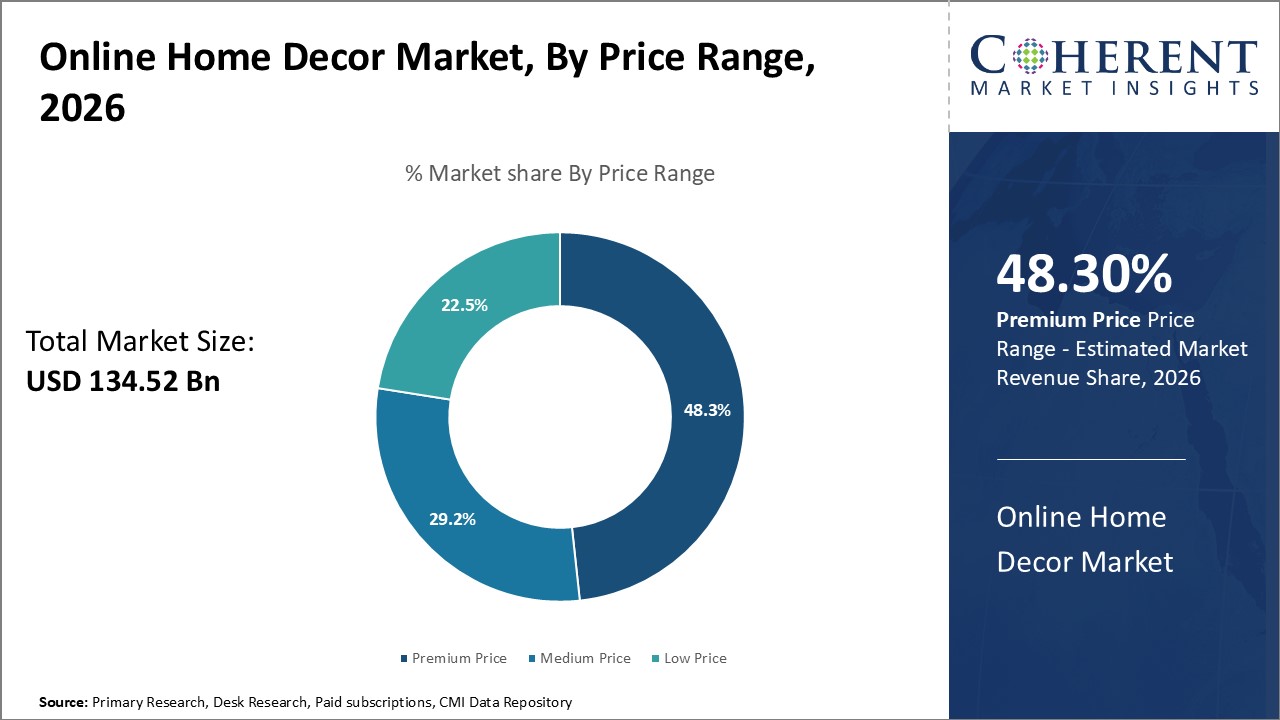
Online Home Decor Market Insights, By Price Range
In terms of price range, the premium price segment is expected to contribute largest share of the Online Home Decor market trends in 2026. The premium price segment in the online home decor market is experiencing robust growth, driven by affluent consumers’ increasing preference for luxury and high-quality home decor products purchased via digital channels.
This segment includes upscale offerings such as designer furniture, bespoke textiles, handcrafted decor, and exclusive collections, often featuring collaborations with renowned designers or artists.
Online Home Decor Market Insights, By Distribution Channel
In terms of distribution channel, the online segment is expected to contribute largest share of the Online Home Decor market trends in 2026. The growing popularity of e-commerce platforms and consumers' strong preference for easy, accessible purchasing experiences have been the main drivers of the online segment's rapid rise in the online home decor market.
Digital platforms including e-commerce websites, brand portals, and online marketplaces offer a wide variety of products in this area, such as wall art, furniture, lighting, textiles, and decorative accessories.
Online Home Decor Market Insights, By End User
In terms of end user, the residential segment is expected to contribute largest share of the Online Home Decor market trends in 2026. Due in large part to the wide range of customers, including homeowners, renters, and those looking to customize their living areas, the residential category commands the highest proportion of the online home décor industry. To improve the appearance and usability of their homes, these customers buy a variety of home décor items online, such as wall art, furniture, lighting, textiles, decorative accessories, and carpets.
Online Home Decor Market Insights, By Material Type
In terms of material type, the wood segment is expected to contribute largest share of the Online Home Decor market trends in 2026. The expansion of wood items in the online home decor market is supported by the rising use of technology advances like artificial intelligence (AI) and augmented reality by online platforms to improve the customer experience. This allows customers to see wooden furniture in their homes before making a purchase.
Rising urbanization, the need for multipurpose and space-saving designs, and a growing desire for artisanal and personalized wood furniture items are all contributing factors to the growth of the online market for wooden furniture.
Regional Insights
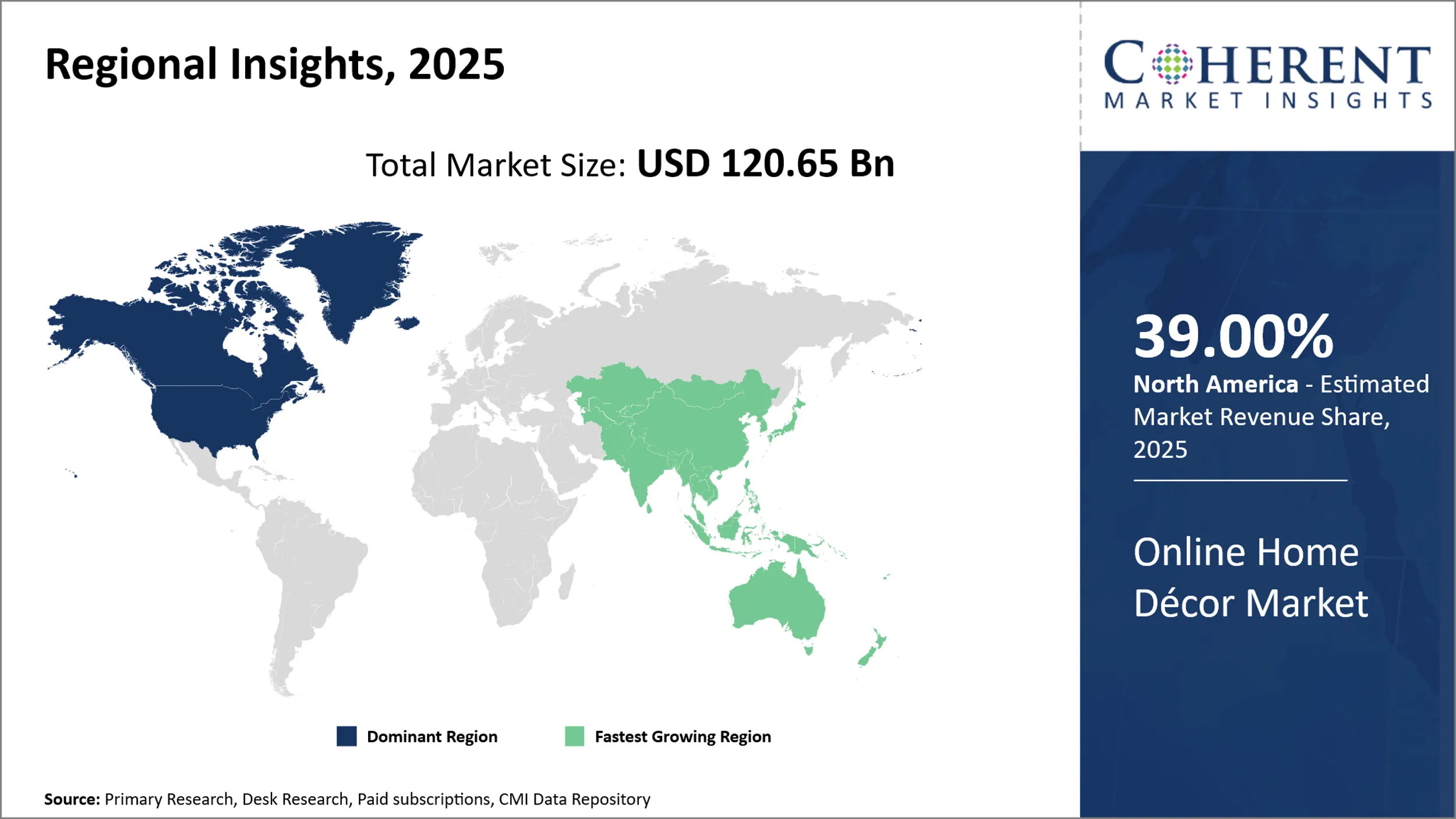
North America Online Home Decor Market
North America is the largest online home decor market, accounting for over 39.00% of global revenue. The market is driven by a number of factors, including a growing middle class, increasing disposable income, and the rise of e-commerce.
Europe Online Home Decor Market
Europe is the second largest online home decor market, accounting for over 25% of global revenue. The market is driven by similar factors to North America, as well as a strong focus on sustainability and eco-friendly products.
Online Home Decor Market In Asia Pacific
Asia Pacific is the fastest-growing online home decor market, with growth projected to outpace other regions in the coming years. The market growth is driven by a number of factors, including rising incomes, urbanization, and the growing popularity of online shopping.
Online Home Decor Market Dominating Countries
U.S Online Home Decor Market
The US market is also influenced by the normalization of remote work, which has increased demand for home-office furniture and multifunctional decor solutions. E-commerce platforms, enhanced by technologies like AI and virtual design tools, have made it easier for consumers to access a wide range of high-quality and customizable decor items.
India Online Home Decor Market
India’s online home decor market is experiencing rapid expansion, fueled by rising disposable incomes, urbanization, and the increasing penetration of internet and smartphone usage. Indian consumers are becoming more design-conscious, seeking both traditional and contemporary styles that reflect their cultural heritage and modern aspirations.
Online Home Decor Market In China
China stands as one of the largest and fastest-growing markets for online home decor, underpinned by massive urbanization, a burgeoning middle class, and advanced digital infrastructure. The country’s online home decor sector benefits from the popularity of e-commerce platforms and social commerce, where influencers and live-streaming play a significant role in shaping consumer preferences.
Market Report Scope
Online Home Decor Market Report Coverage
| Report Coverage | Details | ||
|---|---|---|---|
| Base Year: | 2025 | Market Size in 2026: | USD 134.52 Bn |
| Historical Data for: | 2020 To 2024 | Forecast Period: | 2026 To 2033 |
| Forecast Period 2026 to 2033 CAGR: | 11.5% | 2033 Value Projection: | USD 288.22 Bn |
| Geographies covered: |
| ||
| Segments covered: |
| ||
| Companies covered: | Amazon, Bed Bath & Beyond, Walmart, Wayfair, IKEA, Overstock.com, Target, Home Depot, Williams-Sonoma, Lowe’s, Etsy, eBay, HomeGoods, JCPenney, Kohl’s, Macy’s, Pier 1 Imports, Crate and Barrel, At Home Stores, and Restoration Hardware | ||
| Growth Drivers: |
| ||
| Restraints & Challenges: |
| ||
Online Home Decor Market Growth Drivers
- Increasing Internet and Smartphone Penetration
The increasing internet and smartphone penetration, especially in developing regions, is driving the growth of the online home decor market. More consumers are now able to access online shopping platforms. For an instance, as per United Nations Conference on Trade and Development, Alibaba, Amazon, JD.com, and Pinduoduo increased their revenues by 70% between 2019 and 2021, and their share of total sales through all these 13 platforms rose from around 75% in 2018 and 2019 to over 80% in 2020 and 2021.
- Growth of the Real Estate Industry
The growth in residential and commercial real estate construction globally has led to increasing demand for home decoration and furnishing products, which is driving the online home decor market.
- Rise in Disposable Incomes
The rise in middle-class populations and growing disposable incomes in developing regions has led to increased spending on home improvement and décor, contributing to market growth.
- Popularity of Interior Design
The rising popularity and awareness of interior design and decoration is resulting in higher consumer spending on stylish and trendy home décor products.
Online Home Decor Market Trends
- Integration of Augmented Reality
Augmented reality is being integrated by online home decor retailers to allow customers to visualize products in their homes before purchase, enhancing user experience.
- Voice Commerce Adoption
Voice assistant devices are enabling seamless voice commerce for online home decor, allowing hands-free shopping to drive higher adoption.
- Personalization of Products
Online retailers are offering personalized home decor products like customized furniture, tailored wall arts, monogrammed textiles, etc. as per individual choices.
- Sustainability Focus
Using organic, recycled, and up cycled materials for manufacturing home decor products caters to rising eco-consciousness among consumers.
Online Home Decor Market Opportunities
- Growth Potential in Developing Regions
The largely untapped markets of developing regions like India, Southeast Asia, and Africa present significant growth opportunities for online home decor companies. Rising incomes in these regions are driving demand.
- Customization of Home Decor Products
Providing highly customizable home decor products integrated with technologies like 3D printing and virtual reality can help companies differentiate their offerings in a competitive market.
- Usage of Sustainable Raw Materials
Using recycled and upcycled raw materials like wood, plastic, glass, etc. for manufacturing eco-friendly home decor products caters to environment-conscious consumers.
- Smart Technology Integration
Integrating smart technology like IoT and AI in home decor products such as smart furniture, networked appliances, etc. can open new market segments.
Online Home Decor Market: Key Developments
- January 2025, Consortium Brand Partners, announce the acquisition of Jonathan Adler, an iconic home décor, furniture, and lifestyle company renowned for its bold, modern aesthetic, and creative design sensibility. CBP, through a strategic partnership with American Exchange Group, a leader in fashion accessory, design, manufacturing, and distribution, together, closed the transaction.
- October 2024, Nilkamal introduced Nilkamal Homes, a new retail brand focused on elevated home furniture and décor. The collection includes stylish sofas, elegant beds, dining sets, utility furniture, and essential household items such as décor, bedding, crockery, cookware, and mattresses.
- October 2021, Rajkot, Gujarat-based multi-interest business group, PAN Group has invested Rs 75 crores to launch an online furniture platform InnoDesigns. The start-up plans to disrupt the online furniture market through its innovative platform. Where buyers can choose any furniture design that can be built by various listed and rated carpenters, small & medium scale manufacturers in their locality.
Analyst Opinion
- The online home decor market has tremendous growth opportunities driven by increasing internet and smartphone penetration. More consumers are now comfortable shopping for decor items online as online retailers offer greater convenience and choice.
- The ability to view high-resolution images and read detailed product descriptions online aids customers in virtual shopping and makes online an attractive purchase channel. Further, multiple payment options and easy return policies have boosted customer confidence in online purchases.
- However, not being able to physically see and feel products remains a key restraint for the online home decor market. Many customers still prefer visiting brick-and-mortar stores to choose decor items.
- Additionally, online merchants struggle with the high shipping costs of bulky items and last-mile deliveries to remote locations. Marketers also find it challenging to build an emotional connection required for decorative purchases without visual merchandising used in stores.
- With strong investments to enhance virtual and augmented reality-based shopping experiences, this restraint can be reduced. The online home decor space in Southeast Asia and Latin America is expected to grow the fastest as rising affluence and internet access in these regions drive the market. In contrast, the North American market is relatively mature with heavy offline competition in the home furnishings space.
- Overall, the online home decor category has high growth potential but marketers need innovative strategies to overcome the “touch-and-feel” limitations of online shopping for decorative categories.
Speak to the analyst
Want personalized insights?
Take the findings above to one of our principal consultants, or have the report rebuilt around the segments, geographies and competitors you actually track.
Market Segmentation
- Global Online Home Decor Market, By Product Type (Revenue, USD Bn, 2021 - 2033)
- Furniture
- Home Textile
- Home Decor
- Kitchenware
- Bathware
- Garden Decor
- Others (Wall Decor, Lighting, Rugs, Mirrors)
- Global Online Home Decor Market, By Price Range (Revenue, USD Bn, 2021 - 2033)
- Premium Price
- Medium Price
- Low Price
- Global Online Home Decor Market, By Distribution Channel (Revenue, USD Bn, 2021 - 2033)
- Online
- Offline
- Global Online Home Decor Market, By End User (Revenue, USD Bn, 2021 - 2033)
- Residential
- Commercial
- Global Online Home Decor Market, By Material Type (Revenue, USD Bn, 2021 - 2033)
- Wood
- Glass
- Metal
- Plastic
- Ceramic
- Others (Cane, Bamboo)
- Global Online Home Decor Market, By Region (Revenue, USD Bn, 2021 - 2033)
- North America
- U.S.
- Canada
- Europe
- U.K.
- Germany
- Italy
- France
- Russia
- Rest of Europe
- Asia Pacific
- China
- India
- Japan
- ASEAN
- Australia
- South Korea
- Rest of Asia Pacific
- Latin America
- Brazil
- Mexico
- Rest of Latin America
- Middle East
- GCC
- Israel
- Rest of Middle East
- Africa
- Northern Africa
- Central Africa
- South Africa
- North America
Sources
Primary Research interviews
- Retailers of online home decor products (e.g., boutique e-commerce stores)
- Category managers at online marketplaces (e.g., Amazon, Flipkart, Pepperfry)
- Interior designers and home stylists
- Urban millennial and Gen Z consumers (especially in Tier 1 and Tier 2 cities)
- Logistics and last-mile delivery partners
- Furniture and decor product manufacturers
Databases
- Euromonitor Passport
- IBISWorld
- Orbis
- Technavio
- EMIS (Emerging Markets Information Service)
Magazines
- Elle Decor
- Architectural Digest
- House Beautiful
- GoodHomes India
- Livingetc
- Dwell
- Home & Design
- Interior Design Magazine
- The Ideal Home and Garden
Journals
- Journal of Interior Design
- International Journal of Retail & Distribution Management
- Journal of Housing and the Built Environment
- Journal of Consumer Behaviour
- Design Studies
- Journal of Marketing Research
- International Journal of Design
- Journal of Business Research
Newspapers
- The Economic Times
- Business Standard
- Mint
- The Hindu BusinessLine
- Financial Express
- Times of India (Business section)
- The Guardian (Lifestyle/Design)
- The New York Times (Real Estate/Design)
Associations
- Retailers Association of India (RAI)
- Confederation of Indian Industry (CII)
- Furniture & Fittings Skill Council (FFSC)
- Export Promotion Council for Handicrafts (EPCH)
- Indian Institute of Interior Designers (IIID)
- Home Furnishings Association
- All India Furniture Manufacturers’ Association
- World Design Organization (WDO)
Proprietary Elements
- CMI Data Analytics Tool, Proprietary CMI Existing Repository of information for last 8 years
*Definition: The online home decor market consists of the sales of home furnishings, furniture, home accessories, and decorative items through e-commerce online channels. It excludes offline sales through physical stores. Online platforms like company websites, apps, and marketplaces offer a wide range of decor products for different spaces and rooms including furniture, upholstery, carpets & flooring, lighting, decorative accents, kitchen & dining accessories, bath fittings, textiles, garden accessories, and more. The online distribution channel gives consumers convenience and a wider choice. Market growth is driven by increasing internet penetration, growth in online spending, rise in disposable incomes, and growth of the real estate sector globally.
Get access to 250+ pages report
Every segment, forecast, competitor profile and data table behind the analysis above — available for instant download.
- ESOMAR Member
- ISO 9001:2015 Certified
- D-U-N-S Registered
- GDPR & CCPA Compliant
Missing comfort of reading report in your local language? Find your preferred language:
Transform your Strategy with Exclusive Trending Reports
Frequently Asked Questions
The Online Home Decor Market size is estimated to be valued at USD 134.52 Bn in 2026, and is expected to reach USD 288.22 Bn by 2033.
The key factors hampering the growth of the online home decor market are - high logistics costs, inability to physically view/try products, dominance of offline stores, low penetration in developing regions, delivery damages affecting replacement, lack of quality standardization, fragmented vendor landscape, limited adoption by traditional decorators and designers, and data privacy & security concerns regarding online purchases.
The major factors driving the market growth are - rising internet and smartphone penetration globally, growing real estate sector, increasing disposable incomes, especially in developing economies, rising trend of customized interior designing, adoption of advanced technologies like AI and 3D printing for personalization and product customization, and the growing number of value-conscious millennials opting for online shopping.
The leading segment in the market by type is Kitchenware.
The major players operating in the market are Amazon, Bed Bath & Beyond, Walmart, Wayfair, IKEA, Overstock.com, Target, Home Depot, Williams-Sonoma, Lowe’s, Etsy, eBay, HomeGoods, JCPenney, Kohl’s, Macy’s, Pier 1 Imports, Crate and Barrel, At Home Stores, and Restoration Hardware.
Asia Pacific is expected to lead the market during the forecast period.
The CAGR of the Online Home Decor Industry is projected to be 11.5% from 2026 to 2033.