

Global Power Connectors Market Size and Forecast – 2026 To 2033
The global power connectors market is expected to grow from USD 2.70 Bn in 2026 to USD 4.15 Bn by 2033, registering a compound annual growth rate (CAGR) of 3.6% from 2026 to 2033. The global power connectors market is driven by increasing deployment of industrial automation and robotics. On March 24, 2026, FANUC America announced plans for a USD 90 million investment to acquire property and construct a new 840,000 sq. ft. facility in Michigan providing production-ready space for the potential expansion of the company’s existing U.S.-based manufacturing capabilities for robots.
Key Takeaways of the Global Power Connectors Market
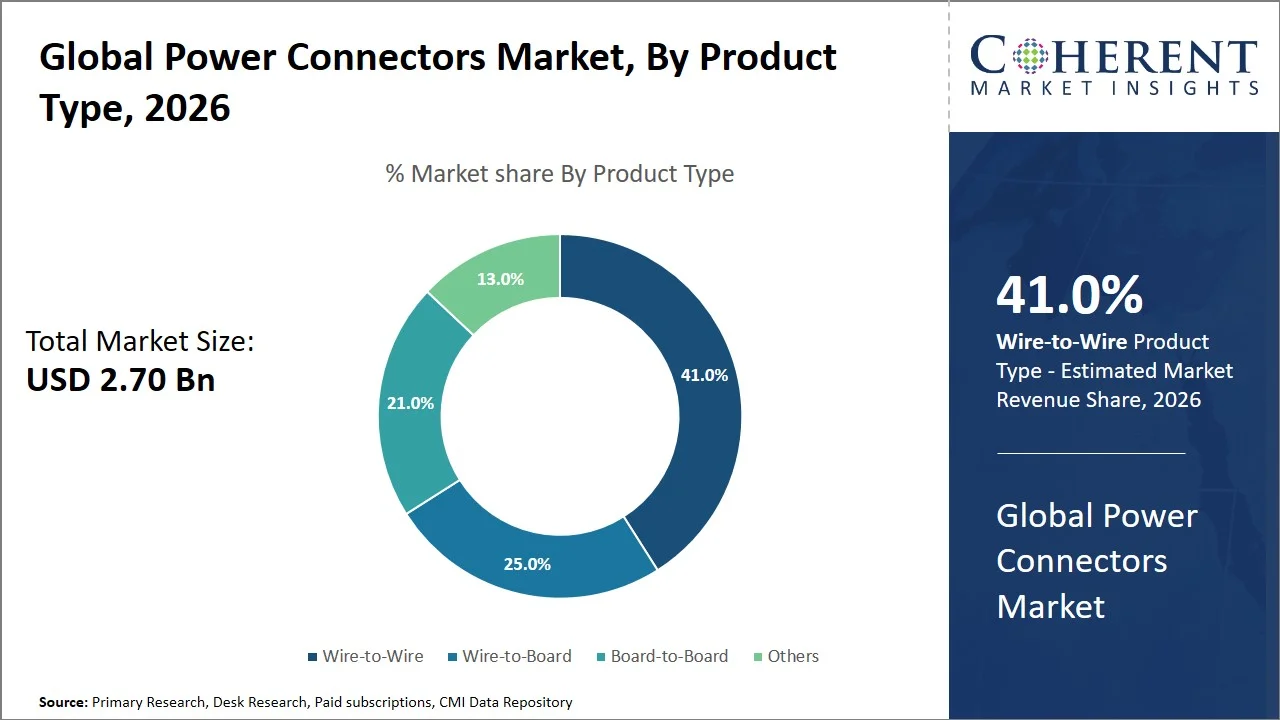
- The Wire-to-Wire segment is expected to account for 41.0 % of the global power connectors market share in 2026. Growth in renewable energy generation and energy-storage systems is driving the growth of the segment. On May 16, 2025, ReNew Energy Global Plc announced that it will invest USD 2.5 billion to set up one of India’s largest hybrid renewable energy projects in Andhra Pradesh’s Anantapur district.
- The Automotive segment is estimated to capture 33.0 % of the market share in 2026. Increasing demand for high-current and high-density power interconnects is majorly driving the growth of the segment. On February 17, 2026, Molex launched its Impress Co-Packaged Copper Solutions combining a compact on-substrate connector with cable assemblies supporting 224 Gbps PAM4 and beyond.
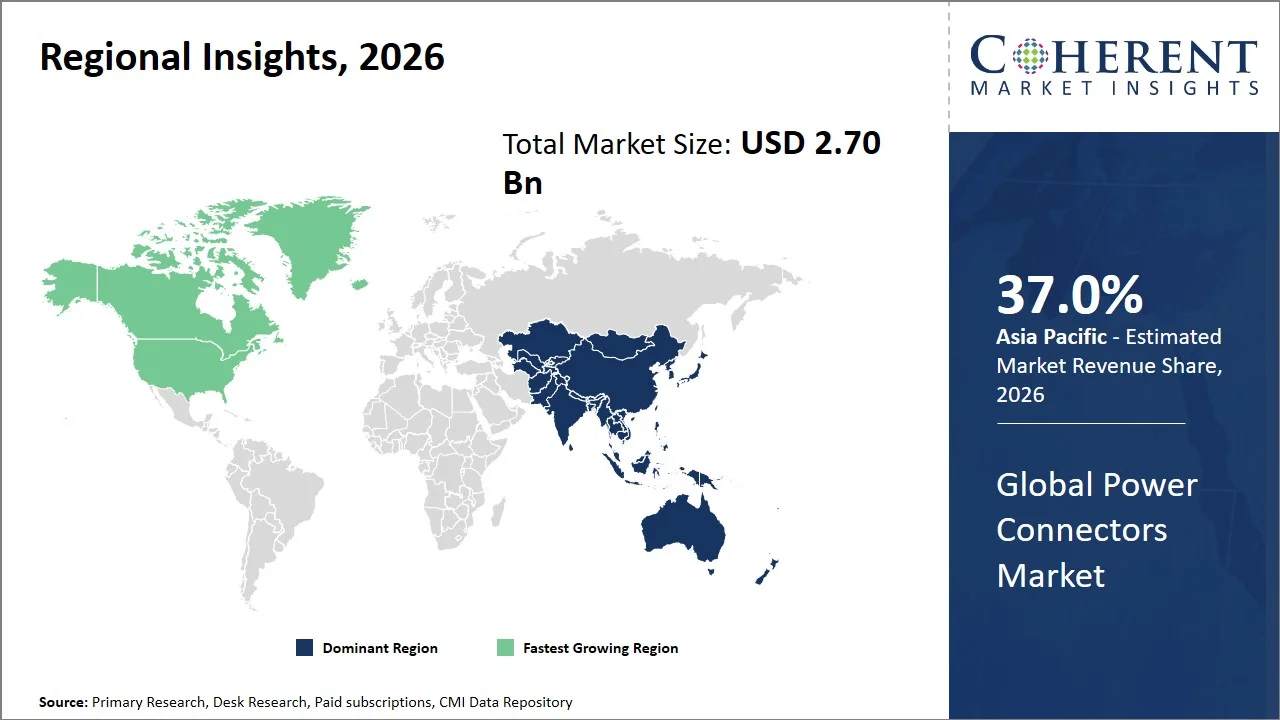
- Asia Pacific is expected to dominate the power connectors market in 2026 with a market share of 37.0 %. Expansion of liquid-cooled and high-power server architectures in Asia Pacific is driving the growth of the regional market. On June 25, 2025, HPE and KDDI Corporation announced they are collaborating to open the Osaka Sakai Data Center by early 2026 to support startups and enterprises with NVIDIA AI infrastructure for developing AI applications and training large language models.
- North America is expected to account for 28.0% share in 2026 and is projected to record the fastest growth over the forecast period. Growth of modular connectors for industrial automation in North America is driving the growth of the regional market. On August 5, 2025, HARTING Americas launched the Han Protect connector, D-Sub PushPull connector and Single Pair Ethernet technology specifically to address smart-factory and industrial-automation requirements.
Segmental Insights
Why Does Wire-to-Wire Dominate the Global Power Connectors Market?
The wire-to-wire segment is expected to account for 41.0% of the global power connectors market share in 2026. Wire-to-wire connections are widely used in the global power connectors market, as they offer a practical and dependable approach to directly connecting electrical wires, allowing for flexible system design, simplified installation, and easier maintenance in the field. They are commonly used in automobile wire harnesses, industrial machinery, power distribution equipment, appliances, telecommunications equipment, and energy systems when several connections need to be interconnected or disconnected without altering the circuit board. Availability in a variety of current ratings, wire gages, sealing configurations and locking mechanisms also allows manufacturers to standardize connection systems across a range of equipment platforms, simplifying assembly and enhancing serviceability. On December 9, 2025, Molex launched MX-DaSH Modular Wire-to-Wire Connectors that integrate power and signal terminals into one modular system, lowering the weight and complexity of wiring harnesses for automotive zonal architectures. This system provides greater design flexibility and supports multinational OEMs.
- Current Industry Events of 2026
- Market Size Estimation
- Regional Breakdown
- Competitive Landscape
- Customer Intelligence
- Segmental Analysis
- Pricing Analysis
- Key Market Drivers, Challenges & Future Trends
- Customized Insights Section
Why is Automotive the Most Widespread Application?
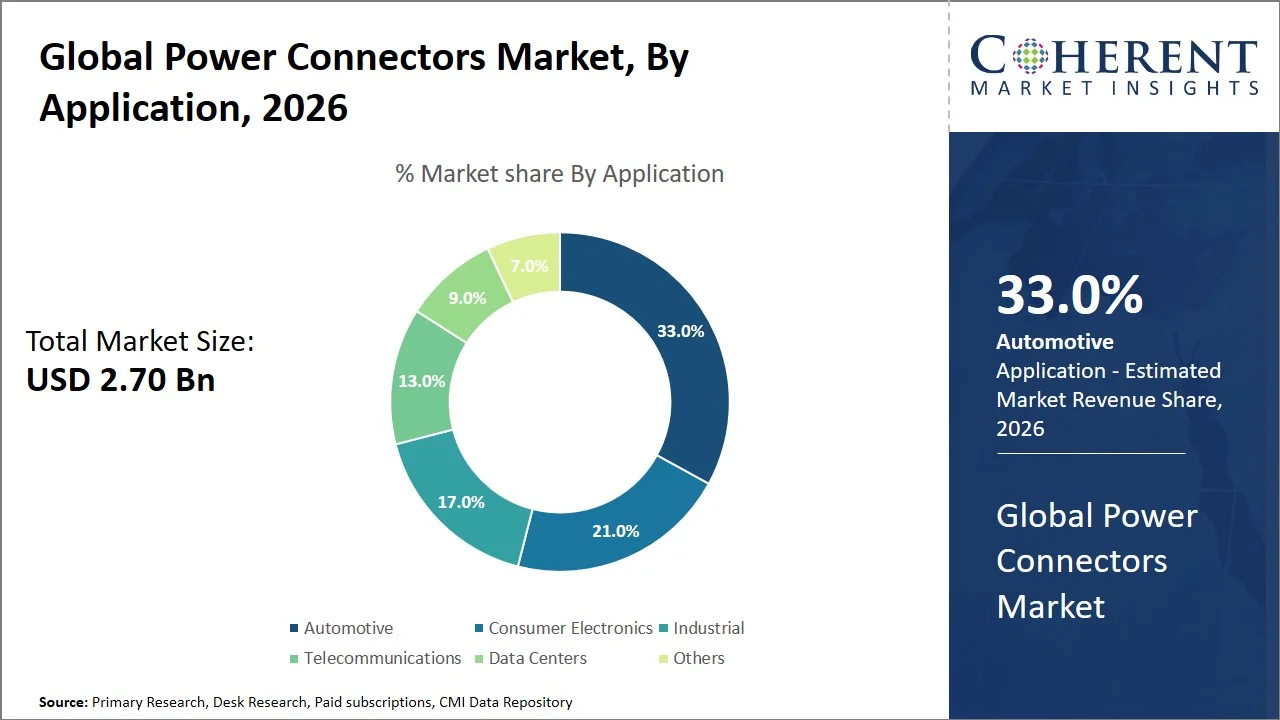
The automotive segment is expected to account for 33.0% of the global power connectors market share in 2026. The automotive sector needs broad electrical distribution across powertrains, lighting systems, infotainment, safety systems, sensors, battery systems and electronic control units, which leads to high demand for dependable power connectors. As the transition to electric and hybrid vehicles continues, so do the demands on connectors. High voltage battery packs, inverters, charging systems and electric drive units all require secure connections that can handle higher currents, vibration, temperature variations and extreme environmental conditions. On November 12, 2025, Molex released the eHV60, the first product in its eHV high-voltage connector range for auxiliary high-voltage tasks in electric and hybrid vehicles. This tiny solution improves dependability, offers sourcing flexibility and simplifies system integration.
Current Events and their Impact
Current Events | Description and its Impact |
European Union - Commission Regulation (EU) 2025/2052 |
|
United States - EPA Greenhouse Gas Standards for Heavy-Duty Vehicles |
|
Power Connectors Market Dynamics
Market Drivers
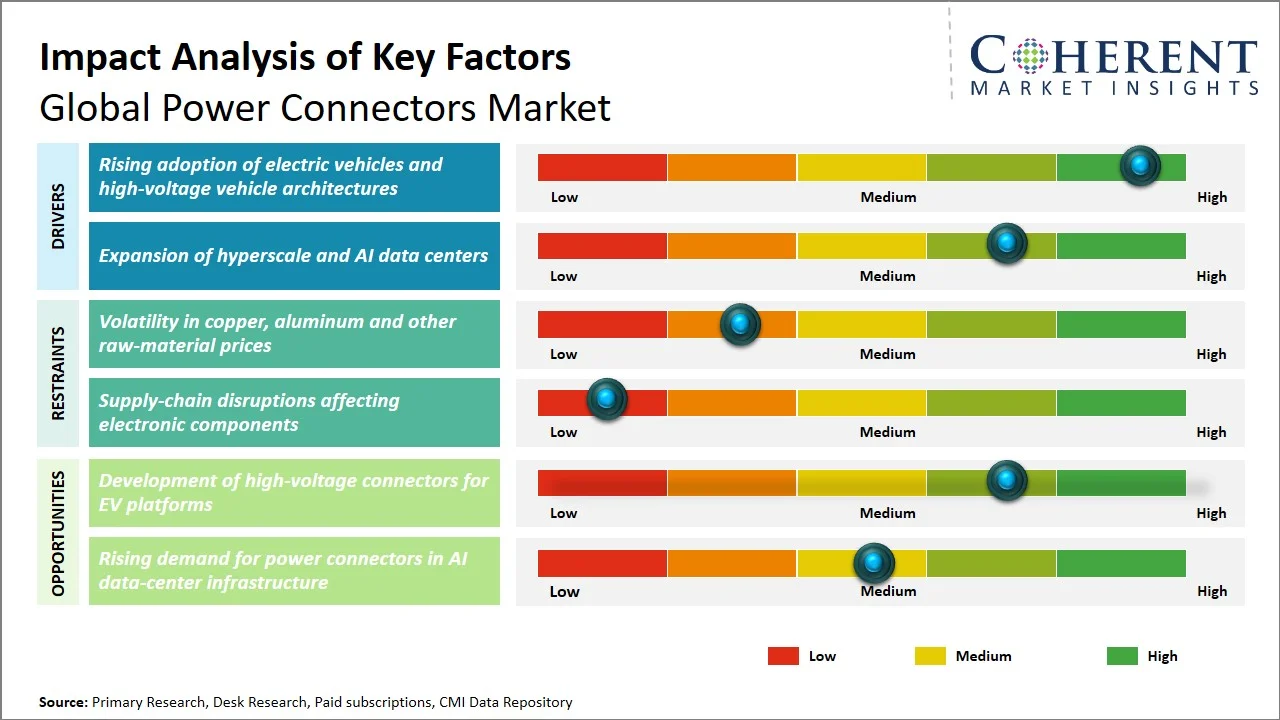
- Rising adoption of electric vehicles and high-voltage vehicle architectures: The rising adoption of electric vehicles is fueling the demand for high-voltage power connectors that can transfer electricity safely between the battery packs, inverters, electric motors, charging systems and other high-power components. Automakers are more and more shifting away from traditional 12 V architectures and moving to higher voltage architectures such as 400 V and 800 V in an effort to enable faster charging, higher power output and better efficiency, which requires the use of connectors with higher voltage ratings, stronger insulation, better shielding and better thermal management. Consequently, the increase in EV production by manufacturers like Tesla, BYD, Hyundai, Volkswagen and General Motors is creating opportunities for high-voltage connectors, busbar connectors, battery connectors and charging interface suppliers. On September 4, 2025, Volvo Cars unveiled their all-electric ES90, which comes with a revolutionary 800 V electrical architecture that can add up to 300 km of range in 10 minutes and reach up to 700 km of range. The move is important for connector demand since the higher-voltage architecture requires updated high-voltage connections across the battery, power electronics and charging system.
- Expansion of hyperscale and AI data centers: The rapid growth of hyperscale and AI data centers is driving demand for high-current power connectors as AI accelerators, GPU servers and advanced networking equipment consume significantly more power than traditional computing infrastructure. Data-center operators are deploying higher-density power distribution architectures such as higher-voltage DC architectures and advanced rack-level power solutions that require connectors that can support higher current levels while maintaining low electrical resistance and good thermal performance. Investments by major cloud and technology companies in large-scale AI infrastructure are consequently creating opportunities for manufacturers developing high-current, high-density and thermally optimized power connectors for servers, power distribution units, racks and data-center electrical infrastructure. On December 9, 2025, Microsoft announced its largest investment in Asia, USD 17.5 billion over four years (CY 2026 to 2029) to advance the India’s cloud and artificial intelligence (AI) infrastructure, skilling and ongoing operations.
Emerging Trends
- High-current connectors for AI data centers: The rapid deployment of GPU-intensive AI infrastructure is increasing demand for power connectors capable of handling higher current densities within increasingly compact rack architectures. Connector manufacturers are focusing on lower-resistance contacts, improved thermal management, higher power ratings and designs compatible with next-generation data-center power distribution systems.
- 800 V connector architectures for electric vehicles: Automotive manufacturers are increasingly turning to 800 V electrical architectures to enable faster charging and improve power-transfer efficiency, driving demand for connectors with higher voltage ratings, better insulation, improved shielding and greater resistance to heat and vibration.
- Miniaturization with higher power density: Connector designs are getting smaller, while preserving or enhancing the current-carrying capability to meet the demands of space-constrained electronic and industrial equipment.
- Smart and condition-monitoring connectors: Power connectors are becoming more integrated with sensor features that can monitor temperature, current, voltage, contact resistance and connection state.
Regional Insights
Why is Asia Pacific a Strong Market for Power Connectors?
Asia Pacific is expected to account for a market share of 37.0% in 2026. Asia pacific is benefiting from the combination of large-scale electronics manufacturing, EV production and industrial automation across China, Japan, South Korea, India and southeast Asia, creating demand for high-current and compact power connectors across automotive, consumer electronics and factory equipment. The region’s EV connector opportunity is particularly strong, with Asia pacific wire-to-board EV connector demand being supported by rapid integration of electronic and infotainment systems and greater standardization of vehicle electrical interfaces. India is also becoming an increasingly important incremental demand center as electronics production reached USD 100 billion in 2024-25, while the electronics component manufacturing scheme has approved projects covering PCBs, copper-clad laminates and camera modules; these investments expand the domestic component ecosystem in which power connectors are required.
Why Does North America Power Connectors Market Exhibit High Growth?
North America is expected to register the fastest growth with a CAGR of 4.3% over the forecast period. It is projected to account for 28% of the global power connectors market in 2026. The region is being driven particularly by the rapid electrification of data-center power infrastructure rather than by conventional electronics alone. In the U.S., the Lawrence Berkeley National Laboratory estimates that data centers could consume 11.8% of total U.S. electricity by 2030, while Deloitte estimates that U.S. AI data-center power demand could rise from 4 GW in 2024 to 123 GW by 2035, creating strong requirements for high-current connectors, busbar interfaces, rack-level power connections and increasingly high-voltage DC architectures. The June 2026 federal order directing regional grid operators to accelerate interconnection of energy-intensive AI data centers further demonstrates the scale of infrastructure expansion underway.
Global Power Connectors Market Outlook for Key Countries
Why is China Emerging as a Major Hub in the Power Connectors Market?
China represents the strongest automotive-driven opportunity because its enormous EV manufacturing ecosystem is rapidly increasing the volume of high-voltage connections required across battery packs, inverters, charging systems and electric drive units. More than 13 million electric cars were sold in China in 2025, giving electric vehicles almost 55% of new-car sales, while China produced about 16 million electric cars and accounted for nearly 75% of global EV production; its electric-car exports also exceeded 2.5 million units. This production concentration creates sustained connector demand from domestic manufacturers such as BYD, Geely and SAIC as well as from battery and component suppliers supporting export-oriented vehicle platforms.
Is U.S. the Next Growth Engine for the Power Connectors Market?
The U.S. has a particularly strong opportunity in high-power computing because AI infrastructure is increasing the electrical load per data-center rack and forcing operators to redesign power-delivery systems. U.S. AI data-center electricity demand could reach 123 GW by 2035 compared with 4 GW in 2024, while individual AI facilities can already require tens of megawatts, increasing requirements for high-current connectors, power distribution units, switchgear interfaces and low-resistance interconnects. The June 2026 Federal Energy Regulatory Commission initiative to accelerate grid connections for large AI data centers is also supporting faster deployment of the electrical infrastructure required around these facilities.
Germany Power Connectors Market Analysis and Trends
Germany is being shaped primarily by the transformation of its established automotive manufacturing base toward electrified and software-defined vehicles, which is increasing the number and power rating of electrical interfaces inside each vehicle. The German EV market is also rebounding, with combined BEV and PHEV volumes expected to account for around 30% of new-car registrations in 2025, while the Volkswagen ID.7 became the country’s top BEV model for the year. The adoption of higher-voltage vehicle systems is also reinforced by the revised IEC 62196-1:2025 standard, which covers EV connectors and vehicle inlets up to 1,500 V DC and 800 A, encouraging suppliers serving European automotive programs to develop higher-capacity charging and vehicle power interfaces.
Japan Power Connectors Market Analysis and Trends
Japan presents a distinct opportunity through its combination of hybrid-heavy automotive production, robotics and advanced manufacturing equipment rather than rapid battery-EV penetration alone. In 2025, electric car sales were just over 100,000 units and less than 3% of new car sales. Conventional hybrids made up around a third of sales, which means connector demand is increasingly tied to complex hybrid powertrains, battery management systems, motor control units and electronically intensive vehicles and not just BEV platforms. At the same time, Japan’s ministry of economy, trade and industry has been rolling out a 2025 initiative focused on integrating supply-chain data for semiconductors and automotive parts that support automated driving and CASE technologies, driving demand for reliable interconnects in ever more sophisticated vehicle electronics and production equipment.
South Korea Power Connectors Market Analysis and Trends
South Korea is being propelled by the convergence of EV batteries, semiconductor manufacturing and advanced electronics, creating demand for connectors that combine high current capacity, compact dimensions and thermal reliability. Electric-car sales increased by around 65% in 2025 to more than 200,000 units, taking EVs to an 11% share of new-car sales, while the government has set a target for EVs and fuel-cell vehicles to represent 50% of new-car sales by 2030. The semiconductor side is becoming an additional growth engine, with the government announcing a KRW 5 trillion fund for semiconductor materials, components and equipment in August 2026 and plans to supply 14.7 GW of electricity to the Yongin semiconductor cluster by 2041, supporting future requirements for high-reliability power interconnects in fabs and advanced manufacturing infrastructure.
Global Power Connectors Market - Number of High-Voltage Connectors per EV Platform by Vehicle Architecture (2025)
Vehicle Architecture | Typical HV system Voltage | Estimated HV Connector Count Per Vehicle |
400 V BEV | 350-450 V | 8-12 |
800 V BEV | 600-900 V | 10-15 |
800 V high-performance BEV | 700-1,000 V | 12-18 |
400 V PHEV | 250-450 V | 6-10 |
800 V PHEV | 600-900 V | 8-13 |
400 V commercial EV | 350-450 V | 10-16 |
800 V commercial EV | 600-900 V | 12-20 |
1,000 V+ heavy-duty EV | 800-1,200 V+ | 14-24 |
How is Development of High-Voltage Connectors for EV Platforms Creating New Growth Opportunities in the Power Connectors Market?
The development of high-voltage connectors for EV platforms is creating a higher-value opportunity because the shift from 400 V toward 800 V and increasingly higher-voltage architectures is changing the technical requirements of battery, inverter, e-axle, onboard-charger and charging interfaces. For example, TE Connectivity’s AMP+ HVP 800 system supports up to 1,000 V and 250 A continuously on 50 mm² cable, with IP67/IP6K9K protection, while Molex introduced its eHV60 in November 2025 for applications including dc/dc converters, onboard chargers, electric compressors and e-axles, supporting up to 1,000 V DC and 64 A.
This is expanding opportunities beyond conventional connector volumes because EV manufacturers increasingly need smaller, shielded and thermally robust interfaces that can accommodate higher power without adding excessive cable weight or packaging space; Hyundai’s e-gmp, for example, combines 400 V and 800 V charging capability, while Xpeng’s g9, g6 and x9 use 800 V silicon-carbide powertrain platforms. Consequently, connector suppliers that can provide validated high-voltage systems with high-current capability, hv interlock, sealing, shielding and compact packaging are gaining opportunities to become qualified components within complete EV platform architectures rather than merely supplying interchangeable wiring components.
In December 2025, Rosenberger introduced the hvr25 family to address the move toward 1,000 v and higher vehicle architectures, offering up to 40 a through a 4 mm² cable cross-section. The shielded connector uses a common header across cable sizes from 1.5 mm² to 4 mm², allowing automakers to reduce part-management complexity while maintaining a compact interface for space-constrained ev powertrain applications.
Market Players, Key Development, and Competitive Landscape
Key Developments
- On April 20, 2026, HARTING announced it is currently expanding the Han-Modular range to include connectors featuring this connection technology. The two modules Han Domino EE (16A) and Han Domino CC Push-in (40A) will be launched in the spring of 2026. Both are designed for connecting loads in the low to medium voltage and power range.
- On November 3, 2025, Rosenberger expanded its portfolio of high-voltage connectors with the launch of the new HVR25 series. The HVR25 is the smallest shielded high voltage connector compared to latest class 2 connectors. It offers a current capacity of up to 40 A with a cable cross section of 4 mm². With its compact design, high reliability, and optimized cost performance ratio.
Competitive Landscape
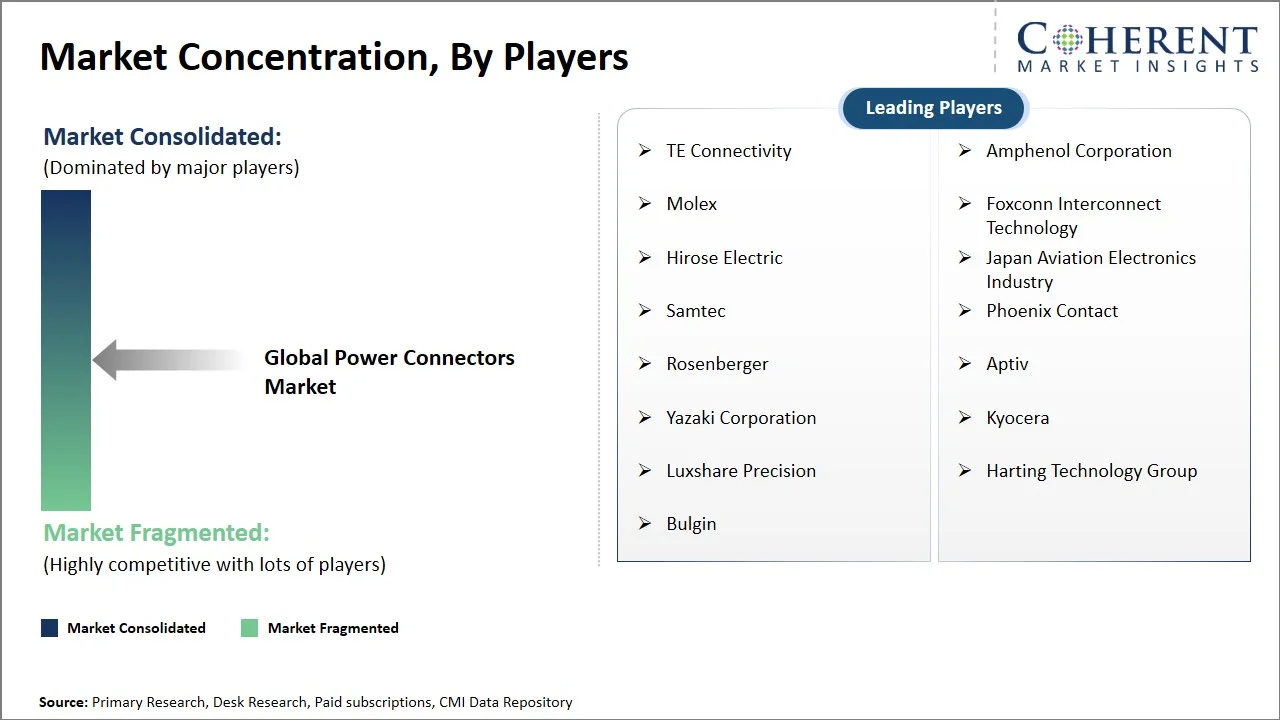
The competitive landscape is being shaped by suppliers that are moving beyond conventional connector volumes toward high-current, high-voltage and application-specific interconnect platforms. TE Connectivity is focusing heavily on EV e-drive systems, with connector platforms designed to link traction batteries, power distribution units, inverters and electric motors while addressing compact packaging, weight and peak-current requirements. Amphenol Corporation is pursuing a different but complementary strategy by targeting AI data-center power infrastructure alongside high-power aerospace and defense applications; its Amphenol Tuchel Industrial business offers 400 A data-center power connectors and participates in the Open Compute Project rack-and-power working group, while its aerospace portfolio includes connectors capable of handling more than 500 A. Molex is strengthening both EV and data-center positions, launching the eHV60 in 2025 for EV dc/dc converters, onboard chargers, electric compressors and e-axles, while also developing busbar and high-power connector systems for AI data centers and smart factories.
Market Report Scope
Power Connectors Market Report Coverage
| Report Coverage | Details | ||
|---|---|---|---|
| Base Year: | 2025 | Market Size in 2026: | USD 2.70 Bn |
| Historical Data for: | 2020 To 2024 | Forecast Period: | 2026 To 2033 |
| Forecast Period 2026 to 2033 CAGR: | 3.6% | 2033 Value Projection: | USD 4.15 Bn |
| Geographies covered: |
| ||
| Segments covered: |
| ||
| Companies covered: | TE Connectivity, Amphenol Corporation, Molex, Foxconn Interconnect Technology, Hirose Electric, Japan Aviation Electronics Industry, Samtec, Phoenix Contact, Rosenberger, Aptiv, Yazaki Corporation, Kyocera, Luxshare Precision, Harting Technology Group, Bulgin | ||
| Growth Drivers: |
| ||
| Restraints & Challenges: |
| ||
Analyst Opinion (Expert Opinion)
- The future of the industry is expected to be increasingly determined by power density rather than connector volume. AI data centers are pushing rack power higher while EV platforms are moving toward 800 V architectures, making low-contact-resistance, thermally optimized and compact connectors increasingly valuable. The convergence of high-current power and increasingly dense equipment will favor suppliers that can validate complete interconnect systems rather than individual connector components.
- The largest opportunity is projected to be in high-voltage and high-current connections for electric vehicles and high-density power connectors for AI data centers, with China and the U.S. being especially attractive markets for these applications. EV suppliers need to focus on the battery-to-inverter, inverter-to-e-motor and charging interfaces, whereas data-center suppliers should be looking at blind-mate busbar connectors, rack-level power distribution and connectors that can support ever higher current levels. Amphenol’s 400 A data-center products and Molex’s busbar systems are indicative of where the specification trajectory is headed.
- To gain an edge, manufacturers should invest in contact-resistance reduction, thermal management, high-voltage insulation, shielding and tolerance compensation while developing application-specific platforms with automotive and hyperscale customers early in the design cycle. Molex's eHV60 approach of providing second-source flexibility and simplified integration is particularly relevant because automakers are seeking supply-chain resilience as well as electrical performance. Suppliers that combine connector design with terminals, busbars, cable assemblies and validation capabilities should therefore have a stronger position in platform-level design wins.
Speak to the analyst
Want personalized insights?
Take the findings above to one of our principal consultants, or have the report rebuilt around the segments, geographies and competitors you actually track.
Market Segmentation
- Product Type Insights (Revenue, USD Billion, 2021 - 2033)
- Wire-to-Wire
- Wire-to-Board
- Board-to-Board
- Others
- Application Insights (Revenue, USD Billion, 2021 - 2033)
- Automotive
- Consumer Electronics
- Industrial
- Telecommunications
- Data Centers
- Others
- Regional Insights (Revenue, USD Billion, 2021 - 2033)
- North America
- U.S.
- Canada
- Latin America
- Brazil
- Argentina
- Mexico
- Rest of Latin America
- Europe
- Germany
- U.K.
- Spain
- France
- Italy
- Russia
- Rest of Europe
- Asia Pacific
- China
- India
- Japan
- Australia
- South Korea
- ASEAN
- Rest of Asia Pacific
- Middle East
- GCC Countries
- Israel
- Rest of Middle East
- Africa
- South Africa
- North Africa
- Central Africa
- North America
- Key Players Insights
- TE Connectivity
- Amphenol Corporation
- Molex
- Foxconn Interconnect Technology
- Hirose Electric
- Japan Aviation Electronics Industry
- Samtec
- Phoenix Contact
- Rosenberger
- Aptiv
- Yazaki Corporation
- Kyocera
- Luxshare Precision
- Harting Technology Group
- Bulgin
Sources
Primary Research Interviews
- Automotive OEMs
- Industrial automation system integrators
- EV manufacturers
Magazines
- Connector Supplier
- EE Times
- Electronic Design
Journals
- IEEE Transactions on Power Electronics
- IEEE Access
- SAE International Journal of Electrical and Electronic Systems
Associations
- SAE International
- International Electrotechnical Commission
Public Domain Sources
- U.S. Energy Information Administration.
- U.S. Department of Transportation.
- National Renewable Energy Laboratory
Proprietary Elements
- CMI Data Analytics Tool
- Proprietary CMI Existing Repository of Information for the Last 10 Years
Get access to 250+ pages report
Every segment, forecast, competitor profile and data table behind the analysis above — available for instant download.
- ESOMAR Member
- ISO 9001:2015 Certified
- D-U-N-S Registered
- GDPR & CCPA Compliant
Missing comfort of reading report in your local language? Find your preferred language:
Transform your Strategy with Exclusive Trending Reports
Frequently Asked Questions
The global power connectors market is expected to stand at USD 2.70 Bn in 2026 and is expected to reach USD 4.15 Bn by 2033.
The CAGR of the global power connectors market is projected to be 3.6% from 2026 to 2033.
Power connectors provide high-current and high-voltage connections between batteries, inverters, electric motors, onboard chargers and charging systems.
The transition from 400 V toward 800 V vehicle architectures is increasing demand for connectors with higher voltage ratings, improved insulation and enhanced thermal performance.
They provide high-current interfaces between battery modules, busbars, power-conversion systems and energy-management equipment.
Higher current densities generate greater heat at electrical contacts, increasing the need for low-resistance terminals, optimized contact geometry and improved heat dissipation.
Rising adoption of electric vehicles and high-voltage vehicle architectures and Expansion of hyperscale and AI data centers are the major factors driving the growth of the global power connectors market.