

Global Proteins Sugar Market Size and Forecast – 2026 To 2033
The Global Proteins Sugar Market is estimated to be valued at USD 13.4 Mn in 2026 and is expected to reach USD 26.7 Mn by 2033, growing at a compound annual growth rate (CAGR) of 10.30% from 2026 to 2033. This growth reflects increasing interest in protein-based sweetening solutions as food and beverage manufacturers seek alternatives that can reduce sugar content while maintaining taste quality, formulation performance, and clean-label positioning.
Market expansion is supported by advancements in biotechnology-based production, rising investment in alternative sweetener platforms, and broader application opportunities across beverages, dairy, confectionery, and functional nutrition products. In February 2025, Oobli announced a strategic partnership with Ingredion to accelerate the development of sweet protein-based sugar reduction solutions by combining Oobli’s sweet protein technology with Ingredion’s ingredient expertise. This collaboration highlights increasing industry efforts to commercialize protein-based sweeteners and integrate them into scalable food and beverage applications.
Key takeaways of the Global Proteins Sugar Market
- Thaumatin is estimated to record a 10.8% CAGR during 2026–2033 and account for 42.8% of the global proteins sugar market in 2026, supported by its exceptional sweetness intensity, clean-label positioning, and broad food application suitability. In August 2026, the U.S. FDA published information on Thaumatin II GRAS evaluation, reinforcing regulatory acceptance for sweetener applications
- Brazzein is estimated to achieve a 10.6% CAGR during 2026–2033 and represent 24.6% of the global proteins sugar market in 2026, benefiting from its high sweetness potency, low-calorie profile, and potential integration into next-generation sugar reduction formulations. In June 2025, researchers published advances in sweet protein engineering, highlighting continued scientific development supporting improved production efficiency and commercial scalability.
- Powder Form is estimated to expand at a 10.4% CAGR during 2026–2033 and capture 58.6% of the global proteins sugar market in 2026, reflecting advantages in storage stability, transportation efficiency, and compatibility with dry-mix food, beverage, and nutraceutical formulations. In April 2025, industry adoption of precision-produced protein ingredients continued expanding through commercial food applications requiring stable ingredient formats.
- North America is estimated to register a 10.7% CAGR during 2026–2033 and maintain the leading position with 34.8% share of the global proteins sugar market in 2026, supported by strong functional food innovation, regulatory pathways, and investments in alternative sweetening technologies. In August 2026, FDA updates continued documenting sweet protein regulatory activity, strengthening the region’s commercialization environment.
- Europe is estimated to achieve 11.2% CAGR during 2026–2033 while accounting for 28.7% of the global proteins sugar market in 2026, driven by sustainability-focused ingredient development, biotechnology adoption, and demand for reduced-sugar food solutions. In 2025, European biotechnology companies continued scaling precision fermentation capabilities to support alternative protein and ingredient production platforms.
Segmental Insights
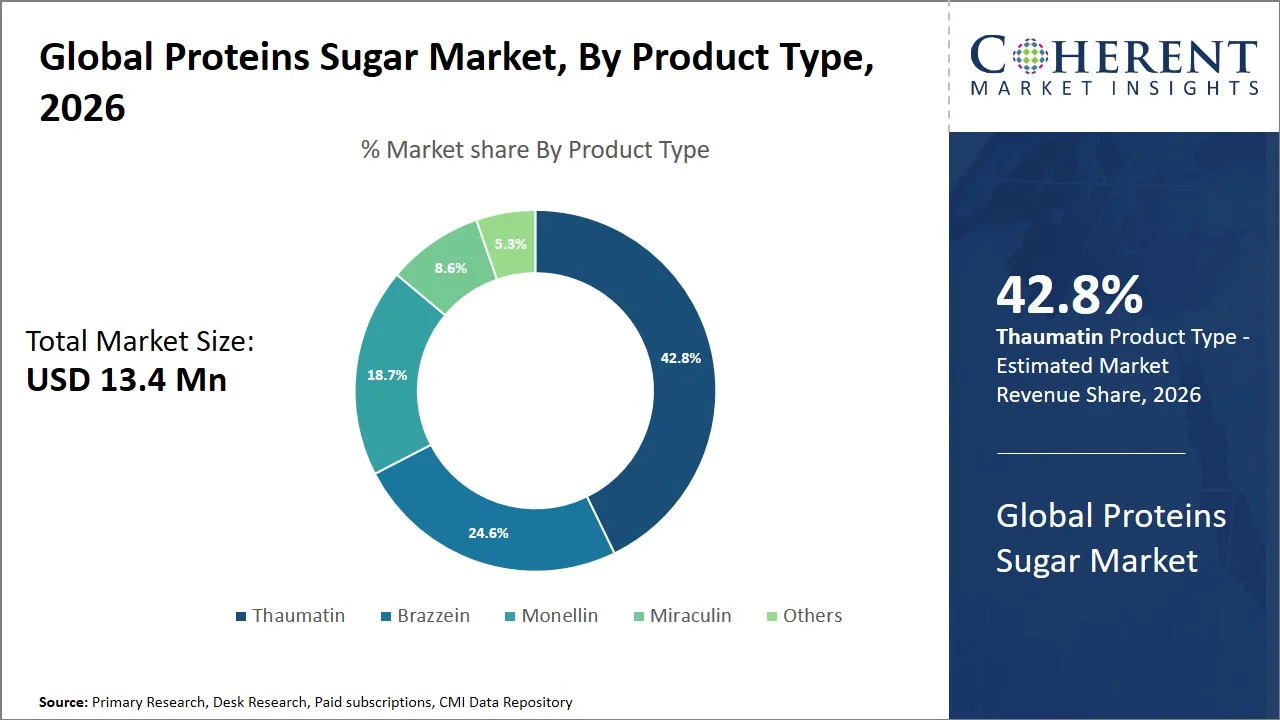
Why Does Thaumatin Dominate the Global Proteins Sugar Market?
Thaumatin is expected to account for 42.8% of the global proteins sugar market in 2026, supported by its established commercial acceptance, exceptional sweetness intensity, and ability to enhance flavour profiles beyond simple sugar replacement. Unlike many emerging sweet proteins, thaumatin has a longer history of use in food applications, allowing ingredient suppliers to integrate it into beverages, dairy products, confectionery, and nutrition formulations. Its strong heat and pH stability also improves formulation flexibility for manufacturers developing reduced-sugar products. From a supply perspective, advances in plant-based production and specialized extraction technologies are improving availability and consistency. Food brands benefit from thaumatin’s ability to reduce sugar content while maintaining taste quality. In August 2025, Natex UK highlighted its continued development of thaumatin-based sweetening solutions through its SweetActive technology platform, supporting broader application of thaumatin in nutrition powders, beverages, and dairy categories.
- Current Industry Events of 2026
- Market Size Estimation
- Regional Breakdown
- Competitive Landscape
- Customer Intelligence
- Segmental Analysis
- Pricing Analysis
- Key Market Drivers, Challenges & Future Trends
- Customized Insights Section
Why Does Plant Extraction Represent the Largest Production Technology Category in the Global Proteins Sugar Market?
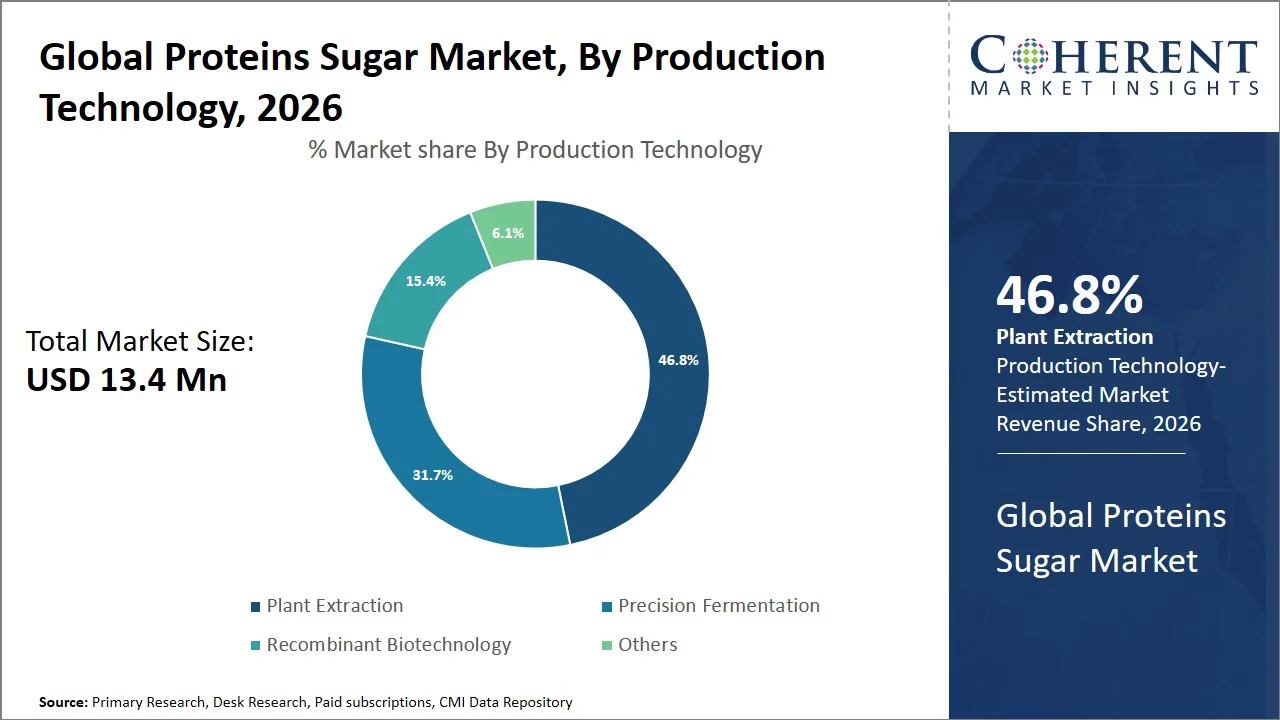
Plant Extraction is projected to represent 46.8% of the global proteins sugar market in 2026, primarily due to its alignment with consumer preference for naturally sourced ingredients and its suitability for producing established sweet proteins such as thaumatin. The technology benefits from existing agricultural knowledge, natural ingredient positioning, and acceptance among manufacturers seeking clean-label formulations. Producers using plant-based extraction methods can leverage biological sources while maintaining a strong connection with natural-origin product claims, particularly in premium food and beverage segments. This production route remains commercially relevant where customers prioritize ingredient transparency and traditional sourcing approaches. In July 2026, according to National Library of medicine researchers published a techno-economic assessment of plant seed-based thaumatin II production, demonstrating continued industry interest in improving plant-derived production efficiency and commercial feasibility.
Why Does Powder Dominate the Form Category of the Global Proteins Sugar Market?
Powder form is expected to capture 58.6% of the global proteins sugar market in 2026, driven by its advantages in storage stability, transportation efficiency, and compatibility with industrial food manufacturing processes. Powdered sweet proteins provide manufacturers with easier handling, accurate dosing, and longer shelf life compared with liquid alternatives, making them suitable for large-scale production of beverage mixes, nutritional products, bakery applications, and functional foods. The format also supports global distribution because suppliers can transport concentrated ingredients with reduced logistical complexity. For ingredient manufacturers, powder processing enables standardized product specifications and broader customer adoption across multiple applications. In March 2025, Brazza Bio introduced its commercial sweet protein products combining brazzein and thaumatin in concentrated formats, demonstrating increasing movement toward consumer-ready and application-focused sweet protein formats.
Current Events and their Impact
Current Event | Description and Its Impact |
FDA GRAS Review of Brazzein Preparation – April 2025 |
|
FDA GRAS Review of Brazzein Produced by Perfect Day – October 2024 |
|
FDA GRAS Database Expansion for Fermentation-Derived Ingredients – 2026 |
|
Global Proteins Sugar Market Dynamics
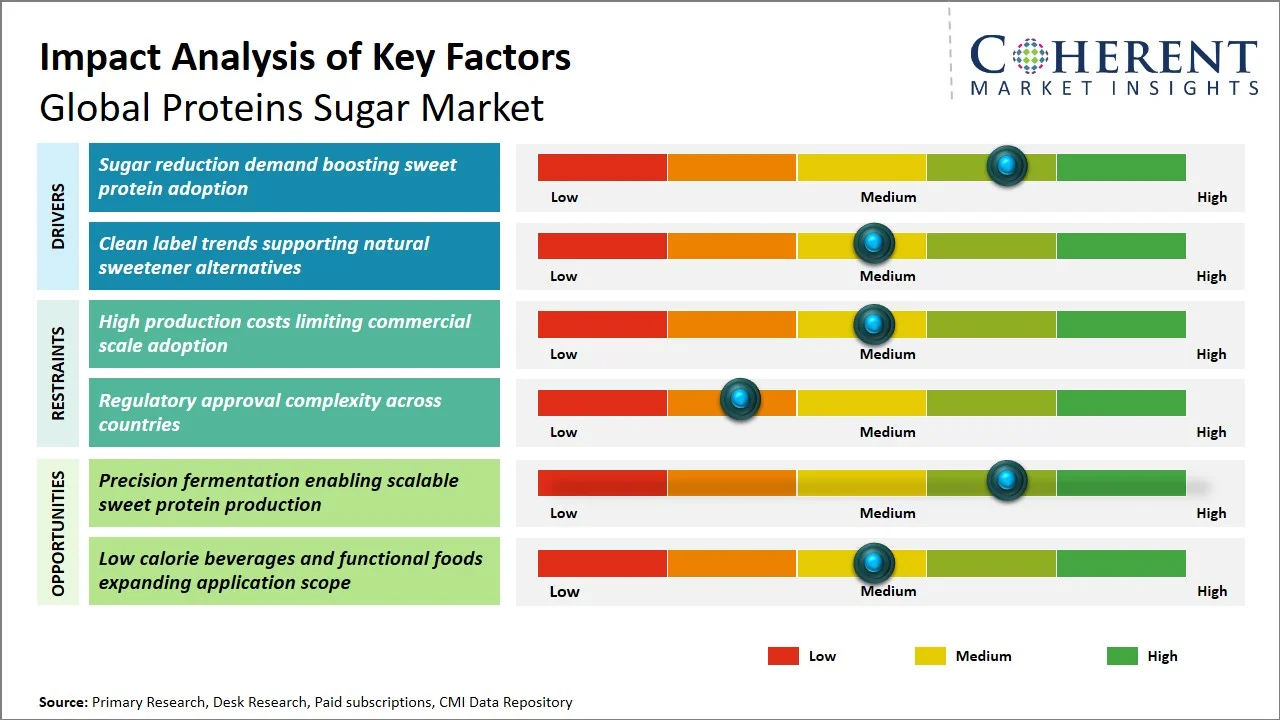
Key Market Drivers
Sugar Reduction Demand Boosting Sweet Protein Adoption
Sugar reduction requirements across beverages, confectionery, dairy alternatives, and functional nutrition products are accelerating interest in sweet proteins such as thaumatin, brazzein, and monellin due to their extremely high sweetness intensity and ability to deliver sugar-like taste profiles with minimal usage volumes. Food manufacturers, ingredient suppliers, and biotechnology companies benefit from these proteins by developing reformulated products that meet consumer expectations for lower sugar intake while maintaining sensory performance. The commercial opportunity is particularly strong for suppliers capable of achieving consistent quality, scalable production, and regulatory acceptance. In April 2025, the U.S. FDA issued a “no questions” response for a brazzein preparation produced through fermentation, supporting broader acceptance of sweet protein ingredients for food applications.
Clean Label Trends Supporting Natural Sweetener Alternatives
Clean-label preferences are encouraging food and beverage manufacturers to move toward naturally derived sweet protein alternatives that offer improved ingredient transparency, reduced sugar content, and better alignment with wellness-focused product positioning. Sweet proteins such as brazzein and thaumatin provide manufacturers with opportunities to develop lower-sugar formulations while maintaining sweetness intensity and sensory quality. Ingredient developers, biotechnology companies, and food brands benefit from these solutions as consumers increasingly evaluate product labels, ingredient origins, and nutritional profiles before purchase. In May 2025, Chanson International Holding announced the development of a natural sweetener blend incorporating brazzein with monk fruit extract for healthier beverage and bakery applications, demonstrating commercial interest in combining sweet proteins with clean-label formulation strategies.
Emerging Market Trends
Shift Toward Precision Fermentation-Based Sweet Protein Manufacturing
Precision fermentation is becoming an important transformation pathway for sweet protein production by enabling manufacturers to move beyond agricultural extraction limitations toward controlled, scalable, and consistent manufacturing systems. Companies developing fermentation platforms can improve supply reliability, production efficiency, and customization capabilities for proteins such as brazzein, thaumatin, and monellin. The trend is expected to reshape supplier competitiveness as customers increasingly prioritize predictable ingredient quality, traceability, and scalable production capacity. Over the forecast period, companies with advanced fermentation capabilities and downstream purification expertise are likely to gain stronger positioning compared with traditional extraction-based suppliers.
Increasing Integration of Sweet Proteins into Functional Nutrition Products
Sweet proteins are increasingly moving beyond conventional sweetener applications into functional nutrition categories, including protein beverages, wellness products, and specialized dietary formulations. Product developers are exploring sweet proteins as enabling ingredients that allow reduced-sugar formulations while maintaining consumer acceptance of taste and texture. This trend may create new opportunities for ingredient suppliers to collaborate with nutrition brands seeking differentiated product concepts. Companies capable of combining sweet protein technology with formulation expertise, sensory optimization, and application support are expected to capture higher-value opportunities compared with suppliers competing only on ingredient availability.
Regional Insights
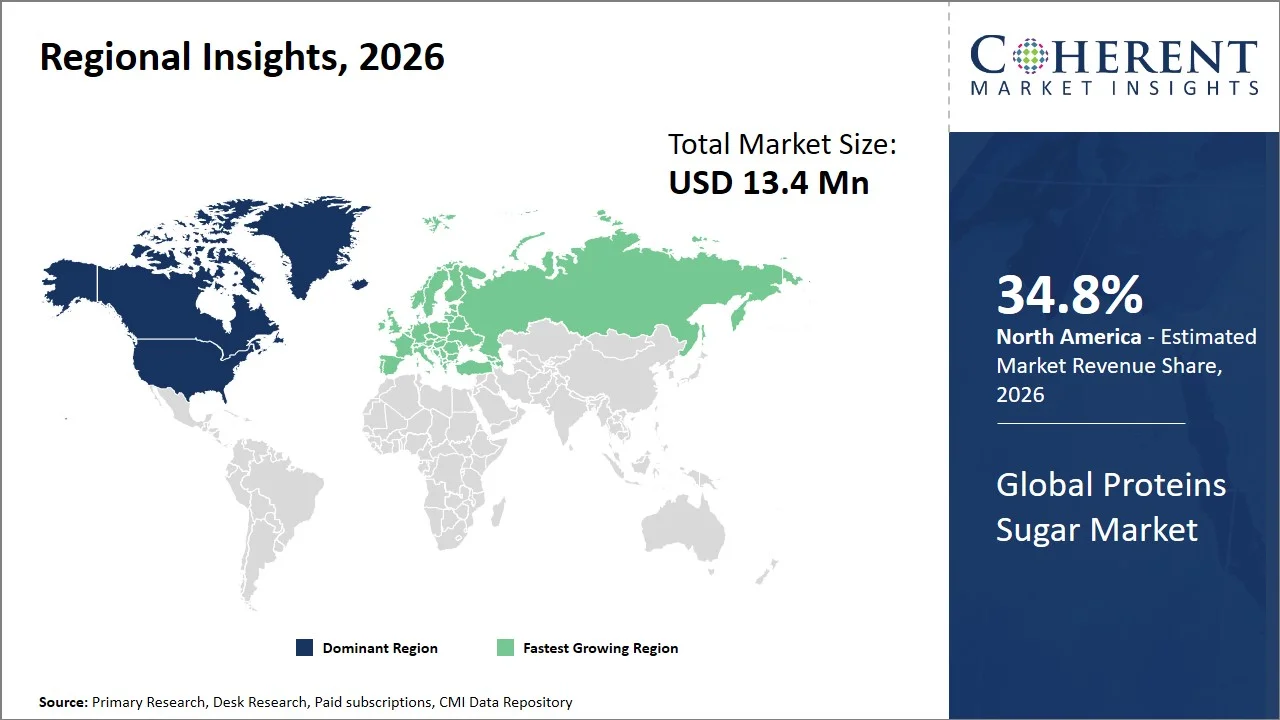
Why Does North America Dominate the Global Proteins Sugar Market?
North America is expected to dominate the Global Proteins Sugar Market with a 34.8% share in 2026, supported by the region’s advanced food technology ecosystem, strong presence of ingredient developers, and high demand for sugar-reduction solutions across beverages, functional foods, and nutraceutical applications. The U.S. and Canada have established innovation pipelines in alternative sweeteners, supported by biotechnology companies developing precision fermentation and recombinant production methods for sweet proteins. The region also benefits from mature regulatory frameworks, strong investment in clean-label ingredients, and significant adoption of reduced-sugar formulations by food and beverage manufacturers. In January 2025, the U.S. Food and Drug Administration (FDA) continued expanding public access to its GRAS Notice inventory, supporting transparency around novel food ingredients and enabling commercialization pathways for innovative sweetening solutions.
Why Is Europe Emerging as the Fastest-Growing Region in the Global Proteins Sugar Market?
Europe is projected to become the fastest-growing region in the global proteins sugar market with a 28.7% share in 2026, driven by increasing regulatory pressure on sugar reduction, consumer preference for healthier food products, and rapid adoption of sustainable biotechnology-based ingredients. Countries including Germany, France, and the United Kingdom are witnessing greater investment in alternative sweeteners as manufacturers reformulate products to meet evolving nutritional standards. The region’s strong food processing industry, sustainability objectives, and focus on reducing dependence on conventional sweeteners create favorable conditions for protein-based sugar alternatives. In February 2025, the European Commission continued advancing initiatives under the EU Farm to Fork Strategy, supporting healthier and more sustainable food systems that encourage innovation in functional ingredients and reformulated products.
Global Proteins Sugar Market Outlook for Key Countries
Why Is the U.S. a Key Market for the Global Proteins Sugar Market?
The U.S. is a key market for the global proteins sugar market due to its strong food and beverage manufacturing base, high consumer awareness regarding sugar reduction, and rapid adoption of biotechnology-derived ingredients. The country hosts several ingredient innovators working on sweet proteins, precision fermentation platforms, and next-generation food technologies. Demand is concentrated across beverages, sports nutrition, functional foods, and low-calorie product categories where manufacturers seek alternatives that maintain sweetness performance while reducing sugar content. The U.S. regulatory environment also provides structured pathways for introducing novel food ingredients through GRAS evaluations. In June 2025, the U.S. Department of Agriculture highlighted continued growth in biotechnology applications within food and agricultural innovation, supporting broader commercialization opportunities for advanced ingredient technologies.
Why Is India Important in the Global Proteins Sugar Market?
India represents an emerging opportunity in the global proteins sugar market due to its expanding packaged food industry, growing diabetic and health-conscious consumer base, and increasing demand for low-calorie alternatives. The country’s large beverage, dairy, and nutraceutical sectors provide significant application opportunities for sweet protein ingredients. India’s cost-efficient biotechnology capabilities, skilled scientific workforce, and growing interest in functional nutrition create potential for domestic production and technology partnerships. Additionally, manufacturers are increasingly exploring natural and plant-derived sweetening options to address changing consumer preferences. In April 2025, the Indian Council of Medical Research (ICMR) emphasized reducing excessive sugar intake through dietary guidelines, strengthening awareness around healthier food formulations and sugar-reduction strategies.
Why Does China Support Growth in the Global Proteins Sugar Market?
The global proteins sugar market is supported by China's high volume food processing industry, biotechnology manufacturing capabilities and growing demand for functional and healthier food products. Industrial infrastructure for fermentation technologies, ingredient production, and food innovation is strong, allowing companies to build up scaling production capacity for alternative sweeteners. The rising middle class in China and their demand for less sugar and health-conscious goods further bolsters market prospects. Additionally, the nation has a long domestic supply chain for the production and distribution of ingredients. In March 2025, China's National Health Commission (NHC) furthered the push on healthier food choices and decreased sugar intake by urging the industry to create better nutritional formulations.
Why Is Germany a Strategic Country in the Global Proteins Sugar Market?
Germany is a key player in the global proteins sugar market, and it has a strong and well-established food ingredient industry, along with a robust biotechnology research environment and a reputation for sustainable manufacturing practices. The country has a well-established food processing industry that is looking for innovative ingredients that enable sugar reduction, clean label positioning and nutritional improvement. Germany's focus on scientific research, industrial biotechnology and regulatory compliance facilitates advanced solutions for sweetening to be developed and marketed. The presence of leading research institutions and ingredient manufacturers further reinforces its standing as an innovation hub in Europe. In May 2025, Germany's Federal Ministry of Food and Agriculture remained dedicated to the continuation of research projects that promote sustainable food production and innovative agriculture technologies, fostering a positive climate for the development of innovative ingredients of the future.
Why Is Brazil an Important Growth Market for the Global Proteins Sugar Market?
Brazil is an important growth market for the global proteins sugar market because of its large food and beverage industry, expanding functional nutrition industry, and the country being a leading agricultural economy. With manufacturers looking into healthier product formulations and lower sugar content in line with consumer interest, the country provides ample opportunities for alternative sweeteners. The large number of beverage manufacturers in Brazil, from soft drinks to dairy to nutritional beverages, demands a large number of new ingredients for sweetening. The country also has a food ingredient distribution network in place throughout Latin America. In February 2025, Brazil’s National Health Surveillance Agency (ANVISA) continued implementing nutritional labeling regulations, encouraging manufacturers to reformulate products and improve transparency regarding sugar content.
Technology & Innovation Landscape in the Global Proteins Sugar Market
Innovation Area / Technology | Current Maturity Level | Primary Market Application | Commercial Significance |
Precision Fermentation Platforms | Commercializing | Brazzein, thaumatin, and other sweet protein production | Enables scalable manufacturing with improved consistency, supporting transition from laboratory-stage sweet proteins toward industrial food ingredient supply chains |
Recombinant Protein Expression Systems | Commercializing | Engineered sweet proteins with enhanced sweetness profiles | Allows customization of protein structures, improving sensory performance and enabling development of differentiated sweetener solutions |
Plant Molecular Farming Technologies | Emerging Commercial | Natural production of thaumatin and specialty sweet proteins | Provides an alternative production pathway with potential advantages in natural positioning, biological efficiency, and long-term supply diversification |
AI-Based Protein Design & Optimization | Early Adoption | Sweetness intensity improvement and protein structure optimization | Supports faster discovery of improved sweet protein variants by reducing development cycles and improving formulation performance |
Advanced Downstream Processing & Purification | Commercializing | Food-grade sweet protein isolation and stabilization | Improves ingredient purity, functional performance, shelf stability, and suitability for large-scale food and beverage manufacturing |
Sensory Science & Taste Modelling Technologies | Commercial Adoption | Beverage, dairy, confectionery, and nutraceutical formulation | Helps manufacturers overcome taste challenges by optimizing sweetness perception, flavour balance, and consumer acceptance of reduced-sugar products |
How Are Precision Fermentation and Application-Specific Formulation Creating New Growth Opportunities in the Global Proteins Sugar Market?
Precision fermentation combined with application-specific formulation represents a significant commercial opportunity for the global proteins sugar market. While sweet proteins have strong potential as sugar-reduction ingredients, wider adoption depends on improving production economics, taste performance, and integration into finished products. Ingredient suppliers can capture growth by developing customized sweet protein solutions for beverages, dairy alternatives, nutraceutical products, and functional foods rather than supplying standardized ingredients alone. Companies with capabilities in fermentation optimization, purification, sensory testing, and customer formulation support are likely to achieve stronger differentiation. The opportunity favors both established ingredient manufacturers expanding biotechnology capabilities and specialized biotechnology companies developing novel production platforms. Strategic investments in application laboratories, regulatory expertise, and regional manufacturing capabilities will become increasingly important for commercial scaling and customer adoption.
Market Players, Key Development, and Competitive Intelligence
Key Developments
- In September 2025, Oobli announced FDA confirmation of GRAS status for brazzein-54, expanding its sweet protein platform that already included other protein-based sweetening solutions. This development is important for the global proteins sugar market because it strengthens Oobli’s ability to support food and beverage companies developing reduced-sugar products and demonstrates increasing commercialization of sweet protein systems beyond traditional sweetener categories.
- In July 2025, Bestzyme showcased its Mellia Brazzein sweet protein platform at IFT FIRST 2025, highlighting its precision fermentation-based production capability and application potential across beverages, dairy, confectionery, and functional food categories. This development is important for the global proteins sugar market because it demonstrates the movement of brazzein from laboratory development toward commercial ingredient solutions, expanding options for manufacturers seeking sugar-reduction formulations with improved taste performance.
- In February 2025, EFKO introduced confectionery products containing brazzein-based sweet protein through its EFKO ART production platform in Russia. This development is important for the global proteins sugar market because it represents one of the early examples of sweet protein integration into finished consumer products, showing how manufacturers are testing alternative sweetening technologies in commercial food applications rather than limiting adoption to ingredient-level solutions.
Competitive Landscape
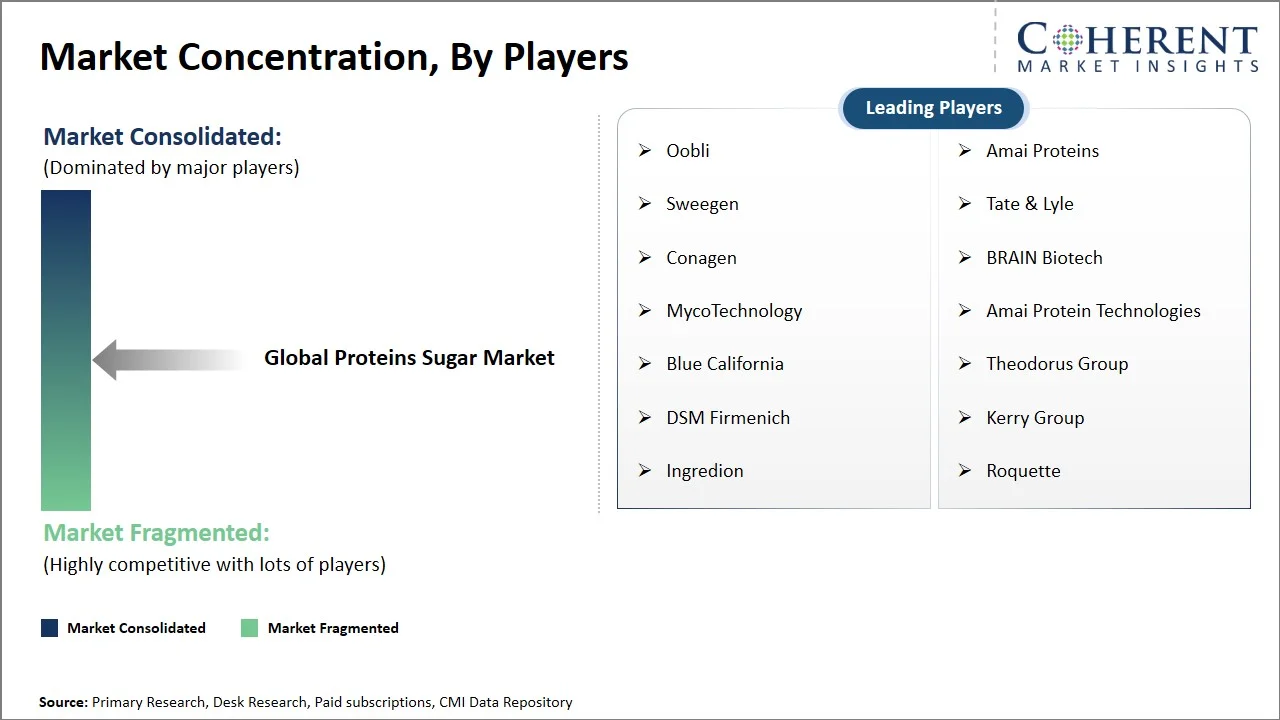
The global proteins sugar market is moderately consolidated, with competition occurring among biotechnology companies, specialty ingredient manufacturers, and emerging fermentation-based sweet protein developers. Competitive positioning depends on production technology, ingredient performance, regulatory readiness, scalability, and application support. Regional specialists and technology-focused companies are gaining importance by offering differentiated sweet protein solutions.
Key focus areas include
- Sweetness intensity and sensory performance differentiation
- Precision fermentation capability and production scalability
- Regulatory approvals and food safety compliance
- Manufacturing consistency and supply reliability
- Product purity and formulation compatibility
- Application development support for food manufacturers
- Intellectual property around protein engineering and production methods
- Strategic partnerships with food and beverage companies
Market Report Scope
Proteins Sugar Market Report Coverage
| Report Coverage | Details | ||
|---|---|---|---|
| Base Year: | 2025 | Market Size in 2026: | USD 13.4 Mn |
| Historical Data for: | 2020 To 2024 | Forecast Period: | 2026 To 2033 |
| Forecast Period 2026 to 2033 CAGR: | 10.30% | 2033 Value Projection: | USD 26.7 Mn |
| Geographies covered: |
| ||
| Segments covered: |
| ||
| Companies covered: | Oobli, Amai Proteins, Sweegen, Tate & Lyle, Conagen, BRAIN Biotech, MycoTechnology, Amai Protein Technologies, Blue California, Theodorus Group, DSM Firmenich, Kerry Group, Ingredion, Roquette | ||
| Growth Drivers: |
| ||
| Restraints & Challenges: |
| ||
Analyst Opinion (Expert Opinion)
- The global proteins sugar market is likely to transition from being primarily an alternative sweetener category toward a broader ingredient solutions market. Future competitive advantage will depend less on individual sweet protein molecules and more on integrated capabilities covering production technology, sensory performance, regulatory support, and customer-specific formulation expertise.
- The major market disruption will emerge from the commercialization of scalable biotechnology production systems. Companies that successfully reduce production complexity and improve consistency may challenge traditional sweetener suppliers by offering highly potent, sustainable, and application-focused alternatives for large-scale food manufacturing.
- Market participants should prioritize fermentation capabilities, regulatory readiness, application development expertise, and strategic customer partnerships. Companies should avoid competing solely on ingredient supply because long-term value creation will depend on differentiated solutions, technical support, and the ability to address cost and scalability challenges.
Speak to the analyst
Want personalized insights?
Take the findings above to one of our principal consultants, or have the report rebuilt around the segments, geographies and competitors you actually track.
Market Segmentation
- Product Type Insights (Revenue, USD Mn, 2021 - 2033)
- Thaumatin
- Brazzein
- Monellin
- Miraculin
- Others
- Production Technology Insights (Revenue, USD Mn, 2021 - 2033)
- Plant Extraction
- Precision Fermentation
- Recombinant Biotechnology
- Others
- Form Insights (Revenue, USD Mn, 2021 - 2033)
- Powder
- Liquid
- Concentrates
- Others
- Application Insights (Revenue, USD Mn, 2021 - 2033)
- Food and Beverages
- Nutraceuticals
- Dairy and Functional Foods
- Pharmaceuticals
- Others
- Distribution Channel Insights (Revenue, USD Mn, 2021 - 2033)
- Direct Sales
- Indirect Sales
- Regional Insights (Revenue, USD Mn, 2021 - 2033)
- North America
- U.S.
- Canada
- Latin America
- Brazil
- Argentina
- Mexico
- Rest of Latin America
- Europe
- Germany
- U.K.
- Spain
- France
- Italy
- Russia
- Rest of Europe
- Asia Pacific
- China
- India
- Japan
- Australia
- South Korea
- ASEAN
- Rest of Asia Pacific
- Middle East
- GCC Countries
- Israel
- Rest of Middle East
- Africa
- South Africa
- North Africa
- Central Africa
- North America
Sources
Primary Research Interviews
- Sweet protein manufacturers, biotechnology companies, food ingredient suppliers, beverage manufacturers, and nutrition product developers
- Food technologists, R&D specialists, formulation experts, procurement professionals, and industry consultants
Stakeholders
- Sweet protein producers, alternative sweetener companies, biotechnology firms, and specialty ingredient manufacturers
- Raw material suppliers, fermentation technology providers, food processing companies, distributors, and ingredient procurement organizations
- Food & beverage brands, nutraceutical companies, functional food manufacturers, and dietary product companies
End-use Sectors
- Food and beverage applications
- Functional foods and nutraceutical products
- Dairy and alternative dairy formulations
- Sports nutrition and wellness products
- Confectionery and reduced-sugar product categories
Regulatory and Industry Bodies
- U.S. Food and Drug Administration (FDA)
- European Food Safety Authority (EFSA)
- Food Safety and Standards Authority of India (FSSAI)
- International Food Information Council (IFIC)
- Global food ingredient and biotechnology regulatory organizations
Databases
- Company annual reports, investor presentations, and corporate filings
- Food ingredient databases and regulatory approval databases
- Trade statistics and biotechnology industry databases
- Product portfolio analysis and formulation databases
- Scientific publications and food technology research databases
Magazines and Journals
- Food technology and ingredient innovation publications
- Biotechnology and fermentation research journals
- Food chemistry and nutritional science journals
- Alternative sweetener and functional ingredient industry publications
Associations
- International Food Information Council (IFIC)
- Institute of Food Technologists (IFT)
- Food and Agriculture Organization (FAO)
- International Association for Food Protection (IAFP)
- Regional food ingredient and biotechnology associations
Public Domain Sources
- Sweet protein regulatory approvals and safety evaluations
- Biotechnology and precision fermentation developments
- Sugar reduction initiatives and food reformulation trends
- Food and beverage innovation updates
- Alternative sweetener technology advancements and industry developments
Key Standards and Regulations
- Food ingredient safety and approval regulations
- GRAS (Generally Recognized As Safe) evaluation requirements
- Novel food approval frameworks
- Food labeling and nutritional declaration standards
- International food import and compliance regulations
Proprietary Elements
- CMI Data Analytics Tool
- Proprietary CMI Existing Repository of information for the last 10 years
Get access to 250+ pages report
Every segment, forecast, competitor profile and data table behind the analysis above — available for instant download.
- ESOMAR Member
- ISO 9001:2015 Certified
- D-U-N-S Registered
- GDPR & CCPA Compliant
Missing comfort of reading report in your local language? Find your preferred language:
Frequently Asked Questions
The CAGR of global proteins sugar market is projected to be 10.30% from 2026 to 2033.
The global proteins sugar market is estimated to be valued at USD 13.4 Mn in 2026 and is expected to reach USD 26.7 Mn by 2033.
Companies are investing in the proteins sugar market due to increasing opportunities in sugar-reduction applications, biotechnology-enabled ingredient development, and growing demand from food and beverage manufacturers seeking innovative sweetening solutions.
The market is gaining opportunities from applications such as beverages, functional foods, dairy products, confectionery, and nutrition products where manufacturers require high-performance sweetening ingredients with improved taste profiles.
Biotechnology advancements are improving the scalability, consistency, and commercial feasibility of sweet protein production, enabling suppliers to develop more reliable ingredients for large-scale food and beverage applications.
A global proteins sugar market report provides insights into market trends, growth opportunities, competitive landscape, key companies, technology developments, application analysis, regional outlook, and strategic factors influencing future market expansion.
Sugar reduction demand boosting sweet protein adoption and Clean label trends supporting natural sweetener alternatives are the major factor driving the growth of global proteins sugar market.