

Natural Sweeteners Market Analysis & Forecast: 2026 to 2033
Natural Sweeteners Market is estimated to be valued at USD 3.99 Bn in 2026 and is expected to reach USD 5.26 Bn in 2033, exhibiting a compound annual growth rate (CAGR) of 4.0% from 2026 to 2033.
Key Takeaways
- Based on Type, the Stevia segment is expected to hold the largest share of the market in 2026, as a versatile, zero-calorie, plant-based solution driving health-conscious demand.
- Based on End-User Industry, the Food and Beverages segment is expected to capture 40.5% share in 2026, driven by global demand for healthier, clean-label sugar alternatives.
- Based on Region, North America is set to lead the market with 32.5% share in 2026. While, Asia Pacific is anticipated to be the fastest growing region.
Market Overview
Growing demand for natural sweeteners among the aging and geriatric population for their daily diet and exercise activities is expected to drive the product demand. Furthermore, natural sweeteners offer a wide range of applications in bakeries, desserts, beverages, confectionaries, dairy products, and others, and this is driving growth of global natural sweeteners market.
Current Events and Its Impacts on the Natural Sweeteners Market
Current Event | Description and its Impact |
Regulatory Health Policy Shifts |
|
Agricultural Technology and Innovation Advances |
|
Key Trends in Natural Sweeteners Market
- Label-Conscious Consumers: 62% of U.S. shoppers now check for “no added sugar” claims, showing a strong health-driven purchasing trend.
- Functional Food Integration: Natural sweeteners are increasingly used in protein bars (35%) and functional beverages (42%), expanding beyond soft drinks.
- Digital Retail Surge: Asia-Pacific’s online sales of sweetener-based products grew 19% year-on-year, outpacing offline channels.
- Ingredient Innovation: China’s approval of allulose in 2025 is driving production capacity toward 20,000 tons annually by 2026.
- Premium Pricing: Products with natural sweeteners command a 12–15% higher retail price, reflecting consumer willingness to pay for healthier options.
- Health Impact Validation: Stevia-based formulations reduce calorie intake by up to 18% daily in trials, reinforcing their role in weight management.
- Current Industry Events of 2026
- Market Size Estimation
- Regional Breakdown
- Competitive Landscape
- Customer Intelligence
- Segmental Analysis
- Pricing Analysis
- Key Market Drivers, Challenges & Future Trends
- Customized Insights Section
Segmental Insights
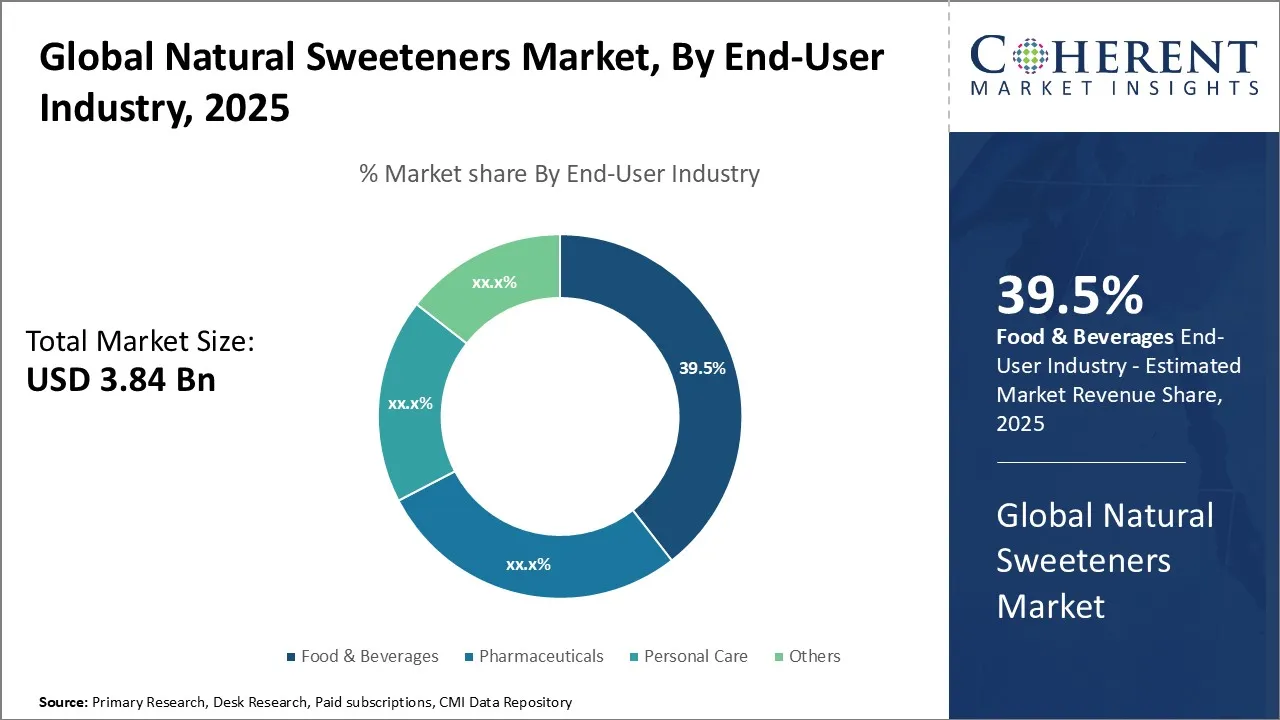
Global Natural Sweeteners Market Insights, By End-User Industry - Food & Beverages Lead Is Driven by Global Demand for Healthier, Clean-Label Sugar Alternatives
In terms of end-user industry, the food and beverages segment is projected to account for 40.5% share in 2026. This dominance is due to the fact that people around the world are moving toward healthier diets and clean-label products. People are also actively looking for ways to replace refined sugar in their daily foods. Natural sweeteners are now common in carbonated drinks, juices, baked goods, dairy products, and candy, where taste and cutting calories are both important. The rise in demand for functional drinks, like flavored waters, protein bars, and plant-based products, has sped up adoption even more.
For instance, in July 2025, Layn Natural Ingredients introduced SteviUp M2, a new plant-based sweetener tailored for food and beverage applications. Derived from stevia, the innovation enhances taste and functionality in products such as drinks, baked goods, and dairy. Supporting clean-label and health-conscious trends, SteviUp M2 strengthens stevia’s role as a leading natural sugar alternative in global markets.
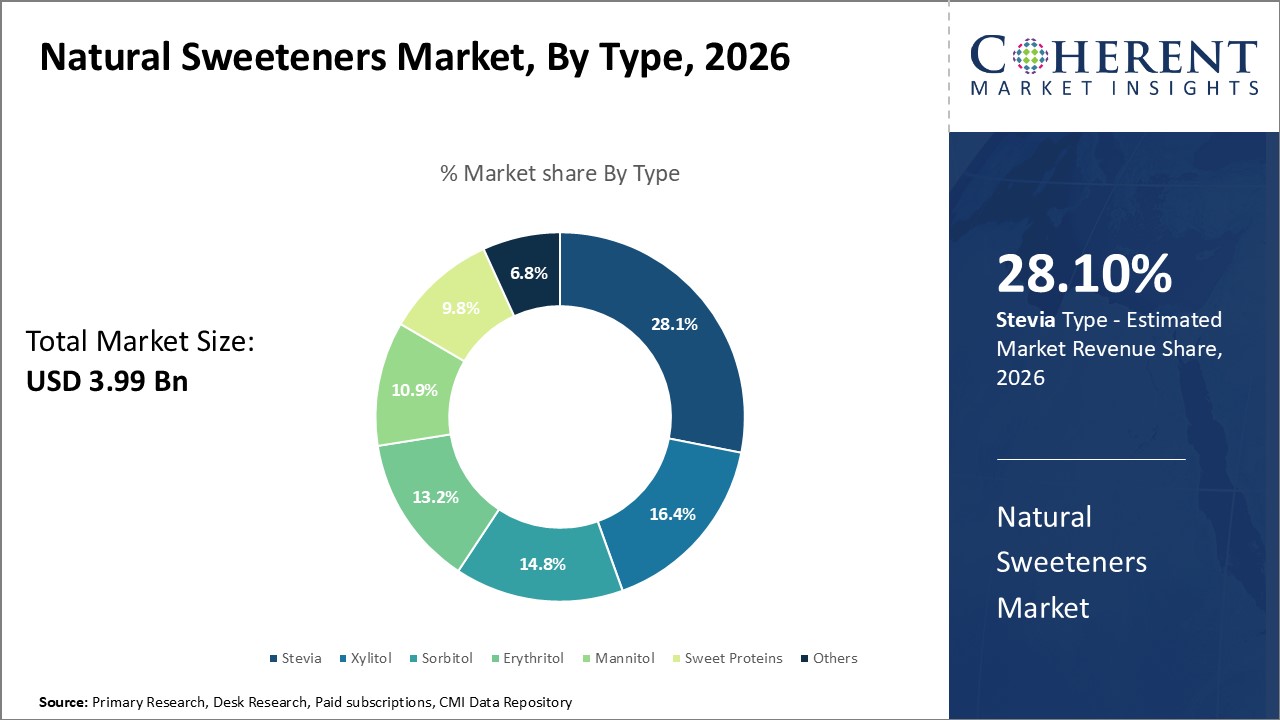
Global Natural Sweeteners Market Insights, By Type - Stevia Dominates as a Versatile, Zero-Calorie, Plant-Based Solution Driving Health-Conscious Demand
In terms of type, the stevia segment is expected to hold the largest share of the market in 2026, because it is a plant-based sweetener with no calories. More and more people around the world are aware of how much sugar they eat because obesity, diabetes, and heart disease are on the rise. Stevia is the best choice for food makers because it is a clean-label option that fits with health trends. It is the leader because it can be used in so many ways, from soft drinks and baked goods to dairy and candy.
For instance, in August in 2025, Stevia 3.0 launched a new plant-based sweetener for regular drinks, has been released. The new product is marketed as a natural, zero-calorie alternative to sugar that solves taste problems and fits in with clean-label trends. As health concerns grow around the world, Stevia 3.0 is expected to make stevia even more popular as a natural sweetener, especially in food and drinks.
Regional Insights
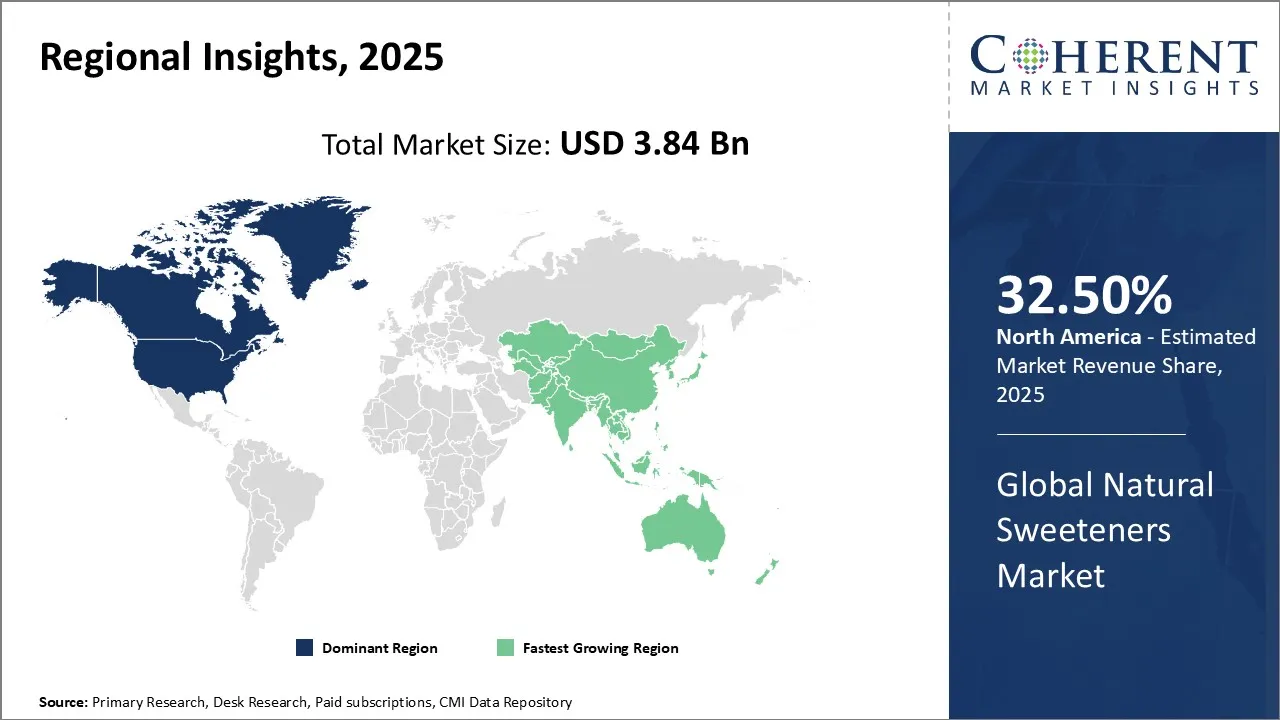
North America Natural Sweeteners Market Analysis & Trends
North America accounted for largest market share of 32.5% share in 2026, owing to growing incidence of obesity and diabetes, in this region, which is creating a significant demand for natural sweeteners. Furthermore, various applications of natural sweeteners, across the food & beverages industry is expected to propel global natural sweetener market growth in the region.
For instance, in July 2024, NutraEx Food Inc., which is based in Burnaby, Canada, introduced Bi-Sugar, a plant-based sweetener for the U.S. market. Bi-Sugar was first shown at the IFT First Expo in Chicago. It is a natural, low-calorie substitute for refined sugar. The innovation is GRAS-certified in the U.S., which means it supports clean-label trends and can be used in more food and drink products.
Asia Pacific Natural Sweeteners Market Analysis & Trends
Asia Pacific is expected to exhibit significant CAGR throughout the forecast period. In emerging economies such as China and India, natural sweeteners are used as a preservative in pickles, sauces, pastes, and others. Moreover, rising aging population and preferences for healthy lifestyle is expected to proliferate the global natural sweeteners market growth across the region. Furthermore, urbanization in developing countries, rise in per capita income, and diet diversification are the major factors to surge the demand for natural sweeteners.
For instance, in October 2026, Indian startup after winning the Tetra Pak Start-up Challenge, Zumi launched a milkshake that are free of lactose and refined sugar. The milkshakes use natural sweeteners instead of refined sugar to appeal to health-conscious customers. This is in line with clean-label trends. The new product shows that there is a growing demand in India for healthier drinks and supports the move toward food products that are good for the environment and good for you.
Natural Sweeteners Market Outlook Country-Wise
The U.S. Natural Sweeteners Market Trends
There is a lot of demand for natural sweeteners in the U.S. in 2026 because people are worried about their health, especially obesity and diabetes. People are moving away from sugar substitutes with no clean-label and are instead using plant-based ones like stevia and erythritol. Food and drink companies are changing their recipes to lower the number of calories in their products. At the same time, more people are interested in functional drinks and protein bars, which is speeding up the use of natural sweeteners across the country.
For instance, in November 2026, Oobli released a protein sweetener that is GRAS-certified and meant to help with the problem of too much sugar consumption around the world. The new idea, which was announced through Cultivated-X, is a low-calorie, plant-based option that can be used in food and drinks. Oobli's protein sweetener supports clean-label trends and makes new sweeteners more important in cutting down on the need for refined sugar by giving people a healthier, more natural choice.
China Natural Sweeteners Market Trends
In 2026, China's market for natural sweeteners is booming because more people are becoming health-conscious and the government has approved alternatives like allulose. People are moving away from refined sugar and toward plant-based, low-calorie options because they are worried about obesity and diabetes.
For instance, in July 2026, Allulose been officially approved as a food ingredient by China's National Health Commission. This is a big step forward for natural sweeteners. Allulose is known for being low in calories and good for your health. It is about 70% as sweet as sucrose. The approval opens up China's domestic market, which gives food and drink makers more chances to sell their products and increases global demand for plant-based sugar substitutes.
Market Report Scope
Natural Sweeteners Market Report Coverage
| Report Coverage | Details | ||
|---|---|---|---|
| Base Year: | 2025 | Market Size in 2026: | USD 3.99 Bn |
| Historical Data for: | 2020 To 2024 | Forecast Period: | 2026 To 2033 |
| Forecast Period 2026 to 2033 CAGR: | 4.0% | 2033 Value Projection: | USD 5.26 Bn |
| Geographies covered: |
| ||
| Segments covered: |
| ||
| Companies covered: | Tate & Lyle, Sunwin Stevia International, Roquette Frères, GLG Lifetech, Cargill, Inc, Archer Daniels Midland Co., Wilmar International Ltd., Ingredion Incorporated, Ajinomoto Co., Inc., and PureCircle | ||
| Growth Drivers: |
| ||
| Restraints & Challenges: |
| ||
Natural Sweeteners Market Driver
Growing awareness about healthy life style among the consumers
Consumers prefer less harmful and healthier alternative for artificial sweeteners across the globe. Moreover, there is speedy growth in the number of consumers that are adopting natural food products, owing to health issues. In recent times, consumers demand is shifting to food products made with natural sweeteners. Natural sweeteners consist less calories and low sugar content. It is a natural- based product that maintains blood sugar level of person and leads to a healthier lifestyle.
Rising prevalence of chronic diseases
Diseases such as obesity, heart- related diseases, diabetes, high blood pressure, and others, are caused due to the high consumption of sugar in daily diet. Natural sweeteners are more efficient, nutritive, and unprocessed than refined sugar, which has low effect on insulin level in human body. Furthermore, growing prevalence of such chronic diseases throughout the globe, is expected to boost growth of the global natural sweeteners market.
Analyst Opinion (Expert Opinion)
The global natural sweeteners market value is experiencing strong growth, driven by rising health awareness and demand for clean-label, plant-based alternatives to traditional sugar. Health-conscious consumers are increasingly avoiding high-calorie and synthetic sweeteners due to concerns over obesity, diabetes, and other lifestyle-related conditions. Regulatory support, including sugar reduction policies and sugar taxes, is also encouraging manufacturers to reformulate products using natural alternatives.
High-intensity sweeteners, such as stevia and monk fruit, are particularly in demand, while liquid and syrup forms are gaining popularity due to ease of use in beverages and processed foods. North America leads in adoption, fueled by ready-to-drink and wellness-oriented products, whereas Asia-Pacific is emerging as a high-growth region thanks to traditional use of natural sweeteners and favorable regulatory initiatives.
Innovation is accelerating, with companies developing novel sweeteners, improving extraction methods, and enhancing cost-efficiency and purity. However, the market faces challenges, including higher costs, supply variability due to agricultural factors, and regulatory uncertainties for newer sweeteners.
Overall, the market is poised to transition from a niche segment to a mainstream sweetening solution, supported by ongoing health trends, product innovation, and expanding applications across food and beverage industries.
Speak to the analyst
Want personalized insights?
Take the findings above to one of our principal consultants, or have the report rebuilt around the segments, geographies and competitors you actually track.
Recent Developments
- In October 2025, Swiggy has added a "No Added Sugar" category to its menu to appeal to India's growing number of health-conscious diners. The program promotes sugar-free food choices on its platform, which goes along with the clean-label and wellness trends. Swiggy wants to meet the growing demand for healthier meals in the food delivery market by promoting alternatives to refined sugar.
- In September 2025, the Howtian Group hosted the SoPure Symposium in Mexico City, where they talked about how stevia and other natural sweeteners are becoming more important in new food and drink products. Leaders in the industry talked about new developments, market trends, and the need for clean-label sugar substitutes. The event's success shows how important Mexico is as a center for promoting plant-based sweeteners that are better for your health around the world.
- In August 2025, Monin come out with PURE, a new line of drinks that don't have any added sugar. The collection focuses on clean-label formulations and tasty drink options for health-conscious consumers. The launch shows that there is a growing demand for sugar-free products in India's food and drink industry. This shows that Monin is committed to making products that fit with modern lifestyle trends and promote health.
Market Segmentation
- Global Natural Sweeteners Market, By Type (Revenue, USD Bn, 2021 - 2033)
- Stevia
- Xylitol
- Sorbitol
- Erythritol
- Mannitol
- Sweet Proteins
- Others
- Global Natural Sweeteners Market, By End-user Industry (Revenue, USD Bn, 2021 - 2033)
- Food & Beverages
- Pharmaceuticals
- Personal Care
- Others
- Global Natural Sweeteners Market, By Region (Revenue, USD Bn, 2021 - 2033)
- North America
- U.S.
- Canada
- Latin America
- Brazil
- Argentina
- Mexico
- Rest of Latin America
- Europe
- Germany
- U.K.
- Spain
- France
- Italy
- Russia
- Rest of Europe
- Asia Pacific
- China
- India
- Japan
- Australia
- South Korea
- ASEAN
- Rest of Asia Pacific
- Middle East & Africa
- GCC Countries
- Israel
- Rest of Middle East & Africa
- North America
- Key Players
- Tate & Lyle
- Sunwin Stevia International
- Roquette Frères
- GLG Lifetech
- Cargill, Inc
- Archer Daniels Midland Co.
- Wilmar International Ltd.
- Ingredion Incorporated
- Ajinomoto Co., Inc.
- PureCircle
Sources
Primary Research Interviews
- Natural Sweeteners Manufacturers
- Food & Beverage Product Developers
- Food Ingredient Distributors
- R&D and Quality Assurance Specialists in Food Industry
- Nutritionists and Health Experts
- Others
Databases
- Bloomberg Terminal
- Thomson Reuters Eikon
- SPINS
- Others
Magazines
- Food Business News
- Food Navigator
- Food Processing Magazine
- Nutrition Insight
- Food Technology
- Others
Journals
- Journal of Food Science
- Food Chemistry
- Trends in Food Science & Technology
- Journal of Agricultural and Food Chemistry
- Others
Newspapers
- Financial Times
- The Wall Street Journal
- Reuters
- Bloomberg News
- The Economic Times
- Others
Associations
- American Beverage Association (ABA)
- International Sweeteners Association (ISA)
- Institute of Food Technologists (IFT)
- European Food Safety Authority (EFSA)
- Others
Public Domain Sources
- U.S. Food and Drug Administration (FDA)
- World Health Organization (WHO)
- Food and Agriculture Organization (FAO)
- European Commission – Food & Agriculture
- Others
Proprietary Elements
- CMI Data Analytics Tool
- Proprietary CMI Existing Repository of information for the last 8 years
Get access to 250+ pages report
Every segment, forecast, competitor profile and data table behind the analysis above — available for instant download.
- ESOMAR Member
- ISO 9001:2015 Certified
- D-U-N-S Registered
- GDPR & CCPA Compliant
Missing comfort of reading report in your local language? Find your preferred language:
Transform your Strategy with Exclusive Trending Reports
Frequently Asked Questions
The Natural Sweeteners Market is estimated to be valued at USD 3.99 Bn in 2026, and is expected to reach USD 5.26 Bn by 2033.
The CAGR of the Natural Sweeteners Market is projected to be 4.0% from 2026 to 2033.
Increasing awareness regarding sugar free and low calorie products and rising prevalence of chronic diseases across the globe is driving the market.
Research and development activities among the global natural sweetener market is one of the trends in the market.
High manufacturing cost of natural sweeteners and effects of overconsumption of natural sweetener that causes kidney damage, endocrine disruption, hypoglycemia, and others are hampering the market.
Major players operating in the market include Tate & Lyle, Sunwin Stevia International, Roquette Frères, GLG Lifetech, Cargill, Inc, Archer Daniels Midland Co., Wilmar International Ltd., Ingredion Incorporated, Ajinomoto Co., Inc., and PureCircle.
The current market size of the market is USD 3.99 Bn in 2026.