

Global Quartz Crucible Market Size and Forecast – 2026 To 2033
The Global Quartz Crucible Market is estimated to be valued at USD 1,350.4 Mn in 2026 and is expected to reach USD 1,672.1 Mn by 2033, growing at a compound annual growth rate (CAGR) of 3.10% from 2026 to 2033. Market expansion is closely linked to sustained production of monocrystalline silicon for semiconductor wafers and solar photovoltaic cells, where quartz crucibles provide the high-temperature stability, purity control, and chemical resistance required during crystal pulling.
Increasing production of large-diameter semiconductor wafers is also raising performance requirements for crucible consistency and contamination control. In October 2024, Shin-Etsu Chemical reported that sales volumes of 300 mm silicon wafers increased both year-on-year and quarter-on-quarter, supported particularly by strong demand for generative AI-related semiconductor products. This indicates continued upstream requirements for high-purity silicon crystal-growth consumables, including quartz crucibles.
Key Takeaways of the Global Quartz Crucible Market
- Opaque Quartz Crucibles are estimated to record a 3.2% CAGR during 2026–2033 and hold 42.6% of the global quartz crucible market in 2026. Their lead reflects broad use in high-temperature silicon melting, where thermal stability, controlled heat transfer, and process reliability outweigh optical visibility. In August 2024, Sibelco reported continued progress on its USD 200 Mn Spruce Pine high-purity-quartz expansion, strengthening feedstock availability for semiconductor and photovoltaic crucible production.
- 24 to 28 Inches is estimated to expand at a 3.5% CAGR during 2026–2033 and account for 27.8% of the global quartz crucible market in 2026. This range balances silicon charge volume, ingot length, furnace compatibility, and replacement economics for wafer production. In December 2024, the U.S. Department of Commerce awarded GlobalWafers up to USD 406 Mn to support the first U.S. high-volume 300 mm silicon wafer facility in Texas.
- Semiconductor Manufacturing is estimated to expand at a 3.8% CAGR during 2026–2033 and capture 55.8% of the global quartz crucible market in 2026. It remains the largest application because Czochralski silicon growth requires crucibles with tight purity, bubble, and thermal-control specifications, while advanced nodes raise consistency requirements. In June 2025, SEMI projected global 300 mm front-end capacity to grow at a 7% CAGR through 2028 as AI-related logic and memory capacity expands.
- Asia Pacific is estimated to grow at a 2.9% CAGR during 2026–2033 and represent 50.9% of the global quartz crucible market in 2026. Its dominance rests on dense semiconductor, silicon-wafer, solar-PV, and quartz-processing ecosystems across China, Taiwan, Japan, and South Korea, concentrating crucible consumption near crystal-growth operations. In February 2024, TSMC announced a second JASM fab in Kumamoto, taking planned site capacity above 100,000 12-inch wafers per month.
- North America is estimated to post the fastest 4.4% CAGR during 2026–2033 and hold 22.8% of the global quartz crucible market in 2026. Growth is supported by localization of advanced logic, memory, and wafer supply, creating domestic demand for high-purity quartz inputs and crystal-growth consumables. In July 2026, Micron raised planned U.S. investment to more than USD 250 billion through 2035 and poured first concrete at its Clay, New York fab.
Segmental Insights
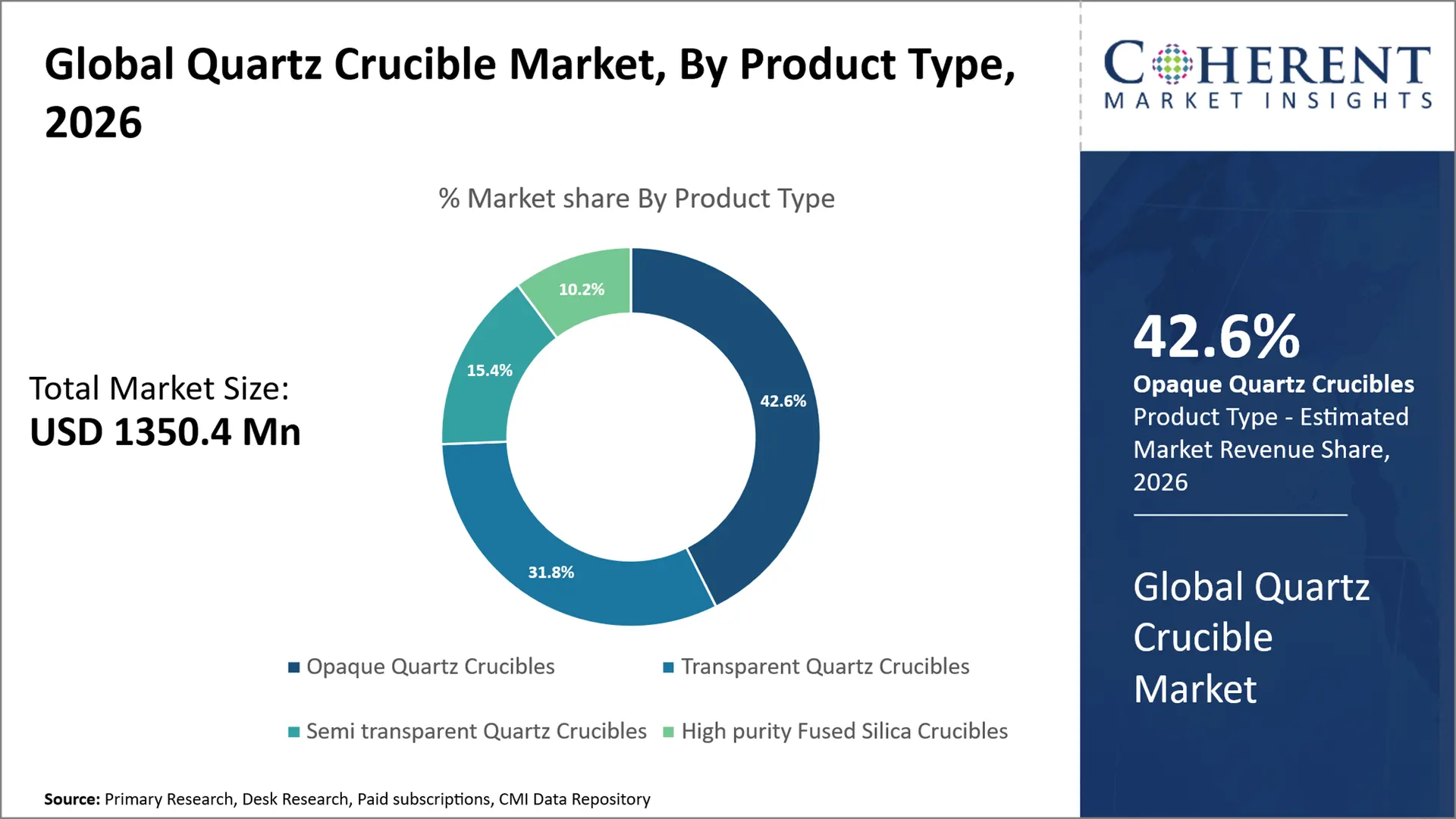
Why Do Opaque Quartz Crucibles Dominate the Global Quartz Crucible Market?
Opaque Quartz Crucibles, with an expected 42.6% market share in 2026, lead the product-type category because their bubble-rich outer structure improves heat retention and disperses radiant energy around the silicon melt, while a cleaner inner contact layer can preserve melt purity. This architecture suits long crystal-pulling cycles and gives manufacturers room to balance thermal performance with raw-material cost, making it commercially practical for both semiconductor and photovoltaic ingot production. Suppliers benefit when customers prioritize pull stability, usable crucible life, and repeatable furnace behavior rather than optical transparency. In December 2024, The Quartz Corp secured NOK 9 million for its SolCru project to modify quartz-sand composition, improve viscosity and thermal stability, and extend quartz-crucible lifetime for solar silicon-wafer production, reinforcing the commercial importance of thermally engineered crucible structures.
- Current Industry Events of 2026
- Market Size Estimation
- Regional Breakdown
- Competitive Landscape
- Customer Intelligence
- Segmental Analysis
- Pricing Analysis
- Key Market Drivers, Challenges & Future Trends
- Customized Insights Section
Why Does 24 to 28 Inches Represent the Largest Diameter Segment in the Global Quartz Crucible Market?
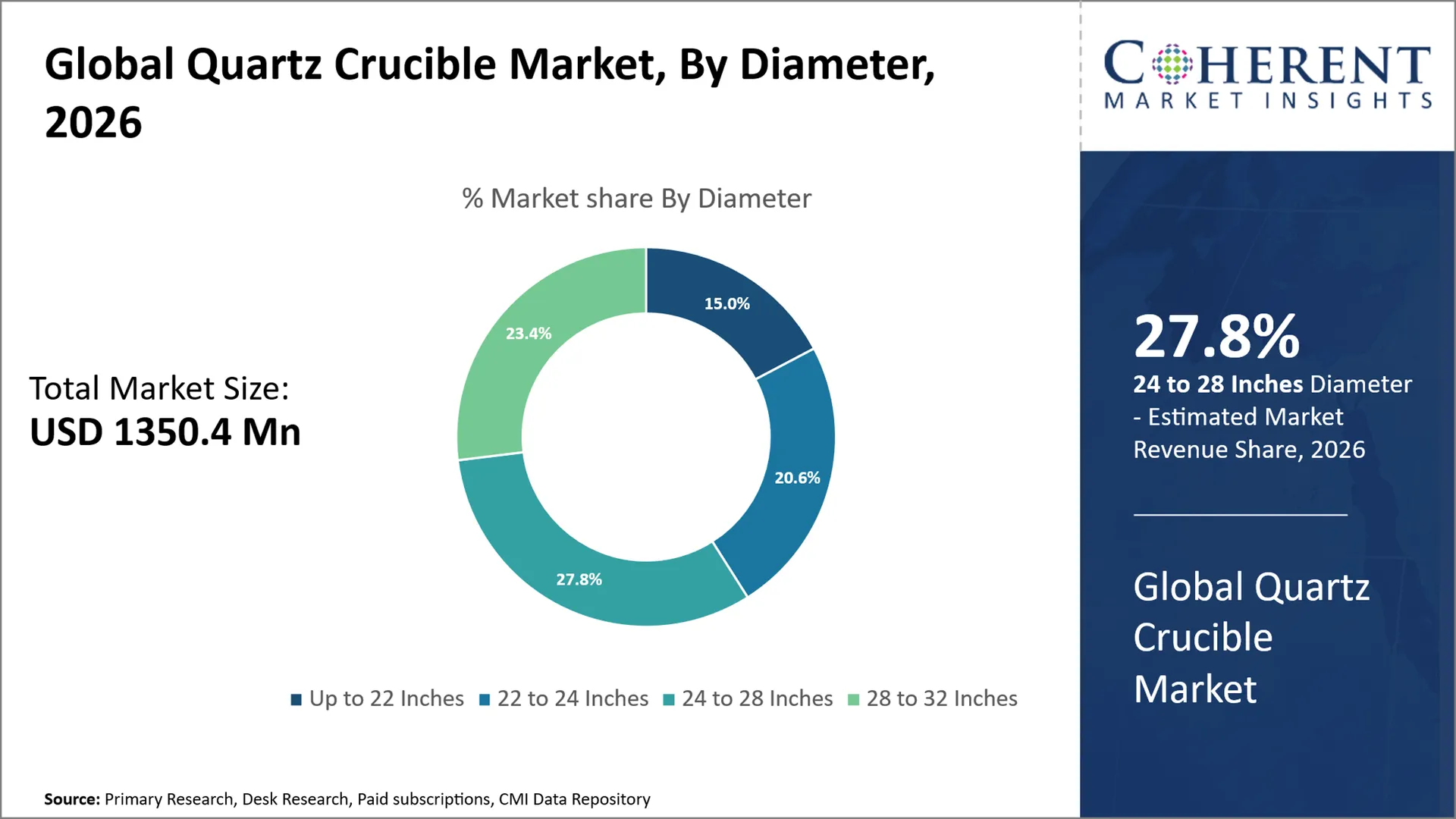
24 to 28 Inches, with an expected 27.8% share in global quartz crucible market, represents the largest diameter band because it sits between smaller legacy formats and the highest-cost oversized crucibles, giving crystal growers a favorable balance of silicon charge volume, furnace compatibility, handling practicality, and replacement economics. The range is well suited to mature high-throughput Czochralski installations where buyers want more output per pull without redesigning the full hot-zone configuration. For suppliers, this creates repeat demand across standardized tooling and reduces the manufacturing risk associated with very large geometries. In May 2024, Ferrotec reported that sales of large-sized quartz crucibles for photovoltaic power generation increased by JPY 7.4 billion in FY3/24 and also disclosed capacity expansion at its Yinchuan quartz-crucible operation, showing strong commercial pull toward larger industrial crucible formats.
Why Does Semiconductor Manufacturing Dominate the Application Segment of the Global Quartz Crucible Market?
Semiconductor Manufacturing, with an expected 55.8% market share in 2026, dominates the application category because silicon wafer producers impose the strictest requirements on trace-metal contamination, bubble behavior, dimensional consistency, and thermal stability during Czochralski crystal growth. A crucible problem can compromise an entire high-value ingot, so buyers place greater weight on qualified supply, lot-to-lot reproducibility, and process history than on lowest unit price. This creates stronger qualification barriers and supports premium, recurring demand for semiconductor-grade products. In July 2026, Siltronic stated that demand for 300 mm wafers remained robust, supported by memory and logic applications, while production capacity at its new Singapore wafer fab continued ramping. That development matters to quartz-crucible suppliers because higher large-diameter wafer output requires sustained upstream single-crystal silicon production under tightly controlled purity conditions.
Current Events and their Impact
Current Event | Description and Its Impact |
India expands ALMM framework to solar wafers – March 2026 |
|
U.S. raises Section 301 tariffs on Chinese solar wafers and polysilicon – December 2024 |
|
China advances national standardization for high-purity quartz – February 2025 |
|
Global Quartz Crucible Market Dynamics
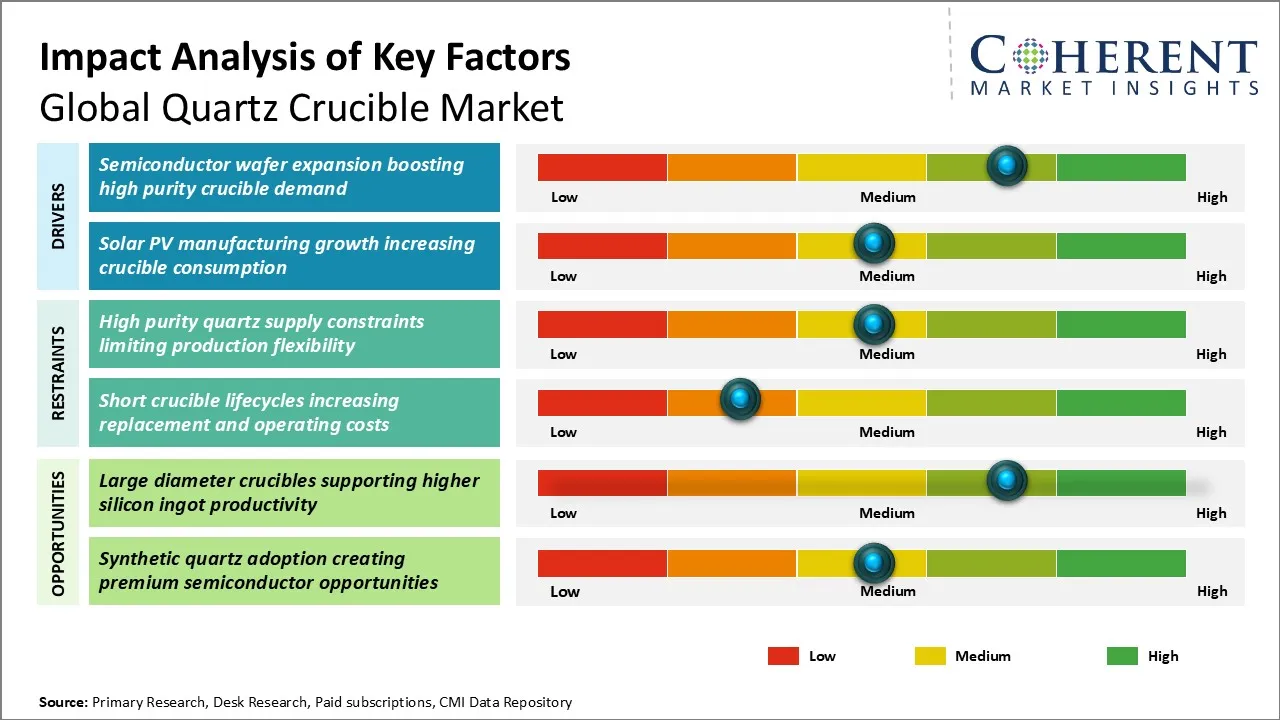
Key Market Drivers
- Semiconductor wafer expansion boosting high purity crucible demand: Quartz crucibles sit upstream of semiconductor fabrication because Czochralski crystal growth converts polysilicon into monocrystalline ingots before wafer slicing. More advanced memory and logic capacity therefore increases demand for tightly controlled crucible purity, thermal behavior, and lot consistency, benefiting qualified crucible producers, high-purity quartz processors, and crystal growers. In February 2026, SK hynix approved KRW 21.6 trillion of additional facilities for its first Yongin fab, expanding the site to six cleanrooms and accelerating production readiness.
- Solar PV manufacturing growth increasing crucible consumption: The shift toward monocrystalline solar wafers keeps quartz crucibles embedded in the upstream PV manufacturing chain, since each crystal-pulling campaign requires a thermally stable vessel with controlled contamination and melt behavior. Higher wafer throughput lifts replacement consumption and favors suppliers capable of supporting large-format, long-duration pulling. In April 2026, LONGi reported that its wafer business shipped 111.56 GW during 2025, demonstrating the industrial scale at which monocrystalline wafer production can translate into recurring crucible demand.
Emerging Market Trends
- Application-Specific Grade Segmentation Is Reshaping Supplier Positioning: Application-specific grade separation is becoming more pronounced. Semiconductor customers increasingly evaluate crucibles around contamination control, qualification stability, inner-layer performance, and reproducibility, while photovoltaic buyers place heavier weight on throughput economics, usable life, and cost per kilogram of ingot produced. This is pushing suppliers away from broad catalog positioning toward differentiated grade families and tighter application engineering. Producers that can segment manufacturing recipes without sacrificing batch consistency should capture better margins, while undifferentiated suppliers may face stronger price pressure in high-volume solar procurement.
- Larger and Advanced Solar Wafers Are Changing Crucible Specification Priorities: Larger and thinner solar wafers are reshaping crucible specification priorities. As cell manufacturers pursue higher output per furnace cycle and migrate toward advanced n-type architectures, ingot growers are placing more emphasis on charge loading, hot-zone compatibility, thermal uniformity, and defect control across longer pulls. The commercial effect is a gradual shift from simply supplying standard diameters toward co-optimizing crucible geometry with furnace and crystal-growth conditions. Suppliers with rapid qualification capability and flexible tooling are likely to gain share as wafer formats continue evolving.
Regional Insights
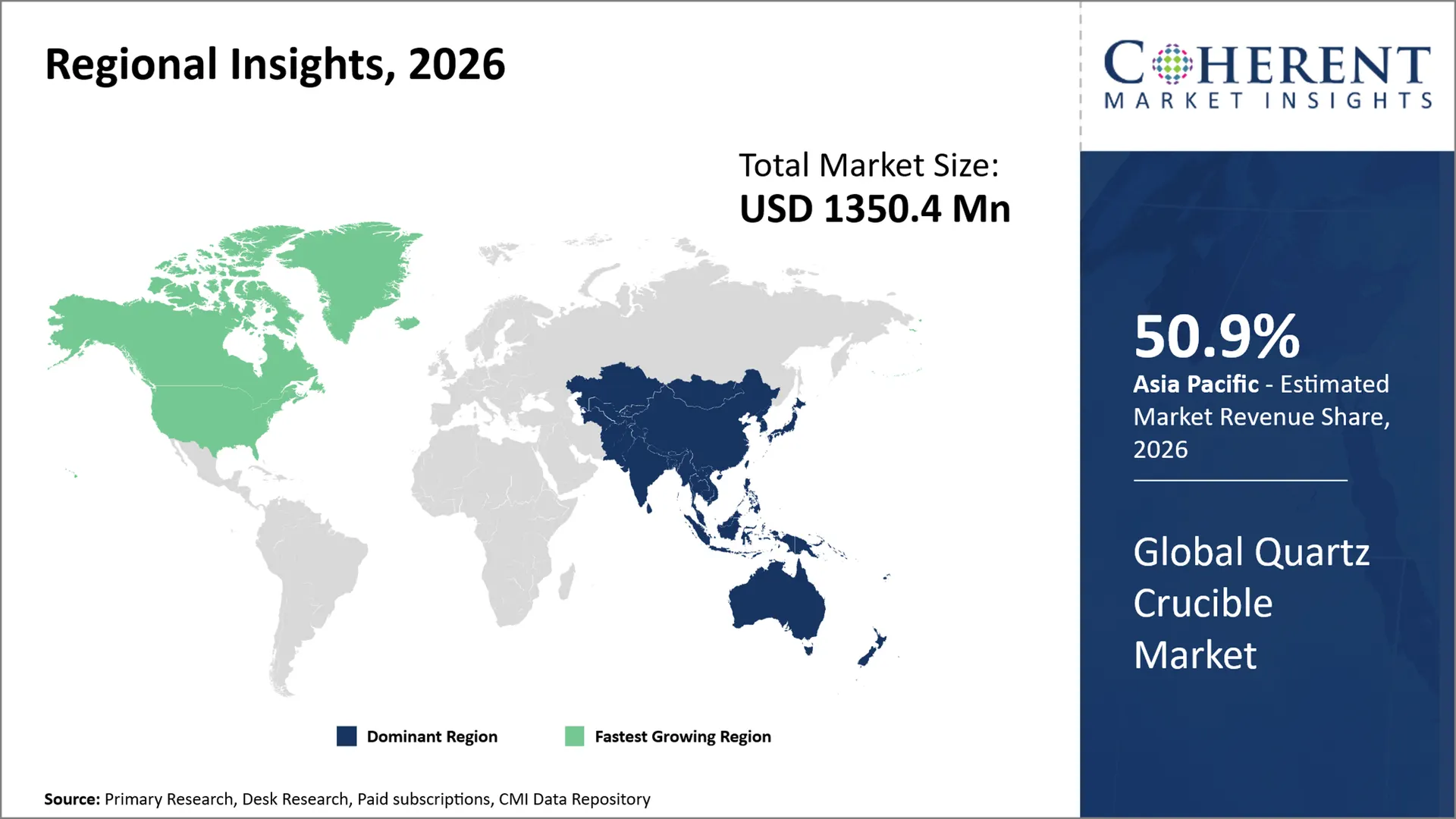
Why Does Asia Pacific Dominate the Global Quartz Crucible Market?
Asia Pacific, with an expected 50.9% share in 2026, leads the global quartz crucible market because the region concentrates the full silicon value chain from high-purity silica processing and crucible manufacturing to monocrystalline ingot pulling, wafer production, solar-cell manufacturing, and advanced semiconductor fabrication. China provides massive photovoltaic wafer demand, while Japan and South Korea add high-specification semiconductor and materials capabilities, creating both volume and premium-grade consumption. This industrial clustering shortens qualification cycles and supports close technical coordination between crucible suppliers and crystal growers. The region’s advantage is reinforced by local expertise in synthetic silica and contamination-sensitive materials. That supply-side depth is visible in Japan. In December 2024, Mitsubishi Chemical Group announced an expansion of ultra-high-purity synthetic silica powder capacity at its Kyushu plant, specifically identifying quartz crucibles for semiconductor silicon ingots as a target application.
Why Is North America Emerging as the Fastest-Growing Region in the Global Quartz Crucible Market?
North America, with an expected 22.8% share in 2026, is the fastest-growing region in the global quartz crucible market as the U.S. rebuilds domestic semiconductor material, wafer, and fabrication capacity. The growth mechanism is not simply higher chip demand; it is the relocation of strategically sensitive silicon supply chains closer to end users, which increases the need for qualified crystal-growth consumables and dependable high-purity inputs. New domestic wafer and fab projects also raise requirements for traceability, specification consistency, and shorter replenishment lead times. Policy support strengthens this shift by reducing investment risk across upstream semiconductor materials. In January 2025, the U.S. Department of Commerce awarded Hemlock Semiconductor up to USD 325 million in CHIPS incentives to expand semiconductor-grade polysilicon production, reinforcing the upstream base that ultimately feeds silicon ingot growth and quartz crucible consumption.
Global Quartz Crucible Market Outlook for Key Countries
Why Is the U.S. a Key Market for the Global Quartz Crucible Market?
The U.S. is a key country in the global quartz crucible market because its semiconductor reshoring program is creating a larger domestic customer base for silicon wafers, crystal-growth materials, and contamination-controlled manufacturing inputs. Demand is strongest where 300 mm wafer fabrication, analog chips, advanced logic, and memory investments require stable upstream wafer supply. For quartz crucible vendors, this favors suppliers able to support stringent qualification, dependable logistics, and consistent purity rather than competing mainly on price. The commercial opportunity is strengthened by long-duration fab investments that can anchor recurring wafer demand. This downstream expansion supports continued requirements for monocrystalline silicon production. In December 2025, Texas Instruments began production at its new 300 mm semiconductor fab in Sherman, Texas, while confirming broader plans for more than USD 60 billion of U.S. manufacturing investment across seven fabs, expanding the domestic manufacturing base that relies on large-diameter silicon wafers.
Why Does China Support Growth in the Global Quartz Crucible Market?
China is central to the global quartz crucible market because it combines an extensive photovoltaic manufacturing ecosystem with large-scale monocrystalline silicon ingot and wafer production. Quartz crucible consumption is therefore linked directly to furnace utilization, wafer output, and the replacement frequency of consumables used in crystal pulling. Chinese buyers also exert strong cost pressure, encouraging crucible producers to improve usable life, thermal behavior, and process consistency while maintaining competitive pricing. The country’s integrated polysilicon-to-wafer supply chain gives suppliers access to high-volume customers and relatively rapid product qualification cycles. Solar wafer capacity illustrates this scale. In March 2025, JinkoSolar stated that it expected annual monocrystalline wafer production capacity to reach 120 GW by the end of 2025, indicating substantial crystal-growing infrastructure and a continuing requirement for quartz crucibles used during silicon ingot production.
Why Is Japan Important in the Global Quartz Crucible Market?
Japan is important in the global quartz crucible market because it occupies a high-value position in semiconductor materials, silicon wafer production, ultra-pure chemicals, and precision manufacturing. Japanese wafer producers serve demanding logic, memory, power-device, and specialty semiconductor customers, which places strong emphasis on trace-metal control, crucible reproducibility, and stable crystal quality. This supports premium rather than purely volume-based crucible demand and creates opportunities for suppliers with advanced purity control and long qualification histories. Japan is also strengthening domestic supply security for critical semiconductor materials and wafers, sustaining requirements across the upstream crystal-growth chain. Government support demonstrates this strategic priority. In March 2026, Japan’s Ministry of Economy, Trade and Industry updated SUMCO’s approved semiconductor supply-security plan, with maximum support of JPY 19.3 billion, reinforcing domestic silicon-wafer capability and associated requirements for high-quality crystal-growth materials.
Why Does South Korea Support Growth in the Global Quartz Crucible Market?
South Korea supports growth in the global quartz crucible market through its dense concentration of memory semiconductor production, silicon wafer manufacturing, and advanced materials suppliers. The country’s DRAM, NAND, and high-bandwidth-memory ecosystem depends on reliable large-diameter silicon wafers, making upstream crystal quality and contamination control commercially important. For crucible suppliers, South Korea is attractive because purchasing decisions are closely tied to process qualification, yield stability, and long-term supply assurance rather than spot availability. Expansion of semiconductor clusters further strengthens demand visibility for wafer and materials suppliers. Infrastructure policy therefore has direct strategic relevance. In November 2024, South Korea’s Ministry of Trade, Industry and Energy announced infrastructure agreements for the Yongin Semiconductor Cluster, scheduled for commercial operation from 2027 and expected to attract more than KRW 600 trillion in private investment.
Why Is Germany a Strategic Country in the Global Quartz Crucible Market?
Germany is a strategic country in the global quartz crucible market because it combines semiconductor-grade polysilicon production, advanced materials expertise, precision equipment engineering, and a growing European microelectronics manufacturing base. Its relevance is strongest at the premium end of the market, where customers require ultra-low impurity levels, documented quality systems, and stable material performance for semiconductor crystal growth. Germany also connects quartz crucible demand with Europe’s broader effort to localize critical semiconductor inputs and reduce supply-chain exposure. This creates opportunities for suppliers serving high-specification wafer and chip ecosystems rather than commodity applications. Upstream material investment strengthens that position. In May 2025, WACKER commissioned a new purification line at Burghausen that increased its capacity for ultra-pure semiconductor-grade polysilicon by more than 50%, strengthening a key European feedstock base for monocrystalline silicon production.
Innovation, Production & Manufacturing Landscape
Manufacturing Practice | Role in Quartz Crucible Production | Adoption Direction | Commercial Impact |
Controlled electric-arc fusion | Melts high-purity quartz sand inside rotating molds while controlling thermal input and fused-wall formation. | Increasing process automation and tighter recipe control. | Improves dimensional repeatability and reduces batch variability, strengthening qualification reliability. |
Multi-layer crucible architecture | Combines functional inner and outer layers with different bubble density, transparency, or purity characteristics. | Moving toward application-specific layer engineering. | Allows suppliers to balance purity, mechanical stability, thermal behavior, and manufacturing cost. |
Synthetic-quartz inner layers | Places ultra-high-purity synthetic silica at the silicon-contact surface while retaining more economical material elsewhere. | Expanding selectively in contamination-sensitive applications. | Supports premium grades and provides differentiation where trace-metal control is commercially critical. |
Bubble and inclusion engineering | Controls bubble population, particle inclusions, wall homogeneity, and defect evolution during prolonged heating. | Becoming more important as pulling cycles become more demanding. | Reduces failure risk and strengthens customer confidence in high-value crystal-growth campaigns. |
Controlled devitrification and surface treatment | Manages crystallization behavior and mechanical stability during extended exposure to high-temperature hot zones. | Increasingly integrated with furnace-specific crucible design. | Can improve usable campaign performance and create specification-based premiumization opportunities. |
Automated optical inspection and trace-element metrology | Combines machine vision, dimensional inspection, and analytical methods such as ICP-based impurity measurement. | Moving from final inspection toward in-process quality control. | Improves traceability, shortens root-cause analysis, and supports tighter semiconductor customer qualification. |
How Are Application-Engineered Crucibles and Pull-Process Co-Development Creating New Growth Opportunities in the Global Quartz Crucible Market?
Application-engineered crucibles combined with pull-process co-development create an underdeveloped service-led opportunity in the global quartz crucible market. Instead of competing only on diameter, purity grade, and unit price, suppliers can work with crystal growers to optimize wall profile, inner-layer architecture, bubble behavior, thermal response, and furnace compatibility for specific pulling recipes. The commercial value lies in linking the crucible to ingot yield, run stability, and usable campaign life, which can support premium pricing and deeper customer lock-in. Semiconductor wafer producers, advanced solar ingot manufacturers, and operators adopting more demanding recharge or long-duration pulling processes are the most attractive customers. Capturing this opportunity requires application laboratories, trace-element analytics, thermal modeling, pilot qualification capacity, and field engineering teams capable of translating furnace data into product changes. Established suppliers and technically focused specialists are best positioned, while new entrants would need credible qualification records before customers accept process risk across multiple production lines.
Market Players, Key Development, and Competitive Intelligence
Key Developments
- In December 2025, Momentive Technologies appointed K. Musaka as Vice President of its Crucibles Business, with responsibility for performance, innovation, market responsiveness, and global integration. This is important for the global quartz crucible market because dedicated business leadership can accelerate application engineering, customer qualification, and operational consistency across semiconductor accounts.
- In March 2025, Tosoh Quartz completed its E1 factory expansion in Tainan, Taiwan, after construction began in February 2024. This is important for the global quartz crucible market because added quartz-processing infrastructure near major semiconductor manufacturing clusters strengthens regional supply responsiveness and supports faster qualification of high-specification quartz materials.
Competitive Landscape
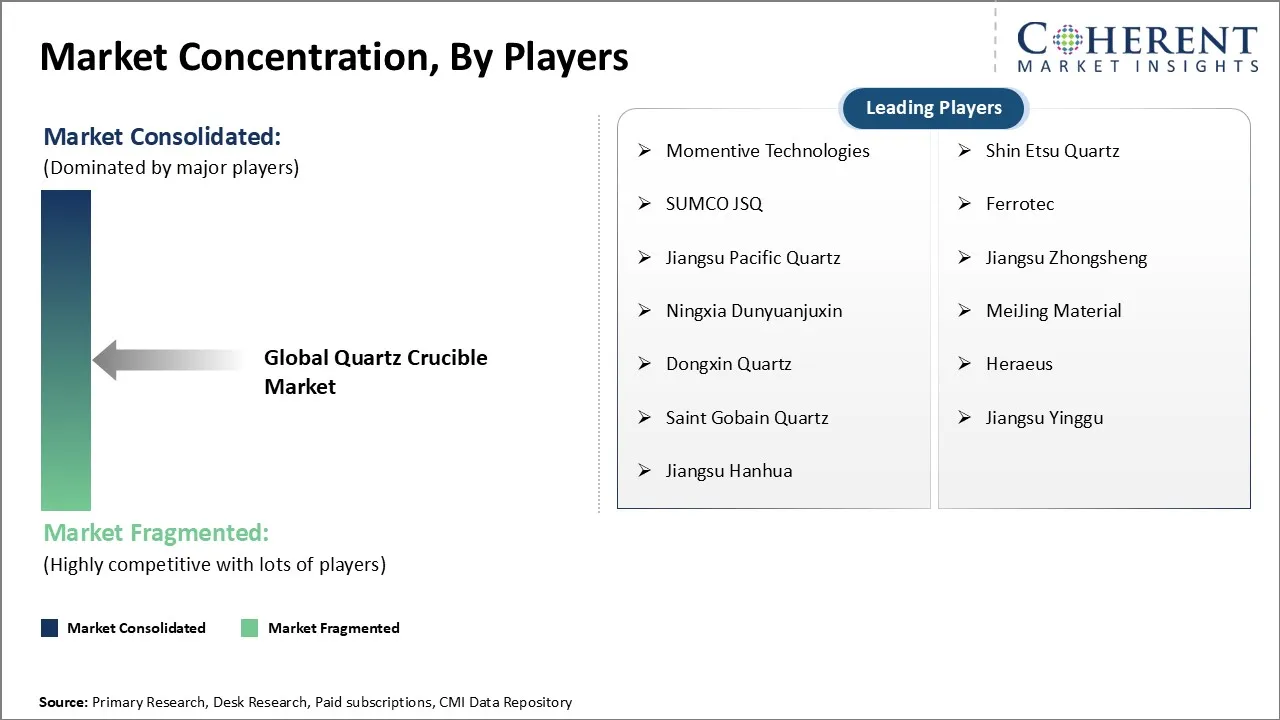
The global quartz crucible market is moderately consolidated, particularly in semiconductor-grade products where customer qualification, high-purity raw materials, and reproducible thermal performance create meaningful entry barriers. Competition is broader in solar-oriented grades, with regional Asian producers exerting stronger cost pressure. Winning suppliers combine process know-how, specification control, scalable capacity, dependable delivery, and close technical engagement with crystal-growth customers.
Key focus areas include
- Purity consistency: Control of alkali metals, transition metals, bubbles, and inclusions directly affects qualification credibility.
- Large-diameter capability: Suppliers must maintain dimensional precision as crucible size and charge volume increase.
- Raw-material control: Secure access to consistently qualified natural or synthetic quartz reduces production variability.
- Customer qualification: Long validation cycles protect incumbent suppliers but increase the cost of winning new accounts.
- Manufacturing repeatability: Automated forming, fusion control, inspection, and statistical process management increasingly influence purchasing decisions.
- Application customization: Wall profile, layer composition, surface condition, and furnace compatibility provide differentiation beyond nominal diameter.
- Supply reliability: Crystal growers value predictable lead times and regional inventory because crucibles are production-critical consumables.
- Technical service: Suppliers capable of troubleshooting pull performance and translating process feedback into crucible adjustments can build stronger customer retention.
Market Report Scope
Global Quartz Crucible Market Report Coverage | |||
Report Coverage | Details | ||
Base Year | 2025 | Market Size in 2026: | USD 1,350.4 Mn |
Historical Data For: | 2020 To 2024 | Forecast Period: | 2026 To 2033 |
Forecast Period 2026 To 2033 CAGR: | 3.10% | 2033 Value Projection: | USD 1,672.1 Mn |
Geographies covered: |
| ||
Segments covered: |
| ||
Companies covered: | Momentive Technologies, Shin Etsu Quartz, SUMCO JSQ, Ferrotec, Jiangsu Pacific Quartz, Jiangsu Zhongsheng, Ningxia Dunyuanjuxin, MeiJing Material, Dongxin Quartz, Heraeus, Saint Gobain Quartz, Jiangsu Yinggu, Jiangsu Hanhua | ||
Growth Drivers: |
| ||
Restraints & Challenges: |
| ||
Analyst Opinion (Expert Opinion)
- The global quartz crucible market leadership is likely to migrate from companies that primarily sell standardized crucibles toward suppliers that behave as process-development partners. Crystal growers increasingly need tighter matching between crucible characteristics, furnace architecture, silicon charge strategy, and customer-specific yield objectives. Suppliers that build strong application-engineering teams and maintain detailed product genealogy should therefore gain greater influence over purchasing specifications and enjoy more durable customer relationships.
- Wider economic viability of synthetic quartz and hybrid natural-synthetic constructions could materially alter competitive boundaries. If synthetic-material processing becomes less costly and more scalable, performance characteristics currently associated with premium crucibles may become accessible to a broader customer base. This would place pressure on suppliers dependent mainly on scarce premium natural quartz resources and reward companies with proprietary purification, fusion, layering, and synthetic-material capabilities.
- Manufacturers should prioritize impurity analytics, defect-control systems, flexible layer engineering, localized finishing capacity, and technical teams positioned near major crystal-growing customers. Capacity should be expanded selectively rather than ahead of qualification demand, particularly in commoditized solar grades where pricing pressure can erode returns. Long-term advantage will come from controlling critical material specifications, shortening qualification cycles, protecting supply continuity, and concentrating capital on products where manufacturing precision translates directly into customer process economics.
Speak to the analyst
Want personalized insights?
Take the findings above to one of our principal consultants, or have the report rebuilt around the segments, geographies and competitors you actually track.
Market Segmentation
- Product Type Insights (Revenue, USD Mn, 2021 - 2033)
- Opaque Quartz Crucibles
- Transparent Quartz Crucibles
- Semi transparent Quartz Crucibles
- High purity Fused Silica Crucibles
- Diameter Insights (Revenue, USD Mn, 2021 - 2033)
- Up to 22 Inches
- 22 to 24 Inches
- 24 to 28 Inches
- 28 to 32 Inches
- Above 32 Inches
- Application Insights (Revenue, USD Mn, 2021 - 2033)
- Semiconductor Manufacturing
- Solar Photovoltaic Manufacturing
- Optical Fiber Manufacturing
- Laboratory and Research
- Other Industrial Applications
- Material Type Insights (Revenue, USD Mn, 2021 - 2033)
- Natural Quartz
- Synthetic Quartz
- Distribution Channel Insights (Revenue, USD Mn, 2021 - 2033)
- Direct Sales
- Indirect Sales
- Regional Insights (Revenue, USD Mn, 2021 - 2033)
- North America
- U.S.
- Canada
- Latin America
- Brazil
- Argentina
- Mexico
- Rest of Latin America
- Europe
- Germany
- U.K.
- Spain
- France
- Italy
- Russia
- Rest of Europe
- Asia Pacific
- China
- India
- Japan
- Australia
- South Korea
- ASEAN
- Rest of Asia Pacific
- Middle East
- GCC Countries
- Israel
- Rest of Middle East
- Africa
- South Africa
- North Africa
- Central Africa
- North America
Source
Primary Research Interviews
- Quartz crucible manufacturers, high-purity quartz suppliers, fused silica producers, semiconductor wafer manufacturers, solar ingot/wafer producers, procurement teams, R&D and quality professionals
Stakeholders
- Quartz crucible manufacturers and converters
- High-purity natural quartz and synthetic silica suppliers
- Semiconductor silicon wafer and solar wafer manufacturers
- Crystal-growing equipment suppliers, distributors, importers and exporters
End-use Sectors
- Semiconductor manufacturing
- Solar photovoltaic manufacturing
- Optical fiber manufacturing
- Laboratory and research
- Specialty industrial applications
Regulatory and Industry Bodies
- U.S. Department of Commerce
- U.S. Department of Energy
- European Commission
- Japan METI
- China MIIT
- SEMI
- IEC and ISO
- National chemical, workplace safety and trade authorities
Databases
- Company annual reports and investor presentations
- Semiconductor wafer and solar manufacturing capacity databases
- Quartz, silica and crucible trade datasets
- High-purity quartz pricing and supply databases
- Semiconductor fab and solar wafer capacity databases
- Product specifications, patents and material technology databases
Magazines and Journals
- Journal of Crystal Growth
- Ceramics International
- Journal of the American Ceramic Society
- Silicon
- Materials Chemistry and Physics
- Semiconductor Science and Technology
Associations
- SEMI
- Semiconductor Industry Association SIA
- Global Semiconductor Alliance GSA
- China Semiconductor Industry Association CSIA
- Japan Electronics and Information Technology Industries Association JEITA
- Regional solar photovoltaic and advanced-material associations
Public Domain Sources
- Semiconductor wafer production and fab-capacity statistics
- Solar ingot and wafer manufacturing data
- High-purity quartz supply and processing developments
- Quartz crucible production and capacity updates
- Silicon wafer and photovoltaic trade flows
- Crystal-growth technology developments
- Raw-material availability and pricing information
Key Standards and Regulations
- High-purity quartz and fused silica quality specifications
- Semiconductor material contamination-control standards
- ISO quality-management standards
- Chemical handling and workplace safety requirements
- Environmental emission and waste-management regulations
- Import-export and customs requirements for quartz and silica materials
- Semiconductor and solar manufacturing localization requirements
Proprietary Elements
- CMI Data Analytics Tool
- Proprietary CMI repository containing 10+ years of intelligence on quartz crucibles, high-purity quartz, fused silica, semiconductor wafers, solar ingot and wafer manufacturing, crystal-growth technologies, capacity, trade flows, pricing and competitive developments.
Get access to 250+ pages report
Every segment, forecast, competitor profile and data table behind the analysis above — available for instant download.
- ESOMAR Member
- ISO 9001:2015 Certified
- D-U-N-S Registered
- GDPR & CCPA Compliant
Frequently Asked Questions
The CAGR of global quartz crucible market is projected to be 3.10% from 2026 to 2033.
The global quartz crucible market is estimated to be valued at USD 1,350.4 Mn in 2026 and is expected to reach USD 1,672.1 Mn by 2033.
Expansion of semiconductor wafer production and continued growth in solar PV manufacturing are the two major factors supporting the growth of the global quartz crucible market. Semiconductor manufacturing requires high-purity quartz crucibles for silicon crystal growth, while expanding solar wafer production increases crucible consumption during monocrystalline silicon ingot manufacturing.
High purity quartz supply constraints limiting production flexibility and Short crucible lifecycles increasing replacement and operating costs are the major factors hampering the growth of global quartz crucible market.
In terms of product type, opaque quartz crucibles are estimated to dominate the market revenue share in 2026.
Momentive Technologies, Shin Etsu Quartz, SUMCO JSQ, Ferrotec, Jiangsu Pacific Quartz, Jiangsu Zhongsheng, Ningxia Dunyuanjuxin, MeiJing Material, Dongxin Quartz, Heraeus, Saint Gobain Quartz, Jiangsu Yinggu, Jiangsu Hanhua are the major players.
Asia Pacific is expected to lead the global quartz crucible market in 2026.