

High Temperature Coatings Market Size and Share Analysis- 2026 To 2033
The High Temperature Coatings Market size is anticipated to grow at a CAGR of 4.3%, with USD 4.29 Bn in 2026 and is expected to reach USD 5.76 Bn in 2033. The primary drivers are largely defined by the growing need for corrosion and thermal protection of industrial equipment, increasing investments in oil & gas and petrochemical infrastructure, expansion of power generation facilities, and rising use of heat-resistant coatings across aerospace, automotive, and heavy industrial applications. According to Sherwin-Williams, high-temperature-resistant coatings are designed to protect equipment such as stacks, boilers, treaters, process piping, valves, and vessels from coating deterioration and corrosion caused by elevated operating temperatures, with certain coating systems providing protection at temperatures of up to 650°C (1,202°F).
Key Takeaways
- The liquid coating segment is likely to lead the market with approximately 80.0% in 2026. The segment’s growth is owing to its application flexibility, effective coverage of complex equipment geometries, compatibility with spraying and conventional application techniques, and growing availability of low-VOC and water-based formulations. Sherwin-Williams’ Heat-Flex Hi-Temp 3500 is a water-based acrylic liquid coating suitable for substrates operating between -62°C and 177°C, with VOC content of less than 100 g/L, demonstrating the advancement of liquid systems toward thermal performance and lower-emission applications.
- The acrylic-based segment is likely to dominate the market with approximately 24.0% in 2026. The segment’s growth is owing to its strong color retention, gloss, weatherability, ease of application, and suitability as a durable finish for equipment exposed to elevated temperatures. Supporting their technical suitability, Jotun’s silicone-acrylic Solvalitt coating is designed to withstand temperatures of up to 600°C and is available in 14 high-temperature-stable colors, highlighting the combination of thermal resistance and aesthetic performance supporting acrylic-based formulations.
- The energy & power segment is set to lead with approximately 17.0% in 2026. The segment’s growth is owing to the extensive requirement for heat and corrosion protection across boilers, turbines, pipelines, furnaces, heat exchangers, stacks, and other thermally stressed power-generation equipment. According to the International Energy Agency, global electricity generation increased by more than 850 TWh in 2025, while renewable and nuclear generation together increased by more than the overall rise in global electricity supply.
- Asia Pacific is expected to acquire the prominent share of approximately 38.0% in 2026. The region’s growth is owing to large-scale industrialization, expansion of power-generation assets, increasing petrochemical and refining capacity, and strong manufacturing activity across China, India, and Southeast Asia. According to the IEA, China accounted for approximately 58% of the increase in global electricity demand in 2025, while its net electricity demand surpassed 9,500 TWh, increasing 5.1% year-on-year.
Market Drivers
Expansion of Power Generation and Industrial Thermal Infrastructure is Accelerating the High Temperature Coatings Market
The High Temperature Coatings Market is gaining strong momentum owing to the expansion and modernization of power-generation and industrial infrastructure. Boilers, turbines, exhaust systems, heat exchangers, stacks, furnaces, and process piping operate continuously at elevated temperatures, creating the need for coatings that can withstand thermal cycling while protecting metallic surfaces from oxidation and corrosion.
According to the U.S. Energy Information Administration (EIA), U.S. electricity generation reached a record 4.43 trillion kWh in 2025, increasing 2.8% from 2024. In addition, at the end of 2025 the U.S. had some 1.28 million MW of utility-scale electricity-generation capacity, indicating a large and growing installed base of turbines, boilers, generators, exhaust systems and related thermal equipment that require protective maintenance.
Expansion of Refining and Petrochemical Infrastructure is Driving High Temperature Coating Consumption
The expansion of refining and petrochemical facilities is another major growth driver for the High Temperature Coatings Market. Refineries and chemical plants contain extensive networks of heated vessels, reactors, columns, pipelines, storage systems and processing equipment where high surface temperatures and corrosion under insulation can dramatically reduce equipment life. High temperature coatings are being used more and more to protect these assets and reduce the need for corrosion related maintenance and unplanned shutdowns.
India's refining capacity was 258.1 MMTPA in 2025 and is projected to rise to 309.5 MMTPA by 2030, according to the Ministry of Petroleum & Natural Gas, India. The petrochemical intensity index for public-sector refineries is also expected to increase from 4.1 to about 9.3 with ongoing and planned projects, reflecting increasing integration of refinery and petrochemical processing assets.
Current Events and Their Impact on the High Temperature Coatings Market
Current Event | Description and its Impact |
European Union Implements Revised Industrial Emissions Directive Requirements (2026) |
|
EU Chemical Classification and Labelling Rules Become Applicable to Industry (2026) |
|
- Current Industry Events of 2026
- Market Size Estimation
- Regional Breakdown
- Competitive Landscape
- Customer Intelligence
- Segmental Analysis
- Pricing Analysis
- Key Market Drivers, Challenges & Future Trends
- Customized Insights Section
Segmental Insights
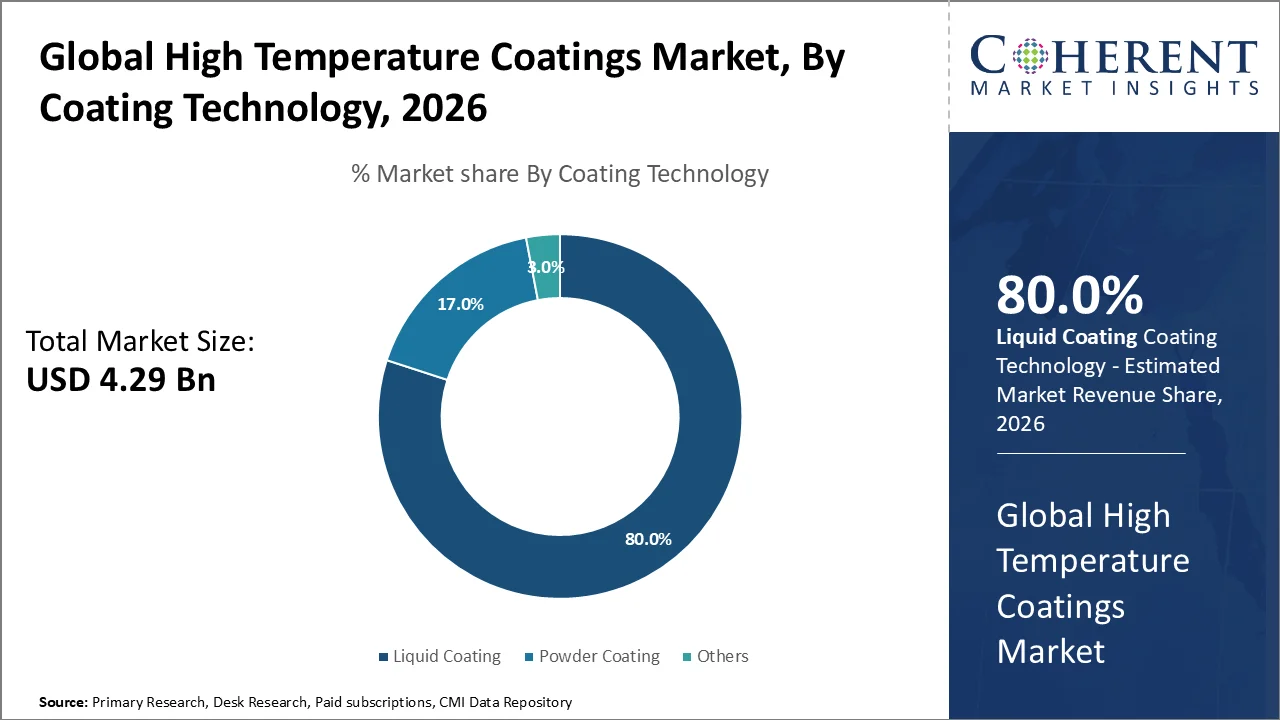
Why is Liquid Coating Acquiring the Largest Share?
On the basis of coating technology, the liquid coating segment is projected to lead the High Temperature Coatings Market with approximately 80.0% share in 2026. The segment’s growth is owing to its application flexibility, ability to coat irregular and complex equipment geometries, ease of maintenance application, and compatibility with spraying, brushing, and rolling methods. Liquid coatings are particularly preferred where specialized colors, thin-film control, and precise coating tolerances are required.
In May 2026, AkzoNobel’s International Protective Coatings published an updated technical specification for Intertherm 50, a liquid high-temperature silicone coating that protects steel at temperatures up to 540°C (1,004°F). The product can be applied by air spray, brush, or roller, demonstrating the application versatility supporting liquid coating adoption.
Why is Acrylic-Based Acquiring the Largest Share?
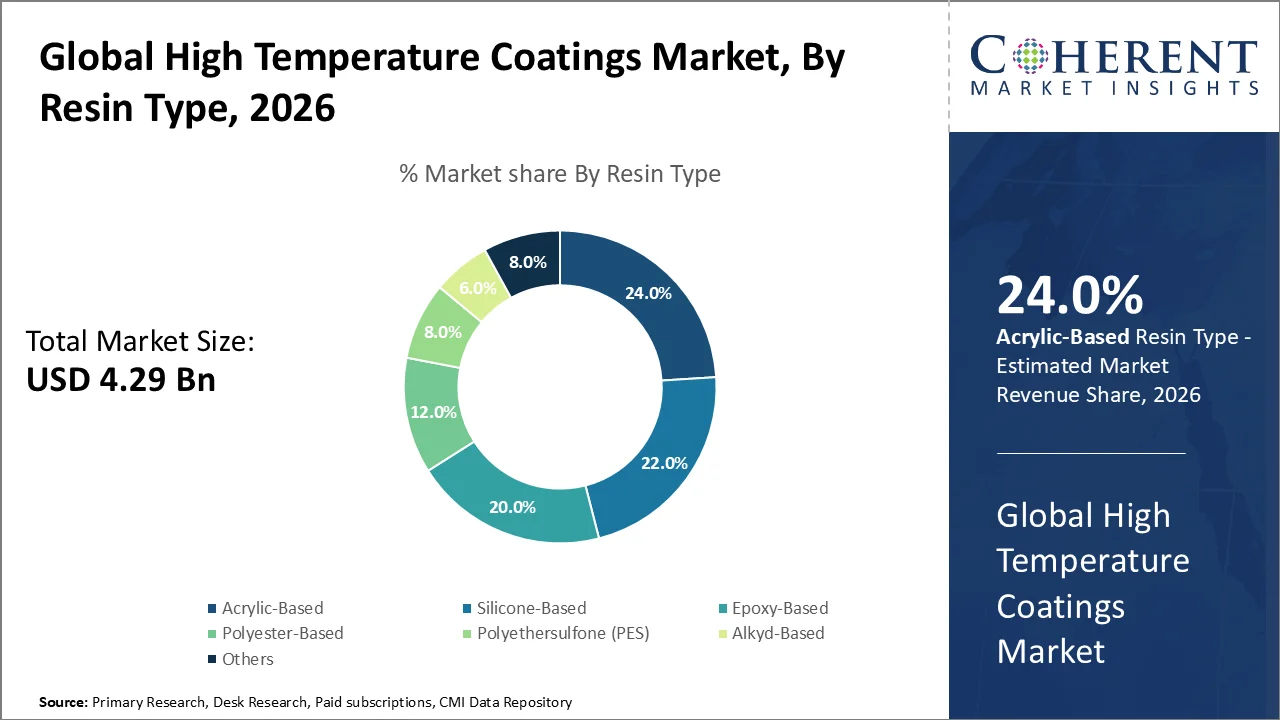
On the basis of resin type, the acrylic-based segment is projected to account for the largest High Temperature Coatings Market share of approximately 24.0% in 2026. The segment’s growth is owing to strong color retention, gloss stability, weatherability, easy application, and its ability to provide durable finishes on industrial equipment exposed to elevated temperatures.
According to Sherwin-Williams, its acrylic-silicone Heat-Flex Hi-Temp 500 is designed for continuous service at temperatures of up to 500°F (260°C). The coating is single-component, air-dries at ambient temperature, and can be applied directly to stainless steel, supporting its use across oil & gas, power generation, mining, and other high-temperature environments.
Why does Energy & Power Hold the Largest Market Share?
On the basis of end user, the energy & power segment is projected to lead with approximately 17.0% share in 2026. The segment’s growth is owing to extensive use of high-temperature coatings across boilers, turbines, furnaces, heat exchangers, stacks, pipelines, separators, and other thermally stressed equipment. Coherent Market Insights identifies energy and petrochemical industries among the largest users owing to their extensive deployment of heaters, separators, furnaces, and systems transporting heated materials.
According to Global Energy Monitor’s 2026 Boom and Bust Coal report, 97.4 GW of new coal-fired power capacity was commissioned globally in 2025, representing the second-highest annual addition on record. China alone commissioned 78.1 GW, while India added approximately 10 GW. This continued construction of thermal power infrastructure expands the installed base of boilers, steam systems, exhaust equipment, and associated high-temperature assets requiring protective coatings.
High Temperature Coatings Market Trends
- Growing emphasis on corrosion-under-insulation (CUI) prevention is generating interest in specialized high-temperature coating systems that will continue to provide corrosion protection through repeated heating, cooling and moisture exposure cycles. According to the Association for Materials Protection and Performance (AMPP), CUI can account for up to 40% of maintenance costs associated with piping, highlighting the increasing economic importance of advanced protective coatings for insulated refinery, petrochemical and power-generation equipment.
- The use of thermal-insulative coatings is on the rise, providing an alternative to traditional insulation-and-cladding systems for heated tanks, piping and process vessels. In March 2025, Sherwin-Williams’ introduced Heat-Flex Advanced Energy Barrier (AEB) can retain process heat on assets operating at temperatures up to 177°C (350°F), with excursions up to 204°C (400°F). The coating can also be applied during operation of assets at temperatures up to 148°C (300°F) for maintenance with uninterrupted production.
- The growing emphasis on high-solids and lower-VOC formulations is influencing new high-temperature coating development. Coating manufacturers are increasingly combining CUI protection with fewer coating layers, reduced solvent content, easier surface preparation, and faster return-to-service characteristics. This trend is particularly important for refineries, chemical plants, and power facilities seeking to reduce coating-related emissions, material consumption, labor requirements, and maintenance downtime.
Regional Insights
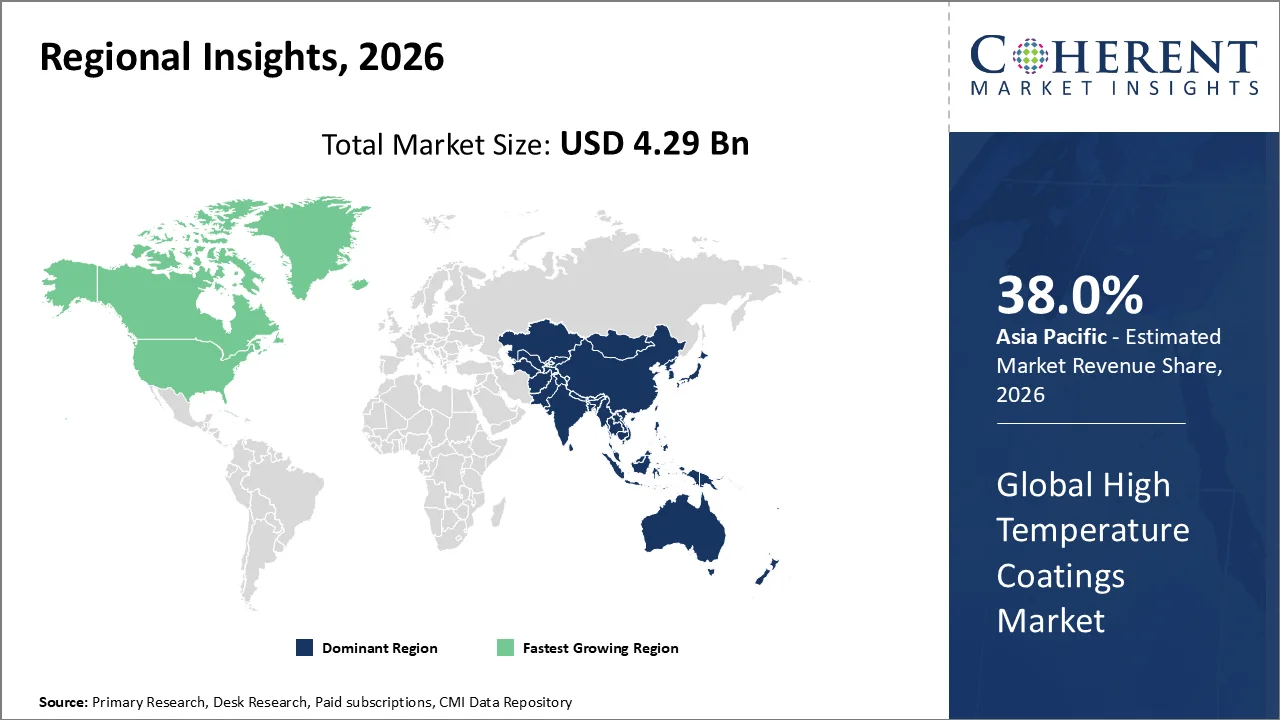
Asia Pacific Dominates Owing to the Large Industrial, Energy, and Petrochemical Manufacturing Base
Asia Pacific is expected to account for the prominent 38.0% share of the High Temperature Coatings Market in 2026. The region’s dominance is owing to its large power-generation infrastructure, extensive petrochemical and refining capacity, strong metal-processing industry, and expanding manufacturing activities across China, India, Japan, South Korea, and Southeast Asia.
Industrial expansion outside China is further strengthening regional demand. According to the World Steel Association, India’s crude steel production increased 10.4% to 164.9 million tonnes in 2025, while Vietnam recorded 12.2% growth to 24.7 million tonnes. The continued expansion of steel and heavy-industrial production supports demand for high-temperature coatings used on furnaces, kilns, exhaust systems, process piping, and heat-treatment equipment.
North America High Temperature Coatings Market Trends
North America is expected to witness strong growth in the High Temperature Coatings Market owing to rising electricity requirements, a large installed refinery and petrochemical asset base, increasing chemical-industry investment, and continued adoption of advanced CUI and high-temperature maintenance coatings. The U.S. remains particularly important due to its extensive power-generation, refining, chemical-processing, aerospace, and industrial manufacturing infrastructure.
The chemical industry is also supporting coating demand. According to the American Chemistry Council, U.S. chemical-industry capital spending reached approximately USD 39.8 billion in 2025 and is forecast to increase to USD 40.5 billion in 2026, while industry shipments were approximately USD 673.3 billion in 2025.
In October 2025, Rust-Oleum announced the expansion of its Custom Spray 5-in-1 technology into a new High Heat 2000°F Coatings product line, with the commercial launch scheduled for spring 2026.
Strong Manufacturing and Chemical-Sector Investment is Accelerating the High Temperature Coatings Market in the United States
The U.S. High Temperature Coatings Market is witnessing steady growth owing to the country’s large chemical-processing, steel, power-generation, aerospace, and advanced manufacturing base. Growing capital deployment across these industries is expanding the installed base of furnaces, reactors, process vessels, heat exchangers, exhaust systems, and pipelines that require coatings capable of resisting high temperatures, oxidation, and corrosion.
According to the U.S. Bureau of Economic Analysis, new foreign direct investment expenditures in the U.S. reached USD 232.2 billion in 2025, increasing 49.5% from 2024. Manufacturing accounted for USD 121.8 billion, or 52.5% of total investment, while chemical manufacturing alone attracted USD 45.4 billion.
In August 2026, the American Iron and Steel Institute reported that U.S. raw steel production during 2025 reached 90 million net tons, increasing 3% year-on-year, while domestic mill shipments rose 5% to 91 million net tons.
China High Temperature Coatings Market Trends
China is expected to remain one of the most important growth markets for High Temperature Coatings owing to its extensive heavy-industrial infrastructure, expanding power and thermal-energy sector, large chemical-processing base, and continued growth in transportation equipment manufacturing. These industries contain significant volumes of furnaces, boilers, reactors, stacks, pipelines, and heat-processing equipment requiring thermal and corrosion protection.
According to the State Council of the People’s Republic of China, citing Ministry of Industry and Information Technology data, Chinese shipyards completed 53.69 million deadweight tonnes of vessels in 2025, increasing 11.4% year-on-year and representing 56.1% of global output.
Who are the Major Companies in High Temperature Coatings Industry
Some of the major key players in High Temperature Coatings Market are Jotun A/S, Aremco, AkzoNobel N.V., Hempel, Belzona International Ltd., The Sherwin-Williams Company, PPG Industries Inc., The Valspar Corporation, Whit ford, Weilburger Coatings GmbH, Axalta Coating Systems, Carboline, Chemco International Ltd.
Key News
- In February 2026, WEILBURGER Coatings and KANSAI HELIOS announced the addition of a new senotherm high-temperature powder coating to their portfolio at Progetto Fuoco 2026.
- In July 2026, Hempel launched Hempafire Optima 515, a new waterborne passive fire-protection coating for structural steel. The product provides certified fire protection for up to 150 minutes, while its optimized dry-film thickness is designed to reduce coating consumption and application costs.
Market Report Scope
High Temperature Coatings Market Report Coverage
| Report Coverage | Details | ||
|---|---|---|---|
| Base Year: | 2025 | Market Size in 2026: | USD 4.29 Bn |
| Historical Data for: | 2020 To 2024 | Forecast Period: | 2026 To 2033 |
| Forecast Period 2026 to 2033 CAGR: | 4.3% | 2033 Value Projection: | USD 5.76 Bn |
| Geographies covered: |
| ||
| Segments covered: |
| ||
| Companies covered: | Jotun A/S, Aremco, AkzoNobel N.V., Hempel, Belzona International Ltd., The Sherwin-Williams Company, PPG Industries Inc., The Valspar Corporation, Whit ford, Weilburger Coatings GmbH, Axalta Coating Systems, Carboline, Chemco International Ltd. | ||
| Growth Drivers: |
| ||
| Restraints & Challenges: |
| ||
Analyst Opinion
- The High Temperature Coatings Market is increasingly becoming an asset-integrity and maintenance-driven market rather than being dependent only on new industrial construction. Refineries, chemical plants, power facilities, and processing industries require coatings that can tolerate thermal cycling while preventing corrosion under insulation (CUI). According to the Association for Materials Protection and Performance (AMPP), CUI can account for up to 40% of piping maintenance costs, while undetected CUI can cause deep pitting, loss of pipe integrity, system failures, and unplanned shutdowns.
- Commercial performance among major coating manufacturers indicates that protective and high-performance industrial coatings are continuing to outperform several conventional coating categories. PPG reported that its Protective and Marine Coatings business achieved double-digit organic sales growth in 2025 and recorded its 11th consecutive quarter of sales-volume growth in Q4 2025.
- The market is also shifting toward higher-performance CUI, thermal-cycling, and passive-fire-protection systems that can extend asset life while reducing maintenance requirements. Hempel reported that it successfully grew its CUI High Heat business during 2025 despite pressure in the broader oil & gas industry, while also strengthening its portfolio with hydrocarbon passive-fire-protection solutions for the energy sector.
Speak to the analyst
Want personalized insights?
Take the findings above to one of our principal consultants, or have the report rebuilt around the segments, geographies and competitors you actually track.
Market Segmentation
- By Coating Technology (Revenue, USD Bn, 2021-2033)
- Liquid Coating
- Solvent Borne
- Water Borne
- Powder Coating
- Others (Laser, Radiation-Cured, etc.)
- Liquid Coating
- By Resin Type (Revenue, USD Bn, 2021-2033)
- Epoxy-Based
- Acrylic-Based
- Silicone-Based
- Polyethersulfone (PES)
- Polyester-Based
- Alkyd-Based
- Others
- By End User (Revenue, USD Bn, 2021-2033)
- Energy & Power
- Oil and Gas
- Solar
- Wind
- Others
- Petrochemical & Chemical Industry
- Metal Processing Industry
- Cookware, Bake Ware, and Small Appliances
- Marine
- Automotive
- Coil Coatings
- Woodstoves, Gas Stoves, and Barbecue Grills
- Aerospace & Defense
- Building & Construction
- Others
- Energy & Power
- By Region (Revenue, USD Bn, 2021-2033)
- North America
- U.S.
- Canada
- Latin America
- Brazil
- Mexico
- Argentina
- Rest of Latin America
- Europe
- Germany
- U.K.
- France
- Italy
- Spain
- Russia
- Rest of Europe
- Asia Pacific
- China
- India
- Japan
- Australia
- South Korea
- ASEAN
- Rest of Asia Pacific
- Middle East
- GCC
- Israel
- Rest of Middle East
- Africa
- South Africa
- Central Africa
- North Africa
- North America
Sources
Primary Research Interviews
- High temperature coating manufacturers
- Protective and industrial coating formulators
- Corrosion and materials engineers
- Coating applicators and inspection professionals
- Raw material and specialty chemical suppliers
- Refinery, petrochemical, and power plant maintenance managers
- Procurement managers from marine, automotive, aerospace, and metal-processing industries
- Industrial coating distributors and technical service providers
- Key opinion leaders (KOLs) in corrosion protection and surface engineering
Databases
- U.S. Energy Information Administration (EIA)
- U.S. Environmental Protection Agency (EPA)
- U.S. Bureau of Economic Analysis (BEA)
- Eurostat
- United Nations Industrial Development Organization (UNIDO)
- UN Comtrade Database
- National Bureau of Statistics of China
- World Bank
Magazines
- Coatings World
- Paint & Coatings Industry (PCI) Magazine
- PaintSquare
- Materials Performance
- European Coatings Journal
- Hydrocarbon Processing
- POWER Magazine
Journals
- Progress in Organic Coatings
- Journal of Coatings Technology and Research
- Surface and Coatings Technology
- Corrosion Science
- Journal of Protective Coatings & Linings
- Materials Chemistry and Physics
- Journal of Materials Engineering and Performance
Newspapers
- Reuters
- Financial Times
- The Wall Street Journal
- The Economic Times
- Business Standard
- Nikkei Asia
Associations
- Association for Materials Protection and Performance (AMPP)
- American Coatings Association (ACA)
- World Coatings Council (WCC)
- British Coatings Federation (BCF)
- ASTM International
- European Council of the Paint, Printing Ink and Artists’ Colours Industry (CEPE)
- World Steel Association
- American Chemistry Council (ACC)
Public Domain Sources
- Company Annual Reports and Investor Presentations
- Company Product Data Sheets and Technical Data Sheets
- Government Industrial and Energy Statistics
- Environmental and VOC Regulatory Publications
- Refinery, Petrochemical, Power Generation, and Steel Industry Reports
- Patent Databases such as WIPO, USPTO, EPO, and Google Patents
- Academic Research Publications on High Temperature and CUI Coatings
- ASTM, ISO, and AMPP Standards and Technical Publications
- Company Press Releases, Product Launches, and Technology Announcements
Proprietary Elements
- CMI Data Analytics Tool
- Proprietary CMI Existing Repository of Information for the Last 10 Years
Get access to 250+ pages report
Every segment, forecast, competitor profile and data table behind the analysis above — available for instant download.
- ESOMAR Member
- ISO 9001:2015 Certified
- D-U-N-S Registered
- GDPR & CCPA Compliant
Missing comfort of reading report in your local language? Find your preferred language:
Transform your Strategy with Exclusive Trending Reports
Frequently Asked Questions
The High Temperature Coatings Market is expected to reach USD 5.76 Bn in 2033, increasing from USD 4.29 Bn in 2026.
Major players operating in the global High Temperature Coatings Market include Jotun A/S, Aremco, AkzoNobel N.V., Hempel, Belzona International Ltd., The Sherwin-Williams Company, PPG Industries Inc., The Valspar Corporation, Whit ford, Weilburger Coatings GmbH, Axalta Coating Systems, Carboline, and Chemco International Ltd.
The high raw material and formulation costs and complex application and surface preparation requirements are the key factors hampering growth of the market.
The increasing demand for thermal protection in power generation and industrial equipment, along with expanding refinery, petrochemical, and chemical processing infrastructure, is boosting demand for high temperature coatings.
The High Temperature Coatings Market is anticipated to grow at a CAGR of 4.3% between 2026 and 2033.
Among regions, Asia Pacific is expected to dominate the High Temperature Coatings Market with approximately 38.0% market share in 2026, supported by its large power-generation infrastructure, petrochemical and refining capacity, metal-processing industry, and expanding manufacturing base.
High temperature coatings are used to protect industrial equipment such as stacks, boilers, process piping, valves, vessels, turbines, furnaces, and heat exchangers from deterioration, oxidation, and corrosion caused by elevated operating temperatures. Certain coating systems can provide protection at temperatures of up to 650°C (1,202°F).