

Global Regenerative Braking System Market Size and Forecast – 2026 To 2033
The global regenerative braking system market is expected to grow from USD 9.00 Bn in 2026 to USD 18.10 Bn by 2033, registering a compound annual growth rate (CAGR) of 10.5% from 2026 to 2033. The global regenerative braking system market is driven by increasing government incentives supporting vehicle electrification. On June 15, 2026, the Press Information Bureau of India reported that the first Memorandum of Understanding under the Government of India's scheme for replacement of old trucks and buses in the Delhi-NCR region was signed between the Ministry of Road Transport and Highways (MoRTH) and Ashok Leyland, along with Switch Mobility, a subsidiary of Ashok Leyland.
Key Takeaways of the Global Regenerative Braking System Market
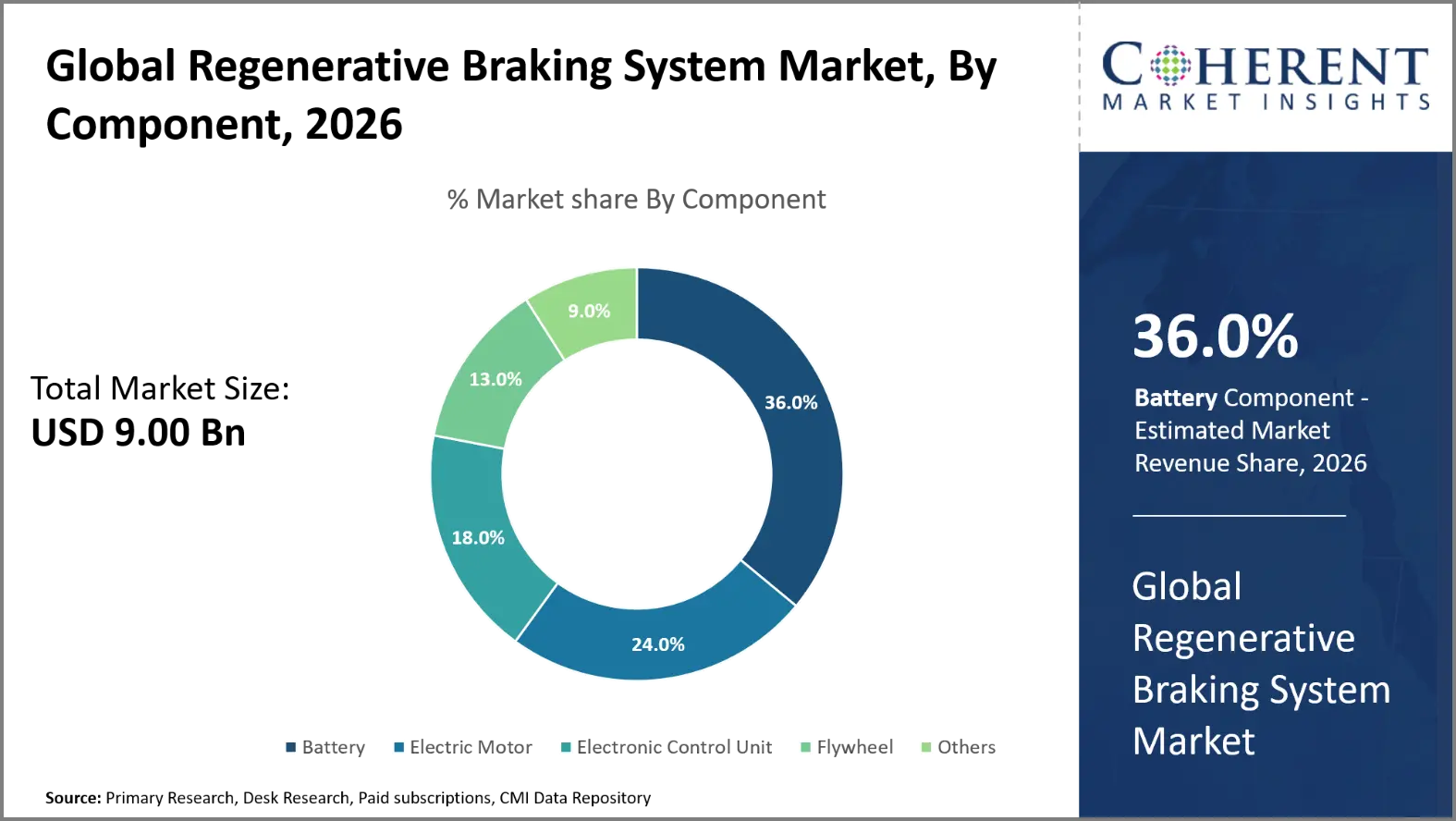
- The Battery segment is expected to account for 36.0% of the global regenerative braking system market share in 2026. Growing integration of regenerative braking in commercial vehicles is driving the growth of the segment. On September 25, 2025, Montra Electric announced its partnership with the Government of India's National Highway for Electric Vehicles initiative. The agreement targets deployment of more than 1,000 electric trucks on Indian roads.
- The Passenger Vehicles segment is estimated to capture 57.0% of the market share in 2026. Increasing demand for extended electric vehicle driving ranges is majorly driving the growth of the segment. On May 13, 2025, Toyota announced significant battery and charging improvements for its updated bZ electric SUV. The front-wheel-drive version offers an estimated driving range of 314 miles.
- The Electric Regenerative Braking segment is estimated to capture 39.0% of the market share in 2026. Advancements in brake-by-wire technologies is majorly driving the growth of the segment. On April 15, 2025, Continental presented its Future Brake System and next-generation integrated brake-by-wire architecture at Auto Shanghai 2025. The integrated system combines the master cylinder, brake booster, and control functions.
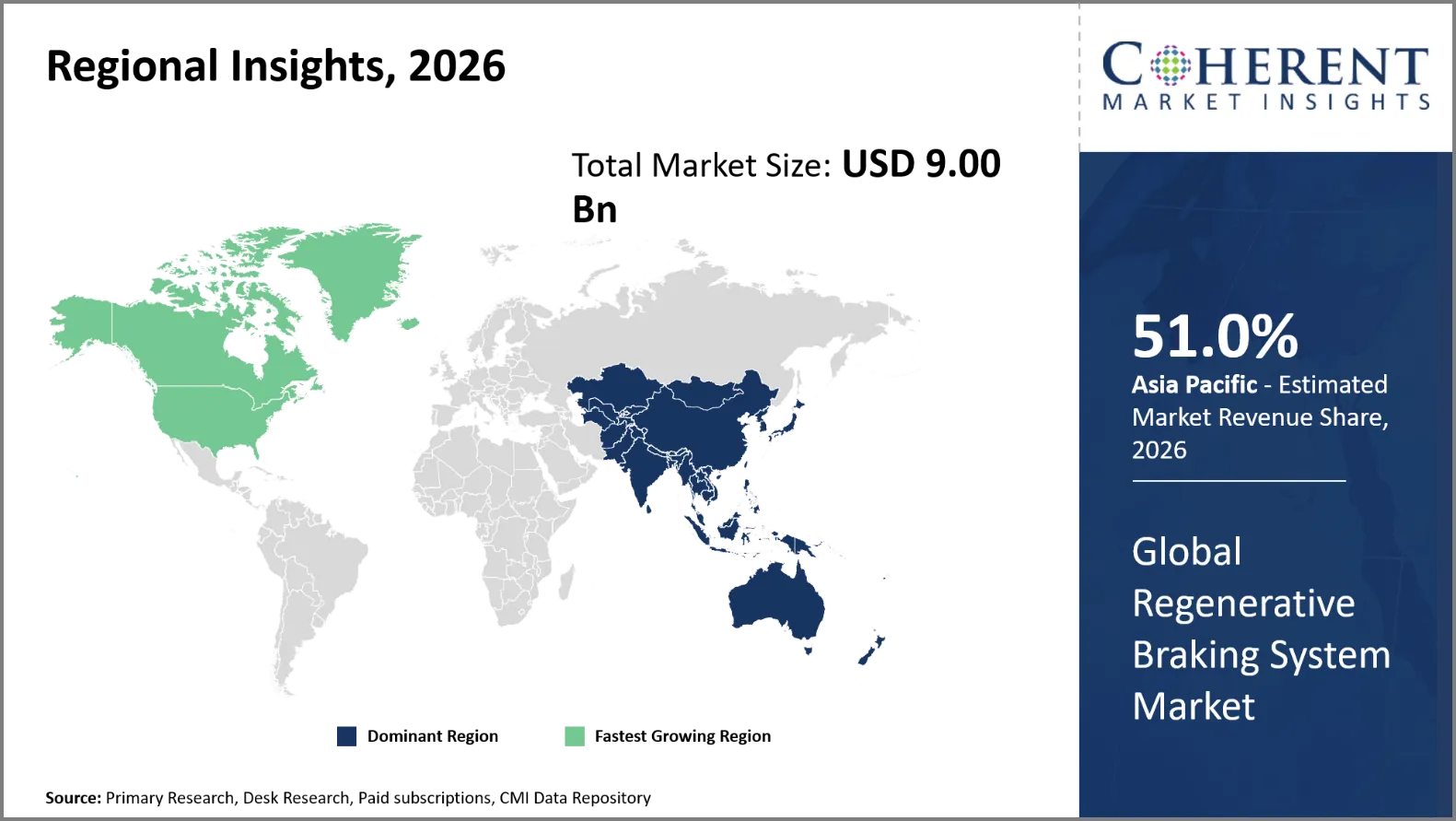
- Asia Pacific is expected to dominate the regenerative braking system market in 2026 with a market share of 51.0%. Expansion of regenerative braking in electric two-wheelers in Asia Pacific is driving the growth of the regional market. On January 6, 2025, Ather Energy introduced its updated 2025 Ather 450 series with Magic Twist regenerative braking as standard equipment across its variants. The technology allows riders to control acceleration and deceleration using the throttle.
- North America is expected to account for 23.0% share in 2026 and is projected to record the fastest growth over the forecast period. Development of high-efficiency energy recovery technologies in North America is driving the growth of the regional market. On November 5, 2025, General Motors introduced certain improvements to regenerative braking across its electric vehicle portfolio. Its blended braking technology captures kinetic energy even when drivers use the conventional brake pedal.
Segmental Insights
Why Does Battery Dominate the Global Regenerative Braking System Market?
The battery segment is expected to account for 36.0% of the global regenerative braking system market share in 2026. Battery storage dominates because it captures and stores recovered kinetic energy during vehicle deceleration. The stored electricity helps with acceleration and decreases reliance on conventional power sources. The growing acceptance of electric vehicles is fueling demand for effective regenerative braking systems linked with batteries. Advanced battery management systems also enhance energy recovery, charging efficiency and power distribution. These qualities are what make batteries vital for enhancing vehicle efficiency and extending the range of electric driving.
On April 1, 2026, Kia introduced the 2027 Kia EV3, at the New York International Auto Show, establishing a new standard as the most affordable offering in Kia’s expanding electric car lineup that includes the popular EV6 and EV9. The EV3 is an entry EV SUV that offers many of the advanced amenities of an EV9 in a smart and approachable package.
- Current Industry Events of 2026
- Market Size Estimation
- Regional Breakdown
- Competitive Landscape
- Customer Intelligence
- Segmental Analysis
- Pricing Analysis
- Key Market Drivers, Challenges & Future Trends
- Customized Insights Section
Why is Passenger Vehicles the Most Crucial Vehicle Type?
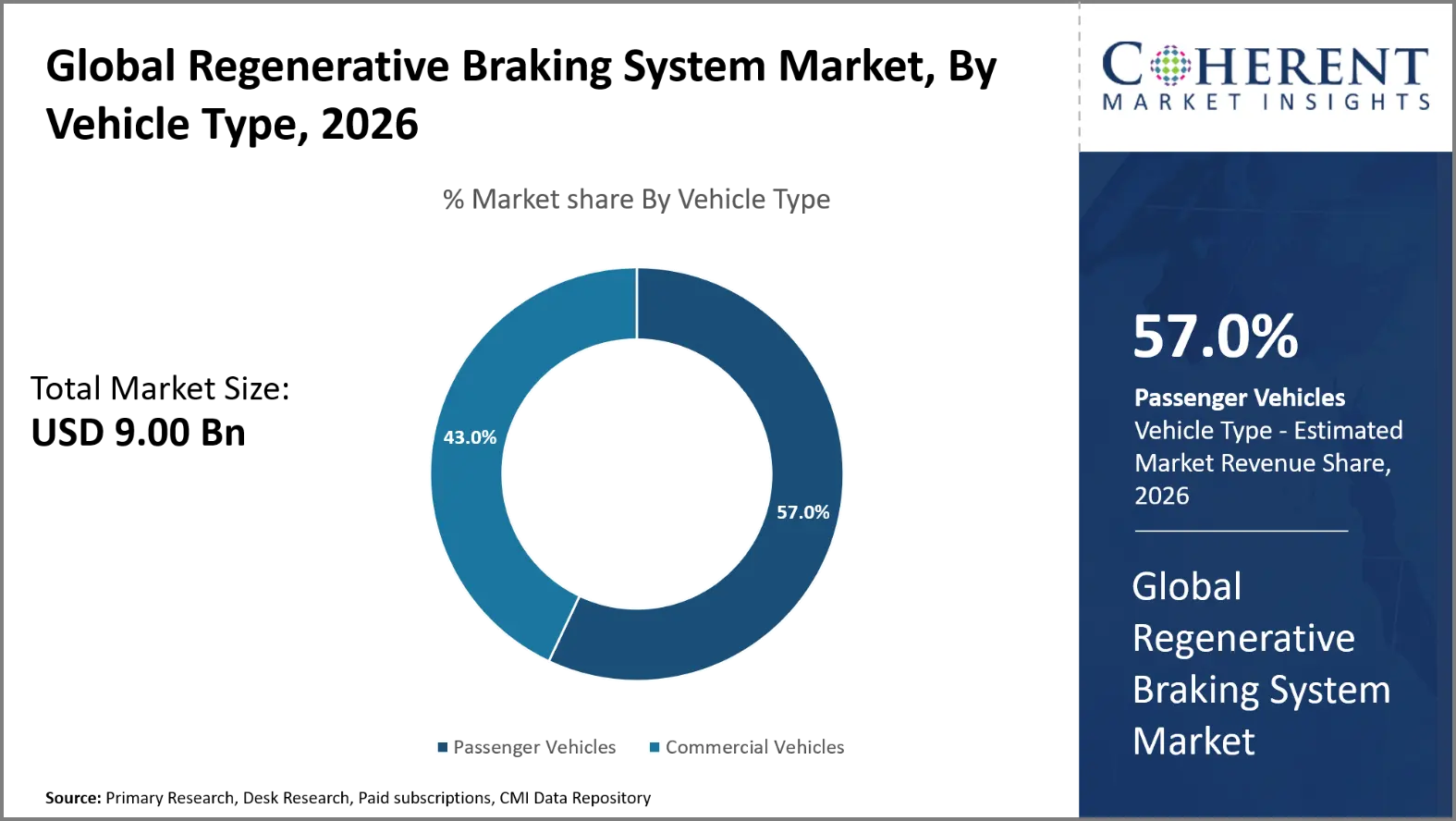
The passenger vehicles segment is expected to account for 57.0% of the global regenerative braking system market share in 2026. The most important vehicle category are passenger vehicles due to their large manufacturing numbers and rising electrification. The increasing customer demand for electric and hybrid cars is driving the use of regenerative braking systems. These technologies recuperate braking energy, enhance fuel efficiency or electric driving range. Automakers are equipping more passenger vehicle platforms with regenerative braking to help satisfy emission rules. Increased availability of electric cars also helps boost demand for the segment in major auto markets.
On January 17, 2025, Hyundai Motor India Limited unveiled the CRETA Electric at the Bharat Mobility Global Expo 2025. The electric SUV features an advanced driver-assistance-linked regenerative braking system. This integration connects deceleration control with vehicle safety functions.
Electric Regenerative Braking Dominates the Global Regenerative Braking System Market
The electric regenerative braking segment is expected to account for 39.0% of the global regenerative braking system market share in 2026. Electric regenerative braking dominates because it efficiently converts vehicle kinetic energy into electrical energy during deceleration. The electricity recovered is used to charge onboard batteries and to support continuing vehicle operation. The increasing usage of battery electric vehicles and hybrid electric vehicles is strengthening the market position of this technology. Electronic brake controls can enhance energy recovery and braking coordination. Ongoing improvements in electric powertrains and battery management systems also bolster broad acceptance across passenger and commercial vehicles.
On September 19, 2025, Stellantis and Saft presented a prototype Peugeot E-3008 featuring their Intelligent Battery Integrated System. The architecture combines battery, inverter and charging into a streamlined electrical system.
Current Events and their Impact
Current Events | Description and its Impact |
United Nations Regulation No. 13-H - Passenger Car Braking Requirements |
|
European Union Regulation (EU) 2026/502 - Updated Passenger Vehicle Braking Standards |
|
Regenerative Braking System Market Dynamics
Market Drivers
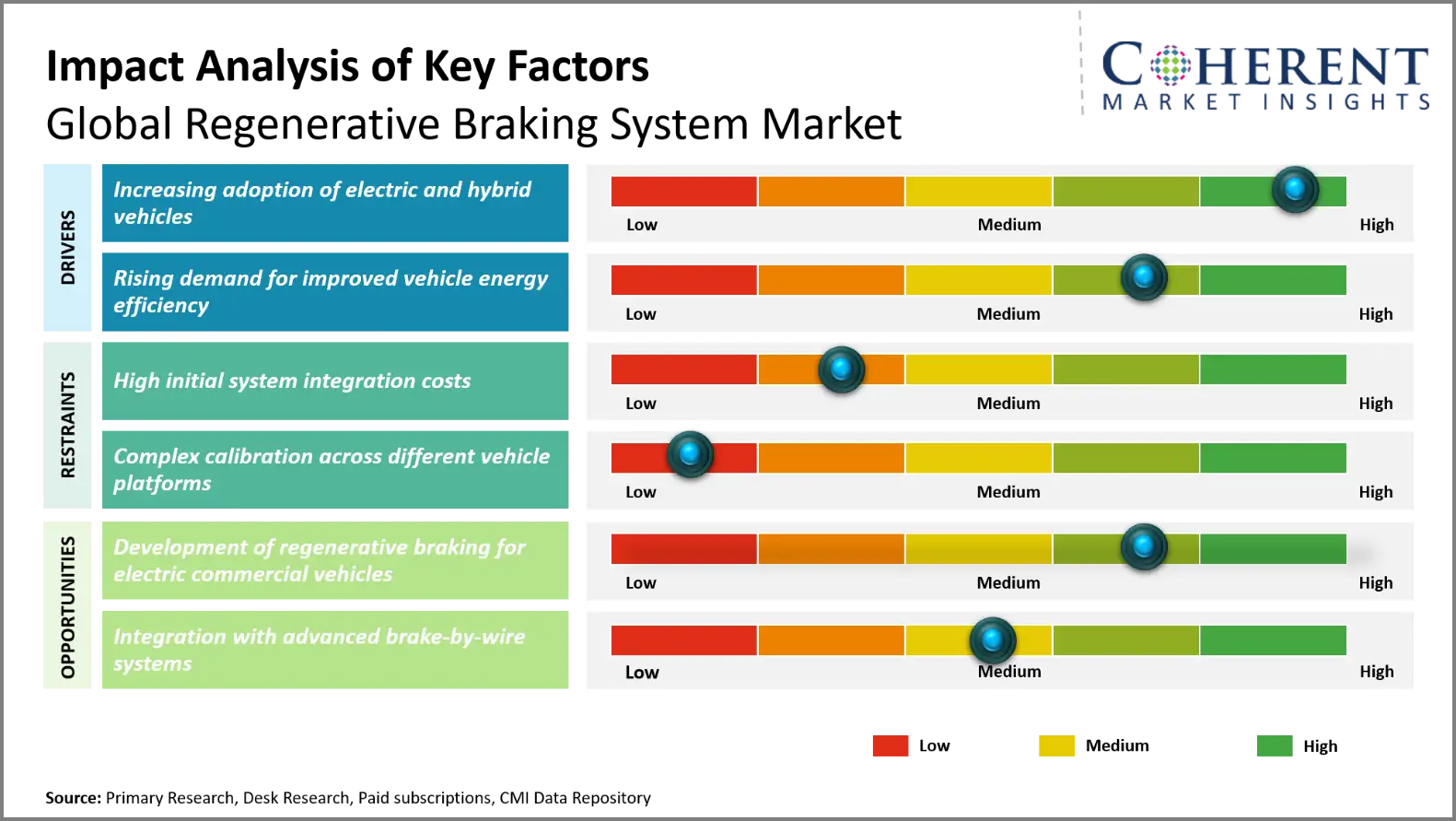
Increasing adoption of electric and hybrid vehicles
Global automotive markets are witnessing surging demand for regenerative braking systems, driven by the increasing adoption of electric and hybrid vehicles. More automakers are adding regenerative braking to their electric powertrains to collect kinetic energy when slowing down. The recovered energy helps to charge the battery and to increase the vehicle’s operating range. Government incentives to electrify and higher emission limits also speed up electric vehicle production. The growing production of hybrid vehicles is also likely to boost demand for improved braking technologies. Regenerative braking component makers see more potential from rising investments in electric car platforms. In 2025, Hyundai Motor Group reported that its electric vehicle portfolio posted rise in global retail sales for January 2026. Sales of hybrid vehicles jumped 32% to 611,783 units and sales of battery electric vehicles surged 17% to 269,169 units. Sales of plug-in hybrids also rose 21% to 44,124 vehicles. Sales of fully electrified vehicles hit 932,123 units, up 27% year-on-year.
Rising demand for improved vehicle energy efficiency
Growing focus on energy efficiency of vehicles propels the automakers to use regenerative braking technologies. The systems transform the kinetic energy created during deceleration into useful electrical power. Recovered electricity minimizes energy losses and boosts the powertrain's overall efficiency. Higher fuel economy regulations are pushing manufacturers to equip both conventional and electrified vehicles with innovative energy recovery systems. With better battery management, the recovered energy can be used more efficiently. These benefits are driving the use of regenerative braking by passenger vehicle and commercial vehicle manufacturers alike.
On April 21, 2025, Hyundai Motor Group introduced its next-generation hybrid powertrain technology, setting a new benchmark for power and economy. The Group wants to use the innovative system to launch a variety of new industry-leading products in the hybrid car category.
Emerging Trends
- Integration of Artificial Intelligence in Regenerative Braking Control: Automakers are integrating artificial intelligence and predictive algorithms into regenerative braking systems to optimize braking torque, anticipate deceleration, and enhance energy recovery in different driving conditions.
- Impact: Intelligent braking controls increase the efficiency of energy recovery, eliminate excessive friction braking and improve the driving comfort. These improvements allow better use of battery and vehicle performance.
- Relevance to the market: Companies like Bosch and Continental are developing sophisticated vehicle control technology. These technologies support integrated braking solutions for future electric and hybrid vehicle platforms.
- Development of Brake-by-Wire and Integrated Braking Technologies: An increasing number of automakers are embracing brake-by-wire architectures that electronically integrate regenerative braking, friction braking and vehicle stability functionalities in integrated braking platforms.
- Impact: These topologies provide accurate energy recovery, minimize mechanical complexity and increase braking responsiveness. They also support flexible car platform designs and enhanced driver assistance integration.
- Relevance to the market: ZF Friedrichshafen and Hyundai Mobis are working on integrated electronic braking systems. Their innovations indicate growing prospects to integrate regenerative braking into electric passenger vehicles.
Regional Insights
Why is Asia Pacific a Strong Market for Regenerative Braking System?
Asia Pacific is expected to account for a market share of 51.0% in 2026. Asia Pacific benefits from rising electric public transport infrastructure and government-supported fleet electrification schemes. India is enhancing this opportunity through its efforts, including PM E-DRIVE and PM-eBus Sewa. Under the PM E-DRIVE scheme, 13,800 electric busses would be rolled out in seven big cities by March 2026. Under the Faster Adoption and Manufacturing of (Hybrid &) Electric Vehicles in India Phase II program, India has deployed 5,197 electric busses. These deployments create opportunities for regenerative braking integration in urban transportation fleets. Regional suppliers can also target electric bus powertrains, braking controllers, and battery energy recovery systems.
Why Does North America Regenerative Braking System Market Exhibit High Growth?
North America is expected to register the fastest growth with a CAGR of 11.0% over the forecast period. The region is projected to account for 23.0% of the global regenerative braking system market in 2026 and presents unique potential for the development of heavy-duty electric trucks and the electrification of commercial fleets. Volvo Trucks North America adds brake energy recovery to VNR Electric platform. Its product documentation says it recovers some 5-15% of braking energy, depending on the driving cycles. Freightliner also calculates eCascadia’s operating performance accounting for regenerative braking. They are specified from more than a million miles of actual fleet experience. Such innovations are encouraging uptake among regional distribution, freight transport and urban delivery companies. Heavy-duty applications particularly benefit from energy recovery during repeated deceleration and downhill operations.
Global Regenerative Braking System Market Outlook for Key Countries
Why is China Emerging as a Major Hub in the Regenerative Braking System Market?
China’s large-scale new energy vehicle manufacturing and fast integration of intelligent electric powertrain technology are bearing fruit. The National Bureau of Statistics stated that output of new energy vehicles reached 16.524 million units in 2025. Production was up 25.1% compared to the previous year. For example, BYD cars like the ATTO 3 feature switchable regenerative braking modes. Vehicle controls allow drivers to choose between conventional and high regen levels. It captures deceleration energy to create electricity which is stored in the battery. Growing domestic manufacture and integrated vehicle electronics improve the potential for regenerative braking controllers, motor-generators and battery management systems.
Is U.S. the Next Growth Engine for the Regenerative Braking System Market?
The U.S. market benefits from growing interest in vehicle efficiency improvements and reduced non-exhaust brake emissions. The U.S. Department of Energy estimates that regenerative braking recovers approximately 22% of energy during combined driving cycles. Its analysis places typical electric vehicle efficiency between 87% and 91%. The Environmental Protection Agency also identifies lower brake-wear emissions in regenerative braking-equipped vehicles. Its research compared the 2016 Toyota Prius and 2019 Tesla Model 3. These findings strengthen interest in regenerative braking across passenger vehicles. Fleet operators also consider reduced friction-brake maintenance an important operational advantage.
Germany Regenerative Braking System Market Analysis and Trends
Germany benefits from advanced vehicle dynamics engineering and increasingly sophisticated energy recuperation architectures. BMW's Neue Klasse development integrates braking, drivetrain management, and energy recovery through its Heart of Joy control system. The company reports that recuperation alone handles approximately 98% of everyday braking situations in its new iX3. The architecture coordinates traction, braking, and vehicle stability functions through centralized software. This advancement underscores the importance Germany places on software-defined braking performance. Domestic engineering capabilities support opportunities for precision sensors, electronic brake controllers, power electronics, and integrated regenerative braking platforms.
Japan Regenerative Braking System Market Analysis and Trends
Japan benefits from established plug-in hybrid engineering and advanced control of regenerative braking intensity. Mitsubishi Motors made its Outlander PHEV’s regenerative braking adjustable. There are six levels of regeneration to choose from, B0 to B5, and these are selected using paddles on the steering wheel. The novel pedal operation style also reduces the frequent switching of the accelerator and brake pedals. Mitsubishi Motors sold 7,794 Outlander PHEVs in its home market in fiscal 2025. The model has been the number one model in Japan’s plug-in hybrid segment for years in a row. These advances are positive for demand for adjustable brake systems and complex hybrid powertrain management.
South Korea Regenerative Braking System Market Analysis and Trends
South Korea is advancing regenerative braking through high-performance electric vehicle platforms and intelligent energy recovery software. The EV3 has a front-wheel drive, and Kia has launched it with a high-deceleration regenerative braking technology. The device provides regenerative braking deceleration up to 0.3G, reducing heat buildup over conventional brakes. Its i-Pedal 3.0 capability also provides accelerator-controlled acceleration, deceleration and stopping. Hyundai IONIQ 9 Introduces Smart Regenerative Braking System 3.0 This technique predicts future vehicles, road curves and speed limits from navigation information. These improvements create more options for predictive braking software and integrated electrical braking components.
Global Regenerative Braking System Market - Integration with Predictive Driving and Automated Deceleration
Research or Technology Area | Organization / Source | Year | Predictive or Autonomous Function |
Predictive regenerative braking control | IEEE American Control Conference research | 2026 | Model predictive control optimizes braking torque while maintaining tire-road safety |
Adaptive regenerative braking using deep reinforcement learning | Scientific Reports research | 2026 | Adjusts braking according to battery acceptance, tire adhesion, and surrounding traffic |
Collision avoidance with regenerative braking | University of Iowa | 2026 | Uses computer vision to anticipate hazards and increase regenerative deceleration |
Predictive automated regenerative braking | Applied Energy research | 2025 | Uses automated braking and gear-ratio shifting to maximize recovered energy |
Energy-positive autonomous emergency braking | Energy and AI research | 2026 | Combines vehicle-to-everything communication, predictive battery management, and regenerative-friction braking |
How is Development of Regenerative Braking for Electric Commercial Vehicles Creating New Growth Opportunities in the Regenerative Braking System Market?
The development of regenerative braking for electric commercial vehicles offers tremendous potential with specific energy recovery systems for heavy-duty operating situations. Especially advantageous for energy recovery is the frequent halting of electric garbage trucks, city busses and regional delivery vehicles. For example, Volvo Trucks has developed regenerative-braking capabilities for its VNR Electric regional distribution truck. This application is applicable for energy recovery from successive deceleration in urban freight routes. There are also chances with electric waste collection vehicles as their stop-start collection cycles produce frequent braking events. Manufacturers can develop higher-capacity regenerative braking controllers, traction motor integration, and thermal management solutions specifically for commercial vehicle platforms.
On May 5, 2026, Driventic and Hendrickson announced an expansion of their partnership. The new jointly engineered solution will bring together Hendrickson’s suspension and axle expertise with Driventic’s advanced, energy efficient technologies in a next‑generation platform designed with performance and uptime in mind.
Market Players, Key Development, and Competitive Landscape
Key Developments
- On October 26, 2026, BASF, Chery Automobile Co., Ltd. and Suzhou Orient Motion Intelligent Technology Co., Ltd. introduced the world’s first mass-produced electromechanical brake (EMB) brake-by-wire system. Developed and industrialized in China, the system has been deployed in Chery’s premium EXEED EX7 model.
- On October 14, 2026, Sensata Technologies announced that its brake force sensors are now enabling electromechanical braking (EMB) systems in leading electric vehicles. This milestone marks a significant step in the transition from traditional hydraulic braking to fully electric, brake-by-wire systems, as vehicle OEMs increasingly adopt architectures designed for electrification, autonomy, and software-defined control.
- On May 4, 2026, Brembo announced that Sensify, the new standard in intelligent braking, has entered production for a leading global vehicle manufacturer. Sensify is fitted as standard on 100% of the vehicles in the program, confirming the platform’s readiness for full industrial deployment.
Competitive Landscape
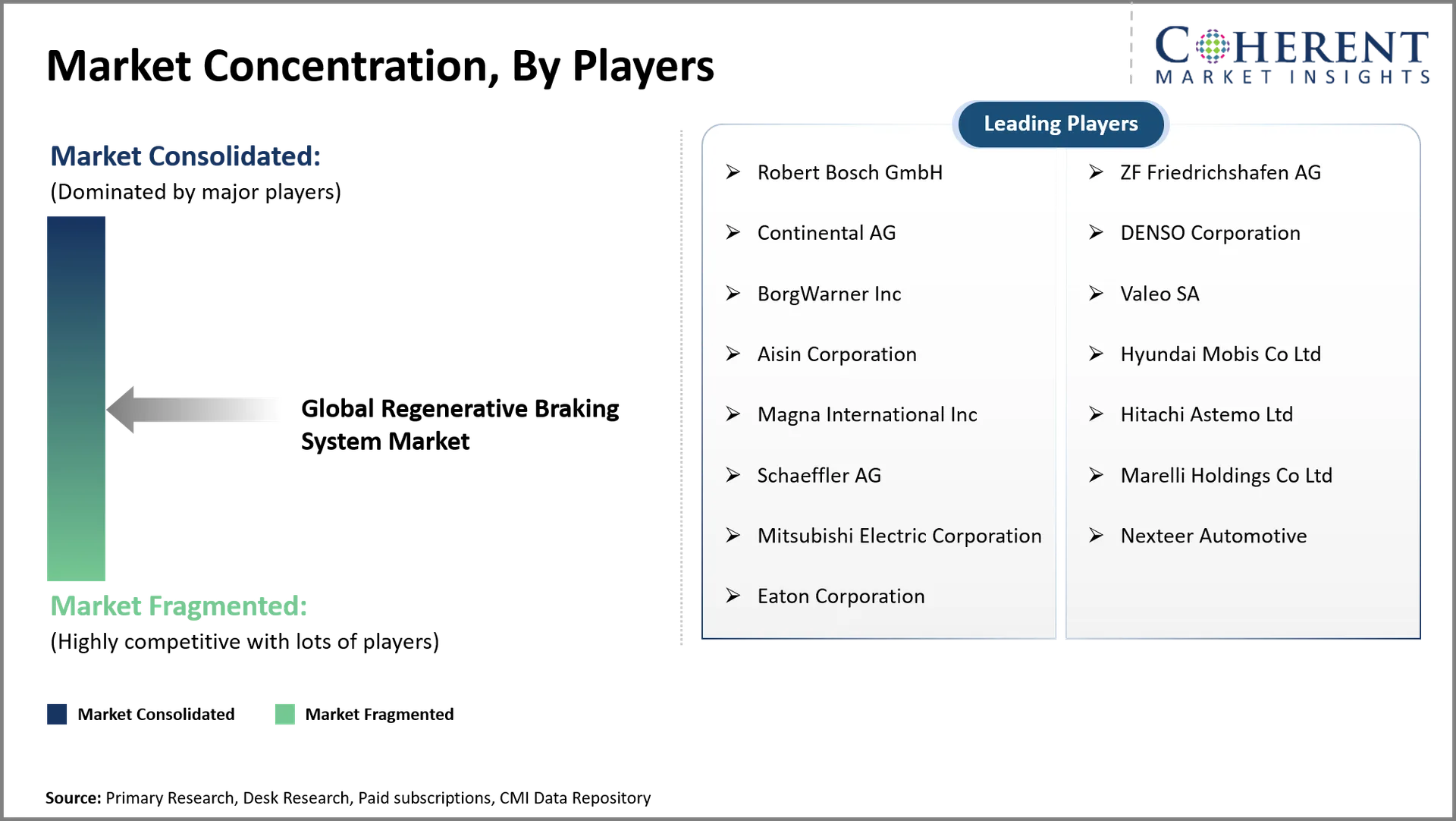
The key players in the global regenerative braking system market are established automotive suppliers competing on the basis of integrated braking technologies and electrification collaborations. Robert Bosch GmbH focuses on its iBooster and ESP hev platforms for the coordinated blending of regenerative braking and friction brake. ZF Friedrichshafen AG is advancing the development of integrated brake control and brake-by-wire technology for electric passenger cars. The integrated brake control enables energy recuperation up to 0.3g. Continental AG is working on next-generation brake-by-wire architectures and semi-dry braking technologies for battery electric vehicles. BorgWarner Inc. is expanding its footprint in electric drive modules, power electronics and high voltage inverters. These leading companies prioritize software integration, braking precision, energy recovery and compatibility with the vehicle platform.
Top Manufacturers and Notable Products in the Regenerative Braking System Market
Manufacturer | Notable Product | Key features |
Robert Bosch GmbH | ESP hev and iBooster | Regenerative braking integration, up to 0.3 g purely generative deceleration, up to 100% recuperation efficiency depending on foundation brake design |
ZF Friedrichshafen AG | Integrated Brake Control and Brake-by-Wire | Electronic braking coordination, regenerative and friction braking integration, support for advanced driver assistance systems |
Continental AG | MK C1 Integrated Brake System | Electrohydraulic braking, precise brake pressure control, regenerative braking coordination, compact system architecture |
DENSO Corporation | Hybrid Power Control Unit and Motor Generator | Motor-generator energy recovery, inverter control, battery charging coordination, efficient hybrid powertrain operation |
Hyundai Mobis Co., Ltd. | Integrated Dynamic Brake | Electronic brake control, regenerative and hydraulic braking coordination, integrated actuator and control functions |
Regenerative Braking System Market | |||
Report Coverage | Details | ||
Base Year | 2025 | Market Size in 2026: | USD 9.00 Bn |
Historical Data For: | 2020 To 2024 | Forecast Period: | 2026 To 2033 |
Forecast Period 2026 To 2033 CAGR: | 10.5% | 2033 Value Projection: | USD 18.10 Bn |
Geographies covered: |
| ||
Segments covered: |
| ||
Companies covered: | Robert Bosch GmbH, ZF Friedrichshafen AG, Continental AG, DENSO Corporation, BorgWarner Inc, Valeo SA, Aisin Corporation, Hyundai Mobis Co Ltd, Magna International Inc, Hitachi Astemo Ltd, Schaeffler AG, Marelli Holdings Co Ltd, Mitsubishi Electric Corporation, Nexteer Automotive, Eaton Corporation | ||
Growth Drivers: |
| ||
Restraints & Challenges: |
| ||
Analyst Opinion (Expert Opinion)
- The future of the regenerative braking system industry will increasingly depend on intelligent energy recovery and electronically controlled braking architectures. Brake-by-wire integration will become particularly important as automakers simplify electric vehicle platforms. Manufacturers will increasingly prioritize software-controlled torque distribution, predictive deceleration, and seamless friction braking coordination. Regenerative braking systems will also become more adaptable to different battery chemistries and vehicle configurations. Suppliers capable of combining braking hardware with advanced control software will gain stronger positions.
- The maximum growth opportunity will emerge in electric commercial vehicles, hybrid passenger vehicles, and battery electric delivery fleets. Electric buses and refuse collection trucks offer attractive applications because frequent stopping creates repeated energy recovery opportunities. China and India present promising opportunities through electric commercial vehicle manufacturing and public transportation electrification. Germany and South Korea offer opportunities in advanced electronic braking architectures and integrated vehicle control systems. Suppliers should prioritize heavy-duty regenerative braking modules and scalable passenger vehicle platforms.
- Market players should strengthen partnerships with electric vehicle manufacturers to secure early integration into upcoming vehicle platforms. Developing proprietary braking algorithms can improve energy recovery without compromising vehicle stability or limiting performance. Companies should also invest in battery-aware braking controls that adjust regenerative torque according to battery temperature and charging capacity. Modular electronic braking platforms can reduce development costs across different vehicle categories. Suppliers may utilize regional engineering and validation facilities to support local vehicle requirements and speed original equipment manufacturer partnerships.
Speak to the analyst
Want personalized insights?
Take the findings above to one of our principal consultants, or have the report rebuilt around the segments, geographies and competitors you actually track.
Market Segmentation
- Component Insights (Revenue, USD Billion, 2021 - 2033)
- Battery
- Electric Motor
- Electronic Control Unit
- Flywheel
- Others
- Vehicle Type Insights (Revenue, USD Billion, 2021 - 2033)
- Passenger Vehicles
- Commercial Vehicles
- Technology Type Insights (Revenue, USD Billion, 2021 - 2033)
- Electric Regenerative Braking
- Hydraulic Regenerative Braking
- Mechanical Regenerative Braking
- Electromagnetic Regenerative Braking
- Propulsion Type Insights (Revenue USD Billion, 2021 - 2033)
- Battery Electric Vehicles
- Hybrid Electric Vehicles
- Plug-in Hybrid Electric Vehicles
- Fuel Cell Electric Vehicles
- Regional Insights (Revenue, USD Billion, 2021 - 2033)
- North America
- U.S.
- Canada
- Latin America
- Brazil
- Argentina
- Mexico
- Rest of Latin America
- Europe
- Germany
- U.K.
- Spain
- France
- Italy
- Russia
- Rest of Europe
- Asia Pacific
- China
- India
- Japan
- Australia
- South Korea
- ASEAN
- Rest of Asia Pacific
- Middle East
- GCC Countries
- Israel
- Rest of Middle East
- Africa
- South Africa
- North Africa
- Central Africa
- North America
- Key Players Insights
- Robert Bosch GmbH
- ZF Friedrichshafen AG
- Continental AG
- DENSO Corporation
- BorgWarner Inc
- Valeo SA
- Aisin Corporation
- Hyundai Mobis Co Ltd
- Magna International Inc
- Hitachi Astemo Ltd
- Schaeffler AG
- Marelli Holdings Co Ltd
- Mitsubishi Electric Corporation
- Nexteer Automotive
- Eaton Corporation
Sources
Primary Research Interviews
- Automotive OEM Manufacturers
- Electric Vehicle (EV) Component Suppliers
- Regenerative Braking System Technology Developers
- Fleet Management & Automotive Service Providers
Magazines
- Automotive Engineering International
- Electric & Hybrid Vehicle Technology International
- Motor Trend (EV & Hybrid Technology Edition)
- Automotive World Magazine
Journals
- Journal of Power Sources (Elsevier)
- IEEE Transactions on Vehicular Technology
- International Journal of Automotive Technology
Associations
- Society of Automotive Engineers (SAE International)
- International Council on Clean Transportation (ICCT)
- Electric Drive Transportation Association (EDTA)
- European Automobile Manufacturers' Association (ACEA)
Public Domain Sources
- U.S. Department of Energy (DOE) – Office of Energy Efficiency & Renewable Energy
- European Environment Agency (EEA) – Transport & Mobility Reports
- International Energy Agency (IEA) – Global EV Outlook Reports
- National Highway Traffic Safety Administration (NHTSA) – Vehicle Technology Reports
Proprietary Elements
- CMI Data Analytics Tool
- Proprietary CMI Existing Repository of Information for Last 10 Years
Get access to 250+ pages report
Every segment, forecast, competitor profile and data table behind the analysis above — available for instant download.
- ESOMAR Member
- ISO 9001:2015 Certified
- D-U-N-S Registered
- GDPR & CCPA Compliant
Frequently Asked Questions
The global regenerative braking system market is expected to stand at USD 9.00 Bn in 2026 and is expected to reach USD 18.10 Bn by 2033.
The CAGR of the global regenerative braking system market is projected to be 10.5% from 2026 to 2033.
Increasing adoption of electric and hybrid vehicles and Rising demand for improved vehicle energy efficiency are the major factors driving the growth of the global regenerative braking system market.
High initial system integration costs and Complex calibration across different vehicle platforms are the major factors hampering the growth of the global regenerative braking system market.
In terms of component, battery segment is estimated to dominate the market revenue share in 2026.
A regenerative braking system converts vehicle kinetic energy into electrical energy during deceleration and stores it for subsequent use.
It recovers energy otherwise dissipated as heat during conventional friction braking and returns electricity to the vehicle battery.