

Global Satellite Propulsion Market Size and Forecast – 2026-2033
The global satellite propulsion market is expected to grow from USD 2.07 Bn in 2026 to USD 6.44 Bn by 2033, at a compound annual growth rate (CAGR) of 17.6% over 2026–2033. Satellite propulsion is the set of thrusters, engines, propellant feed hardware and power electronics that lets a satellite raise its orbit, hold its position, avoid collisions and leave orbit at the end of its life. Systems are built on chemical, electric or cold gas technology, and each is matched to the mass, power and mission length of the satellite it serves. The need is easy to see in recent programs. On June 27, 2023, ESA reported that Sitael's HT100 Hall effect thruster, which delivers up to 6 millinewtons of thrust, had completed its extended qualification firing campaign. The hardware also serves a growing installed base in the Small Satellite Market.
Two forces support this growth. First, launch activity keeps rising as operators deploy large low Earth orbit (LEO) constellations, a space covered in the Low Earth Orbit Satellite Market, and each spacecraft that must change or hold its orbit needs a propulsion system. Second, commercial operators and regulators now expect satellites to maneuver through their whole life, from raising orbit after deployment to avoiding debris and returning to Earth at the end of the mission.
Key Takeaways of the Global Satellite Propulsion Market
- The Small (1–1,200 kg) platform segment is expected to account for 62.0% of the global satellite propulsion market share in 2026. Constellation operators fly large numbers of similar spacecraft, and each one needs a compact propulsion unit for orbit raising, drag make-up and disposal. AIAA's Aerospace America reported that SpaceX's Starlink constellation had over 8,500 satellites operating in orbit as of October 2025, and that each of them carries a Hall thruster.
- Thrusters are expected to hold 40.0% of the system segment in 2026. The thruster is the part that creates thrust, so it carries the largest share of propulsion value on every satellite that maneuvers. In December 2025, L3Harris reported a long heritage of delivering 22,000 chemical thrusters over the years.
- Electric propulsion is expected to be the fastest-growing propulsion technology, at an 18.1% CAGR through 2031. High specific impulse lowers the propellant a satellite must carry. Aerospace America reported that in July 2025 Busek operated its BIT-3 iodine-fueled ion thruster in orbit after three years of dormancy.
- The Commercial segment is expected to account for 58.0% of the global satellite propulsion market share in 2026, the largest of the end user segment. Private operators are launching satellites faster for communications, broadband internet, Earth observation and Internet of Things services. On June 16, 2026, Dawn Aerospace announced the close of a USD 25 Mn Series B round and reported more than 200 of its non-toxic thrusters in space on over 50 satellites.
- North America is expected to dominate the satellite propulsion market in 2026, with a share of 84.6%. The region combines commercial satellite manufacturing, launch services and government space programs. Aerospace America reported that four 6-kilowatt Busek BHT-6000 thrusters are set to be integrated onto NASA's Power and Propulsion Element by Lanteris, formerly Maxar Space Systems.
- Asia Pacific is expected to account for a 4.8% share in 2026 and to be the fastest-growing region over 2026–2033. China, India, Japan and South Korea are investing in satellite manufacturing, launches and space infrastructure, which adds new satellite builders that need propulsion.
Segmental Insights
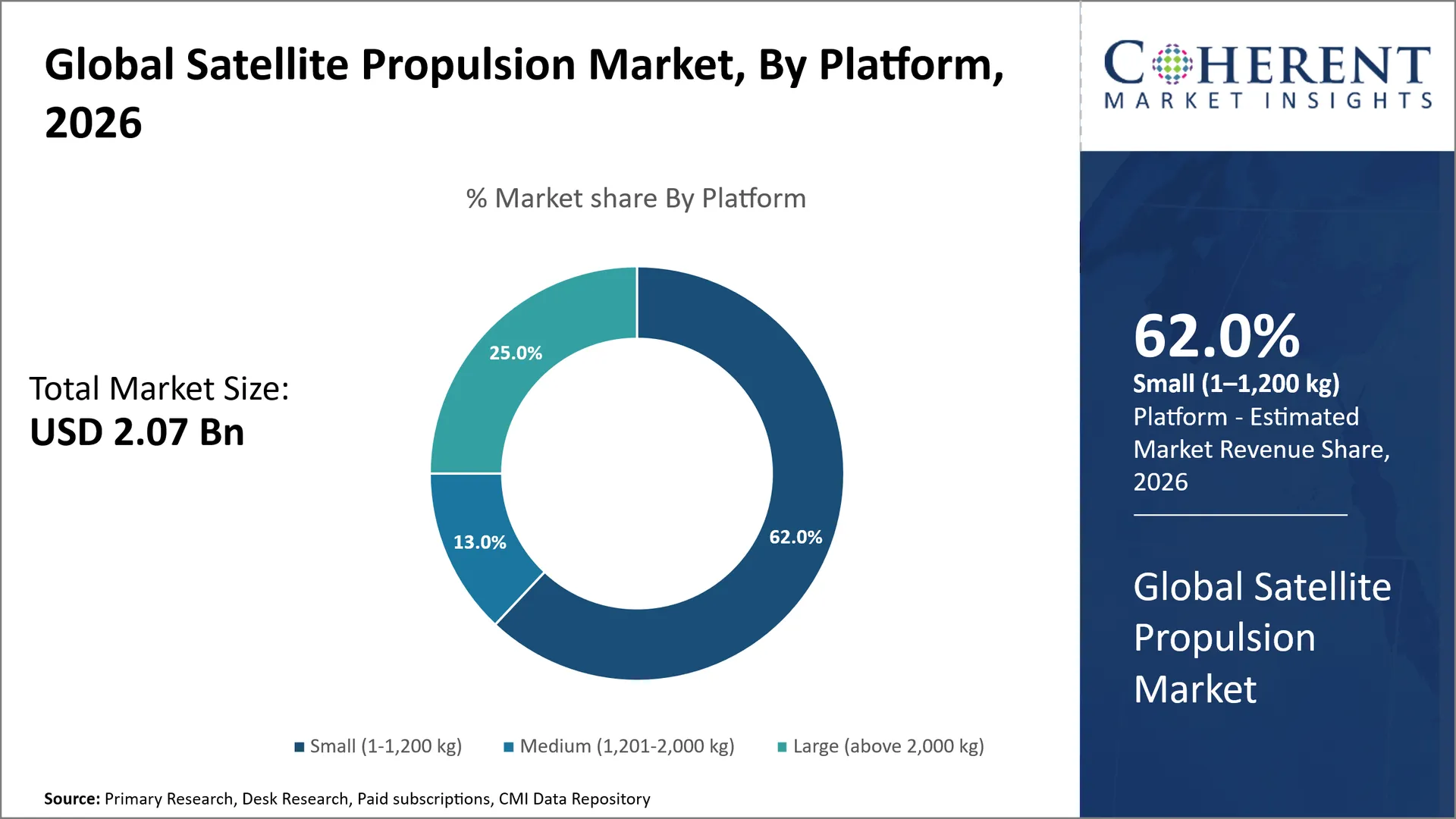
Why Do Small Satellites Dominate the Global Satellite Propulsion Market?
In terms of platform, the Small (1–1,200 kg) segment is expected to account for 62.0% of the global satellite propulsion market share in 2026. Satellites in this mass range are built in series for broadband, Earth observation and Internet of Things constellations, so one design can generate orders for hundreds of identical propulsion units. A satellite released at a low drop-off altitude must climb to its working orbit, offset atmospheric drag, avoid debris and, at the end of its life, descend again. Thrusters sized for small buses make these tasks affordable without taking much mass or power from the payload.
On August 25, 2026, ThrustMe announced that its iodine-based propulsion systems now equip more than 25 satellite constellations across three continents, which shows how many small-satellite fleets now buy propulsion as a standard component.
Four requirements shape propulsion for this mass range
- Low mass and volume: the propulsion unit must fit in a small part of the bus. Sitael's HT 400 Hall effect thruster has a dry mass of 0.9 kg.
- Low power: small buses have limited solar power. The HT 400 draws 525 W on average, and Safran's PPS X00 operates across a 400 to 1,000 W range.
- Useful life: Safran’s PPS X00 is built for low Earth orbit and offers a total thrust time of up to 5,000 hours.
- Volume production: Safran designed the PPS X00 around the needs of the New Space market, where operators tend to order thrusters in batches.
- Current Industry Events of 2026
- Market Size Estimation
- Regional Breakdown
- Competitive Landscape
- Customer Intelligence
- Segmental Analysis
- Pricing Analysis
- Key Market Drivers, Challenges & Future Trends
- Customized Insights Section
Why Do Thrusters Lead the System Segment?
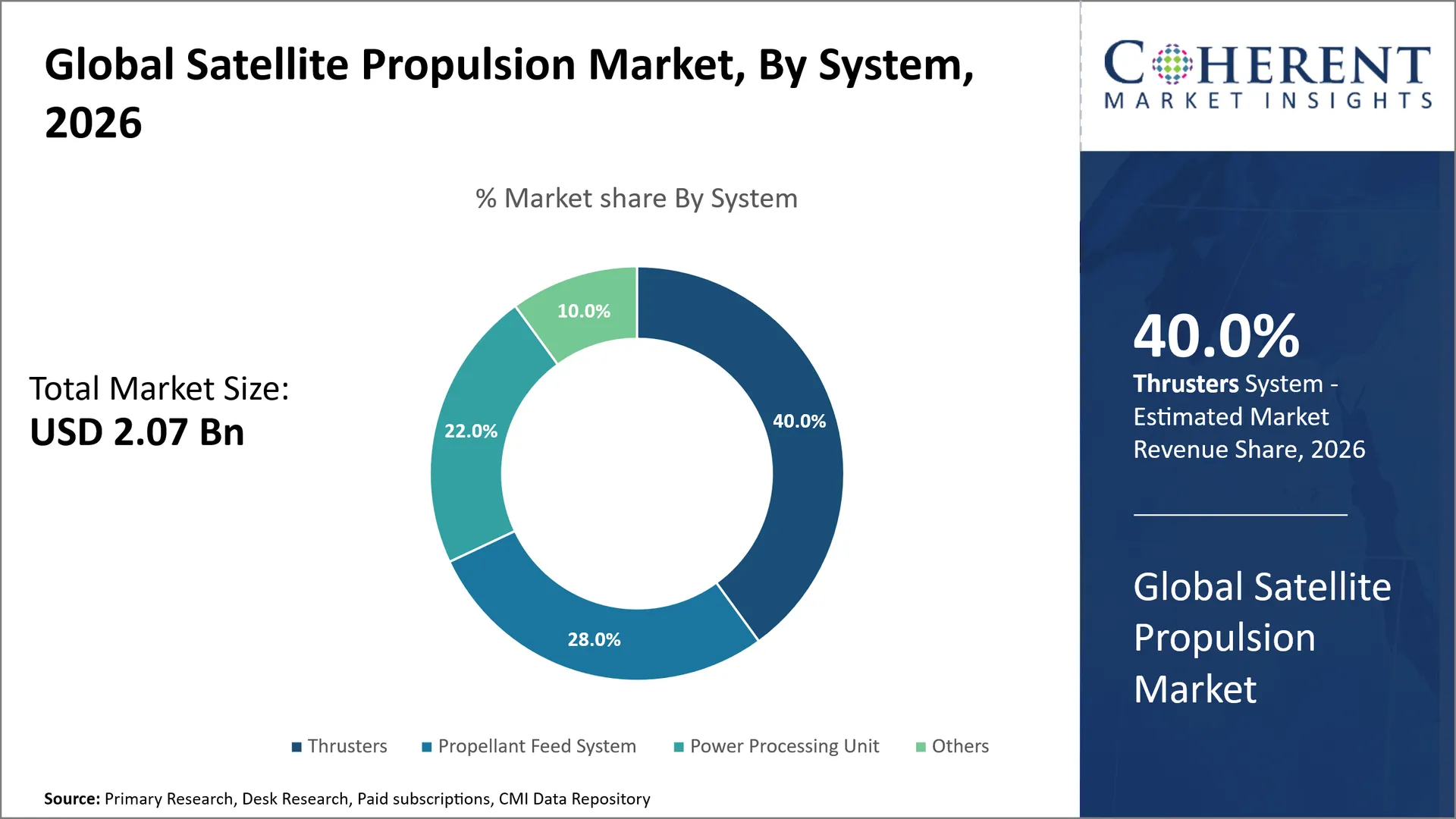
In terms of system, thrusters are expected to account for 40.0% of the global satellite propulsion market share in 2026. The thruster is the part that turns propellant and energy into thrust, so it sets how well the whole propulsion system performs. Any satellite that maneuvers needs at least one, and larger missions often carry several for backup. Flight heritage also counts for the most here. Buyers qualify thrusters carefully and are willing to pay for units with a proven record.
On December 16, 2025, L3Harris announced that it and NASA had completed testing and delivery of three 12-kilowatt Advanced Electric Propulsion System thrusters for the Gateway station, which will be the most powerful electric propulsion system to fly in space.
Buyers compare thrusters on four published measures
- Thrust level: Nammo's LEROS 1c apogee engine delivers a thrust of 458 N.
- Specific impulse: the same engine delivers 324 seconds of specific impulse on MON and hydrazine propellants, which sets how far a kilogram of propellant carries the satellite.
- Qualified life: the number of firing hours a thruster has demonstrated on the ground.
- Flight heritage: the count of units already operating in orbit, which procurement teams weigh heavily.
Why Do Commercial Operators Lead the End User Segment?
In terms of end user, the Commercial segment is expected to hold the largest share of the global satellite propulsion market in 2026. Private satellite operators are launching satellites at a much faster pace for communications, broadband internet, Earth observation and Internet of Things services, and each satellite needs propulsion to reach, hold and leave its orbit. Commercial buyers choose on cost, delivery time and mission life, so they favor standard, repeatable propulsion products. On April 13, 2026, Dawn Aerospace announced the formal launch of its Loop on-orbit refueling network, which uses passive docking ports in place of conventional fill-and-drain valves, and reported that the program is funded through its 2028 demonstration phase.
Current Events and their Impact
Current Events | Description and its Impact |
FCC five-year rule for deorbiting satellites: adopted September 29, 2022 |
|
York Space Systems acquires Orbion Space Technology: March 13, 2026 |
|
Satellite Propulsion Market Dynamics
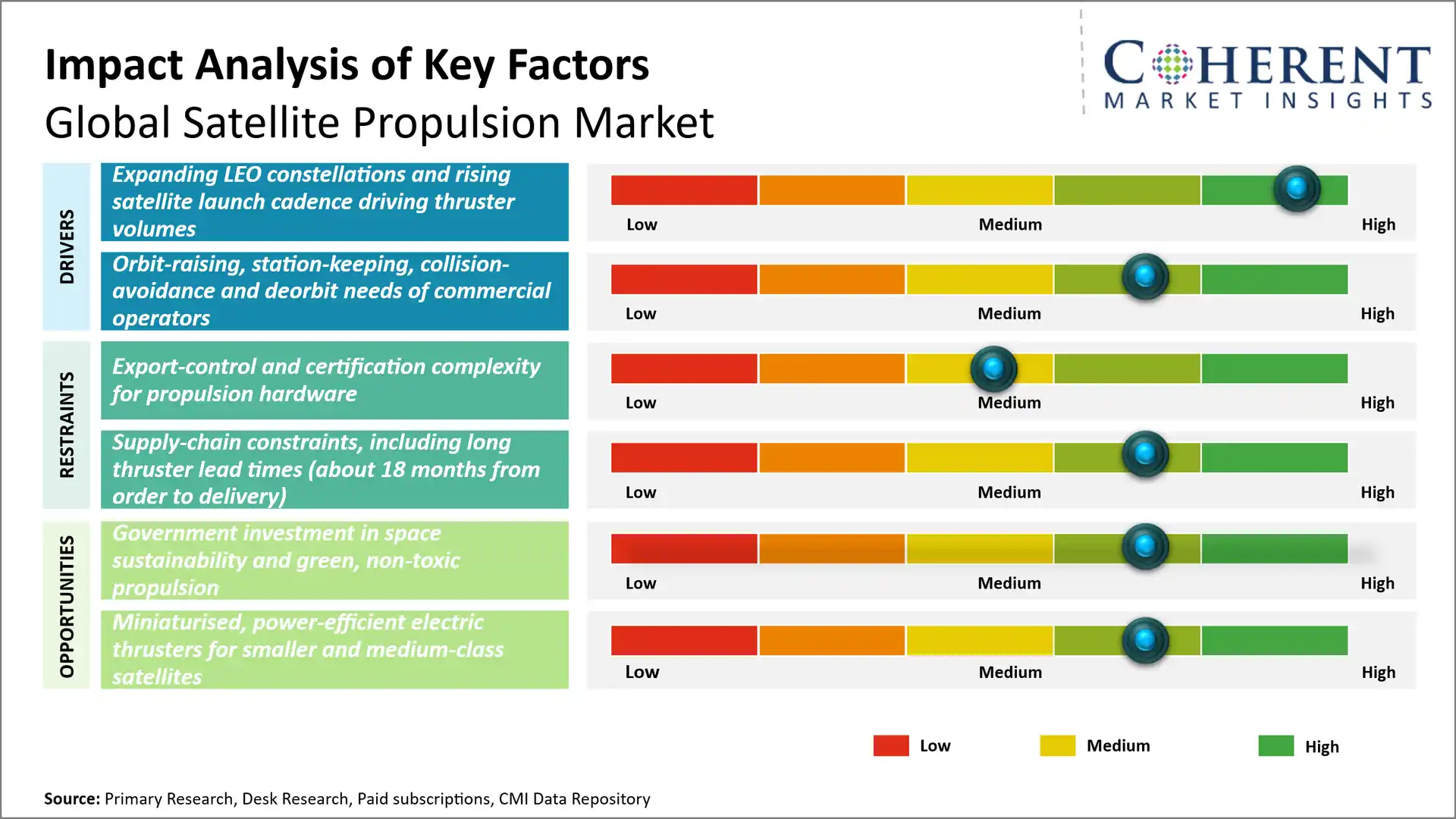
Market Drivers
- Expanding LEO constellations and rising satellite launch cadence driving thruster volumes: Every satellite that must climb to its working orbit, hold its slot or leave orbit needs thrusters, so launch volume converts directly into orders. Launch records for 2025 show that 4,544 spacecraft were launched on 325 orbital launches, and that SpaceX launched 85% of all spacecraft. Satellites under 1,200 kg made up 98% of the spacecraft launched and 85% of the total upmass. Operators therefore buy propulsion in large, repeat batches, which favors suppliers that can build standard thrusters at volume.
- Orbit-raising, station-keeping, collision-avoidance and deorbit needs of commercial operators: Commercial operators now treat propulsion as mission-critical hardware. After deployment, a satellite must be raised to its working orbit, kept in position against drag and other forces, moved aside when a conjunction is predicted and finally lowered at the end of its life. SpaceX reported to the Federal Communications Commission that Starlink satellites performed 207,152 collision avoidance maneuvers between December 2025 and May 2026, up from 148,696 in the previous six-month period, and DLR notes that excessive maneuvers deplete a mission's fuel budget, so every conjunction response draws on onboard propellant. L3Harris reported in an editorial first published on April 8, 2024 that dynamic space operations fundamentally revolve around the capability to maneuver once in orbit, and noted electric satellite thrusters with 10 times the efficiency of conventional chemical propulsion systems.
Emerging Trends
- Non-toxic green propellants are replacing hydrazine on new satellite programs: Hydrazine is still the most widely used monopropellant, but it is highly toxic, and launch crews need special procedures to handle it. Busek’s green monopropellant thruster runs on ASCENT, which gives about 10% higher specific impulse and 45% greater density than hydrazine.
- Impact: Loading a safer propellant is simpler at the launch site, so satellite builders spend less time and money on integration.
- Relevance to the market: Suppliers that already have qualified green propulsion products are better placed to win these programs.
- Additive manufacturing is cutting thruster production time: In April 2026, L3Harris reported that it is using additive manufacturing to speed up production of in-space thrusters, which now average about 18 months from order to delivery. It is also stockpiling valves and other parts that are common to several satellite propulsion systems.
- Impact: Shorter lead times help operators replace and add satellites to their constellations sooner.
- Relevance to the market: Suppliers with automated, repeatable production lines have the advantage.
Regional Insights
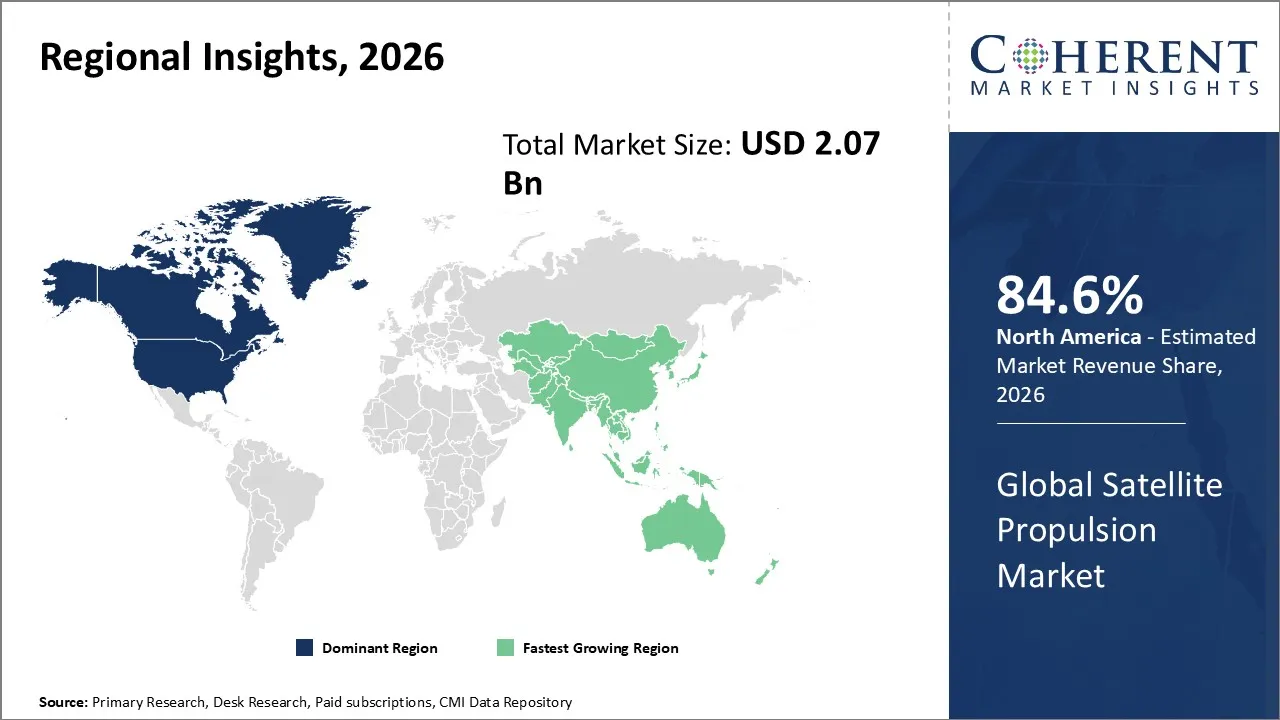
Why Does North America Lead the Global Satellite Propulsion Market?
North America is expected to account for a market share of 84.6% in 2026, the largest of any region. The region's leadership reflects the position of the United States in commercial satellite manufacturing, launch services and government space programs, which together create steady demand for thrusters, engines and electric propulsion systems. The region also hosts established propulsion suppliers and electric propulsion specialists, including Busek and Rocketdyne, so buyers can source close to the satellite builder.
Why Is Asia Pacific the Fastest-Growing Region in the Satellite Propulsion Market?
Asia Pacific is expected to account for a 4.8% share in 2026 and to register the fastest growth over the forecast period. Investment by China, India, Japan and South Korea in satellite manufacturing, launches and space infrastructure is lifting regional demand for propulsion. Each new national or commercial constellation adds satellites that must be raised, maintained and disposed of, which converts regional launch growth into propulsion orders.
Global Satellite Propulsion Market Outlook for Key Countries:
Is the U.S. the Largest Market for Satellite Propulsion?
The U.S. satellite propulsion market is projected to reach USD 1.74 Bn in 2026, the largest of the five countries covered here. The country combines the largest commercial satellite manufacturing base with a deep launch and government space program, and foreign suppliers are building local capacity to serve it. On August 5, 2024, Safran announced that its U.S.-based subsidiary would manufacture EPS X00 electric propulsion systems in a new Colorado facility, with first delivery in the first quarter of 2026. On April 11, 2025, Safran inaugurated the 28,000-square-foot facility in Parker, Colorado.
Is France Europe's Hub for Plasma Propulsion?
France's satellite propulsion market is projected to reach USD 0.07 Bn in 2026. France is the home of a concentrated electric propulsion ecosystem. Safran Spacecraft Propulsion describes itself as a pioneer in stationary plasma thrusters, and a CNES propulsion fact sheet lists Exotrail's spaceware Hall thrusters, ThrustMe's iodine ion thruster and Safran's PPS 5000 as the leading French electric thrusters. The CNES document also notes that E172B, the first European electric satellite, was equipped with PPS 5000 Hall thrusters developed by Safran Spacecraft Propulsion with CNES support and launched in 2017. Safran reported that the PPS 5000 was fully qualified in 2021.
Is the U.K. a Leader in Chemical Engines for Satellites?
The U.K. satellite propulsion market is projected to reach USD 0.06 Bn in 2026. The U.K. is the base of Nammo UK, which tests its engines at the UK National Space Propulsion Test Facility at Westcott. Nammo reported that its LEROS apogee engine family has flown on over 90 missions and its LEROS thrusters on 100 missions. On November 17, 2026, at Space Tech Expo Europe in Bremen, Nammo UK announced that it had completed a prototype hot-fire test campaign for its 6-kilonewton RELIANCE engine, the main engine of the European Space Agency's Argonaut lunar lander.
Is Italy a Specialist in Low-Power Hall Thrusters?
Italy's satellite propulsion market is projected to reach USD 0.03 Bn in 2026. Italy is the base of Sitael, which offers the HT 100, HT 400 and HT 5k Hall effect thrusters. Sitael reported that the HT 100 is the smallest and lowest-power Hall effect thruster developed in Europe and that it is fully based on European, ITAR-free technologies. That origin matters to buyers that want to avoid U.S. export-control rules on their propulsion supply.
Is Japan Becoming a Major Buyer of Imported Propulsion?
Japan's satellite propulsion market is projected to reach USD 0.04 Bn in 2026. Japan is a growing buyer of electric propulsion for Earth observation satellites. On April 11, 2026, ThrustMe signed contracts to equip 40 Japanese Earth observation satellites with its propulsion systems, announced during French President Emmanuel Macron's visit to Japan. Japan is one of four Asia Pacific countries, with China, India and South Korea, that are expanding satellite manufacturing and launches.
Global Satellite Propulsion Market – Published Specifications by Component
Component | What It Does | Published Figure or Capability | Source |
High-power Hall thruster | Provides station keeping and orbit raising for all-electric satellites | PPS 5000: stable operation from 2,500 to 5,000 W; lifespan of about 20,000 hours; fully qualified in 2021 | Safran |
Green bipropellant thruster | Delivers 20 N class thrust from non-toxic propellants | B20: thrust range of 6.46 to 18.11 N on nitrous oxide and propylene | Dawn Aerospace |
Low-power Hall thruster for micro satellites | Provides orbit control for 10 to 250 kg class satellites | spaceware Micro XL: 150 W class; xenon propellant; total impulse of up to 52 kNs | Exotrail (via satsearch) |
Mid-power Hall thruster | Provides orbit transfer and station keeping on moderate power budgets | BHT-350: 350th unit delivered with 150 units operating on orbit | AIAA Aerospace America |
How Are Green Propellants and Miniaturized Electric Thrusters Creating New Growth Opportunities in the Satellite Propulsion Market?
Two openings stand out. The first is government investment in space sustainability and non-toxic propulsion. Public programs now fund maneuverable constellations and safer propellants. On July 24, 2025, Dawn Aerospace announced the kick-off of LEO2VLEO, a European Defence Agency-backed program to develop the continent's first maneuverable military satellite constellation, and joined the consortium to supply green propulsion. Suppliers with qualified non-toxic products are positioned for such awards.
The second is miniaturized, power-efficient electric thrusters. As small and mid-sized satellites take on longer missions, builders want propulsion that fits tight power and mass budgets. On June 5, 2025, Enpulsion launched Nexus, its most advanced propulsion system to date, built on its Field Emission Electric Propulsion platform and a direct evolution of the TRL 9 Micro R3 system, which has flight heritage of more than 280 units in orbit.
Market Players, Key Development, and Competitive Intelligence
Key Developments
- On September 9, 2026, ThrustMe announced that its JPT150, the world's first iodine-fueled Hall thruster, had been delivered to Reflex Aerospace at the end of July and will power MarbleSat-1, the Earth observation satellite built by Reflex Aerospace for German operator Marble Imaging.
- On August 4, 2026, AE Industrial announced that it had closed the purchase of L3Harris's space propulsion, power and electronics units and launched the business as Rocketdyne, led by Chief Executive Officer Kristin Houston, with L3Harris retaining a minority stake. The investment includes ramping up production of in-space propulsion thrusters.
- On April 7, 2026, Dawn Aerospace announced that ArkEdge Space had selected it to provide a custom SatDrive propulsion system for a lunar navigation satellite of about 100 kg, the third lunar mission supported by Dawn's nitrous-based propulsion.
- On March 4, 2026, ENPULSION announced that it had secured growth funding led by Nordwind Growth to scale production capacity, advance next-generation space mobility systems and deepen its presence in the United States.
- On February 17, 2026, Exotrail announced a contract with Dhruva Space for 14 spaceware micro propulsion systems to be delivered by 2027, announced during the inauguration of the India-France Year of Innovation.
- On February 6, 2026, Safran announced the inauguration of a new final assembly line in Vernon dedicated entirely to the PPS X00 plasma thruster for satellites.
Competitive Landscape
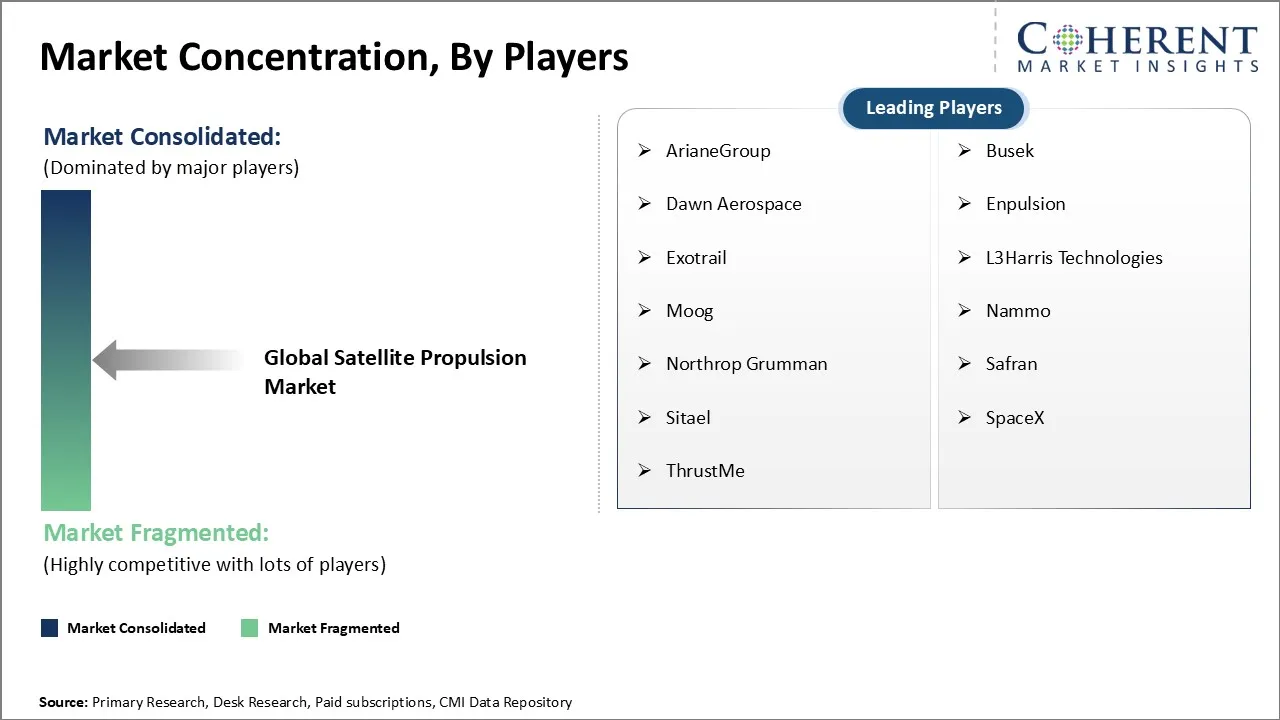
The market is shared between three groups that increasingly overlap. Established propulsion suppliers such as Rocketdyne (formerly part of L3Harris), Northrop Grumman, Safran, ArianeGroup, Nammo and Moog provide chemical engines and high-power electric systems with long flight heritage. Electric propulsion specialists such as Busek, Enpulsion, Exotrail, Sitael and ThrustMe sell compact Hall, ion and field-emission thrusters to constellation builders. Dawn Aerospace competes with non-toxic chemical propulsion and refueling-ready systems. SpaceX builds its own Hall thrusters for Starlink and does not sell them to others. Competition centers on flight heritage, thrust-to-power ratio, delivery time, propellant choice and export-control status. Qualification cycles and flight heritage make it hard for new entrants to displace established suppliers.
Top Companies and Notable Products in the Satellite Propulsion Market
Company | Notable Product | Key Features |
Busek | BHT-series Hall thrusters and BIT-3 ion thruster | Flight heritage that began in 2006 with a 200 W Hall thruster on TacSat-2; also offers an ASCENT-fueled green monopropellant thruster |
Dawn Aerospace | B20 and B1 thrusters, SatDrive and CubeDrive systems | Non-toxic nitrous oxide and propylene propulsion delivered as turnkey systems with tanks, valves and control electronics |
Enpulsion | Nano, Micro R3 and Nexus | Modular electric propulsion based on Field Emission Electric Propulsion for micro and nanosatellites; ISO 9001:2015 certified |
Nammo | LEROS apogee engine family | Bipropellant engines hot-fire tested at the UK National Space Propulsion Test Facility at Westcott |
Safran | PPS 5000, PPS 1350 and PPS X00 | Hall effect thrusters spanning 400 W to 5,000 W power ranges for LEO constellations and all-electric satellites |
Sitael | HT 100, HT 400 and HT 5k | Hall effect thruster family built on European, ITAR-free technologies, with hollow cathode and power processing options |
Market Report Scope
Global Satellite Propulsion Market Report Coverage | |||
Report Coverage | Details | ||
Base Year | 2025 | Market Size in 2026: | USD 2.07 Bn |
Historical Data For: | 2020 To 2024 | Forecast Period: | 2026 To 2033 |
Forecast Period 2026 To 2033 CAGR: | 17.60% | 2033 Value Projection: | USD 6.44 Bn |
Geographies covered: |
| ||
Segments covered: |
| ||
Companies covered: | ArianeGroup, Busek, Dawn Aerospace, Enpulsion, Exotrail, L3Harris Technologies, Moog, Nammo, Northrop Grumman, Safran, Sitael, SpaceX, ThrustMe | ||
Growth Drivers: |
| ||
Restraints & Challenges: |
| ||
Analyst Opinion (Expert Opinion)
- Small platforms and thrusters lead, but heritage and supply decide the wins. Small satellites hold 62.0% of platform spending in 2026, thrusters hold 40.0% of the system segment, and commercial operators lead the end user segment. Buyers choose propulsion that is qualified, available on a fixed delivery date and proven in orbit, so contests are mostly won on heritage and delivery. Vendors that build standard thrusters at volume and can show orbital flight history are best placed.
- Growth is strongest where launches and national programs are scaling, and two risks remain. North America leads, with a share of 84.6% in 2026, while Asia Pacific, with a 4.8% share, grows fastest as satellite manufacturing and launches expand. The first risk is export-control and certification complexity for propulsion hardware. The second is supply-chain constraints, including long thruster lead times of about 18 months from order to delivery. Vendors with in-region production and qualified second sources are the least exposed to both.
Speak to the analyst
Want personalized insights?
Take the findings above to one of our principal consultants, or have the report rebuilt around the segments, geographies and competitors you actually track.
Market Segmentation
- Platform Insights (Revenue, USD Billion, 2021 - 2033)
- Small (1–1,200 kg)
- Medium (1,201–2,000 kg)
- Large (above 2,000 kg)
- System Insights (Revenue, USD Billion, 2021 - 2033)
- Thrusters
- Propellant Feed System
- Power Processing Unit
- Others
- Propulsion Technology Insights (Revenue, USD Billion, 2021 - 2033)
- Chemical
- Electric
- Cold Gas
- End User Insights (Revenue, USD Billion, 2021 - 2033)
- Commercial
- Government & Civil
- Defense
- Regional Insights (Revenue, USD Billion, 2021 - 2033)
- North America
- U.S.
- Canada
- Latin America
- Brazil
- Argentina
- Mexico
- Rest of Latin America
- Europe
- Germany
- U.K.
- Spain
- France
- Italy
- Russia
- Rest of Europe
- Asia Pacific
- China
- India
- Japan
- Australia
- South Korea
- ASEAN
- Rest of Asia Pacific
- Middle East
- GCC Countries
- Israel
- Rest of Middle East
- Africa
- South Africa
- North Africa
- Central Africa
- North America
- Key Players Insights
- ArianeGroup
- Busek
- Dawn Aerospace
- Enpulsion
- Exotrail
- L3Harris Technologies
- Moog
- Nammo
- Northrop Grumman
- Safran
- Sitael
- SpaceX
- ThrustMe
Sources
Primary Research Interviews
- Satellite Propulsion Engineers and Product Managers
- Satellite Manufacturers and Constellation Operators' Procurement Heads
- Electric and Chemical Propulsion Vendors
- Launch Service and Orbital Transfer Vehicle Providers
- Space Agency and Defense Program Officials
Magazines
- SatNews
- SpaceNews
- Aerospace America (AIAA)
- Aviation Week
- European Spaceflight
Journals
- International Electric Propulsion Conference (IEPC) Proceedings
- International Astronautical Congress (IAC) Proceedings
- Journal of Propulsion and Power
Associations
- American Institute of Aeronautics and Astronautics (AIAA)
- Satellite Industry Association (SIA)
- Electric Rocket Propulsion Society (ERPS)
Public Domain Sources
- European Space Agency (ESA): Sitael HT100 qualification article, June 27, 2023
- Federal Communications Commission: Orbital Debris Second Report and Order, adopted September 29, 2022
- CNES: French propulsion fact sheet, December 2025
- Company press releases and newsrooms (ThrustMe, AE Industrial, Dawn Aerospace, Enpulsion, Exotrail, Safran, L3Harris, Nammo, Busek, Sitael)
- Federal Communications Commission: SpaceX Gen 1 and Gen 2 Status Report, December 1, 2025 – May 31, 2026
- German Aerospace Center (DLR): Collision avoidance in satellite operations
Proprietary Elements
- CMI Data Analytics Tool
- Proprietary CMI Existing Repository of information for last 10 years
Get access to 250+ pages report
Every segment, forecast, competitor profile and data table behind the analysis above — available for instant download.
- ESOMAR Member
- ISO 9001:2015 Certified
- D-U-N-S Registered
- GDPR & CCPA Compliant
Frequently Asked Questions
The global satellite propulsion market is valued at USD 2.07 Bn in 2026 and is expected to reach USD 6.44 Bn by 2033.
The CAGR of the global satellite propulsion market is projected to be 17.6% from 2026 to 2033.
Expanding LEO constellations and rising satellite launch cadence driving thruster volumes, and the orbit-raising, station-keeping, collision-avoidance and deorbit needs of commercial operators, are the major factors driving market growth.
Export-control and certification complexity for propulsion hardware, and supply-chain constraints including long thruster lead times of about 18 months from order to delivery, are the major factors hampering market growth.
In terms of platform, the Small (1–1,200 kg) segment is expected to dominate the market, with a revenue share of 62.0% in 2026.
It is the set of thrusters, engines, propellant feed hardware and power electronics that lets a satellite raise its orbit, hold its position, avoid collisions and leave orbit at the end of its life.
A chemical system combines propellant tanks, pressurant, valves, regulators and thrusters or engines. An electric system adds a power processing unit that converts bus power for the thruster, a flow controller and a tank for xenon, krypton or iodine propellant. Control electronics command both types.