

Global Screw Jacks Market Size and Forecast – 2026 To 2033
The global screw jacks market is expected to grow from USD 320 Mn in 2026 to USD 490 Mn by 2033, registering a compound annual growth rate (CAGR) of 5.6% from 2026 to 2033. The global screw jacks market is driven by expansion of infrastructure projects. On May 13, 2025, Bechtel signed an agreement with the King Salman International Airport Development Company to serve as the delivery partner for three new terminals at King Salman International Airport (KSIA) in Riyadh, Saudi Arabia.
Key Takeaways of the Global Screw Jacks Market
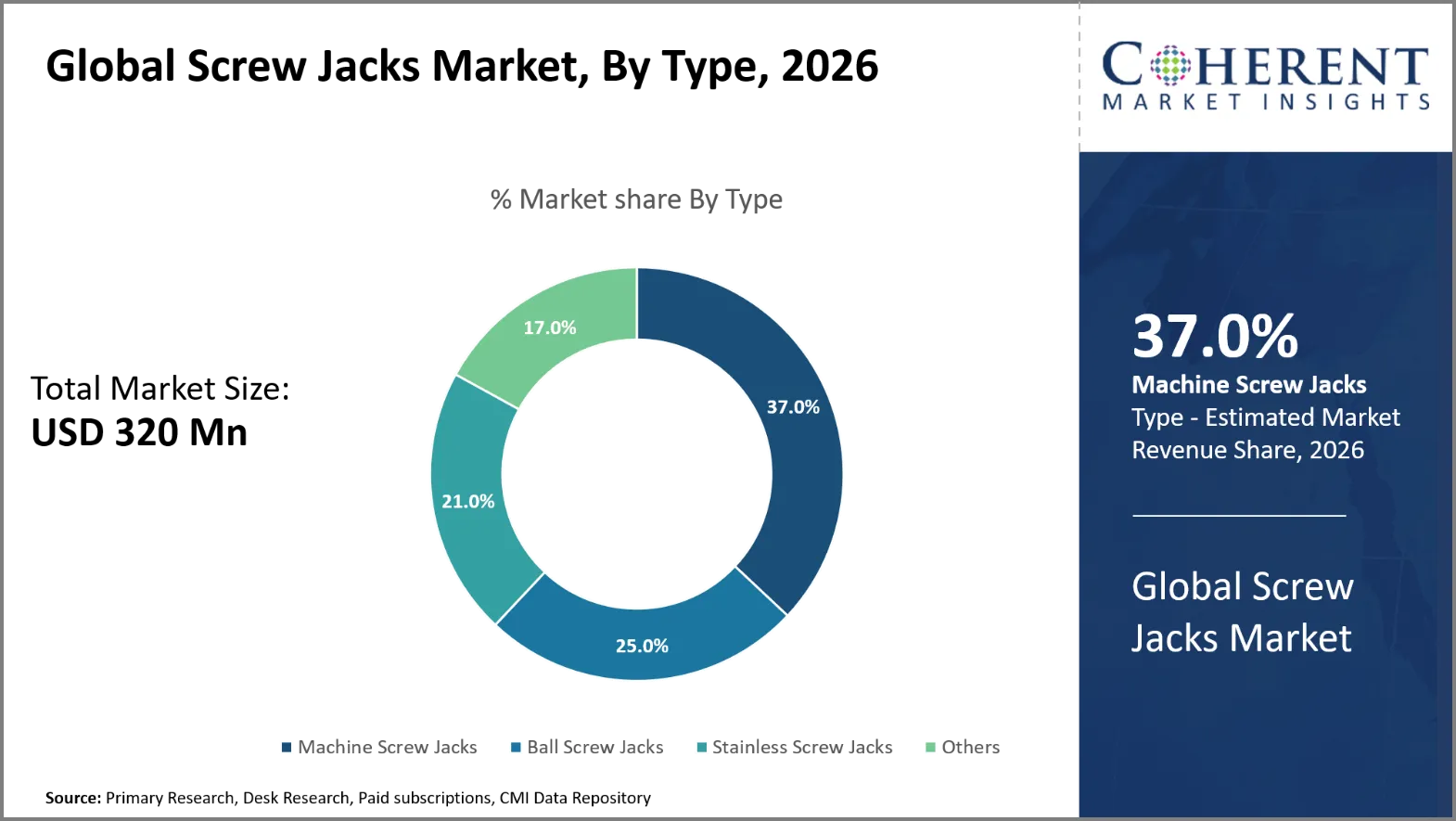
- The Machine Screw Jacks segment is expected to account for 37.0% of the global screw jacks market share in 2026. Increasing material handling automation is driving the growth of the segment. In April 2025, Daifuku opened a new Hyderabad manufacturing plant for material handling systems. The facility produces automated storage and retrieval systems, pallet sorters, and conveyors.
- The Grease segment is estimated to capture 56.0% of the market share in 2026. Growth of automotive production is majorly driving the growth of the segment. In October 2025, Stellantis announced a USD 13 billion manufacturing investment. The program targets five new vehicle launches and 19 product actions across several U.S. plants.
- The Up to 5 Tons segment is estimated to capture 49.0% of the market share in 2026. Rising aerospace manufacturing activity is majorly driving the growth of the segment. In July 2026, Boeing opened its new North Line at Everett, Washington. The production line increases manufacturing capacity and supports future 737 production expansion.
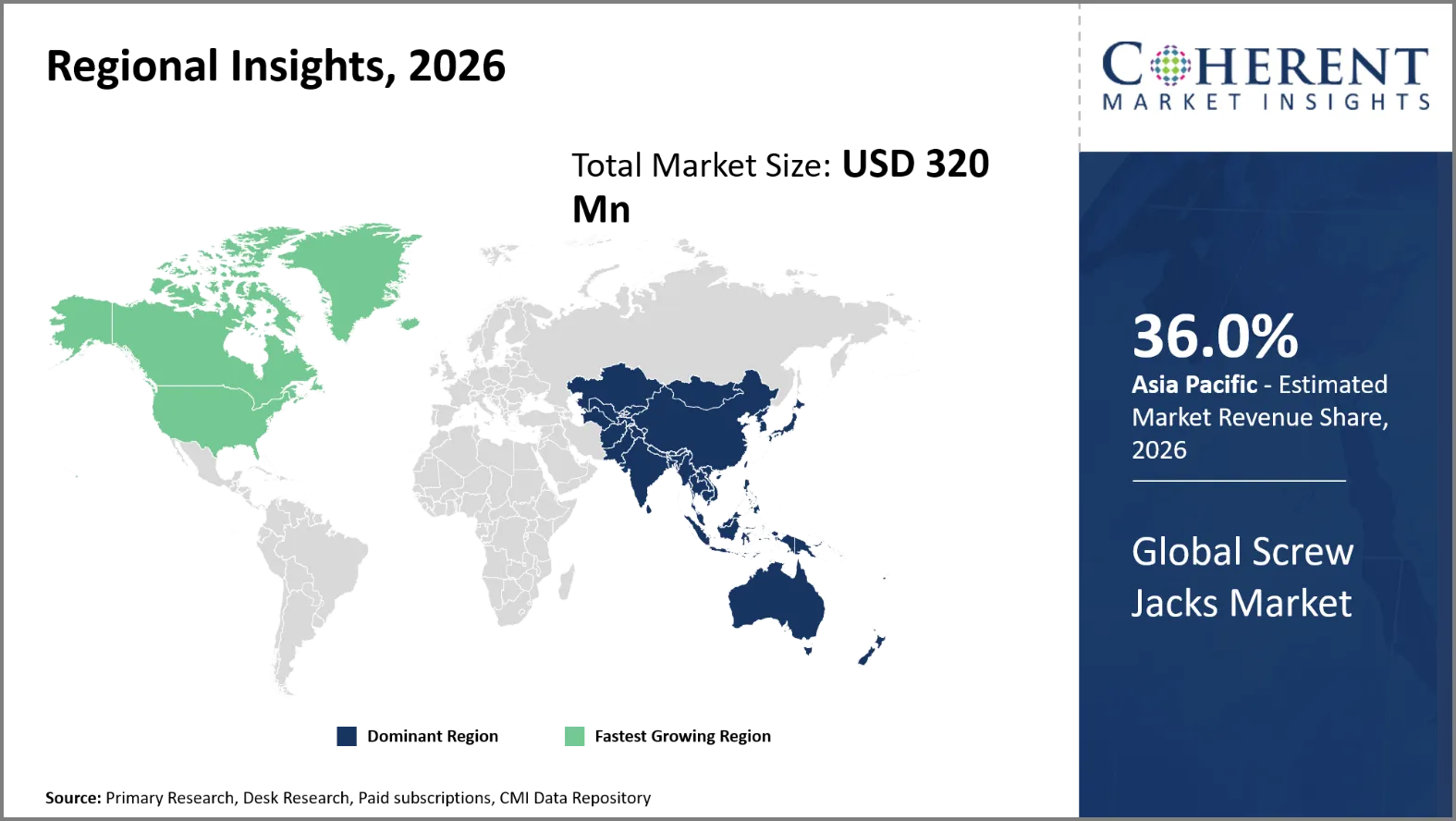
- Asia Pacific is expected to dominate the screw jacks market in 2026 with a market share of 36.0%. Increasing factory automation investments in Asia Pacific is driving the growth of the regional market. On March 11, 2026, ABB announced new manufacturing investments across Karnataka. The expansion includes new Motion facilities, automation production, service centers, and precision equipment manufacturing.
- North America is expected to account for 25.0% share in 2026 and is projected to record the fastest growth over the forecast period. Growing renewable energy installations in North America is driving the growth of the regional market. On March 6, 2026, RWE reported commissioning 2 gigawatts of new U.S. energy projects. The portfolio covered projects across Kentucky, Arizona, Illinois, New York, Texas, California, and Louisiana.
Segmental Insights
Why Does Machine Screw Jacks Dominate the Global Screw Jacks Market?
The machine screw jacks segment is expected to account for 37.0% of the global screw jacks market share in 2026. Machine screw jacks are well known for their ability to provide consistent lifting performance in a variety of industrial applications. Their simple mechanical architecture makes for reliable functioning under severe load situations. They provide cheap positioning and lifting over more complicated options. Their availability in diverse load capacities caters to manufacturing, material handling and construction needs. Their continued use in industrial facilities is also due to established maintenance procedures and broad compatibility. On October 22, 2025, Power Jacks introduced a new 10 kN E-Series machine screw jack for machine construction applications. The design has bolt on mounting points for motor, brakes, encoders and rotary limit switches.
- Current Industry Events of 2026
- Market Size Estimation
- Regional Breakdown
- Competitive Landscape
- Customer Intelligence
- Segmental Analysis
- Pricing Analysis
- Key Market Drivers, Challenges & Future Trends
- Customized Insights Section
Why is Grease the Most Preferred Lubrication Type?
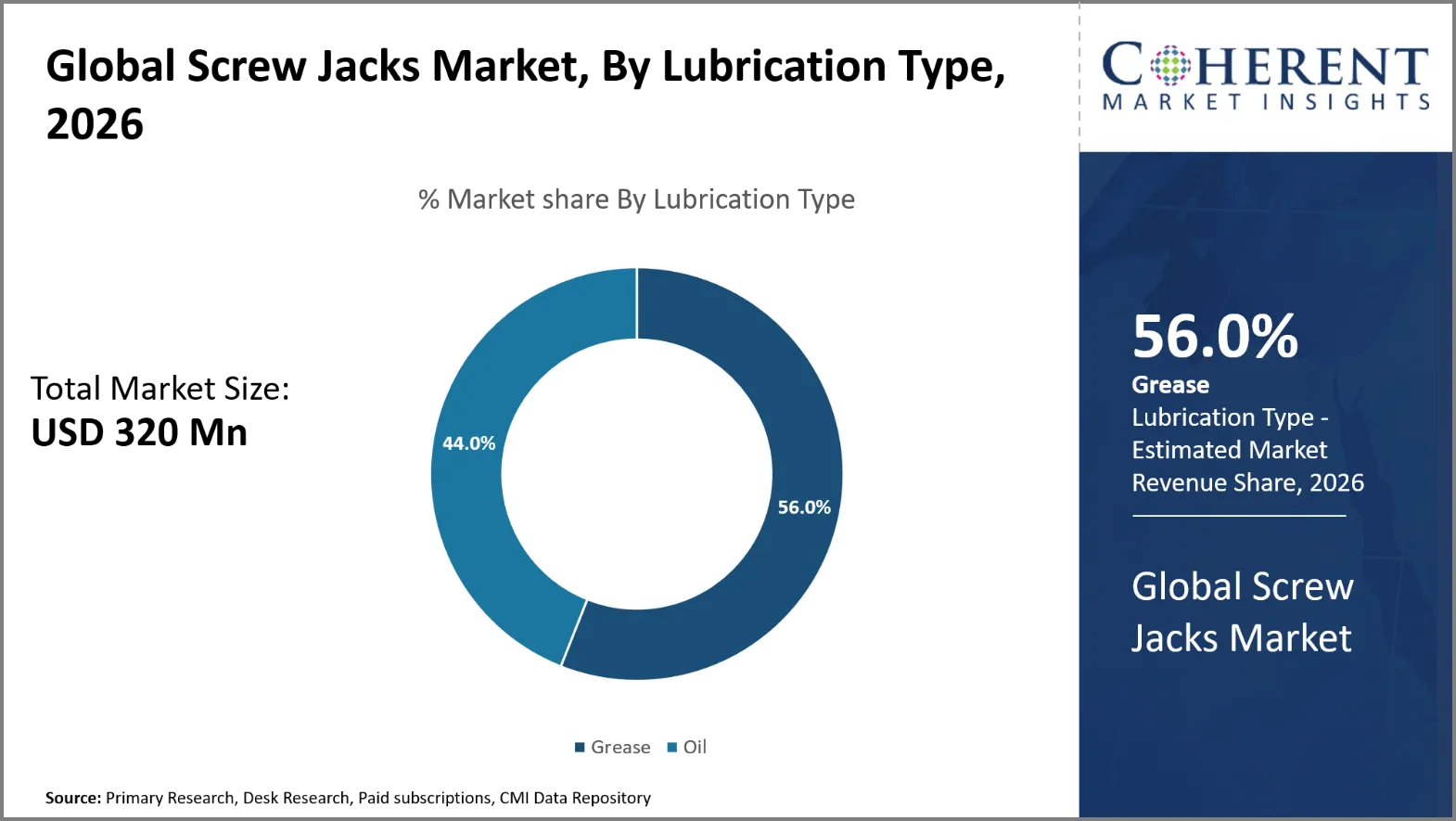
The grease segment is expected to account for 56.0% of the global screw jacks market share in 2026. Grease is beneficial because it provides good lubrication and will stay in place on the screw jack parts. Its greater viscosity will keep lubrication under intermittent lifting and holding operations. Grease also limits the leaking of lubricants in many enclosed mechanical assemblies. It has less maintenance schedules as it does not normally need to be replenished often. These features make grease ideal for industrial environments where reliable, low-maintenance screw jack operation is required. In November 2025, ZIMM published application guidance recommending matched high-performance greases for its screw jacks. The company also highlighted its Z-LUB automatic lubrication system. Recommendations vary according to food-processing, vacuum, cleanroom, and other operating environments.
Up to 5 Tons Dominates the Global Screw Jacks Market
The up to 5 tons segment is expected to account for 49.0% of the global screw jacks market share in 2026. The extensive usage of small lifting systems in manufacturing and material handling applications supports the need. These systems have enough capacity for machinery positioning, assembly activities and equipment adjustment. Their reduced mechanical size can make them easier to deploy in industrial locations where space is at a premium. Lower structural requirements can also help economically integrate the system across several workstations. These advantages stimulate their utilization in applications where moderate lifting loads are enough for normal industrial activities. In April 2025, Joyce/Dayton extended its positioning solutions to include 1-ton machine screw jacks for small lifting applications. The WJ51 and WJ201 variants have a 1-ton capacity and utilize a 3/4-inch lifting screw. They support either upright or inverted mounting and either tension or compression loading. Self-locking mechanism is suitable for controlled positioning operations.
Current Events and their Impact
Current Events | Description and its Impact |
European Union Machinery Regulation (EU) 2023/1230 |
|
U.S. Occupational Safety and Health Administration Machine Guarding Standard, 29 CFR 1910.212. |
|
Screw Jacks Market Dynamics
Market Drivers
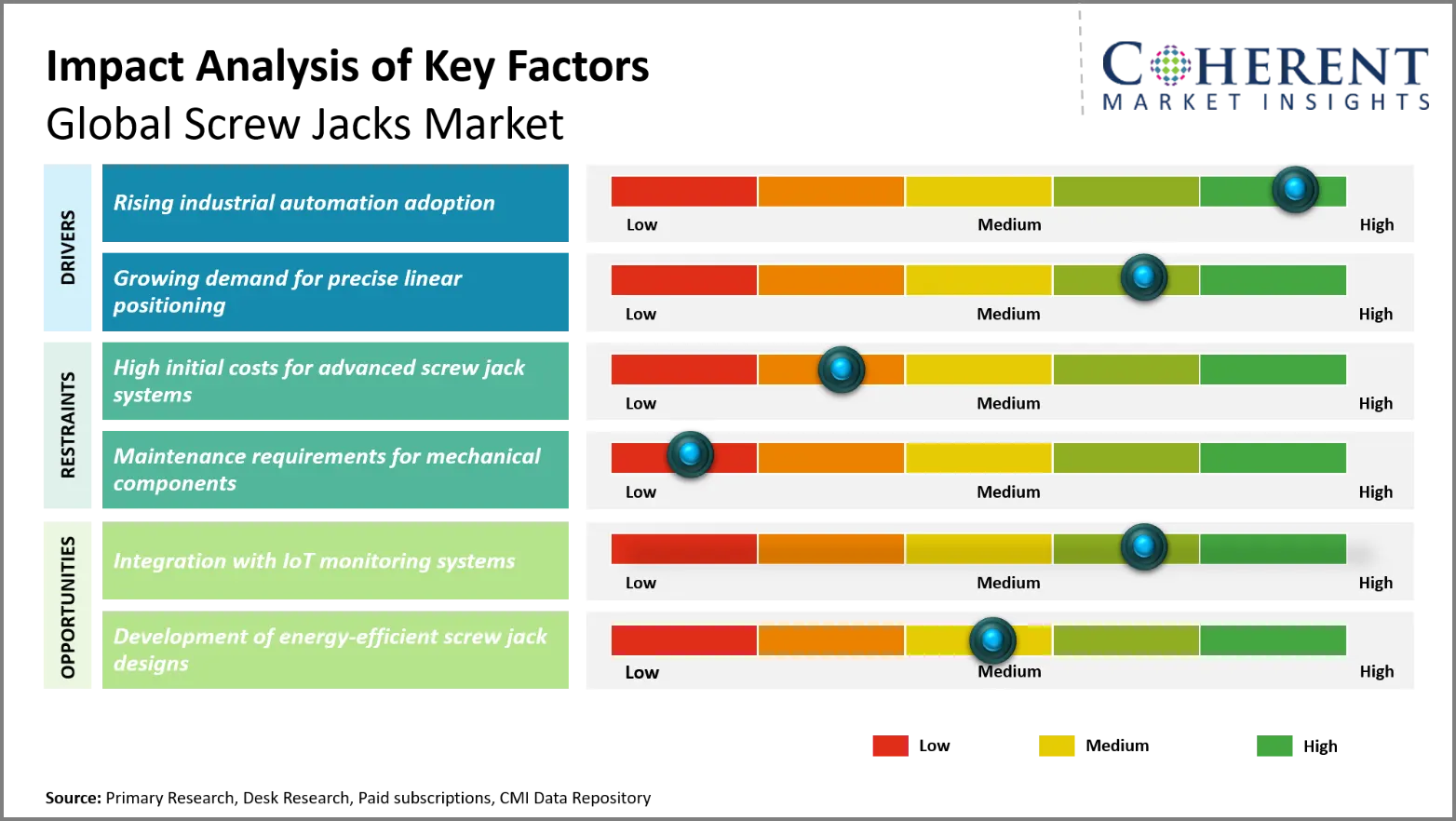
Rising industrial automation adoption
Industrial automation is contributing to the growth in demand for reliable mechanical lifting and positioning equipment throughout production facilities. Screw jacks are used in automated machinery for controlled lifting, adjustment, alignment and synchronization. In automated manufacturing lines regular movement with little operator involvement is required. Their mechanical design is suitable for incorporation with motors, gearboxes and centralized control systems. Thus, increased automation investments are expanding screw jack applications in automotive, packaging, material handling and industrial machines.
On May 19, 2026, ABB announced it is investing in a new campus in Nanjing, China, to become one of the most advanced facilities of its kind. This investment will provide ABB a second campus in China dedicated to drive goods besides its Beijing plant. The Nanjing facility will house a customer experience center, an OEM Hub for product and application demos and client testing and training, and production and R&D facilities.
Growing demand for precise linear positioning
There is a growing trend among manufacturers to require precision linear movement for machinery setup, assembly and manufacturing operations. Screw jacks offer regulated vertical and horizontal placement with predictable mechanical movement. They can work in unison and support several lifting points in complex industrial systems. The accuracy requirements are especially stringent for equipment used in automatic assembly and material handling machines. This demand stimulates the usage of screw jacks when repeatable placement and controlled load movement are required. In January 2025, Thomson rolled out an improvement to its micro precision lead screw configurator. The tool can work on lead screws with sizes from 2 to 4 mm. These devices are aimed at medical equipment, robotics and factory automation applications that require compact positioning.
Emerging Trends
- Smart monitoring integration: Screw jack systems are increasingly being integrated with smart sensors to monitor load, position, temperature and vibration. These features include condition tracking, greater operational visibility, and predictive maintenance plans for automated manufacturing, material handling, and industrial lifting applications.
- Electromechanical system integration: Manufacturers are coupling screw jacks with electric motors, gearboxes and digital controllers. Integrated configurations allow for synchronized lifting, automated positioning and programmable motion, enabling more sophisticated manufacturing systems that require accurate and repeatable mechanical processes.
- Energy-efficient lifting solutions: There is a growing demand for screw jack systems to conserve energy in industrial processes. To help meet sustainability goals, manufacturers are enhancing transmission efficiency, mechanical design and motor integration, all while retaining reliable lifting and positioning capabilities.
- Customized modular designs: Increasingly, end users are requesting screw jacks that are customized for specified load capacities, dimensions, speeds and operating situations. Modular designs allow manufacturers to modify components to meet application demands providing flexible deployment across a variety of industrial machinery and automation systems.
Regional Insights
Why is Asia Pacific a Strong Market for Screw Jacks?
Asia Pacific is expected to account for a market share of 36.0% in 2026. The growth of semiconductor, electronics, automotive and electric vehicle manufacturing is benefitting the Asia Pacific. In 2024, 20% of regional foreign direct investment inflows went to ASEAN manufacturing. Semiconductor exports account for about 23% to 24% globally. Toyota, Samsung, Foxconn, and Infineon operate interconnected production networks across the region. These facilities require synchronized lifting, positioning, and adjustment equipment. Screw jacks therefore gain applications in automated assembly, packaging, semiconductor handling, and production-line equipment. ASEAN manufacturing represented 18% of regional gross domestic product in 2025.
Why Does North America Screw Jacks Market Exhibit High Growth?
North America is expected to register the fastest growth with a CAGR of 7.2% over the forecast period. The region is projected to account for 25.0% of the global screw jacks market in 2026. Demand here benefits from reshoring, aerospace production, automotive manufacturing, and automated factory investment. The U.S. industrial production increased 0.4% in December 2025. Manufacturing output also increased 0.2% during that month. Business equipment production recorded stronger activity during 2025. Industrial robots provide another important application base for precision mechanical components. The United States accounted for 6% of global industrial robot installations during 2024. Screw jacks can support automated lifting platforms, tooling adjustment, conveyor positioning, and synchronized machinery movement. Aerospace manufacturing also creates requirements for controlled positioning equipment.
Global Screw Jacks Market Outlook for Key Countries
Why is China Emerging as a Major Hub in the Screw Jacks Market?
China is a major growth center because equipment manufacturing and industrial automation are expanding rapidly. Equipment manufacturing value added increased 9.2% during 2025. Global industrial robot output was about 773,000 units in 2025. Industrial robot production rose 28% year-on-year. In the same year, the output of new energy vehicles rose 25.1%. Manufacturers raised their spending on automated equipment by 11.3% in 2025. These innovations are supporting screw jack applications in automobile assembly, robotic workstations, battery manufacture and machine positioning.
Is U.S. the Next Growth Engine for the Screw Jacks Market?
The U.S. screw jacks market is supported by automation investment across aerospace, automotive, electronics, and industrial equipment manufacturing. Industrial production increased 2.0% year over year in December 2025. Manufacturing production also increased during December. Machinery production represents an important industrial equipment category. The Federal Reserve reported machinery industry production growth during 2025. The US also represented 6% of global industrial robot installations in 2024. Automated lifting tables, assembly fixtures, machine adjustments and synchronized production equipment are supported by screw jacks.
Germany Screw Jacks Market Analysis and Trends
Germany presents demand from machinery manufacturing, automotive production, and highly automated industrial facilities. Industrial production declined 1.1% during 2025. Machinery and equipment production declined 2.6% during the year. Germany remained the world’s fifth-largest market for industrial robots in 2024. Thus, German companies have high requirements for automated positioning and mechanical adjustment systems. Screw jacks are relevant for machine tools, production fixtures, lifting platforms, and synchronized handling equipment. Automotive facilities also create applications requiring repeatable positioning during assembly and component handling operations.
Japan Screw Jacks Market Analysis and Trends
Japan has strong screw jack demand because manufacturers extensively integrate robotics into production equipment. Japan installed 44,500 industrial robots during 2024. Its operational industrial robot stock reached approximately 450,500 units. Japan also had significant machine tool production and exports in 2025. 2025: Japanese robot industry output up 21.0%. These conditions are perfect for screw jack applications in robotic work cells, machine tools, inspection systems and automated assembly equipment. Precision positioning requirements remain particularly relevant for compact automated machinery.
India Screw Jacks Market Analysis and Trends
India is developing demand through automotive automation, pharmaceutical production, electronics manufacturing, and expanding industrial robotics. India installed 9,100 industrial robots during 2024. Automotive applications represented 45% of those installations. India’s manufacturing expansion also includes pharmaceutical, rubber, plastics, and basic metals production. Official industrial production data tracks these manufacturing segments separately. Screw jacks are useful for supporting automotive assembly fixtures, material handling systems, packing equipment and machinery adjustment applications. The automobile factories are becoming more automated and hence require more synchronized lifting and accurate mechanical placement.
Global Screw Jacks Market - Screw Jack System Versus Standalone Jack Adoption By Region (2025)
Region | Screw Jack System Adoption | Standalone Jack Adoption |
North America | 58.0% | 42.0% |
Europe | 61.0% | 39.0% |
Asia Pacific | 54.0% | 46.0% |
Latin America | 47.0% | 53.0% |
Middle East & Africa | 44.0% | 56.0% |
How is Integration with IoT Monitoring Systems Creating New Growth Opportunities in the Screw Jacks Market?
Integration with Internet of Things monitoring systems adds real-time condition monitoring to screw jack assemblies, opening up potential. During the lifting cycles, sensors are able to monitor load, torque, location, temperature and vibration. Connected monitoring can detect abnormal torque rise before serious damage of the mechanical components. The manufacturers can link the sensor outputs to programmable logic controllers to provide automatic maintenance alerts. This is especially true for synchronized lifting platforms, production lines and automated material handling systems. Remote condition data can also assist maintenance crews in comparing running cycles and identifying lubrication or alignment problems. Such characteristics compel manufacturers to create connected screw jack systems instead of traditional mechanically operated equipment. On November 22, 2025, Festo launched the CEPE edge device for Internet of Things and industrial motion applications. The device collects and analyzes manufacturing data locally, and controls automated operations. It supports motion applications like as pick-and-place, palletizing and servo presses.
Market Players, Key Development, and Competitive Landscape
Key Developments
- On September 1, 2026, Power Jacks officially launched its new ATEX-rated Screw Jacks for potentially explosive environments. The new ATEX-rated Screw Jacks give engineers increased capability when designing electromechanical solutions for applications where hazardous environments and potentially explosive atmospheres need to be considered.
- On March 3, 2026, Servomech announced it will be among the protagonists at MECSPE 2026, scheduled to take place in Bologna from March 4-6, 2026. It will present a complete overview of linear actuators and mechanical jacks, from trapezoidal screw and recirculating ball solutions to satellite roller screw technology.
- On October 22, 2025, Joyce/Dayton Corp. announced that its USD 8.7 million expanded production facility in Portland, Indiana, U.S., was fully operational. The new capacity is already streamlining the production of the company's industry-leading screw jacks and EDrive electric actuators, meeting high customer demand from the automation and industrial sectors.
Competitive Landscape
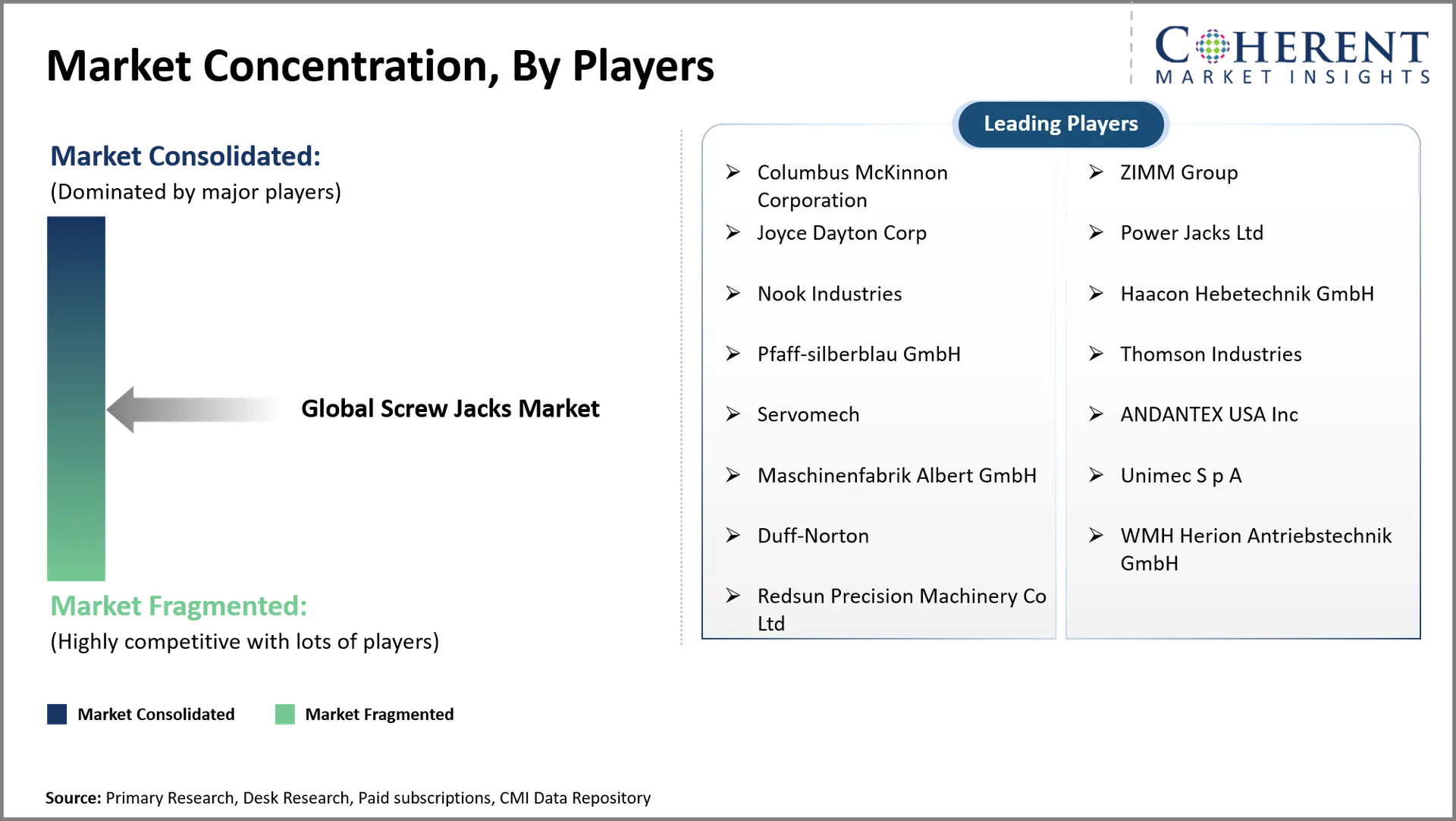
Leading players are distinguishing themselves by offering a wide range of products, customization, and integrated motion-control capabilities. Joyce/Dayton supplies machine screw, ball screw, metric, stainless steel and integrated actuator products. Its JAX Online program helps engineers design multi-jack lifting systems and determine motor needs. Power Jacks specializes in designed lifting and linear motion solutions for harsh industrial environments. ZIMM develops modular screw jack systems for synchronized lifting applications. Columbus McKinnon expands their position with expanded lifting and motion-control capabilities. Across the competitive landscape, suppliers are increasingly combining screw jacks with motors, controls, encoders, and application-specific engineering rather than selling standalone mechanical units.
Market Report Scope
Screw Jacks Market Report Coverage | |||
Report Coverage | Details | ||
Base Year | 2025 | Market Size in 2026: | USD 320 Mn |
Historical Data For: | 2020 To 2024 | Forecast Period: | 2026 To 2033 |
Forecast Period 2026 To 2033 CAGR: | 5.6% | 2033 Value Projection: | USD 490 Mn |
Geographies covered: |
| ||
Segments covered: |
| ||
Companies covered: | Columbus McKinnon Corporation, ZIMM Group, Joyce Dayton Corp, Power Jacks Ltd, Nook Industries, Haacon Hebetechnik GmbH, Pfaff-silberblau GmbH, Thomson Industries, Servomech, ANDANTEX USA Inc, Maschinenfabrik Albert GmbH, Unimec S p A, Duff-Norton, WMH Herion Antriebstechnik GmbH, Redsun Precision Machinery Co Ltd | ||
Growth Drivers: |
| ||
Restraints & Challenges: |
| ||
Analyst Opinion (Expert Opinion)
- The future of the industry is likely to center on electrically driven and digitally controlled lifting systems. Machine screw jacks should remain important where self-locking operation and moderate lifting speeds are required. Ball screw designs can gain applications requiring faster movement and higher mechanical efficiency. Joyce/Dayton already offers ball screw jacks requiring substantially less input torque than comparable machine screw designs.
- The strongest opportunities should emerge in automated manufacturing, packaging equipment, conveyor adjustment, solar tracking, and precision machinery. China and India offer substantial opportunities because manufacturers are expanding automated production capacity. Japan remains important for precision automation applications. In developed markets, opportunities should increasingly involve replacement of hydraulic or pneumatic mechanisms with electrically controlled screw jack assemblies.
- Players seeking an edge should develop complete lifting systems instead of competing primarily on individual jack specifications. Integrated motors, encoders, position feedback, and programmable controls can increase system value. Joyce/Dayton already provides encoders, potentiometers, protective boots, and custom configurations for its jack systems. Manufacturers should also strengthen application engineering, digital configuration tools, predictive maintenance capabilities, and rapid customization for specialized industrial machinery.
Speak to the analyst
Want personalized insights?
Take the findings above to one of our principal consultants, or have the report rebuilt around the segments, geographies and competitors you actually track.
Market Segmentation
- Type Insights (Revenue, USD Million, 2021 - 2033)
- Machine Screw Jacks
- Ball Screw Jacks
- Stainless Screw Jacks
- Others
- Lubrication Type Insights (Revenue, USD Million, 2021 - 2033)
- Grease
- Oil
- Load Capacity Insights (Revenue, USD Million, 2021 - 2033)
- Up to 5 Tons
- 5 to 20 Tons
- Above 20 Tons
- Application Insights (Revenue, USD Million, 2021 - 2033)
- Automotive
- Manufacturing
- Construction
- Aerospace
- Material Handling
- Regional Insights (Revenue, USD Million, 2021 - 2033)
- North America
- U.S.
- Canada
- Latin America
- Brazil
- Argentina
- Mexico
- Rest of Latin America
- Europe
- Germany
- U.K.
- Spain
- France
- Italy
- Russia
- Rest of Europe
- Asia Pacific
- China
- India
- Japan
- Australia
- South Korea
- ASEAN
- Rest of Asia Pacific
- Middle East
- GCC Countries
- Israel
- Rest of Middle East
- Africa
- South Africa
- North Africa
- Central Africa
- North America
- Key Players Insights
- Columbus McKinnon Corporation
- ZIMM Group
- Joyce Dayton Corp
- Power Jacks Ltd
- Nook Industries
- Haacon Hebetechnik GmbH
- Pfaff-silberblau GmbH
- Thomson Industries
- Servomech
- ANDANTEX USA Inc
- Maschinenfabrik Albert GmbH
- Unimec S p A
- Duff-Norton
- WMH Herion Antriebstechnik GmbH
- Redsun Precision Machinery Co Ltd
Sources
Primary Research Interviews
- Screw Jack Manufacturers & OEMs
- Industrial Machinery Distributors & Suppliers
- End-User Industries (Aerospace, Automotive & Heavy Engineering)
- Mechanical Power Transmission Equipment Experts & Consultants
Magazines
- Machine Design Magazine
- Power Transmission Engineering Magazine
- Industrial Equipment News (IEN)
- Design Engineering Magazine
Journals
- Journal of Mechanical Engineering Science
- International Journal of Advanced Manufacturing Technology
- Journal of Mechanical Design (ASME)
Associations
- American Gear Manufacturers Association (AGMA)
- European Association of Machine Tool Industries (CECIMO)
- Motion Control & Motor Association (MCMA)
Public Domain Sources
- U.S. International Trade Commission (USITC) Trade Data
- European Commission Industrial Reports & Statistics
- U.S. Census Bureau – Manufacturing & Industrial Data
- World Trade Organization (WTO) – Industrial Machinery Trade Reports
Proprietary Elements
- CMI Data Analytics Tool
- Proprietary CMI Existing Repository of Information for Last 10 Years
Get access to 250+ pages report
Every segment, forecast, competitor profile and data table behind the analysis above — available for instant download.
- ESOMAR Member
- ISO 9001:2015 Certified
- D-U-N-S Registered
- GDPR & CCPA Compliant
Missing comfort of reading report in your local language? Find your preferred language:
Frequently Asked Questions
The global screw jacks market is expected to stand at USD 320 Mn in 2026 and is expected to reach USD 490 Mn by 2033.
The CAGR of the global screw jacks market is projected to be 5.6% from 2026 to 2033.
Rising industrial automation adoption and Growing demand for precise linear positioning are the major factors driving the growth of the global screw jacks market.
High initial costs for advanced screw jack systems and Maintenance requirements for mechanical components are the major factors hampering the growth of the global screw jacks market.
In terms of type, machine screw jacks segment is estimated to dominate the market revenue share in 2026.
A screw jack converts rotary motion into controlled linear lifting or positioning movement.
Machine screw jacks use a threaded lifting screw to convert rotary input into linear movement.