

Global Sheep Milk Market Size and Forecast – 2026 To 2033
The global sheep milk market is expected to grow from USD 7.4 Mn in 2026 to USD 10.9 Mn by 2033, registering a compound annual growth rate (CAGR) of 5.8% from 2026 to 2033. Currently, the market is branded as a premium value-added dairy market with sheep milk being used almost exclusively in cheese making, yogurt production, fermented dairy, butter, cream and milk powder.
Sheep milk has a higher fat, protein and total solids content than cow's milk, which makes it very suitable for cheese and yogurt production. Sheep milk cheese remains the core value driver in the global sheep milk market, supported by well-established cheese production ecosystems in Greece, Spain, Italy, and France. In 2024, ewe and goat milk production remained strong across these countries, reinforcing Europe’s role as a major processing hub for sheep milk-based dairy products. For instance, the European Commission states that Feta PDO is produced from ewe and goat milk, with the milk required to contain at least 6% fat. This highlights the role of sheep milk in premium processed dairy products, protected-origin cheese categories, and export-oriented value chains, rather than mass liquid milk consumption. (Source: European Commission)
Key Takeaways of the Global Sheep Milk Market
- Sheep milk is not widely consumed as packaged liquid milk compared to cow milk. Its commercial demand is mainly driven by processed dairy products such as cheese, fermented dairy, yogurt, butter, cream, and milk powder. Based on value, sheep milk cheese is expected to be the largest product type segment in the global sheep milk market, accounting for an estimated 46.80 % share in 2026. The segment is strongly supported by Europe, where countries such as Greece, Spain, Italy, and France have a long tradition of processing sheep milk into premium cheeses. Eurostat data also shows that EU dairy processing is largely product-oriented, with cheese and butter accounting for 69.0% of whole milk used by dairies in 2024. This supports the view that processed dairy formats generate higher value than direct liquid milk consumption. (Source: European Union)
- The conventional segment is expected to remain dominant in the global sheep milk market, accounting for 58.6 % share in 2026. Its leadership is driven by the strong presence of traditional dairy farming systems, established sheep milk collection networks, and long-standing cheese processing practices across key producing regions such as Spain, Greece, France, and Italy. Conventional processing enables dairy manufacturers to procure larger milk volumes, maintain better cost control, and produce value-added products such as cheese, yogurt, butter, cream, and milk powder at a stable commercial scale. While organic sheep milk is gaining traction in premium retail, its higher certification, feed, grazing, and compliance requirements continue to limit large-scale adoption compared to conventional processing.
- In 2026, Europe's share of sheep milk consumption will be 42.6 % of the market. The region’s leadership is not only due to high production but also because of its strong sheep milk processing ecosystem, protected cheese categories, cooperative dairy networks, and export-focused cheese industry. In Greece, sheep and goat milk remain key raw materials for dairy production, with Feta continuing to be one of the country’s most important geographical indication products. Spain, France, and Italy also have a strong tradition of producing specialty cheeses and high-quality dairy products from sheep and goat milk, further supporting the region’s strong position in the global sheep milk market. In 2024, according to Eurostat, Spain produced 1.1 million tons of milk from ewes and goats, Greece 0.9 million tons, France 0.8 million tons, and Italy 0.7 million tons from non-cow milk. (Source: Eurostat European Union)
- Asia Pacific is also expected to account for the largest market share of 24.8 % in the global sheep milk market in 2026 and is anticipated to witness the highest growth rate. Sheep milk is a major product in China, New Zealand and Australia as these countries are interested in exporting sheep milk powder, infant nutrition and high-quality nutrition formats. On the demand side, UN agencies reported in January 2023 that by 2030, nearly 55% of the population in Asia Pacific is expected to live in urban areas, which is expected to raise the demand for packaged, premium, functional and specialty nutrition products. New Zealand’s Ministry for Primary Industries also published a Sheep Dairy Survey Report and highlights export requirements for infant formula and milk powder as supporting New Zealand’s positioning in sheep milk powder and nutrition exports. (Source: UNICEF)
- Sheep Milk Cheese Dominates Due to Higher Yield and Premium Pricing: Sheep milk cheese is expected to remain the leading segment in the global sheep milk market, as products such as Feta, Roquefort, Pecorino, and Manchego generate higher value than liquid sheep milk. The segment benefits from sheep milk’s superior composition, including higher fat, protein, and total solids compared to cow milk. According to the Food and Agriculture Organization, sheep milk contains around 5–8% fat, 5–6.5% protein, and 16–20% total solids, while Holstein cow milk contains around 3.41% fat, 3.30% protein, and 12.28% total solids. This composition improves cheese yield, enhances texture and richness, and supports premium pricing for specialty cheese manufacturers. (Source: Food and Agriculture Organization)
Segmental Insights
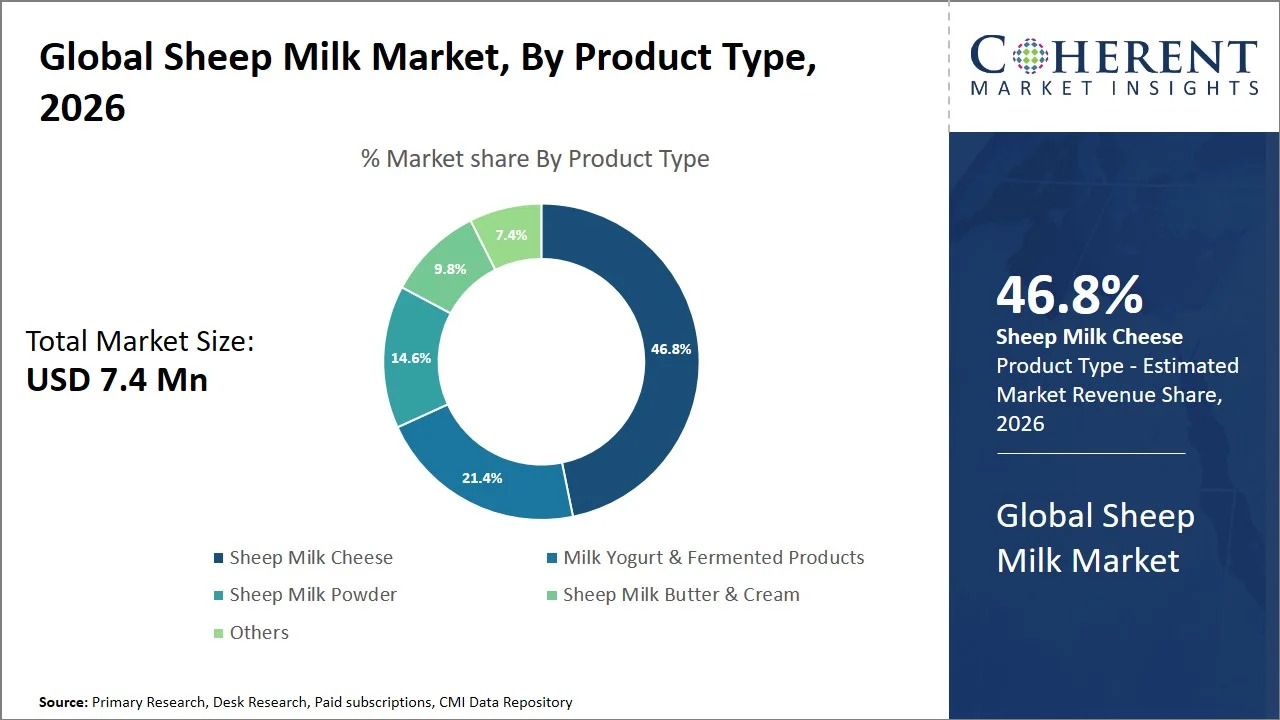
Why Does Sheep Milk Cheese Dominate the Global sheep milk market ?
Sheep milk cheese accounts for the largest share 46.8% in the global sheep milk market due to the highest value realization in comparison to liquid sheep milk, yogurt, butter, and powder. The higher the fat, protein and total solids content of the milk, the better the curd forms, the cheese is richer in texture and yield, and these are key attributes of sheep milk cheese, which EFSA points out can have protein content above 5%, fat above 7% and total solids up to 20%.
Cheese provides stronger commercial value in the global sheep milk market because it offers longer shelf life, higher price realization, and better export potential compared to liquid milk. Sheep milk producers have traditionally relied on cheese production to increase product value, as sheep milk is well suited for premium cheese due to its high fat, protein, and total solid content. PDO-certified cheeses also strengthen consumer trust by assuring product origin, quality, and traditional production standards, which helps producers command premium pricing in domestic and export markets. For example, Pecorino Romano PDO is made only from fresh full-fat sheep milk; and Queso Manchego PDO is a cheese from sheep milk produced and aged in the region of La Mancha following traditional guidelines. Sheep milk cheese is the most commercially attractive and dominant product segment of this protected-origin ecosystem. (Source: European Food Safety Authority)
- Current Industry Events of 2026
- Market Size Estimation
- Regional Breakdown
- Competitive Landscape
- Customer Intelligence
- Segmental Analysis
- Pricing Analysis
- Key Market Drivers, Challenges & Future Trends
- Customized Insights Section
Why is the Conventional Processing Type the Largest Segment in the Global sheep milk market?
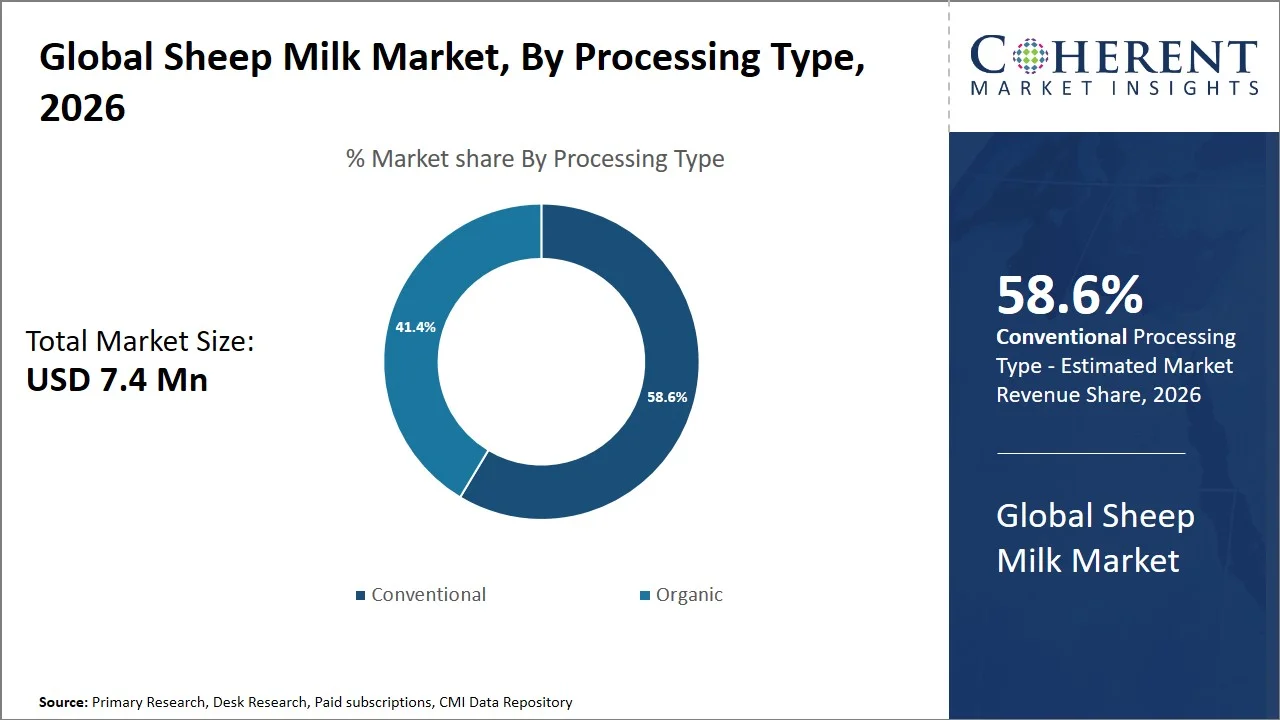
Conventional processing type is expected to hold the largest share of 58.6% in the global sheep milk market in 2026. This is mainly because sheep milk production is still largely based on traditional dairy farming practices, seasonal milk collection, and well-established cooperative networks, especially in key producing regions such as Europe. Conventional sheep milk also remains more widely available and cost-effective compared to organic or specialized processing formats. According to Food and Agriculture Organization (FAO), most of the sheep milk is produced in the Mediterranean which is where the dairy sheep systems are tightly linked with cheese making and processing. Sheep milk yield and lactation length are also lower than dairy cows and goats, making large-scale organic conversion more challenging from a supply consistency point of view. (Source: Food and Agriculture Organization)
Traditional processing supports larger milk procurement volumes, better cost control, and stable production of cheese, yogurt, butter, cream, and milk powder. In Europe, high ewe and goat milk production in Spain, Greece, France, and Italy continues to support established dairy collection and processing networks. Although organic sheep milk is gaining interest in premium retail, stricter EU requirements related to feed, grazing, certification, and farm management increase operational complexity and limit large-scale adoption. Source: European Commission)
Dairy Product Manufacturers Segment Dominates the Global Sheep Milk Market
The dairy product manufacturers segment is the largest contributor to the global sheep milk market, accounting for an estimated 45.8% share in 2026, because dairies are the primary buyers of sheep milk for converting it into other products like cheese, yogurt, fermented dairy, butter, cream, and milk powder. Compared to cow milk, sheep milk has limited demand as a mass liquid milk product. Commercial demand is mainly driven by dairy processors that can convert sheep milk into higher margin products such as cheese, yogurt, butter, cream, and milk powder. Dairy manufacturers benefit from established collection, chilling, standardization, and cheese processing infrastructure, particularly across Europe’s major sheep milk producing regions. Eurostat data retrieved in November 2025 shows that in 2024, ewes and goats accounted for 58.1% of milk delivered to dairies in Greece. This highlights the strong role of sheep and goat milk in dairy processing, rather than direct household consumption. (Source: Eurostat)
Currents Events and their Impact
Current Events | Description and Its Impact |
New Zealand – China Strategic Sheep Milk Export Agreements (2025) |
|
WOAH Reports Increased Surveillance of Small Ruminant Diseases (PPR 2024-2025) |
|
EU PDO Feta & Pecorino Quality Regulations has been updated to 2025. |
|
Global Sheep Milk Market Dynamics
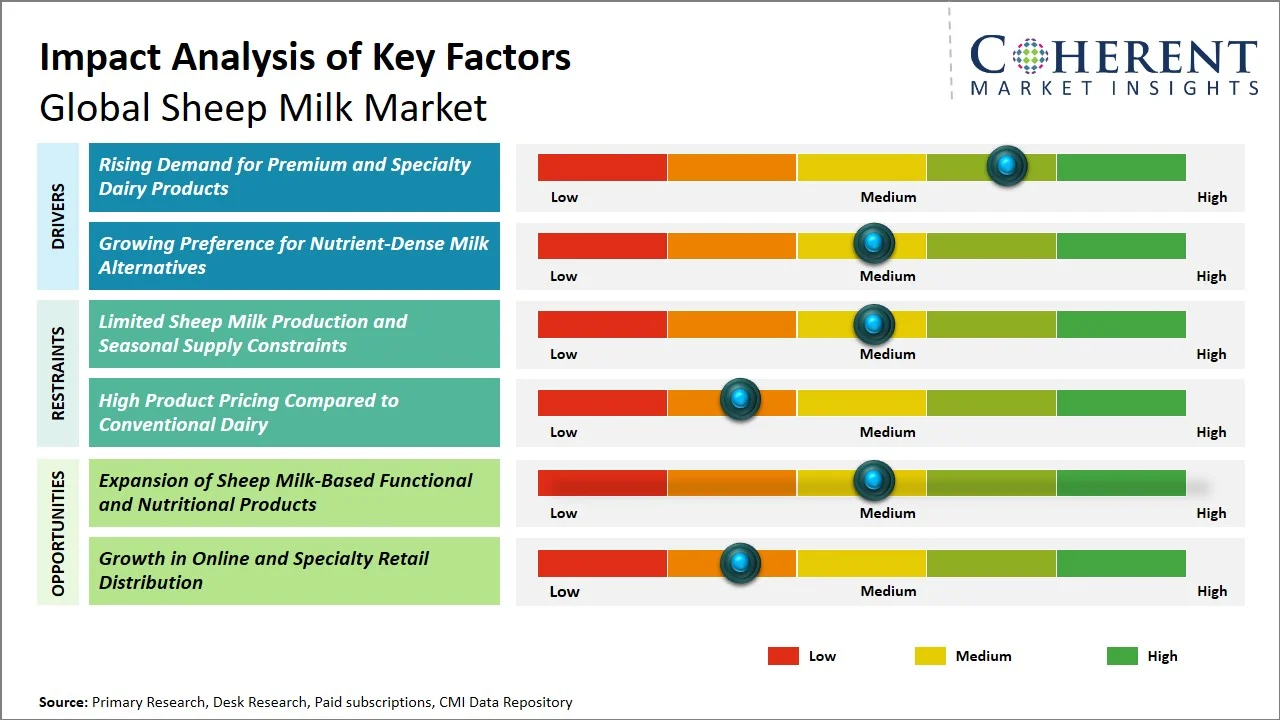
Market Drivers
- Rising Demand for Premium and Specialty Dairy Products: The global sheep milk market is supported by increasing demand for premium dairy products across retail and foodservice channels. Sheep milk is widely used in high-value cheeses such as feta, pecorino, Manchego, Roquefort, and other specialty dairy products because it delivers richer taste, better texture, and higher cheese yield compared to conventional milk. Its strong association with Mediterranean cheese traditions also improves product authenticity and premium positioning. As a result, dairy processors are increasingly using sheep milk to develop differentiated cheese, yogurt, and artisanal dairy products that can command higher margins in domestic and export markets.
- Growing Preference for Nutrient-Dense Milk Alternatives: The global sheep milk market is also benefiting from rising consumer interest in milk alternatives that offer stronger nutritional value without moving away from animal-based dairy. Sheep milk contains higher levels of protein, fat, calcium, and minerals than regular cow milk, making it suitable for premium nutrition products such as milk powder, infant nutrition bases, adult nutrition, and family health formulations. Companies such as Spring Sheep Milk Co. are using sheep milk in bulk powder and nutrition bases, showing how the market is expanding beyond traditional cheese into functional and health-focused dairy categories. For instance, the Spring Sheep Milk Co. manufactures premium bulk sheep milk whole powder and nutritional bases for infants, adults, and family health products.
Emerging Trends
- Development of Sheep Milk Powder and Nutritional Products: Increasing popularity in the powdered form of sheep milk is noted in the global sheep milk market, as sheep milk powder allows longer storage, easy exports and usage in nutritional products. This is especially significant with regard to infant formulas, toddler milk, adult nutrition, senior nutrition, and family nutrition. Full cream sheep milk powder from Spring Sheep Dairy NZ Limited is positioned as an ingredient containing vitamins, minerals, calcium and proteins, whereas Gentle Sheep infant formula consists of high-quality sheep milk obtained from New Zealand. These product developments indicate growing commercialization of sheep milk in functional dairy nutrition. (Source: Spring Sheep Dairy NZ Limited)
- Cross-Border Collaborations and Premium Sheep Milk in Asia Pacific Markets: The increasing popularity of cross-border business in the global sheep milk market is related to the development of premium sheep milk and personalized nutrition in Asian countries. In April 2025, Maui Milk announced its strategic cooperation agreement with Mengniu Group, one of the leaders in Chinese dairy industry. This partnership was made to facilitate the entry into the consumer market of China and promote the development of New Zealand sheep milk industry. (Source: Maui Milk Limited)
Regional Insights
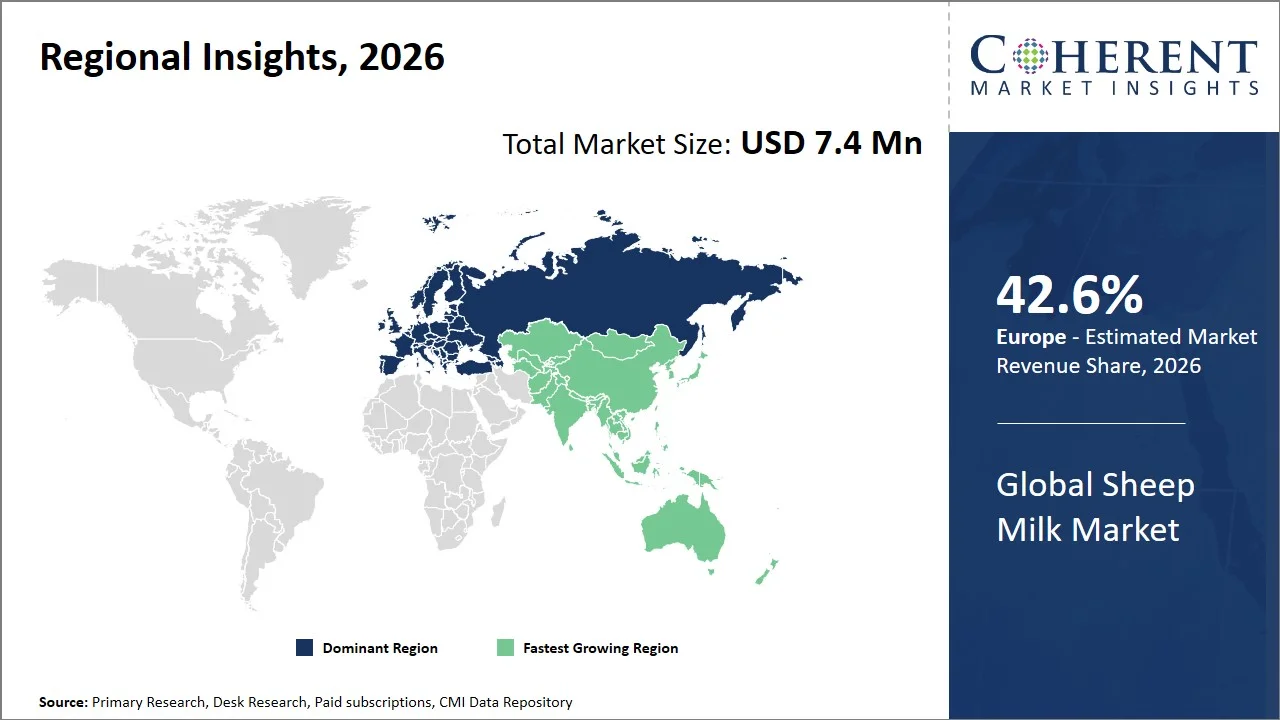
Why is Europe a Strong Market for Sheep Milk?
In Europe, the dominance in the global sheep milk market is shaped by several critical factors, the presence of PDO cheese production, and the existing system of ewe and goat milk collection. Europe is expected to hold 42.6% of the global sheep milk market in 2026. According to Eurostat, in 2024, Spain produced 1.1 million tons of milk from ewes and goats, while Greece and France managed to produce 0.9 million and 0.8 million tons respectively, illustrating the leading role of Europe in the production of non-cow dairy. Moreover, Greece plays an important role because it accounted for 58.1% of the milk delivered to dairies from ewes and goats in 2024. (Source: Eurostat)
In addition, the existence of excellent cheese conversion provides support to the development of the sheep milk market. The Food and Agriculture Organization explains that sheep milk has higher fat content and higher protein and total solids content compared to cow and goat milk; therefore, it is used more efficiently for the cheese and yogurt production. In particular, it is stated that sheep milk plays an important role in the Mediterranean region, which uses this kind of milk mainly for cheese like pecorino, caciocavallo, and feta. (Source: Food and Agriculture Organization)
Why Does the Asia Pacific Sheep Milk Market Exhibit High Growth?
It is expected that Asia Pacific will have high growth in the global sheep milk market due to the change of trend from traditional liquid milk products to premium dairy nutrition, sheep milk powder, specialty cheeses, and functional dairy products. The region is projected to hold 24.8% of the market share in 2026. China is expected to be a leading driver of demand in Asia Pacific, and New Zealand and Australia will lead the export-oriented production of the product in the region. In April 2025, Maui Milk made a partnership deal with Mengniu Group, one of the major Chinese dairy firms.
Apart from this, trade relations as well as the availability of powder-based products are additional growth drivers in the region. As per a report by USDA FAS, safeguard measures on imports of milk powder from New Zealand in China had expired in 2023. This gave preference to New Zealand in terms of tariff access to China without any limit for milk powder products. Moreover, New Zealand accounted for about 68% market share of skim milk powder imports in China between January and August 2024. (Source: USDA)
Global Sheep Milk Market Outlook for Key Countries
Why is Spain a Key Production and Branding Hub in the Global Sheep Milk Market?
Spain sheep milk market benefits from its long-standing tradition of sheep farming, particularly in regions like Castilla-La Mancha and Extremadura. The country is renowned for producing high-quality sheep milk cheese such as Manchego, which adds significant value and visibility to the market. According to Eurostat, the country was producing 1.1 million tons of milk from ewes and goats in 2024, being the leader among those European countries. This market is mostly associated with sheep milk cheese and, particularly, with Manchego cheese. In such a way, the Queso Manchego PDO identification system requires product label indication of total production with Manchega sheep milk usage.
In terms of global sheep milk market, Spain serves as both production and branding center. Its opportunity is in increasing PDO cheese exports, retail premium products and processed sheep milk foods for gourmet food service use. (Source: Eurostat, Manchego Cheese PDO)
Why Does Greece Hold a Strong Position in the Global Sheep Milk Market?
Greece continues to lead in sheep milk production owing to its favorable climate for sheep rearing and rich cultural heritage in dairy farming. In 2024, Greece produced 0.9 million tons of milk from ewes and goats, and 58.1% of milk delivered to dairies came from ewes and goats, which shows the country’s high dependence on small ruminant dairy. The European Commission states that Feta PDO is made only with milk from native breeds of ewes and goats, and the milk used for feta must have at least 6% fat content.
In the global sheep milk market, Greece benefits from strong PDO protection, traditional production knowledge, and global recognition of feta. However, the country also requires stronger animal health and traceability systems because sheep and goat disease outbreaks can directly affect milk supply and feta production continuity. (Source: European Commission)
Why is Australia Emerging as a Value-Added Sheep Milk Market?
Australia is an important player in the global sheep milk market due to its significant sheep industry, innovations in specialty dairy, and focus on exporting its dairy products to Asia. According to Meat & Livestock Australia, there were 79.1 million heads of sheep in Australia as of June 2024, hence making it have a good livestock foundation despite using just a few of them for dairy production. The sheep milk market in Australia, thus, has more of value-added products than volume.
Meredith Dairy represents the market well. It claims to be the largest farm in Australia that milks goats and sheep, and produces dairy products every day. Its main focus is on value added production of dairy on the farm. Some of the opportunities in the global sheep milk market for Australia are premium marinated sheep and goat cheeses, yogurt, gourmet retail and exports of dairy to Asia Pacific. (Source: Meat & Livestock Australia Limited)
Why Does France Remain a Premium Sheep Milk Market?
France is one of the countries that offer an advanced market for the world’s sheep milk industry, including sheep milk cheese, Roquefort production, Lacaune dairy sheep, and strong dairy systems. Eurostat indicated that France was producing 0.8 million tons of milk from ewes and goats in 2024, emphasizing France’s prominence in the European non-cow dairy sector. For instance, Roquefort is a significant market anchor in the country, as Roquefort Cooperative explains that it is PDO blue cheese made of raw sheep milk.
The Roquefort cheese has been protected under production traditions since 1925. Moreover, the Lacaune dairy sheep breed association indicates that France is home to more than 850,000 ewes of Lacaune dairy sheep, which is known for being used to produce Roquefort cheese. In the global sheep milk industry, the main strength of France is in cheese making, breed development, quality system, and protected origin. (Source: UPRA Lacaune)
Regulatory Landscape Governing the Global Sheep Milk Market
Region | Authority & Classification | Approval Pathway | Key Regulatory Insight | |
North America | U.S. Food and Drug Administration (FDA), State Milk Regulatory Agencies, USDA / APHIS; Health Canada and Canadian Food Inspection Agency (CFIA). Sheep milk is regulated as a dairy food product / milk from small ruminants, not as a supplement. | Sheep milk processors must comply with milk sanitation, pasteurization, dairy plant licensing, labeling, and preventive control requirements. In the U.S., Grade “A” milk and milk products follow the FDA Pasteurized Milk Ordinance framework, while Canada applies dairy requirements under the Safe Food for Canadians Regulations. | Entry into the market relies on pasteurization supervision, correct species labelling (e.g. “sheep milk”), dairy plant compliance, the cold chain integrity, and import health clearance. Raw milk, fresh dairy products, cheese and milk powder continue to attract rigorous inspection. | |
Europe | European Commission, National Food Safety Authorities, EFSA where scientific assessment is required. Sheep milk is regulated as a food of animal origin / dairy product under EU food hygiene and dairy rules. | Producers must comply with EU hygiene rules for raw milk, milk collection, processing, heat treatment, traceability, residue control, and official inspection. PDO products such as Feta, Roquefort, Pecorino, and Manchego must also follow protected origin specifications. | The most developed regulations exist in Europe thanks to well-established cheese PDO scheme. Regulatory emphasis lies in raw milk quality, animal health, traceability, hygiene, and origin protection. | |
Asia Pacific | China: SAMR, NHC, GACC; India: FSSAI; Australia and New Zealand: FSANZ and state dairy authorities. Sheep milk is classified as dairy / milk product, while sheep milk powder, infant nutrition, and fortified products may face additional category specific rules. | Imported dairy products into China require compliance with national food safety standards and overseas manufacturer registration through GACC. India’s FSSAI standards include sheep milk under milk and milk product standards, with defined fat and solids-not-fat requirements. Australia and New Zealand follow Food Standards Code dairy standards and primary production controls. | Growth opportunities in Asia Pacific region are highly dependent on sheep milk powder, baby food industry, and premium dairy imports. Regulatory focus revolves around import clearance, food safety requirements, product description, labelling, and nutrition claims. | |
Latin America | Brazil: MAPA and ANVISA; Mexico: SENASICA and COFEPRIS. Sheep milk products are regulated as dairy products of animal origin, including milk, cheese, yogurt, and powder. | Dairy products generally require sanitary or health certificates, approval of exporting establishments, import permits where applicable, labeling compliance, and inspection by animal health and food safety authorities. Brazil requires milk and dairy imports to be accompanied by health certificates. | Market access depends mostly on animal health certification, established status of production, labelling, and sanitary importation. This particularly applies to cheese and powder sheep milk products. | |
Middle East & Africa | Saudi Food and Drug Authority (SFDA), Gulf Standardization Organization (GSO), UAE food authorities, South African Department of Health and Department of Agriculture. Sheep milk is regulated as a dairy product / animal-origin food, with halal and labeling requirements in several markets. | Importers must comply with food registration, health certificates, approved establishment requirements, halal certification where applicable, labeling rules, heat treatment, and dairy hygiene requirements. South Africa has specific regulations for classification, packing, and marking of dairy products. | Regulatory control rests with food safety, halal compliance, labelling of dairy products, and import clearance. Sheep milk needs accurate species identification and dairy compliance, including cheese, yogurt, and powder. | |
How is the growing demand for nutrient dense dairy creating new growth opportunities in the global sheep milk market?
The increasing interest from consumers for nutrient-rich dairy products is generating good prospects for the global sheep milk market since sheep milk has greater amounts of fat, proteins, and total solids compared to cow milk and goat milk. This means that it is very appropriate for making premium cheese, yogurt, milk powder, infant/health/nutrition milk, and functional dairy products. Growing demand for rich nutrients in dairy, clean labeling products, and specialty milk alternatives from consumers is fueling demand for sheep milk products. According to FAO, the levels of fat and proteins in sheep milk are higher than those found in goat and cow milk. Also, the high number of solids in sheep milk makes it appropriate for the production of cheese and yogurt. This gives dairy manufacturers a chance to make premium products like cheese made from sheep milk, sheep milk powder, fermented dairy products, and health/nutritional milk. (Source: Food and Agriculture Organization)
Market Players, Key Development, and Competitive Intelligence
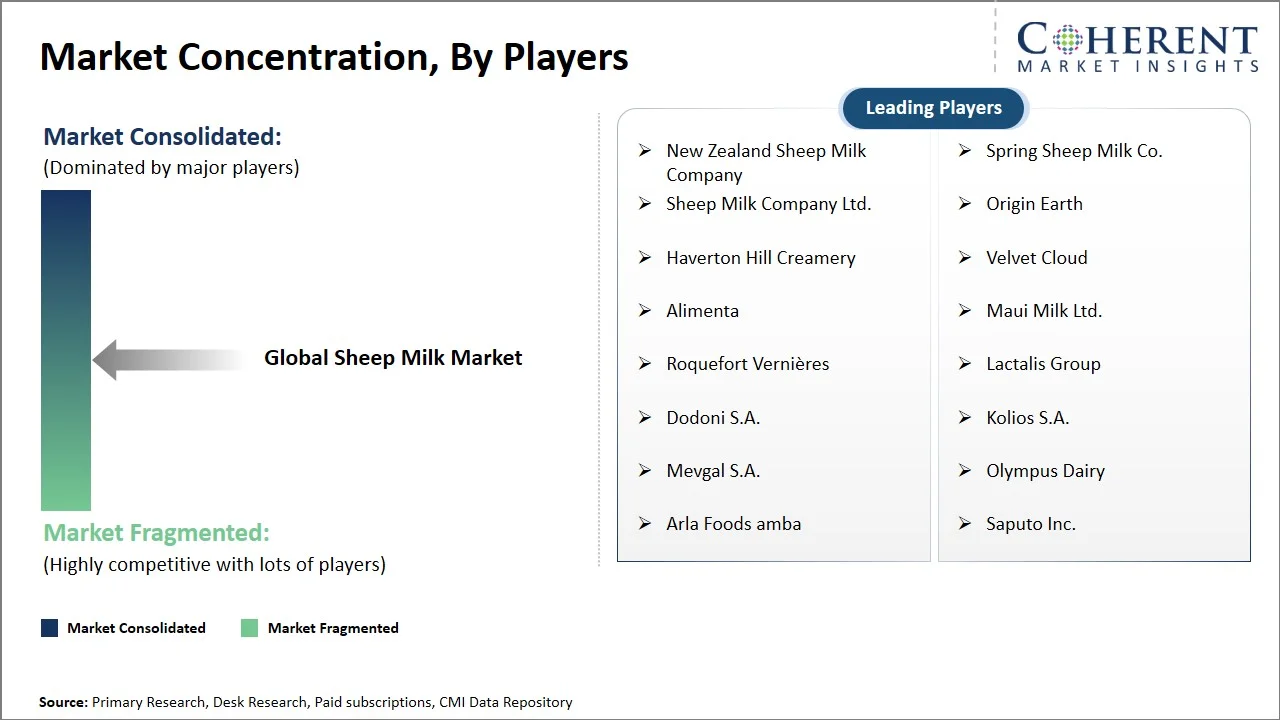
Key Developments
- New Zealand state-owned agricultural enterprise, Pāmu announced in October 2025 that it would divest its controlling 53% stake in Spring Sheep Milk Co. to strategically refocus on core pastoral operations. The move could change the ownership structure of Spring Sheep and its future expansion strategy.
- In June 2025, France’s Roquefort PDO celebrated its 100th anniversary as a protected cheese. This event reinforced the importance of protected-origin sheep milk cheese in Europe and supported premium positioning for sheep milk-based specialty cheese products.
Competitive Landscape
The global sheep milk market is moderately fragmented with regional dairy cooperatives, specialty cheese producers, sheep milk powder manufacturers and premium dairy brands competing on the basis of product differentiation, origin-based branding, and value-added processing. The market is dominated by established European cheese producers from Spain, Greece, France and Italy. New Zealand and Australia are emerging as significant suppliers of sheep milk powder, functional dairy products and premium nutrition products for export. Market players are focusing on the extension of the application of sheep milk from traditional cheese to yogurt, milk powder, infant nutrition, adult nutrition, and specialty foodservice products. Investments in herd productivity, milk quality control, cold chain infrastructure, PDO certification and export partnerships are helping companies to establish their competitive positions in the global market for sheep milk.
Key focus areas include
- Increase in value added sheep milk products such as feta, pecorino, manchego, roquefort, sheep milk yogurt, sheep milk powder, functional dairy nutrition products
- Enhancing origin-led and premium branding strategies with PDO cheeses, regional authenticity, grass-fed positioning, clean-label claims and artisanal dairy identity
- Infant nutrition, adult nutrition, senior nutrition, family health products and premium dairy ingredient applications with sheep milk powder and nutrition portfolios
- Build export partnerships and distribution channels, with a focus on Asia, especially China, Southeast Asia and premium urban retail markets
- Invest in animal health, traceability and milk quality systems to reduce supply risks, improve reliability of dairy processing and meet regulatory requirements across export markets
Market Report Scope
Sheep Milk Market Report Coverage
| Report Coverage | Details | ||
|---|---|---|---|
| Base Year: | 2025 | Market Size in 2026: | USD 7.4 Mn |
| Historical Data for: | 2020 To 2024 | Forecast Period: | 2026 To 2033 |
| Forecast Period 2026 to 2033 CAGR: | 5.8% | 2033 Value Projection: | USD 10.9 Mn |
| Geographies covered: |
| ||
| Segments covered: |
| ||
| Companies covered: | New Zealand Sheep Milk Company, Spring Sheep Milk Co., Sheep Milk Company Ltd., Origin Earth, Haverton Hill Creamery, Velvet Cloud, Alimenta, Maui Milk Ltd., Roquefort Vernières, Lactalis Group, Dodoni S.A., Kolios S.A., Mevgal S.A., Olympus Dairy, Arla Foods amba, and Saputo Inc. | ||
| Growth Drivers: |
| ||
| Restraints & Challenges: |
| ||
Analyst Opinion (Expert Opinion)
- The biggest potential market lies in converting sheep milk into high-end cheese, yogurt, milk powder and functional nutrition products, rather than selling it as liquid milk. Europe will continue to be the anchor market with countries like Spain, Greece, France and Italy having built strong consumer trust for sheep milk cheeses such as Manchego, Feta, Roquefort, Pecorino and other protected origin products. For the new entrants, the opportunity is not just in milk collection but in creating branded, traceable, origin backed dairy products with premium positioning.
- Asia Pacific is emerging as the next big growth corridor for the global sheep milk market especially in the form of sheep milk powder, infant nutrition, adult nutrition and specialty dairy formulations. China is the most important demand side market as premium dairy, functional nutrition and imported milk powder categories are already well developed. New Zealand suppliers like Maui Milk and Spring Sheep Milk Co. are in a better position than many traditional producers, as they are creating export-ready powder formats, nutrition bases and partnerships with Chinese dairy players. This transforms sheep milk from a regional dairy product to a scalable international nutrition ingredient.
- Supply scalability is the major constraint in the global sheep milk market. Sheep milk is produced in lower volumes than cows and production is often seasonal, farm-fragmented and linked to traditional cheese-making regions. This means that companies that invest in breed improvement, farm productivity, milk collection networks, cold chain systems, disease control and quality traceability will have a stronger advantage than brands that rely only on premium marketing. Over the long-term, the most profitable companies will be those that control both ends of the value chain: reliable raw sheep milk supply and high margin processed products such as PDO cheese, sheep milk powder and functional dairy nutrition.
Speak to the analyst
Want personalized insights?
Take the findings above to one of our principal consultants, or have the report rebuilt around the segments, geographies and competitors you actually track.
Market Segmentation
- Product Type Insights (Revenue, USD Mn, 2021 - 2033)
- Sheep Milk Cheese
- Milk Yogurt & Fermented Products
- Sheep Milk Powder
- Sheep Milk Butter & Cream
- Others
- Processing Type Insights (Revenue, USD Mn, 2021 - 2033)
- Conventional
- Organic
- End User Insights (Revenue, USD Mn, 2021 - 2033)
- Households
- Dairy Product Manufacturers
- Food & Beverage Manufacturers
- Nutraceutical & Nutrition
- Foodservice/HoReCa
- Specialty Retailers
- Distribution Channel Insights (Revenue, USD Mn, 2021 - 2033)
- Online
- Offline
- Regional Insights (Revenue, USD Mn, 2021 - 2033)
- North America
- U.S.
- Canada
- Latin America
- Brazil
- Argentina
- Mexico
- Rest of Latin America
- Europe
- Germany
- U.K.
- Spain
- France
- Italy
- Russia
- Rest of Europe
- Asia Pacific
- China
- India
- Japan
- Australia
- South Korea
- ASEAN
- Rest of Asia Pacific
- Middle East
- GCC Countries
- Israel
- Rest of Middle East
- Africa
- South Africa
- North Africa
- Central Africa
- North America
- Key Players Insights
- New Zealand Sheep Milk Company
- Spring Sheep Milk Co.
- Sheep Milk Company Ltd.
- Origin Earth
- Haverton Hill Creamery
- Velvet Cloud
- Alimenta
- Maui Milk Ltd.
- Roquefort Vernières
- Lactalis Group
- Dodoni S.A.
- Kolios S.A.
- Mevgal S.A.
- Olympus Dairy
- Arla Foods amba
- Saputo Inc.
Sources
Primary Research Interviews
- Sheep milk producers and dairy farm operators involved in ewe milk collection and supply
- Sheep milk cheese manufacturers producing feta, Manchego, Roquefort, Pecorino, and other specialty cheeses
- Sheep milk powder manufacturers and ingredient suppliers serving infant nutrition, adult nutrition, and functional dairy applications
- Dairy cooperatives, milk collection centers, and small ruminant dairy associations across Europe, New Zealand, Australia, and Asia Pacific
- Food and beverage manufacturers using sheep milk in yogurt, desserts, bakery, confectionery, and premium dairy formulations
- HoReCa distributors, specialty dairy retailers, gourmet cheese importers, and premium foodservice procurement managers
- Regulatory affairs and quality assurance professionals managing dairy hygiene, animal health, PDO certification, import compliance, and labeling standards
Stakeholders
- Sheep milk producers, dairy cooperatives, and farm-level milk aggregators
- Sheep milk cheese manufacturers and specialty dairy processors
- Sheep milk powder and functional nutrition ingredient manufacturers
- End-use Sectors
- Dairy product manufacturers
- Food and beverage manufacturers
- Infant, adult, and senior nutrition companies
- Nutraceutical and functional food companies
- HoReCa and gourmet foodservice operators
- Specialty retailers and premium dairy importers
- Regulatory & Food Safety Bodies: U.S. Food and Drug Administration (FDA)
- U.S. Department of Agriculture (USDA), European Food Safety Authority (EFSA)
- European Commission Directorate-General for Agriculture and Rural Development
- Food Standards Australia New Zealand (FSANZ), Ministry for Primary Industries New
- Zealand (MPI), Food Safety and Standards Authority of India (FSSAI), General
- Administration of Customs of China (GACC), State Administration for Market
- Regulation China (SAMR), Canadian Food Inspection Agency (CFIA)
Databases
- FAOSTAT Livestock and Dairy Production Database
- Eurostat Milk and Milk Product Statistics
- OECD-FAO Agricultural Outlook Database
- USDA Foreign Agricultural Service GAIN Reports
- UN Comtrade Database for dairy product trade
- ITC Trade Map for cheese, milk powder, and dairy trade flows
- World Bank Open Data
- National Bureau of Statistics of China
- Australian Bureau of Statistics
- Statistics New Zealand
- INE Spain Agricultural and Livestock Statistics
- ELSTAT Greece Agricultural Statistics
- Agreste France Dairy and Livestock Statistics
Magazines
- DairyReporter
- FoodNavigator
- Dairy Industries International
- International Dairy Magazine
- Dairy Foods
- The Dairy Site
- Food Manufacture
- Nutraceutical Business Review
- Natural Products Insider
Journals
- Small Ruminant Research
- Journal of Dairy Science
- International Dairy Journal
- Journal of Dairy Research
- Dairy Science & Technology
- Foods
- Animals
- Journal of Food Composition and Analysis
- International Journal of Food Science & Technology
Newspapers
- Financial Times
- The Wall Street Journal
- The Guardian
- The New York Times
- Dairy News Australia
Associations
- International Dairy Federation (IDF)
- European Dairy Association (EDA)
- Dairy Australia
- Meat & Livestock Australia (MLA)
- Dairy Companies Association of New Zealand (DCANZ)
- DairyNZ
- National Sheep Association (NSA)
- International Committee for Animal Recording (ICAR)
- Queso Manchego Protected Designation of Origin Regulatory Council
- Consorzio per la Tutela del Formaggio Pecorino Romano DOP
- Roquefort PDO / Roquefort producer bodies
- Feta PDO official quality and producer bodies
Public Domain Sources
- Food and Agriculture Organization of the United Nations (FAO) – milk composition, dairy animals, and global milk production statistics
- Eurostat – milk collection and dairy production statistics for Spain, Greece, France, and other European countries
- European Commission – PDO and geographical indication information for feta, Roquefort, Pecorino, and other protected dairy products
- World Organisation for Animal Health (WOAH) – sheep and goat disease surveillance, PPR updates, and animal health risks
- USDA Foreign Agricultural Service – dairy trade, China dairy imports, and country-level dairy market reports
- Ministry for Primary Industries New Zealand – dairy export and food safety requirements
- Food Standards Australia New Zealand (FSANZ) – dairy product standards and food safety framework
- General Administration of Customs of China (GACC) – dairy import registration and compliance requirements
- FAO and WHO Codex Alimentarius – dairy hygiene, milk product standards, and food safety references
Proprietary Elements
- CMI Data Analytics Tool, Proprietary CMI Existing Repository of information for last 10 years.
Get access to 250+ pages report
Every segment, forecast, competitor profile and data table behind the analysis above — available for instant download.
- ESOMAR Member
- ISO 9001:2015 Certified
- D-U-N-S Registered
- GDPR & CCPA Compliant
Missing comfort of reading report in your local language? Find your preferred language:
Transform your Strategy with Exclusive Trending Reports
Frequently Asked Questions
The global sheep milk market is estimated to be valued at USD 7.4 Mn in 2026 and is expected to reach USD 10.9 Mn by 2033.
Sheep milk is milk obtained from dairy sheep and is known for its high fat, protein, calcium, and total solid content. It is widely used in cheese, yogurt, milk powder, and premium dairy nutrition products.
Dairy product manufacturers dominate the global sheep milk market, as sheep milk is mainly processed into cheese, yogurt, fermented dairy products, and milk powder rather than consumed directly as liquid milk.
The CAGR of the global sheep milk market is projected to be 5.8% from 2026 to 2033.
Rising demand for premium and specialty dairy products and growing preference for nutrient-dense milk alternatives are the major factors driving the growth of the global sheep milk market.
Limited sheep milk production and seasonal supply constraints and high product pricing compared to conventional dairy are the major factors hampering the growth of the global sheep milk market.
In terms of product type, sheep milk cheese is estimated to dominate the market revenue share in 2026.