

Global Ship Radar Market Size and Forecast - 2026 To 2033
The global ship radar market is expected to grow from USD 625.5 Mn in 2026 to USD 1,033.9 Mn by 2033, registering a compound annual growth rate (CAGR) of 8.3% from 2026 to 2033. The market is driven by growing port congestion. In January 2025, Yantian Port in China experienced significant congestion ahead of the Lunar New Year. The port increased its daily container handling quota by 15% to manage the surge. Truck turnaround time reportedly reached four times normal levels.
Key Takeaways of the Global Ship Radar Market
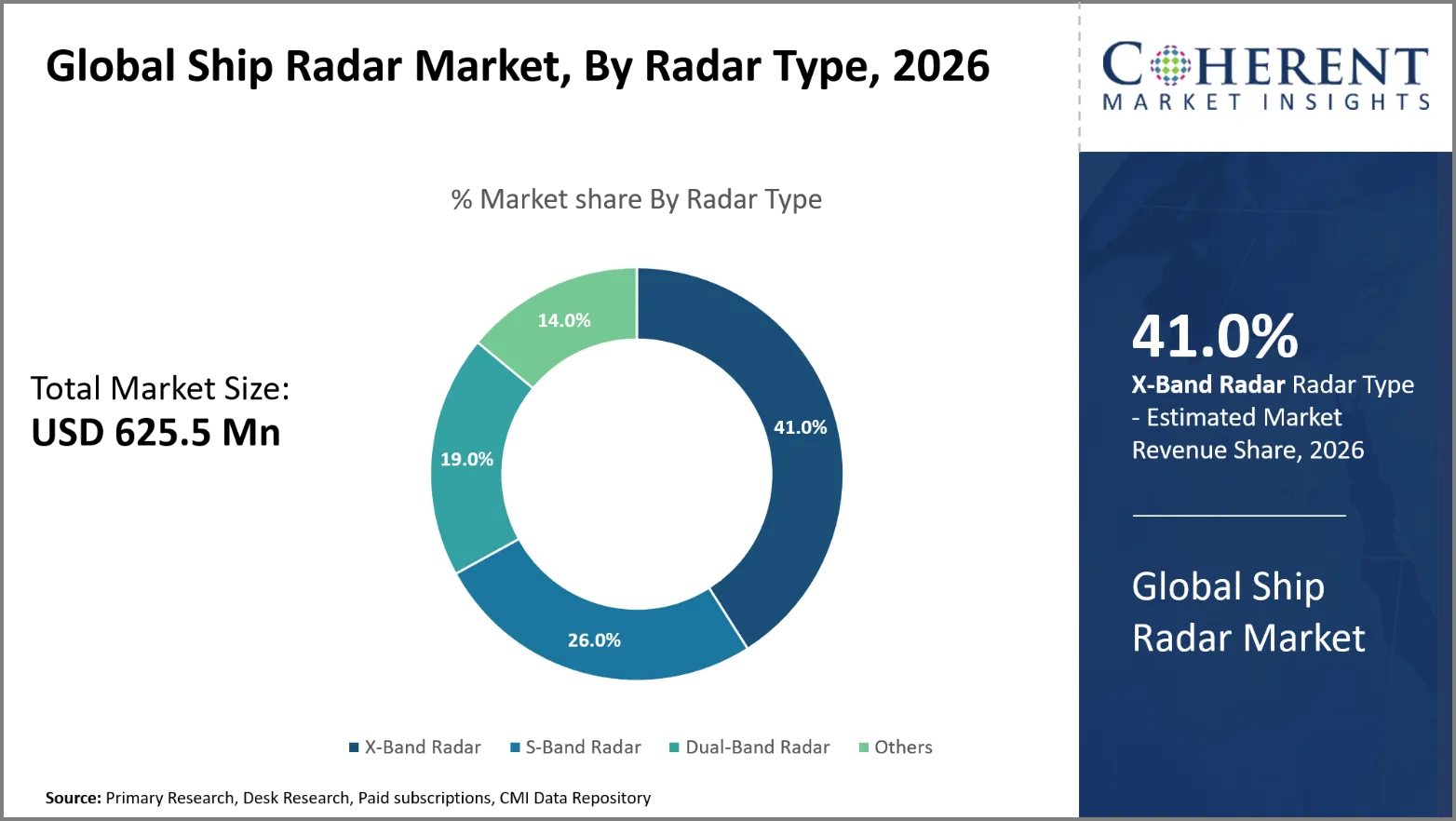
- The X-Band Radar segment is expected to account for 41.0% of the global ship radar market share in 2026. Rising fleet modernization is driving the growth of the segment. On June 25, 2026, MPC Container Ships agreed to acquire four 7,000 TEU container vessels built during 2023-2024. The company also secured USD 375 million in financing for its fleet renewal program.
- The Fixed-Mount Radar segment is estimated to capture 46.0% of the market share in 2026. Increasing solid-state radar adoption improves detection accuracy and reliability which is majorly driving the growth of the segment. In March 2025, Anschütz launched its new Solid-State Transceiver for the SYNAPSIS radar system. The magnetron-free SST provides improved reliability and target detection under different environmental conditions.
- The Solid-State Radar segment is estimated to capture 39.0% of the market share in 2026. Growing autonomous vessel development is increasing demand for advanced radar sensors which is driving the growth of the segment. On January 16, 2025, Kongsberg Maritime delivered the first REACH REMOTE 1 unmanned surface vessel to Reach Subsea. The 24-meter vessel was developed with Reach Subsea, Massterly, and Trosvik Maritime.
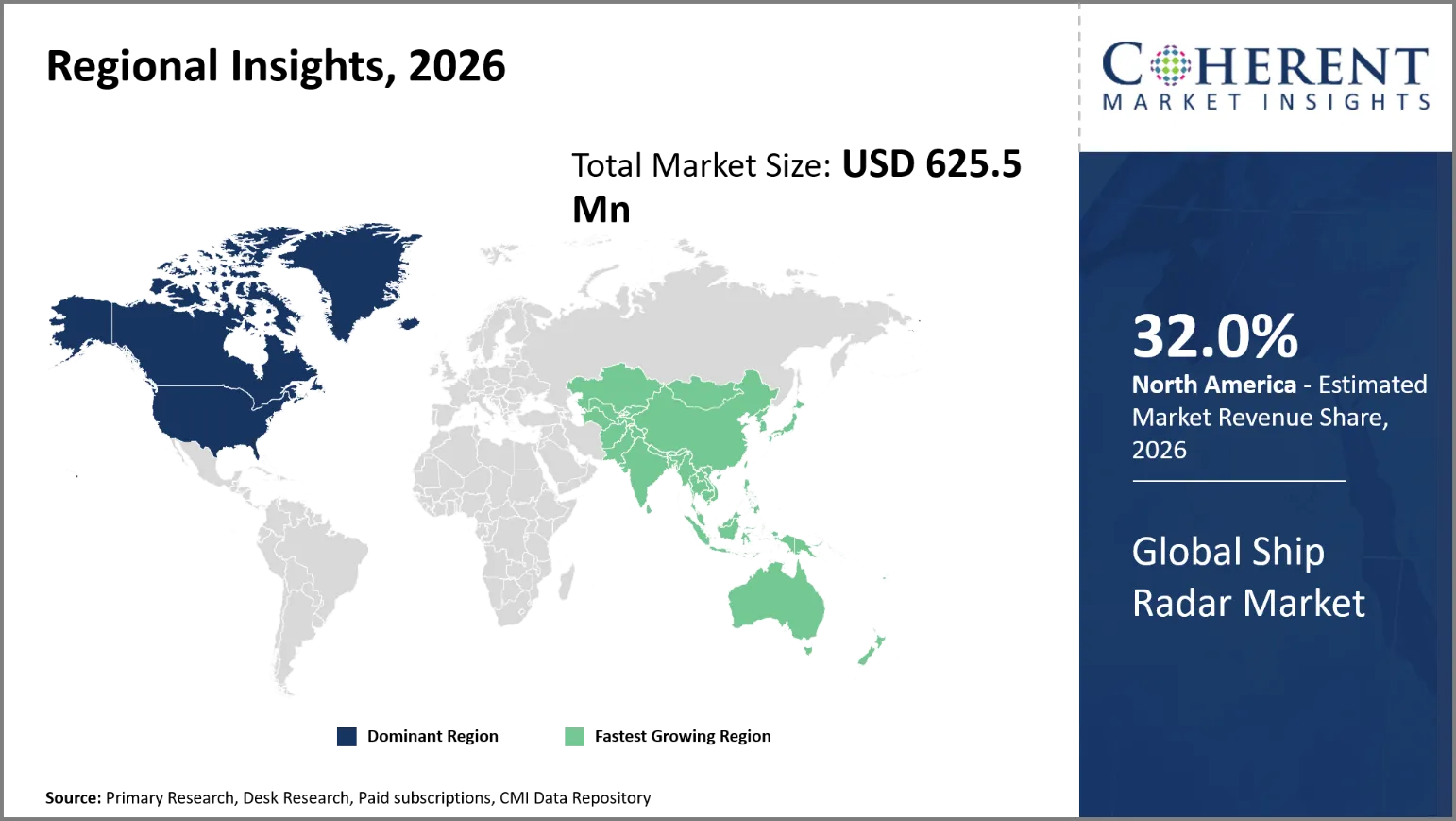
- North America is expected to dominate the ship radar market in 2026 with a market share of 32.0%. Integration with electronic chart systems in North America is driving the growth of the regional market. In February 2025, Raymarine launched LightHouse Charts GEN 2 for its Axiom and Element chartplotters. The update included expanded North American coverage and more than 3,000 additional Canadian lakes.
- Asia Pacific is expected to account for 29.0% share in 2026. Growing offshore energy activity in Asia Pacific is driving the growth of the regional market. On May 22, 2026, INPEX was awarded exploration rights for offshore Eastern Java in Indonesia. The company has also advanced the Abadi LNG Project in Indonesia and continued development activities in Australia.
Segmental Insights
Why Does X-Band Radar Dominate the Global Ship Radar Market?
The X-band radar segment is expected to account for 41.0% of the global ship radar market share in 2026. X-Band radar delivers ship navigation with good discrimination, high sensitivity and accurate target tracking. It operates at 9.2-9.5 GHz which gives better target discrimination and identification of the shoreline in detail. This performance is especially useful in busy waterways with closely spaced vessels and navigation markers. The International Maritime Organization recognizes X-Band radar as having strong discriminating and target tracking performance. Therefore, the combination of resolution and target discrimination is beneficial to high adoption in ship navigation applications.
On May 13, 2026, Furuno Electric Co., Ltd. and Icom Incorporated announced that they have signed a Memorandum of Understanding. The objective of this MoU is to consider possible cooperation on product development and business activities in the radio communication equipment and radar fields based on the technologies and skills developed by each company.
- Current Industry Events of 2026
- Market Size Estimation
- Regional Breakdown
- Competitive Landscape
- Customer Intelligence
- Segmental Analysis
- Pricing Analysis
- Key Market Drivers, Challenges & Future Trends
- Customized Insights Section
Why is Fixed-Mount Radar the Most Preferred Installation Type?
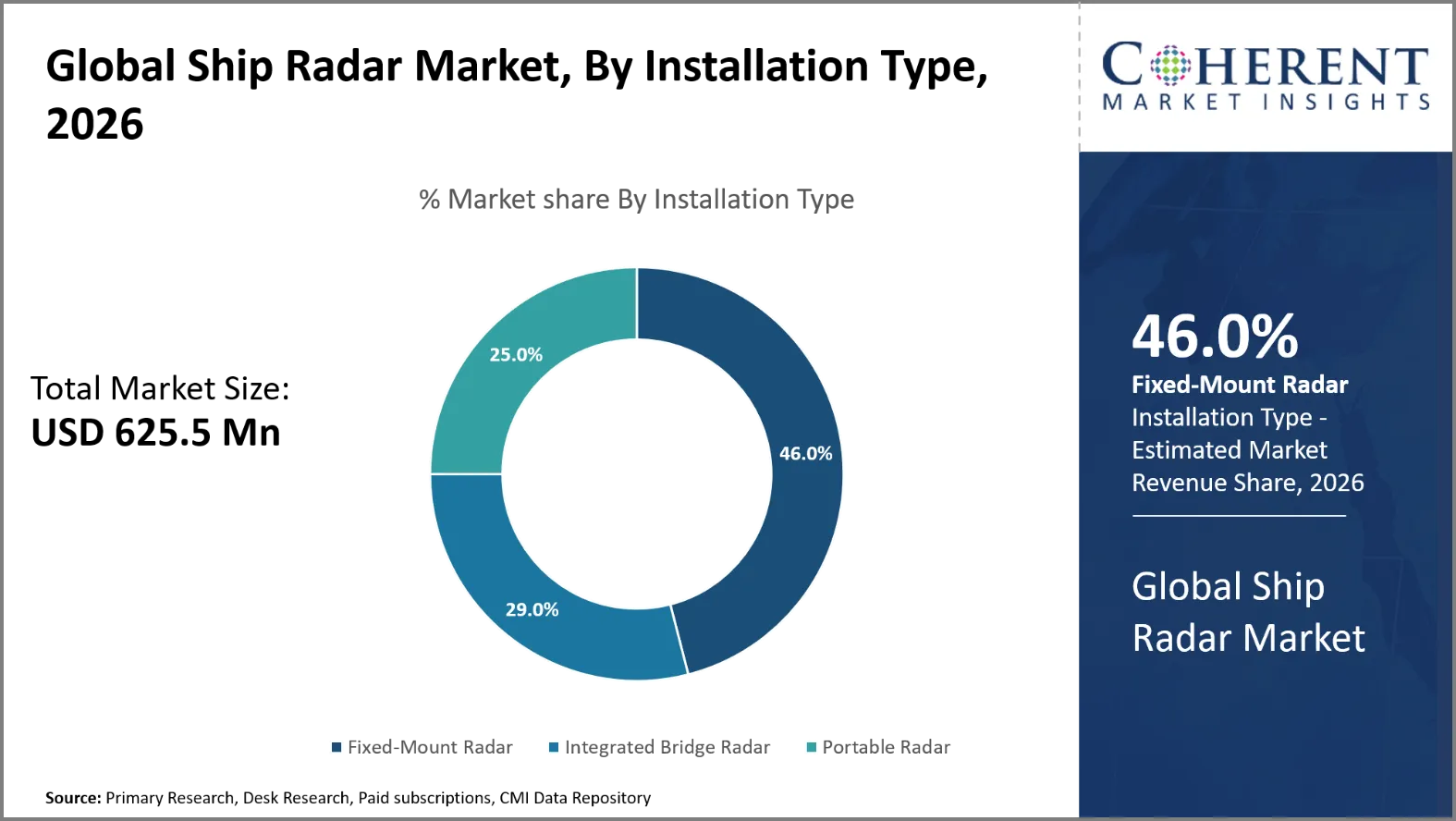
The fixed-mount radar segment is expected to account for 46.0% of the global ship radar market share in 2026. Fixed-mount radar offers steady placement, which helps in repeatability in detection and accurate target tracking. Permanent installation also gives optimum antenna height and no coverage restrictions around the vessel. This arrangement can boost the detection range, as radar performance is highly dependent on the elevation of the antenna. Fixed installation also provides continuous integration with on-board navigation and display system. In November 2025, Raymarine announced their Pathfinder commercial radar suite for international shipping and workboats. It incorporates an IMO Type Approved CAT-1 radar with a 6-foot open-array antenna. It has a fixed architecture that provides a high resolution for target separation and long-range detection. The Black Box version also supports electronic chart display and information system integration.
Solid-State Radar Dominates the Global Ship Radar Market
The solid-state radar segment is expected to account for 39.0% of the global ship radar market share in 2026. Solid-state radar reduces maintenance requirements because it eliminates magnetron replacement and other consumable components. Furuno states that its solid-state systems provide reliable target detection while requiring lower maintenance. Fanless antenna designs cut operational requirements and maintenance expenses even further. These systems generate good pictures of weaker targets and give reliable navigation performance. In September 2025, the FAR-2228-NXT-BB X-band solid-state radar from Furuno was named the 2025 National Marine Electronics Association Product of Excellence Award winner. That recognition included Furuno's commercial radar technology and other maritime devices. The FAR-2228-NXT-BB is developed for reliable target identification with reduced maintenance compared to magnetron systems.
Current Events and their Impact
Current Events | Description and its Impact |
China GB/T 9391-2025 Shipborne Radar Standard |
|
International Maritime Organization SOLAS Chapter V Requirements |
|
Ship Radar Market Dynamics
Market Drivers
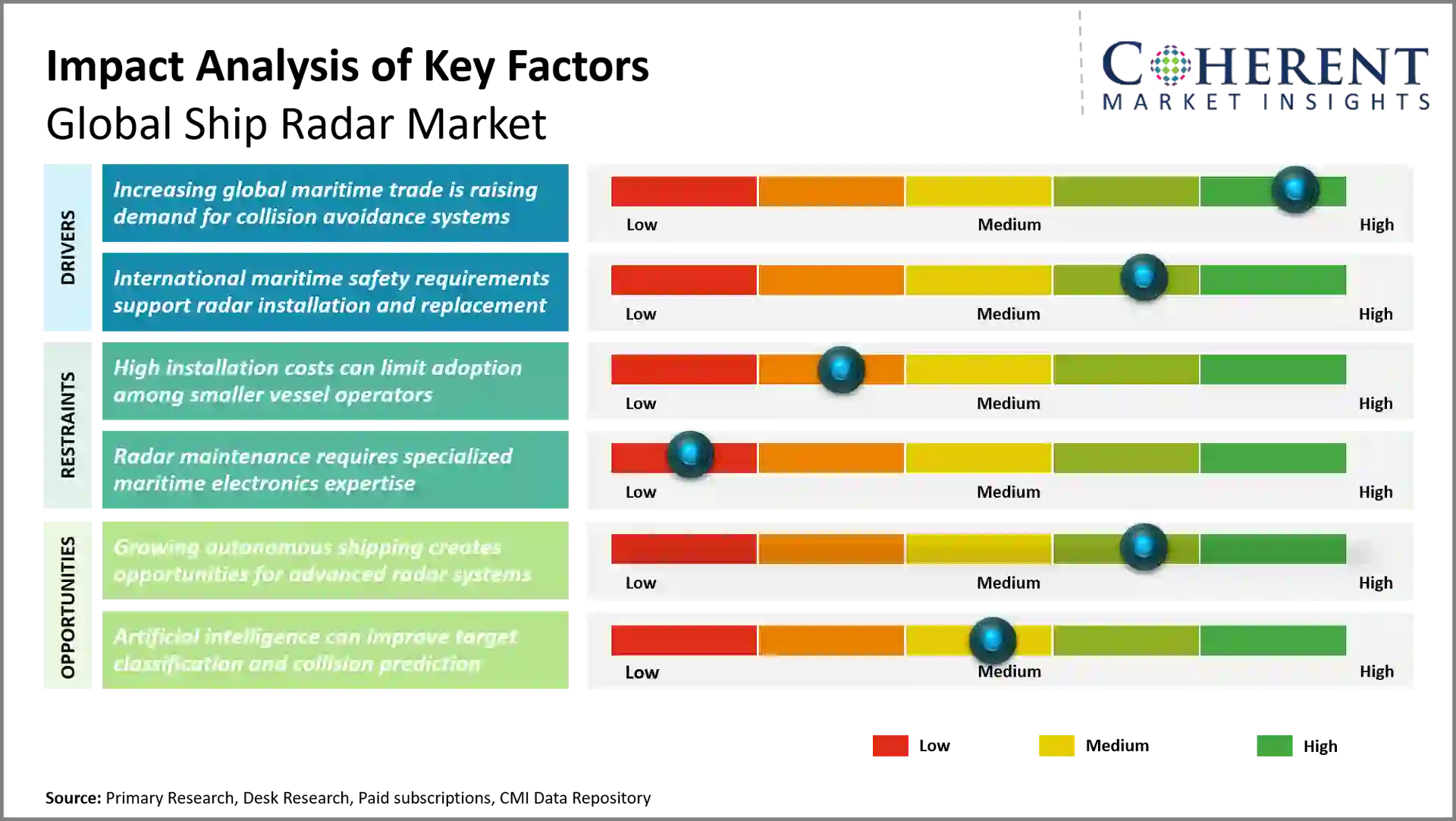
- Increasing global maritime trade is raising demand for collision avoidance systems: The increase in maritime trade is resulting in higher vessel movements along major shipping routes and commercial ports. More vessel traffic means more likely interactions that require accurate detection and tracking. Ship radar gives a constant picture of the ships, obstructions and coastal objects in the vicinity. Modern radars are capable of tracking several targets and computing their movement patterns to facilitate collision avoidance. This increasing operational demand is resulting in more radar use across commercial marine fleets.
- On May 19, 2025, ZIM reported a 12% year-on-year rise in container volumes handled in the first quarter of 2025. The company transported 944,000 TEUs during the quarter. ZIM attributed the stronger performance partly to increased demand across major trade routes. The development demonstrates continued cargo movement growth supporting container shipping activity.
- International maritime safety requirements support radar installation and replacement: International maritime safety rules require eligible vessels to have compliant navigation equipment. The International Maritime Organization (IMO) under the International Convention for the Safety of Life at Sea (SOLAS) Chapter V sets performance standards for shipborne radar. These standards encourage operators to install approved radar systems and to upgrade equipment. Regulatory compliance is another driver of demand for technologically sophisticated radar systems with increased detecting capabilities. Fleet upgrading thus provides a continuing replacement market for radar manufacturers. In June 2025, Wärtsilä showcased new engine-room safety systems supporting SOLAS Chapter II-2 compliance. The manufacturer addressed fire hazards from spilling flammable fluids near hot engine areas. Its solutions show how maritime operators are employing dedicated safety systems to meet changing regulatory requirements.
Emerging Trends
- Artificial Intelligence Enabled Radar Analytics: Ship radar systems are progressively incorporating artificial intelligence for automatic target classification and collision risk assessment. Advanced algorithms can discriminate between vessels, shorelines, buoys and environmental disturbances. It allows to make navigation decisions faster and better situational awareness.
- Solid-State Radar Adoption: Solid state radar technology is gaining acceptance due to longer component life and lower maintenance needs. Manufacturers are coming out with smaller systems with better target detection. These attributes are enabling modernization across commercial vessels, offshore platforms and recreational craft.
- Radar Integration with Digital Navigation Systems: Radar is rapidly being integrated with electronic chart display systems, automatic identification systems and integrated bridge platforms. Unified interfaces offer navigators with a single view of information about the vessel. This combination improves operational awareness and eliminates the need for separate navigation displays.
- Radar Development for Autonomous Shipping: The growth of autonomous and remotely operated vessels is driving the need for improved tracking capabilities in radar systems. High-resolution sensors can provide continuous environmental awareness for automated navigation systems. Manufacturers are therefore developing radar platforms supporting autonomous collision avoidance and vessel control.
Regional Insights
Why is North America a Strong Market for Ship Radar?
North America is expected to account for a market share of 32.0% in 2026. North America benefits from strict navigation equipment requirements and extensive commercial vessel operations. The U.S. Coast Guard requires radar on specified large commercial vessels. U.S. regulations also require operational navigational safety equipment, including radar, on towing vessels. The Federal Communications Commission requires compliant radar installations to follow International Electrotechnical Commission and International Maritime Organization standards. The U.S. Coast Guard also operates approximately 80 radar beacons along U.S. waterways. These beacons support vessel navigation around bridges, offshore structures, and inconspicuous coastlines. Demand is therefore supported by regulatory compliance, fleet maintenance, coastal navigation, and maritime infrastructure upgrades.
Why Does Asia Pacific Ship Radar Market Exhibit High Growth?
Asia Pacific is expected to register the fastest growth with a CAGR of 10% over the forecast period. It is projected to account for 29.0% of the global ship radar market in 2026. The region benefits from its concentration of shipbuilding, maritime trade, and autonomous vessel development. China remained the world's top shipbuilder in 2025 with production of 53.69 million deadweight tons. China also issued GB/T 9391-2025 for shipborne radar performance and testing. Japan is working on digital vessel technologies and autonomous shipping through government-supported programs. In December 2025 Japan also issued the first autonomous vessel inspection certificate. South Korea’s smart ship technologies are being developed through a government-led shipbuilding program. These innovations give rise to the requirement for radar systems to enable automated navigation, collision avoidance and integrated bridge operations.
Global Ship Radar Market Outlook for Key Countries
Why is U.S. Emerging as a Major Hub in the Ship Radar Market?
The U.S. market benefits strongly from federal navigation and vessel safety requirements. Federal regulations require marine radar on mechanically propelled vessels meeting specified tonnage and operating conditions. Commercial passenger vessels also require Federal Communications Commission type-accepted marine radar under applicable regulations. The U.S. Coast Guard specifies performance features including electronic bearing lines, variable range markers, target trails, and anti-clutter functions. The U.S. Coast Guard also maintains approximately 80 radar beacons across navigable waters. These requirements support replacement demand for compliant radar equipment and associated navigation displays.
Is China the Next Growth Engine for the Ship Radar Market?
China represents a major ship radar opportunity because of its exceptionally large shipbuilding ecosystem. In 2025, Chinese shipyards manufactured 53.69 million deadweight tons, accounting for 56.1% of world production. New orders reached 107.82 million deadweight tons during the same year. China also introduced GB/T 9391-2025 for shipborne radar performance and testing requirements. The standard went into effect on May 1, 2026, replacing the 1988 version. In 2025, the Maritime Safety Administration also actively participated in worldwide navigation standardization work. These changes underscore the need for compatible radar technology in new vessel building and upgrade.
Germany Ship Radar Market Analysis and Trends
Germany has a technologically advanced maritime industry and expertise in specialty shipbuilding. According to the U.S. Department of Commerce, Germany is a leading supplier of maritime products, technologies and services. German shipyards are serving commercial, inland, recreational, naval, repair and conversion applications. The maritime ecosystem of the country comprises large shipping corporations and advanced port infrastructure as well. High technology shipbuilding provides chances for integrated radar systems and improved navigation devices. German maritime research organizations also promote the development of digital navigation and vessel automation. The demand is especially applicable to complex commercial vessels that need dependable navigation, collision avoidance and integrated bridge technologies.
Japan Ship Radar Market Analysis and Trends
Japan has a robust ship radar ecosystem backed by established marine electronics manufacturers and autonomous vessel development. Furuno Electric provides radar and navigation systems for new ships and commerce boats. Its latest marine radar systems automatically cancel undesired echoes and compensate for water conditions to give the right picture. In 2025 Furuno introduced new radars for pleasure boats, fishing vessels and high-speed craft. Also in December 2025, Japan certified the first autonomous vessel system. The certified ferry was equipped with technology for vessel recognition, collision avoidance, grounding avoidance and autonomous steering. These innovations generate a high demand for radar enabling autonomous navigation and enhanced situational awareness.
South Korea Ship Radar Market Analysis and Trends
South Korea has mature shipbuilding capacity and government support for smart vessel technologies. Smart and environmentally improved ships are major industry priority highlighted by the Ministry of Trade, Industry and Energy. Specialized workforce development for advanced shipbuilding technology is supported by government programs. South Korean shipbuilding policy also highlights digital transformation and smart vessel development. These projects put demands on sensors for automated navigation and onboard decision-making. Radar systems can offer critical environmental awareness for collision avoidance and autonomous applications. Strong shipyard capabilities also create opportunities for factory-installed radar equipment across commercial, naval, and specialized vessel construction programs.
Global Ship Radar Market - Average Radar Lifespan by Technology (2025)
Radar Technology | Average Radar Lifespan |
Magnetron Radar | 8-12 years |
Solid-State Radar | 10-15 years |
Solid-State Doppler Radar | 10-15 years |
Pulse Compression Radar | 10-15 years |
Hybrid Radar | 8-12 years |
How is Growing Autonomous Shipping Creating Opportunities for Advanced Radar Systems in the Ship Radar Market?
Growing autonomous shipping is creating demand for radar systems that can supply reliable perception to automated navigation systems. Japan’s first certified autonomous ferry, Olympia Dream Seto, uses systems supporting recognition, collision avoidance, grounding avoidance, and automated steering. Furuno is developing sensor-fusion systems combining radar, automatic identification system data, and camera recognition for autonomous target detection. Its maneuvering support system also calculates collision risks and develops avoidance routes from integrated sensor information. The Maritime Autonomous Surface Ships Code was adopted by the International Maritime Organization in May 2026. This regulation change presents more opportunity for radar vendors with high accuracy detection and integration capabilities.
On June 5, 2025, The Maritime and Port Authority of Singapore, Nippon Yusen Kabushiki Kaisha (NYK), and MTI Co., Ltd. (MTI) conducted a joint workshop to collaborate on port-to-port Maritime Autonomous Surface Ship (MASS) experiments. The collaboration is an initiative stemming from the MPA-NYK MOU in 2024 to expand relationship and accelerate efforts in maritime decarbonization, digitization and workforce development.
Market Players, Key Development, and Competitive Intelligence
Key Developments
- On July 13, 2026, FarSounder integrated Tocaro Blue's ProteusCore software into its SonaSoft LT platform. FarSounder's integration with Tocaro Blue's ProteusCore platform extends interoperability across its navigation ecosystem.
- On August 6, 2025, Hefring Marine and Tocaro Blue announced a new partnership to integrate their respective technologies and deliver improved real-time decision support for both manned and unmanned vessels. The agreement will combine Hefring Marine’s IMAS speed guidance system with Tocaro Blue’s Radar perception software, aiming to provide better situational awareness and vessel handling.
- On October 13, 2025, Navtech Radar announced it is partnering with Tocaro Blue to push the boundaries of radar perception in marine environments. The partnership brings together Navtech’s expertise in W-band radar systems and Tocaro Blue’s machine learning radar processing technology to deliver new levels of performance in navigation and collision avoidance.
Competitive Landscape
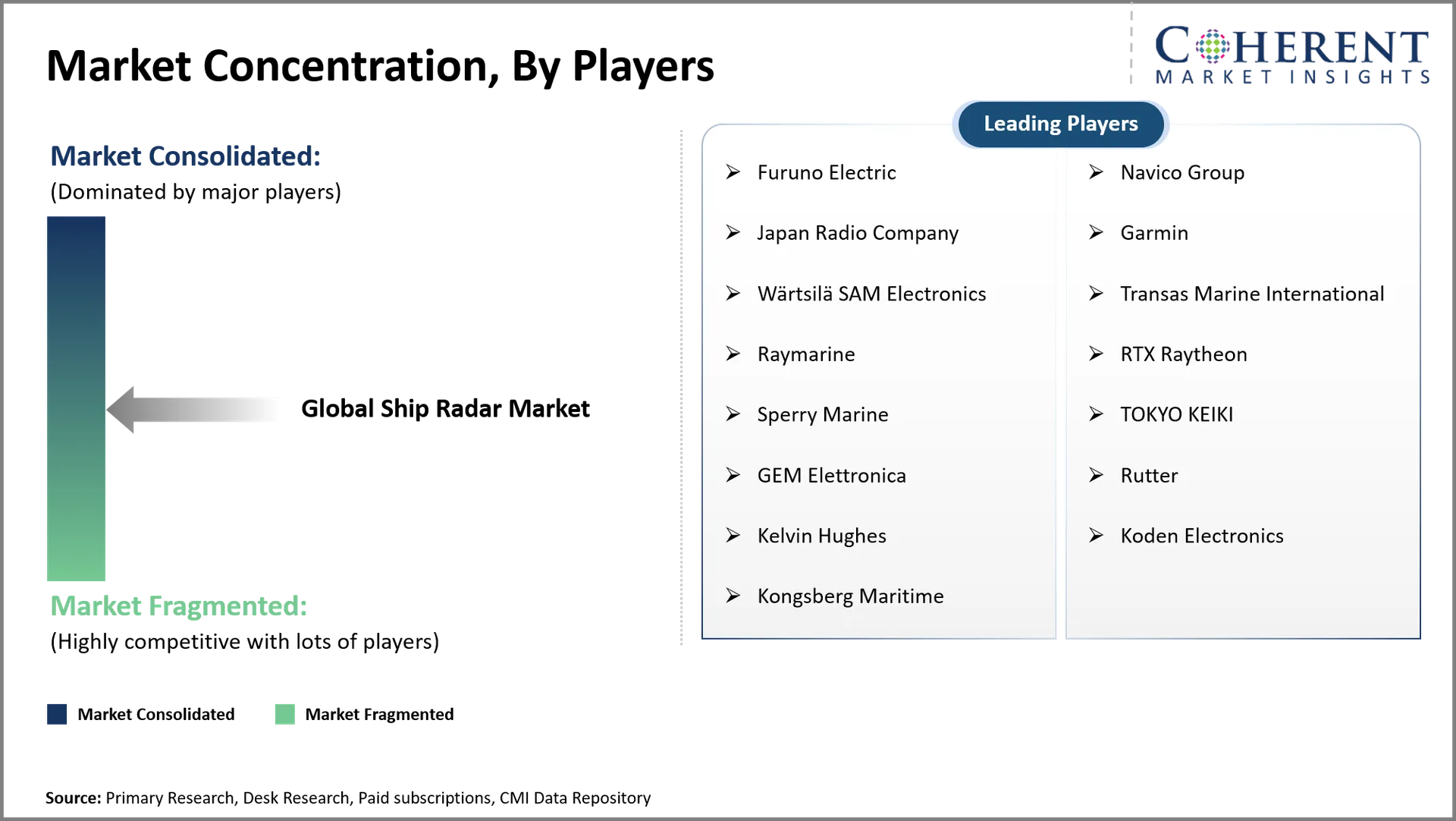
Furuno Electric is strengthening its position by combining radar, automatic identification system, and camera data for autonomous navigation. Its Maneuvering Support System identifies collision risks and automatically calculates safer routes. Its solid-state NXT radar adds Doppler-based Target Analyzer and Fast Target Tracking functions. Japan Radio Company is developing radar and automatic identification system sensor fusion for autonomous collision avoidance. Kongsberg Maritime is focusing on integrated navigation, autonomy, and remote operations across merchant and offshore vessels. Its K-Bridge Autopilot accepts commands from electronic chart display systems and radar stations.
Global Ship Radar Market Report Coverage | |||
Report Coverage | Details | ||
Base Year | 2025 | Market Size in 2026: | USD 625.5 Mn |
Historical Data For: | 2020 To 2024 | Forecast Period: | 2026 To 2033 |
Forecast Period 2026 To 2033 CAGR: | 8.30% | 2033 Value Projection: | USD 1,033.9 Mn |
Geographies covered: |
| ||
Segments covered: |
| ||
Companies covered: | Furuno Electric, Navico Group, Japan Radio Company, Garmin, Wärtsilä SAM Electronics, Transas Marine International, Raymarine, RTX Raytheon, Sperry Marine, TOKYO KEIKI, GEM Elettronica, Rutter, Kelvin Hughes, Koden Electronics, Kongsberg Maritime | ||
Growth Drivers: |
| ||
Restraints & Challenges: |
| ||
Analyst Opinion (Expert Opinion)
- The future of ship radar will increasingly center on sensor fusion, autonomous navigation, and software-enhanced target interpretation. Radar will become a critical perception layer within broader autonomous vessel architectures. Systems combining radar, cameras, automatic identification systems, and navigation software should gain stronger commercial relevance. Furuno and Japan Radio Company are already pursuing these integrated architectures.
- The strongest opportunities should emerge in solid-state radar, autonomous merchant vessels, and technologically advanced Asian shipping markets. Japan offers particularly strong opportunities because autonomous vessel development is progressing through dedicated national programs. China and South Korea also offer attractive opportunities because of their large shipbuilding ecosystems. Radar suppliers should prioritize high-resolution tracking, artificial intelligence, and reliable sensor-fusion capabilities.
- Players seeking an edge should shift from standalone radar hardware toward integrated navigation solutions. Faster target processing, automated collision-risk assessment, and software-upgradable platforms should become important differentiators. Companies should also develop open interfaces supporting automatic identification systems, cameras, electronic charts, and autonomous control systems. Furuno's autonomous navigation architecture demonstrates how integrated sensing can support future unmanned vessel operations.
Speak to the analyst
Want personalized insights?
Take the findings above to one of our principal consultants, or have the report rebuilt around the segments, geographies and competitors you actually track.
Market Segmentation
- Radar Type Insights (Revenue, USD Million, 2021 - 2033)
- X-Band Radar
- S-Band Radar
- Dual-Band Radar
- Others
- Installation Type Insights (Revenue, USD Million, 2021 - 2033)
- Fixed-Mount Radar
- Integrated Bridge Radar
- Portable Radar
- Technology Type Insights (Revenue, USD Million, 2021 - 2033)
- Solid-State Radar
- Magnetron Radar
- Pulse-Doppler Radar
- Digital Radar
- Component Insights (Revenue, USD Million, 2021 - 2033)
- Transmitter
- Receiver
- Antenna
- Processor
- Display Unit
- Others
- Application Insights (Revenue, USD Million, 2021 - 2033)
- Merchant Marine
- Fishing Vessels
- Naval Vessels
- Yachts and Recreational Boats
- Offshore Vessels
- Others
- Regional Insights (Revenue, USD Million, 2021 - 2033)
- North America
- U.S.
- Canada
- Latin America
- Brazil
- Argentina
- Mexico
- Rest of Latin America
- Europe
- Germany
- U.K.
- Spain
- France
- Italy
- Russia
- Rest of Europe
- Asia Pacific
- China
- India
- Japan
- Australia
- South Korea
- ASEAN
- Rest of Asia Pacific
- Middle East
- GCC Countries
- Israel
- Rest of Middle East
- Africa
- South Africa
- North Africa
- Central Africa
- North America
Sources
Primary Research Interviews
- Ship Captains & Navigation Officers
- Radar System Manufacturers & OEMs
- Maritime Defense Procurement Officials
- Port Authority & Harbor Management Executives
Magazines
- Maritime Reporter & Engineering News
- Naval Technology Magazine
- Sea Technology Magazine
- Marine Electronics & Communications
Journals
- Journal of Navigation (Royal Institute of Navigation)
- Journal of Marine Science and Technology
- IEEE Journal of Oceanic Engineering
Associations
- International Maritime Organization (IMO)
- Radio Technical Commission for Maritime Services (RTCM)
- International Association of Marine Aids to Navigation and Lighthouse Authorities (IALA)
- European Maritime Safety Agency (EMSA)
Public Domain Sources
- U.S. Coast Guard (USCG) Official Reports
- European Defence Agency (EDA) Publications
- United Nations Conference on Trade and Development (UNCTAD) Reports
- International Telecommunication Union (ITU) - Maritime Radio Regulations
Proprietary Elements
- CMI Data Analytics Tool
- Proprietary CMI Existing Repository of Information for the Last 10 Years
Get access to 250+ pages report
Every segment, forecast, competitor profile and data table behind the analysis above — available for instant download.
- ESOMAR Member
- ISO 9001:2015 Certified
- D-U-N-S Registered
- GDPR & CCPA Compliant
Missing comfort of reading report in your local language? Find your preferred language:
Frequently Asked Questions
The global ship radar market is expected to stand at USD 625.5 Mn in 2026 and is expected to reach USD 1,033.9 Mn by 2033.
The CAGR of the global ship radar market is projected to be 8.3% from 2026 to 2033.
Increasing global maritime trade is raising demand for collision avoidance systems and International maritime safety requirements support radar installation and replacement are the major factors driving the growth of the global ship radar market.
High installation costs can limit adoption among smaller vessel operators and Radar maintenance requires specialized maritime electronics expertise are the major factors hampering the growth of the global ship radar market.
In terms of radar type, X-band radar segment is estimated to dominate the market revenue share in 2026.
A ship radar detects surrounding objects and supports navigation, tracking, and collision avoidance.
Doppler radar identifies target movement by analyzing frequency shifts in returned signals.