

Global Silicon Carbide Semiconductor Market Size and Forecast – 2026 To 2033
The global silicon carbide semiconductor market is expected to grow from USD 4.30 Bn in 2026 to USD 18.50 Bn by 2033, registering a compound annual growth rate (CAGR) of 11.0% from 2026 to 2033. The global silicon carbide semiconductor market is driven by increasing renewable energy installations. On May 7, 2025 GE Vernova Inc. announced the launch of two key updates to its utility-scale FLEXINVERTER platform. The new FLEXINVERTER 1.5kV solution features advanced silicon carbide (SiC) technology for utility-scale battery energy storage systems (BESS). They also stated the expansion of its previously launched 2kV FLEXINVERTER solution for photovoltaic (PV) plants to International Electrotechnical Commission (IEC) markets, following its initial rollout in the U.S.
Key Takeaways of the Global Silicon Carbide Semiconductor Market
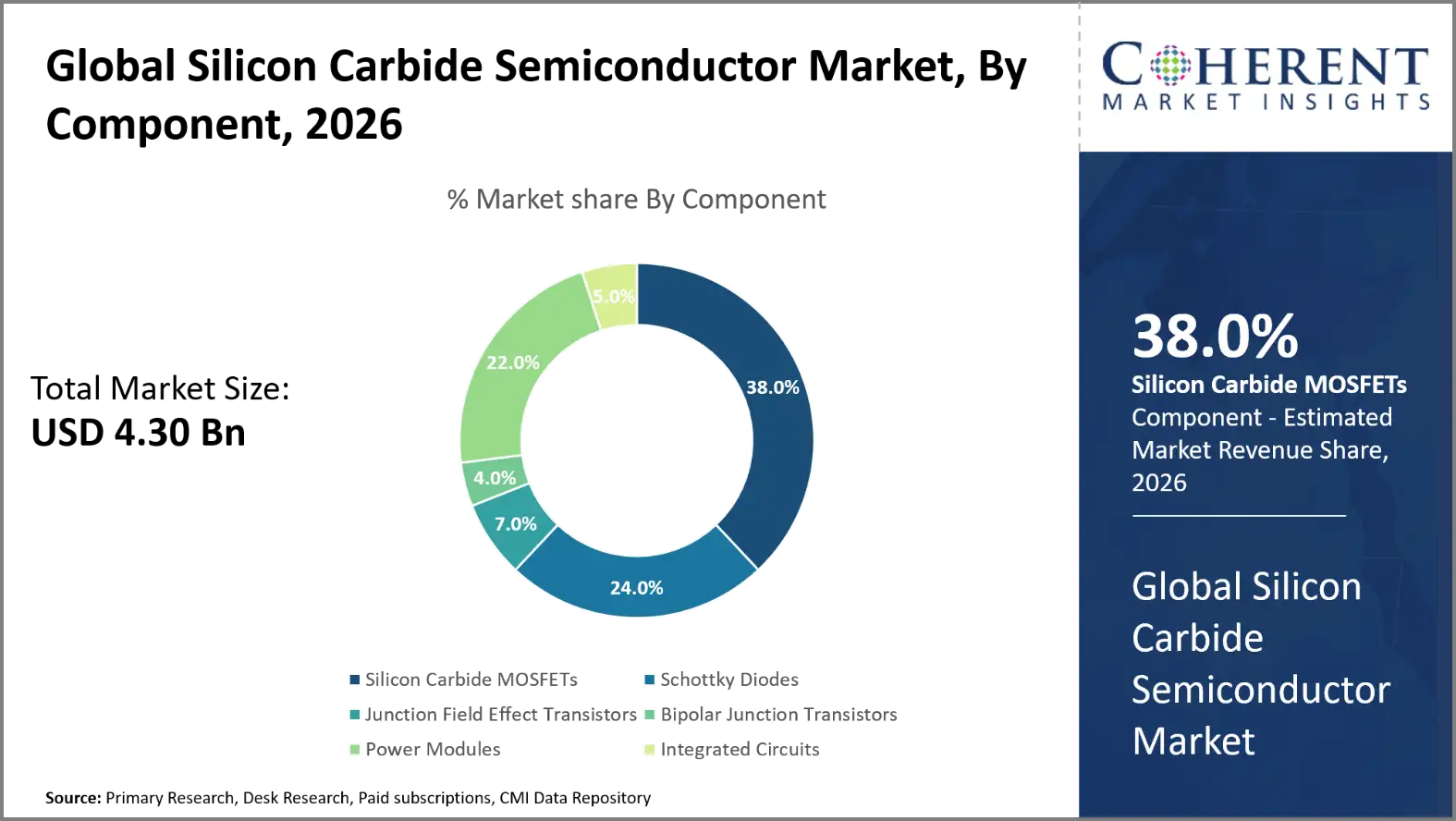
- The Silicon Carbide MOSFETs segment is expected to account for 38.0% of the global silicon carbide semiconductor market share in 2026. Higher adoption of silicon carbide power modules is driving the growth of the segment. On April 17, 2025, Navitas Semiconductor launched new SiCPAK power modules. The modules use trench-assisted planar silicon carbide MOSFET technology and epoxy-resin potting.
- The Automotive segment is estimated to capture 42.0% of the market share in 2026. Growing demand for high efficiency power supplies is majorly driving the growth of the segment. On September 10, 2025, Infineon Technologies introduced a 12-kilowatt power supply reference design. It combines silicon, silicon carbide, and gallium nitride technologies. The architecture emphasizes high conversion efficiency and high-power density.
- The Automotive Original Equipment Manufacturers segment is estimated to capture 41.0% of the market share in 2026. Rising demand for high voltage power conversion is majorly driving the growth of the segment. On April 9, 2026, Coherent Corp. announced advanced silicon carbide thick epitaxy capabilities. The production platforms support power devices reaching 10 kilovolts.
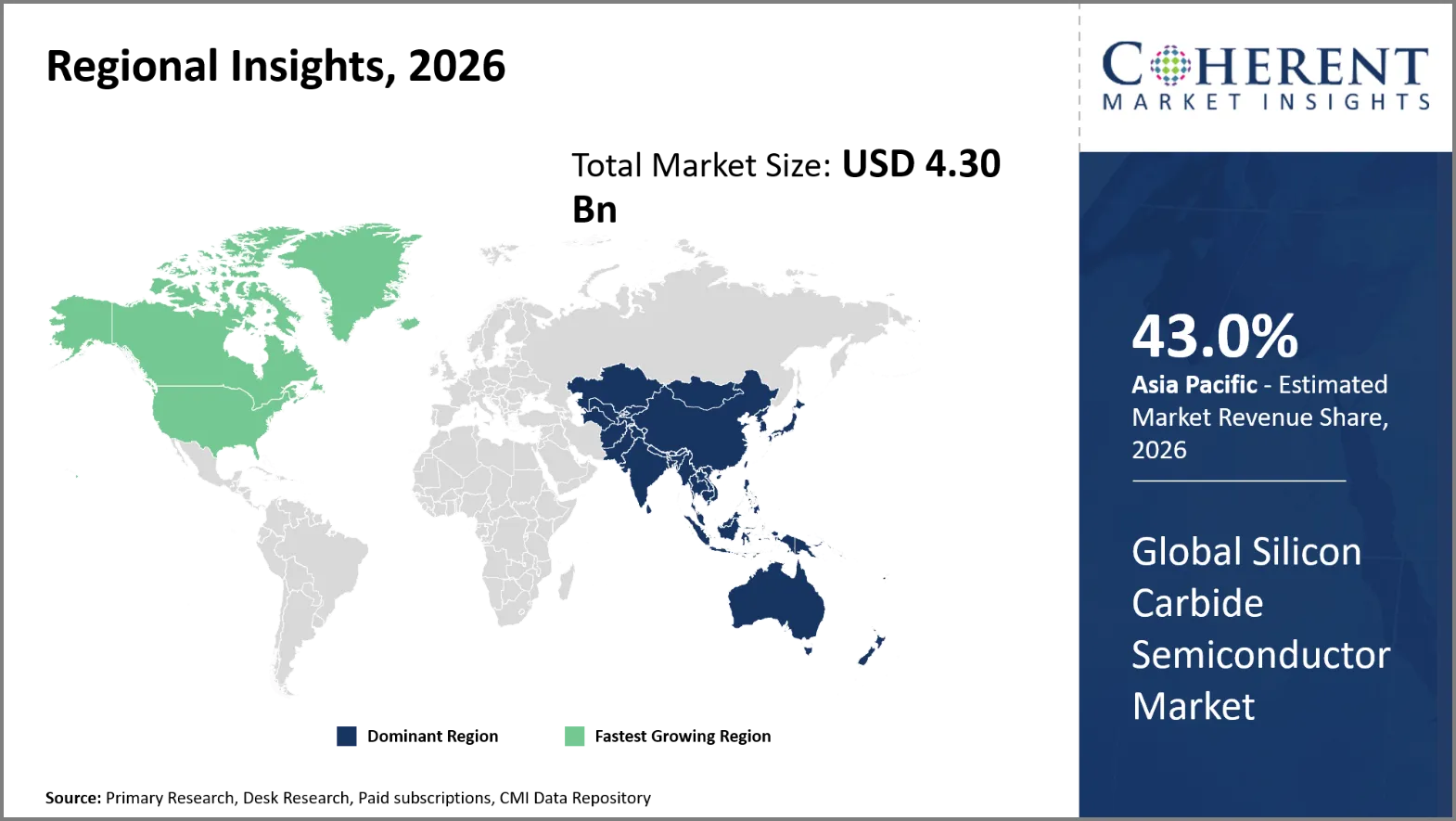
- Asia Pacific is expected to dominate the silicon carbide semiconductor market in 2026 with a market share of 43.0%. Increasing adoption in energy storage systems in Asia Pacific is driving the growth of the regional market. On June 5, 2025, Sungrow launched the PowerTitan 3.0 energy storage platform in China.
- North America is expected to account for 26.0% share in 2026 and is projected to record the fastest growth over the forecast period. Rising demand from data center power systems in North America is driving the growth of the regional market. On January 29, 2026, Wolfspeed introduced its TOLT silicon carbide power module portfolio. The new top-side-cooled package targets artificial intelligence data center rack power supplies.
Segmental Insights
Why Does Silicon Carbide MOSFETs Dominate the Global Silicon Carbide Semiconductor Market?
The silicon carbide MOSFETs segment is expected to account for 38.0% of the global silicon carbide semiconductor market share in 2026. The primary choice is silicon carbide MOSFETs as they can handle high voltage, switch quickly and have minimal conduction losses. The performance enhances power conversion efficiency and reduces thermal management demands. These attributes allow for small and light weight power electronics for demanding applications. Silicon carbide MOSFETs are also more efficient at higher operating temperatures than traditional silicon devices. They allow fewer passive components and more compact power converters due to their switching performance. These characteristics make them useful for traction inverters, onboard chargers, DC converters and industrial drives.
On February 9, 2026, Infineon Technologies announced that its CoolSiC MOSFETs (silicon carbide (SiC) power MOSFETs) have been implemented in the new bZ4X model from Toyota. The announcement was made on February 9, 2026. The SiC MOSFETs, integrated into the on-board charger (OBC) and DC/DC converter, take advantage of the material’s low losses, high thermal resistance, and high voltage capability to assist improve driving range and shorten charging time.
- Current Industry Events of 2026
- Market Size Estimation
- Regional Breakdown
- Competitive Landscape
- Customer Intelligence
- Segmental Analysis
- Pricing Analysis
- Key Market Drivers, Challenges & Future Trends
- Customized Insights Section
Why is Automotive the Most Widespread Application?
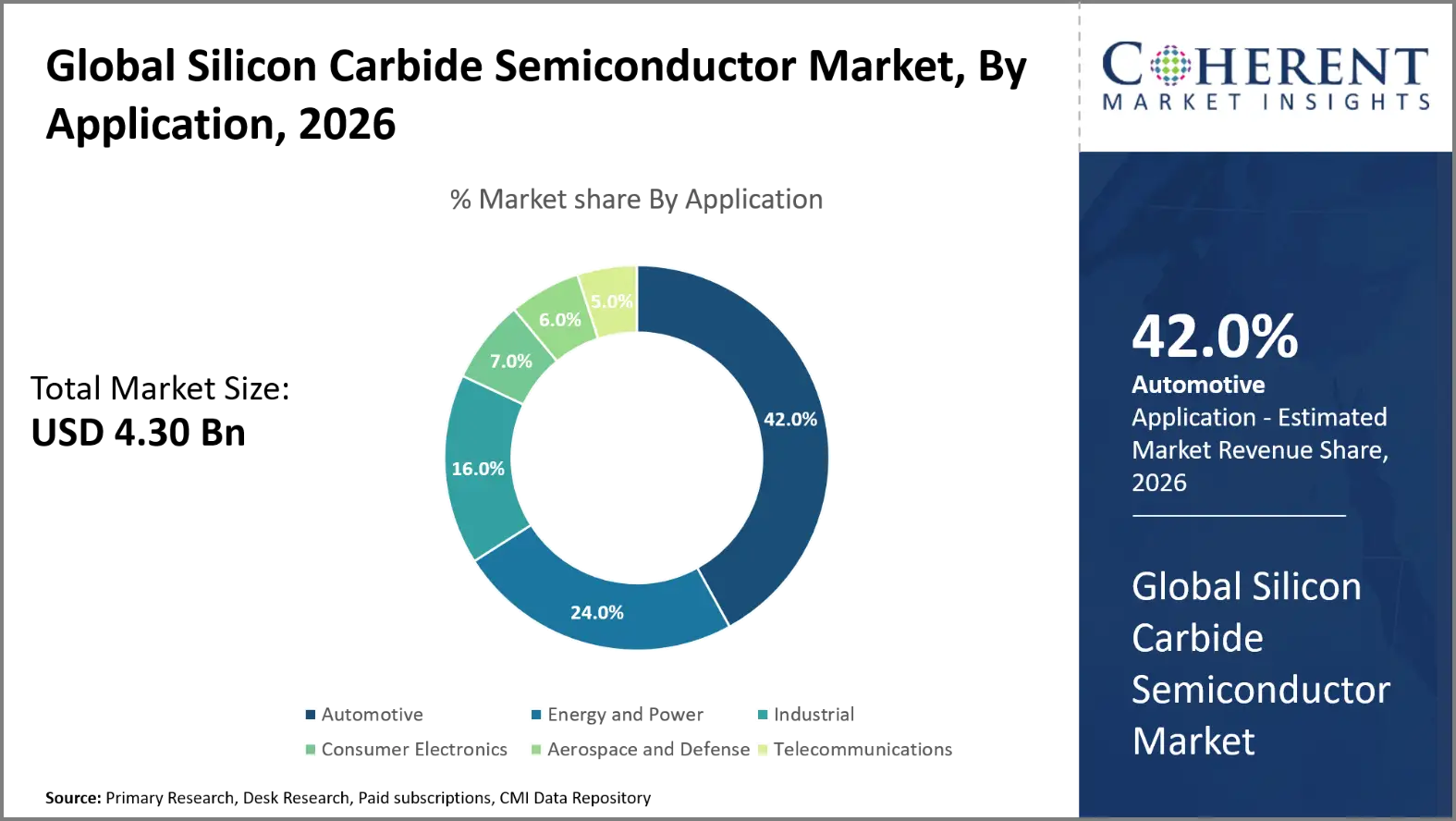
The automotive segment is expected to account for 42.0% of the global silicon carbide semiconductor market share in 2026. Automotive is the most widespread application because electric vehicles require several high-power conversion systems. Traction inverters take the power from the batteries and transform it to electricity that the electric motors can use. The electricity is converted using onboard chargers during the charging of the car. The DC converters supply the right voltages for the vehicle’s various electrical systems. Silicon carbide devices enhance the efficiency at each of these conversion steps and reduce thermal losses. The high temperature capacity also enables compact powertrain designs and efficient thermal management. The manufacture of electric vehicles is continuing to rise in China, Europe, North America and other important markets.
On May 6, 2025, Nexperia announced a range of highly efficient and robust automotive qualified silicon carbide (SiC) MOSFETs with RDS(on) values of 30, 40 and 60 mΩ. These devices (NSF030120D7A0-Q, NSF040120D7A1-Q, NSF060120D7A0-Q), which deliver industry-leading figures-of-merit (FoM), were previously offered in industrial grade and have now been awarded AEC-Q101 certification.
Automotive Original Equipment Manufacturers Dominates the Global Silicon Carbide Semiconductor Market
The automotive original equipment manufacturers segment is expected to account for 41.0% of the global silicon carbide semiconductor market share in 2026. Automotive original equipment manufacturers dominate because their vehicle architectures determine semiconductor requirements across electric powertrains. They specify performance requirements for traction inverters, chargers, converters, and auxiliary electrical systems. Electric vehicle manufacturers are increasingly focused on metrics like driving range, charging performance, power density and thermal efficiency. Silicon carbide semiconductors immediately address these needs with efficient high-voltage switching. Automotive original equipment manufacturers also need to extensively validate the reliability of the semiconductor devices before they are used in production vehicles. This requirement drives suppliers to develop automotive-qualified silicon carbide products with consistent performance.
On April 28, 2026, onsemi and Geely Auto Group expanded their strategic collaboration to accelerate next-generation electric vehicle development. The partnership includes deeper integration of onsemi’s EliteSiC technologies across vehicles built on Geely’s SEA-S, the Super Hybrid variant of Geely’s Sustainable Experience Architecture.
Current Events and their Impact
Current Events | Description and its Impact |
U.S. Export Administration Regulations, 90 Federal Register 5298 |
|
European Union Dual-Use Regulation, Regulation (EU) 2021/821 |
|
Silicon Carbide Semiconductor Market Dynamics
Market Drivers
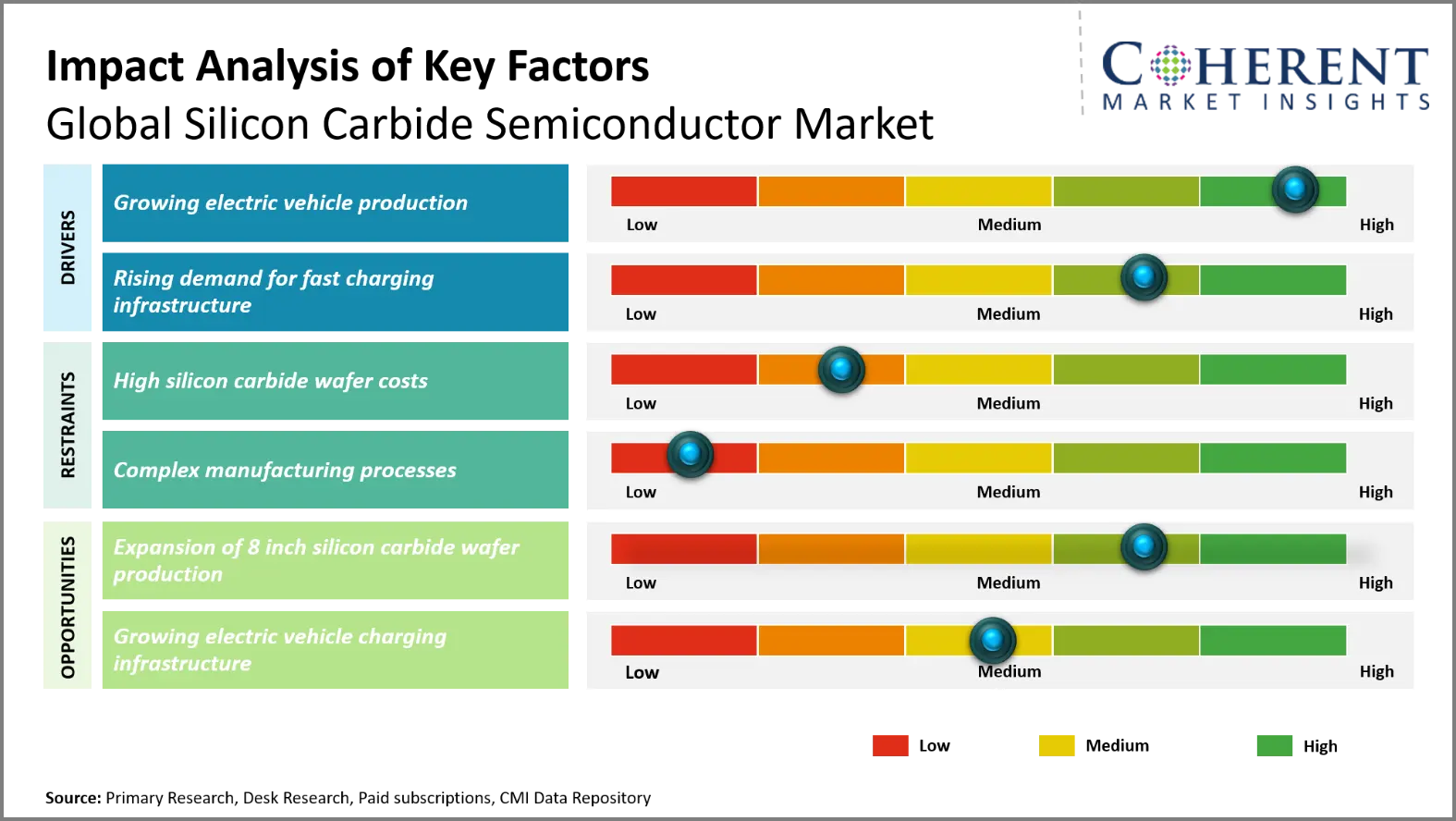
- Growing electric vehicle production: Growing electric vehicle production is driving faster demand for silicon carbide semiconductors in automotive power electronics. Electric vehicles need efficient traction inverters, onboard chargers, and direct-current converters. Silicon carbide devices help to reduce switching losses and enhance the efficiency of power conversion in these systems. The higher temperature capability also allows smaller powertrain design and reduces cooling requirements. For automakers, driving range, charging performance and power density are increasingly important across electric car platforms. These requirements speed the incorporation of silicon carbide into high voltage vehicle layouts. Expanding electric vehicle manufacturing in China, Europe, North America, and other regions further broadens semiconductor demand.
- On March 27, 2025, Hyundai Motor Group Meta-plant America (HMGMA) hosted its Grand Opening celebration, as part of Hyundai Motor Group’s commitment to and investment in the U.S. The new vehicle assembly and battery plant will produce up to 500,000 electric and hybrid vehicles annually for Hyundai, Kia and Genesis brands.
- Rising demand for fast charging infrastructure: Rising demand for fast charging infrastructure is increasing adoption of silicon carbide semiconductors across charging equipment. High power chargers need effective conversion technologies to cope with higher electrical loads. Silicon carbide devices allow for higher switching frequencies and decreased power losses during conversion. This capability enables smaller charging systems with better thermal management and higher power density. Fast chargers also have to be dependable under challenging voltage and temperature circumstances. Silicon carbide components can fulfill these requirements in charging modules and power conversion stages.
- On May 15, 2025, IONITY secured a a record amount of funding up to USD 672.3 million including USD 504.2 million in committed green loan facilities and a so-called accordion facility. Nine top international commercial banks have given this loan transaction, which is the largest ever in the European charging industry and underlines the market’s confidence in IONITY’s long-term strategy.
Emerging Trends
- 200-Millimeter Silicon Carbide Wafer Manufacturing: Manufacturers are shifting to 200-millimeter silicon carbide wafers with the aim of enhancing manufacturing productivity and driving device costs down. The larger the wafer, the more useful surface area can be produced per cycle, and the more output can be achieved, improving the economics of automotive semiconductor applications.
- Higher-Voltage Silicon Carbide Power Devices: Semiconductor companies are developing higher voltage silicon carbide devices for electric vehicles and energy infrastructure applications where there is a big demand. The increased voltage ratings enable effective power conversion for larger battery systems, charging infrastructure, renewable energy installations and industrial power equipment.
- Integrated Silicon Carbide Power Modules: Power semiconductor suppliers are moving toward integrating silicon carbide switches, diodes, substrates and sophisticated packaging into modules. The integration enhances electrical performance, thermal management and installation economy, making it easier to develop powertrains for electric vehicles and industrial conversion systems.
- Silicon Carbide Adoption in Artificial Intelligence Data Centers: Artificial intelligence data centers are opening new doors for silicon carbide power electronics as computer infrastructure demands increasingly efficient power conversion. Silicon carbide devices increase efficiency in high-power supply, minimizing energy losses in ever-denser computing centers.
Regional Insights
Why is Asia Pacific a Strong Market for Silicon Carbide Semiconductor?
Asia Pacific is expected to account for a market share of 43.0% in 2026. The region’s growth is driven by electric car manufacture, localized power semiconductor production and fast wafer capacity increase. Silicon carbide is increasingly used by electric vehicle makers in traction inverters and China still has a big role in it. Japan provides innovative gadget development from Mitsubishi Electric and ROHM. South Korea is also building on top of its semiconductor skills with a silicon carbide wafer ecosystem. Finally, the company is also converting its Kulim, Malaysia facility to 200mm silicon carbide manufacture. This regional manufacturing build-out allows greater wafer economics and local supply chains. ROHM is working on silicon carbide devices for electric vehicles and artificial intelligence server power supplies. These developments create a diverse regional demand base beyond conventional automotive applications.
Why Does North America Silicon Carbide Semiconductor Market Exhibit High Growth?
North America is expected to register the fastest growth with a CAGR of 11.7% over the forecast period. It is projected to account for 26.0% of the global silicon carbide semiconductor market in 2026. Strong silicon carbide investment is being driven by automobile electrification, artificial intelligence infrastructure, and domestic semiconductor activities in North America. Wolfspeed announced in 2026 that it has created a 300-millimeter-diameter single-crystal silicon carbide wafer. The company stated it intends to use the technology for artificial intelligence infrastructure and advanced power gadgets. Bosch is investing USD 2 billion to establish silicon carbide production in Roseville, California. The United States Department of Commerce committed up to USD 225 million under the CHIPS Program. Bosch began sample production and plans commercial manufacturing during 2026. Wolfspeed also maintains silicon carbide production facilities across North Carolina, New York, and Arkansas. These developments strengthen domestic material, device, and packaging capabilities.
Global Silicon Carbide Semiconductor Market Outlook for Key Countries
Why is China Emerging as a Major Hub in the Silicon Carbide Semiconductor Market?
China’s growth is driven by its enormous electric vehicle manufacturing base and rapidly expanding domestic semiconductor ecosystem. Chinese electric vehicle manufacturers increasingly seek localized silicon carbide supply for traction inverters and charging systems. Infineon identifies companies including Changan, Chery, Leapmotor, SAIC, Xiaomi, and XPENG among its silicon carbide design-win customers. Chinese competition is also increasing cost pressure across global silicon carbide power devices. Mitsubishi Electric specifically identifies vertically integrated Chinese competitors as a competitive force. Domestic manufacturers are therefore pursuing greater control over substrates, wafers, devices, and packaging. This integration supports faster qualification and localized supply for Chinese electric vehicle platforms.
Is U.S. the Next Growth Engine for the Silicon Carbide Semiconductor Market?
The U.S. silicon carbide semiconductor market is gaining momentum from domestic manufacturing investments and artificial intelligence power requirements. Wolfspeed operates production facilities in North Carolina, New York, and Arkansas. In January 2026, Wolfspeed demonstrated a 300-millimeter silicon carbide wafer for next-generation power applications. Bosch is converting its Roseville facility into its first U.S. silicon carbide semiconductor manufacturing site. The facility is scheduled for commercial production during 2026 using 200-millimeter wafers. The United States Department of Commerce is supporting this project with up to USD 225 million. These investments strengthen domestic supply resilience while expanding advanced silicon carbide manufacturing expertise.
Germany Silicon Carbide Semiconductor Market Analysis and Trends
Automotive power electronics, industrial electrification and advanced semiconductor manufacturing infrastructure are the drivers for Germany silicon carbide semiconductor market. To illustrate, Infineon is ramping up its silicon carbide capabilities as part of an overall power semiconductor production plan. In 2025, the company began shipping client products produced using advanced 200-millimeter silicon carbide manufacturing. Infineon’s silicon carbide technology is aimed toward electric vehicles, railroads and renewable energy systems. In 2026, Infineon opened its Smart Power Fab in Dresden, following USD 6 billion of investment. The facility supports automotive applications, artificial intelligence data centers, renewable energy, and power grids. Germany therefore combines automotive demand with advanced industrial power conversion requirements.
Japan Silicon Carbide Semiconductor Market Analysis and Trends
Japan is driven by established power semiconductor expertise, automotive electrification, and continuous silicon carbide device innovation. Mitsubishi Electric has started shipping samples of fifth-generation silicon carbide MOSFETs in June 2026. The new gadgets have roughly a 25% reduction in on-resistance compared to prior versions. They target electric vehicle inverters, eAxles, plug-in hybrid vehicles, and other electrified vehicles. ROHM developed fifth-generation silicon carbide MOSFETs with approximately 30% lower high-temperature on-resistance. ROHM also targets artificial intelligence server power supplies and data centers. Mitsubishi Electric completed a new 200-millimeter silicon carbide power semiconductor factory building in Kumamoto during 2025.
South Korea Silicon Carbide Semiconductor Market Analysis and Trends
South Korea is strengthening silicon carbide demand through its advanced semiconductor ecosystem and expanding electrified mobility supply chain. In addition to their strong existing memory and logic production capability, South Korean semiconductor companies are rapidly expanding compound semiconductor capabilities. Hyundai Motor Group and Kia electrification plans create more demand for the country’s automotive industry as well. Other vehicle manufacturers in Infineon’s 2026 design-win portfolio include Hyundai and Kia. South Korea’s semiconductor infrastructure also supports sophisticated packaging, testing and power electronics research. This combination paves the way for silicon carbide use beyond traditional automobile applications. The country is well placed to integrate semiconductor manufacturing skills with the electrification of vehicle powertrains.
Global Silicon Carbide Semiconductor Market - Silicon Carbide Substrate Production (2025)
Region/Country | Major Substrate Producers | Main Substrate Size | Production Capacity |
Asia Pacific | SICC, Resonac, ROHM, SK Siltron | 150 mm and 200 mm | SICC capacity exceeded 420,000 substrates annually based on its latest disclosed production scale |
North America | Wolfspeed, Coherent | 150 mm and 200 mm | Coherent's Pennsylvania expansion targets 1 million 150 mm-equivalent substrates annually by 2027 |
Europe | Coherent, Soitec, Resonac | 150 mm and 200 mm | Coherent operates European substrate and epitaxy production, with capacity expanding |
China | SICC and other domestic producers | 150 mm and 200 mm | SICC reported 420,000 substrates annual capacity in 2024 and continued expansion in 2025 |
Japan | Resonac, ROHM | 150 mm and 200 mm | 200 mm substrate development and sample shipments were expanding in 2025 |
South Korea | SK Siltron | 150 mm and 200 mm | 200 mm silicon carbide substrate production and development were expanding |
How is Expansion of 8 Inch Silicon Carbide Wafer Production Creating New Growth Opportunities in the Silicon Carbide Semiconductor Market?
Growth prospects are emerging from the expansion of 8-inch silicon carbide wafer manufacture as the die yield from each substrate increases. In 2025, Infineon Technologies started high-volume 200-millimeter silicon carbide production in Kulim, Malaysia. The site serves the automotive, renewables and industrial markets. Wolfspeed also showcased the 300-millimeter silicon carbide wafer technology in 2026. This invention could potentially allow for significantly improved die productivity for advanced power devices. Bosch is setting up 200-mm silicon carbide production at its Roseville plant. Commercial production is scheduled for 2026 to serve automotive and industrial clients. These expenditures incentivize semiconductor makers to shift output to larger substrates and improve manufacturing utilization. Also, larger wafer production can help enable more competitive device price as automotive silicon carbide quantities grow.
On September 10, 2025, Wolfspeed, Inc. announced the commercial launch of its 200mm SiC materials products, a major milestone in the company’s aim to expedite the industry’s shift from silicon-to-silicon carbide. The original 200mm SiC launch to a restricted group of clients was well received and the benefits those customers experienced merited a commercial release to the market.
Market Players, Key Development, and Competitive Intelligence
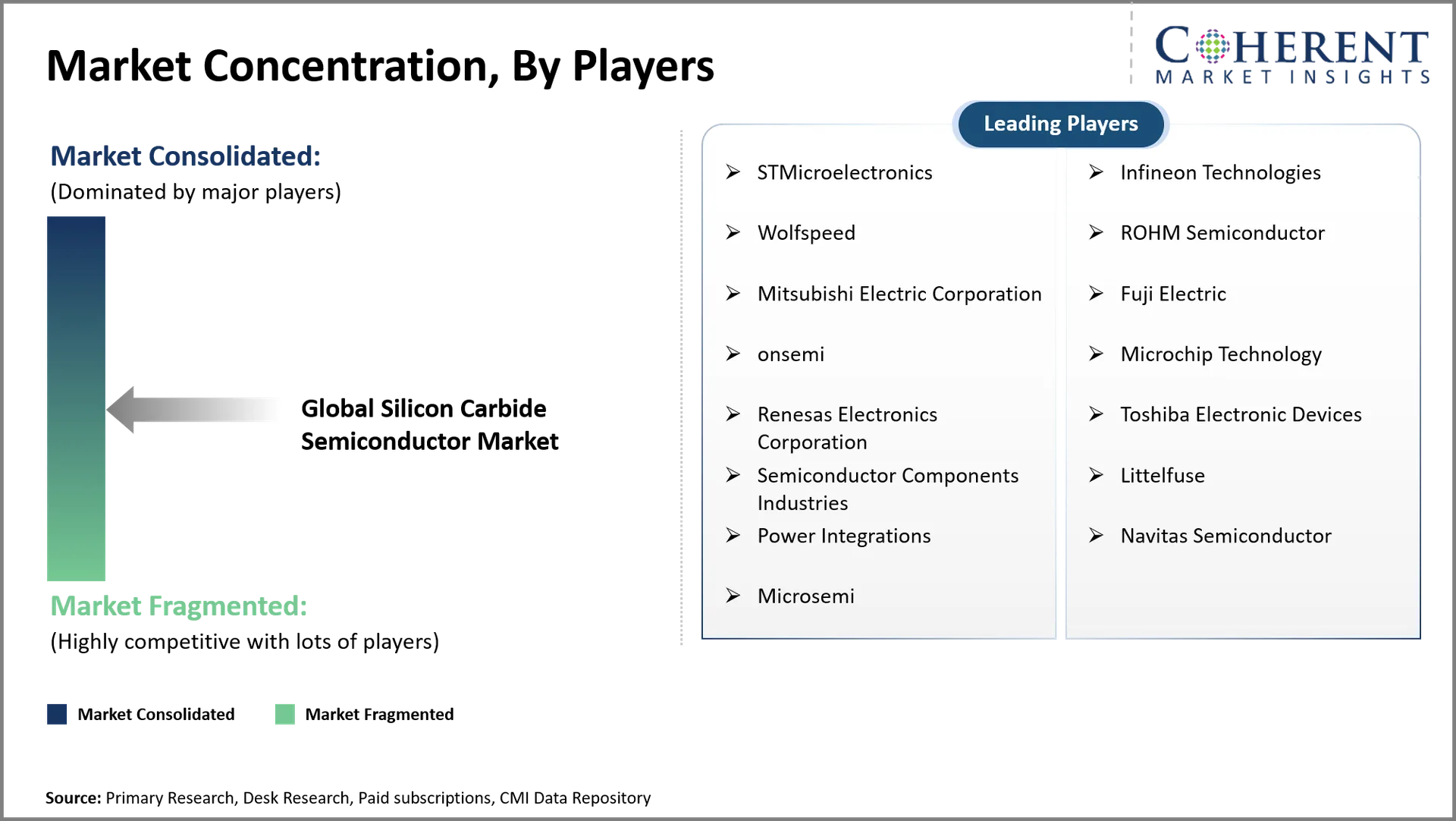
Key Developments
- On May 2, 2026, Microchip Technology announced the availability of its new 3.3 kV HV‑D3 mSiC Power Modules, designed to simplify and accelerate the adoption of solid-state transformers (SSTs) in AI hyperscale data centers and other high‑voltage power applications. The new modules integrate 3.3 kV silicon carbide (SiC) mSiC MOSFETs and Schottky diodes in an industry‑standard 62 mm package, enabling efficient power delivery from the medium‑voltage grid directly to the server rack.
- On April 21, 2026, ROHM announced it has developed the latest device of its EcoSiC series, the 5th Generation SiC MOSFETs optimized for high efficiency power applications. This technology is ideally suitable for automotive electric powertrain systems such as traction inverters for electric vehicles, as well as power supplies for AI servers and industrial equipment such as data centers.
- On September 4, 2025, ROHM and Schaeffler, a leading German automotive supplier, started mass production of a new high-voltage inverter brick equipped with ROHM’s SiC (silicon carbide) MOSFET bare chips as part of their strategic partnership. The inverter brick is intended for a major Chinese car manufacturer.
Competitive Landscape
The competitive landscape is shifting toward larger wafers, lower losses, automotive qualification, and application-specific power modules. Infineon Technologies is advancing 200-millimeter production across Villach and Kulim, targeting electric vehicles, charging, trains, renewables, and artificial intelligence data centers. Wolfspeed is differentiating through Gen 5 MOSFETs and a qualified 200-millimeter platform. Its Gen 5 devices target 750-volt and 1,200-volt automotive and industrial systems. Wolfspeed also commercialized a 10,000-volt MOSFET for grid modernization and artificial intelligence infrastructure. Infineon Technologies and ROHM are pursuing interchangeable silicon carbide packages to improve customer sourcing flexibility. These strategies show increasing competition around manufacturing scale, packaging, voltage range, and application-specific optimization.
Top Manufacturers and Notable Products
Manufacturer | Notable Product | Key features |
Infineon Technologies | CoolSiC MOSFET | Low switching losses, low gate charge, high reliability, high-frequency operation, broad module configurations |
STMicroelectronics | STPOWER SiC MOSFET | Up to 200°C junction temperature, low on-resistance, low switching losses, automotive qualification |
Wolfspeed | Gen 5 SiC MOSFET | Up to 27% efficiency improvement, low specific on-resistance, 200 mm manufacturing platform |
onsemi | EliteSiC M3e MOSFET | 30% lower conduction losses, up to 50% lower turn-off losses, high phase-current capability |
JEL Corporation | GTCR5280 | Approximately 30% lower high-temperature on-resistance, lower losses, compact designs, higher output power |
Global Silicon Carbide Semiconductor Market Report Coverage | |||
Report Coverage | Details | ||
Base Year | 2025 | Market Size in 2026: | USD 4.30 Bn |
Historical Data For: | 2020 To 2024 | Forecast Period: | 2026 To 2033 |
Forecast Period 2026 To 2033 CAGR: | 11.00% | 2033 Value Projection: | USD 18.50 Bn |
Geographies covered: |
| ||
Segments covered: |
| ||
Companies covered: | STMicroelectronics, Infineon Technologies, Wolfspeed, ROHM Semiconductor, Mitsubishi Electric Corporation, Fuji Electric, onsemi, Microchip Technology, Renesas Electronics Corporation, Toshiba Electronic Devices, Semiconductor Components Industries, Littelfuse, Power Integrations, Navitas Semiconductor, Microsemi | ||
Growth Drivers: |
| ||
Restraints & Challenges: |
| ||
Analyst Opinion (Expert Opinion)
- The future of the industry will increasingly center on 200-millimeter manufacturing and higher-voltage silicon carbide architectures. Automotive traction inverters will remain important, but artificial intelligence infrastructure will create a distinct demand channel. Wolfspeed's 10,000-volt MOSFET demonstrates how silicon carbide is moving toward medium-voltage power conversion. The industry's competitive focus will therefore shift from device availability toward system-level efficiency and power density.
- The strongest opportunity should emerge in silicon carbide MOSFETs serving electric vehicle inverters, charging infrastructure, and artificial intelligence data centers. China offers exceptional automotive volume and domestic semiconductor integration opportunities. The U.S. offers attractive opportunities in artificial intelligence power infrastructure and domestic silicon carbide manufacturing. Wolfspeed's 800-volt partnership with LITEON illustrates this emerging data-center opportunity. Japan and Germany remain important for automotive-grade device engineering and power electronics integration.
- Players seeking an edge should prioritize qualified 200-millimeter production while improving wafer yields and device consistency. Suppliers shall design differentiated packages to facilitate heat management and boost power density. The second-source packaging arrangement between Infineon Technologies and ROHM is a desirable strategic strategy. Further, companies must gain vehicle design victories before production ramp tightness. Diversification of demand can be achieved by moving beyond vehicles into charging, grid equipment and artificial intelligence infrastructure.
Speak to the analyst
Want personalized insights?
Take the findings above to one of our principal consultants, or have the report rebuilt around the segments, geographies and competitors you actually track.
Market Segmentation
- Component Insights (Revenue, USD Billion, 2021 - 2033)
- Silicon Carbide MOSFETs
- Schottky Diodes
- Junction Field Effect Transistors
- Bipolar Junction Transistors
- Power Modules
- Integrated Circuits
- Application Insights (Revenue, USD Billion, 2021 - 2033)
- Automotive
- Energy and Power
- Industrial
- Consumer Electronics
- Aerospace and Defense
- Telecommunications
- End User Insights (Revenue, USD Billion, 2021 - 2033)
- Automotive Original Equipment Manufacturers
- Industrial Equipment Manufacturers
- Energy Companies
- Consumer Electronics Manufacturers
- Telecommunications Companies
- Others
- Regional Insights (Revenue, USD Billion, 2021 - 2033)
- North America
- U.S.
- Canada
- Latin America
- Brazil
- Argentina
- Mexico
- Rest of Latin America
- Europe
- Germany
- U.K.
- Spain
- France
- Italy
- Russia
- Rest of Europe
- Asia Pacific
- China
- India
- Japan
- Australia
- South Korea
- ASEAN
- Rest of Asia Pacific
- Middle East
- GCC Countries
- Israel
- Rest of Middle East
- Africa
- South Africa
- North Africa
- Central Africa
- North America
Sources
Primary Research Interviews
- SiC Device Manufacturers & Suppliers
- Power Electronics OEMs & System Integrators
- Electric Vehicle (EV) Component Manufacturers
- Semiconductor Foundry & Wafer Producers
Magazines
- Power Electronics Europe Magazine
- Semiconductor Today
- EE Times (Electronics Engineering Times)
- Compound Semiconductor Magazine
Journals
- IEEE Transactions on Power Electronics
- Journal of Electronic Materials (Springer)
- Materials Science and Engineering: B (Elsevier)
Associations
- Power Electronics Industry Group (PEIG)
- SEMI (Semiconductor Equipment and Materials International)
- European Power Electronics and Drives Association (EPE)
- Wide Bandgap Power Electronics Technology Assessment (U.S. DOE)
Public Domain Sources
- U.S. Department of Energy (DOE) – Power Electronics Reports
- European Commission – Green Deal & EV Policy Documents
- U.S. Geological Survey (USGS) – Mineral Commodity Summaries (Silicon Carbide)
- International Energy Agency (IEA) – Electric Vehicles Outlook
Proprietary Elements
- CMI Data Analytics Tool
- Proprietary CMI Existing Repository of Information for Last 10 Years
Get access to 250+ pages report
Every segment, forecast, competitor profile and data table behind the analysis above — available for instant download.
- ESOMAR Member
- ISO 9001:2015 Certified
- D-U-N-S Registered
- GDPR & CCPA Compliant
Frequently Asked Questions
The global silicon carbide semiconductor market is expected to stand at USD 4.30 Bn in 2026 and is expected to reach USD 18.50 Bn by 2033.
The CAGR of the global silicon carbide semiconductor market is projected to be 11.0% from 2026 to 2033.
Growing electric vehicle production and Rising demand for fast charging infrastructure are the major factors driving the growth of the global silicon carbide semiconductor market.
High silicon carbide wafer costs and Complex manufacturing processes are the major factors hampering the growth of the global silicon carbide semiconductor market.
In terms of component, silicon carbide MOSFETs segment is estimated to dominate the market revenue share in 2026.
Silicon carbide reduces electrical losses, supporting higher drivetrain efficiency, improved thermal management, and potentially greater driving range.
High-power chargers require efficient switching components that can manage substantial electrical loads while limiting conversion losses.