

Global Slim Toaster Market Size and Forecast – 2026 To 2033
The global slim toaster market is estimated to be valued at USD 540.4 Mn in 2026 and is expected to reach USD 828.8 Mn by 2033, growing at a compound annual growth rate (CAGR) of 6.30% from 2026 to 2033. Market growth is supported by consumer preference for space-saving kitchen appliances, particularly among urban households with limited countertop space.
New streamlined designs, adjustable browning controls and handy toasting options are being added to make them more user friendly and different in order to meet the demands of the day-to-day. In August 2026, Morphy Richards announced its plans for Fusion Toaster to be on display at IFA Berlin 2026, featuring a retro design with a modern touch. The development is a reminder of the role that appliance design and convenience play in consumer buying decisions.
Key Takeaways of the Global Slim Toaster Market
- Single Long-Slot Slim Toasters are expected to expand at an estimated CAGR of 6.8% from 2026 to 2033 and account for 55.6% market share of the global slim toaster market in 2026. They feature long slots so that artisan bread can be stored without the need for larger countertops which is useful for smaller kitchens. In March 2024, Made by Gather launched Bella's new slim toaster, which is two-slice wide and 3.5 inches tall, in its Fits-anywhere line.
- 2-Slice Slim Toasters are expected to register an estimated 6.1% CAGR during 2026–2033, capturing 71.3% share global slim toaster market in 2026. Their capacity fits the needs of the average small home kitchen for breakfast on an everyday basis and helps to reduce the size of appliances and complexity of manufacture. Kenwood unveiled its Ripple two-slot toaster in March of 2025, with seven browning settings and a high lift removal mechanism.
- Manual Control is expected to have a 5.9% CAGR for 2026–2033, and will hold 81.3% market share in 2026. Mechanical browning selectors are easy to use and can decrease reliance on electronic interfaces to aid inexpensive product positioning. In June 2025, AENO launched its new, compact, mechanical-controlled, 7-browning-level and 5-bread-preset toaster, called the AENO TS3.
- 801–1,200 W is forecast to achieve an estimated 6.4% CAGR during 2026–2033, representing 61.8% share of the global slim toaster market in 2026. This range of power enables toasting to be done in a practical manner without the need for larger heating assemblies, harmonizing capacity with appliance size. Group Taurus recorded a BLACK+DECKER 1,000 W TOASTER with one long slot that fits various bread sizes in July 2024.
- Asia Pacific is projected to record an estimated 6.2% CAGR during 2026–2033, retaining the largest regional of 33.2% share of the global slim toaster market in 2026. Compact household appliances are space-efficient solutions for an urban kitchen with limited space and domestic appliance portfolios are handy options for purchasing. In November 2026, India's Stove Kraft highlighted the Pigeon Eazy Toaster among its new product launches.
- Europe is expected to register the fastest estimated CAGR of 7.5% during 2026–2033, following a 32.6% share of the global slim toaster market in 2026. Energy efficient and economical use and countertop design may promote replacement purchases. At the end of April 2026, France-based Groupe SEB announced that it had launched a two-slot toaster with an eco-mode option, for when only one is needed.
Segmental Insights
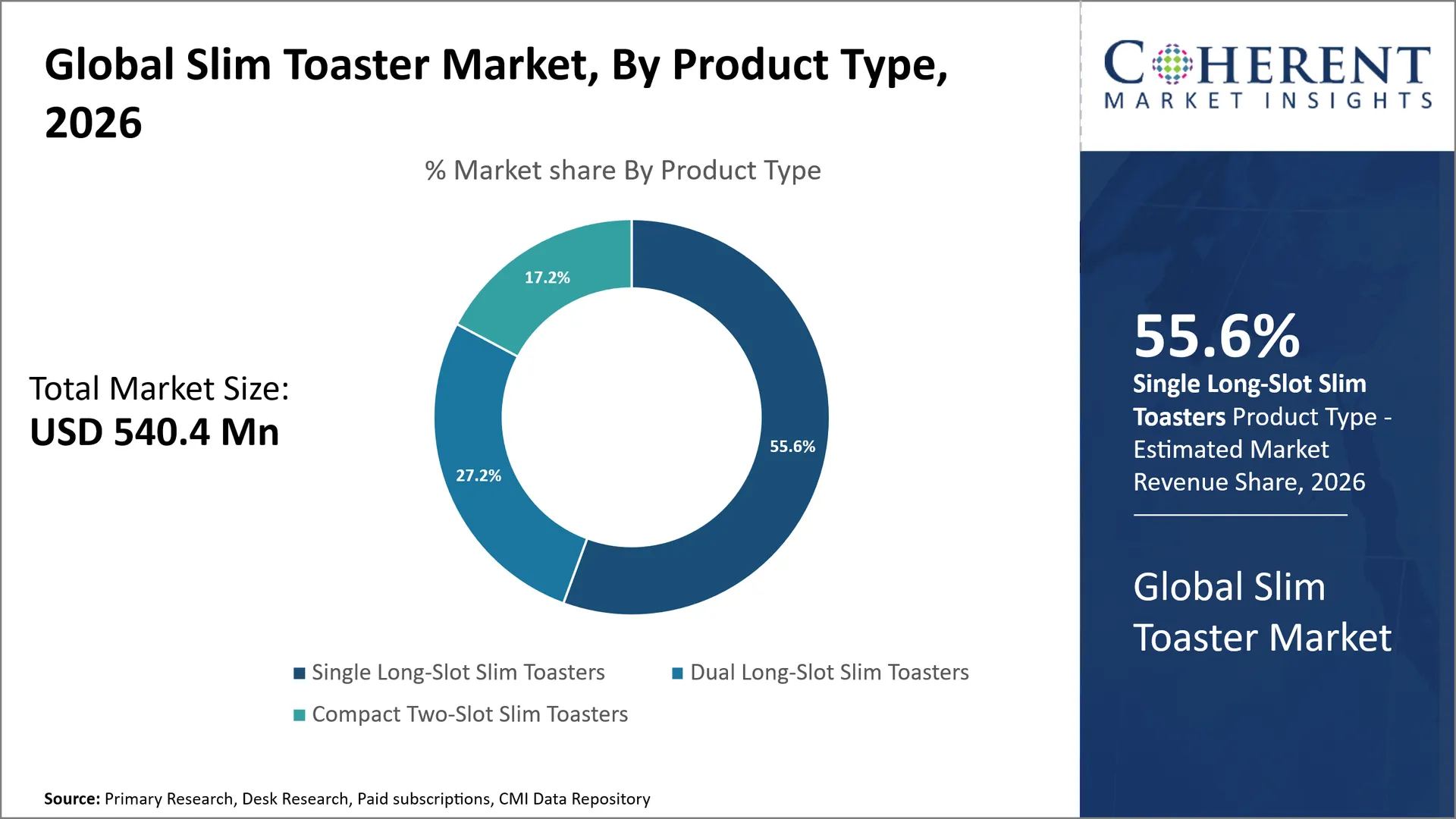
Why Do Single Long-Slot Slim Toasters Dominate the Global Slim Toaster Market?
Single Long-Slot Slim Toasters are expected to account for 55.6% of the global slim toaster market in 2026. Their commercial benefit is to have only one flexible heating chamber as opposed to duplicates of long slots, enabling brands to maintain their product shape while managing their number of components. The finish, construction of the carriages and the control options help manufacturers to develop a clear entry-to-premium product range. The format provides a familiar option to traditional parallel slot appliances for retailers without the need for many different capacities. Severin's 2024 product line comprised the AT 2515 Automatic Long Slot Toaster which had a single long slot, a 1,000 W heating element, a browning control and a stainless steel body. The model illustrates the possibility of manufacturers to leverage flexibility in bread compatibility, temperature control, and the size of appliances to further differentiate their products in the residential kitchen appliance market.
- Current Industry Events of 2026
- Market Size Estimation
- Regional Breakdown
- Competitive Landscape
- Customer Intelligence
- Segmental Analysis
- Pricing Analysis
- Key Market Drivers, Challenges & Future Trends
- Customized Insights Section
Why Does the 2-Slice Segment Represent the Largest Slice Capacity Category in the Global Slim Toaster Market?
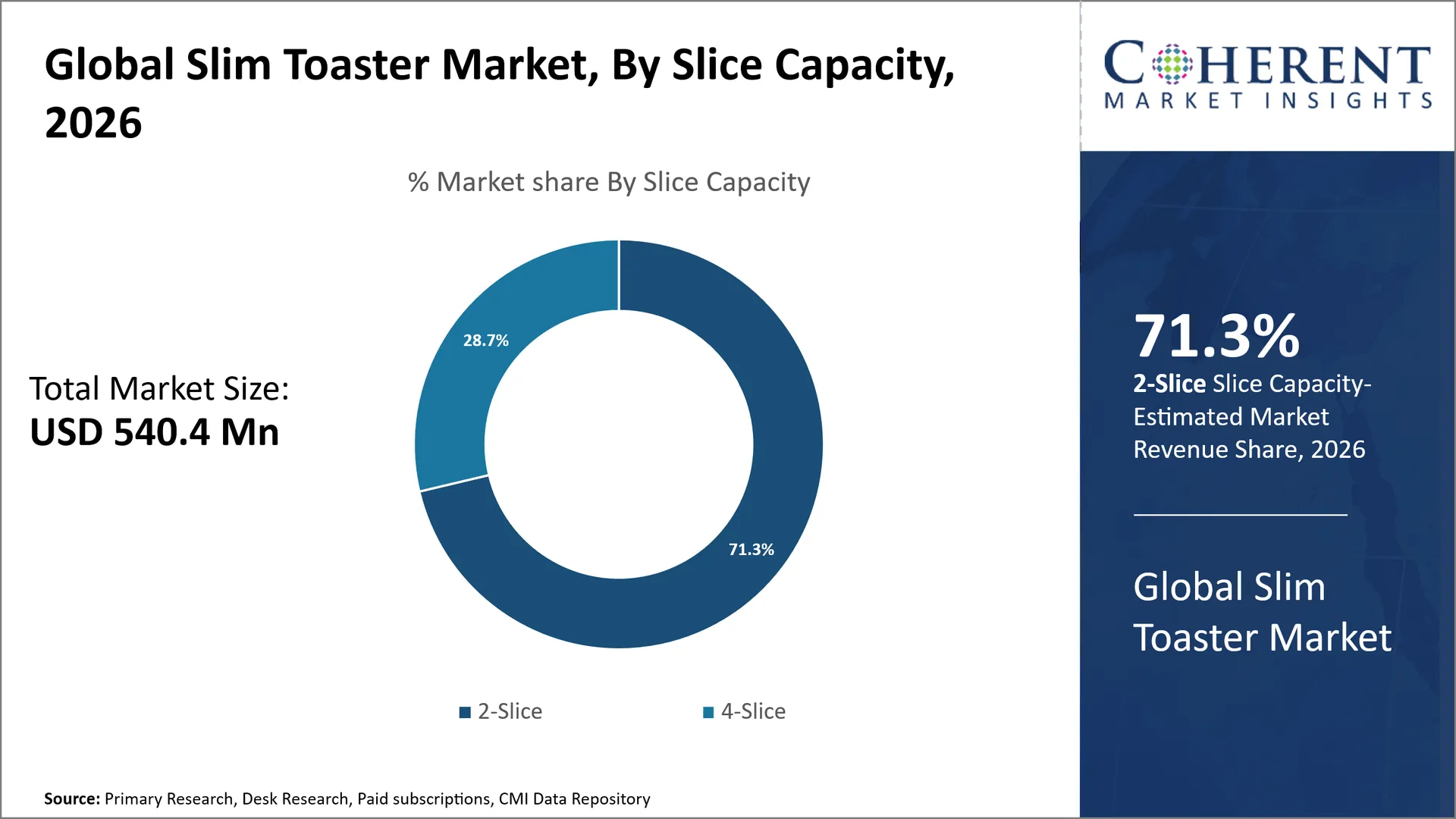
The 2-Slice segment is estimated to represent 71.3% of the global slim toaster market in 2026 within the slice-capacity category. This type of set up enables retailers to provide a variety of designs and price points without forcing higher capacity appliances as the easiest to buy. Distinctions between value and premium products are created as buyers can choose between a basic replacement product and a higher-priced one, which offers better finishes and convenience. There is also a recognized specification that makes it easier for suppliers to merchandise and compare products. In February 2025, Dualit introduced the Stealth version of its Classic toaster line, which comprises a two-slice toaster to be released in March 2025. The model enables the user to switch on one or two heating slots to show the flexibility in operation of limited capacity appliances. This type of setup enables product differentiation while not making the size of the slices the main criterion for choosing the product.
Why Does Manual Control Dominate the Control Type Category of the Global Slim Toaster Market?
Manual Control is expected to account for 81.3% of the global slim toaster market in 2026 within the control-type category. Tactile browning dials enable immediate adjustment without having to read and channel through electronic menus, allowing the dial to be used by a wide cross-section of consumers. Clear controls also allow retailers to show the functions of an appliance in a flash and explain product features at the point of sale. Differentiated dial markings, easily navigated levers, and specific cancellation buttons have been helpful for manufacturers to make the interface easier to use without overhauling it. In December 2025, Core Home also revealed extra options for its two-slice toaster, Thyme&Table, with a manual dial that offers seven browning settings and a dedicated bagel mode. This illustrates the possibility to integrate simple manual use with certain toasting functionalities, while still offering the convenience of using the appliance by the user.
Current Events and their Impact
Current Event | Description and Its Impact |
India – Mandatory Safety Certification for Kitchen Appliances, March 2024 |
|
European Union – General Product Safety Regulation, December 2024 |
|
European Union – Revised Standby Energy Requirements, May 2025 |
|
Global Slim Toaster Market Dynamics
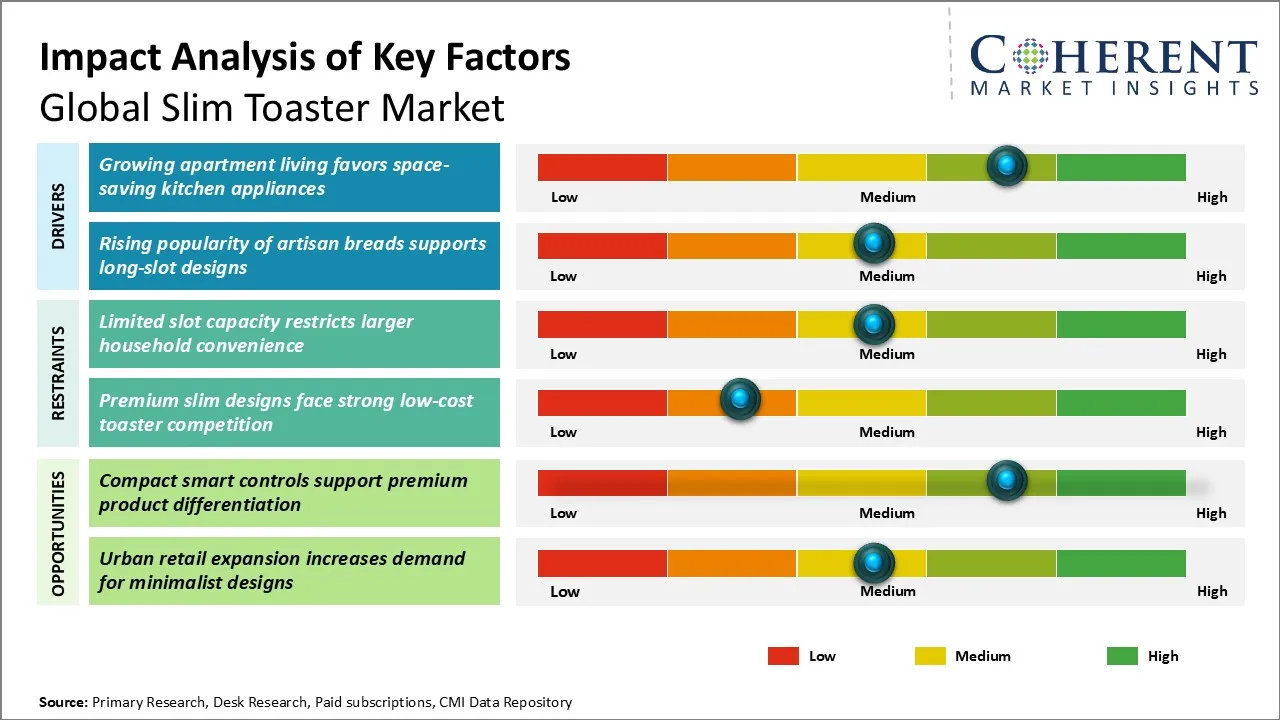
Key Market Drivers
- Growing Apartment Living Favors Space-Saving Kitchen Appliances: The continued development of multifamily housing creates a favorable market for slim toasters that occupy less countertop space than conventional appliances. The narrow profile enables the necessary kitchen equipment to fit in the apartment without compromising the kitchen preparation areas. Manufacturers that provide compact storage, lightweight design and easy operation can better aim at urban families and first-time appliance buyers. In July 2026, the National Association of Home Builders reported that 57% of multifamily units completed in the United States in 2025 were in buildings with at least 50 units. The above is to emphasize the commercial importance of apartment-designed appliances.
- Rising Popularity of Artisan Breads Supports Long-Slot Designs: Specialty bakery loaves, such as sourdough and rye, often require toasters that can handle longer or oddly shaped slices. Classic short slots can limit the bread selection, giving manufacturers an opportunity to differentiate themselves with longer heating chambers and adjustable browning controls. Retailers can sell these products as practical upgrades for bread lovers, rather than as typical appliance replacements. In April 2026, Martha Stewart launched a line of kitchen appliances that included an extra-long, two-slice toaster with wide bread slots. These introductions demonstrate how compatibility of the bread format can help to differentiate products.
Emerging Market Trends
- Premiumization Through Coordinated Kitchen Appliance Collections: Slim toasters are marketed as coordinated kitchen accessories rather than as stand-alone heating appliances. Manufacturers are looking at standardizing esthetics, simplified controls and coordinating finishes across their breakfast appliance lines.
- Impact: This can help increase product margins by encouraging customers to buy appliances that go well together. It also allows premium retailers to sell coordinated collections rather than competing primarily on the price of individual products.
- Relevance to Market: A broader range of styling options between 2026 and 2033 may prove advantageous for established appliance brands and design specialists, whereas those with fewer finishing options might find it difficult to stand out.
- Shift Toward More Consistent Browning Across Different Bread Types: Advanced slim toaster designs are moving away from fixed heating times to more responsive temperature control and bread-specific settings. These features aim to reduce the variations in browning between fresh, frozen, thick and thin bread slices.
- Impact: Improved consistency could enable premium pricing and reduce the dissatisfaction often associated with inconsistent toasting. However, the addition of extra sensors and electronic components can raise the cost of production.
- Relevance to Market: Over the forecast period, manufacturers balancing accurate browning, compact construction, and straightforward operation could gain an advantage in the digital-control category, particularly among customers replacing conventional toasters.
Regional Insights
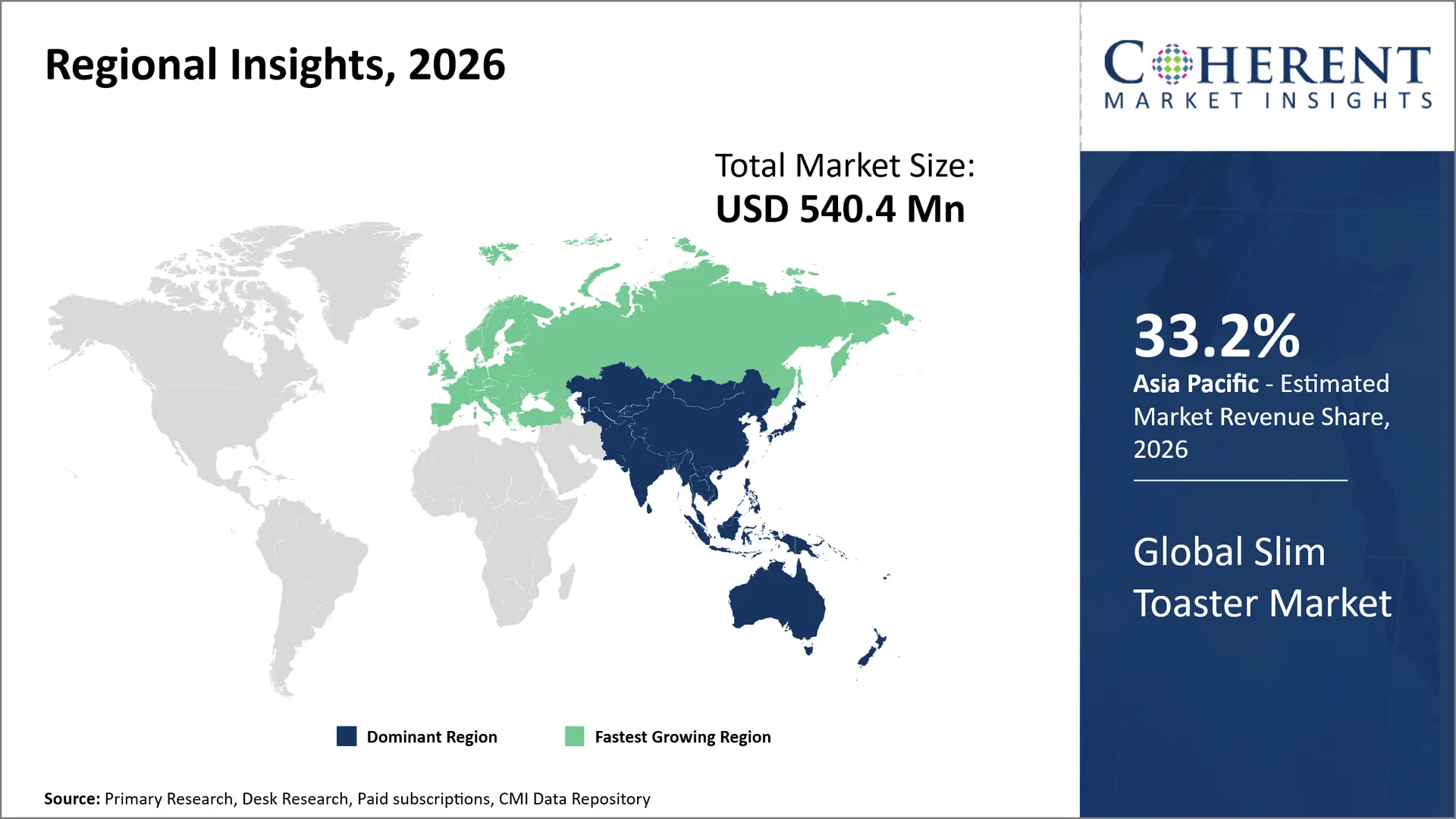
Why Does Asia Pacific Dominate the Global Slim Toaster Market?
Asia Pacific is estimated to account for 33.2% of the global slim toaster market in 2026, making it the largest regional market. The market is broad in terms of consumer budgets, so manufacturers offer both budget-friendly breakfast appliances and models with added convenience features. Plus, appliance brands can expand beyond traditional electronics stores by increasing their direct-to-consumer sales. Manufacturers who have set up regional distribution networks can achieve better product visibility and lower customer acquisition costs. In April 2026, Xiaomi added its toaster to the promotional lineup for the Xiaomi Fan Festival in Malaysia. It shows how mainstream consumer electronics brands can market breakfast appliances through existing regional retail channels, boosting awareness and consumer reach without dedicated appliance distribution infrastructure.
Why Is Europe Emerging as the Fastest-Growing Region in the Global Slim Toaster Market?
Europe is projected to hold 32.6% of the global slim toaster market in 2026 and record the fastest growth during the forecast period. The region offers an opportunity for manufacturers to capture replacement purchases through differentiation in appliance designs, durable construction and premium finishes. Specialty kitchenware retailers offer consumers the opportunity to compare the look and quality of products as well as function. Also, regular product styling can enable manufacturers to enhance their premium positioning in many European markets. In May 2026, Smeg expanded its Moonlight finish to Germany, introducing the color across its toaster, kettle and filter coffee machine line. This indicates the commercial importance of product esthetics in appealing to design-aware European consumers and promoting the purchase of higher-value appliances.
Global Slim Toaster Market Outlook for Key Countries
Why Is the U.S. a Key Market for the Global Slim Toaster Market?
The U.S. continues to be a major global market for makers of slim toasters, with home appliance replacement cycles offering opportunities for products that offer better usability and reliable performance. They may also want to consider browning consistency, what types of bread it will fit, how easy it is to clean and the length of the warranty before buying. So, manufacturers with clearly differentiated features can compete beyond the entry price. The International Housewares Association conducted a survey on kitchen electrics in June 2025 and found that 24% of product purchase intent was for toasters. That suggests consumers are interested in the general category of toasters, but it doesn’t track slim toaster sales specifically. This interest can be harnessed by manufacturers through focused product positioning, transparent specifications and stronger retail merchandising.
Why Is Germany a Strategic Country in the Global Slim Toaster Market?
Germany is a big market for slim toasters worldwide, where product safety, functional versatility and durable construction are factors in selecting household appliances. Also, the preference for German breakfast offers a chance for models which can cope with rolls besides the usual sliced bread Manufacturers can set themselves apart by not only relying on the appearance, but also on reliable heating mechanisms, built-in warming accessories and protective shutoff systems. Bosch also makes a long-slot toaster, the TAT6A004, which has a retractable bread-roll warmer, automatic bread centering and automatic shutoff if bread becomes jammed. Such specifications are examples of how practical functionality can affect product development. By providing comparable features at competitive prices, suppliers may be able to boost their image among German households searching for reliable appliances to prepare their everyday breakfasts.
Why Is India Important in the Global Slim Toaster Market?
India presents opportunities for global slim toaster market manufacturers with the expansion of organized kitchen appliance retail and availability of products across different household budgets. Compact pop-up toasters provide a quick breakfast opportunity for consumers without the commitment to larger countertop equipment. Manufacturers have to strike a balance between affordable price, dependable heating performance and ease of maintenance. In India, the Philips Consumer Lifestyle product portfolio includes the HD2583/90 compact 2-slice toaster with adjustable browning settings, variable-width slots and a built-in bun rack. This shows how manufacturers can package useful features in fairly compact appliance configurations. Companies offering competitive pricing, easy after sales service and consistent availability of products could improve their presence among Indian consumers buying or replacing small kitchen appliances.
Why Does China Support Growth in the Global Slim Toaster Market?
China’s established small appliance manufacturing capabilities, component supplier networks, and export-oriented production infrastructure position it as a key player in the global slim toaster market. With access to heating elements, metal housings, electronic components and appliance assembly services, manufacturers are able to produce a variety of product configurations for international customers. Chinese appliance suppliers can also service private label retailers looking for custom designs, as well as competitive sourcing costs. Guangdong-based Bear Electric Appliance offers two-slice bread toasters with stainless steel construction and wider bread slots. This is a sign of the country's ability to create specialized breakfast appliances. Producers that improve the consistency of production, meet safety requirements of destination markets and build strong relationships with international distributors may be able to capture additional export opportunities.
Why Is the U.K. an Important Growth Market for the Global Slim Toaster Market?
The U.K. is a mature global market for slim toasters for consumers, owing to the popularity of bread and toast as breakfast options and the variety of bakery products that create different appliance requirements. Buyers who intend to make crumpets, sliced loaves or sourdough might want to look at the dimensions of the slots and accessible bread-lifting mechanisms when comparing models. This enables manufacturers to create products around specific food preparation needs, rather than just adding more heating power. Russell Hobbs’ U.K. range features long-slot toasters and compact two-slice models for smaller kitchens. The Federation of Bakers published its bread market summary in May 2026, which is the latest country overview of the industry for the bakery sector. If manufacturers have adaptable slots, convenient controls and reliable heating performance, that may pay off in replacement purchases.
Consumer Preference and Product Evolution Landscape in the Global Slim Toaster Market
Product Technology | Functional Application | Commercial Relevance | Adoption Considerations |
Self-Centering Bread Guides | Place the bread between the heating elements so that both sides are better exposed. | Supports a range of bread thicknesses and enhances daily usability. | Stable carriage alignment and robust guide mechanisms are required. |
Independent Heating-Zone Control | Turn on individual zones for single slice heating or special toasting functions. | Provides more operating flexibility and potential energy savings for smaller batches. | The number of switching parts can be increased to increase the complexity of the manufacturing process. |
Temperature-Compensated Browning | Controls the length of time the heater is on in dependence on the residual temperature from the previous cycle. | Provides more consistent results during consecutive toasting cycles. | Relies on accurate calibration of temperature sensing and control. |
Optical Browning Detection | Monitors changes in bread surface color to determine when a selected browning level is reached. | Provides a differentiation opportunity within premium electronic-control toasters. | Sensor reliability, calibration, and component costs can limit adoption. |
Motorized Bread-Lift Mechanisms | Automatically lowers and raises bread without a traditional mechanical lever. | Enhances operating convenience and opportunities for premium positioning. | Commercially viable depends on motor durability, assembly costs and servicing requirements. |
Thermally Insulated Housing Design | It uses insulation and structural separation to limit heat transfer to external surfaces. | Allows safer handling and flexibility in the choice of exterior materials and finishes. | Insulation performance has to be compromised with compactness and production cost. |
How Are Boutique Hospitality and Shared-Breakfast Facilities Creating New Growth Opportunities in the Global Slim Toaster Market?
Manufacturers can develop slim toasters specifically for light-commercial use in small hotels, boutique accommodations and breakfast facilities at workplaces. Such establishments often need reliable breakfast equipment, but may not have the counter space for larger commercial appliances.
Hospitality operators place greater importance on repeated-cycle performance, ease of cleaning, operational reliability and availability of replacement parts than residential buyers. Manufacturers could meet these needs by providing reinforced heating assemblies, accessible crumb collection systems and models to suit different bread formats.
Dedicated product ranges could be carried by hospitality equipment suppliers, institutional procurement partners and specialist appliance distributors. Participation would necessitate investment in durability testing, after-sales support, and compliance with applicable commercial electrical safety requirements.
This could be a home for specialist manufacturers with flexible production capability. But suppliers must balance higher component specifications with institutional purchasing budgets to maintain commercially acceptable margins and competitive pricing.
Market Players, Key Developments, and Competitive Landscape

Key Developments
- In November 2026, Cuisinart announced its Color Collection of countertop appliances, including a retro two-slice long-slot toaster in Tahini. The development expands product styling options within an established appliance category and provides retailers with opportunities to merchandise coordinated kitchen collections and attract design-conscious buyers.
- In October 2025, Breville introduced its Eye Q Auto toaster range in Australia, using optical sensors to monitor bread browning and automatically end the heating cycle. The development establishes sensor-based control as a premium product differentiator, potentially influencing future investment in precision heating and electronic control systems.
- In September 2026, Rommelsbacher introduced its TOL 1000 Automatic Long Slot Toaster, incorporating motorized bread lifting, temperature-responsive timing, and an LED countdown display. The product strengthens the company's premium kitchen appliance portfolio by combining elongated bread compatibility with improved convenience and consistent performance during repeated use.
Competitive Landscape
The global slim toaster market is fragmented in nature and includes established household appliance manufacturers, specialist kitchenware brands, regional suppliers and private label manufacturers. The main competitive factors include toasting performance, product size, materials, retail price and distribution availability. Specialist brands compete on design and functionality while regional manufacturers compete on affordable product configurations. Consistent component quality and a reliable supply are essential to protect retailer relationships and margins.
Key focus areas include
- Heating Performance: Quality of the product is affected by browning accuracy and constant temperature distribution.
- Pricing Strategy: Competitive sourcing of components helps to maintain margins on entry level ranges.
- Manufacturing Reliability: Long-lasting heating elements and carriage assemblies ensure the product’s longevity.
- Material Selection: Insulated housings, composites and stainless steel all offer different pricing specifications.
- Regulatory Compliance: Certification and testing of electrical safety are required to gain access to international markets.
- Retailer Relationships: Influence Purchase Decisions Availability of product, shelf space and promotional support.
- Private-Label Manufacturing: Retailers can develop exclusive appliance lines by using contract manufacturers.
- Market Restraints: Multipurpose countertop ovens and air fryers create substitution pressure for standalone toasters.
Market Report Scope
Slim Toaster Market | |||
Report Coverage | Details | ||
Base Year | 2025 | Market Size in 2026: | USD 540.4 Mn |
Historical Data For: | 2020 to 2024 | Forecast Period: | 2026 to 2033 |
Forecast Period 2026 To 2033 CAGR: | 6.30% | 2033 Value Projection: | USD 828.8 Mn |
Geographies covered: |
| ||
Segments covered: |
| ||
Companies covered: | Bella, Russell Hobbs, Robert Bosch GmbH, Koninklijke Philips N.V., Breville Group Limited, ZWILLING J.A. Henckels AG, SEVERIN Elektrogeräte GmbH, Dualit Limited, Braun, Smeg S.p.A., De'Longhi S.p.A., Kenwood Limited, Whirlpool Corporation, Groupe SEB, Conair LLC | ||
Growth Drivers: |
| ||
Restraints & Challenges: |
| ||
Analyst Opinion (Expert Opinion)
- Future Market Direction: Competition in the global slim toaster market is likely to place greater importance on product reliability and ownership value rather than feature quantity alone. Manufacturers offering consistent operating performance, credible warranty coverage, and dependable replacement support could strengthen customer retention. Establishing reliable quality standards across multiple price categories may become more valuable than continuously expanding product assortments.
- Transformative Trend or Disruption: Retailers may utilize product return patterns, consumer input, and proven operating performance to influence which toaster models are featured prominently in distribution. The shift could put pressure on manufacturers that rely heavily on promotional pricing and large product catalogs. Retailers may prefer to work with vendors that can respond quickly to consumer feedback and improve product performance, which may also reduce avoidable returns.
- Strategic Priorities, Risks, and Recommendations: Manufacturers should focus on heating element durability, thermal protection, supplier qualification and compliance documentation. Greater attention to product testing and component sourcing can help limit warranty expenses and reduce safety-related risks. Regional distribution partnerships should support reliable stock availability and after-sales service. Companies should avoid excessive investment in premium electronic features without clear evidence that customers will accept the resulting price increases.
Speak to the analyst
Want personalized insights?
Take the findings above to one of our principal consultants, or have the report rebuilt around the segments, geographies and competitors you actually track.
Market Segmentation
- Product Type Insights (Revenue, USD Mn, 2021 - 2033)
- Single Long-Slot Slim Toasters
- Dual Long-Slot Slim Toasters
- Compact Two-Slot Slim Toasters
- Slice Capacity Insights (Revenue, USD Mn, 2021 - 2033)
- 2-Slice
- 4-Slice
- Control Type Insights (Revenue, USD Mn, 2021 - 2033)
- Manual Control
- Digital & Electronic Control
- Power Rating Insights (Revenue, USD Mn, 2021 - 2033)
- Below 800 W
- 801–1,200 W
- Above 1,200 W
- Material Type Insights (Revenue, USD Mn, 2021 - 2033)
- Stainless Steel
- Plastic & Metal Composites
- Other Materials
- End User Insights (Revenue, USD Mn, 2021 - 2033)
- Residential
- Commercial
- Distribution Channel Insights (Revenue, USD Mn, 2021 - 2033)
- Online Retail
- Supermarkets & Hypermarkets
- Specialty Appliance Stores
- Other Channels
- Regional Insights (Revenue, USD Mn, 2021 - 2033)
- North America
- U.S.
- Canada
- Latin America
- Brazil
- Argentina
- Mexico
- Rest of Latin America
- Europe
- Germany
- U.K.
- Spain
- France
- Italy
- Russia
- Rest of Europe
- Asia Pacific
- China
- India
- Japan
- Australia
- South Korea
- ASEAN
- Rest of Asia Pacific
- Middle East
- GCC Countries
- Israel
- Rest of Middle East
- Africa
- South Africa
- North Africa
- Central Africa
- North America
- Key Players Insights
- Bella
- Russell Hobbs
- Robert Bosch GmbH
- Koninklijke Philips N.V.
- Breville Group Limited
- ZWILLING J.A. Henckels AG
- SEVERIN Elektrogeräte GmbH
- Dualit Limited
- Braun
- Smeg S.p.A.
- De'Longhi S.p.A.
- Kenwood Limited
- Whirlpool Corporation
- Groupe SEB
- Conair LLC
Sources
Primary Research Interviews
- Slim toaster manufacturers, OEMs, and contract manufacturers
- Kitchen appliance brands and product development teams
- Heating element, thermostat, and electronic control suppliers
- Appliance retailers, distributors, and e-commerce sellers
- Consumer appliance engineers and product testing specialists
Stakeholders
- Slim toaster and small kitchen appliance manufacturers
- Heating element, control system, and component suppliers
- Stainless steel, plastic housing, and insulation suppliers
- Contract manufacturers and private-label appliance companies
- Retailers, wholesalers, importers, and online marketplaces
End-use Sectors
- Residential Households: Daily breakfast and bread toasting
- Hotels & Guesthouses: Guest breakfast preparation
- Cafés & Small Foodservice Outlets: Toasted bread preparation
- Workplace Pantries: Employee breakfast and refreshment facilities
- Student Accommodation: Compact kitchen appliance usage
Product Applications
- Conventional sliced bread toasting
- Artisan bread and sourdough preparation
- Bagel and specialty bread heating
- Frozen bread defrosting and reheating
- Compact household breakfast preparation
Regulatory and Industry Bodies
- U.S. Consumer Product Safety Commission (CPSC)
- European Commission
- Bureau of Indian Standards (BIS)
- U.K. Office for Product Safety and Standards (OPSS)
- Standards Administration of China (SAC)
- Australian Competition and Consumer Commission (ACCC)
- International Electrotechnical Commission (IEC)
Databases
- UN Comtrade and ITC Trade Map – Toaster Trade Data
- Eurostat – Electrical Appliance Trade Statistics
- U.S. Census Bureau – International Trade Statistics
- USITC DataWeb – Toaster Import and Export Data
- Google Trends – Slim Toaster Consumer Searches
- Company Annual Reports and Investor Presentations
- E-commerce Product Listings and Retail Pricing Databases
Magazines and Journals
- HomeWorld
- HFN – Home Furnishings News
- Appliance Retailer
- International Journal of Heat and Mass Transfer
- Applied Thermal Engineering
- Journal of Consumer Behaviour
Associations
- International Housewares Association (IHA)
- Association of Home Appliance Manufacturers (AHAM)
- APPLiA – Home Appliance Europe
- Association of Manufacturers of Domestic Appliances (AMDEA)
- Electrical and Electronics Manufacturers' Association of India (IEEMA)
- China Household Electrical Appliances Association (CHEAA)
Public Domain Sources
- Slim toaster product catalogs and technical specifications
- Heating element, thermostat, and control system datasheets
- Appliance manufacturing patents and product design disclosures
- Electrical safety testing and energy consumption assessments
- Product launches, retail partnerships, and distribution expansions
- Company financial reports and manufacturing disclosures
- Toaster pricing, consumer reviews, and import-export statistics
- Consumer purchasing preferences and appliance design trends
Key Standards and Regulations
- IEC 60335-1 – Household Electrical Appliance Safety
- IEC 60335-2-9 – Safety of Toasters and Similar Cooking Appliances
- UL 1026 – Household Electric Cooking and Food Serving Appliances
- EU Directive 2014/35/EU – Low Voltage Directive
- EU Directive 2011/65/EU – Restriction of Hazardous Substances (RoHS)
- EU Directive 2012/19/EU – Waste Electrical and Electronic Equipment (WEEE)
- EU Regulation 2023/826 – Standby and Off-Mode Power Requirements, Where Applicable
- India Electrical Appliances for Kitchen (Quality Control) Order, 2023 – IS 302 (Part 2/Sec 23):2009
- China GB/T 4706.14-2024 – Safety Requirements for Toasters and Similar Portable Cooking Appliances
Proprietary Elements
CMI Data Analytics Tool and proprietary research repository, supported by primary interviews, slim toaster product benchmarking, heating technology assessment, power rating and slice capacity analysis, material and pricing evaluation, consumer purchasing behavior, residential and commercial demand assessment, distribution-channel analysis, country-level market sizing, import-export evaluation, regulatory compliance assessment, manufacturer profiling, product launch tracking, and competitive intelligence.
Get access to 250+ pages report
Every segment, forecast, competitor profile and data table behind the analysis above — available for instant download.
- ESOMAR Member
- ISO 9001:2015 Certified
- D-U-N-S Registered
- GDPR & CCPA Compliant
Frequently Asked Questions
The CAGR of the global slim toaster market is projected to be 6.30% from 2026 to 2033.
The global slim toaster market is estimated to be valued at USD 540.4 million in 2026 and is expected to reach USD 828.8 million by 2033.
New entrants can explore opportunities in private-label manufacturing, differentiated product designs, affordable premium appliances, and partnerships with established kitchen appliance retailers.
The report evaluates leading manufacturers, product portfolios, competitive positioning, pricing strategies, distribution networks, and recent company developments to support strategic decision-making.
Consumers consider countertop space requirements, bread compatibility, browning consistency, product durability, ease of cleaning, brand reputation, and value for money when selecting slim toasters.
The report helps manufacturers, distributors, and investors identify underserved customer needs, assess competitive intensity, evaluate market-entry opportunities, and develop product positioning and distribution strategies.
Growing apartment living that favors space-saving kitchen appliances and the rising popularity of artisan breads that supports long-slot toaster designs are the major factors driving growth in the global slim toaster market.