
Flat 45% off this market research report
Nov 26 – 29 · Direct purchase only · Not applicable to customized reports

Global Smart Food Packaging Market Size and Forecast – 2026 To 2033
The Global Smart Food Packaging Market is estimated to be valued at USD 27.44 Bn in 2026 and is expected to reach USD 44.03 Bn by 2033, growing at a compound annual growth rate (CAGR) of 6.99% from 2026 to 2033. Growing demands for food safety, longer shelf life and real-time product quality monitoring drive market growth. Active packaging materials, intelligent freshness indicators and digitally-enabled labels are used by food manufacturers and retailers to reduce product deterioration, enhance traceability and optimize inventory. In addition, the use of functional materials in digital technologies opens up new commercial possibilities in fresh produce, dairy products, drinks, and ready-to-eat foods.
In May 2025, Amcor highlighted its collaboration with Belgian fresh produce supplier BelOrta to preserve pear freshness using P-Plus Liners. The packaging technology controls the amount of oxygen and carbon dioxide to extend the ripening time and reduce dehydration. This app showcases the capabilities of the next generation of smart food packaging for decreasing food waste, expanding transport windows, enhancing product marketability and allowing food suppliers to reach markets that are further away without compromising product quality.
Key Takeaways of the Global Smart Food Packaging Market
- Active Packaging is projected to register an estimated CAGR of 6.6% during 2026–2033, accounting for 43.2% of the global smart food packaging market in 2026. Its leadership is based on the ability to embed preservation mechanisms into packaging structures without a significant overhaul of the food processing operations. ProAmpac launched its ProActive Intelligence Shelf Protect Series in October 2026, with antimicrobial technology that helps to control the microbial growth of spoilage microorganisms.
- Flexible Packaging is anticipated to expand at an estimated CAGR of 7.3% during 2026–2033, securing a 49.7% share of the global smart food packaging market in 2026. Its lightness, versatility in film types and ability to work with automated filling systems enhance its commercial value. StePacPPC is launching Xgo PAZ pouches in September 2026 to deliver moisture sensitive fresh produce, with atmospheric control, humidity management and condensation control.
- Plastic is forecast to achieve an estimated CAGR of 6.2% during 2026–2033, representing 54.0% of the global smart food packaging market in 2026. It processing versatility, economical production and functional additives make it a strong contender. Avient's ColorMatrix Amosorb 4020L is an oxygen-scavenging additive for recycled PET bottles for sauces, juices and other beverages that was introduced in February 2025.
- Shelf-Life Extension is expected to grow at an estimated CAGR of 6.7% during 2026–2033, commanding 46.0% of the global smart food packaging market in 2026. Extended product shelf life allows food producers to have greater flexibility in distribution and less food wasted from inventory. Cosmo Films launched an anti-fog BOPET lidding film in February 2026, which is said to prolong the fresh salads and vegetables' shelf life by four to five days.
- North America is projected to record an estimated CAGR of 6.4% during 2026–2033, retaining the largest regional share of 44.3% of the global smart food packaging market in 2026. Established retail infrastructure and investment in item-level inventory management support regional leadership. In October 2025, Walmart and Avery Dennison announced a collaboration to use RFID technology with fresh meat, bakery and deli products to enhance inventory accuracy.
- Europe is poised to emerge as the fastest-growing region, with an estimated CAGR of 8.1% during 2026–2033 and a 24.3% share of the global smart food packaging market in 2026. The commercial argument for the use of smart packages is reinforced by the regulatory push for reducing food losses. EU Waste Framework Directive was amended in October 2025 and comes with new binding food waste reduction targets by 2030.
Segmental Insights
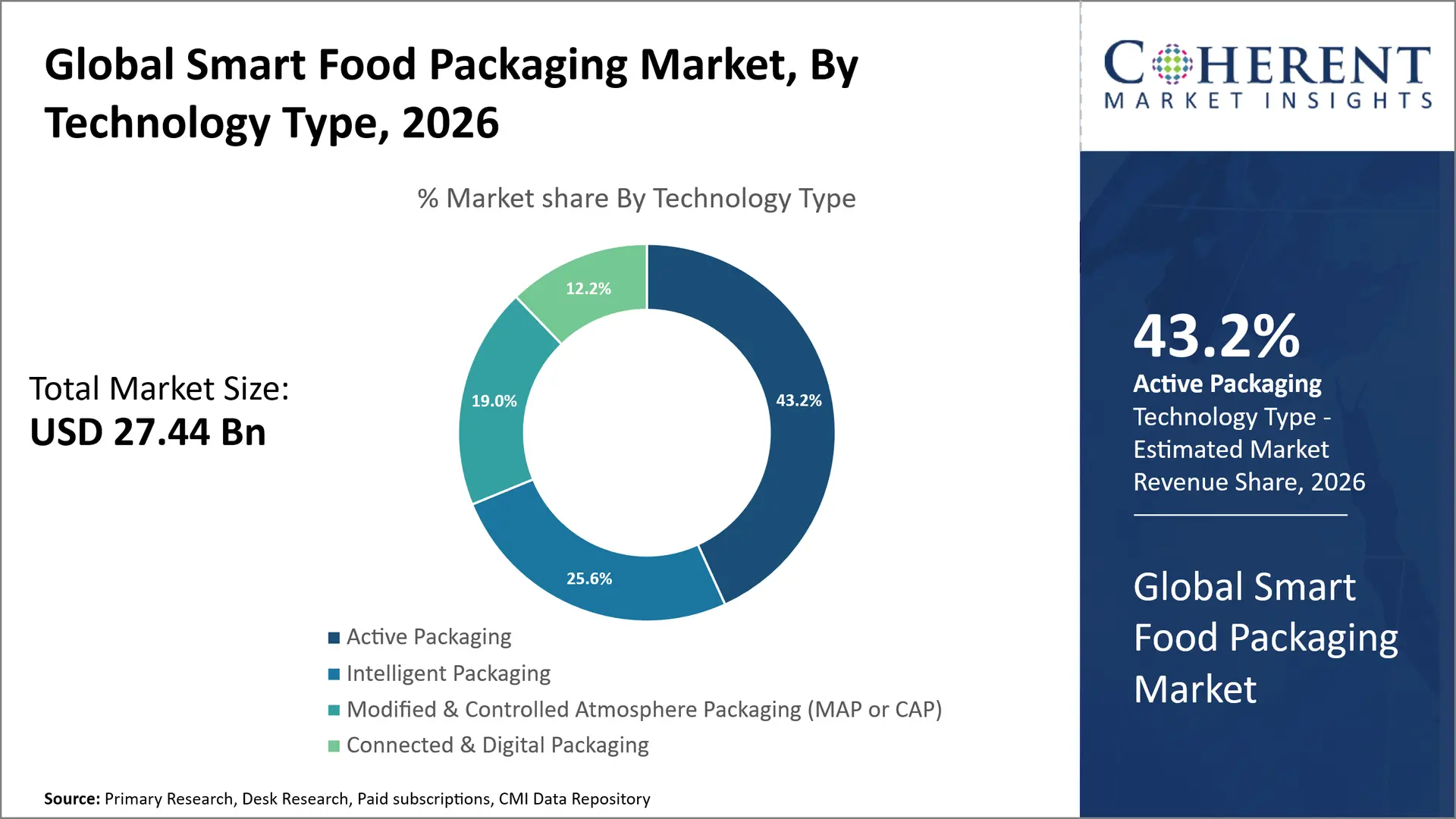
Why Does Active Packaging Dominate the Technology Type Segment of the Global Smart Food Packaging Market?
Active Packaging is expected to account 43.2% share of the global smart food packaging market in 2026, securing the leading position within the technology type segment. It possesses commercial significance because it can intervene in the food deterioration processes instead of just reporting the changes occurring in the product condition. Oxygen absorbers are suitable for use with bakery products, processed foods, and confectionery to help maintain the sensory properties and prevent oxidative degradation. Application-specific absorption capacities enable food processors to choose preservation systems based on the product, package size and storage time. This puts a recurring demand for the food manufacturers in the field of active packaging consumables, which are already established. In July 2026, Flair Packaging introduced their oxygen absorbers range of sachets that can be used to achieve a range of 20 to 200 cc of oxygen absorption. Multiple configurations and automated dispensing options illustrate the extent to which active packaging suppliers can meet the needs of various production volumes and preservation demands.
- Current Industry Events of 2026
- Market Size Estimation
- Regional Breakdown
- Competitive Landscape
- Customer Intelligence
- Segmental Analysis
- Pricing Analysis
- Key Market Drivers, Challenges & Future Trends
- Customized Insights Section
Why Does Flexible Packaging Represent the Largest Packaging Format in the Global Smart Food Packaging Market?
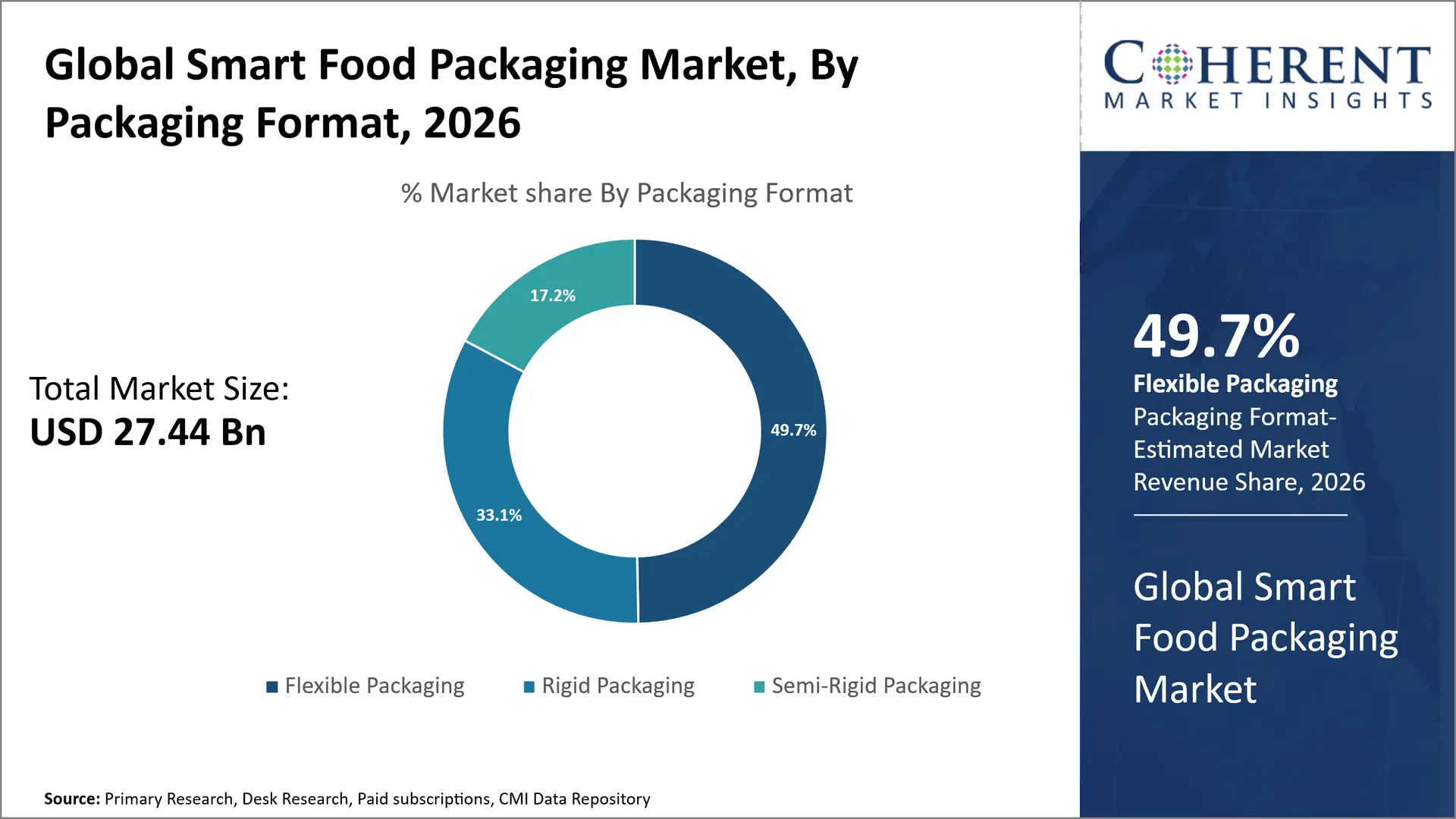
Flexible Packaging is anticipated to capture 49.7% of the global smart food packaging market in 2026, maintaining its leadership within the packaging format segment. Flexible formats are popular among food brands as can the dimensions, sealing configuration and dispensing function of the pouch be tailored to suit the product specification. Packaging designs which enable convenient handling and differentiated retail presentation are especially appropriate for prepared meals and portion controlled food products. In addition, flexible packaging converters have the flexibility to add specialized functional layers and customized surface finishes to meet preservation and branding needs. This opens up the potential for providing more high value packaging in various product lines. In June 2026, Walki and Dow announced the development of a prototype for a recyclable mono-material MDO-PE pouch with low temp sealing technology. The substructure laminate was also determined to be appropriate for fresh food packaging in modified atmosphere, also underlining potential opportunities for functional diversification.
Why Does Plastic Dominate the Material Type Segment of the Global Smart Food Packaging Market?
Plastic is projected to command 54.0% of the global smart food packaging market in 2026, establishing its dominance within the material type segment. It's widely used in beverage bottles, dairy packaging, food trays and closures, creating a proven platform for the introduction of smart identification technologies. The standardized container shapes and predictable surface characteristics make it possible to apply functional labels in a consistent way, and to machine-readable marks. These features can be added to the initial design of the container and to existing food manufacturer-supplier relationships. In addition, packaging lifecycle traceability opens the door for material suppliers to enhance the commercial relevance of their products as brand owners want to know more about packaging recovery. In August 2026, Sun Chemical announced its participation in an operational pilot project with Aldi, Arla Foods and Polytag using ultraviolet tagged milk bottle labels. The project helps to identify plastic food containers during recycling, showing that plastic food containers can assist in data collection beyond use.
Current Events and their Impact
Current Event | Description and Its Impact |
August 2026 – Implementation of the EU Packaging and Packaging Waste Regulation (PPWR) |
|
November 2026 – U.S. FDA Public Meeting on Lot-Level Food Traceability |
|
May 2025 – FSSAI Guidelines for Food-Grade Recycled PET in India |
|
Global Smart Food Packaging Market Dynamics
Key Market Drivers
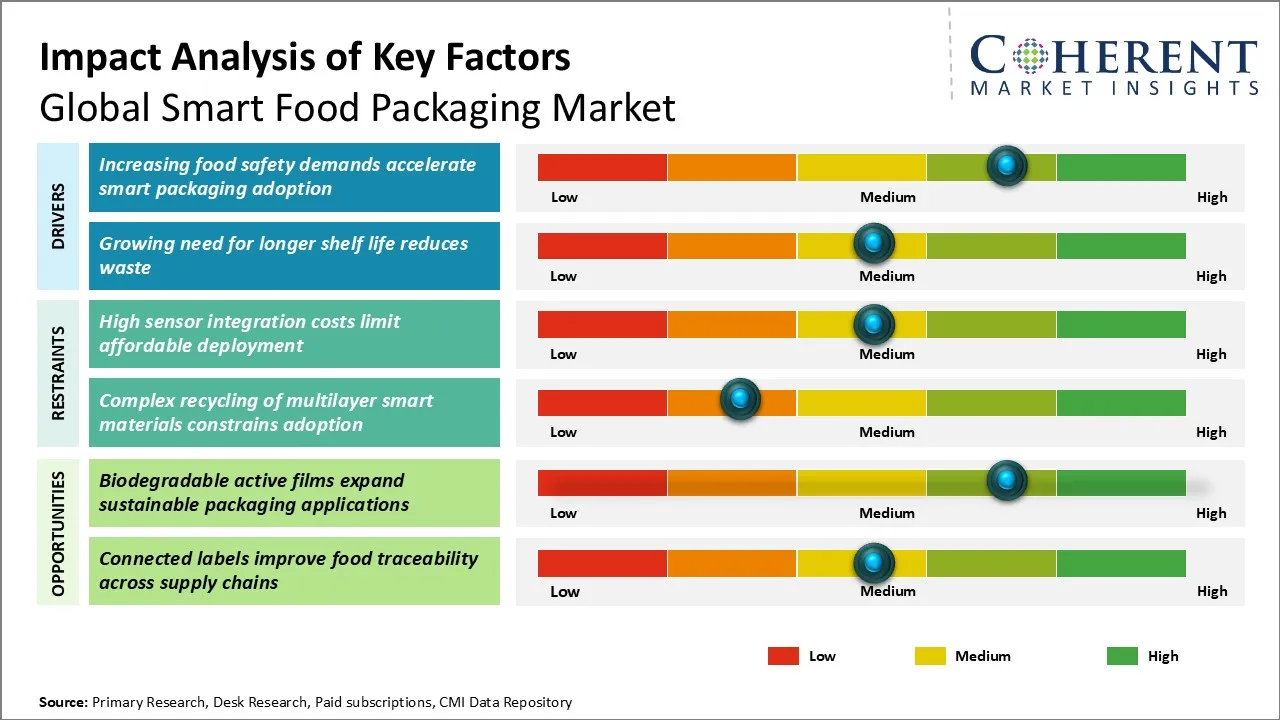
- Increasing food safety demands accelerate smart packaging adoption: Packaging demand is growing to include information demonstrating proper handling of the product during distribution. Traditional packaging does not give much insight into any temperature excursions that can affect the quality and safety of chilled foods. Intelligent indicators help quality assurance to detect handling deviations, investigate impacted shipments and to decide on acceptance. This opens the door for business opportunities for the sensor manufacturers and suppliers of intelligent labels. In January 2025, SpotSee introduced the new time-temperature indicator WarmMark QR, which is battery-free and can be scanned digitally to provide package and shipment temperature excursions.
- Growing need for longer shelf life reduces waste: Food processors face financial losses when products deteriorate before reaching retail shelves or consumers. Packaging systems that control the internal environment of the package can maintain the product's characteristic and prevent early disposal. From a commercial standpoint, the meat processors and packaged food manufacturers are interested in enhancing output that can be sold while maintaining packaging-line productivity. n July 2025, Klöckner Pentaplast introduces kp Elite Nova, an innovative, lightweight modified atmosphere packaging tray for protein packaging lines with automated systems, which provides barrier properties, sealing stability and shelf-life protection plus minimal material use.
Emerging Market Trends
- Transition Towards Recyclable Multifunctional Smart Packaging: The packaging manufacturers are transitioning towards developing recyclable packaging structures with sensing and preservation capabilities, without adding the complexity of the material composition. New features such as functional coatings, detachable markers, and adhesive compatibility are emerging as design elements to consider for the next generation of food packaging.
- Impact: Traditional multilayer packaging suppliers could be pushed to change the structure of packaging materials. There are other formulation needs that could be advantageous to specialty material developers and coating manufacturers.
- Relevance to the Market: During the forecast period, commercial differentiation is expected to increasingly depend on balancing packaging functionality with compatibility across existing collection, sorting, and recycling systems.
- Integration of Intelligent Packaging with Automated Retail Decision Systems: Intelligent packaging is beginning to move from an information carrier towards becoming an operational input for a retail management system. Machine readable expiry information and package level condition data can help with automatic stock rotation, reordering and product marking down.
- Impact: Food retailers will benefit from better decision making and minimize reliance on manual product inspection. Converters could benefit from a closer relationship with retail software and printing system suppliers.
- Relevance to the Market: Future adoption is likely to favor interoperable packaging solutions that deliver measurable operational value beyond conventional product labeling and consumer-facing information.
Regional Insights
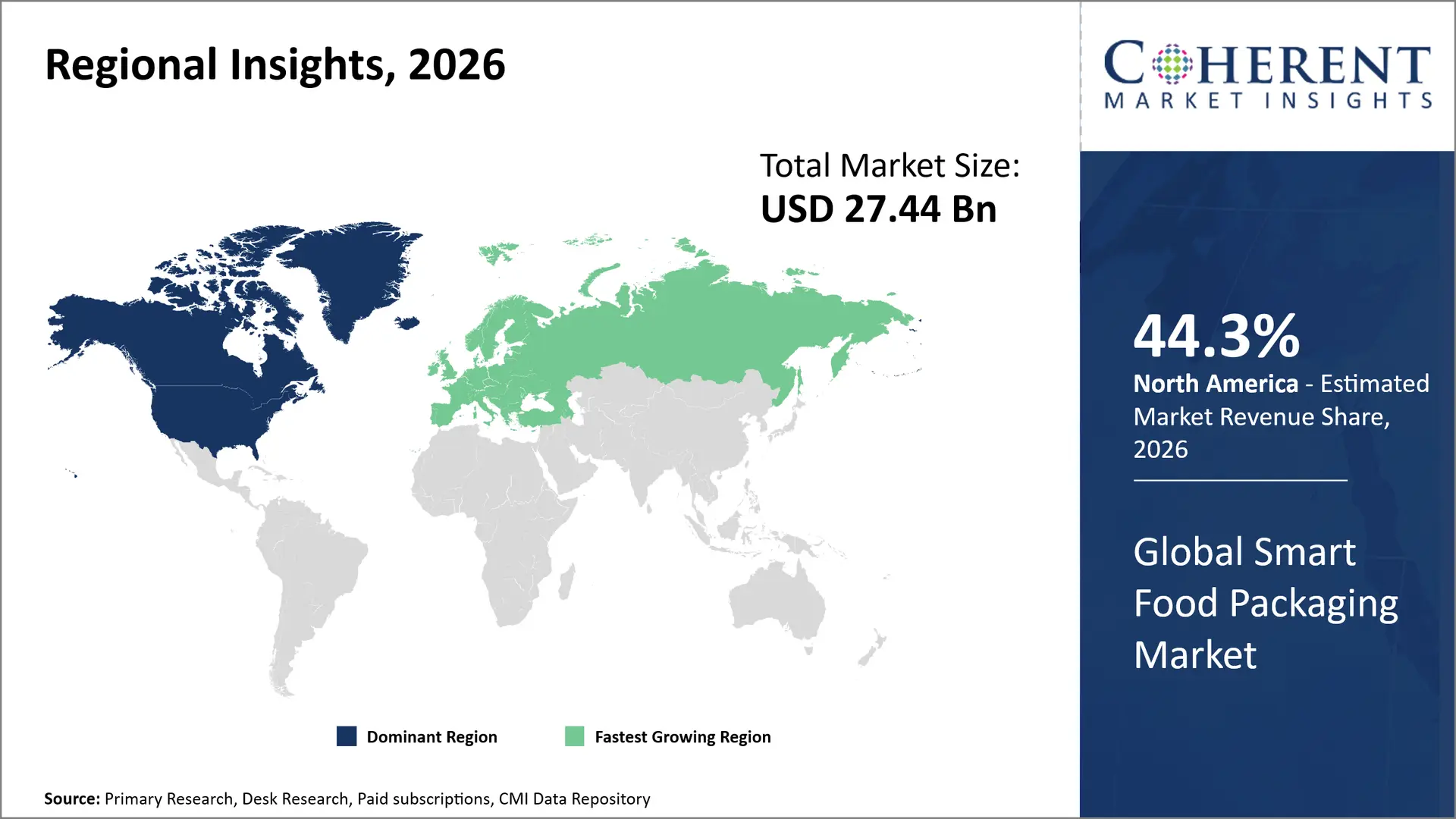
Why Does North America Dominate the Global Smart Food Packaging Market?
North America is expected to account for 44.3% of the global smart food packaging market in 2026. Advanced packaging systems can be commercialized through large-scale food processing systems, central purchasing and wide distribution networks. For meat processors, prepared meal producers and fresh produce suppliers, the packaging needs to keep the product intact over long distribution periods. Industrial scale implementation is greatly aided by close cooperation between packaging converters, material developers and equipment manufacturers. In October 2026, Cirkla, Belmark, and Ossid announced a resealable food packaging solution that is created using engineered packaging trays, specialized lidding films and automatic sealing equipment. Cirkla's application of modified atmosphere packaging in the region demonstrates the commercial possibility of other packaging materials incorporating food preservation functions. Such developments open more procurement opportunities for big food processors.
Why Is Europe Emerging as the Fastest-Growing Region in the Global Smart Food Packaging Market?
Europe is anticipated to capture 24.3% of the global smart food packaging market in 2026. Partnership research programs between food manufacturers, universities and specialized packaging technology developers are creating a platform to facilitate regional growth. The assessment of food products based on their condition is an emerging research topic for European food businesses to make better commercial food product management decisions. Financed research also takes away technical and financial risk when assessing new solutions for packaging. In May 2025, the European Union-funded MICROORC project announced collaborations with Mimica, BlakBear, and Keep-it Technologies to advance intelligent indicators for fresh food applications. The project creates opportunities for testing various sensing mechanisms in real environments, to advance them to become more broadly adopted in the European food distribution system.
Global Smart Food Packaging Market Outlook for Key Countries
Why Is the U.S. a Key Market for the Global Smart Food Packaging Market?
The U.S. smart food packaging market benefits from changing purchasing behavior and consumer expectations regarding product information. Packaging is receiving more attention as a communication channel in the eyes of the branded food manufacturer, who is now aware that it can have a positive impact on the purchasing decision. These opportunities for differentiation of packaged foods in competitive retail categories arise from the availability of digital ingredient information, sourcing information, and product condition information. For high-quality food, and health-focused items, connected packaging has even greater significance, especially given established smartphone use. According to a June 2025 GS1 US consumer survey, 66% of consumers would scan the QR code on food packaging to access more information about freshness, ingredients and shelf life. This signals opportunity for commercialization for intelligent labeling suppliers and food brands that provide increased product transparency.
Why Is Germany a Strategic Country in the Global Smart Food Packaging Market?
Germany's prominence in the smart food packaging market is due to its expertise in precision engineering, packaging machinery, and industrial materials research. Reliable sealing performance that allows control of the internal conditions is key to successful implementation of atmosphere-regulating food packaging. The technical requirements are well suited to the products and services of German equipment manufacturers and research institutes, particularly in the field of advanced inspection and process-control systems. The optical coherence tomography system, which can detect packaging seal defects up to 25 m/min during the manufacturing process, was developed by Fraunhofer IKTS, which announced the result in August 2026. For the industrial adoption of modified atmosphere packaging and other functional food packaging formats, such inspection technologies can help to increase manufacturing reliability.
Why Is Japan Important in the Global Smart Food Packaging Market?
Japan is a significant market for intelligent food packaging, as it is a country with a large number of convenience stores, with an increased demand for freshly prepared food and a demand for strict quality control. The distribution of packaged seafood, chilled foods and ready-to-eat foods more frequently puts demands on more exact freshness assessment in the commercial sector. Knowing specifically about functional materials and chemical sensing and this local expertise can help in the development of compact indicators that can be used with individual food packages. In November 2026, Kyushu University researchers announced the creation of a smart packaging film that changes color and becomes fluorescent when exposed to ultraviolet (UV) light when in contact with compounds linked to meat spoilage. The technology is still in the R&D phase, but it shows the Japan's capacity to create new materials for monitoring freshness.
Why Does China Support Growth in the Global Smart Food Packaging Market?
China's smart food packaging market is supported by its extensive packaging manufacturing ecosystem and established digital commerce infrastructure. Connected packaging can help domestic food products provide product information in all retail channels, both on-site and through e-commerce. Commercial printing, coding and packaging conversion is available to assist implementation in large production volumes. Regulatory acceptance of digital labeling is also making it easier to design a connected food packaging application. In July 2025, the Chinese National Health Commission and State Administration for Market Regulation jointly released a notice on the implementation of digital labels for prepackaged foods. This advancement offers further guidance to food companies and packaging providers with regards to the incorporation of digital information features in the design of commercial packaging.
Why Is India an Important Growth Market for the Global Smart Food Packaging Market?
India offers growth opportunities for global smart food packaging market through the modernization of agricultural processing and refrigerated distribution infrastructure. Dairy manufacturers, seafood exporters, fruit processors, and organized food retailers require affordable packaging technologies that protect products under variable transportation and storage conditions. Application-specific moisture absorbers, atmosphere-regulating films, and temperature indicators can address these requirements without imposing excessive packaging costs. In March 2026, the Ministry of Food Processing Industries reiterated financial assistance covering 35% of eligible integrated cold chain project costs in general areas and 50% for specified difficult areas and beneficiary categories, subject to applicable limits. Such infrastructure investments can indirectly expand the addressable customer base for functional and intelligent food packaging suppliers.
Application-Specific Demand and Commercial Opportunities in the Smart Food Packaging Market
Food Application | Key Packaging Requirements | Commercial Adoption Factors | Market Growth Opportunities |
Fresh & Perishable Foods | Control of ripening, control of moisture, preservation of freshness and reduced microbial deterioration. | High tendency of spoilage during transport, storage and retail display. | Export packaging, organized grocery retail, distribution of fresh-cut foods. |
Prepared & Ready-to-Eat Meals | Product integrity, contamination prevention, extended refrigerated storage, and safe consumption monitoring. | Growth in the consumption of convenience foods, meal delivery services and centralized food preparation facilities. | Premium ready meals, institutional catering and refrigerated meal distribution. |
Dairy Products | Temperature monitoring, product freshness, contamination control, and seal integrity. | High demands on product quality and sensitivity to cold chain interruptions. | Packaging for functional dairy products, premium yogurts, fresh milk and specialty cheese. |
Beverages | Product Authentication, Oxidation, Tamper evidence, Consumer interaction. | Differentiation of the brand and protection against counterfeiting and preservation of beverage quality. | Premium drinks, functional drinks, nutritional drinks and personalized consumer engagement. |
Snack Foods | Moisture protection, oxidative stability, texture preservation, flavor preservation. | Extended retail storage times and consumer preference for consistent product quality. | Snacks, premium snacks, health-oriented confectionery, roasted nuts, protein-enriched products. |
Other Food Products | Product integrity, authenticity assurance, batch identification and storage condition monitoring. | Particular requirements for conservation and an increased emphasis on supply chain transparency. | Infant nutrition, specialty ingredients, frozen foods, and high-end packaged food exports. |
How Are Anti-Counterfeiting and Tamper-Responsive Technologies Creating New Growth Opportunities in the Global Smart Food Packaging Market?
Product authentication and tamper responsive packaging represent a largely untapped commercial opportunity, especially in premium beverages, specialty dairy, nutritional foods and high-value packaged ingredients. Visible evidence of opening is provided by traditional security seals but there is little protection against unauthorized refilling, product substitution and packaging duplication. Together, tamper responsive labels and serialized digital identities can provide brand owners with greater control over product authenticity across distribution channels.
Packaging manufacturers can capitalize on this opportunity with customized security closures, destructible identification labels, encrypted product codes and authentication platforms designed for specific food categories. Commercial involvement would entail investment in security printing infrastructure, reliable adhesive systems, serialization software and integration with existing filling and sealing equipment. Established packaging manufacturers have scale and customer access advantages, while specialist authentication technology providers can compete with proprietary security features. Recurring income could arise from authentication services, agreements for the supply of packaging and product identity management for providers of combined physical and digital protection.
Market Players, Key Developments, and Competitive Landscape
Key Developments
- In August 2026, Kezzler and iFoodDS announced the successful completion of a food traceability data interoperability proof of concept. This is important for the global smart food packaging market because compatible digital infrastructure can support broader implementation of packaging-linked product identification across independent supply chain participants.
- In November 2025, Digimarc Corporation partnered with BERO Brewing to introduce a loyalty program using serialized QR codes incorporated within beverage packaging. This is important for the global smart food packaging market because it demonstrates how connected packaging can generate additional commercial value through secure customer engagement.
- In July 2024, Evigence announced the commercial availability of its FreshSense platform, incorporating chemical sensing technology within QR-enabled labels. This is important for the global smart food packaging market because it expands opportunities for combining physical freshness assessment with automated scanning and centralized analytical capabilities.
Competitive Landscape
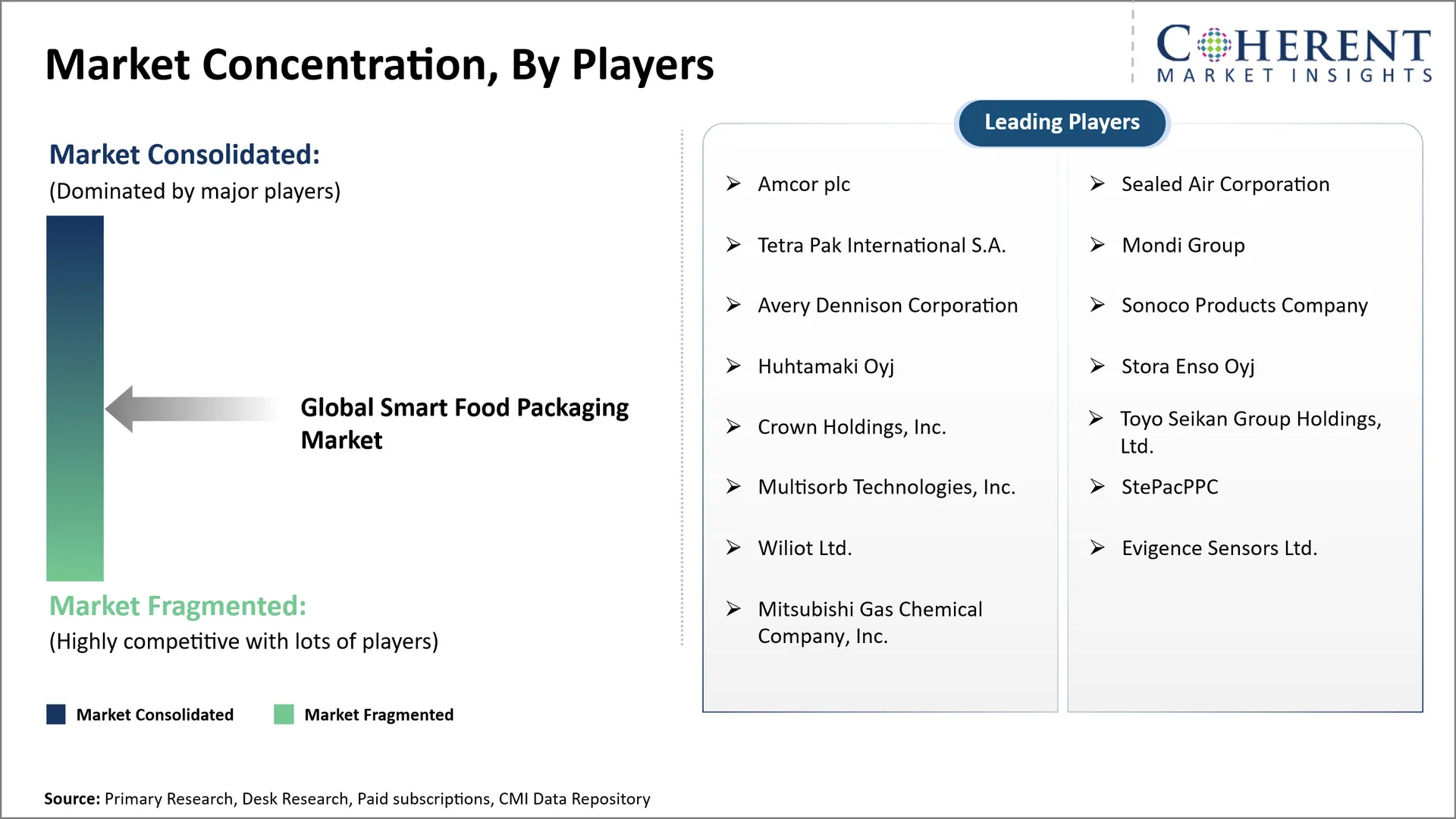
The global smart food packaging market is moderately fragmented, comprising multinational packaging manufacturers, active material specialists, intelligent label producers, sensor developers, and digital identification technology providers. Competition increasingly centers on application-specific engineering, intellectual property, manufacturing consistency, and technical qualification. Regional converters compete through localized production, flexible order quantities, competitive pricing, dependable delivery, and established relationships with food manufacturers.
Key Focus Areas Include
- Proprietary formulations and intellectual property protection.
- Application-specific packaging engineering and customization capabilities.
- Precision manufacturing and consistent functional performance.
- Competitive pricing and lifecycle cost optimization.
- Food-contact certifications and technical qualification capabilities.
- Compatibility with existing filling and sealing equipment.
- Regional manufacturing networks and dependable component sourcing.
- Customer-specific testing, implementation, and technical support.
Market Report Scope
Smart Food Packaging Market | |||
Report Coverage | Details | ||
Base Year | 2025 | Market Size in 2026: | USD 27.44 Bn |
Historical Data For: | 2020 to 2024 | Forecast Period: | 2026 to 2033 |
Forecast Period 2026 To 2033 CAGR: | 6.99% | 2033 Value Projection: | USD 44.03 Bn |
Geographies covered: |
| ||
Segments covered: |
| ||
Companies covered: | Amcor plc, Sealed Air Corporation, Tetra Pak International S.A., Mondi Group, Avery Dennison Corporation, Sonoco Products Company, Huhtamaki Oyj, Stora Enso Oyj, Crown Holdings, Inc., Toyo Seikan Group Holdings, Ltd., Multisorb Technologies, Inc., StePacPPC, Wiliot Ltd., Evigence Sensors Ltd., Mitsubishi Gas Chemical Company, Inc. | ||
Growth Drivers: |
| ||
Restraints & Challenges: |
| ||
Analyst Opinion (Expert Opinion)
- Future Market Direction: The global smart food packaging market is expected to transition towards performance-based procurement, where food manufacturers evaluate packaging investments against measurable product-level economic outcomes. Suppliers capable of demonstrating improvements through controlled application trials and quantifiable customer returns will be better positioned to negotiate premium pricing and long-term contracts.
- Transformative Trend or Disruption: Product-specific freshness modeling could gradually challenge conventional approaches to determining usable product life. Packaging suppliers with expertise in food degradation kinetics, microbiological validation, and predictive analytics may establish stronger competitive positions. However, broader implementation will depend on scientific reliability and regulatory acceptance.
- Strategic Priorities, Risks, and Recommendations: Manufacturers should prioritize modular packaging solutions that accommodate different food formulations, production environments, and regional requirements. Investment in pilot-scale validation, alternative component sourcing, and collaborative development with food processors can reduce commercialization risks. Companies should avoid expensive technological configurations where customers cannot justify the additional packaging cost.
Speak to the analyst
Want personalized insights?
Take the findings above to one of our principal consultants, or have the report rebuilt around the segments, geographies and competitors you actually track.
Market Segmentation
- Technology Type Insights (Revenue, USD Bn, 2021 - 2033)
- Active Packaging
- Intelligent Packaging
- Modified & Controlled Atmosphere Packaging (MAP or CAP)
- Connected & Digital Packaging
- Packaging Format Insights (Revenue, USD Bn, 2021 - 2033)
- Flexible Packaging
- Rigid Packaging
- Semi-Rigid Packaging
- Material Type Insights (Revenue, USD Bn, 2021 - 2033)
- Plastic
- Paper & Paperboard
- Metal
- Glass
- Other Materials
- Functionality Insights (Revenue, USD Bn, 2021 - 2033)
- Shelf-Life Extension
- Freshness & Condition Monitoring
- Product Traceability & Authentication
- Tamper Detection & Consumer Engagement
- Application Insights (Revenue, USD Bn, 2021 - 2033)
- Fresh & Perishable Foods
- Prepared & Ready-to-Eat Meals
- Dairy Products
- Beverages
- Snack Foods
- Others
- Sales Channel Insights (Revenue, USD Bn, 2021 - 2033)
- Direct Manufacturer Sales
- Distributors & Packaging Converters
- Regional Insights (Revenue, USD Bn, 2021 - 2033)
- North America
- U.S.
- Canada
- Latin America
- Brazil
- Argentina
- Mexico
- Rest of Latin America
- Europe
- Germany
- U.K.
- Spain
- France
- Italy
- Russia
- Rest of Europe
- Asia Pacific
- China
- India
- Japan
- Australia
- South Korea
- ASEAN
- Rest of Asia Pacific
- Middle East
- GCC Countries
- Israel
- Rest of Middle East
- Africa
- South Africa
- North Africa
- Central Africa
- North America
- Key Players Insights
- Amcor plc
- Sealed Air Corporation
- Tetra Pak International S.A.
- Mondi Group
- Avery Dennison Corporation
- Sonoco Products Company
- Huhtamaki Oyj
- Stora Enso Oyj
- Crown Holdings, Inc.
- Toyo Seikan Group Holdings, Ltd.
- Multisorb Technologies, Inc.
- StePacPPC
- Wiliot Ltd.
- Evigence Sensors Ltd.
- Mitsubishi Gas Chemical Company, Inc.
Sources
Primary Research Interviews
- Smart food packaging manufacturers and packaging converters
- Active packaging material and intelligent label suppliers
- Food and beverage manufacturers and packaging specialists
- Sensor, RFID, and digital identification solution providers
- Food safety experts, retailers, and cold chain operators
Stakeholders
- Active, intelligent, and connected packaging manufacturers
- Plastic, paperboard, metal, and glass packaging suppliers
- Functional coating, adhesive, and scavenger manufacturers
- Food packaging equipment manufacturers and OEMs
- Food processors, distributors, retailers, and logistics providers
End-use Sectors
- Fresh & Perishable Foods: Freshness preservation and spoilage reduction
- Prepared & Ready-to-Eat Meals: Shelf-life extension and safety monitoring
- Dairy Products: Temperature monitoring and contamination prevention
- Beverages: Product authentication and consumer engagement
- Snack Foods: Moisture control and quality preservation
- Others: Frozen foods, infant nutrition, and specialty ingredients
Product Applications
- Shelf-life extension and food waste reduction
- Real-time freshness and condition monitoring
- Product traceability and authentication
- Tamper detection and consumer engagement
- Modified and controlled atmosphere preservation
Regulatory and Industry Bodies
- U.S. Food and Drug Administration (FDA)
- European Food Safety Authority (EFSA)
- European Commission (EC)
- Food Safety and Standards Authority of India (FSSAI)
- Food and Agriculture Organization (FAO)
- Codex Alimentarius Commission
- International Organization for Standardization (ISO)
Databases
- UN Comtrade and ITC Trade Map – Packaging Material Trade
- Eurostat – Packaging Waste and Manufacturing Statistics
- FAOSTAT – Food Production and Supply Statistics
- USDA Economic Research Service – Food Consumption Data
- WIPO PATENTSCOPE – Smart Packaging Patents
- Company Annual Reports and Investor Presentations
Magazines and Journals
- Packaging World
- Packaging Europe
- Food Packaging and Shelf Life
- Packaging Technology and Science
- Journal of Food Engineering
- Trends in Food Science & Technology
Associations
- Active & Intelligent Packaging Industry Association (AIPIA)
- World Packaging Organisation (WPO)
- Flexible Packaging Association (FPA)
- Institute of Packaging Professionals (IoPP)
- European Flexible Packaging Association (Flexible Packaging Europe)
- GS1 Global
Public Domain Sources
- Smart food packaging product catalogs and specifications
- Active material and intelligent indicator performance studies
- Food-contact safety and migration testing disclosures
- Packaging patents and sustainability reports
- Product launches and commercial adoption announcements
- Manufacturing capacity and company financial disclosures
- Food waste, consumption, and packaging trade statistics
Key Standards and Regulations
- EU Regulation (EC) No. 450/2009 – Active and Intelligent Food-Contact Materials
- EU Regulation (EC) No. 1935/2004 – Food-Contact Material Safety
- EU Regulation (EU) No. 10/2011 – Plastic Food-Contact Materials
- EU Regulation (EU) 2025/40 – Packaging and Packaging Waste
- U.S. FDA 21 CFR Parts 175–178 – Indirect Food Additives
- FSSAI Food Safety and Standards (Packaging) Regulations, 2018
- ISO 22005:2007 – Food Supply Chain Traceability
- GS1 Digital Link and Global Traceability Standards
Proprietary Elements
- CMI Data Analytics Tool and proprietary research repository, supported by primary research interviews, smart packaging functionality benchmarking, material performance assessment, packaging format analysis, shelf-life extension evaluation, application-specific demand assessment, sales channel analysis, country-level market sizing, pricing evaluation, regulatory compliance assessment, manufacturer profiling, product innovation tracking, and competitive intelligence.
Get access to 250+ pages report
Every segment, forecast, competitor profile and data table behind the analysis above — available for instant download.
- ESOMAR Member
- ISO 9001:2015 Certified
- D-U-N-S Registered
- GDPR & CCPA Compliant
Frequently Asked Questions
The CAGR of the global smart food packaging market is projected to be 6.99% from 2026 to 2033.
The global smart food packaging market is estimated to be valued at USD 27.44 billion in 2026 and is expected to reach USD 44.03 billion by 2033.
Smart food packaging helps manufacturers reduce product losses, improve quality assurance, strengthen brand protection, and optimize supply chain operations.
Unlike conventional packaging, smart food packaging actively preserves food quality, monitors product conditions, or enables digital product identification throughout the supply chain.
Companies should evaluate packaging costs, food-contact safety compliance, production-line compatibility, functional performance, scalability, and potential return on investment.
New entrants can explore customized packaging solutions, contract manufacturing, functional material development, and strategic partnerships with food manufacturers and packaging converters.
Increasing food safety requirements and the growing need to extend shelf life and reduce food waste are the major factors driving the growth of the global smart food packaging market.