

Global Solid Conditioner Market Size and Forecast – 2026 To 2033
The global solid conditioner market is estimated to be valued at USD 14,986.2 Mn in 2026 and is projected to reach USD 25,352.6 Mn by 2033, registering a CAGR of 7.80% during 2026–2033. The market is growing as consumers prefer concentrated haircare products that are plastic-free, effective in conditioning, portable and easy to store. To reduce reliance on the traditional liquid format and offer moisture retention, detangling and frizz control, manufacturers are developing special formulations.
In November 2025, Procter & Gamble launched Gemz, a water-activated, single-dose shampoo and conditioner range. The range provides five conditioner variants to cater to the haircare needs of different individuals. But while traditional conditioner bars are made using a distinct process, Gemz uses concentrated solid tiles demonstrating how established personal care makers are looking at other waterless conditioning formats. Such innovations could expand consumer choice and encourage further investment in performance-oriented solid haircare products.
Key Takeaways of the Global Solid Conditioner Market
- Moisturizing and Hydrating Conditioner Bars are estimated to expand at an 8.4% CAGR during 2026–2033 and capture 42.8% of the global solid conditioner market in 2026. They are great for a wide range of people, as they reduce dryness and increase combability, without any extra treatment. This cemented moisture delivery as a key purchase driver, prompting Ethique to launch a reformulated Hydrating Conditioner Bar in December 2024 as part of its performance-focused solid haircare refresh.
- Natural & Botanical-Based Formulations are expected to grow at a CAGR of 9.0% during 2026-2033 and account for 57.4% of the global solid conditioner market in 2026. The use of plant-based ingredients gives brands a differentiated proposition, in addition to reducing packaging. In April 2025, Japanese firm MCML launched a Natural Conditioner Bar that includes plant-based ingredients and essential oils from Japan, highlighting the commercial significance of traceable ingredient selection.
- Normal and All Hair Types conditioner bars are expected to register a CAGR of 7.1% in 2026-2033 and account for 34.5% of the global solid conditioner market revenue in 2026. Multi-use formulas make shopping easier, and also raise the likelihood of repeat use in different households. In May 2026, Bar & Bar introduced Grow + Protect, a solid shampoo and conditioner pair for normal hair, with an emphasis on the allure of daily upkeep.
- Europe is projected to record a CAGR of 7.3% during 2026-2033 and hold 36.3% share of the global solid conditioner market in 2026. Low-waste preferences are turned into habitual buying by established specialty retail networks. In October 2026, Dutch solid-care brand SOLYD reported reaching more than 300,000 households following its broader repositioning, which encompasses conditioner bars.
- North America is expected to deliver an estimated 9.0% CAGR during 2026–2033 and represent 32.5% of 2026 global solid conditioner market revenue. Growth prospects center on improving bar performance to convert shoppers accustomed to liquid conditioners. In October 2025, Colorado-based MidSolid launched a soap-free, pH-balanced solid conditioner line addressing concerns about residue, manageability, and application experience.
Segmental Insights
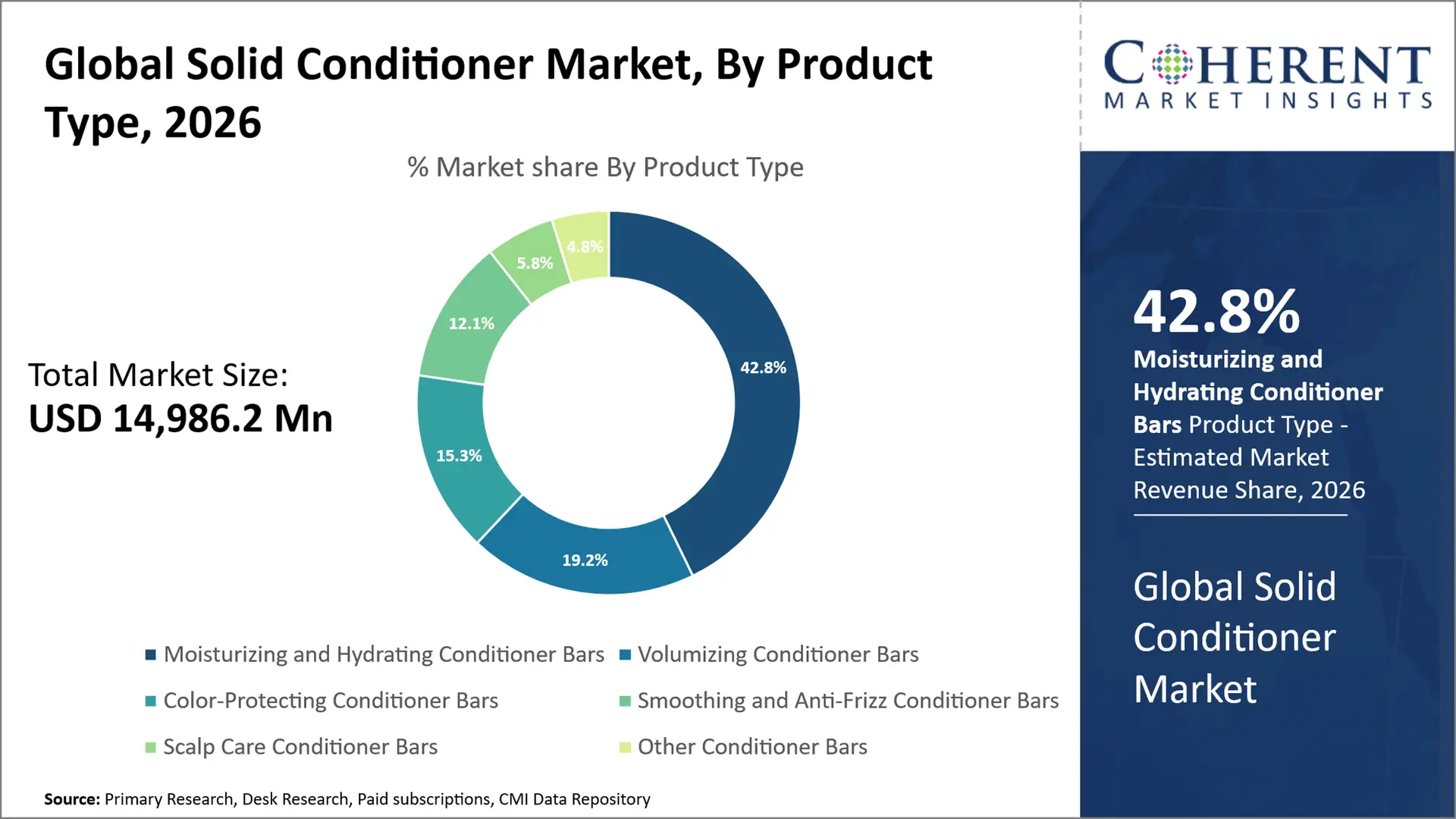
Why Do Moisturizing and Hydrating Conditioner Bars Dominate the Global Solid Conditioner Market?
Moisturizing and Hydrating Conditioner Bars are anticipated to command 42.8% share of the global solid conditioner market in 2026, driven by their ability to meet conditioning needs after frequent washing, heat styling, and environmental exposure. These bars can be used in regular rinse-off routines (as opposed to highly targeted treatments) and the feel of the product and controlled deposition are important to repeat purchasing. Formulators need to balance delivering emollients with a firm bar structure to provide consistent conditioning without over-transferring product to the consumer. For manufacturers, that balance supports reliable performance claims and reduces the risk of buyers walking away from solid formats after initial trial. In August 2026, German brand puremetics included its new Hydroboost solid conditioner in a haircare launch collection. Its product description mentions shea butter, macadamia oil and a water-free concentrate designed to improve softness and application. The launch shows an investment in functional moisturization, not just packaging.
- Current Industry Events of 2026
- Market Size Estimation
- Regional Breakdown
- Competitive Landscape
- Customer Intelligence
- Segmental Analysis
- Pricing Analysis
- Key Market Drivers, Challenges & Future Trends
- Customized Insights Section
Why Do Natural and Botanical-Based Formulations Lead the Global Solid Conditioner Market?
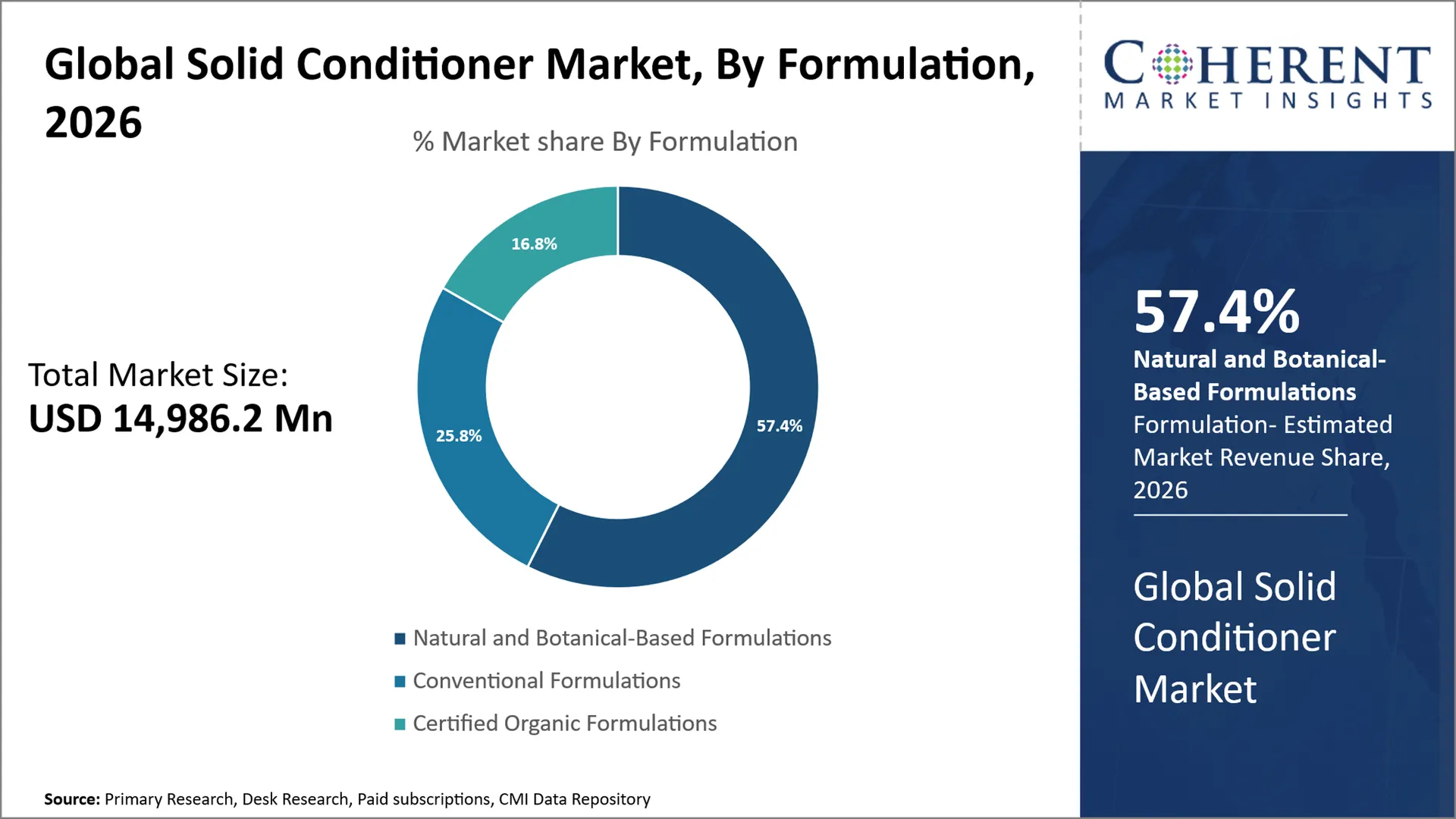
Natural and Botanical-based Formulations are projected to account for 57.4% of the global solid conditioner market revenue in 2026 as brands seek out plant-derived ingredient systems that reliably perform in compact conditioner bars. The big marketing challenge is not to add botanical extracts but to combine conditioning agents, building materials and emollients without affecting the glide or rinse-off properties. Suppliers of raw materials capable of delivering application-ready concepts can accelerate formulation development and assist manufacturers in substantiating natural-origin positioning. This also allows smaller brands to have technically credible product designs without the need to run large in-house labs. In March 2025, Safic-Alcan documented its Softness Catalyst solid conditioner concept, specifying 97.6% natural-origin ingredients under ISO 16128. Its formulation combines jojoba butter and cacay oil with conditioning and emulsifying ingredients, demonstrating the supplier-side development needed to translate botanical positioning into a usable solid product.
Why Does Normal and All Hair Types Dominate the Hair Type Segment of the Global Solid Conditioner Market?
Normal and All Hair Types conditioner bars are expected to represent 34.5% of global solid conditioner market revenue in 2026, reflecting the commercial value of products designed for broadly compatible everyday routines. A single general-purpose bar can help retailers serve shoppers who do not identify with specialized hair-treatment categories, particularly where shelf space and assortment depth are limited. However, wide suitability requires developers to control conditioning intensity so fine hair is not unnecessarily weighed down while thicker strands remain manageable. Clear application guidance becomes an important operational tool because first-time users may struggle to judge how much solid product to apply. In July 2025, Italian brand Coccoon published instructions for its solid conditioner, which it positions for all hair types and use at home or while travelling. The guidance emphasizes controlled application on wet hair, connecting broad positioning with practical usability.
Current Events and their Impact
Current Event | Description and Its Impact |
EU Packaging and Packaging Waste Regulation – August 2026 |
|
UK Extended Producer Responsibility Packaging Fees – June 2025 |
|
U.S. Cosmetic Facility Registration and Product Listing – July 2024 |
|
Global Solid Conditioner Market Dynamics
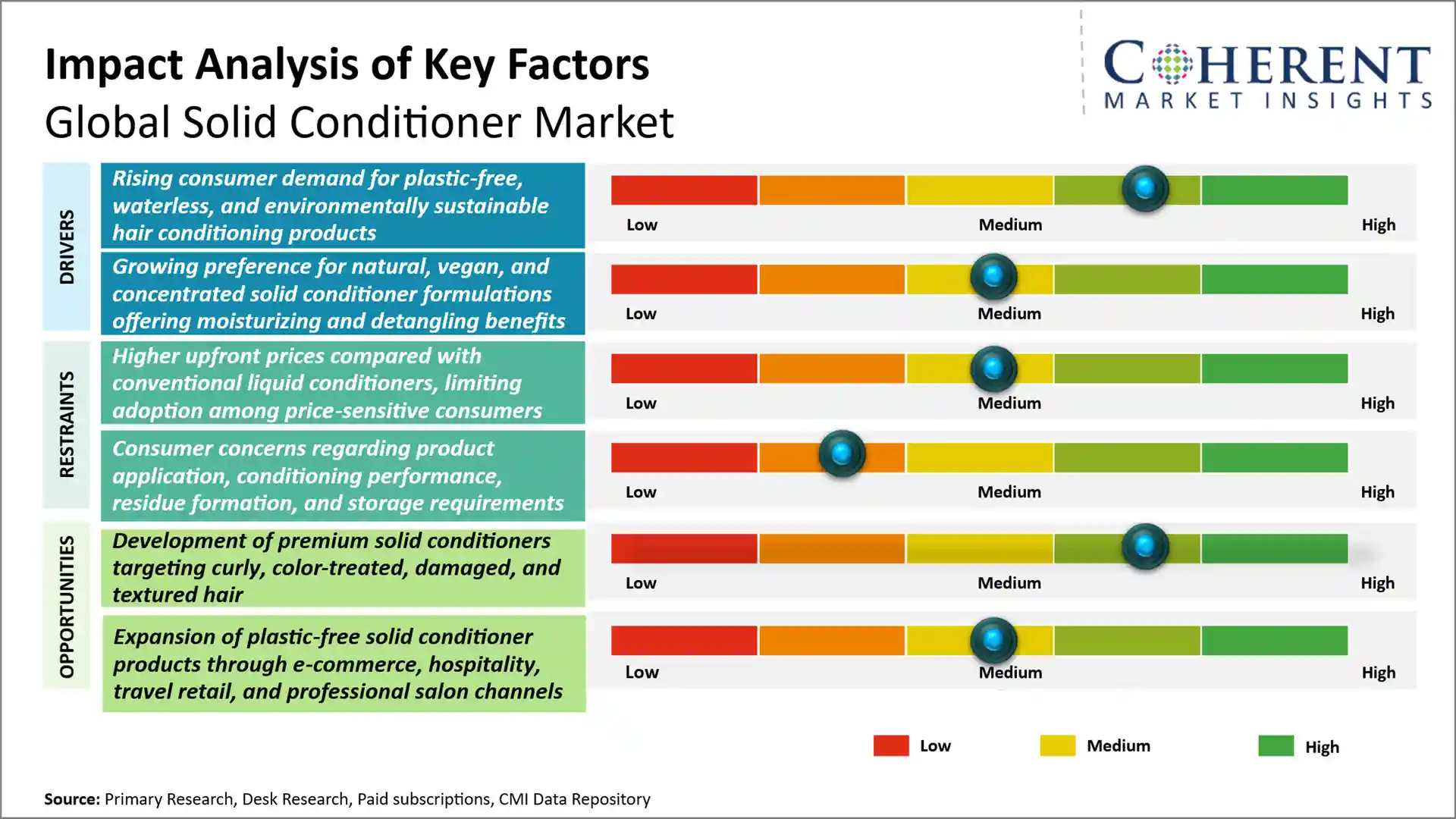
Key Market Drivers
- Rising consumer demand for plastic-free, waterless, and environmentally sustainable hair conditioning products: The increasing demand for products that are environmentally friendly and waterless is beginning to make solid hair-conditioning products more commercially viable alternatives to disposable bottles and water-based product formulations. The concentrated nature of their composition can decrease packaging needs, increase transport efficiency and facilitate sustainable purchasing. Differentiated product positioning for manufacturers and specialty retailers and environmental initiatives for building customer engagement for independent brands. In August 2025, Dip partnered with the band Guster to introduce limited-edition shampoo and conditioner bars through Gogo Refill, connecting plastic-free haircare with community-focused sustainability initiatives. This is an example of how to leverage environmental positioning for product discovery and retail differentiation.
- Growing preference for natural, vegan, and concentrated solid conditioner formulations offering moisturizing and detangling benefits: Ingredient-led differentiation is adding to the commercial viability of solid conditioners, especially in consumers making a strong choice for recognizable botanical ingredients that provide benefits. Manufacturers are adding plant oils, fatty alcohols and functional actives to ensure softer, shinier and more manageable formulas without diluting. In April 2025, KinKind revealed that it would be launching its Make me SHINE! shampoo and conditioner bars with a seaweed complex and glycolic acid. This is a development that demonstrates other ways in which a special formulation can enhance the positioning of a product beyond simply sustainability messaging and contribute to premiumization in the solid conditioner category.
Emerging Market Trends
- Development of Hair-Concern-Specific Conditioning Systems: Solid conditioner formulations are evolving toward targeted treatment systems that address individual hair concerns through differentiated conditioning ingredients. Product development increasingly considers hair porosity, surface damage, texture, and conditioning intensity rather than offering identical formulations across multiple applications.
Impact: This transition may be that it helps to differentiate products and stimulate consumers to choose specific conditioning products. More complex product portfolios are beneficial for formulation specialists and premium brands.
Market Relevance: This trend should stimulate investments into performance testing and application specific formulation development. Brands that will be able to provide measurable conditioning benefits will gain better customer loyalty in the forecast period.
- Increasing Adoption of Flexible Solid Conditioner Manufacturing Models: The new flexible solid conditioner manufacturing models are gaining in commercial interest as new beauty brands are looking to utilize the specialized solid conditioner manufacturing facilities without the capital to setup an in-house plant. Flexible manufacturing arrangements can be used to help produce smaller amounts of goods, develop products with custom formulations, and shorten the product development cycle.
Impact: Specialist manufacturers can take advantage of more outsourcing options while established brands can be flexible in testing a new solid conditioning concept. The efficiency of production and consistency of formulation will increase in importance.
Market Relevance: This change may reduce the entry costs to the category and increase competition. This should benefit manufacturers with a proven quality management system and a production process that is scalable.
Regional Insights
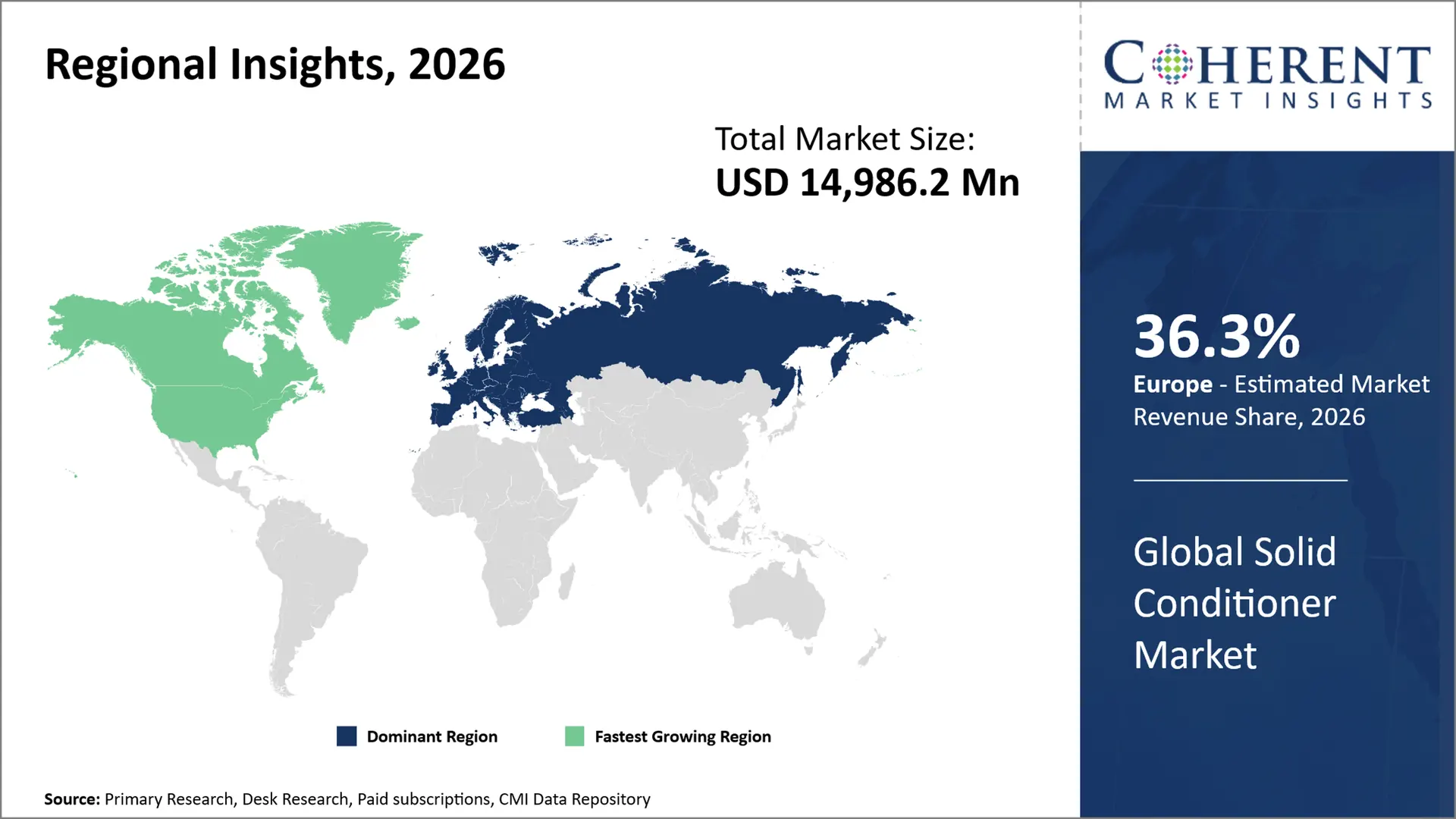
Why Does Europe Dominate the Global Solid Conditioner Market?
Europe is expected to account for 36.3% of global solid conditioner market revenue in 2026, supported by established natural cosmetics manufacturing capabilities and growing acceptance of concentrated personal care formulations. European manufacturers have the advantage of specialty cosmetic ingredients, independent cosmetic brands, and existing certification systems that aid in the determination of product quality. The focus on ingredient transparency also opens up possibilities for premium solid conditioning products with botanical oils and functional extracts. In March 2026, Greenatural, an Italy-based company, showcased its Nourishing Solid Conditioner, made with mullein extract and coconut oil, and its paper-based packaging with compostable film. This is a good example of how the European suppliers are using the functionality of ingredients and packaging design to distinguish their haircare brands. Those manufacturers that are providing credible product performance and transparent formulations will be well-positioned throughout all European beauty retail channels.
Why Is North America Emerging as the Fastest-Growing Region in the Global Solid Conditioner Market?
North America solid conditioner market is projected to account for 32.5% of the global solid conditioner market growth in 2026 owing to the availability of concentrated haircare products by specialized beauty brands. There are a number of opportunities for suppliers to get that initial sale into a continued stream of business by providing product demonstrations, easy-to-use formulations and consistent replenishment options. Canada has a reputation for its consumer friendly natural personal care brands and expertise in domestic manufacturing. In May of 2025, Canada's Rocky Mountain Soap Company launched the Hair Bar line, comprising solid shampoos and conditioners. The company then revealed that it had already achieved "significant consumer uptake" showing the consumer viability of accessible bar-based haircare. Further growth will rely on keeping track of conditioning performance and on enhancing consumer awareness of product application and value.
Global Solid Conditioner Market Outlook for Key Countries
Why Is the U.S. a Key Market for the Global Solid Conditioner Market?
The U.S. is an important market in the global solid conditioners market due to the presence of established direct to consumer beauty market and availability of specialized haircare products in the market. Domestic brands have the opportunity to build repeat purchasing with online subscriptions, ingredient transparency and product education. The competitive environment also ensures that suppliers are forced to show a clear conditioning effect, not only through environmental positioning. The Earthling Co.'s founders have recognized shampoo and conditioner bars as the company's initial product line, which focuses on hair care products as concentrated items. Such business models enable manufacturers to obtain customer input and improve formulations, but keep them in direct contact with consumers. Companies that successfully marry reliable product quality with effective acquisition of customers will continue to be competitive.
Why Is India Important in the Global Solid Conditioner Market?
India offers growth potential for global solid conditioner market manufacturer through its price-sensitive personal care market, expanding digital beauty distribution, and demand for products suited to diverse hair conditions. Conditioning oils, frizz-management properties, and low cost of packaging can help manufacturers distinguish themselves with their products. The importance of competitive pricing is still necessary as consumers can be able to make a direct comparison between solid and readily available liquid conditioners. Earth Rhythm is an Indian brand that provides conditioner bars made with argan and black castor oils and a separate bar with tamanu, kukui nut and camellia oils. Its official catalogue also includes Indian origin and distribution on the top beauty and eCommerce sites. This is a good example of an opportunity for domestic brands to put together a niche product and make it more available through online sales.
Why Does China Support Growth in the Global Solid Conditioner Market?
China's cosmetics manufacturing infrastructure and extensive ingredient supply network provide a potential foundation for expanding global solid conditioner market production. World class formulation knowledge, processing and packaging supply chain can be used by the manufacturer to create product(s) for domestic use and export. But, to be successful in the marketplace, it is important to have consistent quality control and proof of product claims. China's National Medical Products Administration provided a blueprint for cosmetic reforms in December 2025, including changes to cosmetic safety assessment and efficacy evaluation, manufacturing quality and supervision of online distribution. Such measures are applicable for solid conditioner producers in looking for compliance for their product development and access to the market. The medium- to long-term opportunity for China is to blend the low-cost manufacturing and differentiate the conditioning formula to satisfy both domestic regulatory requirements and the specification of the international buyers.
Why Is Japan a Strategic Country in the Global Solid Conditioner Market?
Japan offers opportunities for global solid conditioner market manufacturer through its established personal care industry, sophisticated product-quality expectations, and interest in specialized beauty formats. Compact conditioning bars can be attractive to customers looking for easy-to-use haircare products, especially if they are presented with easy-to-follow instructions and consistent application results. Other routes to market, including product demonstrations and selective distribution, can also be used to launch international formulations differentiated from the local market. Indonesiana natural care brand IBUBUMI joined the Discover Indonesia exhibition in Tokyo in September 2026, and showed interest in the natural solid shampoo and conditioner products. The event was useful to examine Japanese consumer reactions and to involve potential commercial partners. These kinds of programs can be useful in assessing product acceptance prior to a rollout of distribution.
Why Is Brazil an Important Growth Market for the Global Solid Conditioner Market?
Brazil offers international manufacturers and suppliers of solid conditioner products with opportunities due to its haircare culture and the relevance of the products created for curly, coily and textured hair. There are special conditioning requirements, which lead to the opportunity for brands that can deliver detanglement, moisture and frizz control. Professional salons are also a way to show consumers the product and educate them about the differences between solids and liquids, assisting the manufacturer in this communication. B. Brazilian brand, in September 2024.It showed its good-certified shampoo and conditioner products at Beauty Fair, which are designed for curly and coily hair. The brand showcased the products during the event and provided a detailed plan for future direct online sales.The brand presented their products in the exhibition and provided a roadmap for future direct online sales. This is an example of how specialist manufacturers can link professional haircare expertise to targeted solid conditioner development and domestic distribution.
Consumer Preference and Product Evolution Landscape in the Global Solid Conditioner Market
Consumer Trend | Evolving Market Preferences | Commercial Significance | Strategic Implications |
Performance-Oriented Hair Conditioning | While environmental considerations are becoming increasingly important, consumers are now choosing a solid conditioner according to how soft it is, how well it detangles, how well it controls frizzy hair and how well it leaves hair post-wash. | Offers brands the chance to enhance their products with measurable hair-conditioning attributes and uniform application performance. | To promote repeat sales, manufacturers must emphasize effectiveness, clear claims of benefits to the consumer and consumer satisfaction. |
Hair-Type-Specific Product Selection | Buyers expect conditioners for dry, damaged, curly, color-treated and fine hair, and have different expectations when it comes to moisture and conditioning level. | Facilitates differentiated product lines, premium positioning and meets customer needs for specialty retailers. | Brands can develop focused product ranges and clear hair-type recommendations to improve selection accuracy and customer retention. |
Price-to-Usage Value Assessment | Consumers make comparisons between the number of applications, number of times likely to last and the purchase price of solid conditioner bars versus traditional liquid conditioners. | Fosters opportunities for manufacturers to discuss product lifecycle and reinforce value positioning in economy, mid-range and premium segments. | Suppliers need to give realistic advice on how to use the product, the weight of the product, and the benefits of using a product, but not exaggerate its lifetime. |
Convenient and Travel-Friendly Formats | Spill resistant conditioning products and an overall compactness are a plus with travellers, gym users and those who want to streamline their personal care routine. | Increases potential demand in multiple travel retail, hospitality amenities, and convenience-grabbing beauty product assortments. | Brands can offer portable formats and appropriate storage add-on accessories without compromising product integrity on the transport and usage. |
Ingredient Transparency and Product Credibility | Consumers are increasingly looking at ingredients containing plants, the fragrance formulation, vegan claims and whether it's suitable before buying solid conditioners. | Encourages differentiation through credible ingredient disclosures, responsible sourcing, and clearly communicated product attributes. | Manufacturers should substantiate formulation claims, maintain accurate labeling, and distinguish verified certifications from general marketing statements. |
Omnichannel Product Discovery and Replenishment | Consumers utilize digital channels to compare formulations, learn about application instructions and use physical retail channels to examine products and make immediate purchases. | Drives the seamless integration of product education, specialty retail of beauty products and replenishment online to maximize customer conversion and retention. | Companies should coordinate product information, pricing, inventory availability, and consumer education across online and offline distribution channels. |
How Are Climate-Adapted Solid Conditioner Formulations Creating New Growth Opportunities in the Global Solid Conditioner Market?
While the solid conditioner market is a promising opportunity, it is not developed enough for manufacturers who are targeting the hot and humid consumer market. Unfavorable storage conditions may cause softening, surface changes, and early wear of conventional solid bars, which poses problems in transportation, retail handling, and product life cycle.
Better development of matrices with reliable performance in hardness and consistency of wet-application, thermally stable, might help manufacturers cater to tropical and subtropical markets better. These improvements would be particularly relevant for consumers buying products from ecommerce platforms who may have to wait longer for the products to arrive when they are exposed to high temperatures.
Formulation optimization, expedited stability testing, proper packaging development, and regional distribution partnerships are critical for manufacturers to take advantage of this opportunity. Specialists who are very capable of material selection and are existing contract manufacturers may find it easier. But the commercialization of successful products will depend on investments in process validation, evaluation of the sensitivity of the product to the temperature conditions of the logistics chain and designs that meet climate requirements while still providing acceptable conditioning performance and retail price.
Market Players, Key Developments, and Competitive Intelligence
Key Developments
- In June 2026, TOUN28 announced the international rollout of a treatment-oriented solid haircare collection featuring differentiated shampoo and conditioner bars. Its range includes CICA PDRN Volume Lift and other targeted formulations. The development expands product specialization and supports international market access for Korean solid haircare products.
- In early 2025, Sephora Collection launched its first solid and powder personal care range, including solid shampoo and solid conditioner products, as disclosed in Sephora's 2024 Global Impact and Progress Report. The introduction broadens access to solid conditioning products through an established beauty retailer's own-brand portfolio.
- In August 2024, MASSCON announced the launch of All That Solid, a soluble personal care collection covering shampoo, hair conditioner, and other cleansing products in tablet-sized formats. The development introduces an alternative solid-product delivery model with potential applications in hospitality amenities, travel products, and customized personal care manufacturing.
Competitive Landscape
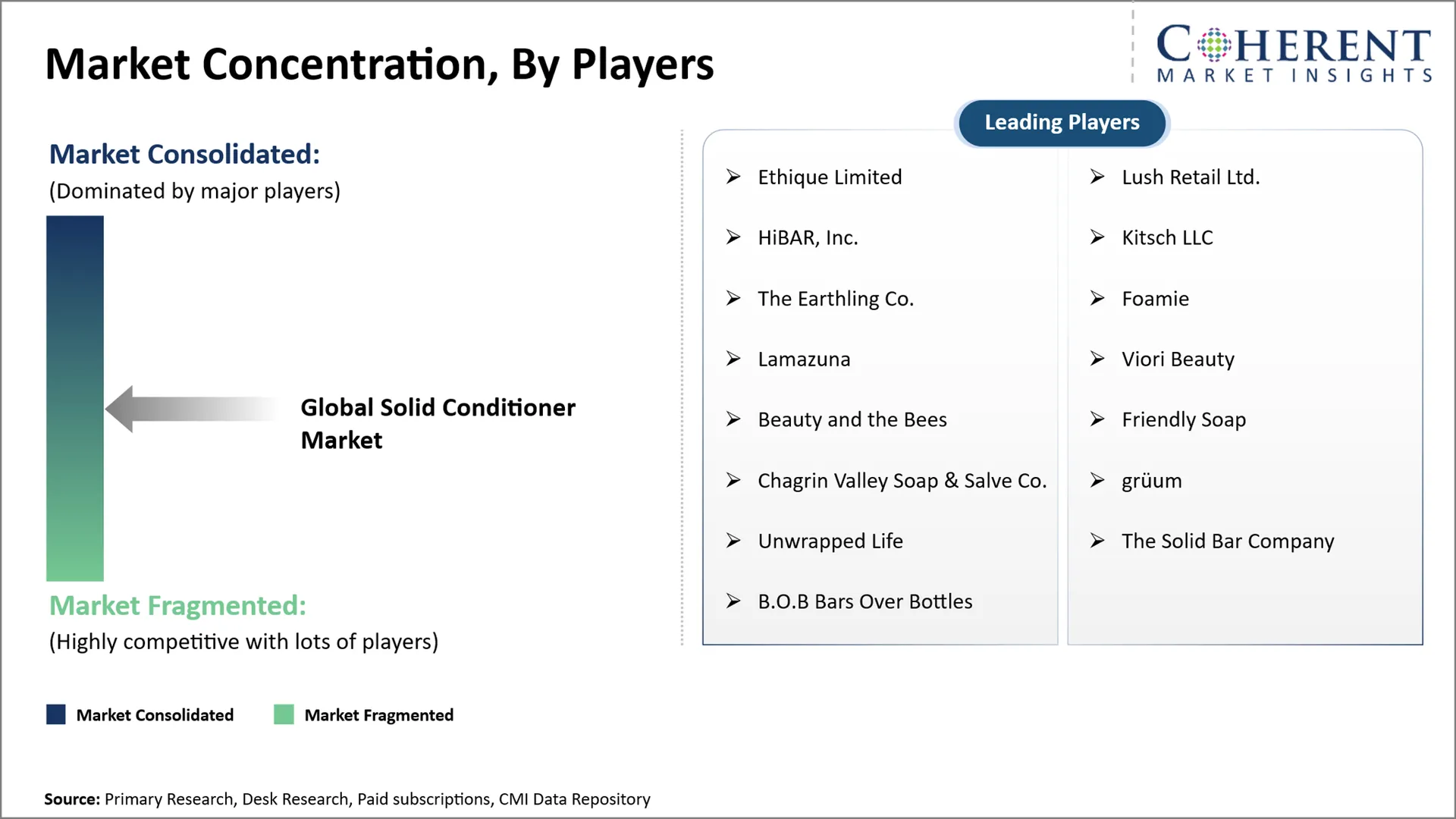
The global solid conditioner market is currently fragmented with major personal care brands, sustainability brands, regional brands, and specialized contract solid conditioner manufacturers. Performance conditioning, formulation consistency, competitive pricing, and reliability of product delivery are increasing factors of competition. Specialist firms stand out in their choice of ingredients and their ability to modify their production, and larger firms have existing supply chains, quality-assurance procedures and a wider distribution network.
Key focus areas include
- Product Performance: Good detangling, softness and residue control are still the key elements to differentiate from conventional conditioners.
- Price Competition: Manufacturers need to weigh the ingredient costs of the concentrate against consumer expectations of product performance and value.
- Manufacturing Efficiency: Consistent molding, controlled processing conditions, and reduced production losses influence operating margins.
- Quality Assurance: Stability test, ingredient traceability, Cosmetic safety documentation for regulatory compliance.
- Product Customization: Targeted Product Portfolio Development and Premium Positioning through Specialized Formulations for different Hair Conditions.
- Supply-Chain Reliability: Reliable provision of conditioning agents, emollients and packaging materials ensures continuous availability of product.
- Private Label Opportunities: Production flexibility and formulation options present opportunities for retailers and new beauty companies.
Market Report Scope
Global Solid Conditioner Market Report Coverage | |||
Report Coverage | Details | ||
Base Year | 2025 | Market Size in 2026: | USD 14,986.2 Mn |
Historical Data For: | 2020 to 2024 | Forecast Period: | 2026 to 2033 |
Forecast Period 2026 To 2033 CAGR: | 7.80% | 2033 Value Projection: | USD 25,352.6 Mn |
Geographies covered: |
| ||
Segments covered: |
| ||
Companies covered: | Ethique Limited, Lush Retail Ltd., HiBAR, Inc., Kitsch LLC, The Earthling Co., Foamie, Lamazuna, Viori Beauty, Beauty and the Bees, Friendly Soap, Chagrin Valley Soap & Salve Co., grüum, Unwrapped Life, The Solid Bar Company, B.O.B Bars Over Bottles | ||
Growth Drivers: |
| ||
Restraints & Challenges: |
| ||
Analyst Opinion (Expert Opinion)
- The solid conditioner market will shift toward greater performance-based competition, with formulation consistency and consumer satisfaction becoming key criteria for assessing suppliers. The role of market leadership could be transferred to firms that can control the entire commercial operation of product development, manufacturing consistency and customer retention as a unified function instead of focusing on the solid product as a feature that differentiates the product.
- Standardized and outsourced manufacturing would change the marketplace by providing a way for small beauty companies to compete in category without significant manufacturing expense. This shift could pressure companies which have a strong reliance on proprietary production. Contract manufacturers with formulation knowledge, quality assurance and flexible business models may become a force to contend with in product development and business decisions regarding supply chains.
- Manufacturers should take into account the performance of each ingredient, the durability of the product, validated shelf-life characteristics, and control formulation and production costs. Reliability of conditioning agents, process quality, and supplier diversification can enhance competitiveness. Businesses should not over-inventorize products that do not have a proven need and they should not create distribution relationships that disrupt product pricing and product availability.
Speak to the analyst
Want personalized insights?
Take the findings above to one of our principal consultants, or have the report rebuilt around the segments, geographies and competitors you actually track.
Market Segmentation
- Product Type Insights (Revenue, USD Mn, 2021 - 2033)
- Moisturizing and Hydrating Conditioner Bars
- Volumizing Conditioner Bars
- Color-Protecting Conditioner Bars
- Smoothing and Anti-Frizz Conditioner Bars
- Scalp Care Conditioner Bars
- Other Conditioner Bars
- Formulation Insights (Revenue, USD Mn, 2021 - 2033)
- Natural and Botanical-Based Formulations
- Conventional Formulations
- Certified Organic Formulations
- Hair Type Insights (Revenue, USD Mn, 2021 - 2033)
- Normal and All Hair Types
- Dry and Damaged Hair
- Curly and Textured Hair
- Fine and Oily Hair
- Color-Treated Hair
- Product Format Insights (Revenue, USD Mn, 2021 - 2033)
- Rinse-Off Solid Conditioner
- Leave-In Solid Conditioner
- Deep-Conditioning and Treatment Bars
- Price Range Insights (Revenue, USD Mn, 2021 - 2033)
- Economy
- Mid-Range
- Premium
- End Use Insights (Revenue, USD Mn, 2021 - 2033)
- Household and Individual Consumers
- Salons and Spas
- Hotels and Hospitality
- Distribution Channel Insights (Revenue, USD Mn, 2021 - 2033)
- Online Retail
- Specialty Beauty and Personal Care Stores
- Supermarkets and Hypermarkets
- Pharmacies and Drugstores
- Other Distribution Channels
- Regional Insights (Revenue, USD Mn, 2021 - 2033)
- North America
- U.S.
- Canada
- Latin America
- Brazil
- Argentina
- Mexico
- Rest of Latin America
- Europe
- Germany
- U.K.
- Spain
- France
- Italy
- Russia
- Rest of Europe
- Asia Pacific
- China
- India
- Japan
- Australia
- South Korea
- ASEAN
- Rest of Asia Pacific
- Middle East
- GCC Countries
- Israel
- Rest of Middle East
- Africa
- South Africa
- North Africa
- Central Africa
- North America
- Key Players Insights
- Ethique Limited
- Lush Retail Ltd.
- HiBAR, Inc.
- Kitsch LLC
- The Earthling Co.
- Foamie
- Lamazuna
- Viori Beauty
- Beauty and the Bees
- Friendly Soap
- Chagrin Valley Soap & Salve Co.
- grüum
- Unwrapped Life
- The Solid Bar Company
- B.O.B Bars Over Bottles
Sources
Primary Research Interviews
- Solid conditioner manufacturers, cosmetic formulators, contract manufacturers, and private-label suppliers.
- Beauty retailers, e-commerce distributors, salon professionals, and personal care industry experts.
Stakeholders
- Conditioning agent, botanical oil, fatty alcohol, fragrance, and specialty ingredient suppliers.
- Sustainable packaging manufacturers, cosmetic testing laboratories, and haircare brands.
End-use Sectors
- Household and individual consumers, salons and spas, hotels, and hospitality establishments.
- Specialty beauty retail, supermarkets, pharmacies, and online personal care platforms.
Regulatory and Industry Bodies
- U.S. Food and Drug Administration (FDA)
- European Commission (EC) and European Chemicals Agency (ECHA)
- Bureau of Indian Standards (BIS) and Brazil's ANVISA
Databases
- European Commission CosIng Cosmetic Ingredient Database
- UN Comtrade and International Trade Centre (ITC) Trade Map
- PubMed, ScienceDirect, and FDA Cosmetics Direct
Magazines and Journals
- International Journal of Cosmetic Science
- Journal of Cosmetic Dermatology
- Cosmetics & Toiletries
- Cosmetics
Associations
- Cosmetics Europe
- Personal Care Products Council (PCPC)
- Society of Cosmetic Chemists (SCC)
- International Federation of Societies of Cosmetic Chemists (IFSCC)
Public Domain Sources
- Solid conditioner product catalogues, ingredient technical data sheets, formulation specifications, and manufacturer sustainability reports.
- Cosmetic ingredient research, product launch announcements, packaging assessments, patents, and company annual reports.
Key Standards and Regulations
- EU Cosmetics Regulation (EC) No 1223/2009 – Cosmetic Product Safety and Compliance.
- U.S. Modernization of Cosmetics Regulation Act (MoCRA) – Cosmetic Safety, Registration, and Listing.
- ISO 22716 – Cosmetics Good Manufacturing Practices.
- ISO 16128 – Natural and Organic Cosmetic Ingredient Guidelines.
- ISO 11930 – Evaluation of Antimicrobial Protection of Cosmetic Products.
Proprietary Elements
- CMI Data Analytics Tool
- Proprietary research repository, supported by primary interview findings, solid conditioner consumption modeling, ingredient and formulation assessments, pricing analysis, distribution channel evaluation, and competitive intelligence.
Get access to 250+ pages report
Every segment, forecast, competitor profile and data table behind the analysis above — available for instant download.
- ESOMAR Member
- ISO 9001:2015 Certified
- D-U-N-S Registered
- GDPR & CCPA Compliant
Frequently Asked Questions
The global solid conditioner market is projected to register a CAGR of 7.80% from 2026 to 2033.
The global solid conditioner market is estimated to be valued at USD 14,986.2 Mn in 2026 and is projected to reach USD 25,352.6 Mn by 2033.
Buyers should evaluate conditioning performance, ingredient composition, hair compatibility, ease of application, product longevity, and overall value for money.
Solid conditioners typically contain less water and require less packaging than conventional liquid conditioners while offering benefits such as softness, detangling, and improved hair manageability..
Manufacturers must balance product firmness, conditioning effectiveness, ingredient compatibility, shelf-life stability, and consistent performance under different storage and usage conditions.
New entrants can explore specialized formulations, private-label manufacturing, direct-to-consumer sales, and differentiated product offerings that address unmet consumer needs and purchasing preferences.
The major factors driving market growth are increasing consumer demand for plastic-free, waterless, and environmentally sustainable hair conditioning products, along with a growing preference for natural, vegan, and concentrated formulations that offer moisturizing and detangling benefits.